Skip to content

Call Center Performance
Improve First Call Resolution (FCR):
Proven Call Center Tactics
Is your customer support team stuck in a loop of frustrating repeat calls? The key to breaking the cycle and boosting your
First Call Resolution (FCR) rate is empowering your agents with the right training, technology, and authority to solve problems on the spot.
TL;DR: Your Quick Guide to a High-FCR Strategy
- FCR is a mirror reflecting your entire customer experience. A low rate points to broken processes, undertrained agents, or clunky tech.
- A high FCR rate slashes operational costs. Every repeat call you prevent saves agent time and resources.
- Empowered agents are your FCR champions. Give them knowledge, tools, and decision authority.
- Technology is a force multiplier. CRM + intelligent routing gets customers to the right agent fast—with the right info.
- Customer loyalty lives and dies by resolution. Small FCR gains can drive meaningful CSAT improvements.
Is your customer support team stuck in a loop of frustrating repeat calls? The key to breaking the cycle and boosting your First Call Resolution (FCR) rate is empowering your agents with the right training, technology, and authority to solve problems on the spot.
It’s about arming them with a rock-solid knowledge base and using intelligent call routing to get the customer to the right agent from the very beginning. When you nail this, you eliminate frustrating transfers and annoying callbacks, transforming your customer experience from a liability into a loyalty-driver.
Why FCR Is the Metric That Defines Your Customer Experience

The Real Cost of a Second Call
Let’s talk about Sarah. She calls your support line about a billing error. She explains everything, gets put on hold, and is eventually told it’ll be fixed in 24-48 hours.
Three days later, that charge is still on her account. Now she’s calling back. But this time, she’s not just bringing a problem—she’s bringing frustration. That second call isn’t just a tick on a spreadsheet; it’s a crack forming in her relationship with your brand.
This exact scenario is why First Call Resolution (FCR) is arguably the single most important metric in any contact center. It’s not just about being efficient; it’s a direct measure of whether you’re meeting a customer’s most basic expectation. While metrics like Average Handle Time (AHT) focus on speed, FCR is about effectiveness.
A low FCR rate is a blaring alarm bell that your customer experience is failing at the most critical moment.
“The number one thing customers expect from call centers is the fast resolution for resolving their inquiries or problems.”
This simple truth is why a laser focus on FCR isn’t optional. When customers have to call back, their satisfaction plummets, and your operational costs shoot through the roof.
Connecting FCR to Tangible Business Outcomes
Improving FCR isn’t just about making customers happy—it’s a core business strategy with benefits you can take to the bank. When you make it a priority to solve issues the first time, you unlock serious advantages. We dive deeper into this in our guide on why First Call Resolution matters for your business.
Here’s how a strong FCR rate directly impacts your bottom line:
- Dramatically Reduced Operational Costs: The math here is simple. Fewer repeat calls mean your agents aren’t wasting time on redundant problems. They can focus on handling new, unique customer needs instead. A 1% improvement in FCR can reduce operating costs by 1%.
- Increased Customer Retention: When you solve a customer’s problem quickly and efficiently, their trust in your brand skyrockets. Research shows that 95% of customers will stick with a company if their issue is resolved on the first call.
- Improved Agent Morale and Retention: Your agents want to solve problems. When they’re equipped with the right tools and knowledge to be effective, their job satisfaction soars. This directly leads to lower agent churn, a massive hidden cost for any BPO.
At the end of the day, FCR is the central nervous system of your support operation. By understanding its impact and committing to improving it, you’re not just tweaking a KPI—you’re building a more resilient, efficient, and customer-obsessed business.
 How to Pinpoint the Real Reasons for Repeat Calls
Before you can fix a low FCR rate, you have to find the source. Improving your first call resolution isn’t about guesswork; it’s about putting on your detective hat and digging into why customers really have to call you back.
Too often, blame falls on the agent, but that surface-level thinking gets you nowhere. The real culprits are usually buried in your processes, systems, or training. You need to shift your focus from asking, “What did the agent do wrong?” to “Where did our process fail the customer?” That simple change in perspective is where breakthroughs happen.
Mine Call Recordings for Actionable Insights
Every call center listens to recordings for quality assurance, but most QA programs are just compliance checklists. Did the agent use the right greeting? Did they read the disclosure? That’s fine, but it won’t tell you why your FCR is tanking.
To get to the root cause, you need to listen with a different ear. Zero in on the calls that weren’t resolved. Find the exact moment the interaction went sideways. Was the agent stuck, unable to find an answer? Did a clunky system stop them from processing a request? Or worse, did they give out bad information that guaranteed a callback? These are the clues that point to systemic problems.
The goal is not to find fault with an agent, but to diagnose the breakdown in the system, process, or knowledge that prevented a first call resolution.
Uncover Patterns in Your CRM Data
Your CRM is more than a customer database—it’s a goldmine of FCR insights. If you know where to look, your call logs, agent notes, and ticket categories will tell a story about why customers are calling back.
Start looking for patterns. Are repeat calls always tied to a specific product? Do they spike after a new marketing campaign launches? Is there a certain billing issue that comes up month after month? This kind of analysis lifts you out of the anecdotal weeds and gives you hard data to work with. You can learn more about turning this data into action in our guide to call center reporting and metrics dashboards.
For example, a large e-commerce company we worked with saw a huge spike in callbacks every quarter. By digging into their CRM, they found that 25% of these repeat calls were about their seasonal return policy. It wasn’t an agent problem; the information was just confusing. A simple knowledge base update and a quick team huddle solved a massive FCR headache—a fix they never would have found without the data.
Diagnose Common FCR Roadblocks
To fix the issues you uncover, it helps to sort them into categories. This isn’t just an organizational exercise; it helps you see where the biggest problems lie and assign the right people to solve them. Think of it like a diagnostic checklist for improving first call resolution.
| Category | Common Problem | How to Investigate |
|---|---|---|
| Process & Policy | The company’s return policy is too complex, forcing agents to get a supervisor for simple exceptions. | Review call logs for transfers coded as “returns” or “policy exceptions.” Poll your agents to see which policies cause the most confusion. |
| Knowledge & Training | Agents don’t have the details on a new product feature, leading to wrong answers and callbacks. | Listen to call recordings from the week the product launched. Check knowledge base search logs for terms about the new feature. |
| Technology & Systems | A slow CRM prevents agents from seeing key customer history, so they can’t solve the issue on the first try. | Monitor system performance for lag. Actively ask agents to flag instances where tech problems blocked a resolution. |
| External Factors | A shipping partner consistently has delays, causing customers to call back repeatedly for status updates. | Track call reason codes tagged “shipping” or “delivery status” and cross-reference the dates with your logistics provider’s data. |
By using a structured approach like this, you move from just knowing you have a problem to understanding exactly what it is and how to fix it. This is the foundation of any successful FCR improvement plan.
How to Empower Agents to Solve Problems on the Spot

All the tech and processes in the world don’t solve problems—people do. If you want to pull the single biggest lever to improve your first call resolution, you have to empower your agents. They’re on the front lines, and their confidence, knowledge, and authority are what turn a tricky call into a one-and-done resolution.
An empowered agent doesn’t sound like they’re reading from a script. They sound like a genuine problem-solver who has the tools—and the trust from leadership—to get the job done. This is where you unlock a higher FCR rate and, just as importantly, a much better customer experience.
Go Beyond Scripts with Dynamic Training
Standard, one-off training sessions don’t cut it. They can’t prepare agents for the complex, emotionally charged calls they handle daily. To build a true team of resolvers, you need ongoing, dynamic training that moves beyond memorizing canned responses.
A perfect example is mastering active listening. This skill alone ensures agents fully grasp the customer’s issue from the get-go, so they don’t have to circle back for more information. It cuts down handle time and, more importantly, makes the customer feel heard right away.
Try weaving these practical elements into your training regimen:
- Complex Role-Playing: Ditch the simple “password reset” scenarios. Create role-playing exercises based on your most common repeat call drivers. Simulate a frustrated customer calling about a recurring billing error or a technical issue that requires multi-step troubleshooting.
- De-escalation Drills: Give agents the exact phrases and techniques to calm upset customers. The goal isn’t to win an argument; it’s to steer the conversation back toward a productive resolution.
- Peer-to-Peer Learning: Let your top performers—the ones who consistently crush FCR—lead training sessions. They can share real-world tactics and shortcuts you’ll never find in a manual.
Build a Knowledge Base Agents Actually Use
A clunky or outdated knowledge base is a liability, not a help. The goal is a single source of truth that serves up clear, concise answers in seconds. When an agent can find the right information while the customer is still on the line, you’ve just eliminated a callback.
Put yourself in their shoes. They’re under pressure to resolve the issue quickly. A slow or inaccurate knowledge base forces them to either put the customer on a long hold or, even worse, take a guess.
“Your knowledge base should be the agent’s most reliable teammate—always available, always accurate, and always fast.”
To transform your knowledge base into an FCR machine, ensure it has:
- A Powerful Search Function: Agents should be able to type in natural language queries (like “customer wants refund for late delivery”) and get an immediate, relevant article.
- Clear, Scannable Articles: Use headings, bullet points, and bold text to make information easy to find at a glance. No one has time to read a wall of text during a live call.
- A Solid Update Process: Assign ownership for different sections. When a policy changes, updating the knowledge base needs to be a non-negotiable part of the process.
Delegate Authority to Change the Game
Nothing kills FCR faster than an agent saying, “I’ll need to get my supervisor’s approval for that.” That phrase guarantees a transfer or a callback, torpedoing the customer’s hope for a quick fix.
Giving agents the authority to make decisions within clear guidelines is a total game-changer. This isn’t about giving them free rein; it’s about defining a framework where they are trusted to act.
Here’s a real-world example:
An e-commerce client of ours was getting hammered with repeat calls about minor shipping issues. Agents had to escalate every single request for a shipping fee refund, no matter how small.
- The Problem: Customers with valid complaints were put through a multi-step ordeal for a tiny $5.99 refund.
- The Solution: We helped them set a new policy: all front-line agents could issue shipping refunds up to $15 at their own discretion. No approval needed.
- The Result: Their FCR for shipping-related calls jumped by 22% in the first month. Agents felt trusted, and customers were thrilled.
By delegating even a small amount of authority, you show your team you trust their judgment and empower them to own the customer’s problem from start to finish.
How to Use Technology to Enable Seamless Resolutions
Your agents can be smart, empathetic, and well-trained, but without the right tools, they’re fighting an uphill battle. The right tech stack is a superpower. It arms your team with the context and capabilities they need to resolve issues efficiently, turning frustrating interactions into seamless, one-call resolutions.
Technology isn’t just a backend utility; it’s the central nervous system of a modern call center. It’s what connects a customer with the perfect agent and delivers a complete history of their journey before the agent even says, “Hello.”
Use Intelligent Call Routing to Stop Problems Before They Start
Nothing kills the customer experience faster than being transferred. It forces customers to repeat their story, wastes their time, and signals that your internal processes are a mess. This is exactly why intelligent call routing is a foundational piece of any strategy for how to improve first call resolution.
Instead of randomly assigning calls, this technology uses predefined rules to send customers to the agent best equipped to handle their specific issue. This can be based on several factors:
- Skill-Based Routing: A customer calling about a complex billing error gets sent directly to a Tier 2 support agent, bypassing the front-line team entirely.
- Language Preference: A caller who selects Spanish in the IVR is routed directly to a fluent, bilingual agent—a core strength of CallZent’s nearshore advantage.
- Customer Value: A high-value VIP client might be fast-tracked to a senior agent or a dedicated account manager.
The goal is simple: make the first handoff the only handoff. This single piece of tech directly tackles one of the biggest FCR killers—unnecessary transfers. Top-performing call centers keep their transfer rates below 15%, as even a single transfer can slash satisfaction ratings.
Integrate Your CRM for Complete Customer Context
Picture this: an agent answers a call and instantly sees the customer’s name, their last three orders, a recent support ticket, and notes from their previous call. This isn’t a futuristic dream; it’s the reality of a deeply integrated Customer Relationship Management (CRM) system.
When your phone system and CRM talk to each other, you give your agents complete context. They don’t have to waste time asking for account numbers or making the customer re-explain their history. This seamless flow of information is absolutely critical for an effective omnichannel customer experience, where the conversation feels consistent no matter how the customer reaches out.
A disconnected tech stack forces your customer to be the bridge between your departments. An integrated one puts the customer at the center of a unified experience.
We worked with a SaaS company struggling with a low FCR rate. Agents were toggling between five different browser tabs to solve a single issue. By implementing a CRM integration that brought all that data into one screen, they boosted their FCR by 18% in just two months. It was a game-changer.
Future-Proof with AI and Automation
While CRM integration and intelligent routing are foundational, forward-thinking call centers are already looking at what’s next. To get ahead, explore how AI customer service solutions can automate conversations and solve problems instantly.
These tools can handle simple, repetitive queries through chatbots or voice assistants, freeing up your human agents to tackle complex, high-emotion issues that require a human touch. This blend of automated efficiency and skilled human support creates a powerful engine for improving first call resolution. By automating the simple stuff, you ensure your agents are focused where they can make the biggest impact.
How to Build a Culture of Continuous FCR Improvement
Improving First Call Resolution isn’t a one-and-done project. It’s a cultural shift. To get it right, FCR must become part of your daily operations—a shared responsibility from your newest agent to senior leadership. It’s about moving past the metrics and building a system where learning and recognition are constant.
When one-call resolution becomes the standard, you kickstart a powerful cycle. Agents feel more empowered, customers are happier, and the whole business runs smoother. This is how you make FCR a core part of your team’s DNA.
Evolve Quality Assurance into a Coaching Powerhouse
Traditional Quality Assurance (QA) often feels like getting a report card, focused on compliance and scripts. To drive FCR, your QA program needs to transform into a coaching tool. The central question must shift from, “Did the agent follow the rules?” to, “Did we solve the customer’s problem? If not, why?”
This means rethinking your evaluation forms. Instead of just ticking boxes, your QA specialists need to act like investigators, digging in to find the root cause when a call isn’t resolved. Was it a knowledge gap? A clunky system? A confusing company policy? This information is gold for targeted, effective coaching. A QA program built around coaching gives agents specific, actionable feedback that helps them grow.
Create a Holistic FCR Dashboard
You can’t improve what you don’t measure, but tracking FCR in a vacuum is misleading. An effective strategy demands a KPI dashboard that connects FCR to other critical metrics to give you the full picture.
Your dashboard should track FCR right alongside:
- Customer Satisfaction (CSAT): Are customers happy with the resolution, even if it happened on the first call? This is your gut check to ensure you aren’t sacrificing quality for speed.
- Agent Satisfaction (ASAT): Empowered agents who solve problems are happier agents. Tracking their satisfaction can be a powerful leading indicator of your FCR success.
- Average Handle Time (AHT): While FCR is the star, you still need to watch AHT. This ensures your efforts to solve problems aren’t leading to excessively long, inefficient calls.
This process flow shows how the right technology can streamline the entire journey from the initial call to the final resolution.
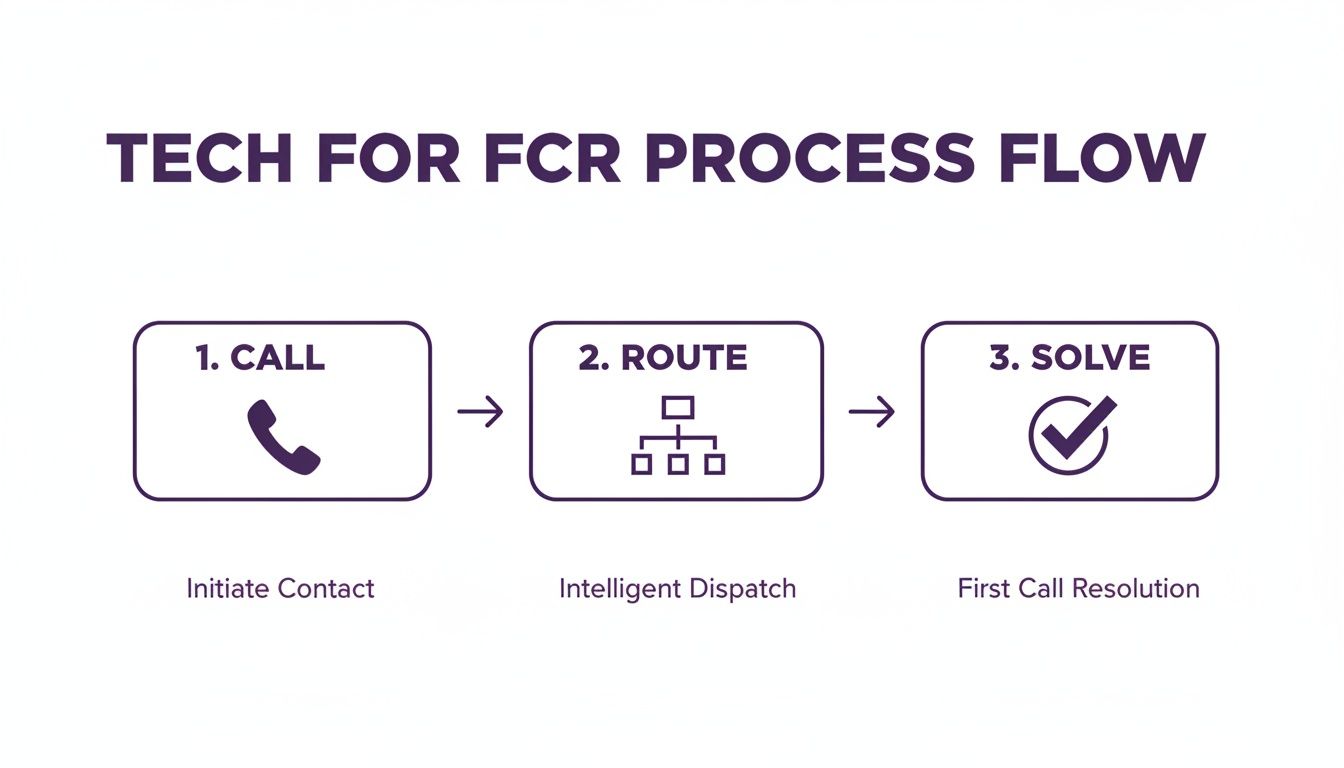
Each step—the call, the routing, and the solve—is a critical moment where you can gain or lose efficiency. By visualizing the flow, you can pinpoint exactly where to invest in better tech and training to create a smoother experience for everyone.
Celebrate Wins and Recognize FCR Champions
Finally, if you want FCR to stick, you have to celebrate it. Publicly recognizing agents and teams who consistently achieve one-call resolutions reinforces the exact behaviors you want to see more of. This is about more than just bonuses; it’s about creating FCR champions who inspire everyone else.
Consider putting these ideas into practice:
- An “FCR Hero of the Month” award: Spotlight an agent who tackled a particularly tough issue and nailed it on the first try.
- Team-based FCR goals: Get everyone working together by setting and celebrating team achievements. This builds camaraderie and shared accountability.
- Sharing success stories: Use team meetings to play recordings of great FCR calls. Break down what made the call so successful so others can learn from it.
A culture of continuous improvement isn’t built on spreadsheets; it’s built on shared goals, targeted coaching, and celebrating the people who make resolution happen.
By transforming your QA, building a smarter dashboard, and celebrating your wins, you shift FCR from being just another KPI to a core company value. A crucial part of this is gathering the right data, which we cover in our guide to using customer feedback for continuous improvement. This is how you build a resilient, customer-focused operation that solves problems for good.
FCR Frequently Asked Questions
Even the best plans run into questions once you start digging into First Call Resolution. Getting the details right, especially around measurement and goals, is crucial. Let’s tackle some of the most common questions that pop up when leaders get serious about this metric.
What is a good First Call Resolution rate?
While the industry benchmark floats around 70-75%, a truly “good” FCR rate depends on your business. A straightforward retail support line could easily aim for 85% or higher. However, if you’re a highly technical help desk for a SaaS product, hitting 65% might be a huge win due to problem complexity. The best approach? Establish your own baseline and aim for steady, measurable improvement rather than chasing a generic number.
How do you accurately measure First Call Resolution?
Relying on one method to measure FCR gives you a skewed picture. The most reliable approach is to blend internal tracking with direct customer feedback.
- Internal Tracking: The “no repeat call within X days” method is your starting point. You flag any customer who calls back about the same issue within a set window, like 7 or 14 days.
- External Feedback: Use simple, automated post-call surveys via SMS or email to ask the most powerful question: “Was your issue fully resolved during your call today?” This captures the customer’s perception, which is what matters most.
Will improving FCR increase my Average Handle Time?
Initially, yes, it probably will—and that’s okay. It’s a common worry, but it signals a necessary shift in mindset from pure speed to genuine effectiveness.
Think about it: spending an extra two minutes to solve a problem completely on the first try is far more efficient than handling a second or third call on the same issue down the line.
The focus must shift from how fast an agent can end a call to how effectively they can resolve it. True efficiency is found in fewer callbacks, not shorter calls.
Over time, as agents become more skilled and processes improve, your total call volume will drop. That reduction in repeat calls is the real cost-saver and the true prize of a smart FCR strategy.
How can a nearshore partner help improve our FCR?
A good nearshore partner can dramatically speed up your FCR improvements because they bring a pre-built culture of resolution to the table. Instead of starting from scratch, you’re plugging into a team that’s already focused on your KPIs from day one.
A partner like CallZent already invests heavily in the pillars of FCR success:
- Empowered Agents: We give our teams the authority and ongoing coaching they need to solve problems on the spot.
- Solid Knowledge Management: We build and maintain comprehensive knowledge bases that are easy for agents to use.
- The Right Tech: We use a technology stack designed for seamless resolutions, not just call handling.
By partnering with experts who live and breathe FCR, you free up your internal team to focus on growing the business, confident that your customers are getting effective, one-call resolutions.
FCR Frequently Asked Questions
1) What is First Call Resolution (FCR)?
FCR measures the percentage of customer issues resolved on the first interaction—without transfers, callbacks, or repeat contacts.
2) What is a good First Call Resolution rate?
Many teams land around 70–75%, but “good” depends on complexity. Retail can aim higher; technical SaaS may run lower.
Establish your baseline and improve steadily.
3) How do you accurately measure First Call Resolution?
Use a blended approach: (1) internal “no repeat contact within X days” tracking (often 7–14 days), plus
(2) post-contact surveys asking “Was your issue fully resolved today?”
4) Will improving FCR increase my Average Handle Time (AHT)?
Initially it can—because agents are doing deeper resolution. Over time, fewer repeat calls reduces total workload and improves true efficiency.
5) What are the biggest drivers of repeat calls?
Confusing policies, limited agent authority, weak knowledge bases, poor routing, system lag, and incomplete CRM context are the usual suspects.
6) What’s the fastest way to improve FCR?
Start with the top 3 repeat-call categories, update KB content, add routing rules, and empower agents with clear decision thresholds.
7) How does call routing impact FCR?
Skill-based routing reduces transfers and gets customers to the agent most capable of solving the issue—raising resolution rates immediately.
8) What role does QA play in improving FCR?
QA should diagnose why calls weren’t resolved and feed those insights into coaching, process fixes, and knowledge-base improvements.
9) Can AI improve First Call Resolution?
Yes—AI can deflect simple questions, assist agents with suggested answers, and surface the right KB steps faster so issues get solved in one contact.
10) How can a nearshore partner help improve our FCR?
A strong nearshore partner brings trained, bilingual teams, structured coaching, and operational discipline—helping you improve FCR faster without rebuilding everything in-house.
Ready to Stop Repeat Calls and Boost FCR?
CallZent provides the empowered agents, proven processes, and nearshore partnership you need to improve First Call Resolution—without sacrificing quality.
Ready to stop the cycle of repeat calls and build a customer experience that drives loyalty? CallZent provides the empowered agents, proven processes, and dedicated partnership you need to elevate your First Call Resolution rate. Discover how our nearshore solutions can reduce your operational costs and delight your customers.