Skip to content
Contact Center Services
Inbound Contact Center Services: The Complete Guide
Unlock growth and improve customer loyalty with expert inbound contact center services. Learn what they are, the benefits, and how to choose the right partner.
TL;DR — Quick Takeaways
- Inbound contact center services manage all incoming customer communications across phone, email, chat, and more.
- They are critical for resolving issues, protecting brand reputation, and building long-term customer loyalty.
- Outsourcing—especially nearshore—reduces costs while improving scalability and access to bilingual talent.
- Success is measured through KPIs like First Call Resolution (FCR), CSAT, and NPS.
TL;DR: Inbound contact center services are your business’s frontline, handling all incoming customer communications like calls, emails, and chats to resolve issues and build brand loyalty. Outsourcing these services, especially to a nearshore partner, offers significant cost savings, access to specialized talent, and 24/7 scalability. Key services include customer support, technical help, and order processing. Success is measured by metrics like First Call Resolution (FCR) and Customer Satisfaction (CSAT) to ensure a positive customer experience and operational efficiency.
Is your team drowning in customer calls, struggling to keep up with support tickets, and losing focus on your core business? That’s where inbound contact center services come in. They are the strategic command centers that manage every incoming communication from your customers—whether it’s a phone call, email, or live chat.
The mission is simple: resolve issues, answer questions, and turn potential customer friction into moments of genuine brand loyalty.
 Understanding Inbound Contact Center Services
Think of an inbound contact center as a dedicated front door for your business—a place where every customer question, concern, or compliment is met with professional expertise. It’s a fundamentally reactive role, which means agents respond to customer needs rather than initiating the conversation.
But that reactive nature is its greatest strength. Instead of making cold calls, inbound agents become masters of problem-solving. They’re the empathetic human voice of your brand, ready to tackle any inquiry with speed and skill precisely when customers need it most. And as technology evolves, so do these services; it’s worth exploring the benefits of AI chatbots to see how they complement human agents to boost efficiency.
What Is the Difference Between Inbound and Outbound Services?
One of the biggest points of confusion is the difference between “inbound” and “outbound” services. While both fall under the larger umbrella of what contact centers are, they serve opposite functions.
Inbound is all about receiving and resolving. Outbound is about reaching out and initiating.
It’s like running a restaurant: the inbound team takes reservations and answers questions from diners who call in, while the outbound team might call past customers to announce a new seasonal menu. Both are vital, but they meet different needs.
The key difference is simple: Inbound services pull customers closer by solving their immediate problems, while outbound services push the company’s message out to a target audience.
To help you see exactly how these two functions differ and figure out which one aligns with your business goals, this table lays it all out.
Inbound vs Outbound Services At a Glance
| Attribute | Inbound Services | Outbound Services |
|---|---|---|
| Primary Goal | Resolve customer issues, provide support, and increase satisfaction (reactive). | Generate leads, make sales, and conduct market research (proactive). |
| Communication Flow | Customer initiates contact with the business. | Business initiates contact with the customer or prospect. |
| Key Metrics | First Call Resolution (FCR), Customer Satisfaction (CSAT), Average Handle Time (AHT). | Conversion Rate, Calls Per Agent, Lead Generation Volume. |
| Agent Skills | Empathy, active listening, deep product knowledge, and problem-solving. | Persuasion, resilience, salesmanship, and follow-up tenacity. |
| Typical Scenarios | Technical support, order inquiries, billing questions, account management. | Telemarketing, appointment setting, customer surveys, fundraising campaigns. |
Getting this distinction right is the first step toward building a customer communication strategy that actually works. By recognizing the unique value of inbound contact center services, you can focus on creating a world-class support system that builds lasting relationships and fuels your company’s growth.
 The Core of Inbound Contact Center Services
It’s easy to think of an inbound center as just a room full of people answering phones. But the reality is far more sophisticated. Its true power comes from the specific, expertly handled services it delivers—the kind of critical functions that make or break customer loyalty and keep your operations running smoothly.
Think of a modern inbound partner as a specialized extension of your own team. They come equipped with the right people, proven processes, and the best technology to manage a whole host of customer-initiated interactions. Each service is its own discipline, requiring a unique blend of skills and know-how.
Customer Service and General Inquiries
This is the absolute bedrock of any inbound contact center. Agents on this team are your brand’s frontline, handling everything from simple questions about business hours to navigating complex account issues. Their goal is always the same: to be the friendly, knowledgeable, and empathetic first point of contact for your company.
For example, imagine an e-commerce customer who just received the wrong item. A great inbound agent doesn’t just process a return. They listen, empathize, quickly track down the correct order, and arrange for an expedited replacement. They might even add a discount on a future purchase for the trouble.
This single positive interaction transforms a frustrating mistake into a memorable experience, securing a customer for life instead of losing them to a competitor.
How that agent turns a negative into a positive is a direct reflection of your company’s commitment to its customers.
Technical Support and Help Desk Services
If you’re a software, electronics, or any kind of tech-driven company, technical support isn’t just a service—it’s a lifeline. Customers aren’t just buying a product; they’re buying a solution that’s supposed to work. When it doesn’t, they need immediate and competent help.
Inbound technical support agents are, first and foremost, expert problem-solvers. They are trained to patiently diagnose issues, guide users through often-complex troubleshooting steps, and get things working again efficiently.
- Scenario: A user of your SaaS accounting platform can’t access a critical report, and their deadline is looming.
- Action: They contact the inbound help desk. A trained agent calmly walks them through clearing their cache, checking user permissions, and re-syncing their data, quickly identifying a minor user error.
- Result: The problem is solved in under ten minutes. The user meets their deadline, and their faith in your software—and its support system—is stronger than ever.
Effective tech support is a powerful tool against customer churn and helps build a rock-solid reputation for reliability. It’s a function that demands a rare mix of deep technical knowledge and excellent people skills.
Order Processing and Management
Inbound centers are also vital hubs for sales and other revenue-driving activities. Agents can manage a whole range of tasks that directly impact your bottom line, from processing new orders and handling billing questions to managing subscriptions.
This service is crucial for any business that still takes orders over the phone or simply wants to provide a human touch to guide customers through a purchase. To get a better sense of the technology powering these operations, it’s worth exploring the various inbound call center software solutions available that help make these tasks seamless.
Here’s a quick look at what this often includes:
- Placing New Orders: Assisting customers who prefer the confidence of ordering with a real person.
- Subscription Management: Handling upgrades, downgrades, or cancellations for recurring services without a hitch.
- Payment and Billing Inquiries: Resolving billing discrepancies and securely processing payments.
- Returns and Exchanges: Guiding customers smoothly through the return merchandise authorization (RMA) process.
These are just a few real-world examples of what inbound contact center services can do. A skilled partner like CallZent can offer many other specialized solutions. To see what else is possible, check out our guide on the top 10 services provided by call centers in Tijuana. By outsourcing these essential functions, you can ensure every customer touchpoint is handled with the professionalism and care it deserves.
Strategic Benefits of Outsourcing Inbound Contact Center Services
So, why would a growing business hand over its customer conversations to a partner? The decision to outsource inbound contact center services goes way beyond just freeing up phone lines. It’s a strategic move that unlocks serious advantages in cost, talent, and scalability, letting you get back to focusing on what your company does best: innovating and growing.
Think of it this way: you hire a specialized accounting firm to manage your finances. It’s not because your team can’t count, but because experts do it better, faster, and more efficiently. Outsourcing your inbound services is the exact same logic applied to your customer experience. You’re entrusting a critical function to a team whose entire business is built around perfecting every single customer interaction.
Unlocking Significant Cost Efficiencies
The most immediate—and tangible—benefit is the massive reduction in operational costs. Building an in-house contact center is a huge capital investment. You’re talking about everything from real estate and tech infrastructure to recruitment, training, and the ongoing headache of management overhead.
When you partner with a nearshore provider like CallZent in Tijuana, you sidestep those expenses completely. You get access to a fully operational, state-of-the-art contact center without the crushing upfront cost. This model flips a large capital expenditure into a predictable, manageable operating expense.
For a clearer picture, here are the core financial wins:
- Lower Labor Costs: Nearshore locations offer highly skilled, bilingual talent at a much more competitive wage compared to the U.S. or Canada. That difference goes straight to your bottom line.
- No Infrastructure Investment: Forget about buying servers, software licenses, headsets, or office furniture. Your partner handles all of it.
- Reduced Overhead: You eliminate the hidden costs of an in-house team, like benefits, payroll taxes, HR management, and facility maintenance.
Gaining Immediate Access to Specialized Talent
Recruiting, hiring, and training expert customer service agents is a long and expensive process. A great inbound agent needs that rare combination of empathy, product knowledge, and technical skill. Outsourcing gives you instant access to a pre-vetted, highly trained talent pool ready to represent your brand from day one.
This is especially true with nearshore partners who specialize in serving North American markets. You gain a team that is not only fluent in English and Spanish but also culturally aligned with your customer base, ensuring conversations feel natural and effective. You’re not just hiring agents; you’re onboarding a team of seasoned CX professionals.
Achieving 24/7 Scalability and Flexibility
Customer demands don’t stick to a 9-to-5 schedule, and your business needs can swing wildly. An outsourced partner gives you the agility to scale your support up or down on demand, whether you’re handling a seasonal rush, a new product launch, or just an unexpected spike in call volume.
Outsourcing your inbound contact center isn’t just a cost-cutting tactic; it’s a powerful growth strategy that gives you the freedom to focus on your core business.
This flexibility also extends to technology. The global cloud-based contact center market, which powers modern inbound services, is projected to surge to USD 82.43 billion by 2030. This explosive growth shows the rapid shift toward scalable solutions that partners like CallZent already have in place. By outsourcing, you tap into this technology without having to make the massive investment yourself. You can explore more about these trends and discover insights about contact center statistics on Plivo.com.
Ultimately, the strategic benefits of outsourcing create a powerful competitive advantage. By leaning on an expert partner, you can improve customer satisfaction, reduce your operational burdens, and dedicate your resources to what really matters—driving your business forward. To dive deeper, learn more about the 5 benefits of customer care outsourcing in our detailed guide.
Why Nearshore Is Your Smartest Outsourcing Choice
So you’ve decided to outsource your inbound contact center services. Great. Now comes the next big question: where? In the world of BPO, you’ve got three main paths: onshore, offshore, and nearshore. While each has its place, the nearshore model is consistently the smartest, most balanced choice for North American companies.
This isn’t about just splitting the difference between cost and quality. It’s about finding that sweet spot where you sacrifice neither, creating a partnership that feels less like a vendor and more like a true extension of your team.
The Nearshore Advantage for Inbound Services
Think about a U.S.-based e-commerce brand that first sent its customer support offshore to Asia. The low costs were tempting, but the cracks showed almost immediately. The 12-hour time difference meant management calls had to happen at 9 PM local time, and subtle cultural gaps in communication were leaving customers frustrated.
So they switched to a nearshore partner in Tijuana, and the difference was night and day. With everyone in the same time zone, collaboration became effortless. Agents just got the cultural context of North American consumers, leading to better conversations and a 25% jump in CSAT scores in the first quarter alone. This isn’t a one-off story; it’s what happens when businesses discover the power of proximity.
This decision tree helps visualize when it makes sense to outsource customer-facing roles versus keeping core functions in-house.
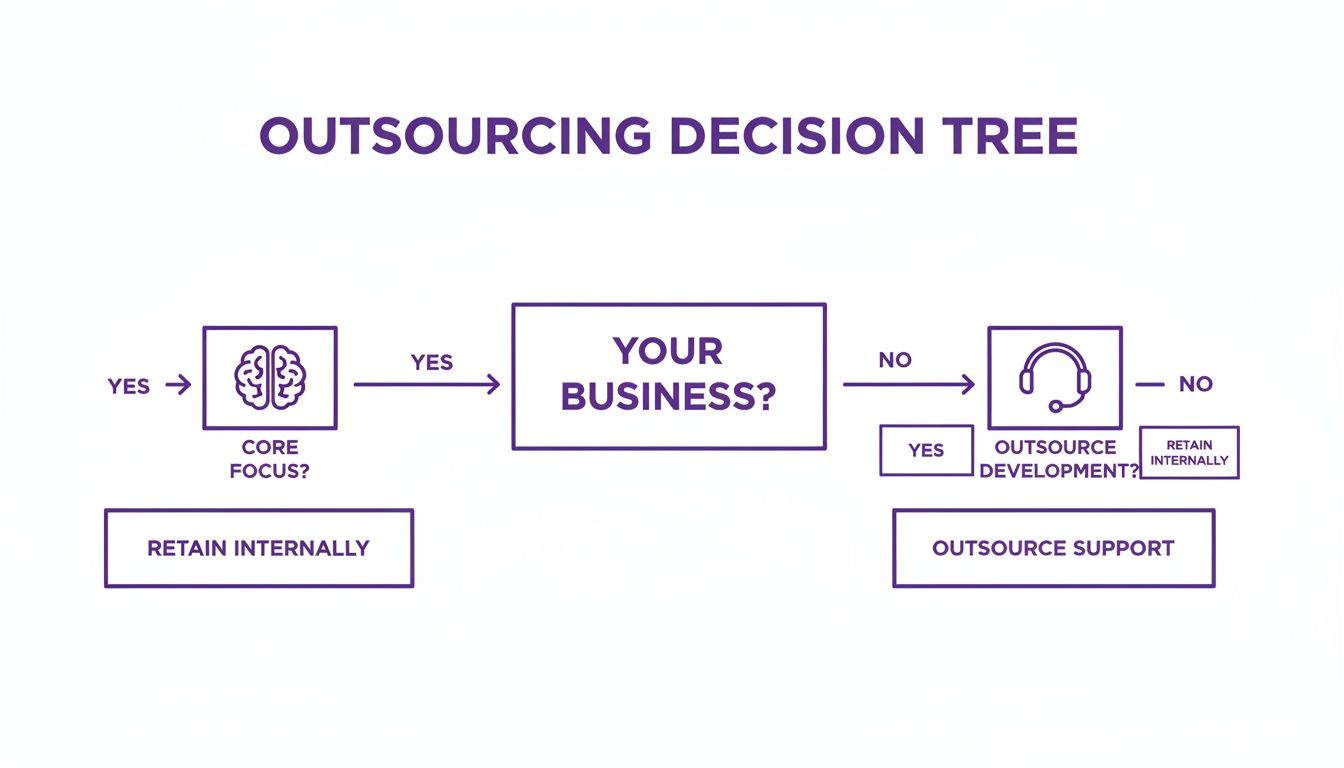
As you can see, when the goal is to enhance the customer experience, the smartest path leads directly to a specialized partner who can serve as the voice of your brand.
A Clear Comparison of Outsourcing Models
To really get why nearshore works so well, it helps to see how the three models stack up against each other on the factors that actually matter. Each option comes with its own set of trade-offs.
Here’s a head-to-head comparison to make the decision clearer.
Outsourcing Models Compared: Onshore vs. Nearshore vs. Offshore
| Factor | Onshore (U.S./Canada) | Nearshore (e.g., Tijuana) | Offshore (e.g., Asia) |
|---|---|---|---|
| Cost Efficiency | Highest cost due to domestic wages and overhead. | Highly competitive, offering significant savings over onshore. | Lowest cost, but can come with hidden management expenses. |
| Time Zone Alignment | Perfectly aligned, allowing for real-time collaboration. | Fully aligned with North American time zones for seamless workdays. | Significant delays (8-12+ hours), making real-time work difficult. |
| Cultural Affinity | Seamless cultural understanding. | Strong cultural and linguistic alignment with U.S. customers. | Major differences can lead to communication barriers. |
| Ease of Collaboration | Very easy; travel is simple for training and oversight. | Simple and affordable; quick flights or even drives for site visits. | Difficult and expensive; requires extensive travel and planning. |
| Talent Pool | Skilled but expensive and highly competitive market. | Large, bilingual, and highly skilled professional workforce. | Vast talent pool, but language proficiency can vary greatly. |
As the table shows, the nearshore model—especially with a partner in a hub like Tijuana—hits the sweet spot. You get the cost savings you expect from outsourcing without the logistical nightmares and cultural disconnects that often derail offshore arrangements.
Nearshore isn’t a compromise between cost and quality—it’s the strategic intersection where both are optimized for North American businesses.
This unique balance is why so many companies are looking just across the border for their partners. They’re not just hiring a vendor; they’re gaining a team that’s cost-effective and deeply integrated with their own operations. To dig deeper, you can explore the primary benefits of nearshore outsourcing in our detailed guide.
Ultimately, choosing a nearshore partner for your inbound contact center services means you get the best of both worlds. You get the operational efficiency that drives your bottom line and the high-quality customer experience that protects your brand. It’s a powerful combination that’s tough to beat.
 Measuring Success in Your Inbound Contact Center
You can’t improve what you don’t measure. It’s an old saying, but it’s the absolute truth in customer service. When you partner with an inbound contact center services provider, success isn’t just a feeling—it’s a set of hard numbers that prove your investment is paying off.
The difference between a true strategic partner and a simple vendor is their approach to data. A real partner moves beyond basic call counts and dives into meaningful KPIs. These metrics are the language of performance; they tell you exactly how efficiently issues are being handled, how happy your customers are, and where the real opportunities for improvement lie. A data-driven partner is transparent with this information, using it to refine processes and deliver better results, month after month.
Key Metrics That Truly Matter for Inbound Contact Center Services
The post-pandemic world has cranked up the pressure on inbound centers. With 61% of leaders reporting increased call volumes since 2020, the need for efficiency and effectiveness has never been more critical. This surge has positioned high-performing inbound teams as genuine revenue drivers, capable of building loyalty one successful resolution at a time. For more context, check out the latest call center trends and statistics on ximasoftware.com.
To get a clear, honest picture of performance, you need to zero in on a few essential KPIs:
- First Call Resolution (FCR): What percentage of customer issues get solved on the very first try, with no need for a follow-up? A high FCR is a dead giveaway that your agents are knowledgeable and your processes are dialed in.
- Average Handle Time (AHT): This is the clock on a single customer interaction, from “hello” to the final wrap-up notes. While a lower AHT often looks good, it must be balanced with FCR. Speed means nothing if the customer has to call back.
- Customer Satisfaction (CSAT): Typically measured with a quick post-interaction survey like, “How satisfied were you with your service?” CSAT gives you an immediate pulse check on customer sentiment and the quality of that specific interaction.
- Net Promoter Score (NPS): This one gauges long-term loyalty by asking how likely a customer is to recommend your company. It sorts customers into Promoters, Passives, and Detractors, giving you a powerful, high-level view of your brand’s health.
Together, these four metrics create a balanced scorecard, covering both the nuts and bolts of operational efficiency and the all-important quality of the customer experience.
FCR in Action: The Ripple Effect of Getting It Right
Let’s see how powerful a single metric can be with a real-world example. Imagine an e-commerce company discovers its FCR is stuck at 65%, well below the industry benchmark of 74%. This isn’t just a number—it means over a third of their customers have to call back, tying up phone lines and breeding frustration.
By bringing in a skilled inbound team, they quickly pinpoint the root cause: agents don’t have access to real-time inventory and shipping data. They can’t answer the simplest questions without putting customers on hold or promising a callback.
Improving First Call Resolution doesn’t just make customers happier—it directly reduces operational costs by minimizing repeat calls and frees up agents to handle new inquiries more effectively.
The new partner gets to work, integrating the company’s CRM with its inventory system. Suddenly, agents have the information they need right at their fingertips. Within just three months, the FCR jumps to a solid 80%.
The impact is immediate and widespread. Repeat call volume plummets, operational costs drop by 15%, and CSAT scores get a healthy boost. This is how focusing on a single, critical KPI can create a powerful ripple effect across the entire business.
Understanding these metrics is the first step toward accountability and continuous improvement. To dive even deeper, take a look at our guide on call center reporting and metrics dashboards.
How to Choose the Right Inbound Contact Center Partner
Picking the right partner for your inbound contact center services is one of the most important decisions you’ll make for your brand. This isn’t just about hiring someone to answer the phone; it’s about finding a team that becomes the voice of your company. A great partner should feel like an extension of your own team—so seamless that your customers never know the difference.
To get it right, you need a clear game plan. Think of this as your buyer’s guide, designed to cut through the sales pitches and get straight to what actually delivers results. Following a structured approach ensures you find a partner who lines up with your goals, culture, and operational needs from day one.
The Ultimate Vetting Checklist
Use this checklist to systematically size up potential BPO providers. Each point is designed to peel back the layers and reveal a partner’s true capabilities and cultural fit, helping you see beyond the shiny promises.
- Proven Industry Experience: Do they have a real track record in your specific world, whether it’s e-commerce, healthcare, or finance? Ask for case studies and don’t be shy about requesting references from companies like yours. A partner who already gets your customers’ unique headaches can start adding value right away.
- Technological Capabilities: A modern contact center is powered by smart tech. Dig into their CRM integrations, omnichannel platforms (voice, chat, email, social), and data analytics tools. Getting this right means they can give you a unified view of the customer and pull out insights you can actually act on.
- Agent Training and Company Culture: How a provider finds, trains, and treats its agents says everything. This is where the human side of customer service really comes to life. A positive, agent-first culture translates directly into happier, more effective customer interactions. Look for partners who invest heavily in ongoing training. Ask about their agent retention rates—low turnover is a huge green flag for a healthy work environment.
- Security and Compliance Protocols: In an age of constant data threats, ironclad security is non-negotiable. Your partner will be handling sensitive customer information, so they must have rock-solid protocols in place. Verify their compliance with regulations that matter to you, like HIPAA for healthcare or PCI DSS for financial transactions.
Your partner’s technology stack should empower your strategy, not limit it. Make sure their systems can scale with your growth and bend to your specific operational workflows.
Making the right choice comes down to finding a partner who hits the mark in all these areas. By aligning our nearshore advantages—like our bilingual talent pool and strong cultural affinity—with these criteria, CallZent is built to be the clear choice for North American businesses seeking a true extension of their team.
Frequently Asked Questions
When you’re exploring the world of inbound contact center services, a lot of questions come up. We get it. Here are the answers to the ones we hear most often, designed to help you make a confident, well-informed decision.
How Long Does It Take To Get Started?
This is one of the biggest perks of partnering with an experienced nearshore provider: speed. If you were building an in-house team from scratch, you could be looking at months of work. But with a BPO partner, we can typically have a trained team ready to take calls in just a few weeks.
The exact timeline depends on the complexity of your needs—things like integrating with your CRM or developing in-depth product training. But the goal is always the same: get you up and running quickly and smoothly.
What Does It Cost To Outsource Inbound Services?
There’s really no one-size-fits-all price tag here, since every business has different needs. The good news is that most pricing models are built for flexibility.
- Per-Agent Hour: You pay a straight hourly rate for each agent dedicated to your business. This is a great fit if you have a pretty steady, predictable call volume.
- Per-Call or Per-Minute: This model bills you based on the actual time agents spend talking to customers. It’s perfect for businesses with call volumes that go up and down.
- Hybrid Models: Sometimes a blend works best. A small fixed monthly fee paired with a variable usage rate can give you a nice balance of predictability and scale.
The key takeaway? Nearshore outsourcing offers some serious savings. We’re talking 40-60% less than keeping everything onshore, and you don’t have to sacrifice an ounce of quality.
How Is Customer Data Kept Secure?
Security isn’t just a feature; it’s the foundation. When you’re handling sensitive information, you need a partner who takes that responsibility seriously. A reputable inbound contact center invests heavily in layers of protection.
This includes things like:
- Compliance Certifications: Sticking to the letter of the law with standards like PCI DSS for payment info and HIPAA for healthcare data.
- Technological Safeguards: Using encrypted networks, secure VPNs, and undergoing regular security audits to keep data locked down tight.
- Physical Security: Controlling who gets into the building, constant surveillance, and secure workstations are non-negotiable.
When you’re vetting potential partners, don’t be shy. Ask for detailed documentation on their security protocols. A transparent partner will have no problem showing you exactly how they protect your data and earn your customers’ trust.
Can An Outsourced Team Really Understand My Brand?
Absolutely, and they have to. A core part of any successful launch is a deep-dive immersion into your brand. Before an agent ever picks up a call, they go through intensive training on your products, services, company culture, and unique brand voice.
They learn to think and speak like a member of your own team. The goal is to make them true brand ambassadors, ensuring every single customer interaction feels authentic, consistent, and genuinely helpful.
🚀 Ready to Elevate Your Inbound Support?
CallZent delivers nearshore inbound contact center services designed to scale, protect your brand, and drive customer loyalty.
Ready to see how a dedicated nearshore team can elevate your customer experience? At CallZent, we build custom inbound solutions that drive growth and customer loyalty. Discover how our services can work for you.