Skip to content

Insurance BPO
Insurance Back Office Outsourcing: The Complete Growth Guide
Learn how insurance back office outsourcing reduces costs, improves efficiency, and helps agencies scale with expert support and automation.
TL;DR — Quick Takeaways
- Insurance back office outsourcing helps agencies reduce costs by up to 70% while improving efficiency.
- Key tasks include claims support, policy management, underwriting assistance, and commission tracking.
- Outsourcing frees licensed agents to focus on sales, retention, and customer relationships.
- Choosing the right BPO partner requires strong compliance, security, and insurance expertise.
Are your best insurance agents buried in paperwork when they should be closing deals? It’s a common story, and it’s the exact operational drag that insurance back office outsourcing was designed to solve. This isn’t just about handing off tasks; it’s a strategic move to partner with a specialized firm that handles the essential, non-client-facing work, freeing up your core team to focus on what they do best: driving growth.
What Exactly Is Insurance Back Office Outsourcing?
Think of a world-class racing team. The driver has one job—win the race. They aren’t worried about refueling the car, swapping tires, or running engine diagnostics. A dedicated, expert pit crew handles all of that, ensuring the car is always performing at its peak. Insurance back office outsourcing applies the same logic to your agency.

You delegate specific administrative functions to an external partner, like a nearshore BPO. For example, a mid-sized agency in Arizona could partner with a firm in Tijuana to manage all their policy renewals and commission tracking. This isn’t just offloading work; it’s re-engineering your agency for significant gains in efficiency and scalability.
The Engine Room of Your Insurance Agency
Every insurance operation has a back office—it’s the engine room where the critical, yet often invisible, work gets done. These are the repetitive tasks that demand a high degree of accuracy and can easily consume your team’s most valuable hours. When these processes slow down, the entire business feels the strain.
This is precisely where outsourcing shines. By partnering with a dedicated BPO, you can hand off the heavy lifting and keep your agency running smoothly.
Here’s a look at the most common back-office functions that are perfect for outsourcing.
Core Back Office Functions to Outsource
| Service Area | Key Tasks Handled by an Outsourcing Partner | Real-World Example |
|---|---|---|
| Claims Processing Support | Managing first notice of loss (FNOL), verifying claim details, and preparing documentation. | An outsourced team fields initial claim calls 24/7, ensuring no customer waits until morning. |
| Policy Administration | Handling renewals, processing endorsements, updating policyholder data, and managing cancellations. | A BPO team processes 500+ policy endorsements per month, ensuring 99.8% accuracy. |
| Underwriting Support | Gathering applicant data, running preliminary checks, and preparing files for underwriter review. | The partner gathers all necessary documents for a new commercial policy, delivering a complete file to the underwriter. |
| Commission Management | Accurately calculating, tracking, and reconciling commission payments for agents and brokers. | An outsourced specialist reconciles commissions across three different carriers, saving the agency owner 10 hours a month. |
| Document Management | Digitizing, indexing, and organizing massive volumes of paperwork for easy access and compliance. | A team digitizes and tags 10 years of paper records, making them instantly searchable. |
Moving these tasks to a dedicated partner unburdens your licensed agents and underwriters, freeing them to concentrate on high-value activities like advising clients and strategic risk assessment. For a deeper dive into these operational divisions, check out our guide on the differences between front office and back office roles.
Modern insurance outsourcing isn’t about losing control; it’s about gaining focus. You delegate the routine so you can dominate the strategic.
The Top 3 Benefits of Insurance Back Office Outsourcing
We’ve covered what insurance back office outsourcing involves. But the real question is, why should your agency consider it? The benefits go far beyond just saving a few dollars. It’s about making a fundamental shift from being bogged down by operations to hitting the accelerator on growth.

Think about it: every hour your top agents spend wrestling with paperwork is an hour they aren’t selling or advising clients. When you hand off those critical but repetitive tasks, you’re buying back your team’s most valuable asset: time.
1. Slash Costs and Boost Efficiency
Let’s be direct: the impact on your bottom line is a primary motivator. And for good reason. Cost savings are a huge driver for insurance back office outsourcing, especially when you see the numbers.
Some agencies see up to a 70% reduction in operational costs by partnering with providers in nearshore locations. For a small to mid-sized insurer, this could mean reclaiming over 15 hours per week, per agent previously lost to administrative work.
How does that happen?
- Lower Labor Costs: You access a professional, skilled workforce in more affordable regions without sacrificing quality.
- Reduced Overhead: Say goodbye to the costs of extra office space, computers, and benefits for a large in-house admin team.
- A Flexible Cost Model: Your fixed payroll expenses become a variable operational cost. You pay for what you need, when you need it.
This isn’t just about cutting expenses; it’s about smart capital reallocation. That money can be poured back into marketing campaigns, tech upgrades, or hiring another top-producing agent.
2. Get Instantly Scalable and Agile
The insurance world has peaks and valleys. You have the rush of open enrollment, a surge in claims after a storm, or the paperwork from a massive book of business renewal. Scaling an in-house team for these spikes is slow and expensive.
Outsourcing gives you a ‘volume dial’ for your operations. You can turn capacity up or down on a dime, without the friction of hiring, training, and onboarding.
Imagine doubling your policy admin team during your busiest season and then scaling right back down. For example, a Florida-based agency can instantly add 10 claims support agents through their nearshore partner after a hurricane, then scale back down a month later. That agility is a massive competitive advantage.
To see how this agile model can be applied, check out our deep dive into BPO in the insurance sector.
3. Tap into a Specialized Talent Pool
The insurance industry faces a significant talent shortage. Finding, training, and retaining skilled people who know the ins and outs of claims processing or commission management is getting tougher and more expensive.
When you use insurance back office outsourcing, you’re not just hiring a few people; you’re plugging directly into a pre-vetted, highly trained team of specialists. Reputable BPO partners invest heavily in continuous training, ensuring their teams are experts in insurance workflows and the latest technology. This insulates you from the talent crunch and elevates the quality of your back-office work, leading to fewer errors and happier clients.
Key Services for Your Insurance Back Office Outsourcing Strategy
So you understand the strategy, but what can you actually hand off to a partner? Getting specific is where the real value becomes clear. Certain tasks are a perfect fit for outsourcing and can deliver an immediate, noticeable boost to your agency’s efficiency.
Think of it like adding specialized plug-ins to your business. You don’t have to build them from scratch; you just pick the right tool for the job. Let’s break down the high-impact services that deliver results right away.
Streamline Your Claims Processing Support
For any policyholder, a claim is the moment of truth. A slow, error-riddled process can destroy client trust, but a fast, smooth one builds loyalty for life. The problem is, the administrative work behind claims is incredibly time-consuming.
An outsourced team can take over these critical support roles:
- First Notice of Loss (FNOL) Intake: Your partner can operate 24/7, ensuring every claim is logged accurately and immediately, no matter when it comes in.
- Data Verification and Entry: The team meticulously checks policy details, cross-references information, and enters it into your claims system, slashing the risk of costly errors.
- Document Management: They gather and organize all necessary documents—photos, reports, statements—and prepare a complete file for your adjusters.
This pulls your in-house claims experts out of the administrative weeds. Instead of chasing paperwork, they can focus their full attention on adjudication and providing a great client experience.
By outsourcing claims support, you’re not just speeding up a process. You’re fundamentally improving the client experience at its most critical point.
Perfect Your Policy Management
The lifecycle of an insurance policy is packed with administrative hurdles. Renewals, endorsements, and billing questions are essential but highly repetitive. They can easily bog down your staff, pulling them away from revenue-generating work. This is a prime area where insurance back office outsourcing shines.
Imagine your team no longer having to manually process hundreds of policy endorsements. An outsourcing partner handles these tasks with precision and speed.
Here’s a practical example:
- Policy Renewals: The outsourced team manages the renewal process, ensuring all documents are sent, received, and processed on time for a book of 2,000 personal auto policies.
- Endorsements and Changes: They handle policyholder requests, like adding a new vehicle to a policy, ensuring every detail is accurate.
- Commission Tracking: Your partner takes on the complex task of calculating and reconciling agent commissions, ensuring everyone is paid correctly and on schedule.
When you delegate these functions, you create a more efficient and accurate policy administration system. To see how these specialized tasks fit into the bigger picture, you can learn more about our comprehensive back office outsourcing services and how they support business growth.
Sharpen Your Underwriting Assistance
Your underwriters are your most valuable risk assessors. Their expertise is best used to analyze complex cases, not do administrative prep work. Yet, many spend a huge chunk of their day gathering data and preparing files.
Outsourcing underwriting support lets your experts focus on analysis. An outsourced team can handle the groundwork by:
- Gathering Applicant Data: They collect all needed information from potential clients, ensuring applications are complete before they hit an underwriter’s desk.
- Running Preliminary Checks: The team can perform initial background checks, verify information, and flag any missing items for follow-up.
- Preparing Underwriting Reports: They compile all data into a clean, standardized report, giving your underwriters everything they need for a fast, informed decision.
This approach creates a more efficient underwriting department, shortening turnaround times and allowing your team to handle more applications with greater accuracy.
How to Choose the Right Insurance Back Office Outsourcing Partner
Picking a partner for your insurance back office outsourcing is the single most important decision in this process. This isn’t about finding the cheapest hourly rate; it’s about finding an operational partner that fits your agency’s goals and culture.
The wrong choice can lead to data security nightmares and operational headaches. The right one becomes a true extension of your team. To get it right, you have to ask the tough questions and look for a few non-negotiables.
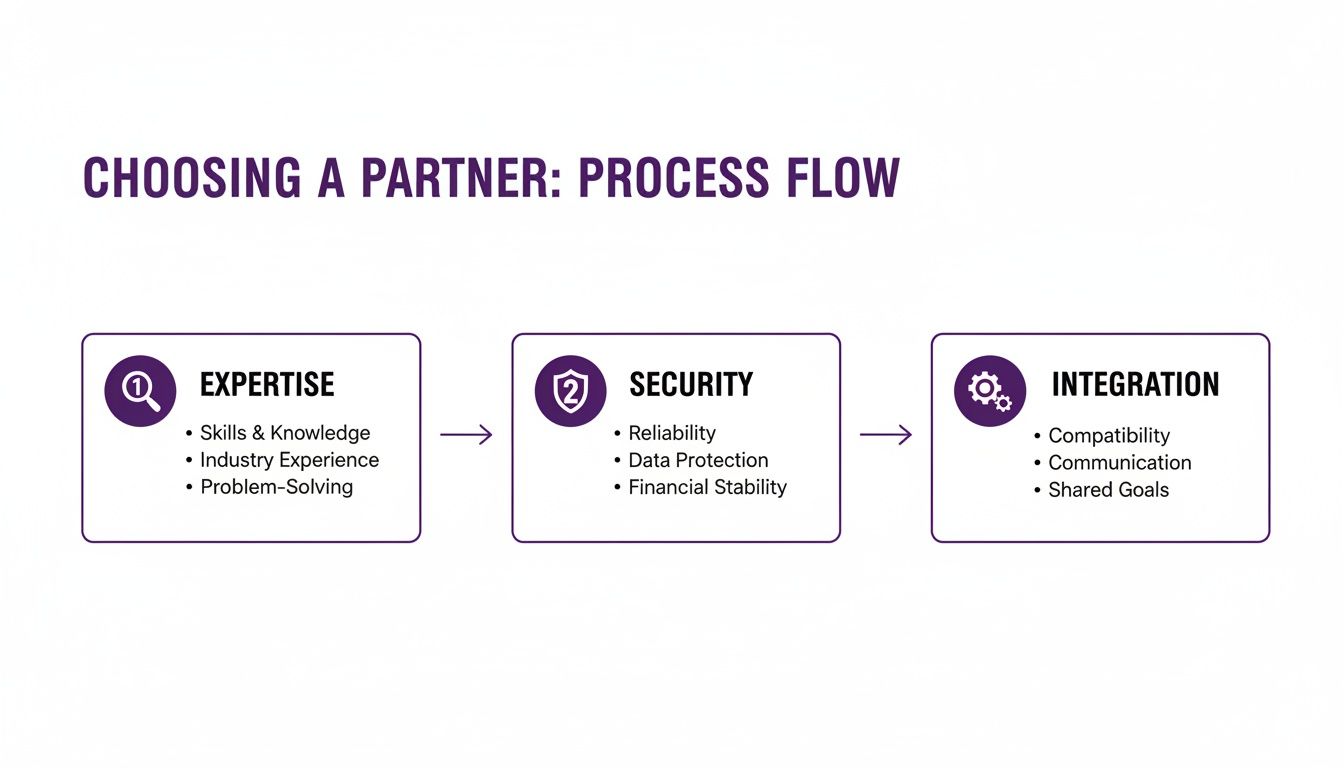
1. Vet for Deep Insurance Industry Expertise
First things first: your partner has to live and breathe insurance. A generic BPO that handles customer service for a retail brand one day and data entry for a tech company the next won’t understand the nuances of your business.
You need a team that already knows the difference between an FNOL and a subrogation claim. Ask potential vendors these pointed questions:
- What specific experience do you have with insurance agencies our size? Ask for case studies showing how they’ve handled tasks like commission reconciliation.
- How do you train your agents on insurance-specific terms and processes? A solid partner will have a dedicated, ongoing training program for the insurance vertical.
- Can you walk me through your quality assurance process for insurance tasks? Look for a multi-layered approach that ensures accuracy.
2. Scrutinize Security and Compliance Protocols
In insurance, data is the crown jewel, and protecting it is non-negotiable. A data breach could be catastrophic. Security isn’t an afterthought—it must be a core competency.
When sizing up partners, understanding what SOC 2 compliance entails is a must. It’s a key indicator that a vendor is serious about data protection.
A partner without rock-solid security certifications is not a partner—it’s a liability. Do not compromise on this.
Beyond SOC 2, look for HIPAA compliance if you handle any health-related information. A secure partner will be transparent about everything from physical security at their facilities to encryption protocols and employee background checks.
3. Assess Technology and Integration Capabilities
The best outsourcing partnerships feel seamless because the technology just works. If your partner’s systems can’t communicate with your agency management system (AMS) or claims software, you’re just creating more work.
Before you sign, dig into how they’ll integrate with your existing tech stack. A forward-thinking partner will have experience with common insurance platforms (like Vertafore or Applied Systems) and a clear plan for getting everything connected. This ensures data flows smoothly and eliminates manual re-entry.
For more tips on this critical vetting process, check out our guide on how to find and vet the best call center outsourcing companies.
Your Roadmap to a Smooth Outsourcing Transition
Making the move to an outsourced model can feel like a massive project. But with a clear, step-by-step roadmap, that leap becomes a series of manageable steps. A successful transition to insurance back office outsourcing is a carefully planned process designed to cause zero disruption.
A solid plan gets your team and your new partner on the same page, setting the stage for a seamless integration.
Phase 1: Internal Audit and Goal Setting
The first move is to look inward. Before you decide what to hand off, you need a clear picture of how your agency runs now. Map out every back-office workflow, from claims data entry to commission reconciliation.
Find the bottlenecks. Which repetitive processes are eating up the most staff hours? Use this analysis to pinpoint the exact functions that are prime candidates for outsourcing.
Once you’ve identified the pain points, set clear, measurable goals. For example:
- Reduce policy processing time by 30%.
- Cut operational costs on specific tasks by 50%.
- Achieve 99.5% accuracy on data entry for new business.
- Give agents back 10 hours per week to focus on selling.
Phase 2: Partner Due Diligence and SLA Crafting
With your goals set, it’s time to find the right partner. This is the due diligence phase, where you’ll vet potential partners on their insurance knowledge, security credentials, and tech stack.
After you’ve picked your partner, the next critical task is to build a rock-solid Service Level Agreement (SLA) together. The SLA is your rulebook, a formal contract that spells out every detail of the partnership.
A strong SLA is the foundation of a successful outsourcing relationship. It translates expectations into contractual obligations, ensuring everyone is accountable for the results.
Your SLA needs to explicitly define Key Performance Indicators (KPIs) like accuracy targets, turnaround times, and agent availability. This document makes sure everyone agrees on what success looks like. For agencies weighing their options, understanding the benefits of a transition from offshore to a nearshore model can add valuable perspective here.
Phase 3: Knowledge Transfer and a Pilot Program
This is where the rubber meets the road. The knowledge transfer phase is about methodically training the outsourced team on your agency’s specific processes, software, and culture. A great partner will use a “train the trainer” model to ensure the information sticks.
This phase includes:
- Documenting Workflows: Creating detailed process maps and standard operating procedures (SOPs) for every task you’re outsourcing.
- System Training: Giving the partner’s team access to—and thorough training on—your Agency Management System (AMS) and other critical software.
- Cultural Onboarding: Sharing how your company communicates and the service standards you uphold.
Before going all-in, launch a pilot program. Start with a small, defined scope of work, like handling policy renewals for just one line of business. This lets you test the entire workflow in a low-risk environment and smooth out any wrinkles before the full-scale rollout.
The Future of Insurance Back Office Outsourcing
The conversation around insurance back office outsourcing is changing. It’s no longer just a line item for cutting costs—it’s now a core strategy for building a resilient, agile, and growth-ready agency.
When you strategically partner with a nearshore expert, you’re not just handing off tasks. You’re upgrading your operational engine. This model lets you scale as needed, navigate compliance with confidence, and free your best people to do what they do best: take care of clients and grow the business.
Get Agile and Innovate Faster
The insurance world doesn’t stand still. New tech and evolving customer demands are constantly raising the bar. Smart outsourcing is about more than efficiency; it’s about plugging innovation directly into your operations. For a clearer picture of where things are headed, a deep dive into insurance agency automation shows what tools are reshaping the industry.
The future of insurance isn’t about doing more work; it’s about creating more value. Outsourcing administrative functions is the lever that allows you to shift your focus from mundane tasks to strategic growth.
This approach gives you access to new capabilities immediately, without the time and money it takes to build them from the ground up.
Paving the Way for a Client-First Future
At the end of the day, every operational tweak should lead back to a better client experience. When your back office runs like a well-oiled machine, the positive effects ripple outward.
- Faster Claims: An efficient process means quicker resolutions and happier policyholders.
- Accurate Policies: Flawless policy administration builds trust and cuts down on frustrating errors.
- More Agent Time: When agents are freed from paperwork, they can provide the personalized advice that sets your agency apart.
By embracing the insurance back office outsourcing model, you’re investing in a more efficient, profitable, and client-focused future. It’s the move for agencies ready to lead the pack.
Frequently Asked Questions About Insurance Outsourcing
Making the leap to insurance back office outsourcing is a big decision, so it’s natural to have questions. Getting straight answers is the only way to feel confident about the move.
Let’s dig into some of the most common questions we hear from agency owners.
What Is the Biggest Risk of Outsourcing and How Is It Managed?
The biggest concerns are almost always data security and operational disruption. You’re handing over sensitive client information and key processes, which requires trust.
A top-tier partner tackles these head-on. For security, they will have non-negotiable protocols and certifications like SOC 2 and HIPAA. This is proof that your data is handled under strict, audited security frameworks. To avoid operational chaos, the best providers use a phased rollout, often starting with a small pilot program to work out any kinks before a full launch. This ensures the transition is smooth.
How Much Does Insurance Back Office Outsourcing Actually Cost?
There’s no single price tag, but nearshore outsourcing is known for significant cost savings—often between 50-70% compared to the fully-loaded cost of an in-house administrative team.
But it’s better to think of this as an investment, not just an expense. The real ROI comes from:
- Slashing overhead from salaries, benefits, and office space.
- Giving your licensed agents more time to sell.
- Boosting your overall operational efficiency and accuracy.
Smart outsourcing isn’t about chasing the cheapest hourly rate. It’s about unlocking the highest possible value for every single dollar you put into your operations.
Can a Small Insurance Agency Truly Benefit from Outsourcing?
Absolutely. In fact, outsourcing is one of the most powerful growth tools for a smaller agency because it’s scalable. You don’t have to ship your entire back office away on day one.
You can start small and be strategic. For example, a two or three-person agency could offload a single, time-draining task like commission processing or managing policy renewals. That one change can free up your agents to focus 100% on quoting new business and keeping clients happy. This makes insurance back office outsourcing a game-changer for ambitious agencies, not just a tool for massive carriers.
🚀 Ready to Streamline Your Insurance Operations?
Partner with CallZent to reduce costs, improve efficiency, and scale your insurance back office operations.
Talk to an ExpertReady to see how a dedicated nearshore team can free your agents to focus on growth? CallZent provides expert, scalable back-office solutions designed for the insurance industry. Learn more and transform your agency’s efficiency today.