Skip to content
Insurance BPO Strategy
Insurance Process Outsourcing: How to Cut Costs, Boost Efficiency & Stay Competitive
Learn how insurance process outsourcing (IPO) helps insurers streamline operations, reduce costs, and deliver faster, higher-quality service—without losing control.
TL;DR — Your Guide to Insurance Process Outsourcing
- What is IPO? Hiring a specialized BPO firm to manage non-core functions like claims, policy admin, and customer service.
- What Can Be Outsourced? Claims intake, data entry, renewals, underwriting support, and billing inquiries.
- Benefits: Faster operations, reduced overhead, and higher customer satisfaction.
- Choosing a Partner: Look for deep insurance expertise, data compliance, and modern technology.
- Why Nearshore: Partners like CallZent offer bilingual talent, cultural alignment, and same-time-zone collaboration.
Is your insurance firm leaving money on the table by handling every single task in-house? Insurance process outsourcing (IPO) is the secret weapon that lets you hand off specific operational tasks to specialized experts. This isn’t just about trimming the budget; it’s about sharpening your competitive edge by letting you focus on what you actually do best.

What Is Insurance Process Outsourcing (IPO)?
Think of your insurance agency as a general contractor building a luxury home. The contractor doesn’t personally pour the concrete, install the HVAC, and wire every outlet. That would be insane. Instead, they bring in master plumbers, electricians, and masons—specialists who execute their part of the job flawlessly and efficiently.
Insurance process outsourcing is built on that very same idea. It’s the practice of partnering with a specialized firm, like a BPO provider, to take over specific, non-core functions that are still absolutely essential to your business. We’re talking about everything from the initial claims intake and policy administration to customer service calls and back-office support.
Why IPO Matters More Than Ever
Not too long ago, keeping every single function under your own roof was seen as a sign of strength. Today, it’s often a major operational drag. The insurance market is feeling the squeeze from all sides. Customers demand instant, 24/7 service, digital tools are table stakes for survival, and the competition is more intense than ever.
Trying to juggle it all internally stretches your resources thin. It pulls your focus away from the activities that actually make you money—like underwriting complex policies, nurturing client relationships, and innovating new products.
By strategically outsourcing the administrative and repetitive work, you turn your operational backbone from a costly necessity into a powerful engine for growth.
The Core Idea Behind Insurance Process Outsourcing
At its heart, insurance process outsourcing is all about smart delegation. It’s about letting your highly skilled, highly paid internal teams stop wasting time on routine tasks so they can concentrate on high-value work.
Here’s what that looks like in practice:
- Focus on Core Strengths: Your underwriters should be underwriting, not chasing down missing paperwork. Your adjusters should be analyzing complex claims, not just taking down initial call notes. Insurance process outsourcing frees them up to do exactly that.
- Tap into Specialization: BPO partners are experts in operational efficiency. They show up on day one with optimized workflows, trained teams, and modern tech, saving you the massive investment and painful learning curve of building it all yourself.
- Scale Up or Down on a Dime: Need to triple your customer service capacity for open enrollment or after a big storm? A good outsourcing partner can deploy the staff and infrastructure you need almost overnight. You get to adapt to market demands without the long-term burden of hiring full-time staff.
This strategic shift is what’s powering a massive market expansion. The global insurance BPO market was valued at around USD 13.71 billion in 2024 and is on track to hit USD 32.00 billion by 2032. This explosive growth shows just how many insurers are using outside expertise to modernize their workflows and deliver better service. To see how this fits into the bigger picture, check out our guide on what business process outsourcing is and how it drives value across industries.
Ultimately, insurance process outsourcing isn’t about just offloading tasks. It’s a calculated business move that helps you build a more nimble, efficient, and customer-first organization ready for whatever comes next.

Key Services in Insurance Process Outsourcing
So, moving past the big-picture idea, what does insurance process outsourcing actually look like in practice? It’s all about handing off specific, high-volume tasks to a partner who can handle them with speed and skill.
This move frees up your in-house experts to zero in on the complex, high-stakes work that truly drives your business forward. It’s not about losing control; it’s about gaining leverage and turning your back office from a cost center into a growth engine.
Let’s dig into the most common services that insurers successfully outsource to a specialized BPO partner.
Nailing Down Claims Processing
For most policyholders, the claims journey is the moment of truth. A clunky, slow experience can destroy years of loyalty in an instant. Outsourcing the initial administrative steps of the claims process is a surefire way to lock in speed and accuracy right from the get-go.
A BPO partner can take several key claims functions off your plate:
- First Notice of Loss (FNOL): When a customer calls to report a loss, BPO agents act as your empathetic and efficient frontline. They’re trained to gather every crucial detail, ensuring the claim file is rock-solid from day one.
- Data Verification and Entry: Agents double-check claim details, cross-reference policy info, and input everything into your system without a single typo. This careful work stops downstream errors that cause major settlement delays.
- Status Inquiries: Instead of your adjusters fielding endless “Where’s my claim at?” calls, an outsourced team provides policyholders with instant updates. This keeps customers happy and lets your adjusters focus on investigating and settling claims.
By handing off these foundational tasks, your licensed adjusters can pour their expertise into complex case analysis, negotiation, and fraud detection—the high-value work that directly protects your bottom line.
Perfecting Policy Administration
Think of policy administration as the engine room of your insurance company. It’s a constant churn of routine but vital tasks that demand absolute precision. These responsibilities are a perfect fit for an insurance process outsourcing strategy because they thrive on consistency and meticulous detail.
An outsourcing partner becomes a true extension of your team, managing the entire lifecycle of each policy with dedicated focus. This gives you seamless operational continuity and lets your core team concentrate on strategic growth.
An expert BPO can manage:
- New Policy Setup: From entering application data to generating policy documents, an outsourced team gets new clients onboarded quickly and correctly.
- Endorsements and Changes: A policyholder needs to add a car, update an address, or tweak their coverage? BPO agents process these requests in a flash, keeping your records perfectly current.
- Renewals Management: Renewals are all about retention. An outsourced team can handle the notices, payment processing, and questions, creating a smooth experience that encourages policyholders to stick around.
Beefing Up Underwriting Support
Your underwriters are your most critical risk managers. Their time is incredibly valuable and should be spent analyzing risk, not chasing down paperwork. Outsourcing underwriting support gives them the clean, verified data they need to make smarter, faster decisions.
Example: Before a complex commercial policy ever hits your senior underwriter’s desk, an outsourced team has already done the legwork. They’ve gathered the necessary documents, verified data from third-party sources, and flagged anything that’s missing. The file arrives complete and ready for an expert eye. This simple change can slash quote turnaround times from days to hours.
Elevating the Customer Experience
In a competitive market, fantastic customer service is your secret weapon. Policyholders want fast, helpful answers, whether they call, email, or open a live chat. A specialized BPO partner delivers the omnichannel support needed to meet—and exceed—those expectations.
If you’re weighing your options, our breakdown of the best call centers for insurance companies offers some great insights on what to look for in a service partner.
Common outsourced customer service tasks include:
- General Policy Questions: Answering queries about coverage limits, deductibles, and policy fine print.
- Billing and Payment Inquiries: Helping customers process payments, understand their statements, and fix any billing issues.
- Technical Support: Guiding policyholders through your online portal or mobile app.
Partnering with a nearshore BPO like CallZent gives you access to a bilingual, culturally aligned team that provides top-tier service across every channel. The result? Higher first-call resolution rates and happier, more loyal customers.
The Real ROI of Insurance Process Outsourcing
Talking about benefits is fine, but let’s get down to brass tacks. How does insurance process outsourcing actually move the needle for your business? The real value isn’t just about shaving a few points off your expense report; it’s about fundamentally changing how your company operates and creates value.
We need to look past the buzzwords and at the cold, hard return on investment (ROI) that shows up in your key performance indicators (KPIs).
The market trends tell a pretty clear story. The insurance outsourcing sector is on track to hit USD 9.88 billion in 2025, a solid jump from USD 9.22 billion in 2024. What’s driving this? Insurers are feeling the heat to speed up turnaround times and deliver a better customer experience—and outsourcing is a direct line to achieving both. You can read the full research on this market expansion here.
More Than Just Labor Savings
When most people hear “outsourcing,” they immediately think “cheaper labor.” And while that’s part of the equation, it’s really just the tip of the iceberg. The real savings come from offloading a whole host of operational headaches you no longer have to manage.
Think about everything it takes to run a team in-house:
- Reduced Overhead: You’re not just saving on salaries. You’re saving on the cost of office space, utilities, desks, and computers for every single person you don’t have to house.
- Technology and Infrastructure: Your BPO partner brings their own tech stack. That means no massive capital investment from you on CRMs, phone systems, or pricey software licenses.
- Training and Development: The partner handles all the hiring, continuous training, and certifications for their agents. That’s a significant, ongoing expense completely removed from your budget.
When you add it all up, the savings go way beyond payroll. You end up with a leaner, more financially agile organization. For a closer look at the numbers, checking out the ROI of outsourcing your call center can give you a solid financial framework.
Gaining Speed and Efficiency
In the insurance world, speed is everything. A slow claims process or a delayed policy issuance doesn’t just create a backlog; it pushes customers out the door. A specialized partner brings battle-tested workflows and trained experts who know how to handle high-volume tasks with precision and speed.
Real-World Example: A mid-sized property and casualty insurer was drowning in a claims processing backlog. Their average time from the First Notice of Loss (FNOL) to the initial assessment was dragging on for four to five business days. After bringing on a nearshore BPO partner, they crushed that time down to under 24 hours. The BPO team, working in the same time zone, handled all the initial data intake and verification, teeing up perfectly prepped files for the in-house adjusters to review first thing every morning.
This isn’t just about moving faster. It’s about letting your most valuable people—your expert adjusters and underwriters—focus on the critical thinking and decision-making they were hired for, instead of getting bogged down in administrative grunt work.
Boosting Customer Satisfaction and Retention
Great service is what keeps customers loyal. When a policyholder calls with a question or needs to file a claim, they want a fast, empathetic, and helpful person on the other end of the line. An insurance process outsourcing partner can provide dedicated 24/7 support, making sure you never miss an opportunity to connect with a customer.
This is where nearshore partners like CallZent have a serious edge. Our bilingual agents don’t just speak the language; they have a deep cultural understanding of the U.S. market. This cultural fluency leads to more natural, effective conversations that build genuine trust and rapport. The result? Higher Customer Satisfaction (CSAT) scores and Net Promoter Scores (NPS).
Here’s a practical look at how it all comes together:
- Case Study: A regional health insurance provider partnered with a BPO to manage its member services and policy administration. Within the first year, they saw a 35% reduction in operational costs. But here’s the kicker: by offering extended hours and bilingual support, their policyholder retention rate shot up by 15%. Members simply felt better supported and more valued.
This proves that outsourcing isn’t just a defensive play to cut costs. It’s an offensive strategy that directly improves the customer experience, protecting and growing your most important asset: your client base.
How to Choose the Right Insurance Process Outsourcing Partner
Picking a partner for your insurance process outsourcing needs is one of the most important business decisions you’ll make. This isn’t just about finding a vendor; it’s about starting a long-term relationship that will directly shape your operational efficiency, customer happiness, and bottom line.
The right partner slots in like they’ve always been part of your team. The wrong one? They just create more headaches than they solve.
The secret is to look past the price tag. You need to evaluate potential partners on a much deeper, more strategic level. The goal is to find a BPO provider that not only nails the tasks you’re handing off but also clicks with your company’s culture, values, and vision for the future. That takes a smart, structured approach.
Look for Deep Industry Specialization
First things first: your partner absolutely has to speak fluent insurance. A generic call center that handles retail accounts one minute and telecom the next just won’t cut it. They won’t have the specialized knowledge to handle complex policy questions or sensitive claims details.
Real expertise is non-negotiable.
When you’re vetting a potential partner, ask them some sharp questions to see how deep their knowledge really goes:
- “Describe your agent training program for insurance-specific terminology and regulations.” A solid partner will have a dedicated curriculum covering everything from policy types to the nitty-gritty of compliance.
- “What experience do you have with our specific line of insurance (e.g., P&C, Health, Life)?” Their answer will tell you right away if they have real-world experience or just a pamphlet-level understanding.
This kind of focus is becoming more critical as the global insurance BPO market continues to expand. Valued at USD 7.2 billion in 2024, it’s on track to hit USD 12 billion by 2034. Why? Because more insurers are outsourcing to modernize their operations and give customers a better experience.
Prioritize Data Security and Compliance
In the insurance world, data isn’t just data. It’s highly sensitive, personal information that’s locked down by strict regulations. A security breach isn’t just an operational hiccup; it’s a direct threat to your reputation and legal standing. Your partner’s security has to be rock-solid.
Your partner’s security framework should be a fortress, not a fence. Scrutinize their certifications and protocols as if your own business depends on it—because it does.
Don’t let them get away with vague promises of “robust security.” You need to see the proof.
- Certifications: Are they compliant with key regulations like HIPAA (for health information) and PCI-DSS (for payment card data)? Ask to see the actual certificates.
- Physical and Digital Security: What are their measures? This covers everything from encrypted data transfers and secure servers to facilities with controlled access.
- Disaster Recovery Plan: What’s the plan if their systems go down? A reliable partner will have a detailed business continuity plan ready to roll.
Evaluate Their Technology Stack
The right technology can make or break an outsourcing partnership. An outdated tech stack is a recipe for inefficiency and a clunky customer experience. You need a partner who invests in modern tools that can plug right into your existing systems.
To make sure you’re picking the best fit, using a thorough vendor profiling workbook can be a huge help in sizing up potential partners. A forward-thinking BPO will be using advanced CRM platforms, workflow automation, and omnichannel communication systems. This is how they deliver the speed and consistency your policyholders demand.
This whole approach is a core part of what we call smart sourcing—a strategy focused on finding partners who bring real, tangible value to the table. For a deeper dive, check out our strategic guide to outsourcing.
The Nearshore Advantage in Insurance Process Outsourcing
When you’re looking for the right partner for insurance process outsourcing, where they are is just as important as what they can do. For years, the default move was to go offshore to places like Asia, chasing the lowest possible cost. But more and more U.S. insurance companies are realizing there’s a smarter alternative right next door.
A nearshore partner, especially one in a hub like Tijuana, brings a powerful mix of benefits to the table that traditional offshore models just can’t compete with. It’s not just about being closer on a map; it’s about hitting that perfect sweet spot between cost, collaboration, and cultural connection.
Real-Time Collaboration with Time Zone Alignment
Let’s be honest: one of the biggest headaches of working with an offshore team is the massive time difference. A 12-hour gap means your workday is over just as theirs is starting. This isn’t just an inconvenience—it’s a real drag on productivity, creating frustrating delays when you’re trying to resolve a complex claim or get an urgent answer for underwriting.
Nearshore partners change the game completely because they operate in the same or similar time zones as the U.S. Your managers can talk to your outsourced team in real-time, just like they’re in the next office. A problem comes up? You can jump on a video call instantly instead of waiting an entire day for an email response. That seamless connection is what keeps things moving.
Cultural Affinity and Bilingual Talent
Great communication in the insurance world is about more than just speaking the same language. It’s about understanding cultural nuances. Agents who get American social customs and communication styles can build rapport much faster and deliver more genuine, empathetic service. This comes naturally to nearshore teams in places like Tijuana, where cultural ties to the U.S. are incredibly strong.
On top of that, a great nearshore partner provides a team of truly bilingual agents, fluent in both English and Spanish. This isn’t just a nice perk; it’s a massive competitive advantage. It opens the door for you to properly serve the fast-growing Hispanic market in the U.S., turning a potential communication gap into a huge opportunity for growth.
Mini Case Study: A U.S. insurance agency was having a hard time connecting with its Spanish-speaking customers. They partnered with a nearshore provider in Tijuana and set up a dedicated team of bilingual agents to handle everything from service calls to new policy sales. The results were immediate. They saw a 40% increase in policy sales to the Hispanic market within the first year.
The Perfect Balance of Cost and Quality
Outsourcing often feels like you have to make a tough choice. You can go with an onshore partner for perfect alignment, but you’ll pay a premium. Or, you can go offshore for big cost savings, but you risk sacrificing communication quality and cultural fit.
Nearshoring is the answer. It gives you significant cost savings compared to U.S.-based operations but without the communication hurdles and cultural disconnects that can make offshore partnerships so challenging. You get access to a highly skilled, motivated talent pool at a price that makes sense for your bottom line.
This unique combination of benefits is what makes nearshoring such a powerful strategic move. To dig deeper into this, you can learn more about the complete CallZent nearshore advantage and see how it works for U.S. businesses. By choosing a nearshore partner for your insurance process outsourcing, you’re not just hiring a vendor—you’re gaining a team that feels like a true extension of your own.
Implementing Your Insurance Process Outsourcing Strategy
Making the move to an outsourced model isn’t as simple as flipping a switch. It’s a fundamental shift in how you operate, and it demands a clear, deliberate plan to get right. A successful transition to insurance process outsourcing really boils down to three things: careful preparation, open communication, and a solid framework for managing the partnership from day one.
Think of this as your high-level roadmap. It’s designed to guide you through the key steps for a smooth, efficient implementation that’s built to last.
And the journey starts not by looking at potential partners, but by looking in the mirror.
Conducting an Internal Assessment
Before you can even think about what to outsource, you need a painfully honest picture of your current operations. Start by mapping out your key processes—everything from that first claims call to policy administration and routine customer questions. Pinpoint the bottlenecks. Where are things getting stuck? What administrative tasks are eating up all the time? Where are your most skilled people getting bogged down in busywork?
This internal deep-dive will quickly show you which functions are perfect candidates for outsourcing. You’re looking for the repetitive, high-volume tasks that don’t need high-level strategic decisions. These are the sweet spots where a specialized BPO partner can deliver immediate efficiency, freeing up your internal experts to focus on what they do best: complex underwriting, nuanced claims analysis, and building client relationships.
This is also the perfect time to weigh the strategic advantages of a nearshore model, where things like time zone alignment, cultural affinity, and cost-effectiveness can make a massive difference.
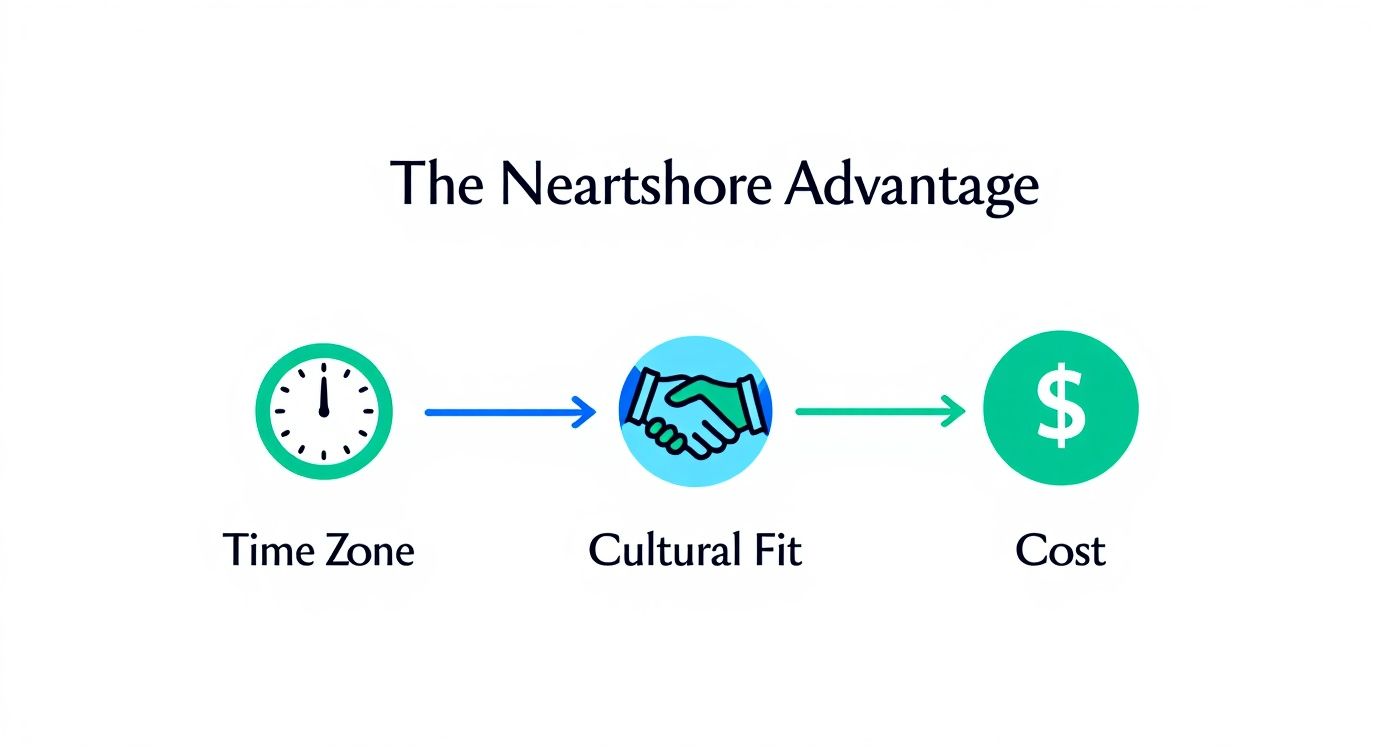
This visual really gets to the heart of the nearshore advantage. It’s not just about one benefit, but how real-time collaboration, cultural understanding, and financial smarts all work together to create a stronger partnership.
Defining Success From Day One
Once you know what you’re handing off, you have to define what a “win” looks like in cold, hard numbers. This is where Key Performance Indicators (KPIs) and Service Level Agreements (SLAs) come in, and they are absolutely non-negotiable. Don’t settle for vague goals. Get specific.
Your SLAs should be granular, detailed, and agreed upon by both sides. They need to cover concrete metrics like:
- Average Handle Time (AHT): For all customer service and claims interactions.
- First Call Resolution (FCR): The percentage of problems you solve the first time a customer reaches out.
- Data Accuracy Rate: Aim for the gold standard—99.5% or higher on data entry.
- Turnaround Time: Hard deadlines for processing claims, endorsements, or policy updates.
Metrics like these create a shared language of expectations and give you an objective way to measure performance. No ambiguity, no excuses.
Creating a Robust Governance Framework
A great partnership doesn’t just happen; it needs a solid governance structure to thrive. This isn’t about micromanaging your partner. It’s about building clear lines of communication, setting a rhythm for check-ins, and having a pre-defined process for tackling issues when they pop up.
Your governance plan is the blueprint for a healthy, long-term partnership. It ensures alignment, transparency, and continuous improvement, turning your outsourcing vendor into a true strategic ally.
This framework should lay out a schedule for weekly performance huddles, monthly strategic reviews, and more formal quarterly business reviews. It’s also critical to keep an eye on the future. Understanding the industry’s readiness for Insurtech 2.0 helps you build a forward-thinking plan that can adapt as the market evolves.
Follow these steps, and you’ll transform insurance process outsourcing from a simple cost-cutting move into a powerful tool for driving efficiency, growth, and a genuinely better customer experience.
Common Questions About Insurance Process Outsourcing
As you start exploring a strategic move like insurance process outsourcing, it’s completely normal for questions to pop up. This isn’t just a small operational change; it’s a big decision that ripples through your team, your customer relationships, and your bottom line. We get it.
To help, we’ve put together some straight-to-the-point answers to the questions we hear most often from insurance leaders. Our goal is to give you the clarity you need to move forward with confidence.
How Is Data Security and Compliance Handled?
This is usually the first question people ask, and for good reason. For any reputable BPO partner, data security isn’t just a checkbox item—it’s woven into the very fabric of their business. They know that a single breach can be catastrophic. The standard is a multi-layered security approach, which includes ironclad adherence to regulations like HIPAA for health information and PCI-DSS for payment card data.
A serious partner will have invested heavily in secure infrastructure. Think end-to-end data encryption, regular security audits by third-party experts, and rigorous, ongoing employee training on privacy protocols. When you’re talking to a potential partner, don’t be shy. Ask to see their compliance certifications and demand a detailed rundown of their cybersecurity measures.
What Is the Typical Transition Timeline?
The timeline for getting up and running with a BPO partner can be anywhere from a few weeks to a couple of months. It really depends on how complex and wide-ranging the processes are that you’re handing off. Any transition worth its salt is broken down into clear, manageable phases to make sure nothing gets missed.
A solid project plan usually looks something like this:
- Discovery and Planning (2–4 weeks): This is where we all get on the same page about goals, KPIs, and the exact scope of work.
- Process Mapping and Training (4–6 weeks): We meticulously document your workflows and get the BPO team trained up to act as a seamless extension of your own.
- Pilot Program (2–4 weeks): Before going all-in, we run a limited-scope launch. It’s the perfect way to spot and iron out any wrinkles.
- Full Launch and Optimization: This is the official go-live, but the work doesn’t stop. We’re constantly monitoring and tweaking things to make sure performance is top-notch.
A quality BPO provider won’t just promise a smooth transition; they’ll show you a detailed project plan with clear milestones so you know exactly what to expect.
Can Smaller Agencies Benefit from Insurance Process Outsourcing?
Absolutely. In fact, small to mid-sized insurance agencies often see the biggest bang for their buck with insurance process outsourcing. It’s a game-changer that levels the playing field, giving them access to enterprise-grade technology, specialized talent, and 24/7 operational power without the crippling upfront investment.
By offloading the administrative grind, smaller agencies can start punching well above their weight. Suddenly, they’re competing head-to-head with the big players on customer service and efficiency. It frees up their core team to do what they do best: sell, underwrite, and build those crucial client relationships that fuel growth.
Ready to Unlock Growth with Nearshore Experts?
At CallZent, we build dedicated nearshore teams that act as a seamless extension of your insurance business. Streamline your operations, cut costs, and deliver exceptional service—without compromise.
Meta Title: Insurance Process Outsourcing: The Smarter Way to Scale Your Insurance Business
Meta Description: Discover how insurance process outsourcing (IPO) cuts costs, boosts speed, and improves customer experience. Learn why nearshore partners like CallZent are redefining insurance operations.
Slug: insurance-process-outsourcing-guide
Ready to unlock a new level of efficiency and growth? At CallZent, we build dedicated nearshore teams that become a true extension of your insurance business. Discover how our tailored solutions can help you save costs and elevate your customer experience.