Skip to content
IT SUPPORT & OUTSOURCING
IT Help Desk Support Services: The Ultimate Guide
Discover the strategic value of IT help desk support services. Learn about support tiers, delivery models, and why nearshoring is the smart choice.
TL;DR — Quick Takeaways
- Modern IT help desk support services are strategic drivers of retention, efficiency, and growth.
- A tiered model (L1, L2, L3) ensures faster resolutions and smarter use of technical talent.
- Nearshore delivery offers the best balance of cost savings, quality, and collaboration.
- Outsourcing IT support frees internal teams to focus on innovation and core business goals.
Is a technical snag with your product the end of the conversation, or the beginning of a stronger customer relationship? That single moment is more than a support ticket—it’s a make-or-break test of their trust in your brand. Modern IT help desk support services have evolved far beyond simple troubleshooting; they are now the strategic core of customer retention and business growth.
Why Top-Tier IT Help Desk Support Is Your Strategic Advantage
Viewing IT support as a line-item expense is a critical mistake in today’s competitive landscape. It’s a core business function that drives revenue and strengthens customer relationships. When executed correctly, your help desk becomes the frontline of your brand promise, transforming moments of user frustration into opportunities for exceptional service.
This shift from a reactive “break-fix” model to a proactive, strategic partnership is essential for businesses of all sizes, from agile e-commerce brands to large healthcare networks. The goal is no longer just solving problems as they appear, but anticipating them, streamlining operations, and ensuring technology empowers your team rather than hindering it.
The Modern Evolution of IT Support
The demand for robust IT support has skyrocketed. The IT help desk software market has seen explosive growth, jumping from 11% usage among companies in 2020 to 53% in recent years. This reflects a major pivot to digital solutions as businesses grapple with support ticket volumes that have swelled by an average of 16% since 2020.
This evolution means today’s most effective IT help desk support services are built on three key pillars:
- Proactive Monitoring: Identifying and resolving potential issues before they impact your users. For example, a managed service provider might notice a server’s memory usage is spiking and fix it before it crashes, preventing downtime for an entire e-commerce site.
- Data-Driven Insights: Analyzing ticket trends to inform smarter business decisions and improve processes. If a SaaS company sees a flood of tickets about a specific feature, they can use that data to improve the user interface in the next update.
- Omnichannel Accessibility: Meeting customers on their preferred channel, whether it’s phone, email, live chat, or social media, for a seamless experience.
Integrating robust IT asset management best practices is also a game-changer, boosting the efficiency and value your help desk delivers.
Nearshore IT Help Desk Support Services: A Powerful Alternative
As the volume and complexity of support tickets climb, many businesses are turning to nearshore solutions. Partnering with a provider in a nearby hub like Tijuana offers a powerful blend of cost savings and top-tier service. Unlike traditional offshore models, nearshoring provides the benefits of cultural alignment and shared time zones, which makes collaboration feel seamless.
The key takeaway is this: Investing in the right IT help desk isn’t just about managing technology; it’s about investing in customer retention, operational excellence, and sustainable growth.
By evaluating your options, you can find the perfect support model to drive efficiency, reduce costs, and build lasting customer relationships. To see how this comes together in practice, you can explore specialized IT help desk solutions designed for the challenges modern businesses face.
Understanding the Tiers of IT Help Desk Support
Not all tech problems are created equal. A forgotten password requires a different approach than a critical server outage, which is why the best IT help desk support services are structured in tiers. Think of it as a hospital’s medical team: this layered system ensures resources are used efficiently, simple issues are resolved quickly, and your top experts are free to tackle the biggest challenges.
You wouldn’t call a heart surgeon for a common cold, and the same logic applies to IT support. A tiered system acts as an intelligent filter, routing each problem to the right specialist without overwhelming your most valuable tech talent with routine requests.
This diagram illustrates how a well-organized IT support system is the foundation for achieving strategic business goals and driving growth.
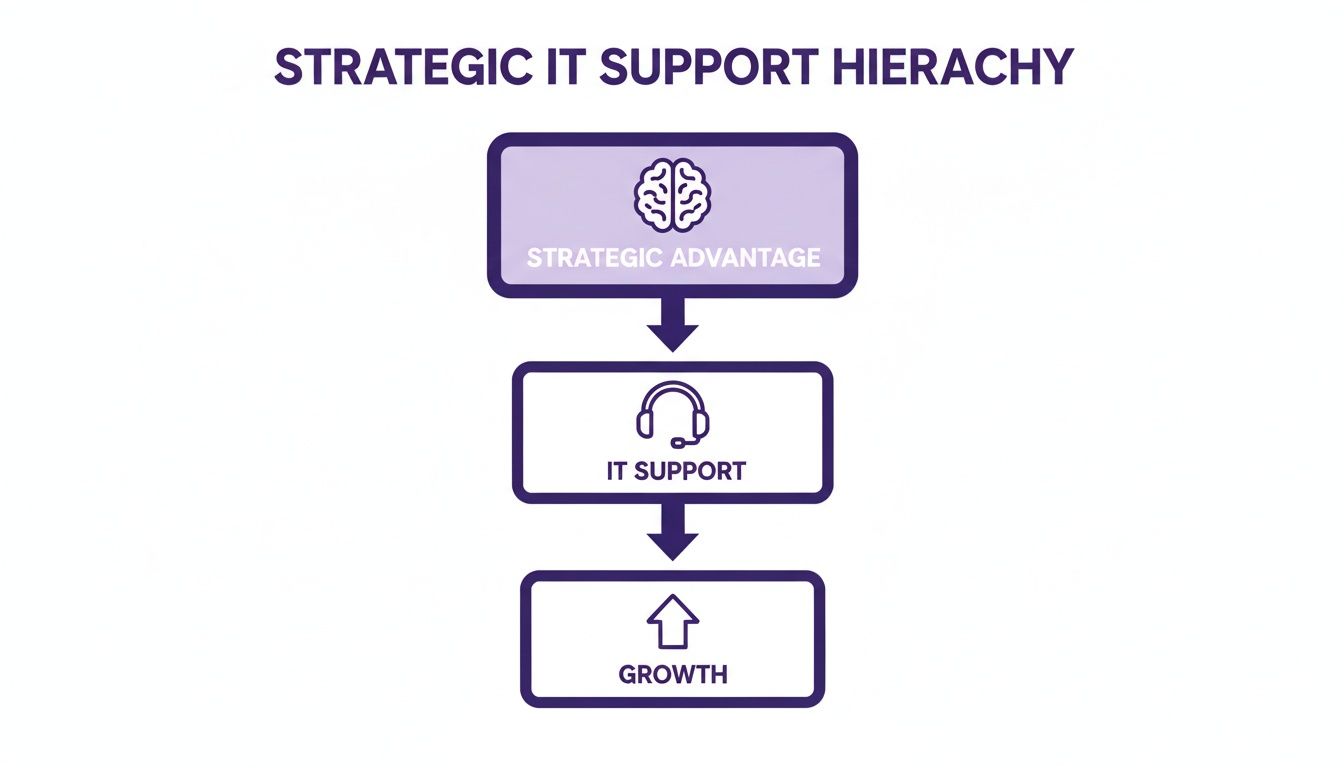
IT support is not just about fixing problems; it’s a central pillar that enables high-level strategic advantages for the entire business.
Tier 1 Support: The First Responders
Tier 1 (T1) support is the front line of your IT help desk. They are the first voice a user hears and the initial point of contact for every inquiry. Think of them as the triage nurses of the tech world, skilled at quickly diagnosing and resolving a high volume of common issues. Their primary goal is to get the user back on track as quickly as possible by gathering key details and solving problems using established scripts and a comprehensive knowledge base.
- Real-World Example: An employee can’t log into the company’s CRM. They contact T1 support. The agent calmly walks them through a password reset and verifies their account permissions, resolving the issue in under five minutes. A strong T1 team can resolve up to 80% of incoming tickets at this first touchpoint.
Here’s what T1 support typically handles:
- Resetting user passwords and unlocking accounts.
- Answering “how-to” questions for standard software.
- Troubleshooting basic hardware and software installation issues.
- Documenting tickets and escalating more complex problems to the next level.
By managing the bulk of routine requests, T1 support provides immediate relief to users and prevents a backlog of simple tickets from reaching more specialized technicians.
Tier 2 Support: The Technical Investigators
When a problem is too complex for T1, it gets escalated to Tier 2 (T2) support. These agents are your technical investigators—technicians with deeper knowledge and more hands-on troubleshooting experience. They take the information gathered by T1 and dig deeper to find the root cause of issues that require more than a scripted solution.
- Real-World Example: An entire department reports they can’t access a shared network drive. The T1 agent gathered the initial reports, but the T2 technician takes over to figure out why. They might check network connectivity, investigate server permissions, or analyze recent system updates to pinpoint the failure.
While many issues are resolved here, some require an even more specialized touch. To get a better sense of these challenges, you can explore some of the most common IT help desk problems and their solutions.
A well-defined escalation path from T1 to T2 is critical. It ensures a seamless handoff, so users never have to repeat their issue, and resolution times remain low.
T2 technicians are also vital for maintaining overall system health. They often document new solutions for the knowledge base, which in turn helps T1 agents resolve similar issues faster in the future.
Tier 3 Support: The Subject Matter Experts
Tier 3 (T3) is the highest level of technical support, composed of subject matter experts. These are your specialist surgeons—the engineers, architects, or senior developers who handle the most critical and complex issues. Problems that reach T3 are often novel, affect multiple systems, or require a code-level analysis to solve.
- Real-World Example: A company-wide software application is experiencing intermittent crashes that T2 technicians can’t diagnose. The ticket moves to T3. This team dives into application logs, debugs the source code, and may work directly with the software vendor to develop a patch. They are the final authority on technical issues, responsible for solving the problems that no one else can.
How to Choose Your IT Help Desk Support Services Model
Deciding how to deliver your IT help desk support services is a critical business decision. Do you build an in-house team, or do you partner with an expert to manage it for you? This choice impacts your budget, customer experience, and ability to scale.
There is no single “right” answer. The best model is the one that aligns with your specific business needs, growth plans, and long-term goals.

Comparing In-House, Offshore, and Nearshore IT Help Desk Support
Each support model comes with unique advantages and disadvantages. Understanding these differences is the first step toward making a smart, strategic choice.
- In-House Support: This classic approach involves hiring and managing your own IT technicians. You get complete control over culture and processes, but it is by far the most expensive option when you factor in salaries, benefits, office space, and continuous training.
- Offshore Outsourcing: This involves partnering with a provider in a distant country. The primary draw is significant cost reduction. However, the trade-offs can be substantial, including major time zone differences, cultural disconnects, and language barriers that can frustrate customers.
- Nearshore Outsourcing: This model offers a powerful balance. You partner with a provider in a neighboring country, like CallZent in Tijuana. It combines the cost-effectiveness of outsourcing with the close collaboration of an in-house team.
The strategic advantage of nearshoring lies in its ability to deliver the ‘best of both worlds’—substantial cost savings without sacrificing quality, collaboration, or cultural alignment.
For a growing number of North American businesses, the choice is clear. When you explore the benefits of outsourcing to a nearshore partner, you discover a path to high-quality, scalable support that feels like an extension of your own team.
Real-World Scenarios and Solutions for Your IT Help Desk
Let’s see how these models apply to different businesses:
- The E-commerce Startup: Needs 24/7 support for a global customer base but lacks the capital for a large in-house team. An offshore model seems cheap, but the risk of communication breakdowns during a Black Friday sale is too high. A nearshore IT help desk support services partner provides round-the-clock coverage with culturally aligned agents who can handle customer issues smoothly.
- The Mid-Sized Financial Firm: Requires iron-clad data security and needs their support team to work in lockstep with compliance. An in-house team offers control but at a prohibitive cost. A nearshore partner in Tijuana provides dedicated, highly trained agents who follow strict security protocols and work the same business hours, delivering in-house-level control at a fraction of the cost.
- The Large Healthcare Provider: Navigates complex HIPAA regulations and needs bilingual agents for a diverse patient population. Recruiting specialized, bilingual talent locally is difficult and expensive. Nearshoring provides instant access to a deep pool of fluent English and Spanish speakers already trained in healthcare compliance.
Why Nearshoring is a Leading IT Support Solution
The trend toward outsourcing IT support is a core strategy for modern businesses. In fact, 50% of organizations already outsource some or all of their IT services, and 91% plan to maintain or increase that level.
Nearshoring to Latin America has become a game-changer. LATAM shared service outsourcers run IT processes at double the global rate (64% vs. 32%). The reasons are clear: shared time zones, lower agent turnover, and a naturally bilingual workforce. You can read the full research on help desk outsourcing trends to get the complete picture. This isn’t just a trend; it’s a fundamental business shift.
The Real-World Benefits of Outsourced IT Support
The decision to outsource your IT help desk comes down to one thing: tangible results. Partnering with a specialized provider of IT help desk support services isn’t just about offloading tasks; it’s a strategic move that delivers measurable outcomes across your entire business.
Many leaders fear that outsourcing means losing control. In reality, you’re gaining a dedicated partner focused on operational excellence, freeing your internal teams to concentrate on core business growth.

Significant Cost Reduction
One of the most immediate benefits of outsourcing is a dramatic reduction in operational costs. Building an in-house IT support team is a major financial commitment. Outsourcing converts these high, unpredictable fixed costs into a single, manageable operational expense.
Consider the true cost of an internal team:
- Salaries and Benefits: Competitive pay, health insurance, retirement plans, and paid time off.
- Recruitment and Training: The endless cycle of hiring, onboarding, and training new technicians.
- Infrastructure and Technology: Office space, hardware, software licenses for ticketing systems, and ongoing maintenance.
A nearshore partner removes these burdens. For example, a mid-sized software company can save up to 60% on labor costs by partnering with a provider in Tijuana, all while gaining access to a larger, more flexible team.
Enhanced Operational Efficiency with IT Help Desk Support Services
Outsourcing brings a level of efficiency that is difficult for most in-house teams to match. Specialized BPOs live and breathe support. Their entire business is built around resolving issues quickly and effectively, with investments in advanced ticketing systems, proven workflows, and continuous agent training.
This focus leads directly to better performance. An expert partner is obsessed with achieving a high First-Call Resolution (FCR) rate, solving more issues on the first contact. This improves customer satisfaction and prevents simple problems from escalating. Learning more about the advantages of outsourced IT support services can clarify the potential gains.
Outsourcing your IT help desk isn’t about giving up control; it’s about gaining a strategic partner dedicated to your operational excellence and customer satisfaction.
24/7 Availability and Support
In our always-on world, technical problems don’t wait for business hours. An outage at 2 a.m. can be just as damaging as one at 2 p.m. Providing true 24/7/365 support with an in-house team is a logistical and financial nightmare.
Outsourcing makes round-the-clock availability an affordable reality. A nearshore partner can seamlessly cover after-hours, weekends, and holidays, ensuring your customers and employees always have a lifeline. This continuous availability is a critical competitive advantage that builds trust and loyalty.
Access to Specialized Expertise
No single in-house team can be an expert in everything. Technology evolves rapidly, and keeping staff trained on every new application, security threat, and hardware update is a constant challenge. When you outsource, you instantly tap into a deep and diverse talent pool.
A quality BPO partner has teams of specialists with experience across countless industries and technologies. Whether you need support for proprietary software, cloud infrastructure, or specific compliance standards like HIPAA, an expert provider has that expertise ready. This gives even small businesses access to enterprise-grade knowledge without the massive upfront investment.
How to Choose the Right IT Help Desk Partner
Selecting the right partner for your IT help desk support services is more like choosing a business co-founder than hiring a vendor. This decision impacts everything from customer satisfaction to your bottom line. The right partner becomes a true extension of your team, invested in your success. The wrong one creates friction and drains resources.
The Technical Capabilities Checklist for an IT Help Desk Partner
Before discussing culture or strategy, you must confirm a potential partner has the foundational technology to meet your needs.
Start by evaluating their technical infrastructure:
- Omnichannel Support: Can they handle inquiries from phone, email, chat, and social media with a consistent, seamless experience?
- Robust Ticketing Software: Ask for a demo. A powerful ticketing system is essential for tracking issues, managing escalations, and gathering data for process improvement.
- Strong Security Protocols: This is non-negotiable, especially in sensitive industries. Ask directly about their compliance with standards like PCI DSS or HIPAA. A transparent provider will readily share their security measures and certifications.
Beyond the Tech: Soft Skills and Strategy
Technical skills are only half the equation. A partner with a great tech stack will fail if their team isn’t motivated or their strategy doesn’t align with yours. The vetting process is similar to following the steps to building a successful partnership with a tech vendor.
Look for these crucial strategic and cultural signs:
- Cultural Fit and Agent Training: How do they recruit, train, and retain their agents? A provider that invests in an agent-first culture will have lower turnover, meaning more experienced, dedicated agents for your customers.
- Transparent Reporting: How will you measure success? A top-tier partner will define key performance indicators (KPIs) with you and deliver clear, consistent reports on performance.
- Proven Scalability: Can they grow with you? Ask for case studies or specific examples of how they’ve helped other clients scale during busy seasons or periods of rapid growth.
A forward-thinking partner doesn’t just close tickets. They analyze trends and bring you strategic insights that help you improve your products, your services, and your entire customer experience.
To truly understand a provider, ask the right questions. Go beyond the sales pitch with our guide on how to find and vet the best call center outsourcing companies.
Asking direct questions like, “What specific steps do you take to empower your agents and reduce turnover?” or “Can you walk me through a case study from a client with challenges similar to ours?” provides invaluable insight. At CallZent, we welcome these conversations. Our agent-centric culture and collaborative strategy set us apart, allowing us to deliver a custom-fit service that hits every essential mark.
Ready to Elevate Your IT Support?
You are serious about transforming your IT support from a cost center into a strategic advantage. We’ve covered the support tiers, delivery models, and what to look for in a partner. The path forward is clear.
Investing in the right IT help desk support services is a direct investment in your customer retention, operational efficiency, and long-term growth. Every resolved ticket builds your brand’s reputation and frees up your internal team to focus on innovation. Now is the time to turn knowledge into action.
The biggest leap is always from learning to doing. A great strategy is one thing, but a well-executed partnership is what delivers real-world results and gives you a tangible edge over the competition.
It’s Time to Act
Don’t get stuck in “analysis paralysis.” An expert, empowered support team is a core part of doing business well.
We invite you to take the next step. Let’s move from theory to a practical solution built around your specific business challenges and goals. A nearshore partnership can deliver the high-quality, cost-effective advantage you’ve been looking for.
Schedule Your Consultation
Let’s build a solution that works for you. Contact CallZent today to schedule a no-obligation consultation. We’ll listen to your needs, discuss your goals, and show you exactly how our nearshore IT help desk support services can elevate your customer experience and drive your business forward.
Frequently Asked Questions
When exploring IT help desk support services, a few questions consistently arise. Here are the answers you need to make an informed decision.
What Is the Difference Between a Help Desk and a Service Desk?
Think of a help desk as your IT firefighter. It’s a tactical team focused on putting out immediate fires—a user can’t log in, a printer is offline. It’s reactive and focused on break-fix solutions.
A service desk is more like the fire marshal. It’s strategic and proactive. It includes all help desk functions but also manages the bigger picture: handling service requests, managing IT changes, and aligning technology with long-term business goals. It’s about improving the entire user experience, not just fixing a single ticket.
How Do I Measure the ROI of Outsourcing My IT Help Desk?
Measuring the return on your investment goes beyond a lower monthly bill. The real value appears in financial and operational wins across your business.
Track your ROI through improvements in these key areas:
- Reduced Operational Costs: Sum the savings on salaries, benefits, office space, and software licenses.
- Improved First-Call Resolution (FCR): More issues solved on the first call means fewer escalations and less wasted time—a direct boost to efficiency.
- Decreased Ticket Resolution Times: Faster ticket resolution means less downtime and more productivity for your team.
- Higher Customer Satisfaction (CSAT): Happy users are productive users. Better CSAT scores are a clear sign of improved loyalty and retention.
Is a Nearshore Help Desk Secure Enough for Sensitive Data?
Absolutely. For any reputable provider of IT help desk support services, especially in the nearshore space, data security is the foundation of their business. Top-tier partners like CallZent earn trust by protecting your data obsessively.
Our operations are built around comprehensive security measures, including strict adherence to industry standards like HIPAA and PCI DSS, secure data centers, and rigorous, ongoing agent training on data privacy and security protocols.
How Long Does It Take to Onboard with an Outsourced Provider?
A typical onboarding process takes just a few weeks. The goal is a smooth, seamless transition with zero disruption to your daily operations.
Our professional onboarding process includes:
- Discovery: We gain a deep understanding of your needs, workflows, and goals.
- Strategy Development: We build a customized support plan and agree on key performance indicators (KPIs).
- Agent Training: Our team receives intensive training on your products, services, and brand voice.
- Systems Integration: We seamlessly integrate our technology with your existing platforms.
At CallZent, we use a highly collaborative approach, keeping you informed and confident every step of the way.
🚀 Ready to Elevate Your IT Support?
Turn your IT help desk into a strategic growth engine with CallZent’s nearshore expertise.
Ready to turn your IT support from a cost center into a strategic asset? CallZent creates custom-fit, nearshore IT help desk solutions that cut costs, drive efficiency, and make your customers happier. Let’s build a support system that actually moves your business forward.