Skip to content
Customer Experience · Performance Metrics
Customer Service KPIs: How
to Measure What Actually Drives Growth
The most successful companies don’t just track customer service KPIs — they use them to tell a story about customer behavior, operational health, and future growth. This guide shows you which KPIs matter, why they matter, and how to use them strategically.
TL;DR — Key Customer Service KPIs That Matter
- Customer KPIs: CSAT, NPS, and Churn predict loyalty and long-term growth.
- Efficiency KPIs: FCR, AHT, and Resolution Time measure speed and effectiveness.
- Financial KPIs: Cost Per Contact ties support performance to profitability.
- Strategy Wins: The right KPIs turn customer service into a growth engine — not a cost center.
Are you actually measuring what matters in your customer service, or are you just collecting numbers? The most successful companies know the difference. They don’t just track customer service KPIs—they use them to tell a story about their customers and write the next chapter of their growth.
In short, Key Performance Indicators (KPIs) are the specific, measurable values that show you exactly how well your support team is performing against your most important business objectives.
Why Customer Service KPIs Are Your Ultimate Growth Engine
Think of your business as a high-performance car. Sales and revenue are the fuel, but KPIs in customer service are the gauges on your dashboard. They tell you everything you need to know about your engine’s health, from its temperature (agent efficiency) to the tire pressure (customer satisfaction).
Driving without them? It’s like flying blind. You might move forward for a bit, but you’re heading for a breakdown.
Getting a handle on these metrics is non-negotiable for any business that wants to scale. When you partner with a nearshore call center like CallZent, we don’t just handle contacts; we dig into the data behind every single interaction to find strategic ways to improve. This approach turns customer service from a cost center into a true engine for growth.
TL;DR Key Customer Service KPIs to Watch
Need the highlights? Here’s a quick rundown of the essential KPIs we’ll break down in this guide. Each one gives you a unique window into your operations and the health of your customer relationships.
- Customer-Focused KPIs: These are all about sentiment and loyalty. Think Customer Satisfaction (CSAT), Net Promoter Score (NPS), and Customer Churn.
- Operational Efficiency KPIs: These track your team’s speed and effectiveness. We’re talking First Contact Resolution (FCR), Average Handle Time (AHT), and Resolution Time.
- Financial KPIs: These tie your service efforts directly to the bottom line, with metrics like Cost Per Contact leading the charge.
“What gets measured gets managed. If you can’t measure it, you can’t improve it.”
This simple idea is the bedrock of any world-class support strategy. By tracking the right KPIs, you get the clarity you need to make smarter decisions, cut operational costs, and build a customer base that’s fiercely loyal.
The connection between great service and a stellar overall experience is undeniable. For a deeper look, check out our guide on the key differences between customer service vs. customer experience. Each KPI is a piece of a much larger puzzle, helping you fine-tune your process and deliver excellence every time.
Tracking the Foundational KPIs for Customer Loyalty
While operational numbers tell you how busy your team is, the most critical KPIs in customer service measure something far more valuable: how your customers feel. These are the metrics that don’t just reflect past performance but actively predict future loyalty and growth. They’re the pulse of your customer relationships.
At the top of this list are two powerhouse KPIs: Customer Satisfaction (CSAT) and Net Promoter Score (NPS). They work in tandem, giving you both a real-time snapshot and a long-term forecast of customer sentiment. Mastering these is the first step toward building a base of fiercely loyal advocates for your brand.

Unpacking Customer Satisfaction (CSAT)
Think of CSAT as an immediate pulse check. It’s a simple, direct question asked right after an interaction: “How satisfied were you with the support you received today?” The answer, usually on a 1-5 scale, tells you how effectively you solved a customer’s immediate problem.
This isn’t just about making one person happy; it’s about validating the quality of your entire service process at that moment. A high CSAT score shows that your agents are well-trained, your processes are smooth, and your customers feel heard.
The Customer Satisfaction Score is a vital KPI for gauging how well your service meets expectations. It’s no surprise that by 2026, 31% of business leaders are expected to rank CSAT as their top customer experience metric due to its direct link to loyalty. Hitting a score above 80% signals excellence, and for leading companies, this often translates to an 88% higher likelihood of repurchasing after a positive experience. You can explore more about future CX trends in this 2026 forecast.
How CSAT Plays Out in the Real World
Imagine an e-commerce customer who receives a damaged product. They contact your support team, frustrated and ready for a difficult conversation. Instead, they connect with a highly-trained, empathetic bilingual agent from a nearshore partner like CallZent.
The agent quickly verifies the order, apologizes sincerely, and immediately processes a replacement—no complicated return process needed. At the end of the chat, the customer gets a CSAT survey and gives the experience a “5 – Very Satisfied.”
Why? Because the agent turned a negative situation into a positive, effortless one. This is the power of CSAT in action; it isolates the impact of a single interaction, showing you precisely where your team shines.
High CSAT scores are not just feel-good numbers; they are a leading indicator of repeat business. A satisfied customer today is far more likely to be a returning customer tomorrow.
Gauging Brand Advocacy with Net Promoter Score (NPS)
While CSAT measures satisfaction with a single interaction, Net Promoter Score (NPS) zooms out to measure overall brand loyalty. It asks the ultimate question: “On a scale of 0-10, how likely are you to recommend our company to a friend or colleague?”
This single question sorts your customers into three distinct groups:
- Promoters (9-10): Your brand champions who fuel growth through word-of-mouth.
- Passives (7-8): Satisfied but unenthusiastic customers who are vulnerable to competitors.
- Detractors (0-6): Unhappy customers who can damage your brand through negative reviews.
Your NPS is calculated by subtracting the percentage of Detractors from the percentage of Promoters. The resulting score, which can range from -100 to +100, is a powerful predictor of future growth. A rising NPS suggests your customer experience strategy is working and creating long-term value.
Improving this score requires a consistent, high-quality approach across every touchpoint. For detailed strategies on turning detractors into promoters, you can explore our guide on how to improve Net Promoter Score. Understanding and acting on this feedback is absolutely essential for sustainable business health.
Measuring Efficiency with Your Call Center KPIs
Customer loyalty is built on good feelings, but those feelings are often the direct result of a well-oiled operational machine. While sentiment KPIs like CSAT and NPS tell you how customers feel, efficiency KPIs measure how quickly and effectively your team delivers the solutions that create those positive feelings.
Mastering these metrics is the key to providing service that’s not just exceptional, but also sustainable and cost-effective.
First Contact Resolution: The Gold Standard KPI in Customer Service
First Contact Resolution (FCR), sometimes called “one-touch resolution,” is arguably the most important operational KPI. It measures the percentage of customer issues resolved during the very first interaction—no follow-up calls, emails, or escalations needed.
Put yourself in the customer’s shoes. Nothing is more frustrating than having to explain your problem over and over again to different agents. A high FCR rate means you’re not just solving problems, but also removing friction and frustration from the customer journey.
Industry benchmarks put the average FCR rate around 70-75%. But top-performing teams, especially those with advanced agent training and robust knowledge bases, often hit 85% or higher. This is a big deal, as nearly 50% of consumers say FCR is one of the most important parts of a good support interaction. It has a direct line to building trust and loyalty.
A high FCR rate is a win-win. Customers are happier because their issue is solved instantly, and your business saves money by reducing the number of repeat contacts.
Average Handle Time: Finding the Right Balance
Average Handle Time (AHT) tracks the average length of a customer interaction, from the moment an agent picks up to the second all post-call work is finished. This includes talk time, hold time, and any after-call work like logging notes or sending follow-up emails.
There’s a common myth that the goal is always to slash AHT. While efficiency matters, rushing an agent can lead to unresolved issues, unhappy customers, and a nosedive in your FCR and CSAT scores. The real goal isn’t speed for speed’s sake; it’s effectiveness.
- What a low AHT might mean: Your agents are incredibly efficient, your processes are streamlined… or agents are rushing calls and not fully resolving issues.
- What a high AHT might mean: The issues are complex, agents need more training… or they’re building great rapport and solving problems thoroughly.
The secret is to look at AHT alongside other KPIs. If AHT goes down while CSAT and FCR go up, your team is getting more efficient. But if AHT drops and FCR follows, you’ve got a quality problem on your hands. To get a deeper look, many ops leaders use tools like AI-powered transcription software to analyze calls for quality and completeness.
Resolution Time: Tracking the Full Journey
While AHT measures a single touchpoint, Resolution Time measures the entire lifecycle of a customer issue, from the moment a ticket is created until it’s fully closed. This is especially vital for complex problems in fields like tech support or financial services, where a fix might involve multiple steps, escalations, or input from different departments.
For instance, a customer reports a software bug. The clock on Resolution Time starts ticking and continues through:
- The first agent’s troubleshooting attempts.
- An escalation to a Tier 2 technical team.
- The engineering team’s investigation.
- The final message back to the customer confirming the fix is live.
Tracking this KPI helps you pinpoint bottlenecks in your support workflow. A long Resolution Time might not be a single agent’s fault; it could point to slow handoffs between teams or clunky internal processes. Getting these metrics right is also a core part of any solid service agreement. You can dive deeper into these crucial service level agreement metrics and performance indicators.
Choosing the Right KPIs for Your Business Goals
It’s tempting to track every metric under the sun. More data, more insights, right? Not quite. In reality, that’s one of the most common mistakes we see businesses make—it just creates noise and paralyzes your team with information overload.
The most powerful KPIs in customer service are the ones that directly answer your biggest strategic questions. Are you focused on scaling as fast as possible? Trying to tighten up profitability? Or is your main mission to build unbreakable customer trust? Your answer changes everything.
Think of it like a crossroads. A common one is deciding whether to prioritize getting the issue solved on the first try (FCR) or keeping the interaction time low (AHT). This decision tree shows that fork in the road.
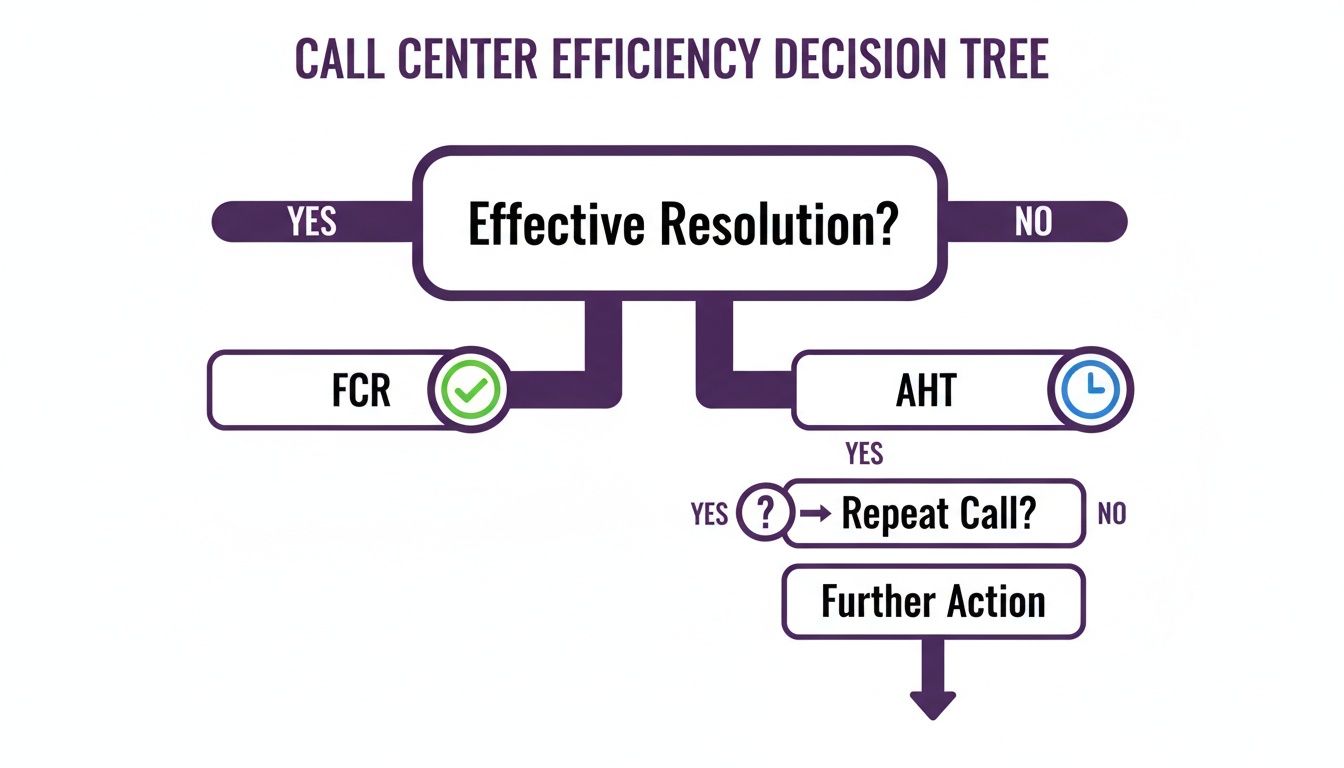
Ultimately, the goal is always an effective resolution. That makes FCR the North Star for success, while AHT acts as a secondary check on efficiency.
Aligning KPIs With Your Growth Stage
Where your company is on its journey should dictate which metrics you obsess over. A startup scrambling for market share has totally different priorities than an established enterprise defending its turf. Let’s break it down with some real-world examples.
- For the Growth-Focused Startup: The name of the game is acquiring users and turning them into loyal fans. You need metrics that predict long-term loyalty and word-of-mouth marketing.
- Net Promoter Score (NPS): This is your brand advocacy meter. It tells you how likely you are to grow organically through referrals from happy customers.
- Customer Churn Rate: You need to know how many customers are walking out the door. Keeping churn low is absolutely essential for sustainable growth.
- For the Profitability-Driven E-commerce Brand: An established online store wants to protect its margins and run a tighter ship. The focus shifts from pure growth to cost control and service effectiveness.
- Cost Per Contact: This directly measures how much you’re spending on every single customer interaction, making it easy to spot areas for savings.
- First Contact Resolution (FCR): A high FCR is a double-win. It cuts down on repeat calls—slashing operational costs—and makes customers happier at the same time.
- For the Trust-Reliant Healthcare Provider: In an industry like healthcare, patient trust and confidence are non-negotiable. Your KPIs have to reflect reliability, accuracy, and empathy.
- Customer Satisfaction (CSAT): This gives you an immediate pulse check on how a patient feels after an interaction, ensuring quality of care.
- Resolution Time: When dealing with complex medical or billing questions, the total time to a complete resolution is critical for a patient’s peace of mind.
Your business goals are the question. Your KPIs are the answer. If your metrics don’t align with your goals, you’re answering the wrong question.
A Framework for Selecting Relevant KPIs in Customer Service
To make this even more straightforward, you can map your core business objectives directly to the KPIs that best measure them. This framework gets your team laser-focused on moving the needles that actually matter to the entire organization.
The table below is a simple guide to connect your strategic goals with the most impactful KPIs in customer service.
Mapping KPIs to Your Strategic Business Goals
| Business Goal | Primary KPIs to Track | Why It Matters |
|---|---|---|
| Increase Customer Loyalty | NPS, CSAT, Customer Churn Rate | These metrics are a direct line into customer sentiment and tell you how likely they are to stick with you for the long haul. |
| Improve Operational Efficiency | FCR, AHT, Agent Utilization Rate | Tracking these helps you cut the fluff from your processes, reduce wasted effort, and manage your team’s workload effectively. |
| Reduce Operational Costs | Cost Per Contact, FCR, Ticket Volume by Channel | Focusing here allows you to optimize how you spend your resources, lower the cost of each interaction, and find smart ways to save. |
| Enhance Brand Reputation | NPS, CSAT, Social Media Mentions | These indicators reflect how the public sees you and how positive service experiences translate into a stronger brand image. |
When you take a goal-oriented approach, your KPI dashboard stops being a static report and becomes a dynamic roadmap to success. It ensures every single action your customer service team takes is a deliberate step toward achieving your company’s biggest objectives. This is the kind of strategic alignment we build into every partnership here at CallZent.
Building a Powerful Customer Service KPI Dashboard
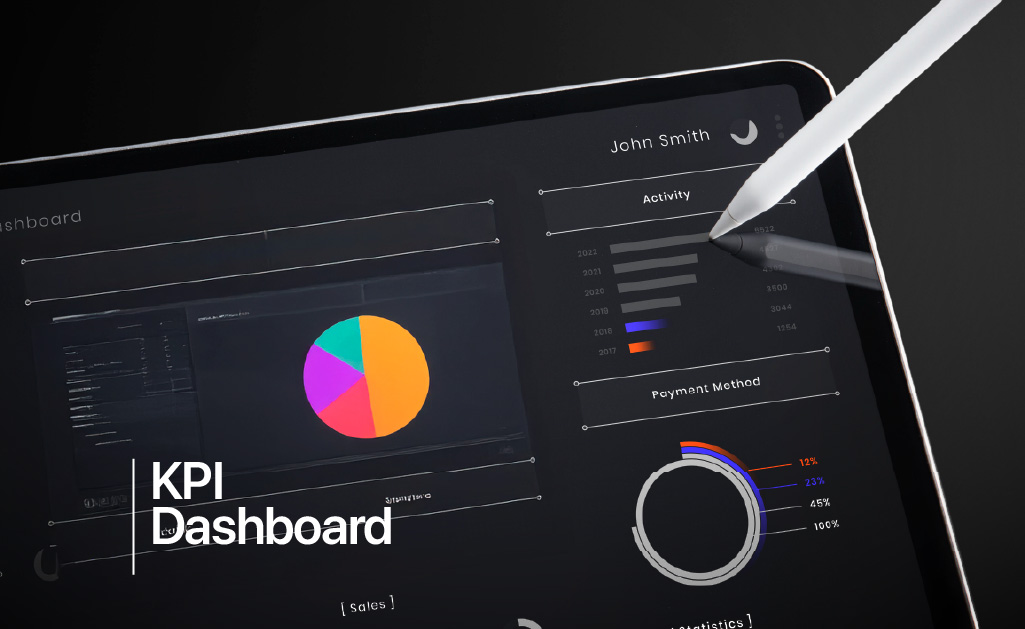
Raw data is just a pile of numbers. A well-built dashboard, on the other hand, turns those numbers into a clear, actionable story about how your customer service is really performing. It’s the difference between staring at a spreadsheet and seeing a live map of your customer experience, complete with signposts pointing you toward what to fix next.
An effective dashboard doesn’t just list your KPIs in customer service; it brings them to life visually, letting anyone grasp what’s happening in a single glance. The goal is to make complex data instantly digestible.
From Raw Data to Actionable Insights
The real magic of a great dashboard is its ability to reveal what’s hiding beneath the surface. Knowing your overall CSAT is 85% is nice, but it doesn’t tell you why it’s 85%. The power comes when you slice up that data to uncover the real story.
When you start breaking down your KPIs, you can ask smarter questions and get answers that actually mean something.
- Segment by Channel: Is your CSAT higher on live chat than email? Maybe your email templates need a refresh, or the team needs better training. To see this clearly, you need tools with strong Whatsapp analytics and reporting features feeding channel-specific data right into your dashboard.
- Segment by Agent: Does one agent consistently nail a higher First Contact Resolution (FCR) rate? Their approach could become the new gold standard for training the rest of the team.
- Segment by Customer Type: Are your enterprise clients waiting longer for resolutions than your SMB customers? That might signal it’s time to create a dedicated support tier for your high-value accounts.
A dashboard should provoke action, not just admiration. If your metrics don’t lead to questions and strategic conversations, they are just decorations.
The Importance of Real-Time Reporting
In customer service, yesterday’s data is ancient history. A sudden spike in ticket volume or a dip in satisfaction needs to be handled now, not reviewed in next week’s meeting. This is where real-time reporting becomes a non-negotiable.
Live dashboards give you the agility to make smart decisions on the fly. When a manager sees the call queue ballooning, they can immediately pull agents from email to help on the phones. If CSAT scores plummet right after a product launch, the team can jump on investigating bugs or user confusion without delay.
This level of transparency is the bedrock of a strong partnership between a business and its nearshore support team. At CallZent, we build custom dashboards that give our clients a live, transparent window into their operations. It’s not just about sending you numbers; it’s about creating a true partnership grounded in shared data and common goals. To learn more about our approach, check out our in-depth guide to call center reporting and metrics dashboards.
This collaborative way of working ensures we’re always on the same page, turning insights into immediate action that strengthens your customer relationships and moves your business forward.
Actionable Strategies to Improve Your KPIs
Knowing your numbers is just the starting line. The real win comes from making those numbers better. Moving from simply tracking your KPIs in customer service to actively improving them means putting your agents front and center. This is where the data meets the real world, turning insights into happier customers and a smoother operation.
Improving key metrics isn’t about pushing agents to work faster; it’s about empowering them to work smarter. When you invest in great coaching, the right tools, and cleaner workflows, you build an environment where peak performance just happens naturally.
Boosting CSAT and NPS Scores
If you want to improve customer satisfaction (CSAT) and loyalty (NPS), you have to listen carefully to what your customers are telling you and then actually do something about it. The most direct way to do this is with post-interaction surveys that capture feedback right in the moment. This isn’t just about getting a score; it’s about digging into the “why” behind it.
Use this feedback to fuel targeted agent coaching. Did a customer leave a low score because they misunderstood a company policy? That’s a perfect training opportunity. Did an agent get a perfect 10? Break down that interaction and share it as a model for the rest of the team. You can explore proven call center coaching techniques to see how turning feedback into growth works in the real world.
Driving Up First Contact Resolution
A high First Contact Resolution (FCR) rate is a direct reflection of how empowered your agents are. When agents have the autonomy to solve problems without needing a manager to sign off on every little thing, they can close tickets right then and there.
To improve FCR, give your agents two things: the right tools and the trust to use them. A robust internal knowledge base and a well-integrated CRM are their best allies.
For example, a retail client we work with saw their FCR take a hit during the chaotic holiday season because of complex return questions. We stepped in and gave our bilingual support team extra training on their specific return logistics and more authority to process exchanges on the spot. The result? They boosted their FCR by 15% in a single month, turning frustrated shoppers into loyal customers.
Lowering AHT Without Sacrificing Quality
The goal with Average Handle Time (AHT) is to cut it down by removing roadblocks, not by rushing conversations. Streamlining your internal workflows is the key. Even simple automations, like having your CRM auto-populate customer details, can shave precious seconds off every single call. Those seconds add up fast.
This gives your agents more mental energy to focus on what really matters—solving the customer’s problem—instead of getting bogged down in repetitive admin tasks.
Got Questions About Customer Service KPIs? We’ve Got Answers.
Even with the best game plan, questions pop up. It’s natural. When you start digging into the data, you want to be sure you’re on the right track. Here are some clear, straightforward answers to the questions we hear most often.
What’s the Real Difference Between a Metric and a KPI?
Think of it like this: a metric is any number you can track. The total number of calls your team fields in a day? That’s a metric. It’s useful information, for sure.
A KPI, on the other hand, is a metric you’ve hand-picked because it tells you if you’re winning at a specific business goal. First Contact Resolution (FCR) is a classic KPI because it directly measures your strategic goal of providing efficient, effective service.
The takeaway? All KPIs are metrics, but you only give the “KPI” title to the metrics that truly matter to your mission.
How Often Should We Be Looking at Our KPIs?
This isn’t a one-size-fits-all answer. Your review cadence really depends on what you’re measuring.
Operational metrics that change quickly—like daily call volume or Average Handle Time (AHT)—need to be on a real-time or daily dashboard. These are your early warning signals for staffing gaps or sudden technical issues.
But for your big-picture, strategic KPIs like CSAT and NPS, a weekly or monthly review is perfect. This gives you enough data to spot meaningful trends in customer health without getting lost in the daily noise. Save the quarterly reviews for stepping back and making major strategy adjustments.
We’re a Small Business. Which KPIs Should We Actually Focus On?
When you’re a small business, focus is your superpower. You can’t track everything, so you have to track the right things. We always recommend starting with this powerful trio:
- Customer Satisfaction (CSAT): This gives you an immediate, gut-check pulse on how customers feel about individual interactions. It’s your direct line to service quality.
- First Contact Resolution (FCR): This is all about efficiency and reducing customer effort. Are you solving problems on the first try? This KPI tells you.
- Net Promoter Score (NPS): While CSAT is transactional, NPS looks at the bigger picture of long-term loyalty and your potential for word-of-mouth growth.
Together, these three give you a surprisingly balanced view of customer sentiment, operational effectiveness, and the overall health of your brand.
How Can a Nearshore Partner Like CallZent Actually Improve My KPIs?
This is where the magic happens. Partnering with a specialized nearshore call center isn’t just about outsourcing calls; it’s about importing expertise, proven processes, and advanced tech that directly move the needle on your most important numbers.
At CallZent, we improve scores by bringing in highly-trained, bilingual agents who are experts at boosting FCR and CSAT. We implement smarter workflows that drive down AHT and resolution times. And by offering 24/7 coverage, we can slash your response times and eliminate backlogs. It’s how we help turn your customer service from a cost center into a strategic asset that drives growth.
Frequently Asked Questions About Customer Service KPIs
1. What are customer service KPIs?
They are measurable indicators that show how well your support team meets business and customer experience goals.
2. What are the most important customer service KPIs?
CSAT, NPS, FCR, AHT, Resolution Time, and Cost Per Contact.
3. How often should KPIs be reviewed?
Operational KPIs daily; strategic KPIs weekly or monthly.
4. What KPI matters most for customer loyalty?
NPS and CSAT.
5. What KPI reduces support costs?
First Contact Resolution.
6. Is AHT still relevant?
Yes — but only when balanced with quality KPIs.
7. Can small businesses use KPIs?
Absolutely. Focus on CSAT, FCR, and NPS.
8. What tools are used to track KPIs?
CRM platforms, QA tools, speech analytics, and dashboards.
9. How do KPIs improve revenue?
By reducing churn, increasing loyalty, and lowering service costs.
10. How does CallZent help improve KPIs?
Through trained bilingual agents, real-time reporting, and KPI-driven coaching.
Turn Your Customer Service KPIs Into Growth
CallZent helps businesses turn customer service data into strategic action. From KPI dashboards to high-ddddperformance nearshore teams, we help you move the metrics that matter.
Ready to transform your customer service from a cost center into a growth engine? The team at CallZent leverages two decades of experience to help businesses like yours master their KPIs and build lasting customer loyalty. Learn more about our approach.