Skip to content
Lead Generation & Revenue Growth
Lead Generation for Technology Companies: A Scalable Pipeline Blueprint
Is your current lead generation strategy keeping up with the breakneck speed of the tech industry?
This guide breaks down how modern technology companies build scalable, predictable pipelines by
blending automation, AI, and skilled human follow-up.
TL;DR: Your Modern Blueprint for Tech Lead Generation
Successful lead generation for technology companies is no longer about volume—it’s about systems.
The most effective pipelines combine omnichannel visibility (SEO + LinkedIn), AI-driven automation for
intent detection and nurturing, and expert human qualification. This blended model delivers scalable,
cost-effective, and predictable revenue growth.
- Be Everywhere They Are: Engage buyers through LinkedIn, SEO, and high-value content.
- Embrace Smart Automation: Score, personalize, and nurture leads at scale.
- Double Down on Human Expertise: Complex tech deals still close through real conversations.
Before diving deeper, it helps to clarify the fundamentals of lead generation marketing
.Is your current lead generation strategy keeping up with the breakneck speed of the tech industry? For most, the answer is a resounding “no.” The old playbook of casting a wide net and hoping for the best just doesn’t cut it anymore. A modern approach is about building a scalable engine that merges slick automation with a skilled human touch to create a predictable pipeline of high-value leads.
Before diving deeper, it’s worth getting a clear handle on What is Lead Generation Marketing. Nailing down this foundation is the first step to building a more sophisticated, effective strategy.
The Core Pillars of Lead Generation for Technology Companies
The best way to think about modern lead generation is as a continuous flow, fine-tuned to maximize both efficiency and conversions.
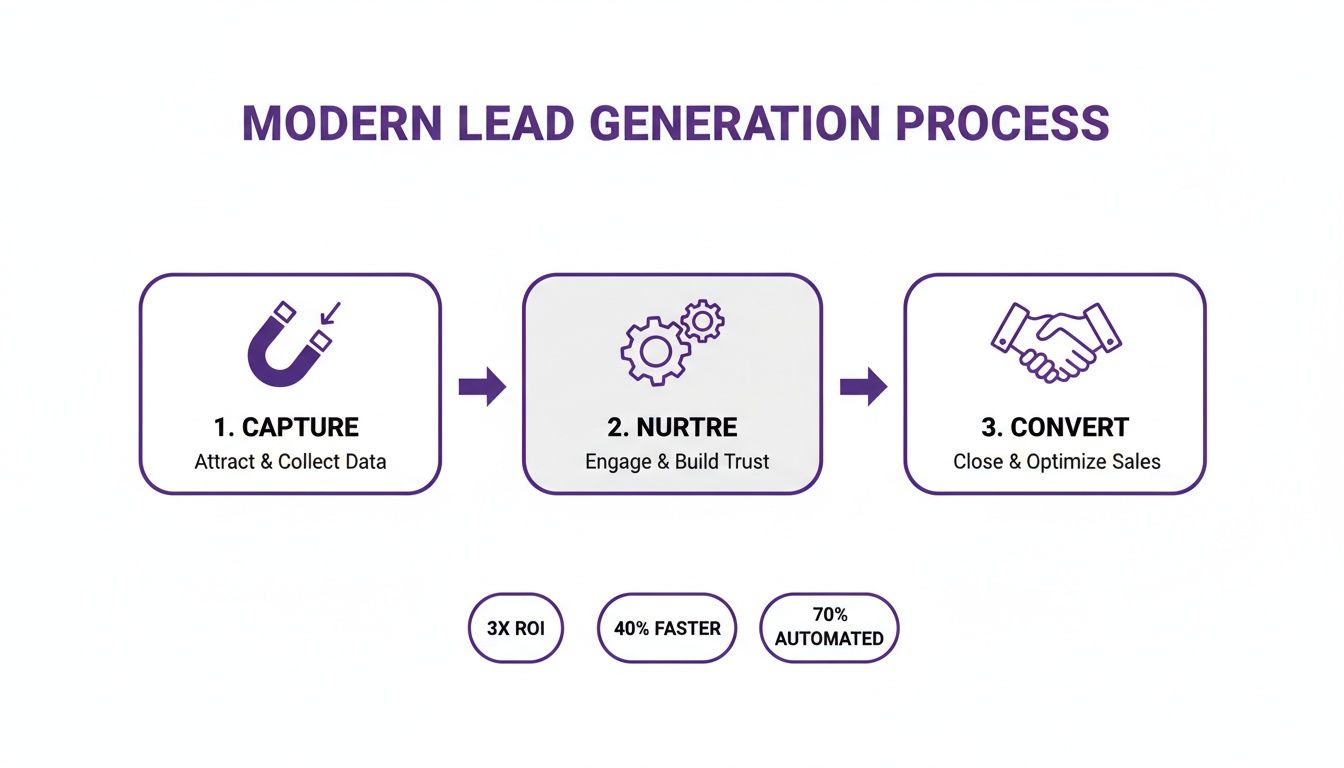
This process maps out the journey from a prospect’s first touchpoint to a closed deal. The real magic happens when you create a seamless handoff between each stage, perfectly blending automated nurturing sequences with timely intervention from your sales team.
To put this all into perspective, here is a breakdown of the core components of a modern tech lead generation program.
Key Strategies for a Modern Tech Lead Generation Program
This table summarizes the essential strategies required for a successful lead generation program in the technology sector.
| Strategy Pillar | Key Focus | Why It Is Critical for Tech Companies |
|---|---|---|
| Data-Driven Targeting | Identifying and segmenting ideal customer profiles (ICPs) using firmographic, technographic, and behavioral data. | Tech sales cycles are long and complex. Focusing on high-fit accounts from the start prevents wasting resources on leads that will never convert. |
| High-Value Content | Creating in-depth, problem-solving content like whitepapers, case studies, webinars, and technical guides. | Tech buyers are researchers. They need to trust your expertise before they’ll even consider your solution. Content builds that authority. |
| Omnichannel Engagement | A coordinated presence across multiple channels, including SEO, LinkedIn, paid ads, email, and events. | Buyers don’t live on one channel. An omnichannel approach ensures your brand is visible wherever they’re looking for solutions. |
| Marketing Automation | Using platforms like HubSpot or Marketo for lead scoring, email nurturing, and workflow automation. | It’s impossible to manually manage leads at scale. Automation ensures timely, relevant follow-up without burning out your team. |
| Sales Development | Employing skilled Sales Development Reps (SDRs) to qualify marketing leads and book meetings for closers. | This is the crucial human element. SDRs, whether in-house or outsourced, bridge the gap between marketing interest and a genuine sales opportunity. |
Ultimately, these pillars form the foundation of a system that generates not just leads, but predictable revenue for your tech company.
Using AI and Automation to Supercharge Your Pipeline
The biggest shift in lead generation for tech companies isn’t about working harder; it’s about working smarter. Today’s high-growth firms are leaning on intelligent, automated systems that predict, engage, and qualify leads with surgical precision. This is where AI and automation become your unfair advantage.
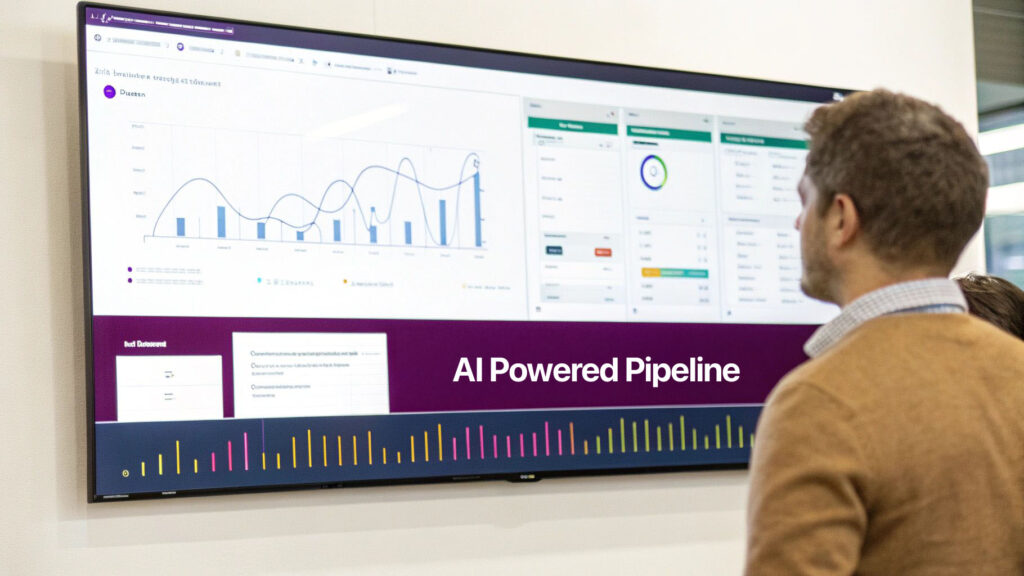
Let’s move beyond the buzzwords and into a practical application. Imagine a system that doesn’t just collect leads but actually understands their intent, nurtures them with personalized content, and hands them off to a sales development team at the perfect moment. This isn’t science fiction anymore—it’s the new standard.
Uncovering Hidden Intent with AI in Lead Generation
One of the most powerful things AI brings to the table is its ability to analyze intent data. It tracks signals across the web—like what topics people are researching or what content they’re consuming on third-party sites—to pinpoint accounts actively in a buying cycle.
Here’s a real-world example: a prospect from a target account downloads your whitepaper. That’s a good signal. But what if AI also tells you that three other people from that same company have been researching your competitors and reading articles about the exact problem your software solves? That’s not just a lead; it’s a priority account flashing a giant “buy” signal.
This predictive insight lets your team stop chasing cold leads and start engaging warm, educated buyers who are already looking for a solution like yours. It transforms your outreach from an interruption into a timely, helpful conversation. To truly supercharge your lead generation pipeline, leveraging advanced AI automation solutions can streamline processes and improve efficiency.
Automating the Nurturing Process
Once you’ve identified a promising lead, the journey is far from over. This is where automation takes over, making sure no prospect slips through the cracks. Automated nurturing sequences keep your brand top-of-mind by delivering the right content at exactly the right time.
Here’s a practical example for a cybersecurity SaaS company:
- Initial Engagement: A CISO signs up for your webinar on “Threat Detection in the Cloud.” Automation instantly adds them to a “Webinar Attendee” email sequence.
- Follow-Up Content: A day after the webinar, they automatically get an email with the recording and a link to a related case study about a similar company you helped.
- Behavioral Triggers: If they click the case study link, the system might then send them an invitation for a personalized demo a few days later.
- Scoring and Routing: Throughout this process, an automated lead score adjusts based on their engagement. Once the score hits a certain threshold, the lead is automatically assigned to a sales rep with a notification to follow up.
“The goal of automation isn’t to replace human interaction, but to make it more meaningful. It handles the repetitive tasks so your team can focus on high-value conversations that close deals.”
This systematic approach ensures consistent follow-up, scales your nurturing efforts, and guarantees that sales reps only spend time on leads who have demonstrated genuine interest.
Capturing Leads 24/7 with Conversational AI
Your website is your most valuable lead-gen asset, but it can’t be staffed by humans around the clock. Conversational AI, in the form of intelligent chatbots, fills this gap perfectly. These aren’t the clunky bots of the past; modern AI chatbots can understand complex questions, qualify visitors, and even book meetings directly on your sales team’s calendar.
By implementing these AI-driven strategies, you build an efficient machine that works tirelessly in the background. It surfaces the best opportunities, nurtures relationships at scale, and ensures a steady, predictable stream of sales-ready leads flows directly into your pipeline.
Find and Engage Tech Buyers Where They Already Are
Great lead generation is all about showing up in the right place at the right time. For tech companies, that overwhelmingly means two places: professional networks and organic search. While your automation platform is the engine, your channel strategy is the GPS. The fastest way to fill your pipeline is to focus your efforts where your ideal buyers are already hunting for solutions.
This is why a two-pronged attack on LinkedIn and SEO is so critical. These aren’t just marketing channels; they’re the modern-day forums where B2B tech decisions get researched, debated, and ultimately, made.
 Mastering LinkedIn for High-Value B2B Lead Generation
LinkedIn is the single most powerful platform for B2B tech companies, period. But just posting company updates won’t get you anywhere. A winning strategy needs a more surgical approach that blends precise targeting with genuine, valuable engagement.
The real power is in tools like LinkedIn Sales Navigator. It lets you move past basic job titles and build hyper-targeted prospect lists using criteria that actually signal buying intent.
Forget surface-level filters. Try digging deeper with these:
- Company Headcount Growth: Growing companies are almost always investing in new technology to support their expansion. This is a massive buying trigger.
- Technologies Used: You can find companies using complementary software (a perfect integration story) or even a competitor’s tool (a prime opportunity to get them to switch).
- Recent Job Changes: A new executive, like a VP of Engineering or CIO, is often looking to make an impact within their first 90 days. They’re more open to hearing about new solutions.
Once you’ve built that list, craft outreach that actually gets a response. Generic, copy-pasted InMail messages are a one-way ticket to being ignored. Your message has to be personal, concise, and focused on their problem, not your product features.
Fueling Your Pipeline with Strategic SEO for Tech Companies
While LinkedIn is your go-to for proactive outreach, SEO is your engine for attracting inbound leads who are already looking for a solution. When a CTO searches for “how to choose a SOAR platform,” you need your company’s in-depth guide to be the first thing they click on. That’s the core of effective SEO in the lead generation for technology companies game.
Your goal is to become a resource. Create high-value, long-form content that answers the pressing questions your ideal customers are asking. This content becomes a digital asset that works for you 24/7, pulling in qualified leads for months, or even years.
For tech companies, a few content formats consistently deliver results:
- Technical Whitepapers: Go deep on a complex industry problem to establish your company as a true thought leader.
- Comprehensive ‘How-To’ Guides: Write step-by-step articles that solve a specific, tangible problem. A guide on “Migrating from an On-Premise Server to a Cloud Environment” is infinitely more valuable than a generic blog post.
- Unbiased Comparison Guides: Articles that break down different solutions (e.g., “SOC 2 Type 1 vs. Type 2 Compliance Software”) position you as a trusted advisor, not just a vendor.
Integrate Your Channels for Maximum Impact
The real power kicks in when you stop treating these channels like silos. A lead who downloads a whitepaper (from your SEO efforts) can be added to a hyper-targeted ad campaign on LinkedIn. A connection you make on LinkedIn can be nurtured through an email sequence triggered by your marketing automation platform. Each channel makes the other one stronger, creating a lead generation machine that’s both robust and resilient.
Understanding the Economics of Your Lead Generation Strategy
A killer lead generation strategy can still fall flat if the numbers don’t add up. To build a growth engine that actually lasts, you have to look past vanity metrics like website traffic and get down to the cold, hard economics of lead generation.
Knowing your Cost Per Lead (CPL) and accounting for long sales cycles is fundamental to making smart investments in lead generation for technology companies. Without a firm grip on these numbers, you’re flying blind—dumping money into channels without knowing their true return.
Calculating Your Cost Per Lead (CPL)
The first metric you must nail down is your Cost Per Lead (CPL). It’s a simple calculation—total marketing spend on a campaign divided by the number of leads generated—but it tells you exactly how much you’re paying to get a potential customer to raise their hand.
Of course, not all leads are created equal, and neither are their costs:
- Paid Search (PPC): A Google Ads campaign targeting high-intent keywords might bring in leads fast, but that CPL can get steep, especially in a crowded tech space.
- Content & SEO: Writing a killer whitepaper takes a serious upfront investment. But once it starts ranking, the CPL can become incredibly low as it generates leads on autopilot for months or even years.
- Events & Webinars: These can have a high initial cost, but they often produce high-quality, engaged leads that are much further down the sales funnel, justifying the spend.
Knowing your CPL for each channel transforms your budget conversations from “we need more money for marketing” to “if we invest another $10,000 in this channel, we can expect to generate 100 qualified leads.”
Planning for the Long Tech Sales Cycle
Another huge economic factor for tech companies is the notoriously long sales cycle. A B2B tech sale involves multiple decision-makers, technical evaluations, and serious budget approvals. That extended timeline has a massive impact on your strategy.
Market analyses show that a staggering 63% of leads might not convert for at least three months. This means you need multi-touch nurture programs and consistent follow-up just to stay in the game. You have to budget for sustained nurturing. A lead who isn’t ready to buy today isn’t a lost cause; they’re an asset you need to cultivate over time.
“Your sales team’s time is your most expensive resource. The goal of a cost-effective lead generation strategy is to ensure they only spend that time on conversations with the highest probability of closing.”
Building a Cost-Effective Blended Model
A truly smart economic strategy mixes automated, top-of-funnel activities with cost-effective human intervention for qualification. This is where partnering with a specialized BPO like CallZent can give you a major financial edge.
Picture this: Your marketing campaigns pull in 500 new leads from LinkedIn, SEO, and paid ads. Instead of flooding your internal sales team with every single name, you first route those leads to a dedicated team of outsourced agents.
These agents handle the crucial, time-consuming follow-up. They qualify each lead against your specific criteria, nurture the ones who aren’t quite ready, and book meetings only with the most promising, sales-ready prospects.
This model optimizes every dollar you spend. You’re using a more cost-effective resource for the initial qualification work, which frees up your expensive in-house experts to do what they do best: close deals. For a deeper dive into making this model work, you can learn more about how to outsource lead generation. It’s the key to maximizing your budget for the highest possible return.
Integrating Human Expertise for Unbeatable Conversion Rates
Automation is a powerful engine, but in high-value B2B tech sales, it can only get you so far. The final, most critical miles of the customer journey are almost always navigated by a skilled human. While AI can spot intent and automated sequences can nurture interest, it’s a timely, intelligent conversation that turns a warm prospect into a scheduled demo.
This is the secret weapon in modern lead generation for technology companies: blending technology with a perfectly timed human touch. It’s a “human-in-the-loop” model where tech and people work in sync to create conversion rates that automation alone can’t touch.
How a Nearshore Partner Bridges the Gap
This is where a strategic partnership with a nearshore call center becomes a game-changer. It’s not about replacing your internal team; it’s about letting them operate at their absolute peak. A skilled BPO partner acts as the essential bridge between your automated marketing machine and your high-value sales reps.
Here’s how that looks in the real world:
- Marketing Generates a Lead: A prospect downloads a technical guide from your site, which kicks off an automated email nurture sequence.
- Automation Nurtures Interest: Over the next week, the prospect opens a couple of emails and visits your pricing page. Your marketing automation platform flags them as a “Marketing Qualified Lead” (MQL).
- The Human Handoff: Instead of this MQL landing in your busy Account Executive’s inbox, it’s routed to a highly-trained agent at your nearshore partner.
- Intelligent Follow-Up: This isn’t a cold call. The agent calls with full context: “Hi Alex, I saw you were looking at our guide on cloud migration. We help companies like yours tackle that all the time. What were some of the key challenges you were hoping to solve?”
This isn’t just a follow-up; it’s a consultative conversation starter. The agent’s goal is to continue the dialogue marketing started, qualify the lead’s needs, confirm their budget and authority, and then—only when the opportunity is truly vetted—schedule a demo on your sales team’s calendar.
The Impact of a Human-in-the-Loop Model
This blended model is a massive force multiplier for efficiency and conversions. The outsourced agent acts as an expert filter, making sure every meeting your sales team takes is with a genuinely qualified prospect. This frees up your reps from the grind of chasing and qualifying, letting them focus entirely on what they do best: closing deals.
The results are powerful and almost immediate:
- Increased Sales Team Productivity: Your top performers spend their days in demos and negotiations, not sifting through MQLs.
- Higher Conversion Rates: Leads come to the table better prepared and more qualified, which naturally boosts your meeting-to-close ratio.
- Faster Speed-to-Lead: A dedicated team ensures every warm lead gets a timely human follow-up before they have a chance to go cold.
- Improved Customer Experience: Prospects feel heard and understood from the very first touchpoint, setting a positive tone for the entire relationship.
Adding this human element is what unlocks the full power of your entire lead generation engine. To see how this model works in practice, you can learn more about our specialized approach in our overview of outsourced lead generation services. It’s the final piece of the puzzle for building a truly scalable and efficient sales pipeline.
Common Questions About Tech Lead Generation
Even with a great strategy, the world of tech lead generation is full of questions. Getting straight answers is the only way to get past the usual roadblocks and make smart decisions that actually grow your business.
Let’s dig into some of the most common questions we hear from tech leaders trying to build a healthier sales pipeline.
How Long Does It Take to See Results from Lead Generation?
This is the big one, and the honest answer is: it all comes down to your channels. The timeline for seeing a real return on your efforts can vary wildly.
- Paid Advertising (PPC/Social Ads): You can get results here almost instantly. A well-built campaign can start bringing in clicks and leads within days, giving you quick wins. The trade-off? These leads usually come with a higher Cost Per Lead (CPL).
- Content Marketing & SEO: This is the long game. It can easily take 6-9 months to see a meaningful amount of organic traffic and a steady stream of inbound leads. The reward is a sustainable engine for high-quality, cost-effective leads.
The best approach is a balanced one: use paid channels for immediate impact while building the long-term, compounding value you get from organic growth.
Should My Tech Company Prioritize Lead Quantity or Quality?
For tech companies with a complex product and a long sales cycle, the answer is always quality over quantity. This isn’t just a nice idea; it’s fundamental to building an efficient sales machine.
A hundred unqualified leads will just jam up your pipeline and burn out your sales team. On the other hand, five highly qualified, sales-ready leads who have a real problem and the power to make a decision can turn into serious revenue. The goal is to build a predictable flow of prospects who are a perfect match for what you sell.
How Does a BPO Partner Actually Improve Lead Generation?
A specialized BPO partner is a force multiplier for your sales efforts. They don’t just dial numbers; they become an integrated part of your strategy, taking on the crucial but time-consuming tasks that are essential for growth.
Imagine them as a dedicated extension of your team that can:
- Handle Top-of-Funnel Qualification: They qualify inbound leads from your website or content downloads 24/7, ensuring every prospect gets a fast response.
- Execute Targeted Outbound Campaigns: They can run focused calling campaigns to break into those key accounts you’ve been trying to land.
- Nurture Lukewarm Leads: They can manage the long-term follow-up for leads who aren’t ready to buy right now, keeping your brand visible until the time is right.
This strategic support frees up your in-house sales reps to do what they do best: focus on high-value conversations and close deals. That’s how you dramatically improve your efficiency and ROI.
Common Questions About Tech Lead Generation
How long does it take to see results?
Paid channels can generate leads within days, while SEO and content typically take 6–9 months to mature.
A blended strategy delivers both short- and long-term wins.
Should tech companies prioritize quality or quantity?
Quality always wins. A smaller number of well-qualified leads outperforms large volumes of unqualified traffic.
How does a BPO partner improve results?
A specialized BPO handles qualification, follow-up, and nurturing—freeing internal teams to focus on closing deals.
Build a Predictable, Scalable Tech Sales Pipeline
CallZent helps technology companies scale lead generation with nearshore expertise,
automation-ready workflows, and performance-driven qualification.
Ready to integrate expert human touch into your lead generation strategy and turn more prospects into profitable customers? CallZent provides specialized, cost-effective BPO solutions from our nearshore center in Tijuana that empower your sales team to focus on what they do best: closing deals. Discover how our experts can supercharge your pipeline by visiting us at callzent.com.