Skip to content
Why Smart Companies Partner with Lead Generation Outsourcing Companies
Is your sales team spending more time hunting for leads than closing deals? Partnering with
lead generation outsourcing companies is no longer just cost-cutting — it’s a growth strategy.
Discover why outsourcing lead gen accelerates your pipeline, improves lead quality, and frees your team to close more business.
TL;DR: Outsourcing Lead Generation
- Why Outsource? Gain instant access to specialized talent and technology, turning fixed overhead into flexible, results-driven spend.
- What’s Included? Prospect list building, lead qualification (BANT), appointment setting, and nurturing long-term prospects.
- Choosing a Partner: Prioritize industry experience, seamless CRM integration, and transparent communication.
- Nearshore Advantage: Mexico offers cost savings, cultural alignment, and real-time collaboration for U.S. businesses.
- AI Impact: Smarter prospecting and automation free agents to focus on real conversations.
👉 Explore CallZent’s outbound sales and lead gen services to supercharge your pipeline.
and closing deals. That’s why smart companies are turning to specialized lead generation outsourcing companies.
They provide a scalable way to fill your sales pipeline with high-quality, pre-qualified prospects, so your closers can focus
on revenue.
Why Smart Businesses Work with Lead Generation Outsourcing Companies
For most growing companies, generating a steady stream of new leads is a constant bottleneck. Your in-house sales team has the deep product knowledge and the personality to turn interested people into loyal customers. The problem is, their time is finite.
Every hour they spend on cold outreach, data entry, and initial qualifying calls is an hour they aren’t spending on high-value sales activities. This creates a serious operational drag. Plus, the cost of building an in-house lead generation team—salaries, benefits, software, and training—adds up fast. It’s no wonder so many forward-thinking companies are turning to specialized partners like CallZent.
The Strategic Shift from Cost-Cutting to Growth Hacking
Outsourcing lead generation isn’t just about saving money anymore; it’s a powerful growth strategy. When you partner with experts, you get immediate access to a team whose sole purpose is to find and engage your ideal customers. They already have the proven processes, the best technology, and trained agents ready to represent your brand from day one.
This strategic move lets you:
- Accelerate Pipeline Growth: An outsourced team can scale outreach much faster than you could internally, keeping your sales funnel consistently full of opportunities.
- Improve Lead Quality: These specialized firms use proven methodologies to ensure only the most qualified, sales-ready leads get passed to your closers.
- Boost Sales Team Productivity: Freed from the grind of prospecting, your sales reps can focus their energy on what they do best—building relationships and closing deals.
The goal isn’t just to get more leads. It’s about getting the right leads, already warmed up and ready for a real sales conversation.
This approach transforms lead generation from a fixed internal expense into a flexible, results-driven investment. It also provides a clear way to measure the financial upside, which is a key part of analyzing the ROI of outsourcing call centers to save time and money.
To get a feel for the bigger picture, you can explore the broader practice of outsourcing lead generation for more context. By bringing in an external partner, you empower your business to scale efficiently, break into new markets, and drive tangible revenue growth without taking on massive overhead.

What Do Lead Generation Services Actually Cover?
So, what exactly are you paying for when you outsource lead generation? Think of your partner as a highly specialized scouting team for your business. Their entire mission is to find, qualify, and connect you with prospects who are a perfect fit, freeing up your sales team to do what they do best—close deals.
Rather than a one-size-fits-all approach, a great partner offers a menu of services that work together to build and sustain a healthy sales pipeline. Each service plays a crucial role in moving a potential customer from a curious onlooker to a scheduled meeting on your calendar.
Let’s pull back the curtain on the most essential services.
Key Features and Benefits of Top Lead Generation Providers
The world of B2B lead generation has become a sophisticated ecosystem, blending data, technology, and strategy to help businesses target and convert the right prospects at the right time. If you’re considering software or agency partners, here’s what separates the best from the rest.
What Modern Lead Generation Partners Bring to the Table
A true leader in the space goes far beyond just sending out emails or running ads. Here’s how:
- Multichannel Outreach: Top providers integrate email, phone outreach, social media engagement, and even targeted ad campaigns. This omnichannel approach boosts your chances of making real connections with decision-makers, wherever they happen to spend their digital time.
- Data-Driven Prospecting: Forget spray-and-pray. Leading agencies use AI-driven tools to identify your Ideal Customer Profile (ICP), scour relevant databases for fresh contacts, and score leads based on intent signals—so your pipeline is filled with prospects who are actually ready to engage.
- Personalized Content and Nurturing: It’s not just about first contact. These companies craft tailored email sequences, retargeting ads, and relevant content (from blog posts to whitepapers) that nurture leads and keep your brand top of mind—all tailored to where each prospect is in their buying journey.
- Marketing Automation: The best partners don’t just automate tasks—they optimize them. Expect streamlined follow-ups, triggered workflows, and deep analytics showing you which campaigns convert and which need work.
- Events and Webinars: Agencies are increasingly leveraging webinars and virtual events to spark real engagement and qualify interest, turning passive onlookers into active sales opportunities.
- Account-Based Marketing (ABM): For businesses targeting enterprise clients, ABM is a game changer. Sophisticated providers build hyper-personalized campaigns aimed at specific accounts and stakeholders, maximizing your relevance and response rate.
Why These Features Matter — The Business Benefits
Beyond flashy tools and clever campaigns, what does this actually mean for your bottom line?
- Expand Your Reach: With access to vast, verified databases, agencies can introduce your brand to untapped markets and hard-to-reach decision-makers—opening doors you might never have found in-house.
- Boost Lead Quality, Not Just Quantity: By analyzing buyer behavior and real-time engagement signals, outsourced teams filter out tire-kickers and prioritize leads that are already demonstrating interest or intent.
- Improve Conversion Rates: Through smart nurturing, retargeting, and multi-touch campaigns, they build trust with prospects and guide them toward a genuine sales conversation—lifting your conversion metrics across the board.
- Save Time and Money: Outsourcing means your salespeople spend less time hunting, more time closing. It’s a cost-effective way to scale, skipping the headcount and operational headaches of building your own team from scratch.
- Stay Agile and Scalable: Need to ramp up for a new product launch or test new markets? The right partner can scale your outreach up or down without missing a beat.
- Data Compliance and Trust: Leading agencies keep your outreach compliant with evolving privacy laws, protecting your reputation while ensuring your campaigns run smoothly.
All told, working with a top-tier lead generation software or agency transforms your sales efforts from guesswork to a finely tuned, ROI-driven engine that fuels sustainable growth.
What Is B2B Lead Generation (and How Is It Different from B2C)?
B2B lead generation is the art and science of finding businesses—not just individuals—who might need what you sell and starting a conversation with them. Instead of targeting everyday consumers, B2B (business-to-business) lead gen zeroes in on decision-makers at companies, organizations, or brands like Salesforce, Cisco, or even the local accounting firm down the street.
Unlike B2C, where you’re after impulse clicks or personal purchases, B2B is all about building relationships that can lead to big-ticket deals and longer sales cycles. The stakes are higher, the buying process is more complex (think procurement teams, multiple stakeholders, and longer negotiations), and the tactics are more tailored. You’re often dealing with specific roles—like VPs of Marketing or IT Directors—instead of the general public.
The objective? Attract businesses that genuinely fit your ideal customer profile, connect with the right contacts, and guide them through a thoughtful qualification process. It’s part detective work, part matchmaking, and all about keeping your sales team busy with people who are actually likely to buy.
Lead Prospecting and List Building
Before you can talk to anyone, you need to know who to talk to. That’s lead prospecting in a nutshell. It’s the foundational step of identifying the specific people and companies that match your Ideal Customer Profile (ICP). A top-tier outsourcing partner doesn’t just go out and buy a stale, generic list; they build a fresh, custom one just for you.
This is a deep-dive process. They conduct market research to find contacts who are genuinely likely to need what you’re selling. Using sophisticated tools and databases, they gather accurate contact info, ensuring your message actually lands in the right inbox or gets to the right person on the phone.
For instance, if you’re a B2B software company targeting the manufacturing space, your partner would build a list of Plant Managers and Operations Directors at companies with over 500 employees, complete with verified emails and direct-dial numbers.
Account-Based Marketing (ABM)
Now, if your business aims for bigger fish—think enterprise clients—this is where Account-Based Marketing (ABM) steps in. Instead of casting a wide net, lead generation companies using ABM go ultra-targeted: they identify high-value accounts that fit your ideal profile and zero in on the key decision-makers within those organizations.
Here’s how the ABM playbook typically unfolds:
- Targeted Account Selection: The agency works with you to pinpoint dream accounts—those with the best potential for partnership or purchase.
- Stakeholder Mapping: Using platforms like LinkedIn Sales Navigator, ZoomInfo, or Apollo.io, they map out the decision-makers and influencers at each company. That means personalized outreach doesn’t just go to “info@corporate,” but to people with real buying power.
- Tailored Content and Messaging: Every touchpoint—emails, calls, LinkedIn messages—is customized to resonate with the unique pain points, goals, and lingo of that specific account. No generic pitches here.
- Multi-Channel Campaigns: Successful ABM strategies mix it up, reaching out to prospects through email, phone, social media, and even direct mail to ensure your message gets noticed.
This tailored approach dramatically boosts your chances of landing meetings with truly valuable prospects, especially if you’re selling complex solutions that require buy-in from multiple stakeholders. With ABM, you’re not just filling the pipeline—you’re stacking it with opportunities that fit your strategy and sales goals.
Lead Qualification and Scoring
Okay, you have a list. Now what? The next crucial step is figuring out who’s just browsing and who’s actually ready for a sales conversation. This is lead qualification, a non-negotiable service offered by lead generation outsourcing companies. They use proven frameworks like BANT (Budget, Authority, Need, Timeline) to sort through the noise.
Their agents will engage prospects through calls or emails, asking smart, targeted questions. This filters out the tire-kickers and prioritizes individuals showing real buying intent, saving your sales team from countless dead-end conversations.
A qualified lead isn’t just someone who downloaded an ebook. It’s a decision-maker who has a problem they need to solve and the resources to do it.
This process is often supercharged with lead scoring. Prospects get points based on their behavior, demographics, and engagement. Someone who visited your pricing page and requested a case study is a much “hotter” lead than someone who just opened a single email two weeks ago.
Appointment Setting and Scheduling
This is where the rubber meets the road. For many campaigns, the ultimate goal is getting qualified meetings booked directly onto your sales team’s calendars. Appointment setting is a true skill, requiring a blend of persistence, professionalism, and sharp communication.
Your outsourced team manages all the frustrating back-and-forth of finding a time that works, sending the calendar invites, and confirming attendance. It completely removes one of the biggest administrative headaches from your sales reps’ plates.
Here’s how it looks in the real world:
- The Goal: A cybersecurity firm needs to schedule demos with Chief Technology Officers (CTOs) at mid-sized financial companies.
- The Process: The outsourced team calls their list of qualified CTOs, delivers a crisp value proposition, and secures a 30-minute demo slot on a sales executive’s calendar.
- The Result: The sales exec logs in Monday morning to a calendar already populated with pre-vetted meetings. They can jump right into showcasing their solution to interested buyers.
At CallZent, our agents are masters of this craft. You can see exactly how we operate as the best call center for outbound sales and appointment setting.
Lead Nurturing
Let’s be realistic: not every qualified lead is ready to sign a contract today. Some have the need but not the budget—yet. Others are in a longer, more complex evaluation cycle. That’s where lead nurturing comes in.
Instead of letting these valuable prospects go cold, an outsourced team keeps your brand top-of-mind. They do this by sharing helpful content, following up at just the right moments, and maintaining a positive, no-pressure relationship. When the time is finally right for them to buy, you’re the first call they make.
But it’s not just about staying in touch. A skilled outsourced lead generation team leverages targeted content marketing and advertising to put your brand in front of new audiences who might otherwise never discover your services. Through carefully crafted campaigns—think LinkedIn outreach, informative blog posts, and well-placed digital ads—they expand your brand’s reach, introducing your solutions to untapped markets. This approach doesn’t just nurture existing leads; it actively broadens your pool of potential buyers, ensuring your message resonates with decision-makers who matter most.
In short, lead nurturing isn’t a passive waiting game—it’s an ongoing process of building awareness, adding value, and keeping your company at the forefront, so when prospects are ready, you’re already on their radar.
The Real Advantages of Using Lead Generation Outsourcing Companies
Sure, outsourcing can save you money, and that’s a great starting point. But the real, game-changing value comes from the strategic firepower it gives your business. Handing off lead generation to a specialized firm isn’t just about getting tasks off your plate—it’s about gaining a serious competitive edge.
Think about what it would take to build a top-tier lead generation team from the ground up. You’d have to find, hire, and train the right people. Then, you’d need to sink a small fortune into CRM software, auto-dialers, and sophisticated data tools. This whole process can eat up months and a ton of capital before you ever see a single qualified lead.
Get Instant Access to Specialized Talent and Technology
The best outsourcing partners live and breathe lead generation. It’s all they do. Their agents are already experts in sales techniques, handling objections, and representing brands professionally. They don’t need a long ramp-up period; they’re ready to hit the ground running and start delivering results from day one.
These firms have also already made the big investments in the tools needed for modern outreach. We’re talking about premium contact databases, slick email automation platforms, and powerful analytics software that can zero in on high-intent prospects with scary accuracy.
For a growing business, this is huge. It means you can go toe-to-toe with the big players without needing their massive internal budgets for sales tech and staff.
Turn Fixed Costs Into Flexible Expenses
One of the smartest financial moves outsourcing enables is changing fixed costs into variable ones. An in-house team comes with heavy, fixed overhead—salaries, benefits, office space, software licenses—that you pay every month, whether your pipeline is booming or bone dry. That can put a real strain on cash flow, especially during slow seasons.
Outsourcing completely flips that script. Instead of paying fixed salaries, you pay for the services you actually use. This makes your lead gen budget way more efficient and directly ties your spending to real results, like qualified leads or appointments set.
This shift from fixed to variable costs is a game-changer for financial agility. It gives you the freedom to scale your lead generation efforts up or down in a flash to meet market demand, all without the headache of hiring or laying people off.
Many modern agencies now offer flat-rate contracts without locking you into long-term commitments, which is perfect for adapting to new priorities. As SalesHive’s blog explains, this flexibility is especially valuable for hitting seasonal trends or going all-in on a big product launch.
Flexible Pricing Models That Fit Your Growth Strategy
Outsourcing your lead generation also means you can pick a pricing model that actually aligns with your business goals and budget. There’s no one-size-fits-all approach here—the best agencies give you options designed for companies at every growth stage.
Here’s a quick rundown of the most common pricing structures you’ll see:
- Monthly Retainer: Pay a flat fee for dedicated services each month. Great if you want predictable costs and a committed team working for you.
- Pay-Per-Lead or Appointment: Only pay when you get a qualified lead or booked meeting. This model puts the focus on results, making it especially appealing for companies that want to tie spending directly to outcomes.
- Commission-Based: In this arrangement, you pay a percentage based on deals closed or revenue generated. It tightly aligns your partner’s incentives with your own success.
- Project-Based or One-Time Fees: Perfect for special campaigns or short-term projects, these models let you get a feel for outsourcing without a long-term commitment.
Whether you’re eyeing a sprint for a product launch or ongoing lead generation support, there’s a model out there that can flex with your needs. Want to mix and match? Many agencies, like SalesHive and others, let you tailor contracts to suit your changing priorities.
How to Set the Right Lead Generation Budget
Now, how do you actually figure out what you should spend on lead generation?
Start by looking at your company’s big-picture sales and revenue goals. Are you aiming for rapid growth this year, or is the focus more on steady, sustainable progress? Aligning your budget with your targets ensures your investment is proportional to your ambitions.
Next, factor in the value of a typical customer. If landing a single client means significant long-term revenue (think: Salesforce or HubSpot clients), it makes good sense to allocate more budget toward bringing those prospects through your pipeline. On the flip side, if your deals are smaller and higher in volume, focus on optimizing for cost per qualified lead.
Don’t forget to weigh in your team’s in-house strengths—and gaps. If you don’t already have the right expertise or proven strategies, it may be more cost-effective to invest with an outsourced partner like the ones we’ve discussed rather than spinning your wheels (and burning through the budget) trying to build capabilities from scratch.
A quick gut-check formula: Estimate how many leads you need to reach your revenue goal, work backward using your average close rate, and then determine how much you can comfortably spend to acquire each lead while keeping profitability in the crosshairs. That way, your budget works for you, not the other way around.
How Much Should You Pay for Lead Generation Services?
If you’re wondering what you’ll actually shell out for outsourced lead generation, the answer is: it depends—on a lot. Prices swing from modest starter packages to hefty enterprise campaigns, all based on what you need, where you’re targeting, and how demanding your industry is.
Here’s what goes into the price tag:
- Scope of Services: Are you looking for simple lead lists, or do you want full-cycle support like nurture campaigns, appointment setting, and personalized outreach? More bells and whistles naturally push the price up.
- Industry and Audience: Chasing C-level executives at Fortune 500 companies? That’s going to be pricier than targeting small businesses in your local area, thanks to the extra research and expertise required.
- Lead Quality & Volume: High-quality, sales-ready leads don’t come cheap, especially if you’re looking for a steady stream. Bulk leads lower the per-lead cost, but quality is where you see better ROI.
When it comes to billing, agencies typically offer:
- Flat monthly retainers—great if you want predictable costs.
- Pay-per-lead or pay-per-appointment—ideal if you want to pay only for real results.
- Project-based or one-time campaigns—good for short-term sprints.
To nail down the right budget, weigh your marketing goals, the value of each new customer, and the expertise required to win in your space. Don’t be shy about asking for a detailed quote that spells out deliverables so you know what’s included (and what isn’t).
Pro tip: ROI matters more than sticker price. If an agency like Belkins or CIENCE can consistently bring in high-quality leads that convert, paying a bit more can generate much bigger wins for your bottom line.
Scale Up or Down, Seamlessly
Scalability is where outsourcing truly flexes its muscles. Let’s paint a picture.
Imagine your company is launching a new software product in three months. To hit your Q4 revenue goals, you need to generate 1,000 qualified demo requests. Trying to build an in-house team to handle that kind of surge would be a logistical nightmare.
An outsourced partner like CallZent, on the other hand, is built for exactly this kind of challenge. They have the systems and a deep bench of trained agents ready to scale your campaign fast.
- Quick Ramp-Up: They can get a dedicated team on your project in weeks, not months.
- Flexible Resources: If the campaign takes off and you’re flooded with interest, they can easily add more agents to keep up.
- Controlled Scale-Down: Once the launch blitz is over, you can scale the team back to a smaller, steady crew for ongoing lead nurturing.
This on-demand scalability lets your business pounce on market opportunities without getting stuck with long-term overhead. You get all the power of a large, dedicated sales development team exactly when you need it—and only for as long as you need it.
How to Choose the Right Outsourcing Partner
Picking a partner for lead generation is a make-or-break decision for your sales pipeline. Seriously. The right choice can pack your calendar with qualified meetings, but the wrong one will just burn a hole in your budget and leave you with nothing to show for it.
Think of it like hiring a key employee—you have to look past the shiny sales pitch and really focus on their experience, how well they fit with your team, and whether they have a proven track record. You’re not just buying a service; you’re building a partnership. That means digging into how they operate, how they communicate, and if they actually get your business and its goals. A great partner isn’t a vendor; they’re an extension of your team.
Start with Industry Expertise and Specialization
First thing’s first: does the potential partner actually understand your world? Generic lead generation tactics are a recipe for failure, especially in specialized industries. A team that’s a rockstar at booking demos for SaaS companies probably doesn’t have the right touch for generating leads in the complex worlds of healthcare or manufacturing.
Look for lead generation outsourcing companies that have real, demonstrable experience in your niche. They’ll already know the industry jargon, understand your buyer’s biggest headaches, and have experience navigating the unique challenges of your market. This kind of specialized knowledge shortens the learning curve dramatically and leads to much better conversations from day one.
Who Typically Uses Lead Generation Outsourcing?
Not every business looks the same, and neither do their outsourcing needs. The best partners have experience generating leads for a range of B2B organizations, including:
- Technology companies (think SaaS, IT services, cybersecurity)
- Manufacturing and industrial firms
- Professional services (consulting, accounting, legal)
- Healthcare and medical device companies
- Financial services providers
- Education and training organizations
- Even non-profits
If your potential partner has case studies or references from companies that look like yours—whether you’re a fast-growing fintech or a global manufacturer—you’re on the right track. If they hesitate or can’t provide any, that’s a huge red flag.
A quick way to check this? Ask for case studies or references from companies that look like yours. If they hesitate or can’t provide any, that’s a huge red flag.
Evaluate Their Technology and Integration Capabilities
In today’s sales game, technology is the engine that drives everything. Your outsourcing partner needs to have a solid tech stack, but what’s even more important is how smoothly it plugs into your existing systems—especially your CRM.
If you’re stuck with a messy, manual data transfer process, you’re signing up for friction, lost information, and a total inability to track your ROI accurately. It’s a nightmare.
Get straight to the point and ask them:
- CRM Integration: Can your platform sync seamlessly with our CRM (like Salesforce or HubSpot)?
- Data Handling: How do you make sure lead data is passed over accurately and in real-time?
- Reporting Tools: What kind of dashboard or reporting will we get access to?
A partner who offers a transparent, integrated workflow is absolutely essential for a successful, long-term relationship. It means your sales team gets the info they need without jumping through frustrating administrative hoops.
This quick decision tree can help you figure out if outsourcing is the right move based on your current team and goals.
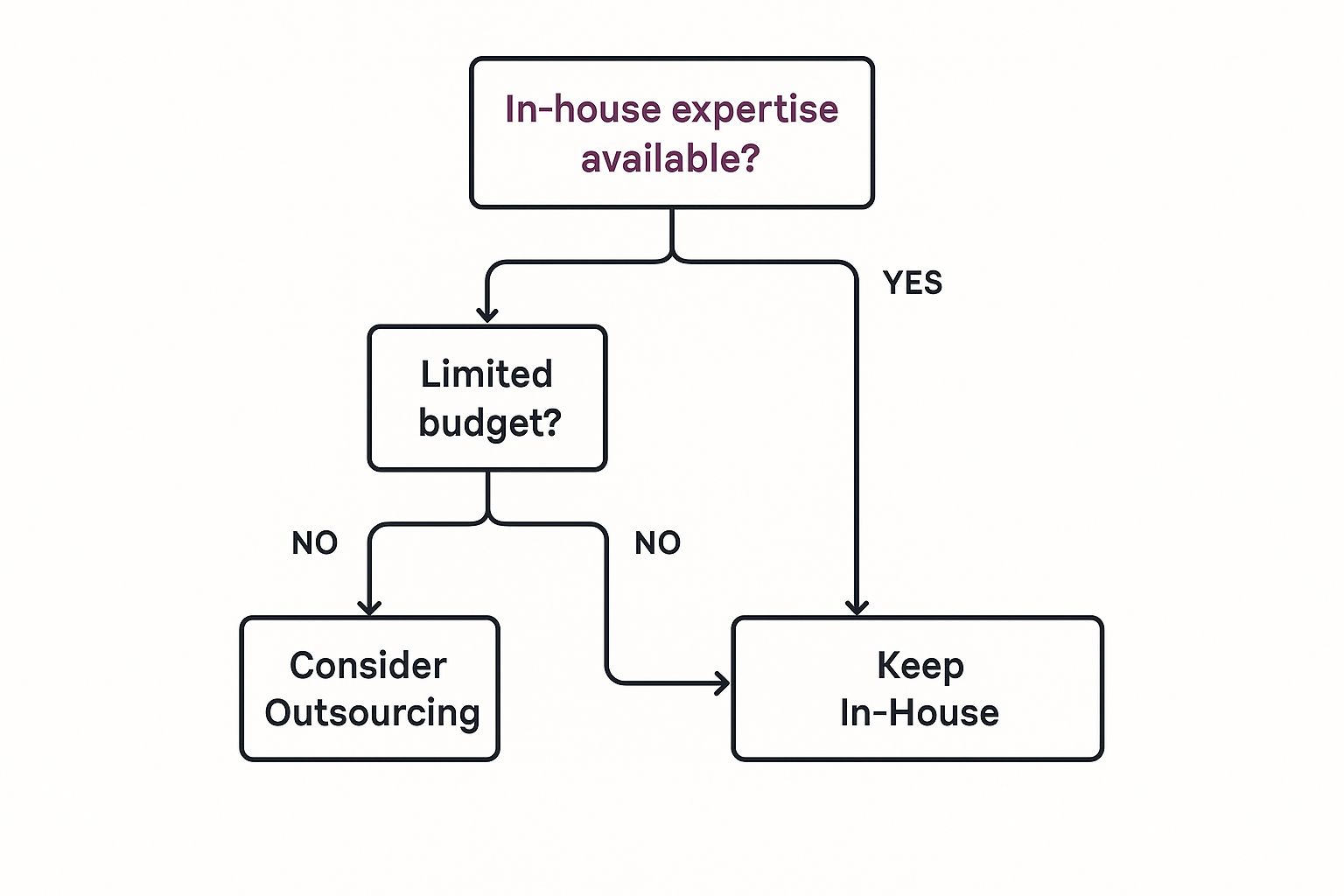
As you can see, if you’re lacking in-house expertise, working with a tight budget, or need to scale up fast, outsourcing becomes a pretty strategic move.
Prioritize Communication and Cultural Alignment
How are you and your partner going to stay on the same page? A common reason outsourcing relationships fail is a lack of clear, consistent communication. The best partners set up a regular schedule for meetings and reporting from the very beginning.
A true partnership is built on transparency. You should never have to wonder what your outsourced team is doing or how your campaigns are performing.
Beyond just check-ins, think about cultural alignment. The agents representing your company have to be able to adopt your brand’s voice and values. They are the very first impression many prospects will have of your business, making this a non-negotiable. This is especially crucial when looking at nearshore options, where cultural similarity can make a massive difference in communication quality. Our guide on how to choose the best call center in Mexico dives deeper into how to evaluate this kind of cultural fit.
Before diving into the checklist, here’s a quick scenario to bring this all together.
A Practical Vetting Scenario
Let’s say you run a B2B FinTech company and you’re weighing three different providers. Here’s how you could apply this framework:
- Provider A: Has a fantastic reputation but mostly works with e-commerce brands. Their agents are sharp, but they stumble over the complex compliance language of the finance world. (Red Flag: Lack of industry specialization).
- Provider B: Specializes in FinTech and shows you some impressive case studies. The catch? You have to manually export lead data from their system into your CRM every single week. (Red Flag: Poor technology integration).
- Provider C: Also a FinTech specialist and offers seamless HubSpot integration out of the box. They propose weekly performance reviews and assign a dedicated account manager who clearly understands your value proposition. (Strong Candidate: Checks all the boxes).
Using a structured evaluation process focused on expertise, technology, and communication helps you confidently pick a partner who will drive real, measurable results.
To make this process easier, we’ve put together a checklist you can use when comparing potential partners.
Evaluating Lead Generation Outsourcing Companies
Use this table as a scorecard to vet potential lead gen partners. It’ll help you keep your evaluation consistent and ensure you don’t miss any critical details.
| Evaluation Criterion | What to Look For | Red Flags to Avoid |
|---|---|---|
| Industry Expertise | Proven track record in your specific niche or a similar one. | Generic, one-size-fits-all approach; no relevant case studies. |
| Technology & CRM Integration | Seamless, real-time integration with your existing CRM. | Manual data entry required; proprietary, closed-off systems. |
| Communication Protocol | A clear plan for regular meetings, reporting, and feedback. | Vague promises about communication; no dedicated point of contact. |
| Agent Quality & Training | Transparent process for hiring, training, and quality assurance. | High agent turnover; inability to explain their training process. |
| Cultural Alignment | Agents who can naturally adopt your brand’s tone and values. | Noticeable cultural or language barriers during initial calls. |
| Scalability | The ability to easily scale the team up or down based on your needs. | Rigid, long-term contracts with no flexibility for change. |
| Pricing & ROI | Transparent pricing model with clear metrics for success (CPL, CPA). | Hidden fees, unclear ROI calculations, or focusing only on vanity metrics. |
By systematically working through these criteria, you move beyond gut feelings and make an informed decision based on what truly matters for a successful partnership.
Top Lead Generation Companies to Watch in 2025
Now that you know what to look for in a partner, let’s ground things in reality: who are the top players actually leading the charge in lead generation this year?
You’ll find the landscape packed with both specialized agencies and AI-powered SaaS solutions—each with their own style of helping you fill your sales pipeline. Here are a few industry standouts making waves in 2025:
- Belkins: Renowned for white-glove B2B lead generation services, Belkins takes a hands-on approach—from research and personalized outreach to filling up your appointment calendar. They’re a favorite for companies wanting done-for-you results powered by both strong process and savvy humans.
- Salespanel: Looking for website visitor intelligence and lead qualification? Salespanel excels at identifying and nurturing B2B prospects browsing your site, integrating seamlessly with most CRMs. Their behavioral-based scoring ensures your sales team spends time on the right opportunities.
- LinkedIn Sales Navigator: For teams who live and breathe networking, LinkedIn’s Sales Navigator remains the secret weapon for prospect research and real-time insights. With robust filters and personalized lead recommendations, it keeps your outreach focused and efficient.
- Upgrow: A full-service digital marketing agency, Upgrow specializes in combining paid media, content, and analytics to drive qualified leads straight to your inbox. They’re a solid choice if you want holistic, channel-agnostic growth.
- CIENCE: Operating at the intersection of tech and talent, CIENCE offers both managed SDR teams and data-driven outreach platforms. Their expertise bridges automation with creative human engagement—great for scaling outbound campaigns cost-effectively.
Each of these companies brings something unique to the table—whether that’s advanced AI, industry specialization, or simply the hustle of great sales professionals.
Choose a partner that not only fits your criteria but is also aligned with your company culture and growth ambitions.
Steps to Find a Budget-Friendly B2B Lead Generation Partner
Worried about keeping costs in check while still choosing the right partner? Here’s how to approach the search without sacrificing quality—or your sanity.
1. Nail Down Your Goals—and Your Budget
Before you start comparing vendors, get laser-focused on exactly what you want out of your lead generation program. Are you looking for qualified appointments? Raw lead lists? Multi-touch nurture? Set clear, measurable objectives, then map out how much you can realistically allocate. Remember, it’s not just about spend—it’s about ROI.
2. Do the Homework: Industry Fit Matters
Don’t just chase the lowest bid. Shortlist providers with a real track record in your industry or with your specific buyer profile. A call center that crushes it for SaaS might not be up to speed on manufacturing or legal compliance. Dig into their case studies and ask for references in your vertical.
3. Look for Flexibility in Services and Scale
Budget constraints call for adaptability. Scan for partners who offer customizable packages or modular services you can scale up, down, or tweak as your business needs evolve. Avoid rigid, “all-in” contracts that lock you into paying for bells and whistles you won’t use.
4. Consider the True Cost Over Time
Think beyond the sticker price. Drill down into the expected lifetime value of a converted lead (how much revenue can you expect?) and factor in any hidden costs—setup fees, integration charges, or incremental commissions. The cheapest provider today might end up costing you more down the road if their leads don’t convert.
5. Quality Matters More Than Volume
A bargain is only a bargain if the leads actually close. Don’t be dazzled by huge lead volumes at rock-bottom prices; low-quality contacts can swamp your sales team and drag down performance. Prioritize partners who emphasize verified, sales-ready leads over sheer quantity.
6. Set Clear Expectations—And Don’t Skip Negotiation
Before you sign the dotted line, have an open conversation about your requirements and budget. Be up front about what you need, what you can afford, and where you expect flexibility. Negotiate pricing, clarify exactly what’s being delivered, and put key performance indicators in writing to avoid any misunderstandings later.
Taking these steps lets you compare options with a clear, numbers-driven head—and minimizes the risk of buyer’s remorse.
How Lead Generation Partners Safeguard Compliance and Trust
Data privacy isn’t an optional extra—these days, it’s table stakes for any serious lead generation effort. The right outsourcing partner doesn’t just update their privacy policy and call it a day. They actively monitor regulations like GDPR and CCPA, update internal processes, and make sure every outreach stays on the right side of the law—locally and internationally.
Here’s how top-tier providers keep your reputation (and wallet) safe:
- Ongoing Training: Agents are continuously trained on compliance standards from the EU’s GDPR to the U.S.’s ever-expanding patchwork of privacy laws.
- Transparent Opt-Ins: Every lead gets clear, up-front choices about consent, with meticulous record-keeping for audit trails.
- Data Security Tech: Expect providers to leverage encrypted CRMs (think Salesforce, HubSpot, Zoho) and tightly controlled access, putting an immediate stop to any data breach shenanigans.
- Regular Audits: External compliance assessments and detailed logs make it easy to demonstrate accountability—just in case regulators ever come knocking.
The upshot? Working with compliance-focused partners lets you confidently engage prospects, knowing you’re not risking hefty fines or your brand’s hard-earned trust.
Legal & Compliance Considerations
It’s impossible to talk about outsourcing lead generation—especially if your operations cross borders—without addressing legal and compliance issues. Regulations like GDPR (for Europe) and CCPA (for California) aren’t just fine print; they’re a top consideration when partnering with any lead gen company.
What does this mean in practice? Your vendor should:
- Demonstrate a clear understanding of data privacy regulations that apply to your target markets (think GDPR, CCPA, and any industry-specific rules).
- Have airtight protocols for collecting, processing, and storing prospect data—ideally, they should be able to walk you through their entire compliance playbook.
- Be open about how they obtain, use, and share data, and provide documentation proving adherence to required standards.
Red flags to avoid here include vague answers about compliance, reluctance to provide copies of their data processing agreements, or a “trust us, we’re careful” attitude. Bottom line: Any reputable lead generation partner should treat data privacy with the same seriousness as you do, minimizing risk and building trust from the first interaction.
The Role of AI in Modern Lead Generation

Technology is completely changing how lead generation gets done, and artificial intelligence is right at the center of it all. The best lead generation outsourcing companies aren’t just dialing numbers anymore; they’re using AI to work smarter, faster, and with a level of precision that was impossible just a few years ago.
Think of AI as a tireless research assistant that works around the clock. It combs through mountains of data—from social media chatter and industry news to website visits—to find prospects who are showing clear signs they’re ready to buy. This lets your outsourcing partner skip the generic cold-call lists and focus their efforts on people who are already halfway there.
This tech-forward approach doesn’t make skilled agents obsolete; it makes them better. By automating the grunt work and serving up deep insights, it frees up the human experts to do what they do best: build relationships and have meaningful conversations.
How AI Pinpoints High-Intent Prospects
AI-powered tools are masters of pattern recognition. They can spot the subtle buying signals a human might easily miss, turning a sea of raw data into a treasure map of actionable leads. This means your outsourced team isn’t just calling a list—they’re connecting with prospects who are actually primed for a conversation.
Here’s a look at how it works in the real world:
- Predictive Analytics: AI digs into your past sales data to build a detailed profile of your ideal customer. Then, it scours the web to find new prospects that match that profile perfectly.
- Real-Time Optimization: The system is smart enough to watch a campaign’s performance and adjust on the fly. If emails sent to a specific industry are getting low open rates, the AI can pivot the strategy instantly.
- Personalized Outreach at Scale: AI can help craft personalized outreach messages based on a prospect’s job title, industry, or recent online behavior. This makes that first touchpoint feel relevant and genuinely helpful, not robotic.
This data-first strategy ensures that when an agent finally picks up the phone, they’re calling someone who is far more likely to be a fantastic fit.
The Synergy of AI and Human Expertise
While AI is brilliant at figuring out who to talk to and when, the actual conversation still needs a human touch, especially in the world of complex B2B sales. Technology handles the data, but it’s the skilled agents who bring the empathy, critical thinking, and nuance required to close a deal.
AI finds the door, but a skilled agent knows how to open it. The combination of smart technology and human expertise is what delivers superior results.
For instance, an AI tool might flag a prospect who just downloaded a whitepaper from your site and then immediately visited your pricing page. That alert goes straight to a CallZent agent, giving them the perfect, timely reason to make a well-informed follow-up call. The conversation is no longer “cold”—it’s contextual, relevant, and helpful. You can learn more about how we integrate these tools in our guide to automation and artificial intelligence in call centers.
Data from HubSpot’s 2024 Sales Trends Report backs this up, showing that 43% of sales reps feel AI has a positive impact on their performance. By empowering agents with better data and filling gaps in human capacity, this technology ensures a much steadier flow of truly qualified leads.
Choosing Your Outsourcing Model: Nearshore vs. Offshore
So, you’ve decided to bring in one of the many lead generation outsourcing companies to help you scale. Great move. But now you’re facing the next big question: where should that partner be?
Don’t underestimate this decision. The location of your outsourcing partner sends ripples through everything—from day-to-day communication and campaign agility to your budget and bottom-line results. Your choice boils down to three main models.
Each one—onshore, offshore, and nearshore—comes with its own playbook of pros and cons. The right call depends entirely on your business priorities, how much you’re looking to invest, and how closely you want to work with your outsourced team.
Understanding the Key Differences
Let’s cut through the jargon and get straight to what these models mean for you. Think of it like picking a satellite office for a vital part of your sales engine.
- Onshore (Domestic): This is the home-field advantage. Your partner is right here in your own country. You get perfect cultural and language alignment, but it comes with the highest price tag.
- Offshore: Your partner is in a country far away, often halfway across the globe in a place like the Philippines or India. This route offers the biggest cost savings, but you might run into headaches with massive time zone gaps, language barriers, and cultural disconnects.
- Nearshore: This is the sweet spot. Your partner is in a neighboring country with a similar time zone—for a U.S. business, think Mexico or Latin America. Nearshore is all about striking that perfect balance between cost-efficiency and close collaboration.
Why Nearshore Offers a Strategic Advantage
For a huge number of North American businesses, the nearshore model isn’t just a trend; it’s become the smartest strategic choice for lead generation. It manages to capture the best of both worlds, giving you the cost benefits of going global with the seamless teamwork of a domestic partner.
The time zone alignment alone is a massive win. No more sending an email and waiting a full business day for a response. Your in-house team and your outsourced team can hop on a call and collaborate in real-time, making it easy to tweak strategies and pivot on a dime.
But the real magic of the nearshore model is cultural affinity. It’s one thing for an agent to speak the language, but it’s another thing entirely to get the subtle cultural cues and business etiquette needed to build real rapport with prospects.
This shared context makes conversations feel authentic and unscripted, which is a total game-changer in B2B sales, where every deal is built on a foundation of trust. On top of that, nearshore hubs like Mexico have a massive pool of highly educated, bilingual talent. You get access to world-class agents without paying the premium domestic price. Our deep-dive guide on nearshore vs. offshore outsourcing unpacks these differences even more.
To make this crystal clear, let’s stack the three models up against each other.
Outsourcing Models Compared: Nearshore vs. Offshore vs. Onshore
Here’s a quick breakdown to help you see how the three primary outsourcing models compare, so you can decide which is the best fit for your lead generation needs.
| Factor | Nearshore | Offshore | Onshore |
|---|---|---|---|
| Cost Savings | High | Highest | Low |
| Time Zone Alignment | High | Low | Highest |
| Cultural Affinity | High | Low | Highest |
| Communication Quality | Excellent | Variable | Excellent |
| Agent Skill Level | High | Variable | High |
Looking at the table, it’s easy to see why nearshore has become such a compelling option. It offers a powerful blend of cost savings and quality that’s tough to beat.
Common Questions About Outsourcing Lead Generation
Handing over a piece of your sales pipeline to an outside team is a big step. It’s only natural to have questions. In fact, you should be asking tough questions. Let’s walk through some of the most common ones we hear from business leaders just like you.
How do lead generation outsourcing companies qualify—and actually generate—leads?
A great partner doesn’t just lob names over the fence. They have a real process for making sure every lead they send you is worth your sales team’s valuable time. This usually starts with a proven framework like BANT (Budget, Authority, Need, and Timeline) to filter prospects during those first few chats.
But qualification is only half the story. The best lead gen companies use a multi-pronged approach to actually generate those leads in the first place:
- Email marketing campaigns: Targeted, personalized email sequences keep your brand front and center, gently nurturing prospects along the sales funnel.
- Social media advertising: Paid campaigns on platforms like LinkedIn and Facebook zero in on your ideal audience by interests, demographics, and behaviors.
- Search engine optimization (SEO): From keyword research to high-quality backlinks, strong SEO helps your business climb the rankings and attract organic inbound inquiries.
- Pay-per-click (PPC) advertising: With Google Ads or Bing, PPC campaigns get your offer in front of high-intent buyers—fast. You pay for each interested click, making it easy to track ROI.
- Webinars and events: Hosting and promoting webinars or digital events draws in prospects looking for value, turning education into real business conversations.
- Inbound marketing: Content is king. Think blog posts, whitepapers, and eBooks crafted around your audience’s pain points—designed to attract and capture leads who are already searching for answers.
What Kind of Reporting and Visibility Will I Get?
Transparency is everything. You should have a live dashboard where you can see all the critical numbers in real-time—calls made, emails sent, meetings booked, and your cost per lead. No smoke and mirrors.
A good partner will also set up a regular meeting schedule right from the start, typically weekly or bi-weekly check-ins. This keeps you in the loop on campaign performance and gives you a chance to collaborate on any tweaks needed along the way.
But great lead generation partners don’t just report the numbers—they bring strategic insights to the table, too. Because they work with diverse clients and industries, they spot patterns and best practices that can help you optimize your approach. Expect proactive recommendations on messaging, targeting, and campaign tactics, all based on what’s actually working in the market right now. The right outsourcing company acts as both your reporting source and your strategy advisor, so you’re always evolving, not just tracking.
How Long Does It Take to See Real Results?
You’ll see activity almost immediately—the calls and emails will start flying. But building a consistent, predictable flow of quality leads doesn’t happen overnight. You should plan for a ramp-up period of about 30-90 days. This is where the magic happens. It’s all about testing messages, dialing in the target lists, and listening to what the market is telling us.
Being patient in those first few months is key. The best lead generation outsourcing companies use this time to fine-tune everything. That early work is what leads to stronger, more sustainable results down the road.
Can an Outside Team Really Understand My Complex Product?
Yes, but only if they have a rock-solid onboarding process. Any partner worth their salt will invest serious time upfront to learn your business inside and out. We’re talking deep-dive training on your product, your ideal customer, your brand’s voice, and who you’re up against in the market.
They should work hand-in-hand with you to build scripts, run role-playing exercises, and create a detailed knowledge base for their team. The goal is simple: for their agents to represent your brand with the same confidence and expertise as someone sitting in your own office.
Customization is a big part of this. The best lead generation companies won’t offer you some cookie-cutter approach—they’ll tailor their pricing models, campaign parameters, and even the tools they use to fit your specific needs. Expect them to ask about your preferred integrations with platforms like Salesforce, HubSpot, or Outreach, and to adapt their process so it feels like an extension of your sales team—not some disconnected, generic call center.
Ultimately, if your product or service is complex, you want a partner who’s willing to get in the weeds with you—learning the nuances, adapting quickly, and making sure every outreach feels personal, informed, and on-brand.
From Cold Calls to Closed Deals
Outsourcing lead generation gives you the talent, tools, and scalability to consistently fuel growth.
Instead of draining your team with prospecting, you empower them to do what they do best — close business.
But there’s another major advantage: you instantly gain access to a much larger pool of potential customers. Top lead gen partners have deep databases covering a wide range of industries, company sizes, and geographies—think of it like plugging your business into a global prospecting engine. This reach helps you break into new markets and uncover high-value prospects you might never have found on your own.
The right partner doesn’t just add manpower—they open doors to new opportunities, so your pipeline stays full and your sales team can focus on sealing the deal.
👉 Ready to fill your pipeline with qualified leads?
Talk to CallZent today