Skip to content

Ecommerce Customer Support
The Ultimate Guide to Live Chat Software
for E-commerce
Learn how to choose and implement the best live chat software for e-commerce to increase sales, reduce cart abandonment, and improve customer support.
TL;DR — Quick Takeaways
- Live chat software for e-commerce provides instant support that reduces cart abandonment and increases conversions.
- Key features include proactive chat invitations, AI chatbots, CRM integration, and e-commerce platform compatibility.
- Tracking metrics like chat-to-conversion rate, CSAT, and first response time proves the ROI of live chat.
- Outsourcing live chat to a nearshore partner like CallZent enables 24/7 bilingual support without operational overhead.
What if you could answer every customer’s question the second it pops into their head? Imagine stopping cart abandonment before it even starts. Today, customers don’t just prefer instant answers—they expect them. This is what makes live chat software for e-commerce a non-negotiable tool for driving revenue and building loyalty.
Why Live Chat Is Essential for
Modern E-commerce
The days of customers waiting 24 hours for an email response or sitting on hold to ask a simple question are over. Modern shoppers operate in real-time. If they hit a moment of doubt—about sizing, shipping, or a product feature—they want an answer now. If they can’t get one, they’re gone, and that sale is lost forever.
This is where live chat software steps in. It’s not just another support channel; it’s a direct line to your shoppers at the most critical points in their buying journey. Think of it as placing a friendly, knowledgeable sales associate right next to your customers, ready to help the moment they look confused.

Meeting the Demand for Instant Gratification
The numbers speak for themselves. Live chat achieves a massive 73% satisfaction rate among users, leaving email (61%) and phone support (44%) far behind.
This preference is directly tied to your bottom line. A full 63% of consumers say they are more likely to return to a website that offers live chat. This immediate connection does more than just answer questions; it builds trust. By being available and responsive, you show customers you value their time and their business.
Turning Support into a Sales Engine with Live Chat
One of the biggest mistakes businesses make is viewing live chat as just a customer service cost. The reality is, it’s one of the most powerful sales tools you can have. An agent using live chat can:
- Prevent Cart Abandonment: Proactively reach out to a customer who’s been stuck on the checkout page for a few minutes. For example, an agent can send a message like, “Hi there! I noticed you’re on the checkout page. Can I help with any shipping questions?”
- Upsell and Cross-Sell: Recommend a matching accessory or a premium version of a product based on the customer’s questions. A real-world example is an agent helping with a camera purchase, suggesting, “The telephoto lens for that model is perfect for wildlife photography. Would you like to add it?”
- Overcome Objections: Address concerns about your return policy or product specs in real-time, clearing the path to purchase.
Live chat isn’t about solving problems after the fact. It’s about proactively guiding customers, building their confidence, and driving sales right at the moment of decision.
Implementing live chat transforms your support team from a reactive department into a proactive revenue-generating force. It bridges the gap between a passive browsing experience and an interactive, guided shopping journey, which is a core part of building a solid framework for customer support in e-commerce. By meeting customers where they are, you create an experience that keeps them coming back.
Understanding the Core Features of Top Live Chat Platforms
Choosing the right live chat software for your e-commerce store can be overwhelming. On the surface, most platforms look the same, promising instant communication with your customers.
But the real value isn’t just in the chat widget itself. It’s in the specific features that transform a simple messaging tool into a powerful engine for sales and customer loyalty. Let’s break down the core components you should be looking for.
Proactive Engagement and Chatbots
The best live chat strategies don’t just sit back and wait for a customer to ask a question. They start the conversation. This is where proactive engagement comes in, driven by two key features.
- Proactive Chat Invitations: This feature automatically sends a targeted message to a website visitor based on their behavior. For instance, if someone lingers on a product page for more than 60 seconds or has several high-value items in their cart, a chat can pop up with a helpful prompt like, “Have any questions about that item? I can help!”
- AI-Powered Chatbots: A modern AI chatbot is far more than a basic FAQ bot. It can handle common questions around the clock—think “What’s your return policy?” or “Do you ship internationally?”—freeing up your human agents to focus on complex sales questions and high-value conversations that truly need a human touch.
These automated tools act as your digital greeters, making sure no customer feels ignored. They are your first line of defense, solving simple issues on the spot or smartly routing customers to the right agent.
Essential Integrations for a Complete Customer View
A live chat tool that works in a silo is a massive missed opportunity. For your live chat software for ecommerce to be truly effective, it has to plug directly into the other tools you rely on.
The two most critical integrations are:
- E-commerce Platforms (Shopify, Magento, WooCommerce): This connection is a game-changer. It lets your agents see a customer’s entire order history, what’s in their cart, and their browsing activity—all from within the chat window. Imagine your agent being able to say, “I see you’re looking at the blue jacket in a medium. We have that in stock and can ship it out today!” This level of context turns a generic response into a highly personalized and helpful interaction.
- Customer Relationship Management (CRM) Systems: Integrating your live chat with a CRM automatically saves every chat transcript to the customer’s profile. This builds a complete, unified history of every interaction, giving any agent who talks to them the full context they need.
Agent-Facing Tools for Efficiency and Quality
Finally, the best software makes your support team’s job easier, not harder. You need features designed to help your agents handle more chats without sacrificing quality. A great way to start is by running a help desk software comparison to see which platforms offer the most powerful tools for your agents.
Here’s what to look for:
- Canned Responses: These are pre-written answers to common questions that agents can send with a single click. This simple feature ensures your messaging is consistent and dramatically speeds up response times for routine inquiries.
- Chat Routing: This automatically sends incoming chats to the right person or department. A technical question goes to your support team, while a pre-sale question is routed straight to a sales specialist. No more manual transfers or wasted time.
How to Choose the Right Live Chat Software for Your Business
With a market that seems to add new options every week, picking the perfect live chat software for e-commerce can feel like you’re staring at a wall of choices. But it doesn’t have to be complicated. The secret is to zero in on what your business actually needs and match that with the right features, pricing, and room to grow.
Think of it like picking a vehicle. A solo founder might just need a nimble scooter—a simple, free chat tool—to get around. But a fast-growing company needs a whole fleet of delivery trucks, which is more like an advanced platform with all the bells and whistles. The goal is to find the perfect ride for your journey.
Define Your Core Needs and Budget
Before you even start window shopping for software, take a look inward. The first step is getting crystal clear on what you’re trying to accomplish. Are you fighting to reduce abandoned carts? Trying to slash your first-response time? Or maybe you want to offer support around the clock?
Your goals will tell you which features are non-negotiable. If your main priority is rescuing abandoned carts, for instance, you’ll need a tool with powerful proactive chat features. If scaling your support team is the goal, then AI chatbots and CRM integrations are must-haves.
This decision tree gives you a great starting point for thinking about how team size shapes your needs.
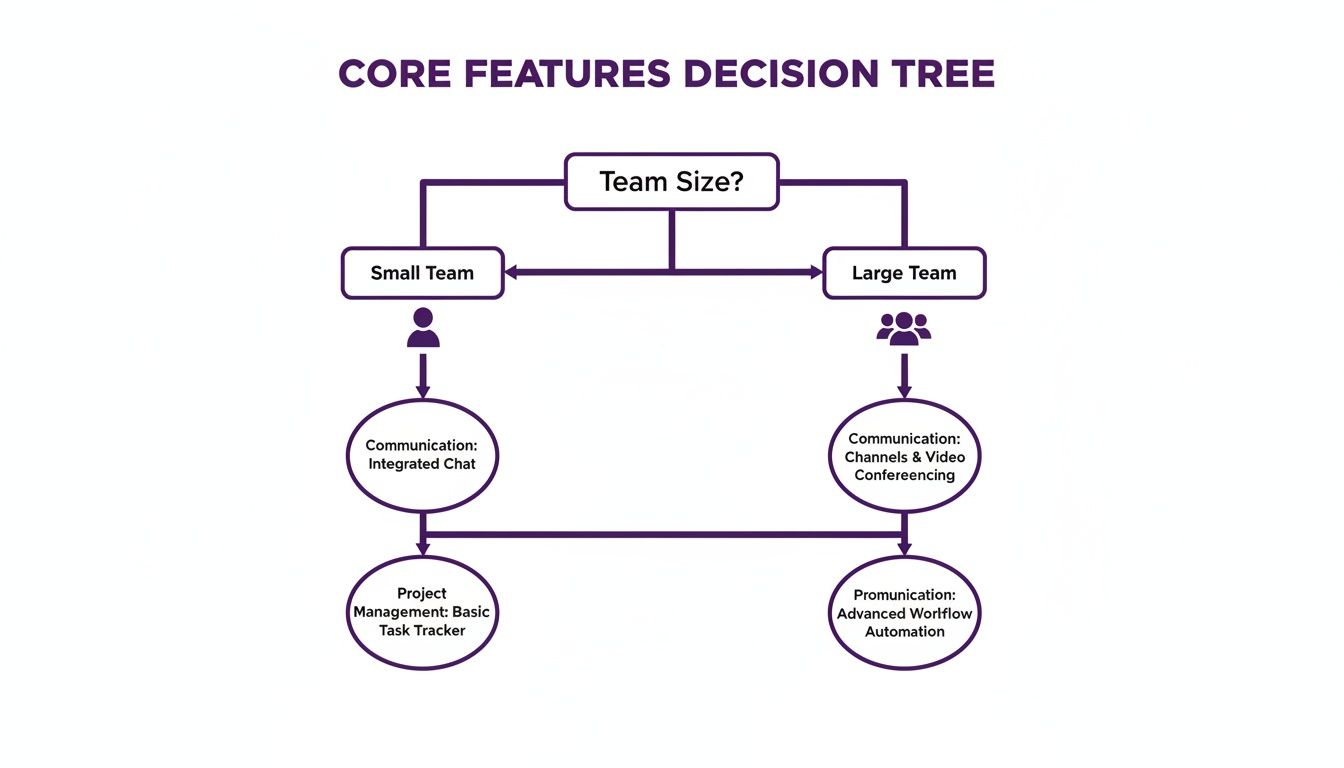
As you can see, smaller teams tend to look for simple shared inboxes, while larger teams need smart routing and automation to handle the sheer volume of conversations.
Understanding Pricing Models and Scalability for Live Chat Software
Live chat pricing can be a bit of a maze, but it usually breaks down into a few common models. Getting a handle on these is the key to avoiding surprise bills as your business grows.
- Per-Agent Pricing: You pay a monthly fee for each person on your team using the software. This is simple and works great if you have a stable team size you can predict.
- Per-Conversation Pricing: Some platforms bill you based on how many chats you handle. This can be a bargain if your chat volume is low, but costs can skyrocket during your busy season.
- Freemium Models: Plenty of providers offer a free plan with basic features, which is a fantastic way to dip your toes in the water. Just be sure to check the fine print—you’ll almost always need to upgrade to unlock critical ecommerce integrations or remove their branding.
The market for these tools is booming. Industry analysis projects the live chat software market will grow by USD 714.6 million between 2026 and 2030. While enterprise-level solutions exist, many top providers offer accessible plans for small businesses, often starting in the $10-49/month range. This makes it a technology that nearly any online store can afford. You can read more market trend research to get a better feel for the landscape.
Evaluating Integrations and Customization
A live chat tool should feel like it belongs on your website, not like a clunky, bolted-on widget. This is where customization and integrations become so important.
Customization is all about changing the look and feel—the colors, logos, and even agent photos—to match your brand. That kind of consistency builds trust with your shoppers from the first click.
Integrations, however, are even more critical. Your chat software has to connect smoothly with your ecommerce platform (like Shopify or WooCommerce) and your CRM. This gives your agents a complete picture of the customer, from their order history to what’s in their cart, all without having to jump between different tabs.
Comparing Popular Live Chat Software for E-commerce
To help you narrow down the options, this table compares some of the leading live chat solutions. Pay close attention to the integrations and ideal use cases to find a match for your store.
| Software | Ideal For | Key Ecommerce Integrations | Starting Price Model | Key Feature |
|---|---|---|---|---|
| LiveChat | Businesses of all sizes looking for a robust, all-in-one solution. | Shopify, BigCommerce, WooCommerce, Magento | Per-agent, from $20/mo | Proactive chat invitations and detailed reporting. |
| Tidio | Small to medium businesses wanting strong chatbot automation. | Shopify, Wix, Squarespace, WooCommerce | Freemium, paid from $29/mo | Visually intuitive chatbot builder and email marketing. |
| Intercom | Growth-focused companies need a full customer communications platform. | Shopify, Stripe, Segment, Salesforce | Per-seat and usage-based | Advanced segmentation and automated customer journeys. |
| Gorgias | E-commerce stores that live inside Shopify, BigCommerce, or Magento. | Deep integrations with major e-commerce platforms | Per-ticket, from $50/mo | Pulls customer data directly into the chat view. |
Ultimately, choosing the right live chat software for e-commerce is a strategic move. It demands a clear-eyed look at your current needs, future ambitions, and budget. By prioritizing scalability, essential integrations, and a pricing model that works for you, you’ll find a tool that doesn’t just improve support—it becomes a powerful engine for driving more sales.
Implementing and Managing Your Live Chat for Success
You’ve picked out the perfect live chat software for e-commerce—but the real work is just beginning. Simply dropping a chat widget on your site and hoping for the best isn’t a strategy. The real wins come from a smart implementation plan that turns your chat channel into a well-oiled machine for sales and customer loyalty.
Think of it like opening a new brick-and-mortar store. You wouldn’t just unlock the doors and walk away. You’d hire the right people, train them on your products and brand voice, and set up the space to be efficient and welcoming. The same exact principles apply here.

Building the Right Staffing Model for Your Live Chat
One of the first questions we always hear is, “How many agents do I actually need?” The honest answer is: it depends on your traffic. A good place to start is by digging into your website analytics to pinpoint your peak shopping hours.
You don’t need 24/7 coverage right out of the gate. Focus on having agents online when your customers are most active, which for many ecommerce brands is weekday afternoons and evenings. A solid staffing plan boils down to three things:
- Analyzing Peak Times: Fire up Google Analytics and find out when users are browsing and buying. Make sure your agents’ schedules overlap during these high-traffic windows.
- Staggered Shifts: Instead of a standard 9-to-5, use staggered shifts to cover more ground. For instance, one agent could work from 10 AM to 6 PM, and another from 2 PM to 10 PM. Just like that, you have 12 hours of coverage with only two people.
- Setting Chat Limits: Most experienced agents can comfortably handle 2-3 chats at once. Set this as a maximum in your software to prevent burnout and ensure the quality of each conversation stays high.
Training Agents for Empathy and Efficiency
Your live chat agents aren’t just support reps; they are the voice of your brand. The way they communicate directly shapes how customers see you—and whether they decide to buy. Training can’t just be about software tutorials. It needs to focus on blending speed with a genuine human touch.
The goal of live chat isn’t just to close tickets faster. It’s to build relationships. A single agent who is empathetic, patient, and knowledgeable can turn a frustrated shopper into a lifelong brand fan.
Agents have to be masters of your brand’s tone, whether it’s playful and witty or buttoned-up and professional. Role-playing is an incredibly powerful tool for this. Run drills that simulate real customer scenarios—from a simple shipping question to a complex product complaint. This builds the muscle memory and confidence your team needs to handle anything. For a deeper dive, it’s worth reviewing established contact center best practices that balance technical skill with cultural fit.
Using Surveys to Gather Actionable Intelligence
Live chat is so much more than a support channel. It’s a goldmine of customer intelligence. Simple pre-chat and post-chat surveys are your tools for turning every single interaction into a chance to learn and get better.
Pre-Chat Surveys: Start with Context
A pre-chat survey is a quick form a customer fills out before the chat starts. The key is to keep it short—no more than two or three fields. The whole point is to give your agent instant context so they can get right to solving the problem. Good questions to ask are:
- Name: Allows for a personalized greeting.
- Email: Essential for following up if the chat gets disconnected.
- Topic: A dropdown menu (e.g., “Sizing Question,” “Order Status,” “Return Request”) that can automatically route the chat to the right agent or department.
Post-Chat Surveys: Measure and Improve
A post-chat survey is all about measuring satisfaction and spotting areas for improvement. The most common and effective approach is a simple Customer Satisfaction (CSAT) question: “How would you rate your chat experience?” with straightforward options like “Good,” “Okay,” or “Bad.”
Always follow that with an optional, open-ended question: “How could we have made it better?” This qualitative feedback is pure gold. It might shine a light on an agent who needs more training, a confusing page on your website, or a recurring product issue you didn’t even know existed.
Measuring the ROI of Your Live Chat Strategy
So, you’ve got live chat running on your site. Great. But how do you prove it’s more than just another line item on your expense report? It’s one thing to install live chat software for e-commerce; it’s another entirely to measure its direct impact on your bottom line.
To get the real story, you have to look past surface-level numbers like total chat volume. Instead, you need to zero in on the key performance indicators (KPIs) that actually matter. This is how you shift the conversation from “How much does chat cost?” to “How much revenue is chat generating?”
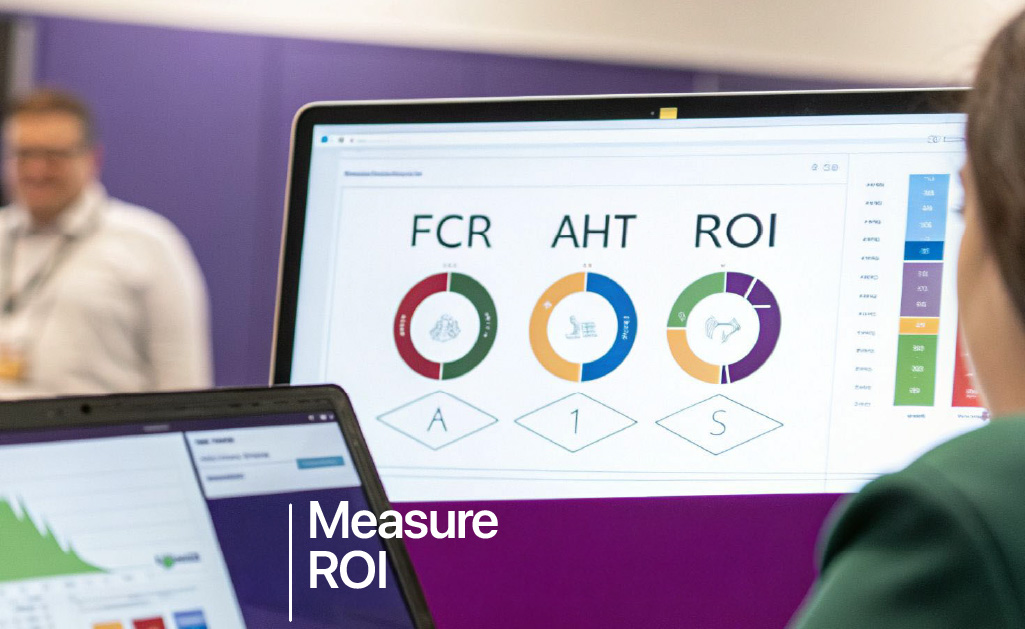
Key Performance Indicators for Live Chat Success
While you could track dozens of different metrics, only a handful are directly tied to your sales numbers. Think of these as the vital signs for your live chat’s financial health.
- First Response Time (FRT): This is how quickly an agent sends that first reply. In e-commerce, speed is everything. A customer with a question about sizing or stock isn’t going to wait around for an answer. A slow response almost always equals a lost sale.
- Customer Satisfaction (CSAT): This is usually measured with a simple post-chat survey asking, “How satisfied were you with your support?” Happy customers don’t just buy once—they come back, spend more, and tell their friends about you.
- Chat-to-Conversion Rate: This is the holy grail of live chat ROI. It tells you exactly how many chat conversations ended with a customer making a purchase. Modern live chat platforms can often track this automatically, especially if they’re deeply integrated with your e-commerce store.
Calculating Your Live Chat Conversion Rate
The chat-to-conversion rate is your most powerful piece of evidence. It’s the number that answers the ultimate question: “Is live chat actually making us money?” To figure this out, you can dig into your platform’s analytics or even use tools like a conversion rate calculator to help quantify the impact.
Let’s walk through a quick example. Imagine you handled 1,000 chats last month. By tracking cookies or checking your software’s reports, you find that 150 of those customers completed a purchase within 24 hours of their chat.
Your chat-to-conversion rate is 15% (150 sales / 1,000 chats). Now, if your average order value (AOV) is $100, you can confidently attribute $15,000 in revenue directly to your live chat team’s efforts for that month.
The real goal here is to connect every support metric back to a business outcome. A lower first response time isn’t just a random number to brag about—it’s a direct contributor to fewer abandoned carts and higher revenue.
By consistently tracking these core KPIs, you build an undeniable case for your live chat program. For a deeper dive into connecting performance data to your business goals, our guide on a variety of KPIs in customer service offers a much broader perspective.
When to Outsource Your Live Chat
to a BPO Partner
Putting live chat software for e-commerce on your site is a great start. But as your business grows, managing it all in-house gets complicated—and fast. Soon enough, the time and money spent on hiring, training, and scheduling agents 24/7 can pull you away from what really matters: growing your brand.
This is the exact moment when outsourcing stops being a simple cost-cutting trick and becomes a powerful strategic move.
Clear Signals It’s Time to Partner Up
The signs are usually impossible to miss. If any of these situations sound familiar, partnering with a Business Process Outsourcing (BPO) provider is your most direct path to scaling efficiently.
- You Need 24/7 Coverage: Your store is now attracting customers from different time zones. A simple 9-to-5 support schedule means you’re losing sales while you sleep. A BPO partner gives you instant access to a team that provides round-the-clock service.
- Your Team Is Stretched Thin: Are your key people—marketers, product developers, or even you—stuck answering the same support chats over and over? Outsourcing frees up your best talent to focus on high-impact work that actually drives growth.
- You’re Expanding into New Markets: If you’re pushing into a new region with a different language, like the massive Spanish-speaking market, you absolutely need native-level support. A bilingual BPO like CallZent gives you an instant, skilled talent pool without the long, expensive headache of trying to recruit specialized staff on your own.
The Nearshore Advantage for E-commerce Support
When you start looking at outsourcing, geography is a huge factor. A nearshore partner, like CallZent in Tijuana, gives you a unique mix of cost-effectiveness, cultural alignment, and operational excellence that offshore alternatives just can’t match.
Our agents are not just fluent in both English and Spanish; they are culturally attuned to the North American market. This means they understand the nuances of customer expectations, leading to more natural and effective interactions.
Working with a team in a similar time zone gets rid of the frustrating communication delays and management issues that often come with partners on the other side of the world. The decision to outsource is about so much more than saving money. It’s about strategically leveling up your customer experience. For ecommerce businesses serious about efficient growth, learning about the benefits of live chat support outsourcing is a critical next step.
Final Questions on E-commerce Live Chat
Even after you’re sold on the idea of live chat, a few practical questions always come up. It’s smart to think through the details of cost, staffing, and technology before you jump in.
Here are the straightforward answers to the questions we hear most often from store owners.
How Much Does Live Chat Software Cost for a Small Store?
Budget is everything for a small e-commerce business, but the good news is that live chat is not a high-cost investment. Most platforms run on a per-agent pricing model, meaning you pay a monthly fee for each person on your team who uses the software.
You can find excellent, full-featured tools in the $10-$49 per month range for each agent. This gets you all the core features like proactive chat, basic chatbots, and reporting, making it accessible even for brands just starting out.
Do I Really Need to Offer 24/7 Live Chat Support?
The short answer: not right away. It’s completely fine to start by offering live chat during your busiest hours. You can use offline forms or a simple chatbot to grab customer questions when you’re closed. This strategy lets you deliver great real-time service when it matters most.
As your store grows, however, 24/7 support becomes a powerful competitive advantage, especially if you’re selling across different time zones.
This is where a BPO partner shines. Outsourcing allows you to achieve round-the-clock coverage cost-effectively, ensuring you never miss a sale, no matter when a customer visits your store.
Can AI Chatbots Completely Replace My Human Agents?
Not yet. While AI is getting incredibly good, it’s not ready to take over completely. The most successful approach is a hybrid model.
Think of your chatbots as the first line of defense. They are brilliant at handling the simple, repetitive questions that flood your inbox, like “Where is my order?” or “What is your return policy?” This frees up your human agents to handle the complex, high-value conversations that actually close sales and build loyalty—the ones that require real empathy and problem-solving skills.
🚀 Scale Your E-commerce Support With CallZent
Need 24/7 bilingual live chat support without building an in-house team? CallZent provides nearshore ecommerce support specialists who help you increase conversions and deliver exceptional customer experiences.
Talk to an ExpertReady to scale your customer support without the operational overhead? CallZent provides expert, bilingual live chat teams that act as a seamless extension of your brand. Discover how our nearshore solutions can help you boost sales and build customer loyalty by visiting https://callzent.com.