Skip to content
Customer Support Outsourcing
Live Chat Support Outsourcing:
Turn After-Hours Conversations Into Revenue
What happens to your customers after 5 PM? Live chat support outsourcing helps businesses deliver 24/7 assistance, boost conversions, and transform customer support from a cost center into a scalable growth engine.
TL;DR: Why Outsource Live Chat Support?
Live chat support outsourcing enables 24/7 coverage, captures after-hours sales opportunities, and scales instantly during peak demand.
By partnering with a nearshore provider like CallZent in Tijuana, companies gain cost efficiency, cultural alignment, and high-quality customer interactions—directly improving CSAT, FCR, and conversion rates.
What happens to your customers after 5 PM? If you’re like most businesses, they’re left waiting. Live chat support outsourcing is how smart companies offer expert, 24/7 support that doesn’t just solve problems—it converts prospects, delights customers, and turns your support function from a cost center into a growth engine.
Why Outsourcing Live Chat Is Your Next Growth Move
Leaving customers to fend for themselves is no longer an option. Today’s buyers demand instant answers, and if you can’t provide them, they’ll find a competitor who can. This isn’t about replacing your core team. It’s about strategically extending your reach to capture every single opportunity, whether it’s at 2 PM or 2 AM. For a growing number of businesses, live chat support outsourcing has become a massive competitive advantage.
Real-World Scenarios Where Outsourcing Excels
Picture a booming e-commerce store in the middle of the holiday rush. Your in-house team is drowning under a 50% spike in questions about order tracking and product details. By partnering with a nearshore team for live chat, you can instantly scale up to handle the surge, making sure no sale is lost to a slow response time.
Or think about a SaaS company with users scattered across the globe. A customer in Australia hits a snag at 2 AM Pacific Time. Instead of stewing in frustration for hours until your US-based team clocks in, they get immediate help from a trained outsourced agent. A moment that could have ended in churn is transformed into one of genuine loyalty.
Comparing In-House vs. Outsourced Live Chat
When you put the two models side-by-side, the benefits become crystal clear.
| Factor | In-House Only Model | Strategic Outsourcing Model |
|---|---|---|
| Availability | Capped at standard business hours, leaving after-hours customers stranded. | Provides 24/7/365 coverage, capturing leads and solving issues around the clock. |
| Scalability | Scaling is slow and expensive—it means hiring, onboarding, and training new staff. | Instantly scalable to manage seasonal peaks or unexpected growth spurts. |
| Cost | High overhead from salaries, benefits, office space, and equipment. | Slashes operational costs by converting fixed expenses into flexible, variable ones. |
| Focus | Pulls your core team away from high-value projects to handle repetitive support tasks. | Frees up your in-house experts to concentrate on complex initiatives that drive the business forward. |
The real takeaway here is that outsourcing isn’t just about cutting costs—it’s about gaining the operational agility to deliver a consistently fantastic customer experience.
As you weigh your options, our complete guide to [contact center outsourcing solutions](https://callzent.com/contact-center- outsourcing-solution/) offers deeper insights into building a successful partnership. It’s also worth exploring AI chatbot solutions that can work alongside your live agents to handle simple, repetitive queries and further boost efficiency.
Defining What Success Looks Like for Your Business
Jumping into live chat support outsourcing without a clear destination is like starting a road trip without a map. Before you even think about looking at vendors, you have to get crystal clear on what a successful outcome actually looks like for your business. Honestly, this internal gut-check is the most important part of the whole process.
So, where do you start? Pinpoint your most nagging operational pain points. Are you hearing from customers that they can’t get help after 5 PM? Is your e-commerce site bleeding cash from abandoned carts? These problems are your starting line. A Forrester study really drove this home, finding that 53% of online shoppers will ditch their carts if they can’t get a quick answer. That’s a direct hit to your revenue.
Turning Problems into Measurable Goals
Once you’ve identified the problems, it’s time to translate them into real, measurable goals. Vague ambitions like “improve customer service” are useless here. You need specific targets that will anchor your partnership and tell you if it’s actually working.
Here are a few practical examples of how to define success with live chat support outsourcing:
- For an e-commerce brand: “Reduce cart abandonment by 25% within 90 days by proactively engaging shoppers on the checkout page.”
- For a SaaS company: “Boost our First Contact Resolution (FCR) for tier-1 technical questions from 60% to 85%.”
- For just about any business: “Hit a Customer Satisfaction (CSAT) score of 90% or higher across all chat interactions.”
A successful partnership isn’t just about answering chats; it’s about moving the needle on the business metrics that matter most to you.
Think of it this way: outsourcing becomes a growth engine. It helps you expand your availability, convert more curious visitors into paying customers, and ultimately, create a base of happy, loyal fans.
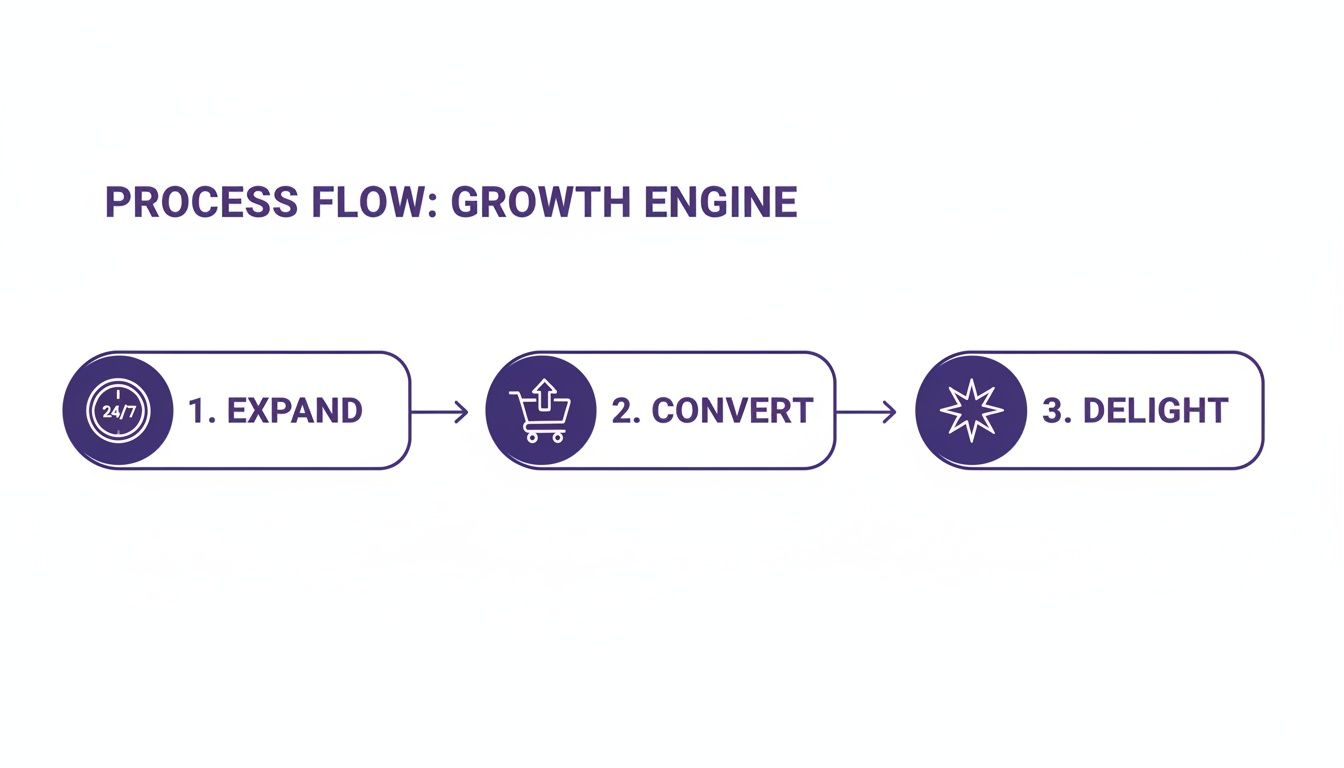
This flow from expansion to conversion and delight creates a virtuous cycle—one where great service fuels both customer acquisition and retention.
Nailing Down the Practical Details
With your big-picture goals set, it’s time to get into the weeds. You need to map out the practical, day-to-day requirements your outsourcing partner must meet. This step is crucial for comparing providers apples-to-apples and finding a team that genuinely fits how you operate.
Your list of practicals should cover things like:
- Hours of Coverage: Do you need true 24/7 support? Or maybe just someone to handle the after-hours, weekend, and holiday shifts?
- Language Requirements: Is English enough, or is bilingual English/Spanish support essential for your customer base?
- Technical Skills: Will agents just be answering general questions, or do they need to be comfortable navigating your custom CRM or troubleshooting your software?
- Key Performance Indicators (KPIs): Decide on the core metrics you’ll use to track performance. If you’re not sure where to start, our guide on essential call center reporting and metrics dashboards is a great resource.
 How to Choose the Right BPO Partner for Live Chat Support Outsourcing
Finding the right BPO isn’t just a box-ticking exercise; it’s a strategic choice. You’re looking for a partner who will protect and elevate your brand, not just handle tickets. The selection process can feel like a minefield, with countless options scattered across the globe.
But once you understand the core differences between outsourcing models, things start to get clearer.
Why Nearshore Live Chat Support Just Makes Sense
Onshore, offshore, and nearshore models each bring something different to the table. While going offshore might look good on paper with its cost savings, it often introduces friction—major time zone gaps and cultural disconnects that leave customers feeling frustrated.
This is where the nearshore advantage really shines.
A nearshore partner, like CallZent here in Tijuana, gets rid of those common outsourcing headaches. You get the cost-effectiveness of an external team while keeping your operations tightly aligned on time zones and cultural norms. This isn’t just a minor convenience; it’s a game-changer for quality.
When agents share a cultural context with your customers, conversations flow naturally. They pick up on subtle cues, build rapport effortlessly, and turn a simple support interaction into a positive brand experience.
Take a real-world example: an online retailer we know switched to a nearshore partner to keep its friendly, helpful brand voice intact. The result? A 15% jump in CSAT scores. Meanwhile, a competitor who chased a cheaper offshore option saw customer complaints about communication issues skyrocket by 30% in just one quarter.
To make the best decision for your business, it helps to see the models side-by-side.
Comparing Outsourcing Models for Your Business
This table breaks down the key characteristics of Nearshore, Offshore, and Onshore outsourcing. Use it to weigh which model aligns best with your budget, quality standards, and operational needs.
| Factor | Nearshore (e.g., Tijuana) | Offshore (e.g., Asia) | Onshore (e.g., USA) |
|---|---|---|---|
| Cost Savings | Moderate to Significant | Highest | Lowest (Premium) |
| Time Zone | Aligned (e.g., PST/CST/EST) | Significant Difference (8-12+ hours) | Identical |
| Cultural Proximity | High Similarity to U.S. | Varies, Potential Gaps | Identical |
| Travel & Collaboration | Easy & Affordable | Complex & Expensive | Easiest |
| Talent Pool | Bilingual (English/Spanish) | English-Speaking, Diverse Languages | Native English |
Ultimately, the right choice balances cost with the quality of customer interaction you want to deliver. Nearshore often hits that sweet spot.
Your Practical Vetting Checklist
As you start talking to potential partners, you need to move past the sales pitch and get into the nitty-gritty of their operations. A truly great partner will be transparent and ready to show you, not just tell you, what they can do.
Here’s a checklist to steer your conversations:
- Industry-Specific Experience: Have they actually worked in your world before (e.g., e-commerce, SaaS, healthcare)? Don’t be afraid to ask for specific case studies or references from businesses like yours.
- Agent Training Protocols: What does their training really look like? Ask how they’ll get agents up to speed on your products, brand voice, and internal tools. Look for a structured, hands-on onboarding program.
- Security and Compliance: This one is non-negotiable. Do they have key security certifications like SOC 2 or ISO 27001? You need to know your customer data is locked down.
- Technology and Integration: Can their platform play nicely with your existing CRM and other software? Seamless integration is the only way agents get the full customer context they need to be effective.
Your BPO partner is the voice of your company. Choose one that speaks your language—both literally and figuratively—to ensure your brand’s reputation is in safe hands.
The process requires real diligence. For a much deeper dive into the evaluation process, check out our guide to help you find and vet the best call center outsourcing companies for your unique needs. It lays out a more detailed framework so you can make a decision you’ll feel confident about from day one.
 Integrating and Training Your New Chat Team
Alright, you’ve picked your partner. Now for the most important part: turning them into a genuine extension of your brand. A successful launch for your live chat support outsourcing hinges entirely on how well you integrate and train your new team.
Getting this right is the difference between having just another vendor and having a true partner. It all comes down to empowering agents with the right knowledge, tools, and sense of belonging from day one.
First, let’s talk tech. The nuts and bolts of integration are foundational. This means getting your BPO’s chat platform talking to your internal systems, especially your CRM. When an agent can instantly see a customer’s entire history—past purchases, old support tickets, even what they just looked at on your site—they transform. They’re no longer just reactive problem-solvers; they become proactive, personal advisors. A unified view of the customer isn’t a “nice-to-have,” it’s non-negotiable.
But all the tech in the world won’t matter without the human element. You can’t just hand over a login and expect magic to happen.
Building an Empowered Agent Framework
A truly great partnership is built on a comprehensive, living knowledge base—not some static PDF that collects dust. This should be a dynamic library covering everything: detailed product specs, common customer questions, and crystal-clear escalation paths for when things get tricky.
Here’s a real-world example. A fintech company we know worked hand-in-hand with their BPO to create interactive training modules and live role-playing sessions. Before ever touching a real customer query, their outsourced agents practiced handling complex account issues in a simulated environment. The result? Agents were confidently resolving most issues on their own within the first week.
Your outsourced team is only as good as the training and tools you provide them.
And the stakes couldn’t be higher. Customers have voted with their clicks—live chat is their preferred support channel. Surveys show a whopping 41% of consumers pick live chat over the phone (32%) or email (23%), all thanks to its real-time convenience. With customers so clearly favoring this channel, a well-trained, deeply integrated team is critical to meeting their expectations. You can see more stats on live chat’s dominance over at ProProfsChat.com.
Key Training Components for Success
Effective onboarding goes way beyond just product features. To truly weave your outsourced team into the fabric of your company, your training needs to hit these key areas:
- Brand Voice and Tone: Give them real “say this, not that” examples. You want agents to sound exactly like you, reflecting the personality your customers know and trust.
- Customer Personas: Who are they talking to? Help agents understand your customers’ motivations, their biggest pain points, and what they really expect from you.
- Problem-Solving Scenarios: Don’t just give them a Q&A. Create complex, multi-step problems that force them to think critically and use the resources you’ve provided.
- Cultural Immersion: Share company news, celebrate team wins (both internal and outsourced!), and make your agents feel like they are a core part of your mission.
Investing time here is what transforms agents from script-readers into passionate brand advocates. For a more detailed blueprint on this, our guide on effective call center training techniques lays out exactly how to build a high-performing team from the ground up.
Optimizing Performance for the Long Haul
Getting your outsourced live chat team up and running is a huge step, but it’s just the starting line. The real magic of live chat support outsourcing happens when you treat it like a dynamic, evolving partnership. This isn’t a “set it and forget it” play; it’s all about continuous optimization and collaboration.
This ongoing management is what separates an okay partnership from a great one. It ensures your outsourced team doesn’t just meet expectations but consistently blows them out of the water, driving long-term growth and turning customers into fans. You’re essentially creating a feedback loop that fuels constant improvement.
Find a Strong Communication Rhythm
Great partnerships are built on clear, consistent communication. You need to lock in a regular cadence for checking in, aligning on goals, and tackling problems as a single, unified team. This rhythm is what keeps everyone in sync and rowing in the same direction.
We’ve found a two-tiered approach works best:
- Weekly Performance Check-ins: Think of these as your tactical huddles. You’ll dig into the previous week’s performance, review key metrics, and talk through specific customer interactions—both the wins and the learning moments. It’s the perfect time to clear any immediate operational hurdles.
- Quarterly Business Reviews (QBRs): These are your big-picture, strategic sessions. Here, you’ll zoom out to analyze broader trends, review progress against your main KPIs, and set ambitious goals for the next quarter. This is also where you’ll brief the team on upcoming product launches or marketing campaigns.
This structure keeps you on top of the day-to-day grind without ever losing sight of your long-term strategic goals.
The Metrics That Actually Matter for Optimization
Data is your best friend here, but it’s way too easy to get lost in a sea of numbers. Instead of tracking every metric under the sun, focus on the handful that give you the most actionable insights.
Don’t just measure what’s easy; measure what matters. Your metrics should tell a story about your customer experience and your operational efficiency.
Here are the vital few to keep a close eye on:
- Average Handle Time (AHT): A low AHT is generally good, but never at the expense of quality. If you see a sudden spike, it could point to a new product issue. A steady decrease? That might signal agents are getting more efficient with their tools and knowledge base.
- First Contact Resolution (FCR): Are agents solving problems on the first try? A high FCR is a powerful indicator of both customer satisfaction and agent expertise. It means you’re saving customers time and frustration.
- Customer Satisfaction (CSAT): This is the ultimate report card. But don’t just glance at the overall score. Dive into the qualitative feedback to uncover trends, identify friction points, and find specific areas to improve.
- Chat-to-Conversion Rate: For any e-commerce or sales-focused team, this metric is gold. It directly connects your support efforts to the bottom line, proving the ROI of great service.
Don’t forget the goldmine that is chat transcripts. For instance, a travel company we worked with noticed a recurring booking glitch kept popping up in customer chats. They flagged it, collaborated with their outsourced team to update the knowledge base with a workaround, and cut related support tickets by a staggering 40% in just one month. This kind of data-driven collaboration is how you create a truly seamless omnichannel customer experience where every single interaction adds real value.
Weave Your Team into Your Company Culture
Finally, always remember that your outsourced agents are people, not just numbers on a dashboard. The more they feel like they’re truly part of your company, the more invested they’ll be in your success.
Share company news, both big and small. Celebrate wins together—whether it’s a killer CSAT score or a glowing customer review that shouts out an agent by name. It’s that sense of shared purpose that elevates a vendor relationship into a true, game-changing partnership.
So, What’s Next?
We’ve covered a lot of ground—from mapping out your support goals all the way to managing a killer outsourced team. If there’s one thing to take away from all this, it’s that live chat support outsourcing isn’t just about cutting costs. It’s a strategic move that can seriously boost revenue, build rock-solid customer loyalty, and give you a real competitive edge.
When you find the right partner and nail the integration, you’re not just outsourcing a task; you’re upgrading your entire customer experience to the 24/7, always-on support that people now expect.
The next move is yours. Honestly, the biggest difference between the companies that win and those that just tread water is their willingness to take that next step. You now have the playbook to make a smart decision that could totally reshape how your customers see you and open up new avenues for growth.
The best way forward is to stop learning and start doing. A quick, strategic chat can give you the clarity you need to move ahead with confidence.
Ready to see what a nearshore partnership could actually look like for your business? Let’s get you from theory to practice. Schedule a chat with one of our experts at CallZent today. We’ll dive into your specific needs and show you exactly how our live chat solutions can turn your customer support from a cost center into a powerful revenue-generating machine.
Common Questions About Outsourcing Live Chat
If you’re considering outsourcing your live chat, you probably have a few questions. Here are the honest answers to the most common ones we hear from business leaders, designed to give you the clarity you need to move forward.
How Can I Ensure Quality Control With an Outsourced Team?
This is probably the biggest concern, and rightfully so. The key is to start by choosing a partner who operates with complete transparency. You’re looking for BPOs that give you full access to all chat transcripts, provide clear and detailed performance dashboards, and schedule regular quality assurance (QA) reviews with you.
The best partners won’t just hand you a generic report. They’ll work with you to build a custom QA scorecard based on what matters most to your brand—evaluating everything from the agent’s tone and accuracy to how effectively they solved the customer’s problem. Consistent communication is non-negotiable; scheduled meetings are crucial for keeping standards high and making smart, continuous improvements.
Will My Customers Know They Are Speaking to an Outsourced Agent?
When it’s done right, absolutely not. The whole point of a great BPO partnership is to create a seamless extension of your brand, not a disconnected, third-party feel.
This all comes down to intensive, high-quality training. Your partner needs to immerse their agents in your brand voice, company culture, and the nitty-gritty details of your products or services. Nearshore partners often have a natural advantage here due to better cultural alignment and language proficiency. When you provide comprehensive training materials and treat the BPO as a true partner, your agents will sound just like your in-house team, ensuring a consistent and authentic customer experience.
What Are the Biggest Risks of Outsourcing Live Chat?
The main risks usually fall into three buckets: data security breaches, a noticeable dip in quality, or a brand disconnect that ends up frustrating your customers. You can head off all three with some thorough due diligence before you sign on the dotted line.
First, prioritize partners with robust security certifications like SOC 2 or ISO 27001 to ensure customer data is protected. Don’t be shy about asking for case studies and references from companies in your industry to verify their track record. And to avoid that brand disconnect, make sure their training process is rigorous and that you have a direct line of communication with team leads for ongoing feedback and fine-tuning.
Ready to Turn Live Chat Into a Growth Engine?
See how CallZent’s nearshore live chat teams deliver 24/7 coverage, higher conversions, and consistently exceptional customer experiences.
Ready to see how a nearshore partnership can elevate your customer experience? The team at CallZent is here to help you build a high-performing live chat solution that feels like your own. Learn more about our services at CallZent.com.