Skip to content

Healthcare BPO
Medical Billing Outsourcing Company: A Strategic Guide to Maximizing Healthcare Revenue
Discover how medical billing outsourcing company help healthcare providers reduce claim denials, improve revenue cycle efficiency, and increase collections.
TL;DR — Quick Takeaways
- Medical billing outsourcing company helps healthcare providers reduce claim denials and accelerate reimbursements.
- Outsourcing revenue cycle management lowers operational costs and eliminates staffing shortages.
- Key KPIs to track include Days in A/R, Clean Claim Rate, and Net Collection Rate.
- Nearshore healthcare BPO partners offer cost efficiency, bilingual support, and real-time collaboration.
Are you watching revenue leak through the cracks of complex insurance rules and sky-high denial rates? For many healthcare practices, this isn’t just the cost of doing business—it’s a critical operational failure. Specialized medical billing outsourcing company are designed to plug that leak, managing your revenue cycle with expert precision to maximize every dollar you earn.
 Why Top Practices Outsource Medical Billing
Running a successful practice means juggling exceptional patient care with the tough realities of financial management. Too often, clinics find their resources stretched thin, with in-house teams struggling just to keep up with the relentless pace of billing, coding, and collections.
This operational strain is exactly why a growing number of practices are partnering with medical billing outsourcing companies. It’s a strategic pivot away from a costly, often inefficient internal function and toward a partnership laser-focused on maximizing revenue.
The Pressures Driving the Shift to Outsourcing
The decision to outsource isn’t just about saving a few dollars; it’s about gaining a competitive edge in an incredibly demanding environment. From what we’ve seen as a BPO provider, a few key pressures are fueling this trend:
- Persistent Talent Shortages: Finding and keeping skilled medical billers and coders is a constant battle. The high turnover and extensive training required create instability right at the core of your business.
- Ever-Changing Payer Rules: Insurance companies are notorious for constantly updating their policies, coding requirements, and submission guidelines. It’s a full-time job just to keep up, and an in-house team can easily fall behind, leading to a spike in claim denials.
- Rising Operational Costs: The overhead for an in-house billing department—salaries, benefits, software licenses, and ongoing training—adds up fast. Outsourcing converts these fixed costs into a variable expense tied directly to your collections.
This industry-wide move isn’t just anecdotal; the numbers back it up. The global medical billing outsourcing market was valued at USD 12.22 billion in 2026 and is projected to hit USD 20.76 billion by 2031. That explosive growth highlights a fundamental shift in how healthcare leaders are thinking about their revenue cycle.
For example, a mid-sized orthopedic clinic we know of was drowning in an 18% denial rate—way above the industry average. Their small admin team was completely overwhelmed. After partnering with a medical billing firm, they slashed their denial rate to just 4% within six months and recaptured over $250,000 in previously lost annual revenue.
Recapturing Lost Revenue and Restoring Focus
The core benefit of partnering with expert medical billing outsourcing companies is the immediate and direct impact on your bottom line. These specialized firms live and breathe revenue cycle management.
This isn’t just about handing off work. It’s about leveraging specialized expertise to drive tangible results like faster claim submissions, aggressive follow-up on unpaid claims, and proactive denial management.
In-House vs Outsourced Medical Billing At a Glance
| Factor | In-House Billing | Outsourced Billing |
|---|---|---|
| Cost Structure | High fixed costs (salaries, benefits, software, training) regardless of revenue. | Variable costs, typically a percentage of collections. You pay for performance. |
| Efficiency & Speed | Limited by staff bandwidth and expertise. Prone to delays from turnover or vacation. | Specialized teams and technology ensure faster claim submissions and follow-ups. |
| Compliance Risk | Burden falls entirely on the practice to stay updated on complex payer and HIPAA rules. | Experts are dedicated to compliance, reducing risk of errors and penalties. |
| Focus | Administrative staff are pulled away from patient-facing duties to manage billing tasks. | Your team is freed to concentrate on patient care and improving the patient experience. |
| Talent & Training | Constant cycle of recruiting, hiring, and training skilled staff in a competitive market. | Access to a deep bench of experienced, certified billing and coding professionals. |
Choosing to outsource is ultimately about shifting your practice’s energy and resources. Instead of sinking time and money into managing a complex administrative function, you’re investing in a partnership that drives financial health. This not only boosts your cash flow but also frees up your internal staff to concentrate on what they do best: providing an excellent patient experience. You can explore how outsourcing specific tasks can benefit your practice by reviewing our guide on BPO services for healthcare providers.
 How to Establish KPIs for Medical Billing Outsourcing Companies
Before you interview potential partners, you need to define what success looks like for your practice. Without a solid baseline, you have no way to measure the value a medical billing outsourcing company brings to the table. This means getting specific about your financial health, moving past a general feeling that things “could be better.”
Start by taking a hard look at your biggest revenue cycle headaches. Is a high volume of claim denials bleeding you dry? Are your accounts receivable aging out past 90 or even 120 days? Nailing down these pain points is the first step to establishing Key Performance Indicators (KPIs) that truly matter.
Core Metrics Your Billing Partner Must Improve
Don’t let yourself get bogged down in a sea of data. A few core KPIs will give you the clearest picture of your revenue cycle performance. These are the numbers any prospective billing partner should be able to speak to—and improve.
Here are three of the most critical:
- Days in Accounts Receivable (A/R): This is the average time it takes to collect payments owed to you. A lower number is always better, with a healthy industry benchmark sitting between 30-40 days. If your Days in A/R is creeping up, it’s a big red flag for your collections process.
- Clean Claim Rate (CCR): This measures the percentage of claims accepted by payers on the very first submission, no errors attached. A high CCR—ideally 95% or more—means your billing is accurate and efficient, which translates directly to faster payments.
- Net Collection Rate (NCR): This KPI shows how much of your potential reimbursement you’re actually collecting after write-offs. Top-performing practices often hit an NCR of 97% or higher, a sign that they’re maximizing every dollar they’re entitled to.
Setting up a dashboard to track these metrics is a non-negotiable. For some tips on creating effective reports, check out our guide on call center reporting and metrics. This will help you build a clear performance baseline from the get-go.
Benchmarking Your Current Performance
Once you’ve identified your core KPIs, it’s time to see where you stand. This isn’t just about knowing your numbers; it’s about understanding what they mean for your specialty and the industry at large.
For instance, a dermatology practice will naturally have a different average Days in A/R than a complex surgical group. You need to establish a realistic starting point so you can set achievable goals with a new partner.
This is where the right medical billing outsourcing companies prove their worth. They don’t just send you reports; they provide context. A strong partner will show you how your practice stacks up against similar ones and work with you to build a strategy for improvement from day one.
The best partners act as strategic advisors. They analyze your data, identify trends, and provide actionable insights to optimize your entire revenue cycle, not just process claims.
The demand for this level of expertise is surging. The U.S. medical billing services market alone was valued at USD 4.64 billion in 2020 and is projected to hit USD 8.00 billion by 2026. This growth is fueled by rising denial rates and increasingly complex payer rules that make specialized support essential. You can discover additional insights on the market’s growth to see the trend for yourself. It’s a clear signal that providers need solid metrics to effectively evaluate and manage their outsourcing relationships.
How to Vet Potential Medical Billing Partners
Finding a potential medical billing partner is easy. Finding the right one is tough. Once you’ve defined your KPIs and know what success looks like, you can start the crucial work of vetting potential medical billing outsourcing companies. This isn’t a price comparison; it’s a deep dive into their expertise, security, and operational transparency to find a true partner for your practice.
Any vague, one-size-fits-all answers are a major red flag. The right partner will welcome tough questions and give you clear, confident answers backed by real evidence.
Non-Negotiables in a Billing Partner
Before you even glance at a proposal, there are a few deal-breakers that should be at the top of your checklist. A “no” on any of these is an immediate disqualifier.
- Ironclad HIPAA Compliance: This is paramount. The company must prove they have robust security protocols, including data encryption, regular security audits, and thorough, ongoing HIPAA training for every staff member who will touch your data.
- Specialty-Specific Expertise: A company that mainly serves family practices probably won’t have the nuanced coding knowledge needed for a specialized surgical group. Ask for case studies or references from practices in your specialty to confirm they understand your world.
- EHR and System Integration: Seamless integration with your existing Electronic Health Record (EHR) system is non-negotiable. A partner who expects you to completely overhaul your current systems is asking for massive disruptions.
When vetting potential partners, it’s also critical to get a feel for their proficiency with a modern medical billing system. Their tech-savviness has a direct impact on how effectively they can manage your revenue cycle.
Key Questions to Ask Every Potential Partner
To get past the sales pitch, you need to ask sharp, specific questions that reveal how a company truly operates. Keep this list handy to gauge their competence and transparency.
- What is your exact process for denial management? Don’t settle for “we follow up on denials.” Ask for their step-by-step process. How do they dig into the root causes of denials? What’s their appeal success rate?
- Can we see a sample of your performance reports? A reputable company will be proud to show you examples of their reporting dashboards. Look for clarity, detail, and access to the KPIs you’ve already decided are important.
- How do you ensure coding accuracy and stay current with changes? They should have certified coders (like CPCs) on staff and a formal process for continuous education to keep up with the constant shifts in payer rules and coding guidelines.
- What is your communication and support structure like? Will you get a dedicated account manager? What are their standard response times for questions? Clear communication is the bedrock of a healthy partnership.
For instance, one cardiology practice nearly signed with a company offering a rock-bottom price. During the vetting process, they discovered the company’s software couldn’t integrate with their cardiology-specific EHR module. Dodging that bullet saved them from months of billing chaos and lost revenue.
Understanding Pricing Models for Medical Billing Outsourcing Companies
Medical billing outsourcing companies generally use a few different pricing structures. Understanding how they work will help you pick a model that aligns with your practice’s financial goals. Choosing the right partner is a core part of strategic outsourcing; for a deeper dive, you can explore our guide on what smart sourcing is and how it works.
Here’s a quick breakdown:
| Pricing Model | How It Works | Best For |
|---|---|---|
| Percentage-Based Fee | The company charges a percentage (typically 4% to 10%) of the revenue they collect on your behalf. | Practices looking for a true performance-based partnership where the partner is motivated to maximize collections. |
| Flat-Fee Per Claim | You pay a fixed dollar amount for every single claim submitted, no matter the reimbursement amount. | Practices with high claim volume and predictable reimbursement rates, like primary care or pediatrics. |
| Hybrid Model | This model mixes elements, such as a lower percentage fee plus a smaller flat fee for each claim. | Practices that want a custom structure, balancing performance incentives with predictable monthly costs. |
Ultimately, you’re looking for a partner who acts as a genuine extension of your team—someone who is transparent, technologically capable, and completely invested in your financial success.
The Strategic Advantage of Nearshore Healthcare BPO
Where you outsource your medical billing isn’t just about geography—it’s a critical strategic decision that can make or break your revenue cycle and patient relationships. Too often, practices get stuck comparing only two options: onshore vs. offshore. They completely miss the powerful middle ground: nearshore.
Opting for a nearshore partner in a location like Tijuana, Mexico, gives you a unique mix of cost-effectiveness and hands-on collaboration that a distant offshore location just can’t deliver. This is where you find the sweet spot between proximity and performance, creating real, tangible wins for your practice.
Time Zone Alignment and Real-Time Collaboration
Let’s be practical: time zone alignment is one of the biggest, most immediate wins of a nearshore partnership. When your billing team is half a world away, even small issues can snowball.
Imagine you have an urgent question about a high-value claim at 3 PM your time. With an offshore team, you’re likely waiting until the next business day for an answer. With a nearshore team, your partner is on your clock. This close proximity means you can solve problems in real time.
- An unexpected payer rejection? It can be handled in hours, not days.
- Your front-desk staff needs to clarify patient info? They can jump on a quick call, not trade emails overnight.
- End-of-month reporting becomes a team effort, not a frantic, late-night scramble.
This sync-up keeps your revenue cycle flowing smoothly, without the built-in delays of an offshore model. Your outsourced team stops feeling like a distant vendor and starts acting like a true extension of your practice. You can learn more about how this proximity creates value by reading our article on the benefits of nearshore outsourcing.
The Power of a Bilingual and Culturally Aligned Workforce
Beyond logistics, the cultural and linguistic match you get with a nearshore partner is a game-changer, especially for patient collections and communication. A huge piece of your revenue cycle relies on clear, empathetic conversations with patients about what they owe.
This is where a nearshore team in Mexico really shines. Agents aren’t just fluent in English; they also have a native, deep understanding of Spanish and the cultural nuances of Hispanic communities throughout the U.S. That dual capability is priceless.
Think about a patient with a high-deductible plan who’s confused and worried about a large, unexpected bill. A disconnected offshore agent might just stick to a rigid script, making things worse. A bilingual, nearshore agent, on the other hand, can switch to Spanish if it helps, explain the EOB with genuine empathy, and work with the patient to set up a payment plan. The patient relationship is saved, and you secure the payment.
That cultural fluency closes the communication gaps that so often lead to frustrated patients, delayed payments, and negative online reviews. It means your practice is represented with professionalism and care every single time.
Nearshore vs. Offshore Billing Partner Comparison
When you put them side-by-side, the strategic trade-offs between a nearshore and offshore partner become crystal clear. This isn’t just a minor detail—it impacts everything from your daily workflow to your long-term patient loyalty.
To make it simple, here’s a breakdown of what you’re really choosing between.
| Feature | Nearshore Partner (e.g., Mexico) | Offshore Partner (e.g., India, Philippines) |
|---|---|---|
| Time Zone | Aligned with U.S. time zones, enabling real-time collaboration and immediate support. | Significant time difference (8-12+ hours), leading to communication delays. |
| Cultural Alignment | Strong cultural affinity with the U.S., leading to better patient communication and understanding. | Potential for cultural and linguistic disconnects that can create friction with patients. |
| Bilingual Capabilities | Deep bench of fluent, native English and Spanish speakers for versatile patient support. | English is typically a second language; native-level Spanish is rare. |
| Travel & Oversight | Short, inexpensive flights allow for easy site visits, training, and relationship building. | Long, expensive, and time-consuming travel makes in-person oversight impractical. |
| Problem Resolution | Faster resolution cycles due to shared business hours and direct access to team members. | Slower turnaround times on urgent issues because of the time lag. |
Ultimately, choosing a nearshore partner is more than just a line item on your budget. It’s a strategic investment in better communication, a faster revenue cycle, and a superior financial experience for every one of your patients.
How to Ensure a Smooth Onboarding and Transition
Let’s be honest: the thought of switching medical billing partners can be terrifying. Many practices stick with an underperforming company simply because they dread the chaos of a transition. But a well-executed handover isn’t about flipping a switch and hoping for the best. It’s a structured, collaborative process designed to get you up and running without disrupting your cash flow or your team.
The goal isn’t just to move data from Point A to Point B. It’s about building a solid foundation for a long-term partnership from the moment you sign the contract.
Technical Steps for a Clean Handoff
The technical side of onboarding is all about precision and planning. Your new partner should come to the table with a detailed project plan—not a vague checklist, but a clear roadmap with milestones for every step. If they don’t, that’s a red flag.
Here are the non-negotiables:
- Secure Data Migration: Your new team will need access to historical patient demographics, payer contracts, and, most importantly, your outstanding A/R. This process absolutely must be encrypted and handled with an obsessive focus on security protocols. To get a better sense of what this entails, it’s worth understanding the standards of a HIPAA-compliant call center.
- EHR Integration and System Access: The new team will need secure, role-based access to your EHR and practice management system. This is usually handled via secure VPNs or direct user accounts with permissions limited to exactly what they need to do their job—no more, no less. The integration must be tested repeatedly to ensure data flows flawlessly between systems.
- Clearinghouse and Payer Enrollment: Your new partner takes the lead here. They’ll manage the tedious process of enrolling your practice with the necessary clearinghouses and payers under their own credentials. This is crucial for making sure claims are routed correctly from day one.
Managing the Human Element of Change
Getting the technology right is only half the battle. Just as important is guiding your internal team through the transition. Outsourcing isn’t about replacing your staff; it’s about empowering them to focus on high-value, patient-facing work.
A successful transition hinges on clear communication. Your team needs to see the new partner not as a threat, but as a powerful ally that will free them from tedious administrative burdens and allow them to focus on what truly matters—patient care.
Proactive change management is everything. Be upfront about how roles will evolve. For example, your front-desk staff can stop spending hours on complex insurance verifications and instead dedicate that time to improving the patient check-in experience, confident that the billing team has it covered.
This graphic shows how a well-aligned nearshore BPO partner helps streamline this entire operational flow, making the transition feel more like a collaboration than a takeover.
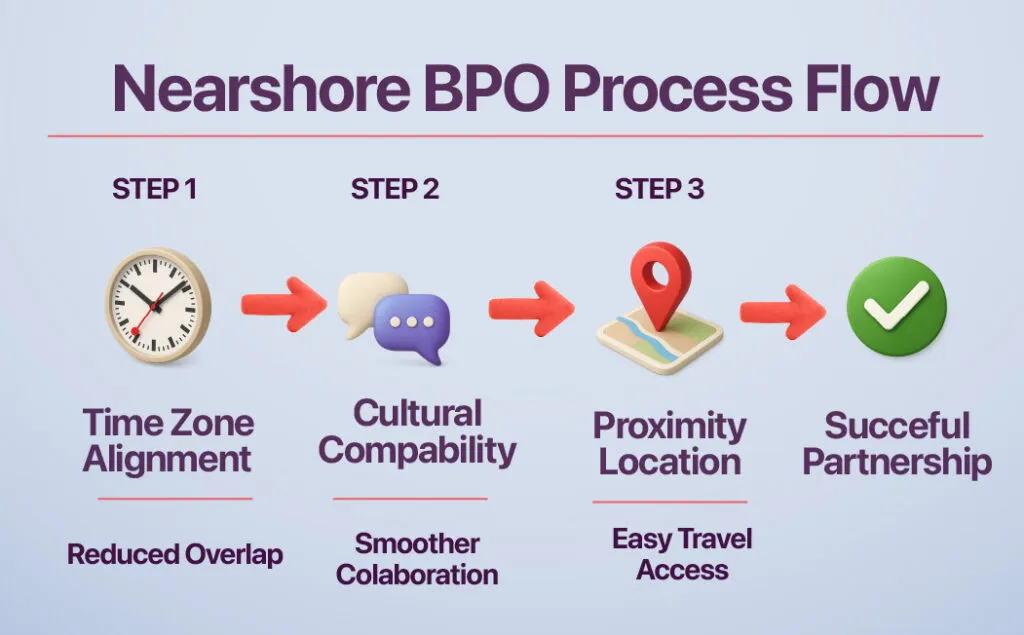
The visualization highlights how alignment in timezone, culture, and location creates a more integrated and responsive partnership, which is essential during the onboarding phase.
Building a Collaborative Partnership from Day One
The first 90 days set the tone for the entire relationship with your medical billing outsourcing company. This is your chance to establish rock-solid communication channels and reporting rhythms.
- Schedule a Formal Kick-Off Meeting: Get all the key players from your practice and the billing company in the same room (virtual or physical). Walk through the project plan, align on goals, and make sure every person knows their exact role and responsibilities.
- Establish a Regular Meeting Cadence: Don’t wait for problems to arise. Set up weekly or bi-weekly check-in calls to review progress, tackle roadblocks, and keep an eye on initial KPI performance. This keeps everyone accountable and prevents small issues from snowballing.
- Define Reporting Needs: Decide what reports you need to see and how often you’ll get them. At a minimum, you should have constant dashboard access to key metrics like claim submission volume, payment postings, and the initial denial rate.
A well-managed onboarding process transforms a moment of potential anxiety into the launchpad for your practice’s financial growth. It ensures your new partnership starts on solid ground, ready to deliver results.
Frequently Asked Questions About Medical Billing Outsourcing Companies
Thinking about outsourcing your medical billing? It’s a big move, and you’ve probably got a dozen questions running through your mind about the cost, the process, and whether you’ll still be in the driver’s seat.
Let’s cut through the noise and tackle the big ones head-on. Here are the straight-up answers we give healthcare providers every day.
How much does it cost to outsource medical billing?
This is always the first question, and the honest answer is: it depends. Most medical billing outsourcing companies charge a percentage of whatever they collect for you, typically landing somewhere between 4% to 10% of your monthly revenue.
The exact rate hinges on factors like your practice size, specialty, and claim volume. For instance, a busy primary care clinic will likely snag a lower percentage than a highly specialized surgical practice with fewer, but more complex, claims. Some firms also offer a flat-fee-per-claim model. The best model comes down to whether you prefer a partner whose pay is tied to performance or one that offers a fixed operational cost.
Will I lose control over my billing process?
This is a huge fear, but the answer is a firm no—at least, not with the right partner. A reputable firm won’t operate in a black box. They act as a true extension of your team, providing total transparency.
Think of it less like handing over the keys and more like getting a co-pilot. Modern outsourcing partners give you access to detailed reporting dashboards where you can see everything in real-time. You’ll have full visibility into:
- Claim submission volumes and timelines
- Clean claim rates and denial trends
- Days in A/R and overall collection performance
- Patient payment status and balances
You maintain full strategic oversight. Your partner just handles the day-to-day grind, freeing you and your team to focus on patient care.
Outsourcing doesn’t mean giving up control; it means gaining a specialist to manage the controls for you. The right partner empowers you with better data and more time, not less authority.
How is patient data kept secure and HIPAA compliant?
In healthcare, data security is non-negotiable. Any top-tier medical billing outsourcing company treats HIPAA compliance as its lifeblood because a single breach would be catastrophic for them and their clients. For them, security isn’t just a policy—it’s baked into their technology and processes.
The best partners implement multiple layers of defense:
- End-to-End Encryption: All data is encrypted, whether it’s at rest on their servers or in transit to a payer.
- Regular Security Audits: They hire third-party experts to constantly test their systems, looking for weaknesses to patch.
- Comprehensive Staff Training: Every person who could possibly touch your data goes through rigorous, continuous HIPAA training. They know the rules inside and out.
Don’t just take their word for it. During the vetting process, ask for proof. A confident partner will have no problem sharing their latest HIPAA audit reports, security certifications (like SOC 2), and training records. If they hesitate, that’s a red flag.
What is the typical onboarding timeline?
Getting fully up and running with a new billing partner usually takes anywhere from 30 to 90 days. The exact timeline depends on the complexity of your practice, the EHR system you’re using, and how much historical data needs to be moved over.
A good partner won’t just “wing it.” They’ll provide a detailed project plan that maps out the entire transition. This plan should have clear milestones for everything—data extraction, system integration testing, payer re-enrollment deadlines, and go-live. A proactive partner manages this process meticulously to ensure there are no bumps in the road, setting you up for success from day one.
🚀 Ready to Optimize Your Healthcare Operations?
CallZent helps healthcare organizations streamline revenue cycle support and patient communication through scalable nearshore BPO solutions.
Schedule a CallReady to transform your revenue cycle with a partner who understands your needs? CallZent offers expert, nearshore BPO solutions that combine specialized billing support with exceptional, bilingual patient communication. Discover how our team can help you increase collections, reduce administrative burdens, and improve your bottom line.