Skip to content
Healthcare BPO
Medical Call Center Services: How Outsourcing Transforms Patient Communication
Medical call center services streamline patient communication, reduce hold times, and ensure HIPAA compliance—elevating care, efficiency, and satisfaction with nearshore expertise.
TL;DR — Quick Takeaways
- Problem: In-house teams are overwhelmed by call volume, leading to poor patient experience, staff burnout, and administrative errors.
- Solution: Outsourcing to a specialized medical call center handles non-clinical tasks like appointment scheduling, insurance verification, and patient follow-up.
- Key Benefits: 24/7 access, higher efficiency, real cost savings, and strict HIPAA compliance improve outcomes and satisfaction.
- Nearshore Advantage: A Tijuana-based partner offers proximity, cultural alignment, and a skilled bilingual talent pool.
Is your medical practice struggling to keep up with patient calls, leading to long hold times and frustrated staff? You’re not alone. In today’s healthcare landscape, patients expect instant, seamless support, but outdated phone systems often create bottlenecks that hurt both patient satisfaction and your bottom line. How can you deliver exceptional service without overwhelming your in-house team?
The answer lies in strategic outsourcing. A specialized medical call center partner can transform your patient communication from a chaotic cost center into a powerful tool for growth and retention.
Why Modern Healthcare Demands
Better Patient Communication
The patient experience doesn’t start in the waiting room anymore. It begins with the very first phone call. But let’s be honest, most in-house teams are stretched incredibly thin, juggling a constant flow of inquiries, scheduling requests, and urgent calls. This strain doesn’t just create operational headaches; it directly chips away at patient satisfaction and can even impact health outcomes.
The numbers are pretty staggering. The average healthcare call center handles a massive volume of interactions, often around 2,000 calls every single day. The real problem? Staffing levels rarely keep up, meeting only about 60% of the needed coverage during peak hours. This gap creates a domino effect: longer waits, frustrated patients, and a decline in the quality of care.
Evolving From a Switchboard to a Strategic Hub
A modern medical call center service is much more than a glorified answering service. Think of it less like a chaotic switchboard and more like a strategic command center for all patient engagement. This shift is essential for meeting today’s patient expectations, which now include everything from modern communication methods like SMS for appointments to having immediate access to information.
By taking over all the non-clinical tasks, these specialized services free up your medical staff to do what they were trained for: providing hands-on patient care. When you learn how to improve patient experience, you’ll quickly see that clear, reliable communication is the bedrock of patient loyalty and retention.
A specialized medical call center isn’t just an operational tool; it’s a foundational element of modern, patient-centric healthcare delivery.
This is where a dedicated partner, especially a nearshore provider, can be a game-changer. It’s the perfect middle ground—you get advanced communication capabilities and highly trained agents without the sky-high costs of a domestic team. Making this strategic move ensures every single patient interaction is handled professionally, promptly, and with the empathy your patients deserve.
The Core Services of a Medical Call Center
A top-tier medical call center does more than just answer the phone. It acts as a genuine extension of your practice, taking on the crucial non-clinical work that has a massive impact on patient care and how smoothly your office runs. These specialized medical call center services are built to lift the administrative weight off your in-house team, freeing them up to focus on the patients standing right in front of them.
Think of it like a finely tuned engine. Each service is a different gear handling a specific job, but they all have to work together perfectly to keep the whole patient journey moving forward. One small slip-up, like a bungled insurance check, can grind everything to a halt and cause headaches for both patients and staff.
Seamless Integration with Your In-House Team
A great medical call center doesn’t just sit on the sidelines—it becomes part of your clinic’s inner workings, stepping in exactly where you need backup most. Think of it as your own team’s extension, not a faceless third party.
Here’s how it works in real life:
- Specialist agents are trained to mirror your office’s protocols, processes, and even personality, so patients get a consistent experience whether they’re on the phone or standing at the front desk.
- Coverage isn’t just limited to regular hours. With flexible support before, during, and after business hours, your patients have access to help when they need it—without burning out your core team.
- Both clinical and non-clinical tasks are handled with precision, from appointment scheduling to insurance verifications and prescription refills, allowing your staff to shift their focus to direct patient care.
The beauty of this set-up is its invisibility: to your patients, it feels like one unified, attentive team—regardless of who’s answering the call. This seamless integration means fewer dropped balls, less stress for your in-office staff, and a smoother experience at every touchpoint.
Nurse Line Services: The Unsung Backbone
So, what exactly does a nurse line within a medical call center bring to the table? Think of it as your on-demand clinical support team, seamlessly slotting in alongside your front-office staff to handle a surprising range of patient needs that keep your operation humming. Here’s how they lighten the load:
- Clinical Guidance and Follow-Up: From answering pre- and post-surgery questions to tracking recovery, nurse lines ensure patients never feel left in the dark after leaving your office.
- Prescription Coordination: Need a medication refilled? The nurse line can handle those routine (but crucial) prescription requests, keeping things moving so patients get what they need, minus the phone tag.
- Appointment Management: Whether it’s scheduling follow-up visits, annual wellness checks, or sorting out specialty care, these professionals keep calendars full and patients on track.
- Patient Outreach and Engagement: Checking in on treatment compliance, conducting surveys, or reaching out to make sure patients are sticking with their care plans—nurse lines don’t just wait for calls; they proactively support better outcomes.
- Support for Chronic Care Management: Nurse lines specialize in helping patients manage ongoing conditions with regular check-ins, eligibility reviews, and seamless updates to EMRs, so care teams always stay in the loop.
- Clinical Trial Coordination: For clinics participating in FDA trials or research partnerships, nurse call center agents help bridge the gap between patients and protocols, ensuring compliance and patient safety at every step.
In essence, a robust nurse line doesn’t just answer the phone—it acts as a silent engine driving better patient care, higher satisfaction rates, and fewer headaches for everyone on your team.
Patient Intake and Registration
That first conversation with a new patient sets the tone for everything. A specialized agent handles this with care, gathering all the demographic details and medical history needed with total accuracy. Getting this foundational step right from the jump prevents a cascade of problems later on, from billing mistakes to clinical confusion.
Here’s a real-world example: A new patient calls a busy multi-specialty clinic. Instead of a stressed-out receptionist trying to juggle the call with a line of people at the desk, a dedicated call center agent patiently guides the patient through the entire registration. They make sure every single field in the electronic health record (EHR) is filled out correctly before an appointment is even on the books.
Pre-Authorization and Insurance Verification
Let’s be honest, dealing with insurance is a nightmare. It’s a huge time sink for any practice. A core service of a medical call center is tackling pre-authorizations and verifying a patient’s insurance coverage before they ever set foot in your office. This simple, proactive step means no surprise bills for patients and ensures your practice actually gets paid for its services.
Picture a surgical center that has offloaded all its insurance verification work. The call center agents are the ones calling insurers, confirming coverage for specific procedures, and locking in any pre-authorizations. If they hit a snag, they flag it for the billing team long before it becomes an emergency. This one function alone slashes check-in delays and claim denials.
The true efficiency of a healthcare practice isn’t just about clinical skill—it’s about how well it manages the mountain of administrative tasks that surround patient care. Outsourcing isn’t just a cost-cutting move; it’s a strategic one.
This chart shows just how far we’ve come, moving from clunky, siloed communication to the integrated solutions that dedicated call centers offer.
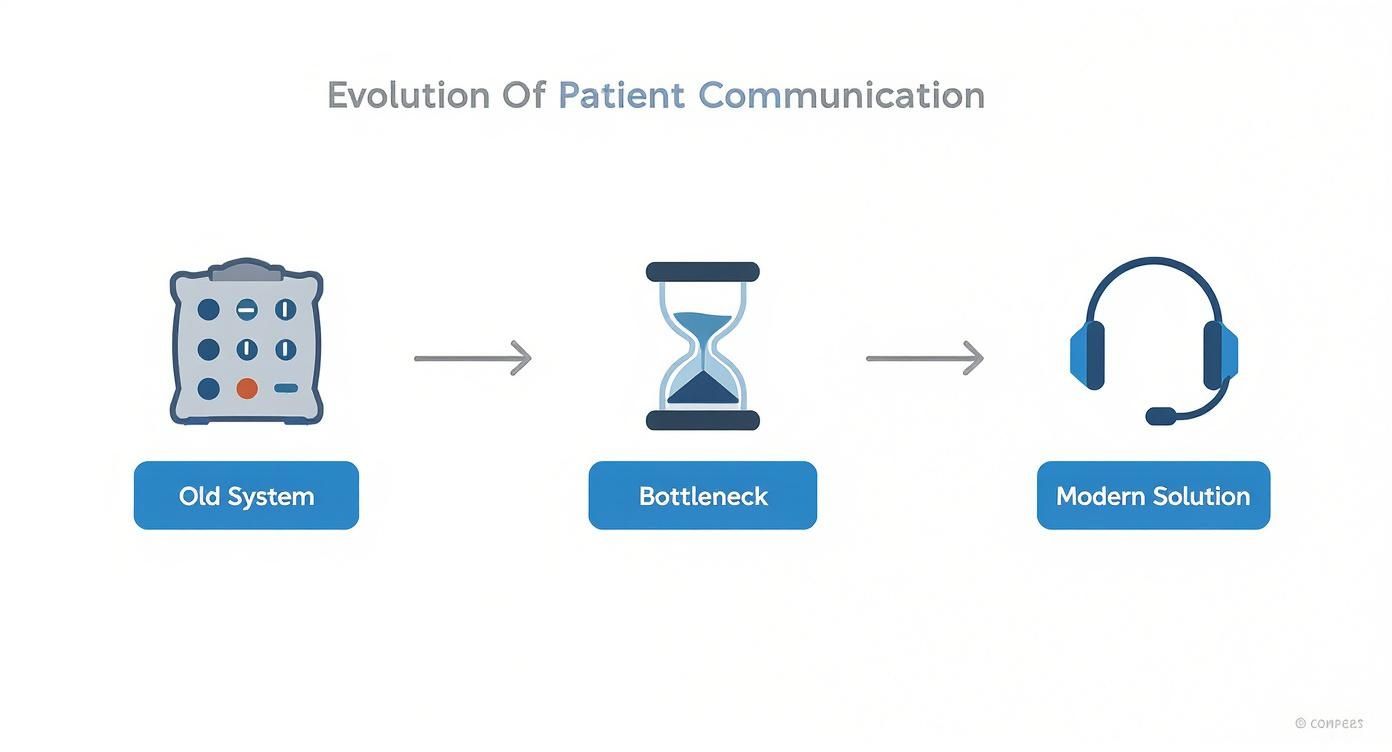
You can clearly see how getting away from the old switchboard model and its bottlenecks creates a much more responsive and effective hub for all patient communication.
Streamlining Appointments and Refills
Of all the core services, managing the appointment book is arguably the most important. This isn’t just about scheduling new visits; it’s about expertly handling cancellations, rescheduling requests, and sending out automated reminders that drastically cut down on no-shows. In fact, many practices are now offering conveniences like fast online dental appointment booking to make life easier for everyone. You can see how CallZent’s own medical appointment scheduling services can completely overhaul your practice’s workflow.
It’s the same story with prescription refills. Agents can field these requests, gather the necessary patient info, double-check the medication details, and then pass it all along to the right clinical staff for approval. This creates a clean, documented process that’s far more organized than a flurry of voicemails.
Post-Discharge and Follow-Up Calls
A patient’s care journey doesn’t end the moment they walk out the door. Proactive follow-up calls after a discharge are absolutely essential. They ensure patients actually understand their care plans, are taking their medications correctly, and have their next appointments scheduled. This isn’t just good service; it has been proven to lower hospital readmission rates and improve patient outcomes by catching potential problems before they become serious.
But follow-up isn’t a one-size-fits-all task. Modern medical call centers can handle an array of crucial touchpoints along the post-discharge continuum:
- Pre- and Post-Operative Encounters
Agents check in with patients before and after procedures to review instructions, answer questions, and reinforce compliance, helping patients feel prepared and supported at every step. - Prescription Refills
Instead of endless voicemails or missed messages, dedicated teams can manage refill requests efficiently—verifying details, collecting necessary info, and ensuring timely handoff to clinical staff. - Follow-Up Appointment Scheduling
Whether it’s a routine check-up or a critical post-op review, call center agents make sure patients are booked for necessary follow-ups, helping avoid gaps in care. - Patient Surveys and Feedback
Proactively reaching out for feedback or compliance checks ensures patients feel heard and lets practices continuously improve their services. - Support for FDA Trials and Chronic Care Management
For practices participating in clinical research or managing chronic conditions, call centers can assist with everything from patient outreach and eligibility analysis to scheduling annual wellness visits and documenting engagement in EMRs.
With these comprehensive services, your call center becomes an extension of your care team—closing the loop on patient communication and ensuring no one falls through the cracks.

The Big Wins: Key Benefits of Outsourcing
Your Medical Call Center
Let’s be honest, bringing a specialized provider on board for your medical call center services is about more than just answering phones. It’s a strategic move with a clear, measurable return. You’re not just offloading a task; you’re actively strengthening your practice across four critical areas: elevating the patient experience, boosting operational efficiency, finding real cost savings, and locking down your HIPAA compliance.
This isn’t just some fringe trend—it’s a major shift in how healthcare administration gets done. The global market for healthcare BPO is exploding, projected to hit an incredible USD 636.95 billion by 2032. What’s driving this? A massive need for smarter administrative processes and more direct, streamlined patient care. You can read more about the healthcare BPO market growth to see just how big this transformation really is.
Elevate the Patient Experience
You only get one chance to make a first impression, and for most patients, that happens over the phone. When you outsource, you guarantee that every single call is handled by a trained professional. This move slashes hold times and gives patients 24/7 access when they need it most. That kind of immediate, empathetic support builds trust and loyalty from day one.
Picture this: a worried patient needs to schedule an urgent follow-up late at night. Instead of getting a cold, frustrating voicemail, they’re greeted by a live agent. Someone who can actually pull up the schedule, book the appointment, and offer a bit of reassurance. That level of care and accessibility is a game-changer.
Boost Operational Efficiency
Your clinical team—your nurses, MAs, and doctors—are highly trained experts. Every minute they spend juggling schedules or verifying insurance is a minute they aren’t spending on patient care. Handing off these non-clinical tasks to a dedicated team frees them up to work at the top of their licenses, where they create the most value.
This has a direct impact on the quality of care. With the administrative weight lifted, your in-house staff can give their full attention to the patients right in front of them. This means shorter check-in times, fewer clerical errors, and a much smoother flow throughout the clinic. The result? A more efficient, less stressed, and higher-performing team.
A specialized medical call center isn’t a cost center; it’s an investment in patient loyalty and operational excellence.
Achieve Significant Cost Savings
Let’s face it, building an in-house call center is a massive financial and logistical headache. You have to think about recruitment, extensive training, technology, office space, and all the overhead that comes with managing another department. A nearshore partner wipes those capital expenses off the table. Instead, you get a predictable, operational cost that’s often far more economical.
By partnering with a provider in a place like Tijuana, you tap into a deep pool of skilled, bilingual talent without the high labor costs of a domestic team. This is the core advantage of smart healthcare business process outsourcing. It gives you the power to scale your support up or down as needed, without the financial strain.
Ensure Ironclad HIPAA Compliance
When it comes to patient data, security is non-negotiable. There are no second chances. Reputable medical call centers live and breathe HIPAA compliance, investing heavily to keep every piece of information locked down tight.
This commitment shows up in a few key ways:
- Secure Technology: All communication channels and data storage systems are fully encrypted and protected.
- Rigorous Training: Every single agent goes through continuous, in-depth training on HIPAA regulations and privacy best practices.
- Controlled Environments: They operate out of secure facilities with restricted access, ensuring sensitive information stays that way.
Choosing a partner who is obsessive about compliance doesn’t just reduce your risk—it gives you priceless peace of mind. You can rest easy knowing every patient interaction is handled with the highest possible standard of confidentiality and care.
 The Nearshore Advantage for Medical Call Center Services
Strengthen Accountability and Quality with Comprehensive Call Recording
One of the unsung heroes behind a high-performing medical call center is its robust call recording system. For healthcare organizations, this isn’t just about keeping tabs—it’s about creating a clear, auditable trail that supports both patient safety and operational excellence.
Here’s why that matters:
- Training and Quality Assurance: Every recorded call becomes a real-world training resource. Supervisors can review interactions, identify best practices, and pinpoint opportunities for skill-building—raising the performance bar across the team.
- Dispute Resolution: If there’s ever a question about what was said or agreed upon, the recording provides a factual reference. It’s your built-in insurance policy for navigating billing questions, claims, or appointment disputes.
- Regulatory Compliance: Call recording reinforces accountability and transparency, making it easier to demonstrate adherence to regulatory requirements like HIPAA, especially during audits or internal reviews.
- Continuous Improvement: Top-performing organizations, like Mayo Clinic and Cleveland Clinic, routinely use call recordings to analyze trends and fine-tune the patient experience—ensuring every conversation reflects empathy and professionalism.
By making thorough call recording standard practice, you empower your team with the tools to continuously improve, safeguard sensitive conversations, and guarantee that every patient interaction meets your highest standards.
When you’re choosing a partner for your medical call center services, location is more than just a pin on a map—it’s a massive strategic advantage. Offshore locations might look tempting on paper, but a nearshore partner in a city like Tijuana gives you a powerful mix of proximity, cultural alignment, and top-tier talent that’s perfectly wired for the US healthcare market.
Think of it as getting the cost benefits of outsourcing without the headaches of dealing with partners halfway around the world.
The biggest win is simple geography. Being in the same or a very similar time zone wipes out the frustrating communication delays that plague so many offshore partnerships. It means your team and your outsourced agents are working in sync, making it easy to collaborate on urgent patient issues in real-time. This seamless integration makes the call center feel less like a vendor and more like a true extension of your practice.
Proximity and Cultural Affinity
Being close by delivers real, tangible benefits. It makes oversight a breeze and builds a much stronger partnership. For example, a leadership team from a Southern California hospital can literally drive down to their partner’s site in Tijuana for a morning strategy session and be back in their own office that same afternoon. That level of hands-on collaboration is just not possible with a team on the other side of the planet.
Even more importantly, nearshore locations like Tijuana share a deep cultural connection with the United States. Agents get the nuances of American patient interactions, which leads to more natural, empathetic, and effective conversations. Patients feel heard and understood because the person on the other end of the line just gets it.
When an agent can genuinely connect with a patient’s concerns, it transforms a routine administrative call into a positive, brand-building experience for your healthcare practice.
This cultural fluency is a game-changer for patient care and one of the key nearshore outsourcing advantages that directly boosts satisfaction and loyalty.
Access to a Bilingual Talent Pool
One of the biggest strengths of a nearshore medical call center is tapping into a vast, highly skilled, and bilingual talent pool. Agents are fluent in both English and Spanish, allowing them to serve a diverse patient population without missing a beat. For healthcare providers in the U.S., this isn’t a luxury anymore—it’s a standard requirement.
But this talent isn’t just bilingual; they’re also trained in the complexities of the US healthcare system. They go through rigorous training on everything from medical terminology to strict HIPAA regulations, ensuring every interaction is both compliant and professional. It’s this blend of language skill and industry-specific knowledge that makes a nearshore partnership such a smart and powerful choice for modern healthcare providers.
How to Choose the Right Medical Call Center Partner
Picking a partner for your medical call center services is a huge decision, one that will directly shape how your patients communicate with your practice. Get it right, and you’ll see smoother operations and happier patients. Get it wrong, and you could be facing compliance nightmares and frustrating experiences for everyone involved.
Think of it this way: you’re not just hiring a vendor. You’re bringing on a true extension of your clinical team. This requires a thoughtful, structured look at what they bring to the table. You have to go beyond the slick sales pitch and really dig into the stuff that matters—patient care and data security. A truly great provider will welcome this level of detail and have clear, confident answers ready for you.
Confirming HIPAA Compliance and Security
Let’s be clear: this is the absolute, must-have, non-negotiable starting point. A potential partner’s commitment to HIPAA isn’t just another bullet point on a feature list; it’s the bedrock of their entire operation. A single breach can torch your reputation, lead to staggering financial penalties, and completely erode the trust you’ve built with your patients.
When you’re vetting a provider, don’t be shy. Ask direct questions about their security framework. If you get vague, hand-wavy answers, that’s a massive red flag.
- How do you conduct ongoing HIPAA training for your agents? You want to hear about a consistent, scheduled training program, not a quick one-and-done session during onboarding.
- What specific technical safeguards are in place? They should be able to talk specifics, like end-to-end data encryption, secure data centers, and multi-factor authentication.
- Can you show us documentation from your latest security audits? A partner who is confident in their compliance will have no problem being transparent here.
To get a solid baseline for what “good” looks like, it’s worth exploring the standards of a fully HIPAA-compliant call center. This will give you a powerful benchmark for your own evaluation.
 Evaluating Agent Training and Healthcare Expertise
A medical call center agent isn’t your typical customer service rep. They need specialized knowledge and a deep well of empathy to navigate sensitive conversations about health. The quality of their training curriculum is a direct reflection of the experience your patients will have.
Get into the nitty-gritty of their training:
- What’s your process for teaching medical terminology and common healthcare workflows?
- How do you train agents to show empathy and handle calls from patients who might be distressed or confused?
- Is the training continuous, so agents stay up-to-date with our practice’s specific needs?
An agent’s ability to handle a call with both professional competence and genuine compassion is the ultimate measure of a medical call center’s quality.
Assessing Technology and Integration Capabilities
The best medical call center services run on a powerful technology platform that plugs right into your existing systems, especially your Electronic Health Record (EHR). Clunky, disconnected tech creates errors and eats up time, which completely defeats the purpose of outsourcing in the first place.
Your questions should be all about how things work in the real world:
- What’s your track record with our specific EHR system?
- What kind of omnichannel support do you offer (phone, chat, SMS, patient portal)?
- How do you guarantee system uptime and data redundancy to avoid service outages?
Reviewing Performance Metrics and Reporting
Finally, you need to know how you’re going to measure success. A transparent partner will give you clear, consistent reports on the key performance indicators (KPIs) that actually matter to a healthcare practice.
Ask for the specifics on what they track and how they report it:
- What are your standard benchmarks for First-Call Resolution (FCR) and Average Handle Time (AHT)?
- How do you measure and track patient satisfaction?
- Can we get access to real-time dashboards to keep an eye on performance?
A provider who is proud of their service will be more than happy to show you the data that proves their worth.
To wrap all this up into a practical tool, here’s a checklist you can use when you’re comparing potential partners. It’s designed to help you organize your thoughts and make sure you don’t miss any critical details during your evaluation process.
Vendor Selection Checklist for Medical Call Centers
| Evaluation Criteria | Key Questions to Ask Your Vendor | Importance Level (High/Med/Low) |
|---|---|---|
| HIPAA & Security | Can you provide BAA and SOC 2 Type II reports? Describe your agent training on HIPAA. | High |
| Agent Expertise | What is the average tenure of your medical agents? How do you train for empathy? | High |
| Technology Stack | Can you demo the integration with our EHR? What are your disaster recovery plans? | High |
| Scalability | How do you handle unexpected call volume surges? What is the process for adding agents? | Medium |
| Reporting & KPIs | Can we see a sample patient satisfaction report? How often are performance reports provided? | Medium |
| Pricing Model | Is your pricing per agent, per minute, or a hybrid model? Are there any hidden fees? | Medium |
| Client References | Can you connect us with 2-3 current clients in a similar specialty or size? | High |
Using a structured checklist like this ensures you’re making a decision based on concrete facts and capabilities, not just a good sales pitch. It puts you in control, allowing you to find a partner that will truly support your practice and enhance your patient care for years to come.
Your Questions About Medical Call Center Services, Answered
Choosing a partner for your medical call center services is a big deal. It’s a decision that touches everything from patient care and data security to how smoothly your practice runs day-to-day. We get it. To help you find the right fit, we’ve put together straight answers to the questions we hear most often from healthcare providers just like you.
How Do You Guarantee Patient Data Is Secure And HIPAA Compliant?
This is, without a doubt, the most important question you can ask. For us, security isn’t just a feature; it’s the foundation of everything we do. We tackle it with a multi-layered strategy that leaves nothing to chance. It all starts with our technology—think end-to-end data encryption on all communications and physical facilities that are locked down and access-restricted.
But technology is only half the battle. Our people are our strongest defense. Every single one of our agents goes through intensive, ongoing HIPAA training. They learn the ins and outs of handling Protected Health Information (PHI) with the utmost care. We then bring in third-party auditors to poke, prod, and test our systems, ensuring we’re not just meeting compliance standards but exceeding them.
Can Your Agents Handle Complex Medical Topics And Sensitive Calls?
Absolutely. We know a call to a healthcare provider isn’t like ordering a pizza. These conversations are personal, often sensitive, and require a specific kind of expertise. Our agents aren’t just reading from a script; they’re trained to understand the healthcare world they’re operating in.
Before anyone on our team ever speaks with a patient, they complete a deep-dive training program designed specifically for the healthcare field. This covers:
- Medical Terminology: Agents get fluent in the language of healthcare, so they can understand patient needs and communicate clearly with your clinical team.
- Empathy and Compassion Training: We drill down on the soft skills. Our goal is to equip agents to manage emotionally charged situations with genuine patience and care.
- Your Practice’s Workflows: We learn your exact processes, from scheduling an appointment to verifying insurance. This way, our team acts as a true, seamless extension of yours.
We don’t train for memorization. We train for genuine understanding and professional compassion, ensuring every patient feels heard and respected.
What Does The Onboarding Process Actually Look Like?
Our main priority during setup is making the switch so smooth that your patients won’t notice a thing—except for even better service. We’ve honed our onboarding into a straightforward, collaborative process that gets us perfectly in sync with your practice from the get-go.
It kicks off with a discovery session where we sit down with your team to map out every workflow you have. From there, we build a custom training manual and assign a dedicated group of agents to your account who will learn your practice inside and out. We then run extensive tests in a closed environment before a carefully phased rollout. This step-by-step approach guarantees a seamless transition and an immediate upgrade to your communication capabilities.
How Quickly Can You Respond to Changes, Issues, or Concerns?
Communication in healthcare moves fast, and waiting days for critical updates just isn’t an option. That’s why we make responsiveness a cornerstone of our service. You’ll always have a direct line to our leadership team—no phone tree, no disappearing into an inbox abyss.
If something needs to be changed or addressed—whether it’s an urgent protocol update, a new workflow, or even a concern from your staff—we’re on it right away. For urgent matters, most updates are handled the very same day. For less critical tweaks, we work with your timeline and keep you informed every step of the way.
This kind of agility is possible because:
- We assign a dedicated service manager to your account who monitors requests in real-time.
- Our systems are designed for rapid updates without cumbersome red tape.
- We conduct frequent check-ins to anticipate issues before they grow.
In short, no matter what comes up, you can count on a prompt, personal response—so your patients always get timely, accurate information and your practice keeps running smoothly.
🚀 Transform Your Patient Communication
Partner with CallZent’s nearshore, HIPAA-compliant team to reduce hold times, streamline scheduling, and elevate patient satisfaction.
Ready to give your patients the responsive communication they deserve and free up your team to focus on care? CallZent provides expert, HIPAA-compliant medical call center services built for healthcare providers. Learn more about our healthcare solutions today.