Skip to content

Nearshore Outsourcing
Boost Growth with Nearshore BPO in Tijuana
Discover how Nearshore BPO in Tijuana helps businesses cut costs, improve CX, and scale fast with bilingual talent, cultural alignment, and real-time collaboration.
TL;DR — Quick Takeaways
- Nearshore BPO in Tijuana offers bilingual agents, cultural alignment, and real-time collaboration.
- Offshore solutions provide cost savings but introduce time-zone and oversight challenges.
- Onshore call centers deliver compliance and local familiarity at higher costs.
- Optimal outsourced outcomes depend on aligning SLAs, KPIs, and a strong vendor selection strategy.
Ready to transform your customer support into a growth engine? Call center outsourced partnerships can cut costs by up to 40% while providing bilingual, culturally aligned agents just across the border in Tijuana.

Key Takeaway
“Strategic call center outsourced partnerships can cut costs by up to 40% while boosting customer satisfaction.”
Working with an outsourced partner gives you the agility to handle sudden spikes or lulls in call volume. You stay in the driver’s seat through clear SLAs and real-time performance dashboards. Typically, the discovery and pilot stages wrap up in about 4–6 weeks before you’re ready for full deployment.
Next Steps for call center outsourced Partnerships
- Outline your core service requirements and budget limits
- Shortlist vendors; score them on certifications, references, and guarantees
- Map out a phased migration plan with technology integration and training
Learn more about foundational outsourcing concepts by checking out our guide on BPO call center essentials.
While this piece zeroes in on call center solutions, you can also streamline other back-office functions. For instance, explore Accounts Receivable Outsourcing to see how outsourcing can optimize your billing and collections.
These high-level insights should help you balance cost, language skills, and cultural fit across different models. From here, the next step is drafting a detailed RFP checklist, allocating budget by phase, and setting up a communication plan for a smooth transition into your outsourced partnership. Start planning today!
Call Center Outsourced Market Trends
What started purely as a cost-cutting measure now fuels growth across industries. From e-commerce shops to healthcare practices and fintech innovators, companies rely on outsourced call centers to absorb sudden spikes in demand and keep customers coming back.
Take the mid-sized U.S. retailer that jumped from 10 to 100 support agents in under three months—simply by teaming up with a bilingual nearshore provider.
The global call center outsourcing market checked in at USD 102.59 billion in 2024 and is on track to hit USD 111.95 billion in 2025. By 2034, projections see it climbing to USD 242.80 billion at a 9.00% CAGR. For a deeper dive, read the full projections on Precedence Research.
That rapid climb mirrors broader digital changes: teams automating routine tasks, then flipping the switch to offer round-the-clock customer engagement.
Growth Driven by Tech Integration in call center outsourced services
Automation, AI-powered chat and omnichannel platforms have reshaped what outsourced call centers can do.
One North American fintech startup slashed its average response time by 30% after layering AI-driven chatbots over human agents.
It’s a clear example of a hybrid setup: bots handling quick queries, then passing off more complex issues to live reps. The result? A friction-free experience that feels almost invisible.
- Seamless Scalability: Tap extra agents during holiday rushes or product launches.
- Multichannel Presence: Phone, chat, email and social—all under one roof.
- Data Insights: Sentiment analytics and real-time reports guide ongoing tweaks.
Key Insight
“Outsourced partnerships enable SMBs to offer enterprise-grade customer support without hefty capital investments.”
Regional Demand And Forecasts
North America leads the pack—proximity to headquarters and familiar regulations give it an edge. Meanwhile, Asia-Pacific surges ahead on competitive rates and deep talent pools. And in Latin America, Mexico shines for bilingual support and cultural alignment.
- North America: Compliance and oversight
- Latin America: Bilingual fluency and proximity
- Asia-Pacific: Cost efficiency and scale
Today, 73% of North American firms plan to expand nearshore outsourcing over the next two years. A California-based healthcare provider shifted to Tijuana, kept its HIPAA compliance intact and cut costs by 25%.
Across the globe, a UK e-commerce brand tapped Philippine call centers for order management—and saw a 20% jump in CSAT. Nearshore hubs in Latin America, on the other hand, deliver minimal time-zone gaps and shared holidays for U.S. teams.
By integrating customer data platforms and live dashboards, businesses gain end-to-end visibility into support metrics. Monitoring SLAs—like ensuring 80% of calls are answered within 30 seconds—becomes a shared mission. That real-time clarity cements trust between clients and outsourcing partners. Together.
Compare Nearshore, Offshore, and Onshore call center outsourced models
Think of choosing a call center like shopping for produce: you can grab it down the street, drive across state lines, or import it from afar. Each choice comes with its own mix of cost, timing, and oversight. The same balance applies when you pick an outsourced call center.
Nearshore operations—like our hub in Tijuana—sit just over the border. They share holidays, overlapping work hours, and cultural touchpoints. That proximity makes it easier to pop in for visits, tweak training on the fly, and keep a close eye on performance.
- Nearshore slashes time-zone gaps for real-time coordination and swift issue resolution.
- Offshore offers up to 40% lower rates but typically demands flexible meeting times.
- Onshore delivers full regulatory compliance and instant team alignment in your home market.
Offshore centers tap into global labor pools at rock-bottom prices, yet you’ll deal with wider time differences and distinct cultural norms. Savings often come at the expense of slower feedback loops.
Onshore support guarantees zero time-zone lag and familiar business practices—though it usually costs a premium.

Comparison Of Outsourcing Models
Below is a side-by-side look at each model’s cost, time-zone gap, cultural alignment, language support, and overall risk level.
| Model | Average Cost Hourly | Time Zone Gap | Cultural Alignment | Language Options | Risk Level |
|---|---|---|---|---|---|
| Nearshore | $15–$25 | 0–3 hours | High | English Spanish | Low |
| Offshore | $8–$12 | 8–12 hours | Medium | Multiple | Medium |
| Onshore | $25–$40 | 0 hours | Very High | English | Very Low |
Use this at-a-glance comparison to spot the model that best fits your operational goals.
When to Use Each call center outsourced Model
If you need fast collaboration and a cultural match, nearshore usually wins out. Offshore makes sense when you’re volume-driven and need around-the-clock coverage on a tight budget.
- A North American startup seeing sudden call spikes during local business hours often goes nearshore.
- A global enterprise juggling 24/7 support for multiple continents taps offshore teams in India or the Philippines.
- A compliance-heavy healthcare or finance firm leans on onshore agents for in-person audits and regulatory peace of mind.
Learn more about the differences between nearshore and offshore models in our guide on nearshoring vs offshoring.
“Proximity can cut training cycles by up to 50% for bilingual agents.”
This local-regional-global analogy highlights how each model trades off cost, flexibility, and control.
Risk And Quality Trade-Offs
When your agents are farther away, risk goes up—especially around data security and regulatory standards.
Onshore teams typically offer the highest compliance and the tightest security, albeit at steeper rates. Offshore delivers scale and savings but introduces language and geopolitical risks. Nearshore hits the sweet spot, balancing oversight with cost efficiency.
- Schedule daily alignment calls with your nearshore partner.
- Define SLAs that specify language quality and response-time targets.
- Audit performance each month to catch any issues early.
Deciding on an outsourced call center model means weighing cost, time-zone, and control requirements. Every organization—from e-commerce startups craving rapid growth to healthcare providers bound by HIPAA—has its own checklist. Map out your core needs, then compare cost profiles, risk levels, and cultural fit before choosing nearshore, offshore, or onshore. With this framework, you’ll see which model aligns best with your goals and customer expectations.
Ultimately, nearshore often emerges as the optimal balance for North American SMBs seeking quality bilingual support. If absolute cost minimization is your top priority, strong oversight can make offshore partnerships work. For ironclad regulatory compliance and instant local access, onshore remains the dependable, if pricier, choice. Adopt these comparisons to decide on the perfect call center outsourced model for your operations.
Advantages Of Bilingual Nearshore call center outsourced Services
Finding the sweet spot between cost and cultural fit can feel like walking a tightrope for North American SMBs. Bilingual nearshore teams in Tijuana, however, bring a balanced solution—combining competitive rates with a genuine feel for U.S. customers.
Take IxaPay, for example. After shifting its customer support to a Tijuana-based team, this fintech startup enjoyed a 15% jump in CSAT within just three months.
Because agents observe many of the same U.S. holidays, staffing and scheduling become far more predictable. On-site visits? They’re just a quick drive away, which means tweaks to training programs and performance check-ins happen in real time.

In the past few years, call center employment across Latin America has surged by over 20% annually. Meanwhile, regions like Southeast Asia still lead when it comes to pure cost-effectiveness. For a deeper dive into global outsourcing trends, check out CallIn’s research here.
Real-Time Collaboration Benefits in call center outsourced operations
One of the biggest perks of nearshore operations is the ability to jump into calls as they happen. Managers can listen live, offer coaching on the spot, and keep agents on track. In a comparable Tijuana setup, daily feedback loops have slashed average handling time by 10%—it really feels like having an extension of your in-house team just down the road.
- Fluent English–Spanish support builds stronger loyalty among bilingual customers.
- Shared holiday calendars make workforce planning align seamlessly with U.S. schedules.
- Close proximity allows for quick on-site audits and hands-on coaching.
Check out our guide on bilingual customer support to see how we deliver consistent quality: Learn more about bilingual customer support in our article.
Nearshore bilingual teams bridge gaps in culture, language, and time zones for measurable gains.
Case Study Tijuana Success
IxaPay didn’t stop at CSAT improvements. By partnering with local bilingual agents, they:
- Cut average handle time by 12%.
- Saw repeat buyer rates climb by 8%.
- Doubled inbound lead conversions in six months.
Daily scrums with U.S. staff happened on Zoom during regular business hours—no more awkward late-night calls.
Best Practices
- Schedule overlapping hours for joint training sessions.
- Match agent backgrounds to your target customer demographics.
- Hold monthly on-site performance reviews to keep standards high.
Embracing a bilingual nearshore call center can drive customer loyalty while keeping costs in check.
Cultural Alignment Advantages
Operating in the same time zone means cultural references and idioms land naturally. Agents pick up on U.S. sports seasons, holiday shopping spikes, and regional expressions—details that generic offshore scripts often miss.
- Increased repeat purchases thanks to clearer, more relatable communication.
- Higher CSAT in Hispanic markets, surpassing national averages.
- Better NPS growth among bilingual customer segments.
Selecting Tijuana for your bilingual nearshore operations unlocks shared culture, simple travel logistics, and measurable improvements in service quality. Start your transition plan now.
Cost Benchmarks and KPI Metrics for call center outsourced partnerships
Outsourcing partnerships thrive on clear budget guardrails and performance goals. When you know what each region typically charges and the KPI targets to aim for, you can build a budget and dashboard that actually works.
Below, you’ll find a quick glance at regional cost brackets alongside core KPI targets like Average Handle Time, First Call Resolution, and Customer Satisfaction.
| Region | Hourly Rate Range | AHT Target (min) | FCR Target (%) | CSAT Target (%) |
|---|---|---|---|---|
| North America | $25–$40 | 4–6 | ≥75% | ≥85% |
| Latin America | $15–$25 | 5–7 | ≥70% | ≥80% |
| Asia-Pacific | $8–$12 | 6–8 | ≥65% | ≥75% |
| Eastern Europe | $12–$18 | 5–7 | ≥70% | ≥80% |
Use this as a starting point for outlining your budget scenarios. Then, you can refine your numbers based on call volume projections and staffing plans.
Setting SLAs and Incentives for call center outsourced Teams
Locking in Service Level Agreements (SLAs) against these KPIs keeps everyone rowing in the same direction. When SLAs are realistic, you head off disputes before they start. On top of that, tying bonuses to measurable wins—like improvements in FCR or CSAT—gives agents a clear reason to excel.
- Pushing for unrealistically high SLAs without a ramp-up phase leads to penalties and stress.
- Rewarding speed alone can drop quality and damage your CSAT scores.
- Ignoring seasonal call spikes skews your metrics and hides true performance.
Expert Insight: Realistic SLAs reduce friction and build trust with your outsourcing partner.
Building A Performance Dashboard
A live dashboard is your early-warning system. It shows trends before they become crises.
Include feeds for:
- Call volume
- Average wait times
- Daily FCR rates
- CSAT scores
Check out our guide on outsourcing costs and calculators to sharpen your budget forecast. To maximize the benefits of outsourcing, it’s essential to implement effective call center cost reduction strategies, ensuring optimal resource allocation and efficiency.
Practical Budget Template Tips
In practice, a simple spreadsheet can become your best friend. Here’s a five-step approach:
- Forecast your monthly call volume from historical data or seasonal trends.
- Calculate required agent hours: (Volume × AHT) ÷ 60.
- Apply regional rate ranges to build low-, mid-, and high-cost scenarios.
- Add line items for training, technology licenses, and incentive programs.
- Review and tweak the template each quarter based on actual performance.
Avoiding Common Pitfalls
Hidden costs have a nasty habit of sneaking up on you. Stay vigilant:
- Employer taxes and benefits can tack on 20–30% to your labor spend.
- High agent turnover inflates ramp-up expenses by as much as 25%.
- Unplanned tech fees can derail your mid-year budget.
- Static SLAs without regular reviews leave you unable to respond when volumes shift.
Bring finance and operations into the conversation early to keep your budget in line with performance goals.
Tracking Trends And Adjustments
Don’t let your benchmarks gather dust. Compare actuals to targets on a rolling basis and adjust when you see gaps.
- Use trend lines to predict when you’ll need to add headcount.
- Revisit rate ranges annually to account for wage inflation and market shifts.
Regular, quarterly reviews ensure your framework remains relevant—and your outsourced operation keeps improving.
Choosing Vendors and Migration Roadmap for call center outsourced projects
Selecting the right vendor is the bedrock of a smooth call center outsourcing journey. When done well, onboarding feels like a well-choreographed dance rather than a frantic scramble. Below is a practical roadmap to guide your vendor evaluation and migration plan.
Essential Vendor Evaluation Questions
Start every vendor conversation with these critical questions:
- Which certifications do you maintain (for example, ISO 27001 or HIPAA)? Confirm they align with your regulatory requirements.
- How is data protected both at rest and in transit? Request a detailed security overview.
- What technology stack drives your call routing, CRM, and analytics? Check compatibility with your existing platforms.
- Can you adjust headcount by 30 days to handle seasonal highs? Define any minimum staffing levels.
- What training curriculum do you use for new hires? Ask for sample modules and agent retention rates.
- How many bilingual agents do you have on hand? Verify their fluency tests and ongoing coaching regimen.
- What Service Level Agreements (SLAs) do you commit to? Drill into penalty structures for missed targets.
These queries expose strengths—and spot potential red flags—early on.
Customizable RFP Checklist
An RFP template keeps scoring consistent, whether you’re in healthcare, finance, or e-commerce. Use the table below to weight and rate each criterion:
| Criteria | Weight (%) | Score (1–5) |
|---|---|---|
| Certifications | 15 | |
| Data Security | 20 | |
| Technology Stack | 15 | |
| Scalability | 10 | |
| Training Programs | 10 | |
| Bilingual Capabilities | 15 | |
| SLA Guarantees | 15 |
Key Takeaway
“A clear RFP checklist reduces selection time by up to 40%.”
Once you’ve assigned scores, calculate weighted totals to compare vendors side by side.
Read more about successful nearshore transitions in our detailed guide on Transition from Offshore to Nearshore.
Discovery And Pilot Phases
Break your migration into two manageable phases:
- Discovery Phase
- Map current workflows, call volumes, and peak times.
- Pinpoint integration touchpoints with your CRM and help desk.
- Gather stakeholder insights and lock in your objectives.
- Pilot Program
- Run a small volume of calls for 2–4 weeks.
- Test data flows, dashboards, and agent scripts.
- Analyze pilot metrics like AHT, FCR, and CSAT.
Pilots act like test drives, revealing hiccups before you hit the highway.
Migration Timeline Analogy
Think of this process as planning a cross-country road trip. Each leg represents a key milestone:
- Route Planning (Discovery)
- Test Drive (Pilot)
- Packing Essentials (Knowledge Transfer)
- Loading the Car (Tech Integration)
- Roadside Coaching (Training)
- Arrival Celebration (Full Launch)
Framing it this way helps keep everyone on the same page.
Knowledge Transfer And Technology Integration
After a successful pilot, shift into sharing and setup:
- Upload SOPs and call scripts to a shared repository.
- Schedule SME sessions for live Q&A.
- Connect your CRM, ticketing system, and reporting APIs with the vendor’s platform.
- Validate data migration with sample records and error logs.
Joint working sessions and strict version control turn theory into practice.
Training And Full Launch
Once integration settles, gear up your agents:
- Run role-plays with real customer scenarios.
- Hold weekly feedback loops during the first month.
- Tie compensation and bonuses to SLA outcomes.
- Cross-train teams for chat, email, and voice support.
A three-week ramp-up ensures agents hit their targets on Day One of go-live.
Onboarding Checklist
Use this list to track progress and keep momentum:
- Finalize vendor contract, SLAs, and escalation paths
- Kick off discovery workshop with all stakeholders
- Approve pilot scope and success criteria
- Transfer knowledge base and secure data handoff
- Complete tech integration tests with real data
- Deliver agent training modules and assessments
- Launch soft go-live and monitor daily dashboards
- Schedule weekly stakeholder alignment meetings
- Debrief after 30 days and optimize processes
Tips For Smooth Data Migration
- Standardize data fields in advance to minimize mapping errors.
- Run reconciliation tests in dry-run mode to catch mismatches.
- Engage your IT team to automate ETL (Extract, Transform, Load) workflows.
- Define rollback steps should critical data fail the initial sync.
Proper data prep can shrink integration from weeks to days.
Stakeholder Alignment Best Practices
- Host weekly steering calls with executives and vendor leads.
- Maintain a living roadmap in your project portal.
- Celebrate early wins—like the first successful bilingual calls—to build momentum.
- Use color-coded boards to spotlight risks and action items.
With a structured vendor evaluation process, objective RFP scoring, and a phased onboarding roadmap, your call center outsourcing becomes a controlled project rather than a leap of faith. This collaborative, milestone-driven approach keeps you on time and on budget—while ensuring every stakeholder stays aligned.
Frequently Asked Questions about call center outsourced Solutions
When you start vetting outsourced call center partners, certain questions always bubble up. Below, I unpack the top concerns around extra fees, ROI benchmarks, compliance requirements, and realistic timelines.
Here’s what most teams want to know:
- What hidden costs should I watch for?
- How do I measure ROI on an outsourced call center?
- Which compliance standards must my vendor meet?
- How long does onboarding typically take?
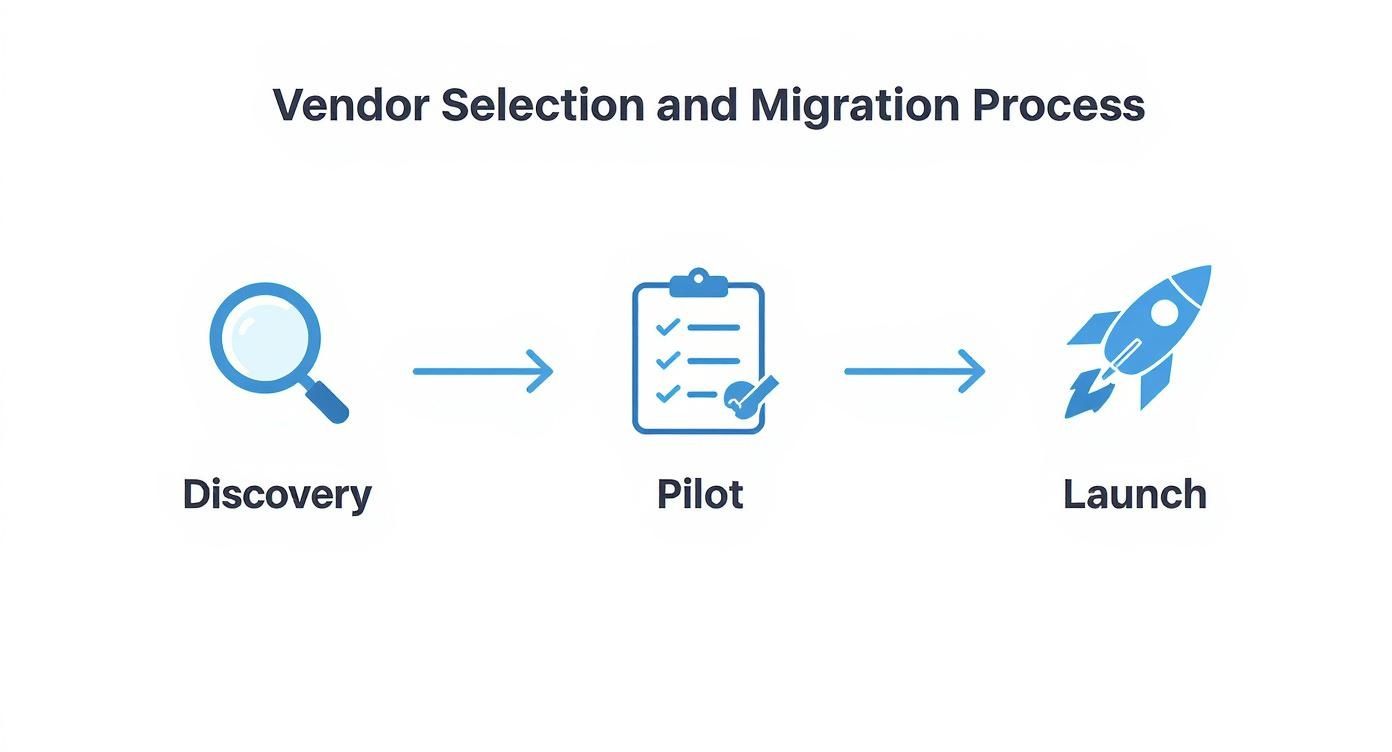
The visual below shows how the vendor selection journey unfolds in three phases: Discovery, Pilot, and Launch.
Hidden Costs In Call Center Outsourced Solutions
Extra line items often hide in plain sight. Think setup fees for integration and training, recurring technology license costs, volume surcharges when call spikes occur, and even currency fluctuations that can tack on 5–10%.
Before you sign, audit each element:
- Setup Fees: One-time charges for initial integration and agent workshops.
- Technology Licenses: Monthly or annual fees for CRM and platform access.
- Volume Surcharges: Overage fees when call volumes exceed agreed thresholds.
- Currency Fluctuations: Exchange-rate swings that add 5–10% more to your bill.
Measuring ROI On Outsourced Call Centers
Calculating ROI goes beyond tallying cost savings. You’ll want to factor in quality wins—things like First Call Resolution (FCR) and customer satisfaction scores (CSAT).
A simple monthly dashboard can help:
- Track labor cost savings versus your in-house baseline.
- Compare monthly metrics against target benchmarks.
- Incorporate quality improvements into your net benefit.
- Tweak scope or staffing when performance drifts.
With regular reviews, you’ll spot trends early and sharpen your ROI over time.
Compliance Standards For Vendors
Not all call centers are created equal when it comes to security. At a minimum, your vendor should hold ISO 27001 and PCI DSS certifications—and if you work in healthcare, insist on HIPAA compliance.
Checklist your vendor’s credentials:
- Ask for recent audit reports.
- Verify encryption methods for data in transit and at rest.
- Confirm ongoing compliance processes and retest schedules.
Key Insight: Vendors who follow strict security audit routines can cut breach risk by up to 60%.
Typical Onboarding Timeline
In my experience, getting an outsourced team live takes 4–8 weeks. Here’s a high-level view:
- Discovery (1–2 weeks): Map workflows, tools, and KPIs.
- Pilot (2–3 weeks): Test scripts, call routing, and data flows.
- Training (1 week): Coach agents with role-play and scenario drills.
- Launch (Week 8): Go live with full monitoring and support.
Asking these timeline questions early sets clear expectations and keeps everyone on track.
Ongoing Support And Optimization
After launch, most vendors include quarterly reviews and workshops to keep performance on point. You’ll typically see:
-
- Quarterly Reports: Deep dives into call volumes, CSAT, and system uptime.
- Improvement Workshops: Joint sessions to close gaps and plan new initiatives.
- Scaling Plans: Flexible options to increase or reduce headcount with a month’s notice.
🚀 Ready to Scale with Nearshore BPO in Tijuana?
CallZent helps you build high-performing bilingual support teams in Tijuana with unmatched efficiency, cultural alignment, and real-time collaboration.
Compare these support packages closely—your ideal partner will adapt to your evolving needs.
Ready to streamline your customer support? Contact CallZent for bilingual nearshore outsourced call center expertise.