Skip to content
Nearshore Outsourcing Guide
Nearshore Call Center Services
for U.S. Companies: Practical 2026 Guide
Learn how to evaluate, onboard, and manage nearshore call center services for e-commerce, healthcare, finance, and retail teams. Practical KPIs, compliance checks, and sourcing guidance.
- Nearshore = outsourcing to nearby countries like Mexico or LATAM
- Main benefit: 30–50% cost savings with strong quality retention
- Best for: customer service, tech support, bilingual programs, back-office work
- Key evaluation factors: KPIs, QA systems, compliance, onboarding process
- Ideal for: U.S. companies needing quality + flexibility (not just lowest cost)
Balancing support costs without damaging customer experience is where many outsourcing decisions go wrong. Teams chase lower rates, then spend months fixing avoidable problems like poor escalation handling, weak quality control, or agents who sound disconnected from the customer.
That is why nearshore call center services matter. For many U.S. businesses, they are the operational middle ground that works. You lower costs, keep collaboration close, and avoid a lot of the friction that shows up when your support team sits half a world away.
Your Strategic Guide to Nearshore Call Center Services
Nearshore is not just a geography choice. It is a management choice. You are choosing a team that can work in your business hours, handle U.S. customer expectations more naturally, and stay close enough for real oversight. That combination is why companies in retail, healthcare, SaaS, insurance, and telecom keep looking at providers across Mexico and Latin America.
TL;DR
- What nearshore means: outsourcing support or back-office work to nearby countries such as Mexico or other Latin American markets
- Why companies choose it: lower cost than domestic operations, stronger alignment than many offshore models, easier real-time collaboration
- Where it fits best: customer service, technical support, bilingual programs, outbound campaigns, and admin-heavy back-office work
- What to evaluate: SLA benchmarks, QA systems, compliance controls, omnichannel capability, onboarding discipline, and reporting transparency
- Best use case: U.S. companies that need quality and flexibility, not just the lowest possible rate
One reason this model gets attention is economics. Nearshore call center services can deliver 30 to 50% cost savings compared to domestic U.S. operations while preserving high service quality, according to CallZent’s overview of nearshore outsourcing advantages. The same source notes BPO billable rates of $15 to $18 per hour in top nearshore destinations.
The bigger point is not the savings alone. It is what you can preserve while reducing cost. You keep easier communication, stronger cultural familiarity, and access to bilingual talent that matters when your customers expect fast, clear service in English and Spanish.
The right nearshore partnership does not feel outsourced. It feels like a tightly managed extension of your own operation.
What Are Nearshore Call Center Services Exactly
Think of a nearshore team as an extension of your office that happens to sit a short flight away. You do not manage it like a distant vendor. You manage it like a production floor, customer care desk, or support pod that operates outside your headquarters but inside your rhythm.

For a North American company, nearshore usually means Mexico or Latin America. Onshore means the work stays in the U.S. Offshore means the work moves to a more distant market such as India or the Philippines.
How nearshore differs in practice
The location matters because location shapes the workday.
- Onshore: easiest for domestic alignment, but usually the most expensive
- Nearshore: close enough for overlapping hours, site visits, and bilingual coverage
- Offshore: can work for highly standardized programs, but oversight often gets harder because of distance and time separation
If you are comparing delivery models broadly, this overview of contact center outsourcing gives a useful outside perspective on how companies structure these operations.
Nearshore is especially practical when your support function depends on quick decisions. A retail brand handling refunds, a healthcare group booking appointments, or a telecom provider resolving service issues usually benefits from same-day feedback loops. A supervisor should not need to wait overnight to review a workflow problem or approve a script change.
Why Tijuana stands out for U.S. companies
For U.S. firms, Tijuana has an obvious operational edge. Leadership can visit easily. Managers can calibrate with agents in real time. Bilingual hiring is built into the market. The service style is also more compatible with North American customer expectations than many buyers assume.
That does not mean every nearshore provider is equal. The model is sound, but execution depends on recruiting, QA, training, and management maturity. A useful starting point is understanding the model itself, which is covered in CallZent’s explanation of what nearshore outsourcing is.
Nearshore works best when you need collaboration, not just labor. That is the dividing line many buyers miss.
Core Services Offered by Nearshore Call Centers
The best nearshore operations do more than answer calls. They run customer-facing workflows, support revenue teams, and take repetitive administrative work off internal staff.

Inbound support that protects customer experience
Inbound is where most companies start. It is also where poor partner selection shows up fastest.
Common inbound programs include:
- Customer service: order status, returns, billing questions, warranty requests, account updates
- Bilingual support: English and Spanish service for U.S. customer bases
- Technical support: password resets, troubleshooting, basic product guidance, escalation triage
- Reservation and scheduling support: booking assistance, changes, confirmations, cancellations
An e-commerce brand, for example, may need agents to handle return windows, damaged-package complaints, subscription updates, and carrier delays across phone, chat, and email. A healthcare practice may need appointment scheduling, patient intake reminders, and insurance-related routing under a compliant workflow.
The technology layer matters here. Nearshore call centers use omnichannel systems so agents can see prior interactions rather than force customers to repeat the same issue across channels. That directly affects resolution quality.
Outbound programs that support growth
Outbound work is often misunderstood. It is not just cold calling.
It can include:
- Lead qualification: first-touch outreach for inbound leads
- Appointment setting: handing booked conversations to internal sales reps
- Retention outreach: contacting customers before churn becomes permanent
- Customer surveys and win-back campaigns: structured follow-up after service or cancellation
Analytics often separates average providers from disciplined ones here. According to RDI, nearshore call centers use speech analytics and business intelligence tools to automate QA, elevating FCR by 10 to 15% and sales conversions by 20% through predictive insights from customer interaction data in its nearshore outsourcing analysis.
That is important in practice. If agents can spot repeat objections, weak handoff language, or compliance misses across calls, managers can coach fast instead of waiting for random sample reviews.
Back-office support that removes operational drag
Back-office work is where many small and mid-sized companies leave money on the table. Internal teams stay buried in repetitive tasks that do not require senior time.
Nearshore teams often handle:
- Order processing and updates
- Data entry and data cleanup
- Claims or case documentation support
- Content moderation
- CRM hygiene and ticket tagging
A healthcare group may use a nearshore team for intake verification and appointment support. A retail company may use one for SKU updates, returns administration, and customer record maintenance. A finance or insurance business may use support staff for document handling and case routing while keeping higher-risk work internal.
Practical rule. If the task is repeatable, process-driven, and trainable, a nearshore partner can usually support it well. If the task requires policy judgment or executive-level context, keep tighter internal control.
Nearshore vs Offshore vs Onshore The Strategic Comparison
Which model gives you the best operating result once you account for QA speed, supervisor access, compliance exposure, and customer experience, not just hourly rate?
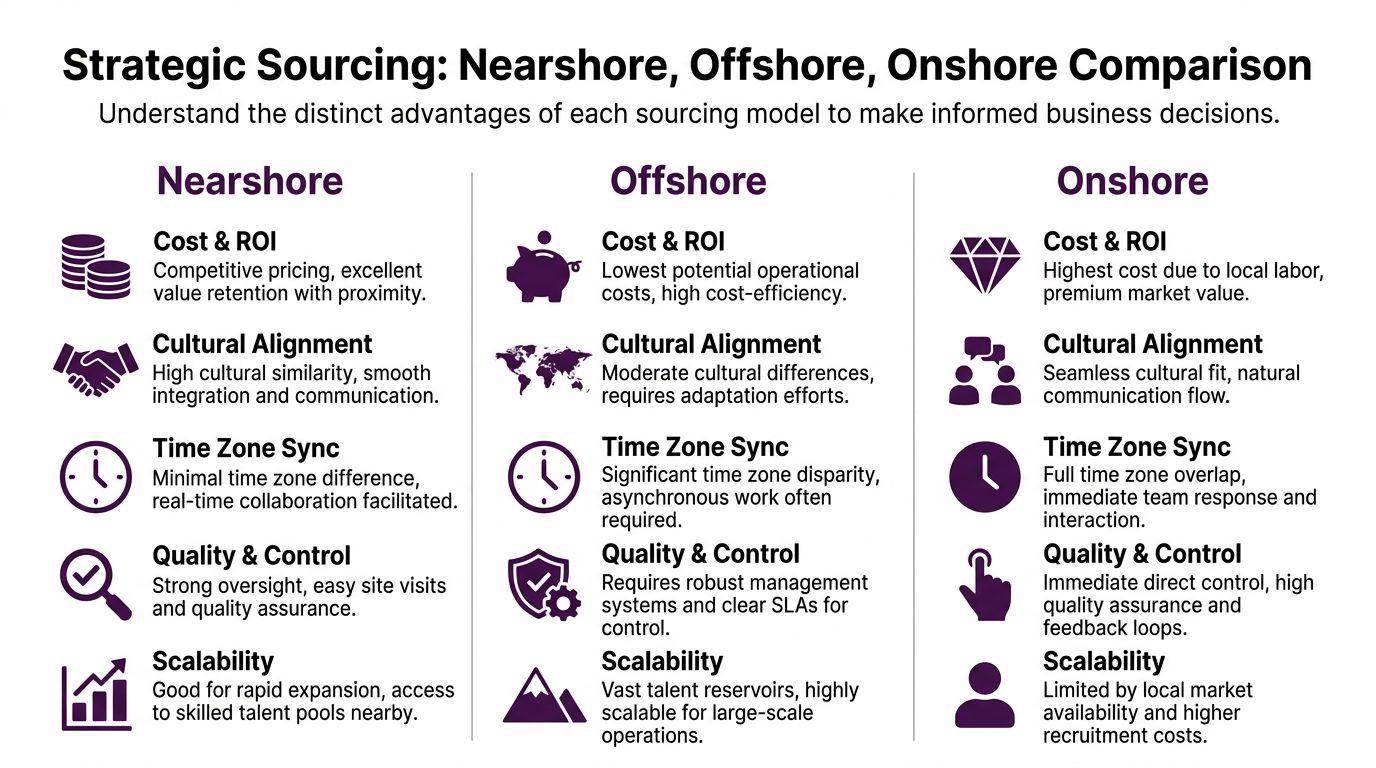
That is the essential comparison. Buyers who start with labor arbitrage often end up paying for it later through rework, higher escalations, slower coaching cycles, or weaker brand control.
Nearshore usually performs best for customer-facing programs that need daily coordination with U.S. teams. Offshore can work well for mature, tightly scripted support where process stability matters more than rapid collaboration. Onshore still has a place for high-sensitivity work, executive escalations, and programs where every policy decision carries legal or reputational risk.
For a clearer breakdown of the operating trade-offs, see this guide to nearshore vs offshore call center models.
Cost only matters if the model holds up under pressure
Nearshore often becomes the practical middle ground because it reduces labor cost without creating the management friction that shows up in distant delivery models. In practice, that matters most in e-commerce, healthcare, fintech, and subscription support, where processes change often and supervisors need same-day alignment with agents.
A U.S. e-commerce brand, for example, may update refund rules after a fraud spike or holiday shipping delays. A nearshore team working in overlapping business hours can absorb the change, retrain quickly, and keep customer messaging consistent. An offshore team may still succeed, but the buyer usually needs tighter documentation, more structured handoffs, and stronger overnight governance.
The same logic applies to healthcare support. If agents handle appointment scheduling, benefits questions, or intake-related contacts, you need tighter control over scripts, escalation paths, and documentation habits. Onshore may still be the safer choice for the highest-risk workflows. Nearshore often fits well for lower-risk, process-driven patient support that still demands clear communication and close oversight.
A lot of companies also compare location models without deciding which contacts should be automated first. This perspective on AI support versus traditional helpdesk solutions helps separate the interactions that need trained agents from the ones that can be triaged or resolved through automation.
The key comparison factors
| Factor | Onshore (e.g., USA) | Nearshore (e.g., Mexico) | Offshore (e.g., Philippines) |
|---|---|---|---|
| Cost | Highest | Lower than onshore with a better control-to-cost balance | Usually lowest |
| Collaboration | Easiest | Strong, especially during U.S. business hours | Harder when teams operate far outside U.S. hours |
| Cultural alignment | Highest | Generally strong for North American customers | Varies by market, provider, and training depth |
| Oversight | Direct and simple | Easier site visits and faster management response | Requires tighter remote governance and documentation |
| Scalability | Can be slower and more expensive | Good balance of growth and control | Often widest labor pool for large-volume programs |
Quality gaps usually come from management conditions, not geography alone
Geography does not guarantee quality. Operating conditions do.
Nearshore teams often have an advantage because supervisors, trainers, client stakeholders, and QA leads can work in the same business day. That shortens calibration cycles and makes course correction faster. If a new returns policy is causing confusion, or if a healthcare script is creating unnecessary transfers, the fix can happen this afternoon instead of after a delayed review window.
Offshore programs can perform well. I have seen them work best when the buyer provides clear SOPs, stable workflows, disciplined reporting, and strong local leadership at the BPO level. Without those controls, distance turns small process gaps into service issues.
Onshore still sets the standard for access and control. It is also the hardest model to scale economically across every support tier. For many U.S. companies, the better design is mixed. Keep high-risk contacts onshore, place core voice and digital support nearshore, and reserve offshore capacity for repetitive back-office or overflow work where precision matters more than live collaboration.
Proximity changes how teams run the account
This is the part procurement teams often miss. The delivery model affects management behavior every week.
If your operations manager can join calibrations live, review QA with team leads during U.S. hours, and visit the site without a long-haul trip, the account usually improves faster. That is why nearshore is often the better fit for brands that iterate constantly. E-commerce catalogs change. Telecom offers expire. Healthcare processes shift with payer rules and scheduling volumes. Support teams need quick updates, clear feedback loops, and managers who can stay close to execution.
Choose onshore if risk tolerance is low and budget pressure is secondary. Choose offshore if the work is stable, highly documented, and cost reduction is the main objective. Choose nearshore if you want lower cost than domestic delivery and still need fast decisions, tighter coaching, and better day-to-day partnership.
Your Checklist for Evaluating a Nearshore Call Center Partner
How do you tell the difference between a nearshore partner that interviews well and one that can run your account cleanly at scale?
Start with operating evidence. A serious evaluation looks closer to an audit than a sales presentation. If your team needs a repeatable screening process, this guide on how to find and vet the best call center outsourcing companies gives you a solid framework.
The practical mistake I see in vendor selection is simple. Buyers ask broad questions about experience and culture, then fail to test the mechanics that drive daily performance. Nearshore works well when the provider can prove how it recruits, trains, measures, escalates, and corrects problems during U.S. business hours.
Start with the operating scorecard
Ask for recent performance by channel and by account type, not a polished company average. An e-commerce returns queue and a healthcare scheduling line should not be judged the same way, and strong partners know that.
Review these areas first:
- FCR trends: ask how the provider defines first contact resolution and how it handles repeat contacts
- CSAT results: request recent score ranges, survey volume, and any gaps between voice, chat, and email
- AHT by workflow: separate simple contacts from verification-heavy or compliance-driven calls
- Service level attainment: check whether staffing plans support the promised response times
- Escalation rate: high escalation volume usually points to weak training, poor permissions, or unclear workflows
Then push one level deeper. Ask what happens when FCR drops for two weeks, when CSAT falls after a policy change, or when AHT rises because agents are putting customers on hold to ask supervisors basic questions.
A provider that can explain root-cause review, action plans, and owner accountability is showing you an operating model. A provider that stays vague is showing you a risk.
Review compliance like an operator, not a buyer
For healthcare, payments, insurance, and any support flow that touches sensitive customer data, compliance needs to be visible in daily execution.
Check for:
- HIPAA readiness: necessary if agents handle protected health information, appointment details, or patient communications
- PCI controls: necessary if agents take payments or work inside payment-adjacent workflows
- SOC 2 or similar security discipline: useful for broader data handling, vendor review, and internal risk teams
- Role-based access: agents should only see the systems and fields required for their job
- Device and environment controls: screen restrictions, recording rules, clean desk policies, and endpoint controls matter
- Business continuity planning: backup power, redundant internet, incident response, and failover procedures should be documented
Ask the provider to walk you through the workflow. How does an agent authenticate into systems? What data can be copied, downloaded, or viewed? How are exceptions logged? How often are permissions reviewed?
In healthcare especially, this separates vendors that can support regulated workflows from vendors that say they can.
Inspect training, nesting, and QA discipline
Training is where nearshore programs usually succeed or slip. Accent neutrality and bilingual coverage help, but they do not fix weak onboarding.
A strong partner should be able to show:
- Training plans by role: new agents, escalations, QA, and team leads need different paths
- Scenario-based practice: agents should handle real order changes, refunds, schedule conflicts, and upset-customer cases before launch
- Nesting support: early production should include extra floor coverage, faster feedback, and tighter QA review
- Calibration routines: your QA lead and the provider’s QA lead should review the same interactions on a fixed schedule
- Coaching tied to defects: quality scores should produce specific coaching actions, not general reminders to improve
For e-commerce, ask how agents are trained on return exceptions, shipping delays, fraud flags, and promotion terms. For healthcare, ask how they handle scheduling rules, identity verification, consent language, and escalation boundaries. The details matter more than the slide deck.
Test the technology stack in a live workflow
Do not settle for a list of platforms. Ask the provider to show how a contact moves through the system from queue to wrap-up.
Review:
- Telephony and CRM integration
- Support for phone, chat, email, and social, if those channels matter to your operation
- Call recording, screen capture, and QA workflow tools
- Dashboard access for your internal team
- Real-time queue visibility and historical reporting
- Ticketing, knowledge base, and workforce management processes
Then ask practical questions. How long does it take to add a new disposition code? Who owns IVR changes? Can supervisors isolate one SKU issue, one payer issue, or one shipping carrier problem in reporting without waiting for a custom analyst request?
CallZent is one example of a nearshore provider serving U.S. brands with bilingual customer support and back-office operations from Tijuana. The more important point is how the partner runs the account. You want clear documentation, usable reporting, and a stack that fits your workflow instead of forcing your team into a generic setup.
Use a short final-pass checklist before you sign
Before contracting, confirm these five points in writing:
- Named leadership: who owns the account, daily operations, QA, and escalation handling
- KPI definitions: every SLA and KPI should be defined the same way on both sides
- Compliance scope: required certifications, controls, and audit expectations should be documented
- Change management process: policy updates, training refreshes, and system changes need response times and owners
- Visit and governance cadence: set regular business reviews, calibration sessions, and site visit expectations early
This is the point of the checklist. Nearshore success depends less on the sales pitch and more on how the partnership is set up, tested, and managed once real customer volume hits.
Understanding Nearshore Pricing Models and Onboarding Timelines
Pricing confusion creates bad contracts. Some buyers choose the cheapest-looking option, then discover it does not fit their volume pattern, staffing needs, or reporting expectations.
The better approach is to match the pricing model to the type of work.
The three pricing models most buyers see
Dedicated agent model
This works well when demand is stable and brand familiarity matters. You are effectively reserving a team for your business.
Best fit:
- steady inbound support
- complex product environments
- programs that need brand immersion
- healthcare or finance workflows with tighter training needs
Risk:
- less efficient if your volume swings sharply and you do not plan schedules well
Per-hour model
This is useful when demand is less predictable. Startups, seasonal brands, and test programs often prefer it.
Best fit:
- variable volume
- early-stage support functions
- limited-hour coverage windows
- pilot programs before larger rollout
Risk:
- if forecasting is weak, costs and staffing consistency can drift
Hybrid model
This combines a base dedicated team with variable support around peaks. For many retail and e-commerce brands, this is the most practical structure.
Best fit:
- core steady volume plus seasonal spikes
- mixed channels
- campaigns with short-term surges
What a realistic onboarding timeline looks like
Nearshore launches fail when leaders expect instant readiness. Even good providers need time to absorb policies, systems, and brand standards.
A practical onboarding flow usually looks like this:
-
Discovery and scope alignment
Review volumes, channels, KPIs, customer types, escalation paths, and compliance needs. -
Contracting and solution design
Finalize staffing model, pricing, reporting cadence, technology access, and pilot terms. -
Training and system setup
Agents learn workflows, systems, scripts, policy exceptions, and QA standards. -
Pilot launch
Start with a controlled group, monitor heavily, calibrate daily, and tighten SOPs before expansion. -
Scale phase
Add seats only after the pilot proves stable quality.
Nearshore maturity matters here. According to Global Response, leading nearshore hubs like Tijuana have adopted flexible staffing models that boost scalability by 40%, allowing them to ramp from 10 to 100 agents for seasonal surges while maintaining 95% CSAT scores in its discussion of onshore, offshore, and nearshore call centers.
The operational lesson is simple. Scale in layers, not in panic mode.
What works during peak seasons
For e-commerce brands heading into Black Friday or holiday returns season, the smartest setup is usually:
- A trained core team that knows your policies thoroughly
- A reserve hiring plan for surge capacity
- A narrowed scope for new agents so ramp is controlled
- Daily calibration during peak weeks
What does not work is trying to throw untested agents into every queue at once. Nearshore can scale well, but only if staffing growth is paired with QA discipline and clear routing logic.
How to Manage Your Nearshore Team for Long-Term Success
Outsourcing is not self-running. The companies that get the most from nearshore call center services stay involved after launch.
That does not mean micromanaging agents. It means managing the partnership with precision.
Build a tight operating rhythm
Start with two owners. One person on your side. One person on the provider side. If ownership is fuzzy, delays multiply fast.
Then set a recurring cadence:
- Weekly performance reviews: queue trends, SLA misses, policy questions, training gaps
- Regular calibration sessions: review interactions together and align on what good looks like
- Monthly business reviews: broader themes, channel shifts, staffing outlook, upcoming campaigns
This rhythm matters more than flashy reporting dashboards. A clean dashboard without active review rarely improves service.
Treat the nearshore team like part of the brand
Agents perform better when they understand the company, not just the script.
Practical ways to do that:
- Include them in product updates
- Share customer feedback
- Invite them to brand or culture briefings
- Use newsletters or short video updates from internal leaders
A retail brand, for example, may brief agents before a holiday promotion so they understand offer logic, likely customer objections, and approved exceptions. A healthcare group may brief agents on referral process changes before those calls start hitting the queue.
That kind of context helps agents make better decisions under pressure.
Use QA as a coaching system
Call recordings, scorecards, and QA flags should support coaching. If they only exist to punish misses, performance gets defensive.
Good coaching looks like this:
- pick a narrow behavior to improve
- show examples from real calls
- clarify what better sounds like
- follow up on whether the change holds
The strongest programs also involve the client in calibration. When your team and the provider hear the same calls and score them together, brand voice gets sharper and disputes drop.
A nearshore team performs best when feedback is fast, specific, and tied to customer outcomes rather than generic compliance language.
Watch for genuine signs of partnership health
Long-term success usually shows up in operating behavior before it shows up in a presentation.
Look for signs such as:
- your partner raises issues before they become failures
- reporting includes root-cause thinking, not just metric dumps
- training evolves when products or policies change
- leaders on both sides can make decisions quickly
If those habits are missing, the relationship becomes transactional. Transactional support rarely protects customer experience for long.
Is a Nearshore Call Center Partnership Your Next Best Move
For many North American businesses, the answer is yes, but only if the decision is made with operational discipline.
Nearshore call center services fit companies that want cost control without giving up visibility, quality oversight, or customer familiarity. They are especially useful when your business depends on bilingual support, same-day collaboration, or a partner close enough to manage like an extension of your own team.
This model is a strong fit for e-commerce brands handling volume swings, healthcare groups that need compliant support, finance and insurance teams that require process accuracy, and telecom or SaaS companies that cannot afford slow feedback loops.
The mistake is treating nearshore as a shortcut. It is not. It works when you vet the partner carefully, define the right KPIs, onboard in phases, and stay involved after launch.
If your current support setup feels too expensive, too rigid, or too hard to manage at scale, nearshore deserves a serious look.
Ready to Explore Nearshore Support?
Discover how CallZent helps U.S. companies scale customer support with bilingual teams in Tijuana.
Get StartedIf you want to explore a nearshore model built for U.S. businesses, visit CallZent to review its bilingual call center and BPO services in Tijuana and request a conversation about fit, scope, and operational requirements.