Skip to content

Nearshore vs Offshore Call Centers: Which Is Right for Your Business?
Explore the differences between nearshore vs offshore call centers and learn how Smart Sourcing can cut costs, improve service quality, and align your customer support with U.S. standards.
TL;DR: Nearshore vs Offshore Call Centers
- Offshore: Cheap but comes with communication, time zone, and cultural challenges.
- Nearshore: Bilingual support, cultural alignment, U.S. time zones, and higher satisfaction.
- Smart Sourcing: Nearshore call centers like CallZent deliver quality, savings, and oversight.
👉 Learn more about CallZent’s nearshore call center solutions.
Nearshore vs Offshore Call Centers: Which Is Right for Your Business?
How Smart Sourcing Can Boost Service Quality and Cut Costs
When outsourcing customer support, businesses typically weigh three options:
- Onshore (domestic)
- Offshore (Asia or Eastern Europe)
- Nearshore (Latin America or Canada)
What exactly is “nearshore” outsourcing?
Nearshore outsourcing means partnering with companies outside your home country but still within the same region—often sharing a border or time zone. For example, a U.S. company might choose a call center in Mexico or Canada. This proximity offers practical advantages: easier business communication, fewer time zone headaches, and quicker travel for in-person meetings if needed. In contrast, offshore outsourcing usually refers to working with partners much farther away, such as those in India or the Philippines, where differences in culture, language, and time zones often present greater challenges.
By understanding these distinctions, it’s easier to see why the choice between nearshore and offshore isn’t just about location—it’s about how well your support teams can align with your business goals and customer expectations.
Why Consider Onshore and Homeshore Call Centers?
Onshore and homeshore call centers offer a few clear advantages, especially when it comes to customer interaction. First, they provide support from agents who are fluent in the same language as your customers—often with little or no accent—making conversations smoother and reducing frustrating miscommunications.
Cultural understanding is another big win. Since these agents are familiar with U.S. norms, idioms, and expectations, they’re better equipped to connect with customers and resolve issues quickly. The result? Fewer misunderstandings, faster solutions, and higher satisfaction for both your team and your clients.
What Is Homeshoring in Call Centers?
Homeshoring refers to a call center model where agents handle customer support from their own homes rather than working in a traditional office environment. Unlike offshore or even nearshore setups, homeshoring keeps agents within the same country as the business—think U.S.-based agents supporting U.S. customers.
Instead of commuting to a centralized office, these team members connect virtually, offering all the advantages of being local: native language fluency, cultural alignment, and a shared time zone. Well-known brands like Amazon, American Express, and Williams-Sonoma have adopted homeshoring to boost flexibility and tap into a wider talent pool—all while maintaining quality control and compliance.
What Is a Homeshore (Virtual) Call Center?
A homeshore call center—sometimes called a virtual call center—is an outsourced model where agents work entirely from home rather than a centralized office. These agents are based domestically, usually in the same country as your business. That means your customers interact with representatives who speak the language fluently and understand the culture—no need to worry about lost-in-translation moments or mismatched time zones.
Virtual call centers offer a unique blend of flexibility and savings. Without the overhead of a physical office, you can cut costs on real estate, utilities, and commute time, all while maintaining high-quality, locally attuned support. This model is ideal for businesses that want to boost customer satisfaction without sacrificing accessibility or breaking the bank.
Why Hire Within Your Country? The Homeshore Advantage
Choosing a homeshore call center means recruiting talent from within your own borders—a move that brings several strategic advantages.
First, tapping into a local workforce helps maintain high service standards and ensures customer interactions reflect cultural familiarity and native-level language skills. This means fewer miscommunications, faster resolutions, and experiences your customers actually appreciate.
Beyond that, homeshore call centers can operate remotely, reducing overhead—no need for massive office spaces or extra administrative expenses. This model not only keeps your costs predictable, but also allows for tremendous flexibility. You can easily scale your team up or down in response to seasonal swings, without locking into long-term commitments.
Ultimately, hiring within your country gives your business the agility and quality control it needs—while keeping customers happy and costs under control.
Homeshore Call Centers: Built-In Flexibility and Scalability
If flexibility is at the top of your wishlist, the Homeshore Call Centers (virtual) call center model delivers. By leveraging a remote, U.S.-based workforce, you’re not tied down by traditional overhead or the need to fly out for site visits—and that’s just the beginning.
Homeshore setups shine when it comes to scaling your customer support team. Need more agents for holiday surges or a product launch? You can easily ramp up. Experiencing a slower season? It’s just as simple to reduce staff, all without being locked into long-term physical office commitments.
This agility lets you stay responsive as your business needs fluctuate—all while keeping linguistic and cultural alignment on your side.
What Are the Advantages of Homeshore Outsourcing for Call Centers?
Homeshore (also called virtual or remote) outsourcing has become increasingly popular for companies looking to deliver excellent customer service without the overhead of traditional call centers. But what sets homeshore solutions apart?
Here are the standout benefits:
- Cost Efficiency: By employing agents who work from home within your own country, you can significantly reduce costs tied to office space, utilities, and on-site management. Forget the expense of commuting or maintaining a centralized location—your team is already where they need to be.
- Cultural & Linguistic Alignment: Homeshore agents live and work in the same country as your primary customer base. That means fewer language hurdles and cultural gaps, resulting in clearer communication and a better customer experience.
- Superior Flexibility: Need to ramp up staffing for peak season? Homeshore models let you scale your team up (or back down) quickly and easily, ensuring you’re always right-sized for demand—no long lead times or major headaches.
- Access to a Wider Talent Pool: Without geographic restrictions, you can tap into high-quality agents from across your country. This broadens your hiring options and often means better customer service skills.
In essence, homeshore outsourcing gives you the best of both worlds—domestic quality with the efficiency and scalability today’s businesses need. For many years, offshore call centers were the default choice because of cost. But that’s changing fast. Smart companies now prioritize service quality, language fluency, and alignment with their brand. Enter nearshore call centers.
In this guide, we’ll break down the pros and cons of each model and explain why nearshore vs offshore call centers is no longer just about price—it’s about value.
Nearshore vs. Offshore Call Centers: 🔍 Key Differences
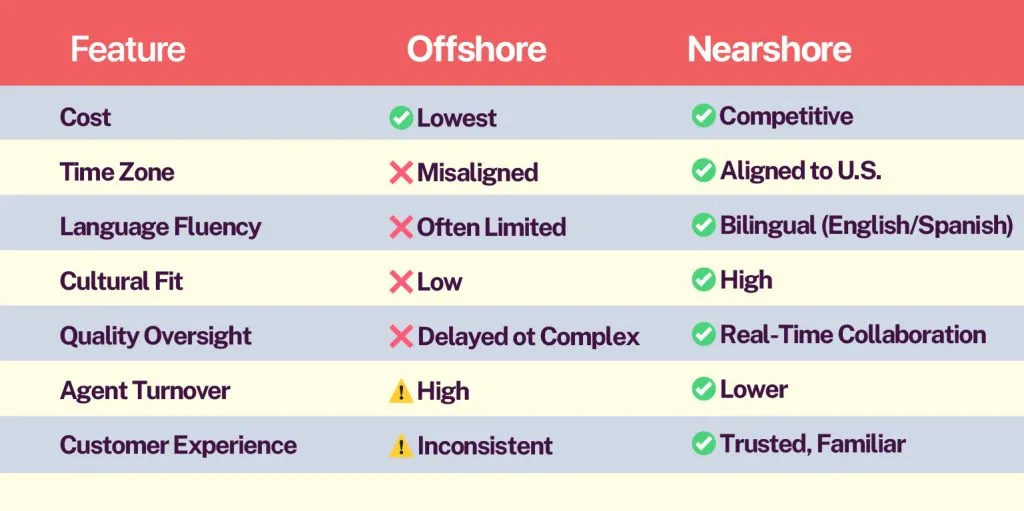
The chart shows that nearshore vs offshore call centers isn’t just about hourly rates. It’s about aligning your support with your customers’ expectations.
The Upsides and Downsides of Onshore Call Centers
It’s easy to see why many businesses gravitate toward onshore call centers, especially when nuance and clarity matter most. Here’s where they shine:
- Seamless Communication: Language mishaps and awkward pauses are minimal, thanks to aligned accents, idioms, and cultural understanding.
- Shared Time Zones: More overlap in time zones means real-time collaboration, shorter lag times, and simpler scheduling.
- Easier Training & Oversight: If travel’s required for onboarding or team-building, hopping a flight within the US is much more appealing than trekking across continents.
- Compliance Confidence: Navigating US data privacy laws (think HIPAA and CCPA) becomes one less headache, with teams already steeped in the local regulatory landscape.
- Cultural Familiarity: Agents get the little things—whether it’s sports references, holiday greetings, or regional preferences—which translates to customers feeling genuinely understood.
But the benefits come with a caveat: cost. Stateside operations mean American wages, pricier facilities, and steeper technology expenses—often a big leap over both nearshore and offshore options.
Some companies see this as a worthy investment, recouped through faster call resolution, greater customer trust, and a stronger brand connection. Others, particularly those watching every penny, may find the price tag tough to justify.
In short, onshore call centers offer unmatched alignment with your audience, but you’ll want to weigh that harmony against the impact on your bottom line.
Offshore Call Centers: Pros and Cons
Pros:
- Low cost per hour
- Scalable teams
- Available in multiple regions (India, Philippines, etc.)
Cons:
- Language barriers and accents
- Misalignment in business hours
- Slower campaign optimization due to time differences
- High agent turnover
- Often viewed negatively by U.S. customers
Best For: Basic support tasks with minimal customer interaction or low brand risk.
When Offshore Makes Sense
Offshore call centers can be a fit for companies with large support needs and tight budgets. If your brand’s top priority is driving down costs and you’re handling high-volume, straightforward customer inquiries, offshore teams can scale quickly. However, the trade-off is often felt in customer satisfaction. Language or cultural barriers may slow down handling time and lead to frustration, especially if your customers expect seamless, native-level communication.
Offshore options are particularly competitive for global companies needing round-the-clock coverage or legacy support channels. But be aware: if your goals include improving the customer experience, building brand loyalty, or providing omnichannel support (voice, chat, SMS, email), offshore may fall short.
Nearshore Call Centers: Pros and Cons
Pros:
- Bilingual agents fluent in English and Spanish
- U.S. time zone coverage (ideal for same-day collaboration)
- Lower labor costs than U.S. teams
- High customer satisfaction rates
- Cultural alignment and familiarity with U.S. service expectations
- Easier oversight and training
Cons:
- Slightly higher cost than offshore teams
- Limited supply in high-demand regions
Best For: CX-driven brands, technical support, bilingual coverage, and businesses scaling smartly.
Why Nearshore Is Often the Sweet Spot
Nearshore call centers strike a balance between cost-effectiveness and service quality. With agents often located in Latin America or Canada, businesses benefit from teams who understand U.S. culture, speak fluent English (often Spanish as well), and work in the same or similar time zones—making real-time collaboration and management much easier.
If your business wants to elevate customer satisfaction, drive higher first-call resolution rates, and maintain a brand voice that resonates with U.S. customers, nearshore is a strong choice. It’s ideal for companies seeking a blend of affordability and quality—without the steep price tag of onshore support.
Matching Call Center Models to Your Business Goals
Choosing the right model—onshore, offshore, nearshore, or even homeshore—depends on your unique needs and priorities:
- For advanced technology or omnichannel solutions: Onshore or homeshore models may provide cutting-edge systems, analytics, and seamless integration with your team.
- For budget-driven, high-volume support: Offshore can be a smart tactical move, especially for basic tasks.
- For brands prioritizing customer experience: Nearshore offers a cost-effective way to deliver high-quality, culturally aligned service.
- For reducing costs with onshore familiarity: Homeshore models (remote agents based in the U.S.) cut overhead while preserving local expertise.
As you weigh your options, remember: the right call center model is the one that lines up with both your budget and your ambition for customer satisfaction.
Homeshore Call Centers: The Drawbacks
Cons:
- Training and managing remote teams can be challenging
- Greater risk of security breaches due to agents working on personal devices and networks
- Monitoring productivity and performance remotely may be less precise
- Staff development and engagement can suffer from isolation
- Extra investment needed in data privacy, especially for industries like finance and healthcare
Best For: Businesses prioritizing a U.S.-based presence, and those with robust remote management infrastructure.
Homeshore Call Centers:
Pros:
- Local teams with deep familiarity of regional language and culture
- Maximum control over processes and training
- Simplified compliance with U.S. regulations
- Reduced overhead—agents work remotely, lowering office costs
- Flexible, pay-as-you-grow models—scale up or down as needed
- Attractive remote work options widen talent pool
Agents are based right here at home, so communication is seamless and oversight is straightforward. With cloud-based tech, your team delivers a strong, unified omnichannel experience—regardless of where they’re logging in from. This model is also a draw for customer-focused brands who want talent that understands U.S. customers inside and out, without the hassles of managing a physical office.
Best For: Highly regulated industries, premium brands, or any business valuing local knowledge and top-tier CX.
Why Businesses Are Switching to Nearshore Call Centers
The global shift toward better customer experience has changed the nearshore vs offshore call centers equation.
Customers expect:
- Fast, helpful service
- Fluent agents who understand them
- Omnichannel communication (voice, chat, SMS, email)
Companies need:
- Lower costs than in-house
- Reliable service quality
- Real-time management
Nearshore call centers deliver all three. Offshore often falls short.
Smart Sourcing: The Hybrid Strategy
Smart sourcing blends:
- The cost advantages of offshore
- The quality and control of onshore
Nearshore call centers in Mexico, Colombia, or Costa Rica hit that sweet spot.
CallZent’s facility in Tijuana, Mexico offers:
- Bilingual, bicultural agents
- 24/7 coverage
- U.S. management team
- Advanced QA and compliance systems
📍 Learn more about our nearshore call center services
Remote Agent Management: Best Practices
Managing a remote call center team isn’t just about plugging in a headset and hoping for the best. It’s about putting smart systems and support in place, so agents—wherever they’re based—perform at their peak.
Here are some proven best practices:
- Effective Virtual Training: Leverage platforms like Zoom or Microsoft Teams for engaging onboarding and ongoing skill-building sessions.
- Clear Communication Channels: Use Slack, Teams, or similar tools to keep conversations flowing and teams connected, no matter the location.
- Performance Tracking: Implement dashboards and KPIs through software such as Five9 or Talkdesk to monitor productivity in real time.
- Regular Feedback and Coaching: Schedule consistent check-ins and feedback loops to keep agents supported and motivated.
- Strong Security Protocols: Ensure remote teams follow best-in-class data security practices, using VPNs and secure logins—think Okta or Duo Security—to protect customer info.
By weaving these practices into your management approach, you’ll empower remote agents to deliver seamless, high-quality support—just like they’re right there in the room with you.
What to Ask When Choosing a Call Center
- Can they align to your business hours?
- Are their agents fluent in your customers’ languages?
- How do they measure quality and customer satisfaction?
- What training do their agents receive?
- Can they scale with your growth?
- Are they PCI/HIPAA compliant?
Beyond the basics, take a closer look at your business’s unique needs. Do you require agents who are not just bilingual, but bicultural—able to truly understand your customer’s expectations and concerns? Is close proximity or legal jurisdiction important for your industry or compliance requirements? If your products or audience are especially sensitive to language or cultural nuances, or if you prefer tighter control over your team, these are key factors.
Ask yourself:
- Will a smaller, highly-trained team better serve your brand than a large, anonymous pool of agents?
- Do you see customer experience as a strategic investment in your reputation and growth, not just a cost to manage?
- Is your business prepared to prioritize cultural or linguistic fluency to deliver exceptional service?
The right call center partner should check all these boxes—aligning with your business model, supporting your growth, and elevating customer satisfaction. If any of these answers are unclear or “no”—it’s time to look at nearshore call centers.
Industries That Should Prioritize Data Security in Virtual Call Centers 🛡️
Not all call center setups are created equal when it comes to data security—and for some industries, that’s a deal-breaker. Sectors handling sensitive customer data, like banking, healthcare, insurance, and financial services, need to be especially vigilant.
When agents work from home on personal devices and networks, the risk of data breaches or compliance mishaps can rise dramatically. If your business deals with credit cards (PCI), medical records (HIPAA), or financial transactions, the security protocols of your chosen call center aren’t just important—they’re essential.
Key questions for high-compliance industries include:
- Are robust IT protections in place, even for remote agents?
- Is customer data always encrypted and access-controlled?
- How frequently are security audits performed?
- Can the partner demonstrate PCI, HIPAA, or SOC2 compliance?
For banks, fintech, healthcare providers, and anyone managing sensitive data, these are non-negotiables when evaluating any virtual or homeshore call center solution.
If the answer to these is unclear or “no”—it’s time to look at nearshore call centers.
Is a Homeshore Call Center the Right Fit?
If the standard nearshore options don’t quite hit the mark, you might be wondering whether a homeshore call center could better suit your needs. Here’s when it’s worth adding homeshore solutions to your shortlist:
- Your entire team is already remote or distributed, and you want operational consistency.
- You’re balancing tight budgets but still need agents based in your home country.
- Flexibility and the ability to quickly scale up or down are top priorities.
- Physical site visits, in-person training, or on-the-ground management aren’t essential to your business model.
As with any big decision, weigh these factors alongside your business goals and workflow preferences. Homeshore call centers can provide a unique blend of convenience and capability for the right operation.
Homeshore vs. Traditional Call Center Costs
One major advantage of homeshore call centers is significant cost savings. Because agents work from home instead of in a dedicated facility, companies avoid big expenses like leasing office space, maintaining infrastructure, and supplying on-site equipment. This leaner model means lower overhead compared to traditional call centers, which must budget for rent, utilities, security, and ongoing facility management.
In other words, shifting to a homeshore setup lets businesses put more money into training, technology, or customer experience—and less into keeping the lights on at a sprawling office.
Navigating the Challenges of Remote Call Center Management
Transitioning to a fully remote call center isn’t just a change of scenery—it introduces its own set of hurdles.
For starters, training agents virtually can be trickier than the traditional in-person method. Without face-to-face instruction, it’s easy for details to slip through the cracks or misunderstandings to go unnoticed until they bubble up in customer interactions. It’s also a bit like herding cats when it comes to tracking productivity and key performance indicators (KPIs) from afar. Some agents might thrive in a home environment (goodbye, commute!), while others may find it harder to stay on track without the background buzz of an office.
To keep service quality high, effective remote call center management relies on:
- Strong onboarding processes and clear, accessible training materials.
- Ongoing communication through video calls, chats, and regular check-ins.
- Performance monitoring tools that offer transparency without feeling intrusive.
- Support systems for remote employees who might need extra guidance or motivation.
Whether you’re building your own team or working with an outsourcing partner, look for experience in virtual management. The right expertise ensures your agents are prepped, productive, and tuned in—no matter where they’re logging in from.
Flexibility and Scalability in Homeshore Call Centers
One of the standout perks of the homeshore model is its built-in adaptability. Without the expense of massive office spaces or hardware, you’re not weighed down by traditional overhead.
What does this mean for your business? You can ramp your support team up or down to match peak seasons, new launches, or those quieter months—without locking yourself into long-term commitments. Instead of paying for empty seats, you get the freedom to dial in only what you actually need.
Bottom line: homeshore call centers let you stay light on your feet, efficiently matching staffing to your real-world demand—no waste, no worry.
Protecting Customer Data in Virtual Call Centers 🔐
When it comes to safeguarding customer data in virtual or homeshore call centers, a thoughtful approach is essential—especially for industries like banking, finance, and healthcare. Here’s what to look for:
- Device Security: Ensure that agents access data only via secure, company-approved devices—not personal laptops or unprotected WiFi.
- Network Protection: Require the use of encrypted connections (VPNs) and robust firewalls to block unauthorized access.
- Data Handling Policies: Implement strict guidelines on how sensitive data can be viewed, shared, and stored.
- Regular Training: Provide ongoing security awareness training so agents stay sharp on best practices and emerging threats.
- Compliance Checks: Stay up-to-date with PCI DSS, HIPAA, and other regulatory standards relevant to your industry.
- Access Controls: Limit data access to only those who truly need it, and use strong authentication methods.
By taking these precautions, you reduce the risk of breaches and ensure your customers’ information stays protected—wherever your agents are working.
If the answer to these is unclear or “no”—it’s time to look at nearshore call centers.
Why CallZent Is Your Nearshore Advantage Winner
CallZent is a U.S.-owned and managed call center headquartered in Mexico. We offer:
- Affordable bilingual customer support
- Smart sourcing with real oversight
- Nearshore infrastructure and talent
- Custom onboarding and flexible contracts
Whether you’re scaling your sales team, handling inbound support, or entering Spanish-speaking markets, CallZent delivers better outcomes for less.
Frequently Asked Questions (FAQs)
1. What’s the main difference between nearshore and offshore call centers?
Offshore centers focus on cost savings but often struggle with time zone and cultural barriers, while nearshore centers offer bilingual agents, U.S. time alignment, and higher customer satisfaction.
2. Are nearshore call centers more expensive than offshore?
Yes, slightly — but they provide higher quality, cultural alignment, and easier oversight, delivering better long-term ROI.
3. Which is better for customer experience?
Nearshore call centers, because customers interact with bilingual, culturally aligned agents in real time.
4. Can nearshore call centers handle compliance?
Yes. Providers like CallZent meet U.S. standards such as PCI and HIPAA, ensuring secure and compliant operations.
5. Why choose CallZent?
CallZent combines U.S. management with bilingual teams in Mexico, delivering affordable, high-quality support that aligns with U.S. business practices.
How Does Remote Work Impact Productivity in Homeshore Call Centers?
Remote work can be a double-edged sword for homeshore call centers. For many agents, working from home means fewer office distractions, less commuting stress, and more schedule flexibility—often leading to a boost in focus and output. In fact, according to a Stanford study, remote employees can be up to 13% more productive compared to their in-office peers.
But not every agent thrives in the home office. Some might struggle with self-motivation or find it challenging to separate work from personal life, which can impact their efficiency. That’s why successful homeshore call centers—whether you’re managing your own team or partnering with a provider—prioritize:
- Proven remote work policies and routines
- Strong digital performance tracking (think: dashboards, call analytics, and real-time feedback)
- Regular coaching, check-ins, and online collaboration tools
- Virtual training programs to onboard agents and reinforce best practices
The right approach ensures teams stay engaged, accountable, and performing at their best—no matter where they log in from.
Final Take: Offshore Is Cheap. Nearshore Is Smart.
Outsourcing support doesn’t have to mean compromising on quality.
If you want:
- Fluent agents
- U.S. time zone coverage
- Lower costs without lower standards
Then nearshore call centers are the smart choice—and the answer in the nearshore vs offshore debate is clear.
👉 Schedule a Free Strategy Session to explore what smart sourcing could do for your business.
About the Author
Joe Andere, CEO of CallZent, leads a U.S.-owned and managed nearshore call center headquartered in Mexico. With 20+ years in outsourcing, Joe helps companies navigate the nearshore vs offshore decision to maximize quality and savings.