Skip to content
8 Proven Outbound Lead Generation Strategies for 2025 Growth
Is your sales pipeline looking a little too quiet? While waiting for leads to find you has its merits, the most resilient businesses don’t just wait; they build a proactive revenue engine by mastering outbound lead generation. This isn’t about revisiting outdated, aggressive sales tactics. Instead, this article is a deep dive into eight potent and modern outbound lead generation strategies designed to cut through the noise, forge genuine connections, and fill your pipeline with high-quality prospects.
This guide is a comprehensive roadmap for businesses in competitive sectors like e-commerce, healthcare, finance, and tech. We will unpack each strategy with actionable steps and real-world examples to help you choose and implement the right approach. These methods are designed not only to generate leads but also to do so efficiently. While focusing on these outbound strategies to fill your pipeline, it’s also wise to consider practical ways to lower customer acquisition cost for maximum profitability.
TL;DR: Top 8 Outbound Lead Generation Strategies
- Precision Cold Email: Hyper-personalized messages to targeted prospects.
- Strategic Cold Calling: Research-driven calls to connect directly with decision-makers.
- LinkedIn Outreach: Building professional rapport on the world’s largest B2B network.
- Account-Based Marketing (ABM): Concentrated sales and marketing on high-value accounts.
- Strategic Social Selling: Using social media to build trust and nurture prospects.
- Video Prospecting: Personalized videos to cut through inbox clutter.
- Direct Mail: Tangible, creative packages to create a memorable impression.
- Referral Programs: Formalizing word-of-mouth to generate warm leads.
The core takeaway is this: outbound isn’t just an alternative to inbound; it’s a necessary component of a robust, scalable growth machine.
But First: Nail the Fundamentals Before You Scale
Before you chase output metrics—like meetings booked or reply rates—focus on strategic groundwork. Outbound success hinges on more than blasting messages; it’s about validating the basics:
- Messaging–product fit: Does your outreach actually resonate with prospects, or does it sound like noise?
- ICP–product fit: Are you targeting accounts that genuinely align with your solution?
- Positioning–product fit: Is your value proposition distinct and relevant?
- Engagement–product fit: Can you spark real, meaningful conversations with your audience?
If you can’t generate even 10–20 quality conversations that validate these fits, it’s too soon to scale.
Test the System Before Turning Up the Volume
Early outbound is less about volume, more about learning what works:
- Are your emails landing in inboxes or spam folders?
- Can you reach actual decision-makers via phone and LinkedIn—beyond just hitting your activity numbers?
- Do prospects engage with your content or visit your site after outreach?
Solving these bottlenecks up front means that when it’s time to scale, you’re scaling something that actually works.
Pro tip: Don’t judge your outbound by raw outputs. Focus first on whether your entire system—from research to conversation—actually delivers results.
Outbound That Wins: Smarter, More Customer-Centric
Outbound isn’t about shouting louder—it’s about being sharper and more relevant. The winning approach in today’s market is customer-centric:
- Reach the right people
- On the channels they prefer
- With messaging that’s tailored, not templated
Treat outbound as an ongoing experiment. Iterate, refine, and keep your process tightly integrated with sales and marketing. Use tools and partners that fill specific gaps, but empower your own team to run, learn, and improve.
Put all these elements together—precise targeting, clean qualification, genuine personalization, multi-channel execution, and continuous improvement—and you’ll build a scalable growth engine that works for startups, scaleups, and enterprises alike.
Outbound isn’t dead. Bad outbound is. The future belongs to teams who approach it with strategy, creativity, and relentless focus on what actually works.
What’s Changed in Outbound Lead Generation?
Before we dive into the strategies themselves, let’s address the elephant in the room: outbound lead generation is not obsolete, but the playing field has shifted dramatically in recent years. Success now looks very different than it did just a few years ago, and here’s why:
- Tighter Inbox Security:Apple’s Mail Privacy Protection and ever-evolving Gmail spam filters have made it much harder to tell who really opens your emails. Open rates now offer little more than a rough guess, not a reliable gauge of interest.
- Message Overload: Buyers are feeling the strain of constant outreach. Their inboxes and LinkedIn DMs are overflowing—which means generic, impersonal messages are ignored or deleted without a second thought.
- Greater Competition for Attention: With businesses from every corner of healthcare, tech, e-commerce, and finance targeting the same decision-makers, it’s far noisier in the market than ever before.
The result? According to recent industry benchmark reports, average reply rates have slipped noticeably year-over-year. Outbound teams that lean on old-school “spray and pray” tactics are increasingly seeing shrinking returns while wasting precious resources.
So, what actually works now? Let’s break down the modern strategies that cut through the clutter and deliver real results.
Whether you’re looking to find your first hundred customers or optimize an enterprise sales team, the answer to sustainable growth lies in the proactive strategies detailed below.
1. Precision Cold Email Outreach That Gets Replies
Cold email is far from dead; it has simply evolved. Modern cold email isn’t about blasting a generic message to thousands. It’s a highly strategic outbound lead generation strategy centered on deep research, hyper-personalization, and delivering value before you ask for anything.
This method involves identifying a curated list of ideal prospects and crafting messages that speak directly to their specific challenges, recent achievements, or industry context. By demonstrating you’ve done your homework, you break through the noise and initiate meaningful conversations. It remains a cornerstone for B2B sales because it’s cost-effective, measurable, and when done right, incredibly powerful for booking meetings with decision-makers.
Personalization at Scale: How Outbound Stays Relevant in 2026
Personalization at scale in 2026 means moving well beyond simple mail merges or the occasional congratulatory note about a company milestone. Today’s most effective outbound teams are elevating their approach by using advanced technology—especially AI—to deliver messages that speak directly to a prospect’s current business reality.
This new breed of personalization isn’t just about using a person’s name or referencing a recent funding round. It’s about deeply understanding the stage, needs, and context of each prospect so your message lands with real relevance, not generic familiarity. Here’s how teams are achieving this:
- AI-Powered Insights: Instead of relying on surface-level signals, teams leverage AI tools to scan a prospect’s website, product pages, or recent blog posts. The technology can summarize what the business does, spot industry trends, and even assess their most pressing pain points.
- Customized Value Propositions: With this information, your outreach can clearly articulate how your solution maps to a prospect’s specific priorities—whether that’s accelerating revenue in the wake of a funding round, solving an operational bottleneck, or supporting rapid hiring needs.
- Real-Time Relevance: By combining your internal expertise (such as unique case studies and differentiators) with up-to-the-minute prospect data from platforms like LinkedIn or industry news feeds, you create bespoke messaging that feels hand-written, even as you send it at scale.
The result? Each prospect receives communication that feels crafted just for them—because it is. This approach not only increases reply rates, but also sets the stage for more meaningful conversations that translate into real pipeline opportunities.
This is where precision meets efficiency—leveraging technology to make every outbound touchpoint matter, minus the cookie-cutter templates.
Navigating the New Realities: Privacy, Fatigue, and Outbound Challenges
If you’ve felt that your outbound emails aren’t packing the punch they used to, you’re not alone—and there are clear reasons why. In recent years, sweeping email privacy changes (think Apple’s Mail Privacy Protection and ever-tightening Gmail spam filters) have made traditional metrics like open rates almost useless. It’s harder than ever to tell if your message is resonating, and vanity numbers no longer equate to genuine interest.
At the same time, buyers are bombarded with more outreach than ever before. Their attention is maxed out, inboxes overflow, and as a result, lackluster or impersonal emails are deleted without a second glance. “Spray and pray” tactics now guarantee little more than wasted effort and burnt budget.
Industry data backs this up: reply rates across most sectors have declined, with some reports showing double-digit drops compared to previous years. The takeaway? Successful outbound today requires a shift from high-volume, one-size-fits-all messaging toward thoughtful, research-driven personalization that breaks through the clutter and speaks directly to each prospect’s unique context.
Moving Beyond Surface-Level Personalization: The Power of AI-Driven Relevancy
In today’s outbound landscape, personalization isn’t just a box to check—it’s a baseline expectation. Gone are the days when swapping in a prospect’s first name or referencing a recent funding round put you ahead of the curve. That level of personalization is now table stakes. The real differentiator for 2026? Relevancy-based personalization, fueled by artificial intelligence.
Rather than relying on cookie-cutter signals that everyone sees—like a company’s hiring spree or latest industry award—AI takes personalization a step further. It analyzes real-time data from a prospect’s website, recent blog posts, or even their LinkedIn activity, then distills it into insights that matter to their current situation.
Here’s what this looks like in practice:
- An AI tool reviews a prospect’s website and generates a concise summary of their business model. Your outreach then connects your solution directly to that unique value proposition—not just to their industry.
- For a marketing agency, AI might scan a prospect’s blog to determine what stage their content targets (top, middle, or bottom of funnel). Your message can then reference a specific article and clearly explain how your services close a content gap.
The result? Every company receives messaging that’s not just personalized, but immediately relevant to their needs, growth stage, or pain points—no more tired templates or generic congratulatory notes.
To unlock this next-level outreach, forward-thinking teams train AI systems not only on their offerings and case studies, but also integrate real-time data from each prospect’s digital footprint. This blend generates outreach that isn’t only personalized—it’s pointed, specific, and truly resonates because it’s grounded in timely value.
This shift from shallow signals to substantive relevancy sets your outreach apart—helping you spark conversations that convert, not just clutter inboxes.
How a Precision Cold Email Strategy Works in Practice
- For a Healthcare Tech Firm: A sales team could research hospital administrators who recently posted on LinkedIn about patient intake inefficiencies. The email would reference their post, acknowledge the shared challenge, and briefly introduce a software solution that streamlines that exact process, offering a 10-minute demo.
- For an E-commerce Logistics Provider: An account executive researches recently funded D2C brands. They send a personalized email congratulating the founder on their funding and offering a complimentary logistics audit to help them prepare for scaling order volume efficiently.
Advanced Personalization: Leveraging AI and Real-Time Insights
Gone are the days when a shallow reference to a prospect’s funding or new hire counted as true personalization. Today’s most effective cold email strategies use a blend of AI, up-to-the-minute data, and sharp value alignment to craft messages that resonate with each recipient’s unique context.
Here’s how leading teams are raising the bar:
- Real-Time Website Analysis: Imagine an AI reviewing a prospect’s website and summarizing their unique business model or latest initiative in just a couple of sentences. It automatically aligns those insights with your solution’s strongest benefits, producing a customized email that shows immediately why your offer is relevant to their current priorities.
- Content Relevance at Scale: For marketing or SaaS providers, AI can scan a prospect’s blog, LinkedIn posts, or press releases to understand what stage of the buyer’s journey they’re targeting (think top-, middle-, or bottom-of-funnel content). Your outreach then references an actual article or post, not just for flattery, but to propose a practical solution—like helping them close content gaps or reach a wider audience—directly tied to what they’re producing right now.
- Dynamic Messaging, Not Templated Fluff: Rather than recycling the same “Congrats on your funding!” intro, each company receives messaging crafted specifically for their situation. The value proposition is stitched directly from current data and your real differentiators, making your outreach relevant, timely, and meaningful.
Expert tip: Train your AI tools to recognize what sets your business apart (think: customer successes, proprietary features, or industry accolades). When you combine that knowledge with the latest insights from your prospect’s digital footprint, you’re not just scaling personalization—you’re delivering real business value with every message.
Actionable Tips for Implementation
- Research Deeply: Spend time on a prospect’s LinkedIn profile, company news releases, and industry articles. Look for triggers like a new hire, company expansion, or a recently published case study.
- Nail the Subject Line: Keep it short (under 50 characters) and intriguing. Pose a question or state a compelling, specific benefit. For example, “Question about [Prospect’s Company] patient scheduling?”
- Make the First Sentence About Them: Start your email by referencing your research. An opener like, “I saw your recent post on managing supply chain costs…” immediately shows you’ve done your homework.
- Offer a Low-Friction CTA: Instead of asking for a 30-minute meeting, aim for a smaller commitment. A great call-to-action is a simple question like, “Would you be open to learning more about how we helped [Similar Company] solve this?”
“The goal of a cold email isn’t to make a sale; it’s to start a conversation. Your entire message should be optimized to earn a simple, positive reply.”
Executing a high-volume, personalized email campaign can be resource-intensive. This is where specialized call center services can provide significant leverage, handling the research, list-building, and initial outreach so your sales team can focus on qualified conversations.
2. Strategic Cold Calling Reimagined
In a digital-first world, the classic telephone call remains one of the most direct and human outbound lead generation strategies. Modern cold calling isn’t about mindlessly dialing from a phone book; it’s a targeted, research-driven approach to connect directly with decision-makers, handle objections in real-time, and build instant rapport.
When executed with skill and empathy, it bypasses email filters and digital noise, allowing for immediate feedback and qualification. Its power lies in its ability to create a genuine human connection, making it a vital tool for B2B sales teams aiming to secure high-value appointments.
How a Modern Cold Calling Strategy Works in Practice
- For a Financial Services Firm: A financial advisor researches growing tech startups that just secured Series B funding. They call the CFO to discuss tailored cash management solutions that can help them optimize their new capital, referencing the funding round to show they’ve done their research.
- For an Enterprise Software Company: An SDR team targets VPs of Sales at mid-market companies. Their call isn’t a hard pitch but an inquiry into the challenges of managing their current sales pipeline, leading to a conversation about how a modern CRM could drive efficiency and revenue growth.
Actionable Tips for Implementation
- Research First, Call Second: Never make a completely cold call. Spend 5-10 minutes on the prospect’s LinkedIn profile and company website. Identify their role, recent company news, or common industry challenges to use as a conversation starter.
- Use a Flexible Script: A rigid script sounds robotic. Instead, use a framework with key talking points, open-ended questions, and common objection handlers. This allows the conversation to flow naturally.
- Interrupt the Pattern: Decision-makers are used to generic sales calls. Start with something unexpected, like “Hi [Name], this is [Your Name]. I know you weren’t expecting my call, have you got 27 seconds for me to tell you why I’m calling?” This often earns you a moment of their attention.
- Listen More Than You Talk: The goal is to understand the prospect’s needs. Ask open-ended questions like, “What are your biggest priorities around [their area of responsibility] this quarter?” Then, listen actively to their response. For more insights on this, you can learn more about how to increase customer engagement over the phone on CallZent.com.
“A great cold call doesn’t feel like a cold call. It feels like a relevant, well-timed conversation between two professionals trying to solve a problem.”
Executing a consistent and effective cold calling campaign requires dedicated time and specialized skills. Leveraging a nearshore partner like CallZent can provide a trained team of agents to handle the high volume of initial calls, allowing your internal sales executives to focus only on speaking with warm, qualified leads.
3. LinkedIn Outreach as a Key Outbound Strategy
LinkedIn has evolved from a simple online resume repository into the world’s most powerful B2B social network. As an outbound lead generation strategy, LinkedIn outreach focuses on leveraging this professional ecosystem to identify, connect with, and engage prospects in a contextual, value-driven way. It’s less about a hard sell and more about building professional rapport and establishing credibility before transitioning the conversation offline.
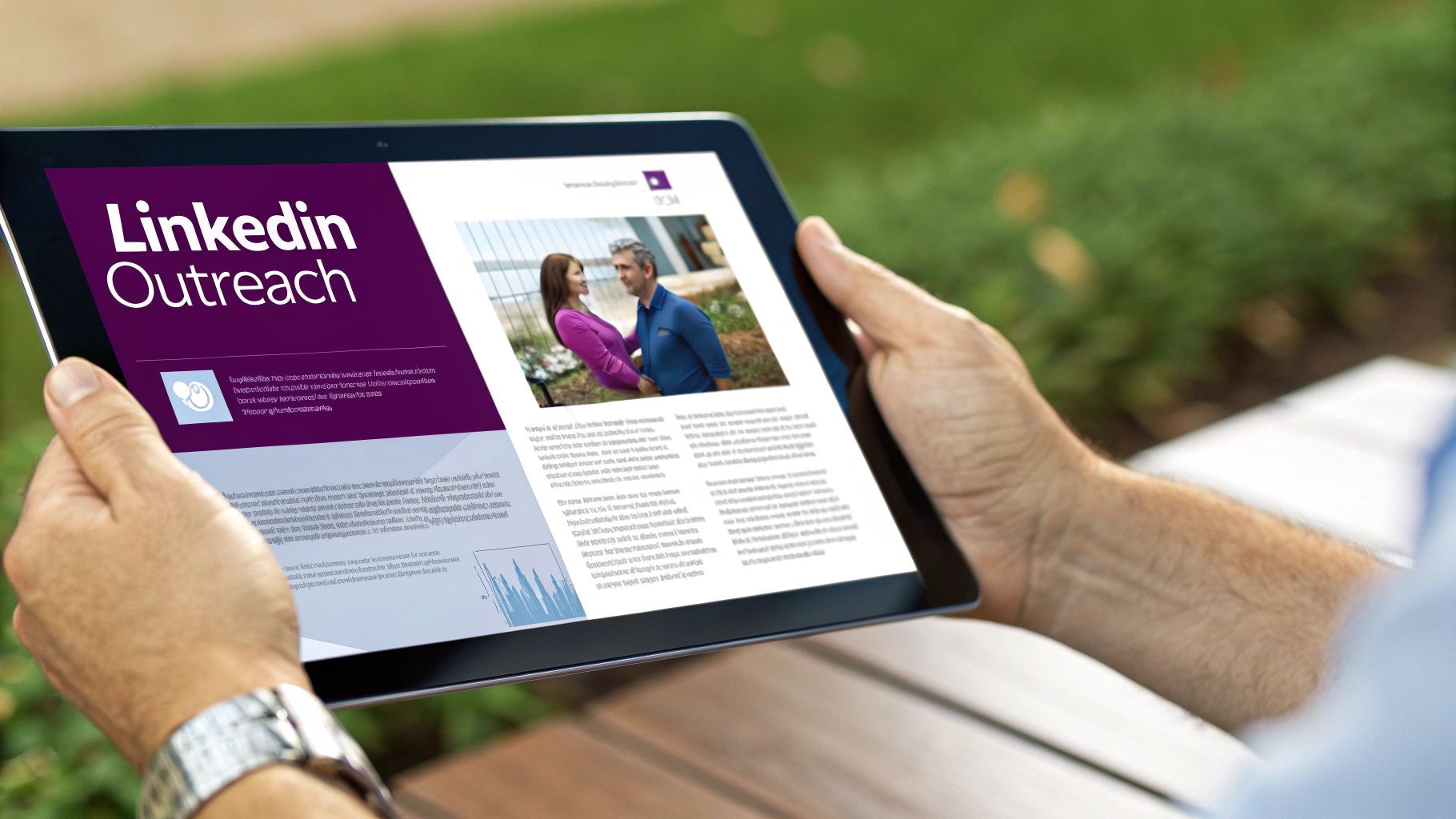
By engaging with a prospect’s content, understanding their professional background, and identifying mutual connections, you can craft highly relevant outreach that feels more like a warm introduction than a cold call. This makes it an essential strategy for any business targeting professional decision-makers.
How LinkedIn Outreach Works in Practice
- For a Financial Services Firm: An advisor identifies VPs of Finance at tech startups using LinkedIn Sales Navigator. Before connecting, they engage with the VPs’ recent posts. The personalized connection request then references their engagement and offers a brief insight related to managing capital during expansion.
- For an Insurance Broker: A broker targeting retail store owners joins industry-specific LinkedIn groups. They share valuable content about risk management and actively participate in discussions. After building a presence, they send direct messages to active group members, referencing a shared discussion point to initiate a conversation.
Actionable Tips for Implementation
- Optimize Your Profile: Treat your LinkedIn profile as a landing page. It should clearly state who you help, the problems you solve, and the value you provide. Use a professional headshot and a compelling headline.
- Personalize Every Connection Request: Never use the default “I’d like to connect” message. Mention a mutual connection, a shared group, a recent post they wrote, or an article their company published.
- Provide Value Before You Ask: Before reaching out, like, comment, and share your prospect’s content. When you finally send a message, it comes from a familiar face, not a complete stranger.
- Leverage Mutual Connections: A warm introduction is the most powerful tool on LinkedIn. Ask a mutual connection if they would be willing to introduce you, providing them with a simple, forwardable blurb to make it easy.
“On LinkedIn, you aren’t just a salesperson; you are a resource. The more value you provide to your network, the more leads will come back to you.”
Executing a consistent and personalized LinkedIn outreach campaign requires significant time for research and engagement. Call center teams can manage this entire workflow, from prospect identification to daily engagement and initial messaging, ensuring your sales pipeline is consistently filled with warm leads.
4. Account-Based Marketing (ABM)
Account-Based Marketing (ABM) flips the traditional lead generation funnel on its head. Instead of casting a wide net to capture as many individual leads as possible, ABM is a highly focused outbound lead generation strategy that concentrates sales and marketing resources on a predetermined set of high-value target accounts.
This strategic approach treats individual customer accounts as unique markets. It involves creating hyper-personalized campaigns designed to resonate deeply with the key stakeholders within those specific organizations. By aligning sales and marketing teams from the start, ABM aims to engage entire buying committees, resulting in larger deal sizes and faster sales cycles.
Using AI to Prioritize Target Accounts
AI-powered tools have revolutionized the way sales and marketing teams identify high-value targets for Account-Based Marketing. Rather than relying on generic qualifications like industry or company size, these platforms—such as Clay, custom-built fit scoring models, and even generative AI like ChatGPT—analyze a blend of firmographic, technographic, and behavioral data to assess each account’s true alignment with your ideal customer profile.
This approach enables you to:
- Evaluate True Fit: AI sifts through signals like recent funding rounds, product launches, hiring trends, technology stack, and public sentiment to score how closely an account matches your best customers—not just on paper, but in practice.
- Prioritize High-Potential Accounts: Instead of working with a broad, undifferentiated list, you can zero in on those organizations where your solution offers the most value and your chances of a successful engagement are highest.
- Continually Refine Targeting: As you gather more data and win more deals, AI models can learn and evolve, ensuring your outreach efforts stay focused on the most promising prospects.
By letting AI take the guesswork out of account selection, your team spends more time engaging stakeholders who are most likely to convert—making every campaign more efficient and impactful.
How Account-Based Marketing Works in Practice
- For a Financial Services Firm: A team targets 20 enterprise-level retail companies. They develop a custom webinar on supply chain finance, promote it with personalized LinkedIn ads to finance executives at those 20 companies, and follow up with tailored case studies.
- For a B2B SaaS Company: The marketing team identifies 50 fast-growing tech companies. They launch a multi-touch campaign that includes personalized emails to the CTO, direct mail with custom-branded items for engineering leads, and targeted digital ads showcasing how their platform solves specific scaling issues.
Actionable Tips for Implementation
- Start Small and Focused: Begin with a pilot list of 10-50 high-value accounts that are an ideal fit for your solution. This makes the personalization process manageable.
- Develop Detailed Account Maps: Identify all key decision-makers, influencers, and stakeholders within each target account. Understand their roles, challenges, and motivations.
- Coordinate Across Channels: Execute a unified multi-channel strategy. Combine digital ads, personalized email sequences, direct mail, and strategic social media engagement to surround the account with a consistent message.
- Use Intent Data: Leverage tools that provide intent data to identify when target accounts are actively researching solutions like yours. This allows you to time your outreach for maximum impact.
Why Mapping the Whole Buying Committee Matters
Let’s face it: B2B purchases rarely hinge on just one person’s “yes.” In fact, today’s buying groups can easily include 8, 10, or even more stakeholders—each with their own priorities, concerns, and veto power. Ignoring even a single key influencer could leave your deal dead in the water, no matter how well you pitch the main point of contact.
Here’s why it pays to look beyond the obvious decision-makers:
- Complex Decisions Require Multiple Perspectives: Technical gatekeepers, finance approvers, end users, and champions all weigh in at different stages. If you only engage with senior leadership, you risk blind spots—or worse, unexpected objections late in the process.
- No Skipped Steps = Fewer Surprises: When you’ve mapped finance, RevOps, and department heads, you build momentum and minimize last-minute roadblocks. The process goes from “endless committee herding” to predictable progress.
- Personalized Messaging Gets Traction: Each role cares about different outcomes. Map the full committee, and you can craft content and messaging that speaks to each stakeholder’s interests, whether it’s technical scalability for IT or ROI for the CFO.
- Stronger Buy-In Across the Org: When everyone feels heard—especially the influencers and power users—adoption skyrockets. You’re not just closing a deal; you’re activating internal advocates.
In short, thorough buying committee mapping is your insurance policy against stalled deals and unseen objectors. Make it a standard practice, and you’ll accelerate both the sales cycle and your win rates.
“ABM isn’t about finding more leads; it’s about finding the right accounts and engaging them so effectively that they have no choice but to notice you.”
Executing a sophisticated ABM campaign requires significant resources. Outsourcing operational tasks like list building and initial outreach can be a strategic move, allowing your core team to focus on high-level strategy and closing deals.
5. Strategic Social Selling to Build Relationships
Social selling is no longer just a buzzword; it’s a fundamental shift in how sales professionals connect with modern buyers. This outbound lead generation strategy moves beyond cold outreach by using social media platforms like LinkedIn and Twitter to find, connect with, and nurture prospects. It’s about building authentic relationships by providing value long before making a sales pitch.
By positioning yourself as a helpful industry expert rather than just a salesperson, you become the go-to resource when a prospect is ready to buy. It’s an essential strategy for B2B sectors like tech and finance, where trust and long-term relationships are critical to closing deals.
How a Social Selling Strategy Works in Practice
- For a Financial Services Firm: An advisor identifies small business owners on LinkedIn discussing cash flow challenges. The advisor engages by commenting with helpful, non-promotional advice and shares a third-party article on effective budgeting, establishing themselves as a knowledgeable resource.
- For a B2B SaaS Company: A sales rep uses social listening tools to track mentions of a competitor’s product. When a user expresses frustration, the rep can offer a helpful tip or a link to a relevant blog post, subtly introducing their solution as an alternative.
Actionable Tips for Implementation
- Optimize Your Profile: Treat your LinkedIn profile as a professional landing page. Use a clear headshot, a benefit-driven headline, and a summary that speaks to how you help your ideal clients.
- Share High-Value Content: Consistently post content that educates and informs your target audience. Share industry news, insightful articles, and company blog posts that address their pain points.
- Engage Authentically: Don’t just “like” a prospect’s post. Leave thoughtful comments that add to the conversation. Creating truly personalized customer interactions is key to standing out. For more ideas on this, learn how to personalize customer interactions on CallZent.com.
- Use Social Listening: Set up alerts for keywords related to your industry, competitors, and customer pain points. This helps you identify buying signals and opportunities to engage in relevant conversations.
“Social selling is about playing the long game. You’re not looking for a quick transaction; you’re building a network of trust that will generate leads for months and years to come.”
Managing a consistent and effective social selling program requires dedicated time for research, content curation, and engagement. Outsourced teams can support this effort by handling prospect identification, social listening, and content scheduling, freeing your sales team to focus on building relationships and closing deals.
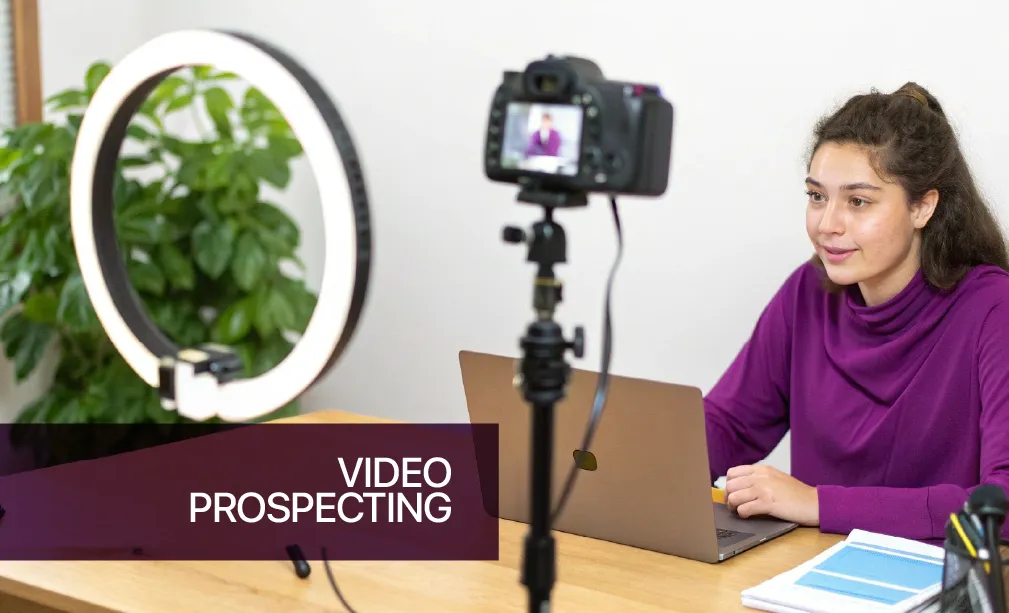
6. Video Prospecting
In an inbox overflowing with text, video prospecting is a powerful outbound lead generation strategy that cuts through the noise. Instead of a standard email, this method involves sending short, personalized video messages to prospects. It leverages the power of visual communication to build human connection, demonstrate authenticity, and capture attention in a way text simply cannot.
This approach immediately differentiates your outreach by showing a real person, not just an automated sequence. By putting a face to your name, you build rapport and trust far more quickly. It’s an effective strategy for B2B sales teams in tech, finance, and other relationship-driven industries.
How Video Prospecting Works in Practice
- For a Financial Advisory Firm: A wealth advisor records a quick video holding a whiteboard with the prospect’s name on it. In the video, they congratulate the prospect on a recent promotion found on LinkedIn and offer to share two specific financial planning strategies relevant to their new role.
- For a B2B SaaS Company: After a prospect downloads a whitepaper, a sales rep sends a follow-up email with an embedded video. In it, they thank the prospect, reference a key point from the whitepaper, and navigate to a specific software feature that solves a related problem.
Actionable Tips for Implementation
- Keep It Short and Sweet: Aim for 30 to 90 seconds. Introduce yourself, state the purpose of your video, provide a piece of value, and close with a clear call-to-action.
- Personalize the Thumbnail: Start your video by holding up a small whiteboard with the prospect’s name or company logo. This visual cue in the email preview drastically increases play rates.
- Focus on Them, Not You: Your script should center on their challenges or recent accomplishments. Start with something like, “Hi [Name], I noticed your team just launched…”
- Optimize Your Setup: You don’t need a professional studio. Just ensure you have good lighting (facing a window works well), clear audio, and a clean background.
- Embed a Clear CTA: End your video with a specific next step, like, “Does it make sense to connect for 15 minutes next week? My calendar is below.”
“Video bypasses the ‘delete’ reflex because it’s novel and human. It’s not just a message; it’s a personal invitation to a conversation, making it one of today’s most effective outbound lead generation strategies.”
Creating and sending personalized videos at scale can be time-consuming. A specialized partner can manage the technical aspects, prospect research, and initial outreach, empowering your reps to focus on the live conversations that video prospecting generates. Integrating these visual tools can also significantly enhance communication, and you can discover more about using video tools in customer interactions.
7. Direct Mail and Dimensional Mail
In a world saturated with digital noise, a physical package can be one of the most disruptive outbound lead generation strategies available. Direct mail, especially its more creative counterpart, dimensional mail, involves sending tangible items to prospects to cut through the clutter and create a memorable, physical connection.
This strategy is built on the element of surprise and reciprocity. A well-crafted physical package is almost guaranteed to be opened, unlike an email that can be deleted with a single click. By delivering a thoughtful, high-value item, you command a prospect’s attention and create a powerful first impression. It’s particularly effective for high-value accounts where a personal touch can make all the difference.
How Direct Mail Works in Practice
- For a Financial Services Firm: A wealth management advisor could send a high-quality leather-bound journal and a branded pen to C-level executives with a handwritten note that reads, “For your next big idea. Let’s talk about funding it.”
- For a B2B SaaS Company: A sales team at a cybersecurity firm sends a locked puzzle box to a Chief Information Security Officer (CISO) with a note saying, “We believe security shouldn’t be a puzzle,” along with a link to a personalized landing page to get the key.
Actionable Tips for Implementation
- Personalize the Experience: Research your prospect’s interests beyond their job title. If they are a known coffee enthusiast, a package with artisanal coffee beans and a branded mug will be far more impactful than a generic gift.
- Plan the Follow-Up Sequence: The magic happens in the follow-up. Time your outreach to coincide with the package’s delivery. A great approach is an email saying, “I hope you enjoyed the [item]. It made me think of [challenge you solve]. Worth a brief chat next week?”
- Make the Unboxing Memorable: The presentation matters. Use quality packaging and design the “unboxing” experience to feel premium and exciting.
- Include a Clear Call-to-Action: Don’t leave the next step to chance. Include a clear, simple instruction in the package, such as a PURL (personalized URL), a QR code to book a meeting, or a direct phone number.
“A digital ad can be scrolled past, an email can be deleted, but a physical box on your desk demands to be opened. That’s the unique power of dimensional mail.”
Coordinating the logistics of a dimensional mail campaign requires significant effort. Call center services can manage the entire fulfillment and coordination process, ensuring your packages land at the right time and are followed up by a timely call, maximizing the impact of your investment.
8. Referral Programs and Partner Outreach
The warmest leads often come from the most trusted sources: your existing customers and strategic partners. This powerful outbound lead generation strategy formalizes word-of-mouth marketing by creating systematic programs that incentivize referrals and collaborations, turning your network into an active, motivated lead-generation engine.
When a happy customer or a complementary business introduces a prospect to your brand, that lead arrives with a pre-built foundation of credibility. It’s a highly efficient approach that significantly shortens sales cycles and increases conversion rates by tapping into proven relationships.
How Referral Programs Work in Practice
- For a Financial Services Firm: A wealth management firm offers existing clients a 10% reduction on their next annual fee for every new client they refer who signs on. This creates a direct financial incentive for clients to advocate on the firm’s behalf.
- For a B2B SaaS Company: A project management software provider partners with marketing agencies that serve the same client base. The agency recommends the software to its clients, earning a commission on each successful referral, creating a mutually beneficial relationship.
Actionable Tips for Implementation
- Formalize Your Program: Create clear, simple rules and incentives. Whether it’s a cash bonus, service credit, or a gift, the reward should be compelling enough to motivate action.
- Make Referring Effortless: Provide referrers with pre-written email templates, social media posts, and a unique tracking link. The less work they have to do, the more likely they are to participate.
- Build Strategic Partnerships: Identify non-competing businesses that share your ideal customer profile. Propose a formal partnership where you co-market and refer leads to each other. To amplify word-of-mouth, consider how developing a brand ambassador program can turn loyal customers into your most effective sales force.
- Follow Up Immediately: Treat every referral lead with high priority. A fast, professional response honors the trust of the person who referred them and makes a strong first impression.
Why True Collaboration Beats Pure Outsourcing
While it might be tempting to simply hand off lead generation to an outside agency and hope for the best, the real magic happens when you join forces as true collaborators, not just delegators. There’s a world of difference between “fix it for me” and “let’s build this together.”
Here’s why collaborative partnerships come out ahead:
- Blending Strengths: You know your business and customers inside and out—your insights set the direction. External partners, meanwhile, bring years of specialized expertise, creative tactics, and scalable processes. Together, those strengths are hard to beat.
- Faster Learning, Smarter Systems: Co-creating your strategy means capturing new ideas and best practices tailored for your company. The result: a program that adapts quickly and avoids cookie-cutter solutions.
- Long-Term Value: Instead of a transactional relationship, you build institutional knowledge and processes that remain with your team—increasing your independence and making future campaigns even more effective.
In short, collaborating with partners leverages the best of both worlds. You maintain control, unlock new capabilities, and set the stage for sustainable lead generation—all while ensuring your brand and customer relationships stay front and center.
“A referral is the highest honor a business can receive from a customer. It means you’ve moved beyond a simple transaction and built a relationship based on real value and trust.”
“A referral is the highest honor a business can receive from a customer. It means you’ve moved beyond a simple transaction and built a relationship based on real value and trust.”
Managing the logistics of a referral or partner program can be time-consuming. A dedicated virtual assistant for your small business can handle the administrative tasks, ensuring every referral is tracked and every partner feels valued, freeing you to focus on closing new business.
Key Bottlenecks to Address Early in Outbound Campaigns
Before you ramp up any outbound lead generation effort, it’s essential to iron out the kinks in your process. Focusing on quality over quantity at the outset ensures that when you do scale, you’re not amplifying inefficiencies.
Here are the most common early-stage hurdles—and how to proactively address them:
- Spam Filters: Test your email deliverability before launching at scale. Verify that your messages land in the inbox by using tools like MailTester or GlockApps, and vary your templates to avoid spam triggers.
- Social Outreach Limits: Platforms like LinkedIn enforce strict daily limits on connection requests and messaging. Monitor your outreach volume and experiment with timing and personalization to maximize responses without risking account restrictions.
- Phone Data Validation: Before cold calling, cleanse your contact lists to weed out outdated or inaccurate numbers. Services such as NeverBounce or NumVerify can help you connect with real prospects rather than dead ends.
- Engagement Tracking: Don’t just rely on sending outreach—make sure prospects are actually engaging. Tools like HubSpot or Mixpanel let you track if recipients are opening emails, clicking links, or visiting your website.
By tackling these operational snags early, you set the stage for a campaign that not only scales but also delivers measurable, meaningful results.
The Role of Technology: Enhancing Human Connection, Not Replacing It
While automation has revolutionized outbound lead generation, it’s important to remember that genuine business relationships are built on trust, credibility, and human touch. Technology—like Salesforce, HubSpot, or Zapier—should act as an enabler, not a substitute.
Automated platforms can handle repetitive tasks, track outreach effectiveness, and keep your efforts organized. But closing deals and nurturing partnerships still relies on empathy, active listening, and nuanced communication—qualities no algorithm or workflow can fully replicate.
When you use technology to empower your team, rather than sideline them, you ensure every interaction feels personalized and authentic. The result? Prospects feel heard, valued, and more likely to engage, giving you a decisive edge in today’s crowded marketplace.
Streamlining Lead Qualification with Automation
Lead qualification is a crucial—but often tedious—step in the outbound process. Fortunately, automation takes the heavy lifting off your team and ensures no promising prospect slips through the cracks.
By harnessing your CRM’s workflow automation (think HubSpot, Salesforce, or Zoho), you can instantly:
- Tag new leads by source, campaign, or partner.
- Match incoming contacts to your Ideal Customer Profile (ICP) using pre-set criteria.
- Score leads based on real-time data, signaling when they’re ready for sales engagement.
This approach means leads are swiftly routed to the right rep rather than languishing in an inbox or queuing for manual review. Automation keeps your pipeline moving, helps reps focus on high-priority prospects, and ensures you deliver a professional, timely response every time.
Outbound Lead Generation Strategies Comparison
| Approach | Implementation Complexity 🔄 | Resource Requirements ⚡ | Expected Outcomes 📊 | Ideal Use Cases 💡 | Key Advantages ⭐ |
|---|---|---|---|---|---|
| Cold Email Outreach | Moderate: Requires research and personalization | Low: Minimal upfront cost, scalable automation | Moderate response rate (1-3%), measurable via open/reply rates | Lead generation at scale, initial prospect engagement | Cost-effective, scalable, easy to track and optimize |
| Cold Calling | High: Needs skilled reps and training | High: Time-intensive, requires experienced staff | Higher conversion rates than email (10-25% meetings from connects) | Complex sales requiring real-time interaction and objection handling | Builds personal rapport, immediate feedback |
| LinkedIn Outreach | Moderate: Requires profile optimization and content strategy | Medium-High: LinkedIn Sales Navigator often needed | Moderate impact with multi-touchpoint engagement | Professional B2B networking, social selling, warming prospects | High-quality audience, rich data, social proof |
| Account-Based Marketing (ABM) | High: Needs cross-team coordination and tech stack | High: Significant investment in tools and data | High ROI and deal sizes, longer sales cycles | Targeting high-value accounts with personalized campaigns | Strong alignment between sales & marketing, efficient resource use |
| Social Selling | Moderate-High: Consistent content and engagement | Medium: Continuous effort across platforms | Builds long-term trust, indirect revenue impact | Relationship-building and consultative sales via social platforms | Builds credibility, less intrusive, multiple touchpoints |
| Video Prospecting | Moderate: Requires video skills and equipment | Medium-High: Time to produce personalized videos | Higher open/reply rates, stronger connections | Standing out in crowded inboxes, personalized outreach | Higher engagement, conveys personality and authenticity |
| Direct & Dimensional Mail | High: Creative design and logistics involved | High: Expensive and less scalable | Very high open rates (80-90%), memorable impressions | Breaking through digital noise, targeted high-value prospects | Tangible impact, high memorability |
| Referral & Partner Outreach | Moderate: Needs program setup and maintenance | Low-Medium: Depends on incentive programs | High-quality leads, faster sales cycles | Leveraging existing networks and warm introductions | Better conversion, low acquisition cost, network effects |
Why a Specialized, Integrated Tech Stack Matters in 2025
Success in outbound lead generation isn’t just about which individual strategies you choose—it’s also about the tools you use to put those strategies into motion. As the landscape becomes more complex and buyer expectations rise, a specialized, well-integrated tech stack has become non-negotiable for agile teams.
Here’s why:
- Alignment with Your Sales Motion: An effective tech stack doesn’t just add shiny new tools for the sake of it. Instead, it’s built around your buyers’ journey and your team’s workflow, ensuring technology actually supports your day-to-day activities rather than slowing them down with clutter or complexity.
- Ongoing Optimization: With the rapid pace of change in sales technology—think AI shifts, data privacy updates, and new outreach platforms—it’s essential to review your tools periodically. Outdated or poorly integrated solutions can drag down efficiency or lead your sales team to chase unreliable signals, making regular audits a must.
- Seamless Omnichannel Execution: When your core CRM (like HubSpot or Salesforce) anchors your stack and specialized apps plug into it, you create a centralized hub for all your sales activities. This integration allows for personalized engagement with prospects across channels—email, phone, social, and beyond—without losing context or dropping the ball on follow-ups.
- Empowering, Not Replacing, Your Team: Your platform should automate routine tasks, streamline lead handoffs, and surface the right data at the right moment—all to free up your sales reps for what they do best: building genuine human connections.
Ultimately, a thoughtful tech stack acts as the connective tissue between your outbound playbook and real results. Instead of a random mix of disconnected apps, it becomes a true workplace for your sales development reps—a system that enhances their strengths, enables focus, and scales your best outbound strategies.
Essential Outbound Tech Stack for Modern Sales Teams
Selecting the right tech stack can supercharge your outbound lead generation engine. Today’s sales teams thrive on connected tools that streamline workflows, boost productivity, and offer real-time visibility.
- CRM Systems: Popular platforms like HubSpot keep your sales and marketing data under one roof, ensuring every interaction is captured and each lead is tracked from prospect to customer.
- Lead Handoff & Scheduling: Calendar tools with automated meeting booking—think Calendly or OnceHub—guarantee hot leads never fall through the cracks by allowing prospects to instantly schedule calls.
- Outreach Automation: Robust platforms such as Reply, Outreach, and Expandi empower reps to execute personalized email sequences, automate LinkedIn engagement, and coordinate follow-ups across multiple channels.
By integrating these solutions, teams create a seamless bridge from first touchpoint to closed deal, ensuring no opportunity slips by unnoticed.
Striking the Right Balance: Automation Meets Human Insight in Lead Qualification
Striving for efficiency often means bringing automation front and center in your lead qualification process. Automated systems—think CRMs, lead scoring tools, and AI-powered chatbots—excel at sifting through large volumes of inbound opportunities, ensuring your pipeline keeps moving without draining your team’s bandwidth.
But not every lead fits neatly into a spreadsheet or meets every checkbox on your ideal customer profile (ICP). That’s where human expertise steps in. While automation handles the repetitive tasks and identifies leads that match set criteria, experienced sales development reps (SDRs) or qualification specialists review the nuances. Whether it’s a promising but unconventional prospect or an enterprise account showing unique buying signals, trained professionals spot the subtle cues that automation might miss.
To make this dynamic work:
- Automate routine qualification steps for speed and scale—let technology handle data collection, scoring, and basic follow-up.
- Reserve human review for edge cases, priority accounts, or situations where judgment, empathy, and deeper conversation matter most.
By combining technology’s consistency with human discernment, you build a more robust qualification engine. This ensures your team doesn’t just move leads rapidly, but also identifies and nurtures the best-fit opportunities that can become your most valuable customers.
Streamlining Lead Qualification and Handoff for Outbound Success
A robust outbound lead generation engine isn’t just about casting a wide net—it’s about ensuring that the most promising leads quickly find their way to the right sales conversations. To pull this off, you’ll need more than generic lead scoring. The magic lies in how you tag, qualify, and route leads based on real signals, so your sales team can spend precious hours with prospects who are actually ready to talk.
Not Every Lead Is Created Equal
It’s tempting to treat every inquiry as a golden opportunity, but a download from your blog isn’t the same as a request on your pricing page. Start by setting up clear, nuanced categories for your Marketing Qualified Leads (MQLs) based on source and activity:
- Content downloads: Often indicate early-stage interest—but not purchase intent.
- Social engagements: Show warmer awareness or curiosity, especially if interactions are with sales-focused posts.
- Solution or service page forms: Typically carry more weight; high-value signals, but double-check if they’re paired with other activity.
- Pricing or demo requests: Usually, your highest-intent leads—these deserve VIP treatment.
This tailored approach reduces false positives and keeps your pipeline humming with the right prospects.
Automate, But Don’t Abdicate
Manual qualification might work when you’re just starting out, but it won’t scale. Modern CRMs—think HubSpot, Salesforce, and Pipedrive—can automate a ton of work for you. Set up workflows to:
- Track and store lead sources and actions.
- Score and segment leads in real time—matching against your Ideal Customer Profile (ICP).
- Prioritize handoffs so sales isn’t hunting through a sea of low-value contacts.
The result: your best-fit leads are automatically queued up for your reps, while others can keep nurturing or be revisited later.
Make Handoffs Frictionless
Ever lost a hot lead to slow follow-up? It happens all too often when prospects get stuck in internal traffic jams—too many forms, unclear ownership, or a game of SDR ping-pong. Instead, deploy calendar booking tools (like Calendly or HubSpot Meetings) to allow top leads to book demos instantly with an available sales executive. This direct approach keeps the momentum going when interest is highest.
Blend Automation and Human Judgment
Automation will carry you about 80% of the way—but don’t underestimate the 20% of leads that defy simple logic. These edge cases need a human touch, whether it’s a strategic account or someone with an unusual buying signal. Designate a qualification specialist or inbound SDR to review these exceptions, refine your ICP over time, and ensure nothing falls through the cracks.
Keep Evolving Your Process
Your definition of a “good lead” will change as your business and audience grow. Review conversion data regularly—are there new titles, industries, or behaviors that reliably close? Adjust your scoring rules, nurture tracks, and sales triggers accordingly. Optimization is never finished, but with the right mix of tech and teamwork, your outbound leads will always land in the right hands at the right time.
Training AI Agents for Hyper-Relevant Outbound Messaging
Looking to sharpen your outbound outreach? AI agents, when used thoughtfully, can be your secret weapon for personalization at scale. The trick isn’t just in using AI, but in teaching it to speak your language and understand your prospects’ world.
Start by training your AI agent with everything that makes your company tick: product details, case studies, and your unique selling points. Feed it your best-performing messages and customer success stories. This builds a knowledge base rooted in your genuine value, not just generic pitches.
Next, set up your AI to gather real-time insights from public sources like company websites, blog updates, and LinkedIn activity—think of it as your digital research assistant. By combining your internal expertise with up-to-the-minute prospect data, your AI can generate email and message copy that’s not just personalized, but also timely and relevant to each individual recipient.
When done right, you’ll create touchpoints that feel like handcrafted notes rather than spam—showing prospects you did your homework and offering something authentically valuable.
Not All Marketing Qualified Leads Are Created Equal
Just because someone fills out a form or clicks on your content doesn’t mean they’re ready to buy—or even interested in a sales conversation. The truth is, the term “MQL” gets thrown around like confetti at a conference, but the differences between these leads can be dramatic.
To avoid chasing dead ends (and preserve your team’s sanity), it’s smart to categorize MQLs by both where they come from and what their actions tell you about their intent:
- Content Grazers: Downloaded your free eBook or whitepaper? Great—but this often signals curiosity rather than purchase intent. Tag these as low-intent leads so your sales team doesn’t waste time chasing “just browsing” window-shoppers.
- Social Engagers: Interactions on LinkedIn or Twitter (now X) are a positive sign, but they typically represent moderate interest. Consider these medium-intent—ripe for nurturing, not hard selling.
- Solution Seekers: Submitted a contact form from your services or solutions page? This is a step up. These leads are showing intent, but check their other touchpoints before rolling out the red carpet.
- Hot Prospects: Anyone requesting a pricing quote or demo—especially via your pricing page—is waving a giant “I’m ready to talk” flag. These leads deserve your quickest, most personalized follow-up.
Not all MQLs should be lumped together. By tagging and responding according to their signals and source, you can allocate resources wisely and boost conversions—without burning out your sales team.
Choosing and Combining Your Outbound Strategies for Maximum Impact
We’ve explored a powerful arsenal of outbound lead generation strategies, from the time-tested effectiveness of cold calling to the highly targeted precision of ABM. Each method offers a unique pathway to connect with your ideal customers.
However, the most profound takeaway is this: isolated strategies yield limited results. The true masters of outbound sales don’t just pick one channel. They build a cohesive, multi-channel engine where each component amplifies the others, creating a system that is far greater than the sum of its parts. This integrated approach is the secret to building a predictable and scalable revenue pipeline.
Outbound Is No Longer About the Vendor—It’s All About the Customer
The days of company-centric outbound are behind us. Gone are the times when sales teams relied on massive databases and generic outreach sequences, optimized for their workflow rather than the customer’s experience. Today’s outbound must be relentlessly customer-centric.
- Reach the right people: Focus on the individuals who truly fit your ideal customer profile, not just anyone with a pulse and an inbox.
- Choose the right channels: Meet prospects where they actually want to engage—whether that’s a thoughtful LinkedIn message, a timely phone call, or even a personalized video.
- Time your outreach: Your message lands best when it arrives at the moment your prospect is most receptive, not just when it’s convenient for your cadence.
- Personalize everything: Ditch the recycled templates. Relevancy wins—craft messaging that feels tailor-made for each recipient.
By weaving these principles into your multi-channel outbound engine, you move from random acts of sales to a system that’s both scalable and deeply relevant. This is how you break through the noise, earn the attention of today’s decision-makers, and build a high-performing outbound machine.
Why Output Metrics Alone Fall Short
It’s tempting to judge the success of your outbound campaigns solely by counting meetings booked or leads generated. But focusing exclusively on those numbers is like judging a gourmet meal by the dessert alone—there’s a lot you’re missing behind the scenes.
The real question is: does your outbound process function seamlessly from start to finish? Numbers like reply rates or conversion percentages matter, but they only tell part of the story. If your foundation—targeting, messaging, workflows, and follow-up—is weak, even the most dazzling output metrics can be short-lived or misleading.
Instead, look at your results holistically.
- Are prospects consistently moving from first touch to follow-up and beyond?
- Is your team able to repeatedly execute each step with quality and clarity?
- Where are drop-offs happening, and do you know why?
By assessing your outreach as an integrated system, not just a tally of outcomes, you ensure you’re building a revenue engine that’s not just productive but also sustainable and scalable. Only then does it make sense to invest in scaling up the numbers.
Ensuring a Frictionless SQL Handoff
A seamless transition from marketing to sales doesn’t just keep the momentum alive—it can be the deciding factor between a booked meeting and a missed opportunity. The last thing you want is to shuffle prospects through endless forms, excessive qualification steps, or slow manual scheduling, only to discover their attention has cooled by the time a rep reaches out.
What’s the smarter move? Implement instant routing and real-time calendar booking using automated scheduling tools like Calendly, HubSpot Meetings, or Salesforce Scheduler. With these in place, marketing-qualified leads can schedule calls with the appropriate sales rep immediately after becoming sales qualified—no bottlenecks, no waiting for call-backs.
- Fast-track your leads: Prospects book meetings on the spot, keeping their interest high.
- Remove manual touchpoints: Automation ensures leads are assigned to the right person, every time, with zero lag.
- Improve conversion rates: The quicker you connect, the more meetings you’ll land—often seeing 50% or more of SQLs turning directly into booked appointments.
The result? An uninterrupted buyer journey that delights prospects and keeps your pipeline flowing.
From Strategy to System: Key Takeaways
The path from individual tactics to a high-performing outbound system is paved with strategic integration.
- Synergy is Your Superpower: The real magic happens when your strategies work in concert. A thoughtful direct mail piece can make a follow-up cold call significantly warmer. A well-timed LinkedIn connection request adds a human face to a cold email, increasing the likelihood of a positive response.
- Context is King: Your choice of outbound lead generation strategies must be dictated by your Ideal Customer Profile (ICP), deal size, and sales cycle length. A high-volume, transactional sale might thrive on cold email and expertly executed cold calls. Conversely, a complex enterprise deal demands the meticulous orchestration of an ABM campaign.
What Makes a Good ICP? Real-World Example
Let’s put theory into practice with a side-by-side look at what separates a generic ICP from one that’s razor-sharp and ready to drive results:
- Vague ICP:
“We target B2B SaaS companies.”
It’s tempting to keep your scope broad, but this leaves you fishing in the open ocean rather than casting your net where the right fish are swimming. Your outreach could hit everyone from a bootstrapped startup in Austin to a multinational like HubSpot—hardly a recipe for focus or efficiency.
- Dialed-In ICP:
- Industry Focus: B2B SaaS, zeroing in on Sales Engagement and Conversational Intelligence providers
- Company Profile: 50–200 employees, Series A–B funded, headquartered in North America
- Growth Signals: Rapid SDR headcount expansion, newly appointed VP of Sales, or recent funding announcements
- Decision Circle: Multi-threaded outreach targeting specific roles—VP of Sales (signer), Head of Demand Gen (internal champion), RevOps Lead (influencer), Sales Manager (day-to-day user), and Finance Controller (budget holder)
Why does this approach deliver? Because it’s detailed, testable, and actionable. You’ll know exactly who to involve, how to tailor your outreach by stakeholder, and when to prioritize an account. This clarity paves the way for smarter sequencing and lets your sales team focus their energy where it matters most—on prospects with the highest conversion potential.
- Start Smart, Then Scale: Don’t try to do everything at once. Select one or two core strategies that align with your business goals. Master them, track your KPIs relentlessly, and once you have a proven process, layer in complementary strategies to expand your reach.
Evaluating and Evolving Your Outbound Tech Stack
Building your outbound toolkit isn’t just about collecting flashy software—it’s about designing a well-oiled machine that fits your team’s workflow and your overarching revenue strategy. In today’s environment, it’s essential to take a step back and ensure that every tool you use actually moves the needle.
- Review Regularly: Set a recurring calendar reminder to audit your tech stack. Circle back every quarter. Is each tool delivering tangible value? Are they aligned with your methods, ICP, and goals? If a tool has become obsolete or fails to integrate cleanly with your sales flow, don’t hesitate to cut it.
- Integration Over Isolation: Look for solutions that work harmoniously together. A strong CRM (like HubSpot or Salesforce) should serve as your command center, with specialized tools for outreach, scheduling, or enrichment seamlessly plugging in. The goal: give your reps a single home base, not a cluttered mess of disconnected apps.
- Assess Signal Strength: Not all data sources maintain their edge. As AI and automation shake up the landscape, reevaluate the reliability of the intelligence you’re acting on. Not all signals are created equal—opt for sources that deliver fresh, actionable insights about your prospects.
Ultimately, your technology should amplify your team’s strengths, not add friction or complexity. Prioritize tools that complement human touch and foster collaboration. Tech is there to empower your SDRs—not to replace them.
Your Actionable Blueprint for Outbound Success
Transforming this knowledge into results requires a clear plan. Start building momentum with these concrete next steps:
- Refine Your ICP: Before anything else, revisit and sharpen your Ideal Customer Profile. Who are you selling to? What are their biggest pain points? Where do they spend their time online? A crystal-clear ICP is the foundation upon which all successful outbound lead generation strategies are built.
But here’s the thing—your ICP isn’t a “set it and forget it” asset. Think of it as a living document that evolves with every sales cycle. Start by drafting your ICP and mapping out key decision-makers. As you engage in outreach, adjust your profile: add missing job titles you encounter, tweak your fit criteria, and trim away segments that yield little return. Double down on the sub-industries and committee structures that convert best.
This process should feel like a continuous feedback loop, not a one-off exercise. The ICP you have in month one will (and should) look different by month six—and that’s a sign you’re on the right track.
Why keep your ICP dynamic?
- It keeps you focused on high-potential leads, not time-wasting long shots.
- Your messaging hits home with the right people.
- Conversion rates improve as you zero in on what works.
- You avoid the dreaded “spammy” label, maintaining your reputation.
- You anchor your strategy in what’s actually working—today, not last quarter.
Advanced Tactics to Build and Refine a High-Impact ICP
Building your Ideal Customer Profile (ICP) goes far beyond ticking off basic firmographic data. If you want real outbound results in today’s market, you need a dynamic, iterative process that evolves alongside your best customers.
Here’s how to take your ICP creation to the next level:
- Go Beyond Surface-Level Segmentation: Don’t settle for broad categories like “Healthcare” or “B2B SaaS.” Drill down into sub-industries, and prioritize those pumping out growth—think sectors announcing fresh funding, scaling their teams, or launching new products. Tracking signals such as hiring velocity, press releases, or funding news helps you zero in on where the real opportunity lies.
- Map the Full Buying Committee: In most B2B sales, a single stakeholder rarely writes the check. The average buying group often spans a range of roles—decision-makers, champions, end users, finance, operations, and more. Sketch out who’s actually involved in approving purchases within your target accounts. Include all influential voices, not just the obvious titles.
- Adapt Committee Structure by Segment: Buying structures shift by company size and geography. A procurement process at a 60-person fintech startup in Austin looks nothing like a 2,000-employee healthtech in Berlin. Tailor your committee mapping to reflect these nuances.
- Demand Account Completeness: Every target account on your list should include all relevant contacts—partial data means missing opportunity. Use tools and research to ensure your outreach doesn’t skip key decision-makers or influential users.
- Implement Intelligent Account Scoring: Leverage platforms like Clay, Apollo, or even homegrown models with AI support to assess not just firmographics, but actual strategic fit. Score prospects on alignment with your solution, current initiatives, and likelihood to convert, so you invest your efforts into deals with the highest payoff.
- Iterate Relentlessly: An effective ICP is a living document. Treat it as a 90-day cycle—start with an initial draft, pressure-test it through outreach, and periodically update your criteria and mapped personas based on market feedback. Add new roles you encounter, prune segments that stall out, and ramp up focus on profiles that yield wins.
Why invest in this advanced approach? A precise, adaptable ICP ensures you’re speaking to the right people, with the right message, at the right time. You’ll:
- Sidestep low-value leads and wasted energy
- Improve your outreach resonance and response rates
- Protect your brand reputation by avoiding scattershot prospecting
- Anchor your entire go-to-market motion in real, evolving market data
In outbound sales, your ICP isn’t just a plan—it’s the filter that turns motion into momentum.
The Dos and Don’ts of Building an Effective ICP
Before you finalize your ICP and charge ahead, keep these best practices (and pitfalls to avoid) in mind:
Do:
- Dig deep into your most successful customers. Analyze not just basic demographics but their pain points, buying triggers, and decision-making processes. Think of this as detective work—look for patterns that reveal why they chose you over competitors.
- Involve both sales and marketing teams in the process. Each has valuable insights, and alignment here prevents costly missteps down the line.
- Keep your ICP rooted in data, not wishful thinking. Review sales win/loss analyses, CRM records, and even LinkedIn profiles to ground it in reality.
- Evolve your ICP regularly. Markets shift, companies pivot, and yesterday’s ideal prospect may not be today’s. Make ICP reviews a routine part of your quarterly planning.
Don’t:
- Avoid being overly broad. “Any business with over 50 employees” invites wasted outreach and poor fit leads. Be specific and intentional in your criteria.
- Don’t confuse ICP with buyer persona. Your ICP is about the type of company; the persona is about the individual within that company.
- Don’t ignore red flags or disqualifiers. If a segment consistently churns or never converts, leave them out—no matter how tempting the numbers look.
- Resist the urge to create your ICP in a silo. Sales learns in the field what marketing won’t see in a spreadsheet, and vice versa.
Clarifying your ICP sets a strong foundation for every outbound strategy you layer on top. Keep it sharp, relevant, and collaborative for best results.
2. Select Your “Core Two” Strategies: Based on your ICP and business model, choose two primary strategies to master first. For instance, an insurance brokerage might pair LinkedIn outreach with strategic cold calling, while an e-commerce brand might focus on cold email and referral programs.
3. Create Your Integrated Playbook: Document how these two strategies will work together. Define the sequence of touches. Will a LinkedIn connection precede the email? Will a call follow up on an opened email? Create simple, repeatable plays for your team to execute consistently.
4. Measure, Analyze, and Iterate: Implement tracking for your core metrics from day one. Use this data not to judge, but to learn. A/B test your email subject lines, call scripts, and LinkedIn messages. Double down on what works and ruthlessly eliminate what doesn’t.
Building a world-class outbound engine is a marathon, not a sprint. It requires discipline, a commitment to data, and the right strategic partnerships to execute flawlessly. By moving from a random assortment of tactics to an integrated system, you transform lead generation from a game of chance into a predictable science.
When you combine a precisely defined ICP, rigorous qualification, hyper-relevant personalization, and true omnichannel execution, you lay the groundwork for sustainable growth. Add in specialized support, a seamlessly connected tech stack, and a scientific approach to constant iteration, and outbound becomes more than just a collection of tactics—it’s a scalable, reliable growth engine. This approach works whether you’re breaking into saturated markets as a nimble startup or expanding your reach as an established enterprise.
With every component working in concert, outbound isn’t just something you “do”—it’s a core driver of predictable, repeatable revenue.
From Strategy to System: Key Takeaways
The path from individual tactics to a high-performing outbound system is paved with strategic integration.
- Synergy is Your Superpower: The real magic happens when your strategies work in concert. A thoughtful direct mail piece can make a follow-up cold call significantly warmer. A well-timed LinkedIn connection request adds a human face to a cold email, increasing the likelihood of a positive response.
- Context is King: Your choice of outbound lead generation strategies must be dictated by your Ideal Customer Profile (ICP), deal size, and sales cycle length. A high-volume, transactional sale might thrive on cold email and expertly executed cold calls. Conversely, a complex enterprise deal demands the meticulous orchestration of an ABM campaign.
- Start Smart, Then Scale: Don’t try to do everything at once. Select one or two core strategies that align with your business goals. Master them, track your KPIs relentlessly, and once you have a proven process, layer in complementary strategies to expand your reach.
Your Actionable Blueprint for Outbound Success
Transforming this knowledge into results requires a clear plan. Start building momentum with these concrete next steps:
- Refine Your ICP: Before anything else, revisit and sharpen your Ideal Customer Profile. Who are you selling to? What are their biggest pain points? Where do they spend their time online? A crystal-clear ICP is the foundation upon which all successful outbound lead generation strategies are built.
But here’s the thing—your ICP isn’t a “set it and forget it” asset. Think of it as a living document that evolves with every sales cycle. Start by drafting your ICP and mapping out key decision-makers. As you engage in outreach, adjust your profile: add missing job titles you encounter, tweak your fit criteria, and trim away segments that yield little return. Double down on the sub-industries and committee structures that convert best.
This process should feel like a continuous feedback loop, not a one-off exercise. The ICP you have in month one will (and should) look different by month six—and that’s a sign you’re on the right track.
Why keep your ICP dynamic?
- It keeps you focused on high-potential leads, not time-wasting long shots.
- Your messaging hits home with the right people.
- Conversion rates improve as you zero in on what works.
- You avoid the dreaded “spammy” label, maintaining your reputation.
- You anchor your strategy in what’s actually working—today, not last quarter.
Advanced Tactics to Build and Refine a High-Impact ICP
Building your Ideal Customer Profile (ICP) goes far beyond ticking off basic firmographic data. If you want real outbound results in today’s market, you need a dynamic, iterative process that evolves alongside your best customers.
Here’s how to take your ICP creation to the next level:
- Go Beyond Surface-Level Segmentation: Don’t settle for broad categories like “Healthcare” or “B2B SaaS.” Drill down into sub-industries, and prioritize those pumping out growth—think sectors announcing fresh funding, scaling their teams, or launching new products. Tracking signals such as hiring velocity, press releases, or funding news helps you zero in on where the real opportunity lies.
- Map the Full Buying Committee: In most B2B sales, a single stakeholder rarely writes the check. The average buying group often spans a range of roles—decision-makers, champions, end users, finance, operations, and more. Sketch out who’s actually involved in approving purchases within your target accounts. Include all influential voices, not just the obvious titles.
- Adapt Committee Structure by Segment: Buying structures shift by company size and geography. A procurement process at a 60-person fintech startup in Austin looks nothing like a 2,000-employee healthtech in Berlin. Tailor your committee mapping to reflect these nuances.
- Demand Account Completeness: Every target account on your list should include all relevant contacts—partial data means missing opportunity. Use tools and research to ensure your outreach doesn’t skip key decision-makers or influential users.
- Implement Intelligent Account Scoring: Leverage platforms like Clay, Apollo, or even homegrown models with AI support to assess not just firmographics, but actual strategic fit. Score prospects on alignment with your solution, current initiatives, and likelihood to convert, so you invest your efforts into deals with the highest payoff.
- Iterate Relentlessly: An effective ICP is a living document. Treat it as a 90-day cycle—start with an initial draft, pressure-test it through outreach, and periodically update your criteria and mapped personas based on market feedback. Add new roles you encounter, prune segments that stall out, and ramp up focus on profiles that yield wins.
Why invest in this advanced approach? A precise, adaptable ICP ensures you’re speaking to the right people, with the right message, at the right time. You’ll:
- Sidestep low-value leads and wasted energy
- Improve your outreach resonance and response rates
- Protect your brand reputation by avoiding scattershot prospecting
- Anchor your entire go-to-market motion in real, evolving market data
In outbound sales, your ICP isn’t just a plan—it’s the filter that turns motion into momentum.
The Dos and Don’ts of Building an Effective ICP
Before you finalize your ICP and charge ahead, keep these best practices (and pitfalls to avoid) in mind:
Do:
- Dig deep into your most successful customers. Analyze not just basic demographics but their pain points, buying triggers, and decision-making processes. Think of this as detective work—look for patterns that reveal why they chose you over competitors.
- Involve both sales and marketing teams in the process. Each has valuable insights, and alignment here prevents costly missteps down the line.
- Keep your ICP rooted in data, not wishful thinking. Review sales win/loss analyses, CRM records, and even LinkedIn profiles to ground it in reality.
- Evolve your ICP regularly. Markets shift, companies pivot, and yesterday’s ideal prospect may not be today’s. Make ICP reviews a routine part of your quarterly planning.
Don’t:
- Avoid being overly broad. “Any business with over 50 employees” invites wasted outreach and poor fit leads. Be specific and intentional in your criteria.
- Don’t confuse ICP with buyer persona. Your ICP is about the type of company; the persona is about the individual within that company.
- Don’t ignore red flags or disqualifiers. If a segment consistently churns or never converts, leave them out—no matter how tempting the numbers look.
- Resist the urge to create your ICP in a silo. Sales learns in the field what marketing won’t see in a spreadsheet, and vice versa.
Clarifying your ICP sets a strong foundation for every outbound strategy you layer on top. Keep it sharp, relevant, and collaborative for best results.
2. Select Your “Core Two” Strategies: Based on your ICP and business model, choose two primary strategies to master first. For instance, an insurance brokerage might pair LinkedIn outreach with strategic cold calling, while an e-commerce brand might focus on cold email and referral programs.
3. Create Your Integrated Playbook: Document how these two strategies will work together. Define the sequence of touches. Will a LinkedIn connection precede the email? Will a call follow up on an opened email? Create simple, repeatable plays for your team to execute consistently.
4. Measure, Analyze, and Iterate: Implement tracking for your core metrics from day one. Use this data not to judge, but to learn. A/B test your email subject lines, call scripts, and LinkedIn messages. Double down on what works and ruthlessly eliminate what doesn’t.
Building a world-class outbound engine is a marathon, not a sprint. It requires discipline, a commitment to data, and the right strategic partnerships to execute flawlessly. By moving from a random assortment of tactics to an integrated system, you transform lead generation from a game of chance into a predictable science.
When you combine a precisely defined ICP, rigorous qualification, hyper-relevant personalization, and true omnichannel execution, you lay the groundwork for sustainable growth. Add in specialized support, a seamlessly connected tech stack, and a scientific approach to constant iteration, and outbound becomes more than just a collection of tactics—it’s a scalable, reliable growth engine. This approach works whether you’re breaking into saturated markets as a nimble startup or expanding your reach as an established enterprise.
With every component working in concert, outbound isn’t just something you “do”—it’s a core driver of predictable, repeatable revenue.
Building a world-class outbound engine is a marathon, not a sprint. It requires discipline, a commitment to data, and the right strategic partnerships to execute flawlessly. By moving from a random assortment of tactics to an integrated system, you transform lead generation from a game of chance into a predictable science.
🚀 Scale Your Outbound with CallZent
Our nearshore agents specialize in cold calling, appointment setting, and multi-channel outreach — let us be your competitive advantage.
Ready to scale your outreach without scaling your in-house team? Many of the most effective outbound lead generation strategies, especially cold calling and appointment setting, require significant time and specialized expertise. CallZent provides expert nearshore call center support, empowering you to execute your outbound campaigns with professional precision and efficiency. Learn how our dedicated agents can become your competitive advantage.
Leverage the Right Tools and Partnerships
Success isn’t just about working harder—it’s about working smarter with the right mix of resources. That means using specialized tools designed for specific sales challenges, such as advanced appointment-booking platforms and integrated outreach stacks to orchestrate your campaigns seamlessly. By combining these technologies with a skilled team, you ensure every handoff is smooth and every lead gets the attention it deserves.
It’s also about knowing when to partner with specialists. While your in-house team can run day-to-day campaigns and continuously share insights, collaborating with dedicated vendors for key activities—like cold calling and multi-channel outreach—can exponentially boost your results. The key is to empower your internal talent while strategically plugging in specialized support where it drives the biggest impact.
Let your team focus on what they do best, and let experts handle the rest.