Skip to content
Customer Experience Strategy
Why Outsource Bilingual Customer
Support Increases Retention: A Practical Guide
Discover why outsource bilingual customer support boosts retention, strengthens customer loyalty, and drives higher satisfaction—with practical strategies and real-world examples.
TL;DR — Quick Takeaways
- Outsource Bilingual support removes communication friction and boosts customer satisfaction.
- Native-language interactions increase trust, loyalty, and long-term retention.
- Clear communication improves FCR, lowers AHT, and prevents escalations.
- Nearshore outsourcing makes bilingual support cost-effective and scalable.
Is your customer support accidentally pushing valuable customers away? If you’re not speaking their language, the answer is almost certainly yes. Bilingual customer support isn’t just a “nice to have” feature; it’s a powerful retention strategy that builds deep, lasting trust. When you solve a customer’s problem in their native language, you do more than close a ticket—you create an immediate human connection that makes them feel seen, heard, and valued.
That positive experience is the bedrock of long-term loyalty.
TL;DR: Why Outsource Bilingual Support Boosts Retention
Bilingual customer support directly increases retention by removing communication friction, building emotional trust, and resolving issues faster. When customers can explain complex problems in their native language, satisfaction skyrockets, First Call Resolution (FCR) rates improve, and they feel a stronger connection to the brand. This leads to higher Customer Lifetime Value (CLV) and transforms support from a cost center into a powerful loyalty engine. Outsourcing to a nearshore partner like CallZent provides instant access to skilled bilingual agents, making this high-ROI strategy accessible and scalable.
The Undeniable Link Between
Language and Customer Loyalty
Have you ever struggled to explain something complicated, only to feel a wave of relief when you finally find someone who just gets it? That’s the exact feeling your customers experience when they connect with a support agent in their native language. It transforms a potentially stressful interaction into a simple and effective one. This isn’t just about convenience; it’s a powerful strategy for keeping your customers around.
The reason why bilingual customer support increases retention is simple: it cuts out the friction. Customers shouldn’t have to wrestle with translations or worry about being misunderstood when they need help. When communication is effortless, problems get solved faster, satisfaction skyrockets, and they walk away with a much stronger, more positive feeling about your brand.
This concept map shows just how direct that path from language to loyalty really is.
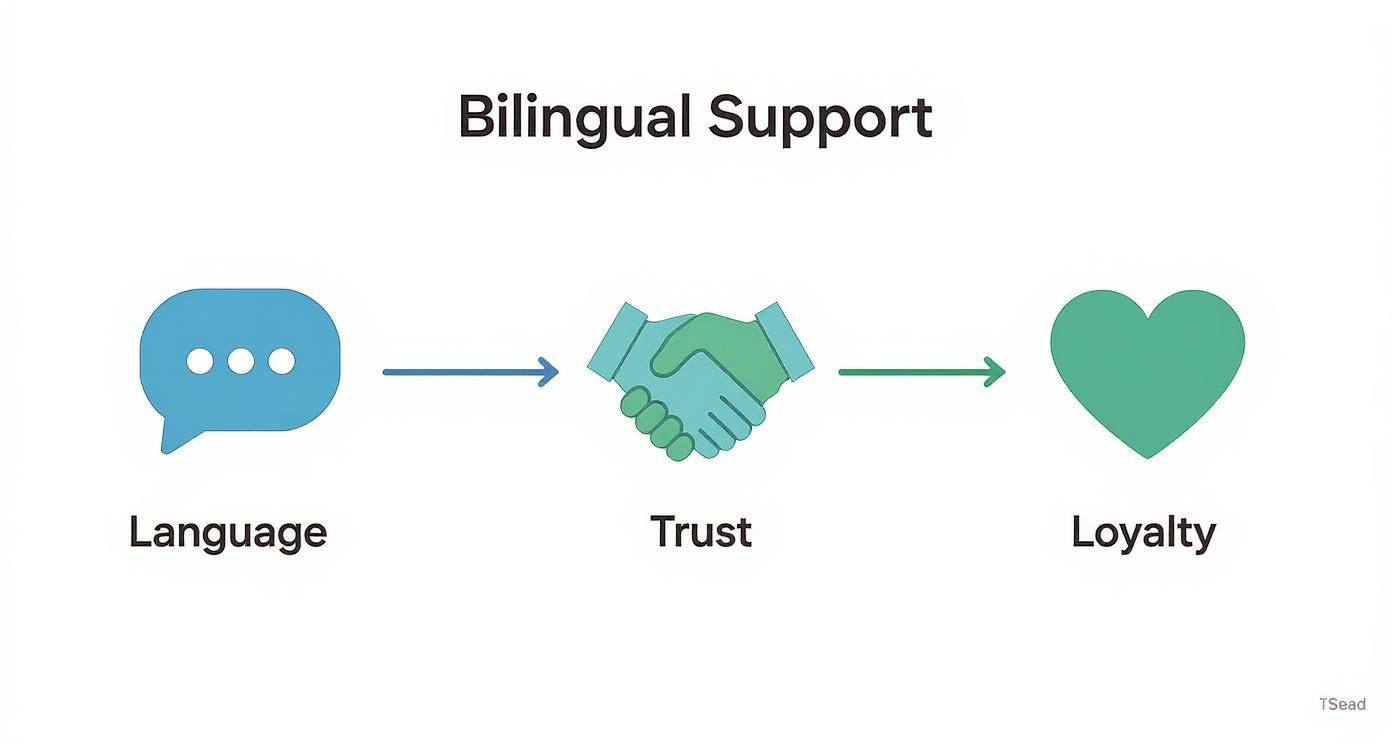
As you can see, speaking your customer’s language isn’t just a perk. It’s a critical first step in building the kind of trust that turns a one-time buyer into a loyal advocate.
An Investment in Understanding, Not a Cost
It’s crucial to see bilingual support as an investment in your customer relationships, not just another line item on a budget. And the data backs this up, loud and clear.
While a vast majority of contact centers interact with non-English speaking customers, many are still unprepared to help them effectively. On the flip side, research shows that 72% of customers feel more satisfied when support is offered in their native language. Even more telling, 58% confirm it directly increases their loyalty to a brand.
The table below breaks down exactly how speaking a customer’s language translates into stronger retention.
How Outsource Bilingual Support Drives Customer Retention
| Core Pillar | Impact on Customer Retention |
|---|---|
| Trust & Connection | Creates an immediate emotional bond, making customers feel understood and valued. |
| Reduced Friction | Eliminates language barriers, leading to faster, more accurate problem-solving. |
| Increased Satisfaction | A smooth, frustration-free experience boosts CSAT scores and positive sentiment. |
| Cultural Relevance | Shows genuine respect for the customer’s background, strengthening the brand relationship. |
Ultimately, this level of personalized care sends a powerful message: we value you enough to meet you where you are. That foundation of respect is essential for building a reputation that not only attracts customers but keeps them coming back. When you invest in clear communication, you’re directly investing in the long-term health and growth of your business. You can dive deeper into how call centers improve brand reputation and loyalty in our detailed guide.
Building Deeper Trust by Removing Communication Barriers
Ever tried to solve a complex, urgent problem—like a major billing error or a faulty product—using only a translation app? It’s exhausting, frustrating, and incredibly slow. That’s exactly what it feels like for many customers when they’re forced to get help in a language that isn’t their own. The whole conversation is filtered through a layer of what experts call cognitive load.
This mental strain is an instant roadblock to trust. When a customer is struggling to find the right words, they can’t focus on the actual solution. Nuances get lost, emotions are easily misinterpreted, and tiny misunderstandings can snowball into deal-breaking frustrations. It’s a huge reason why customers churn—not because the problem was unsolvable, but because the process of solving it felt impossible.
This is exactly why bilingual customer support increases retention. It instantly dissolves that barrier. When you speak a customer’s native language, you remove the mental gymnastics and create a direct path to a clear, human conversation.
The Psychology Behind Why Outsource Bilingual Support Makes Customers Feel Understood
When a bilingual agent connects with a customer in their preferred language, something powerful happens that goes way beyond simple translation. It sends a clear, unspoken message: “We see you. We respect you. And we’ve invested in understanding your needs on your terms.” This simple act validates their identity and shows a real commitment to their experience.
That feeling of validation is the bedrock of genuine trust. Customers feel safe, knowing they can express themselves precisely without worrying about being misunderstood. This psychological safety makes room for more open, honest dialogue—which is non-negotiable for solving problems and building a real relationship. The entire dynamic shifts from a rigid, transactional encounter to a human one. You can dig deeper into the role of empathy in customer service and see how it cements these connections.
“True customer loyalty isn’t built on transactions; it’s built on trust. Speaking a customer’s language is the most direct way to prove you’re worthy of that trust.”
This approach also slashes the risk of miscommunications that can quietly poison your brand’s reputation. A great bilingual agent doesn’t just swap words; they interpret tone, cultural context, and what’s not being said. This deeper level of understanding prevents the friction that leads to bad reviews and lost business. Exploring proven client communication best practices can offer fantastic insights for your whole team.
At the end of the day, removing language barriers isn’t just a nice-to-have. It’s one of the most powerful moves you can make to build the kind of resilient trust that keeps customers coming back.
 How Outsourcing Bilingual Support
Accelerates Problem Resolution
Let’s be honest: effective customer support is fast support. When customers have a problem, they want it solved on the first try, without jumping through hoops or repeating themselves. This is a core reason why bilingual customer support increases retention—it clears the path to a quick solution and directly improves the operational metrics that define a great experience.
Think about a customer trying to describe a complex technical bug or a tricky billing error. If they’re forced to do this in a second language, they’ll almost certainly struggle to find the right words. That hesitation leads to misunderstandings, repetition, and frustration on both ends of the line.
But when they can explain the issue in their native tongue, the entire dynamic shifts. The agent gets to the root of the problem faster, understands the nuances, and delivers a precise fix in a fraction of the time.
Why Bilingual Agents Improve Key Call Center Metrics
Bilingual support isn’t just a “feel-good” feature—it has a direct, measurable impact on call center efficiency. By knocking down the language barrier, agents make huge gains on the performance indicators that matter most for satisfaction and loyalty.
- Higher First Call Resolution (FCR): When communication is crystal clear from the get-go, agents are far more likely to nail the solution on the first attempt. To dig deeper, check out our guide on how to optimize First Call Resolution.
- Lower Average Handle Time (AHT): Less time is squandered clarifying what a customer means or waiting for a translation. This means agents solve problems more quickly and can help the next person in the queue.
- Reduced Escalations: Simple, clear communication stops minor issues from blowing up into major problems that need a supervisor’s help. That saves everyone time and headaches.
Here’s a practical example: A Spanish-speaking e-commerce customer is trying to explain that an item arrived damaged. In English, they might struggle with the right terminology (“chipped,” “scuffed,” “defective”). But a bilingual agent gets it instantly, processes the return, and offers a solution in minutes. The same interaction with an English-only agent might have involved sending photos, follow-up emails, and multiple transfers, turning a simple fix into a frustrating ordeal.
Ultimately, a quick, painless support interaction leaves the customer feeling valued and understood. They didn’t have to fight to explain their problem; it just got solved. That kind of positive experience builds powerful loyalty and gives them every reason to stick with your brand.
The Tangible ROI of Investing in Bilingual Agents
Let’s move past the “soft” benefits and talk about what really matters to the bottom line: the financial return of bilingual support. It’s time to stop thinking of customer service as a cost center and see it for what it is—a powerful revenue driver. The numbers don’t lie.
There’s a foundational business principle that a mere 5% increase in customer retention can boost profits by 25% to 95%. This isn’t just some abstract metric; it’s the direct result of fostering loyalty. And bilingual customer support is one of the most effective ways to fuel that profitable loyalty.
When customers feel genuinely understood, they don’t just stick around—they become more valuable over time. This directly increases their Customer Lifetime Value (CLV), making them far more likely to make repeat purchases and stay open to new offers. They go from being simple consumers to your most powerful brand advocates, generating the kind of organic, high-trust referrals that you just can’t buy.
From Clear Communication to Increased Conversion
Pouring resources into bilingual agents is a direct investment in your bottom line. Think about it: miscommunication doesn’t just create frustration; it actively kills sales. One study found that 64% of executives admitted to losing business specifically because of language misunderstandings. That’s a staggering economic toll and a clear warning sign for any company not catering to its diverse customer base.
The financial upside is crystal clear:
- Reduced Customer Churn: When you solve a customer’s problem in their native language, you’re not just fixing an issue—you’re building a reason for them to stay.
- Increased Sales Conversion: Clear, effortless communication removes friction from the buying process. It makes it easier for customers to say “yes.”
- Enhanced Brand Equity: Building a reputation for inclusivity and excellent service is a magnet for a wider, more diverse audience.
Ultimately, the goal is to improve customer satisfaction, which this playbook for improving customer satisfaction and driving growth rightly highlights as a critical business driver. By creating exceptional experiences, you build a loyal customer base that gives you a sustainable competitive advantage. This approach transforms your customer service into a high-yield investment with tangible returns. To learn more about the financial benefits, explore the ROI of outsourcing call centers to save time and money with a nearshore partner.
How to Build a Winning Bilingual
Support Strategy
Knowing why bilingual support works is one thing. Actually putting it into practice? That’s the real challenge. A winning strategy is about more than just hiring people who speak another language. It’s about building a system that delivers a consistently great, culturally-aware experience every single time.
This means being smart about how you structure your team, what you measure, and how you train your people. Get this right, and your support function transforms from a simple cost center into a powerful retention engine.
Choosing Your Support Model: In-House vs. Outsourcing
One of the first big decisions you’ll face is how to staff your bilingual team. You really have two main paths: build it yourself or partner with a specialist.
- In-House Teams: This model gives you total control over hiring, training, and day-to-day management. But it’s not without its headaches. You’re looking at higher recruiting costs, longer ramp-up times, and the very real challenge of finding enough qualified talent in your local area.
- Outsourced Partners: Working with a nearshore call center like CallZent in Tijuana gives you instant access to a large, pre-vetted pool of skilled bilingual agents. This path completely sidesteps the recruitment grind, cuts down on operational overhead, and lets you scale your support up or down as needed.
For most businesses, especially those trying to grow efficiently, a nearshore partner is the clear winner. You get deep expertise and solid infrastructure without the massive upfront investment, freeing you up to focus on your core business while the experts handle support.
Tracking KPIs to Measure What Matters
If you want to prove the value of your bilingual support, you have to measure its impact. Generic, blended metrics just won’t cut it. You need to segment your Key Performance Indicators (KPIs) by language to get a clear picture of what’s really going on.
Start by tracking these core metrics for each language group:
- Customer Satisfaction (CSAT): Are your non-English speaking customers as happy as your English-speaking ones? A high CSAT score in both columns is a huge win.
- First Call Resolution (FCR): An uptick in FCR for your bilingual customers is solid proof that matching them with native-speaking agents is solving problems faster.
- Customer Churn Rate: This is the ultimate test. Track whether retention improves for the customer segment getting native-language support. A lower churn rate here draws a straight line from your efforts to your ROI.
“Data tells a story. When you segment your KPIs by language, you can clearly see the narrative of how bilingual support is directly boosting customer loyalty and retention.”
More Than Words: The Power of Cultural Competency Training
Real bilingual support goes way beyond literal translation—it demands cultural fluency. An agent’s ability to navigate cultural nuances, like different communication styles, points of etiquette, or even regional slang, is what builds genuine rapport and trust.
This is exactly why bilingual customer support increases retention so effectively. It’s about creating a true connection, not just swapping out vocabulary.
This is where specialized training becomes non-negotiable. Agents need to be armed not just with language skills, but with the cultural context to use them with empathy. You can learn more about how CallZent trains bilingual agents to hit this level of fluency and awareness. When you invest in this deeper competency, you make sure your customers feel heard and understood on every level, locking in their loyalty for the long haul.
 Real-World Scenarios
Where Bilingual Support Saves the Day
It’s one thing to talk about retention in theory, but where bilingual support really proves its worth is in those high-stakes, everyday moments that can make or break a customer relationship. This is why outsource bilingual customer support increases retention—it transforms potential meltdowns into moments of genuine connection.
Let’s walk through a common scenario. An e-commerce customer, a native Spanish speaker, just received a high-value item, and it’s damaged. She’s frustrated and calls support, but she’s struggling to describe the specific problem in English. The agent on the other end is stuck in a script, asking for photos and emails, completely missing the nuances of her issue. The customer doesn’t just feel unheard; she feels distrusted. What happens next? A one-star review, a canceled order, and a story she’ll tell her friends.
Now, imagine that same call goes to a bilingual agent. The customer explains everything, effortlessly, in Spanish. The agent gets it instantly, offers a sincere apology, and ships a replacement right then and there. That customer hangs up feeling relieved and respected. You didn’t just solve a problem; you earned a customer for life.
From Confusion To Clarity In Critical Moments
This isn’t just about e-commerce. The same dynamic plays out across every industry, but the stakes get even higher when complex or sensitive information is involved.
Take a healthcare scenario. A patient needs to understand their co-pay for a critical medical procedure. An English-only conversation is a minefield of misunderstood terms, leading to anxiety, confusion, and maybe even a delayed procedure. It’s a recipe for disaster.
“In moments of high stress—whether it’s a financial decision or a health concern—clarity is kindness. Bilingual support delivers that clarity, building a foundation of trust that customers will remember.”
With a bilingual agent, that patient can ask detailed questions in their native language and get clear, reassuring answers. They end the call feeling confident and cared for, and their trust in their provider is solidified. This is how you turn a routine interaction into a powerful retention tool. Speaking your customer’s language isn’t just a nice-to-have; it’s one of the smartest investments you can make.
Let’s break down how this looks across different sectors.
How Bilingual Support Increases Retention Across Industries
The core challenge is always the same—a communication barrier—but the consequences vary by industry. Here’s a look at how bilingual support turns a negative experience into a loyalty-building moment.
| Industry | Common Customer Challenge | Outcome with Bilingual Support |
|---|---|---|
| E-commerce | A customer receives the wrong size for an important event and can’t explain the urgency or specific style needed for a replacement. | The agent quickly understands the context, empathizes with the situation, and expedites the correct item. The customer becomes a brand advocate. |
| Healthcare | A patient’s family member struggles to understand complex post-op care instructions, leading to potential health risks. | A bilingual agent calmly walks them through the instructions, ensuring full comprehension and patient safety. Trust in the provider deepens. |
| Financial Services | A customer is confused about a late fee on their credit card statement and worries about their credit score due to a language barrier. | The agent clearly explains the fee in the customer’s native language, resolves the issue, and provides peace of mind. The customer feels secure. |
| SaaS/Technology | A small business owner can’t resolve a critical software bug because they can’t articulate the technical details in English. | The bilingual tech support agent diagnoses the problem efficiently, preventing business downtime and solidifying the customer’s reliance on the software. |
In each case, the bilingual agent does more than just translate words. They interpret intent, understand cultural context, and build an emotional connection that an English-only interaction simply can’t match. That’s the real secret to turning support calls into a competitive advantage.
Common Questions About
Bilingual Support and Retention
Even when the benefits are clear, it’s only natural for business leaders to have a few practical questions before committing to bilingual support. Let’s tackle some of the most common ones we hear, because these aren’t just theoretical challenges—they’re real-world business decisions.
Is Hiring Bilingual Agents More Expensive Than Using Translation Software?
It’s a fair question. On the surface, translation software looks like a bargain. But that initial saving often comes at a much higher price down the road.
Software lacks the empathy, cultural nuance, and genuine connection that a human agent provides. This often creates frustrating, clumsy interactions that send customers running to your competitors. Investing in skilled bilingual agents builds real trust and loyalty, delivering a far greater long-term ROI by slashing customer churn. It’s not just an expense; it’s a smarter financial decision.
How Do I Measure the ROI of a Bilingual Support Program?
You measure it by looking at the numbers within your non-English speaking customer base. The proof is right there in the data.
Start by tracking key metrics like Customer Satisfaction (CSAT), Net Promoter Score (NPS), and First Call Resolution (FCR) for that specific group. If you see a significant jump in these KPIs after rolling out bilingual support—along with a drop in churn for that segment—you have clear, data-backed evidence of a positive return.
What Is the Advantage of Outsourcing to a Nearshore Center?
Outsourcing to a nearshore partner like CallZent in Tijuana gives you a massive advantage right out of the gate. You get immediate access to a large, highly skilled bilingual talent pool that’s already culturally in tune with U.S. markets.
This model completely sidesteps the high costs and logistical headaches of trying to recruit specialized agents in-house. It allows you to scale up or down efficiently while ensuring you’re delivering high-quality, empathetic service that directly boosts customer retention and makes your brand stronger.
🚀 Ready to Strengthen Customer Loyalty?
CallZent provides expertly trained bilingual agents who boost retention, improve satisfaction, and elevate your customer experience.
Ready to see how a dedicated bilingual team can transform your customer loyalty and drive growth? At CallZent, we build custom nearshore support solutions that create lasting connections. Contact us today to learn how we can help.