Skip to content
Customer Support Outsourcing
Outsource Customer Support: How to Scale Faster Without Sacrificing Quality
Learn how to outsource customer support strategically to reduce costs, access bilingual talent, scale on demand, and deliver 24/7 customer experiences without operational drag.
TL;DR — Quick Takeaways
- Outsourcing customer support frees your internal team to focus on growth, innovation, and revenue.
- Nearshore outsourcing can reduce support costs by up to 60% compared to in-house or onshore teams.
- Bilingual, trained agents improve CX while maintaining brand voice and cultural alignment.
- The right partner turns customer support into a scalable, strategic advantage—not a cost center.
Is your team constantly pulled away from core tasks to handle customer questions? It’s a common growing pain, but it’s also a major roadblock that prevents your business from scaling effectively.
When you outsource customer support, you’re not just hiring someone to answer phones; you’re bringing on a strategic partner dedicated to managing your customer interactions, freeing up your internal team to focus on innovation and growth.
 Why Smart Businesses Outsource Customer Support
The old view of outsourcing as merely a cost-cutting tactic is outdated. Today, it’s a powerful strategy for growth. By handing off customer interactions to a specialized partner, you’re not just offloading tasks—you’re gaining a serious competitive advantage. This move lets your key people focus on activities that drive expansion, like product development, marketing, and big-picture strategy.
The Strategic Shift in Customer Care
The global outsourced customer experience market is booming, expected to hit $111.4 billion by 2028. This growth is a direct response to sky-high consumer expectations. With 90% of customers now expecting an immediate response to their inquiries, businesses need the resources to deliver every time. This is where an expert outsourcing partner shines, giving you the agility to meet these demands without the massive upfront investment of building a 24/7 in-house team.
“Treating customer support as a strategic asset, rather than a cost center, is the first step toward building a truly customer-centric company.”
More Than Just Answering Calls
If you’re only thinking about cost, you’re missing the bigger picture. The true value lies in transforming your support operations into a professional, well-oiled extension of your brand. A dedicated partner brings a complete toolkit: proven expertise, advanced technology, and trained agents ready to represent your company from day one.
- Significant Cost Reduction: Eliminate the high costs of hiring, training, benefits, and office space. The financial upside is significant; explore the ROI of outsourcing to call centers to understand the potential savings.
- Access to Specialized Talent: Instantly connect with a pool of trained, experienced, and often bilingual agents who are experts in communication and problem-solving.
- Effortless Scalability: Need to ramp up for a product launch or a holiday rush? A partner allows you to scale your support team up or down seamlessly, without recruiting delays.
- 24/7/365 Coverage: Offer your customers support around the clock. Being available whenever they need you is one of the fastest ways to build satisfaction and fierce loyalty.
Choosing Your Model: Onshore, Nearshore, and Offshore
Once you decide to outsource customer support, the next critical question is where? Forget dry, academic definitions. Think of the different outsourcing models as distinct talent pools, each with unique advantages. The right choice depends on your business goals, budget, and customer expectations. Let’s break down the three main options.
Onshore Outsourcing: Your Local Partner
Onshore outsourcing means partnering with a call center in your own country. For a U.S.-based company, this means working with a BPO in another state like Texas or Florida. The primary benefit is zero cultural or language barriers; your outsourced team understands local nuances perfectly. However, this model comes at a premium, offering minimal cost savings compared to an in-house team.
Offshore Outsourcing: The Global Approach
Offshore outsourcing involves partnering with a provider in a distant country, such as the Philippines or India. The main driver for this model is cost—it’s typically the cheapest option. This makes it attractive for businesses needing 24/7 support on a tight budget. However, significant time zone gaps can complicate collaboration, and cultural differences can sometimes lead to communication challenges with customers.
Nearshore Outsourcing: The Best Of Both Worlds
Nearshore outsourcing offers a strategic balance by partnering with a provider in a neighboring country. For U.S. and Canadian businesses, this often means Mexico. This model provides substantial cost reductions while maintaining strong cultural alignment and minimal time zone differences. Agents in nearshore locations like Tijuana are often bilingual and highly familiar with North American culture, ensuring smooth customer interactions.
Cost savings are a major advantage of nearshore. Rates typically range from $10-$25 per hour, which is up to 60% cheaper than the $25-$35+ hourly rates for onshore services. This makes it an ideal fit for growing businesses, e-commerce stores, and healthcare providers.
Nearshore isn’t just a compromise; it’s a strategic decision. It delivers the cost efficiency of global outsourcing with the cultural affinity and operational ease of a local partner.
The minimal time zone difference also makes collaboration between your in-house and outsourced teams incredibly easy. To dive deeper, check out our guide comparing nearshore vs. offshore outsourcing costs and ROI.
Onshore vs. Nearshore vs. Offshore: How to Outsource Customer Support
This table breaks down the key differences between the three main models to help you decide which is right for your business.
| Factor | Onshore (e.g., USA) | Nearshore (e.g., Mexico) | Offshore (e.g., Philippines) |
|---|---|---|---|
| Cost Savings | Low (Highest Cost) | High (Significant Savings) | Highest (Lowest Cost) |
| Cultural Alignment | Very High | High | Moderate to Low |
| Time Zone Overlap | Excellent | Excellent | Poor |
| Agent Skill Pool | High | High (Often Bilingual) | High |
| Collaboration Ease | Very Easy | Easy | Challenging |
Each model serves a purpose, but for a growing number of businesses, nearshore provides a powerful mix of cost savings, cultural fluency, and operational simplicity that’s hard to beat.
The Real Benefits When You Outsource Customer Support
Let’s move past theory. What tangible results can you expect when you outsource customer support? It’s about more than clearing tickets; it’s about transforming a business function into a powerful engine for growth and customer loyalty.
This decision tree illustrates a simplified path for choosing an outsourcing model based on key business priorities.
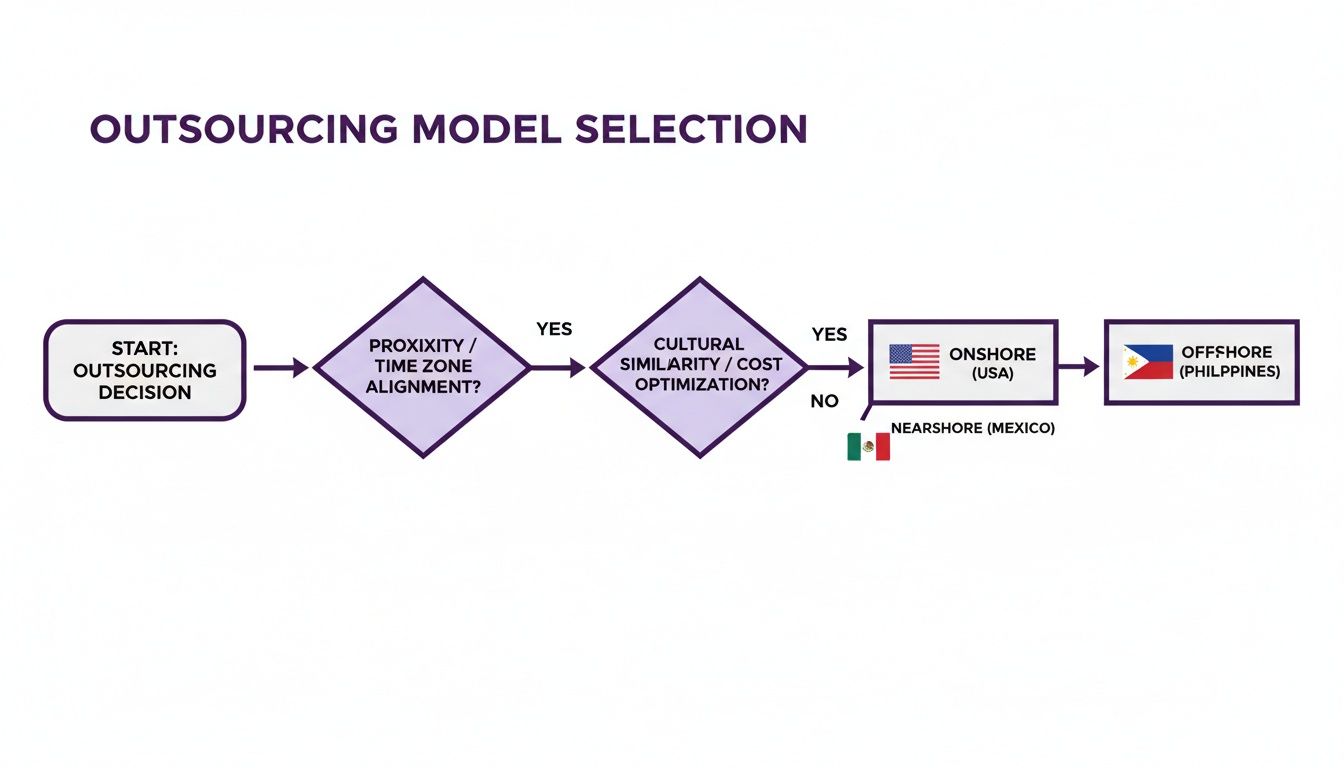
As you can see, nearshore solutions often hit the strategic sweet spot, balancing significant cost savings with the operational ease of being culturally and geographically close.
Reduce Costs Without Sacrificing Quality
The most immediate benefit of outsourcing is the dramatic drop in operational costs. Building an in-house team is expensive—you’re paying for salaries, benefits, office space, technology, and training. With a nearshore provider, these overheads are bundled into a single, predictable cost. For example, a growing e-commerce brand can avoid the six-figure expense of setting up a new support department, reinvesting that capital directly into revenue-driving activities like marketing.
Access A Specialized and Bilingual Talent Pool
Outsourcing instantly connects you with experienced talent you likely couldn’t find or afford on your own. Top BPOs invest heavily in recruiting and training agents skilled in specific industries. This means you get a professional, ready-to-go team from day one. In a nearshore location like Tijuana, this talent is often bilingual (English and Spanish). For a healthcare provider serving a diverse population, bilingual agents can offer seamless, empathetic support to all patients, breaking down language barriers and improving the patient experience.
“The moment you stop seeing customer support as a cost and start seeing it as an investment in relationships, your entire business perspective shifts. Outsourcing is the catalyst for that change.”
Achieve 24/7 Availability and Uninterrupted Service
Your customers don’t operate on a 9-to-5 schedule, so why should your support? Offering around-the-clock service is a powerful way to build loyalty, but it’s often prohibitively expensive for an in-house team. Outsourcing makes 24/7/365 coverage an affordable reality. A financial services company, for instance, can offer clients immediate help at any time, building trust and reinforcing the brand’s reliability.
Scale Seamlessly for Seasonal Demands
Business is rarely predictable. A retail company might see a 300% surge in inquiries during the holidays. Trying to handle these peaks with an in-house team leads to overwhelmed staff and frustrated customers. The flexibility of an outsourced partner is a game-changer. You can scale your support team up or down on demand, paying only for what you need. This agility ensures you maintain stellar service quality even during your busiest periods. To explore these advantages further, review the 5 key benefits of customer care outsourcing.
How to Choose the Right Outsourcing Partner
Choosing a partner to represent your brand is a critical decision. Get it right, and you’ll spark growth and build customer loyalty. Get it wrong, and you risk your reputation. To outsource customer support successfully, you need a vetting process that goes far beyond a price comparison. Think of it like hiring a key executive—you need to assess their track record, values, and how they handle pressure.
A Checklist for Vetting Potential BPO Partners
To find the right fit, you need to ask the tough questions. Use this checklist to guide your conversations:
- Industry Expertise: Have they worked in your industry before (e.g., e-commerce, healthcare, finance)? Ask for case studies and client references. You need proof they understand your unique challenges.
- Technological Compatibility: Do their systems integrate with your CRM and helpdesk? A good partner should simplify your workflow, not create new tech problems.
- Data Security Protocols: How do they protect your customers’ sensitive information? Ask for proof of compliance with standards like PCI DSS or HIPAA and get specifics on their data security measures.
- Scalability and Flexibility: How do they handle scaling your team up or down? Their process for managing growth will reveal their operational capabilities.
Digging Deeper Into Training And Culture
Technology is important, but people deliver the customer experience. A partner’s investment in mastering customer support training is a strong indicator of their commitment to quality. A provider that invests in continuous agent development is serious about excellence.
“A partner’s agent retention rate is one of the most telling metrics. High turnover is a red flag for underlying issues with culture and management, which will inevitably impact the quality of your customer service.”
Cultural fit is also a deal-breaker. Your partner’s values must align with yours. If your brand emphasizes empathy, you need a partner whose agents embody that principle in every conversation.
Defining and Measuring Success From Day One
Before signing a contract, agree on clear Key Performance Indicators (KPIs). Vague goals lead to vague results. A professional partner will work with you to define what success looks like.
Here are a few essential KPIs to establish from the start:
- First Call Resolution (FCR): What percentage of issues are solved on the first try? A high FCR indicates knowledgeable and efficient agents.
- Customer Satisfaction (CSAT): How happy are your customers with the support they receive? This gives you a direct pulse on service quality.
- Average Handle Time (AHT): How long does it take to resolve an issue? This must be balanced with FCR and CSAT to ensure quality isn’t sacrificed for speed.
- Agent Adherence: Are agents following schedules and procedures? This KPI measures your partner’s operational discipline.
For a closer look at evaluating partners, our guide on how to find and vet the best call center outsourcing companies offers more detail.
Ensuring A Smooth Transition to Your Outsourced Customer Support Team

You’ve chosen a partner—now what? The transition is where your decision to outsource customer support comes to life. With a solid plan, what could be a chaotic handover becomes a smooth, organized journey. Success isn’t about flipping a switch; it’s about a collaborative onboarding process.
The Implementation Roadmap: A Step-by-Step Checklist
A seamless transition is built on clear communication and meticulous planning. Your outsourcing partner should work with you to customize a plan that includes these core stages:
- 1. Deep Dive and Documentation: Your partner needs to become an expert on your business. This involves documenting everything—from support workflows and common customer questions to your unique brand voice.
- 2. Define Communication Protocols: Establish clear channels for daily updates, weekly performance reviews, and urgent escalations to keep everyone aligned.
- 3. Establish Reporting and KPIs: Finalize the KPIs you discussed during vetting. Your partner should set up dashboards so you have full visibility from the start.
- 4. Plan a Phased Rollout: Start with a smaller part of your support volume, like email-only inquiries, to work out any kinks before a full launch. This allows the team to gain confidence and ensures a smoother transition.
When evaluating partners, ask about their cybersecurity practices. A top-tier provider may offer comprehensive managed network services to protect your data.
From Plan to Practice: A Real-World Example
A mid-sized e-commerce company selling custom apparel decided to outsource customer support to a nearshore partner before the busy holiday season. Their biggest fear was losing their personal touch. Their new partner initiated a two-week collaborative onboarding process. The e-commerce manager virtually co-trained the new agents, sharing real customer stories and the “why” behind their policies. They launched with a phased rollout, starting with post-purchase inquiries only. This allowed the new team to master one area before handling more complex questions.
“A successful transition isn’t a handover; it’s a handshake. It requires both sides to be actively involved, transparent, and committed to the shared goal of exceptional customer care.”
The result? By the time the holiday rush hit, the outsourced team was a flawless extension of the brand. Customer satisfaction scores increased because of faster response times, and the company’s core team was free to focus on logistics and marketing.
How to Outsource Customer Support in E-commerce and Healthcare
A cookie-cutter approach is a recipe for disaster when you outsource customer support, especially in high-stakes industries like e-commerce and healthcare. Each has its own language, regulations, and customer expectations. A true strategic partner understands your industry’s nuances and helps build trust while protecting your business.
E-commerce Customer Support Outsourcing
For an e-commerce brand, customer service is your digital storefront. The pace is fast, and every conversation is linked to your bottom line. A specialized partner must master several key areas:
- Order and Inquiry Management: Agents need to be experts on your product catalog and ordering system, ready to handle everything from “Where is my order?” to technical product questions.
- Returns and Exchanges (Reverse Logistics): A smooth, empathetic return process can turn a disappointed customer into a loyal one. An outsourced team must handle your policies with both efficiency and a human touch.
- Seasonal Scalability: A viral social media post can cause ticket volume to explode. A battle-tested partner lets you instantly scale your support team to maintain service quality during critical sales periods.
For more details, check out our guide on e-commerce customer service outsourcing.
Case in Point: A boutique online retailer, overwhelmed every holiday season, partnered with a nearshore team. They scaled their support staff by 200% for November and December, slashing response times by 40% and boosting positive customer reviews by 15% during their busiest quarter.
Healthcare Support Outsourcing
In healthcare, the stakes are even higher. This is patient support, governed by strict regulations and demanding a balance of efficiency and compassion. When you outsource customer support in healthcare, your partner must be an expert in these areas:
- HIPAA Compliance: This is non-negotiable. Every agent, system, and process must comply with the Health Insurance Portability and Accountability Act (HIPAA) to protect sensitive patient information (PHI).
- Appointment Scheduling and Reminders: Outsourced agents must handle scheduling with precision and a professional, reassuring tone, as this directly impacts a clinic’s revenue and patient care.
- Insurance Verification: Agents need solid training to handle insurance questions accurately and guide patients through the confusing verification process.
A specialized nearshore partner can provide a solution that is compliant, empathetic, and often bilingual, improving the patient experience while allowing your clinical staff to focus on providing care.
Still Have Questions About Outsourcing?
Deciding to outsource customer support is a major step, and it’s normal to have questions. Here are direct, no-fluff answers to the most common concerns.
How much does it cost to outsource customer support?
The cost depends on the model. An onshore partner in the U.S. can cost $25-$35+ per hour. An offshore provider might be cheaper but comes with challenges. Nearshore partners, like those in Tijuana, offer a strategic sweet spot at $10-$25 per hour, delivering cost savings of up to 60% compared to onshore options without sacrificing quality or cultural alignment. Remember, this price includes training, technology, and management, eliminating many hidden operational costs.
How do I maintain my brand’s voice with an external team?
This is a valid concern, but it’s avoidable with the right partner. The key is a deep, collaborative onboarding process. A great BPO doesn’t just read your FAQs; they immerse themselves in your company culture.
This process should include:
- Intensive Brand Training: Agents are trained on your specific tone, values, and customer personas.
- A Shared Knowledge Base: A single source of truth for your brand’s voice and policies is created and maintained.
- Regular Calibration Sessions: Weekly or bi-weekly meetings between your teams ensure everyone stays perfectly in sync.
“Your brand’s voice is your most valuable asset. The right outsourcing partner doesn’t replace it—they amplify it with a team of trained professionals who speak it fluently.”
What are the biggest risks when you outsource customer support?
The two biggest risks are a drop in quality and a data security breach. Both are manageable with proper due diligence. To avoid a quality drop, scrutinize a partner’s agent training programs and retention rates—high turnover is a major red flag. For data security, demand proof of compliance with standards like PCI DSS (for payments) or HIPAA (for healthcare). A reputable provider will be transparent about their security protocols. The goal is to find a partner who views quality and security as foundational pillars of their service.
🚀 Ready to Scale Customer Support Without the Headaches?
CallZent helps growing companies outsource customer support with nearshore teams that deliver measurable CX and cost efficiency.
Ready to see how a dedicated nearshore team can elevate your customer experience while driving down costs? At CallZent, we build partnerships, not just client lists. Contact us today for a custom consultation.