Skip to content
Operations & Growth
Outsourced Back Office Services: Cut Costs, Scale Faster, and Refocus on Growth
Are tedious administrative tasks eating up the time and money you should be pouring into growth? If so, you’re not alone. The solution for countless growing businesses is outsourced back office services—an expert team handling the operational work that keeps your company running efficiently behind the scenes.
TL;DR — Why Outsource Your Back Office?
- What it is: Delegating non-customer-facing operations like accounting, HR, data management, and IT support to a specialized provider.
- Why it matters: Reduces costs, improves accuracy, and frees internal teams to focus on strategy and growth.
- How it scales: Convert fixed overhead into flexible capacity you can expand or contract on demand.
- Why nearshore wins: Nearshore outsourcing delivers major savings with real-time collaboration and cultural alignment.
Are tedious administrative tasks eating up the time and money you should be pouring into growth? If so, you’re not alone. The solution for countless growing businesses is outsourced back office services—an expert crew in your company’s engine room handling the critical, non-customer-facing operations that keep everything running smoothly.
 What Are Outsourced Back Office Services?
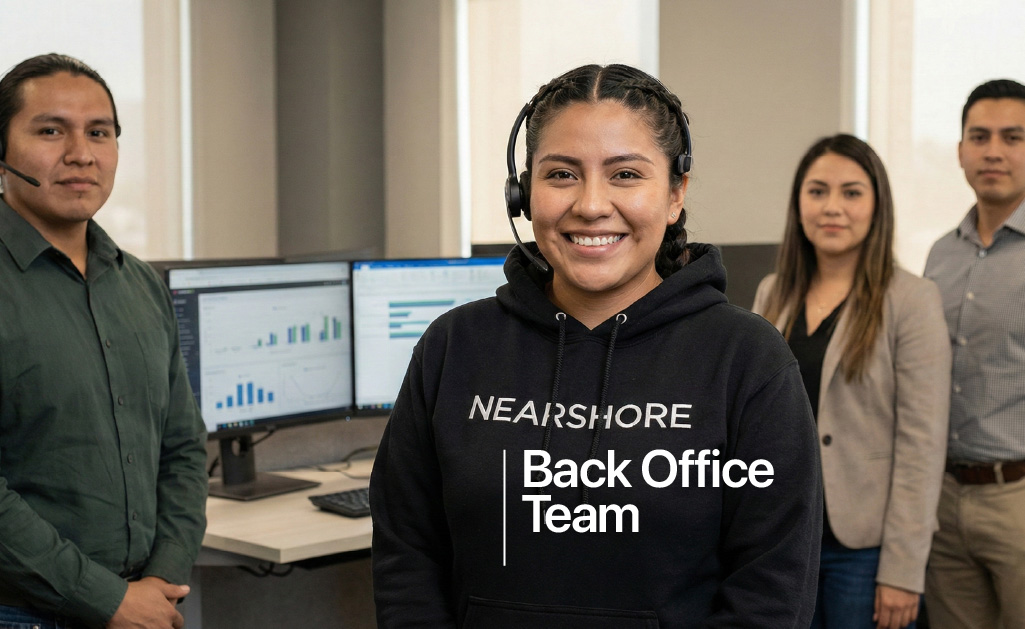
Every company has two sides: the front office (sales, customer support) and the back office (administration, operations). Outsourced back office services involve hiring a specialized third-party provider to manage these essential, non-customer-facing functions.
Instead of building and managing an in-house team for tasks like payroll or data entry, you partner with a firm that already has the expert staff, streamlined processes, and technology in place. This shift allows your core team to stop getting bogged down by administrative work and refocus on what drives your business forward: innovation, strategy, and building great customer relationships.
What Does the Back Office Actually Include?
The back office is the operational backbone of your company. While your front office team interacts with customers, the back office ensures all internal systems run flawlessly. To learn more about how these two areas work together, explore the differences between the front office and back office.
Here are some of the most common functions businesses outsource:
| Service Category | Core Functions | Real-World Example |
|---|---|---|
| Data Management | Data entry, database maintenance, records management, data cleansing, and verification. | An e-commerce company outsources product data entry to ensure its online catalog is always accurate and up-to-date. |
| Finance & Accounting | Accounts payable/receivable (AP/AR), bookkeeping, financial reporting, and invoicing. | A marketing agency hands off its invoicing and collections to improve cash flow and reduce late payments. |
| Human Resources (HR) | Payroll processing, benefits administration, employee record management, and compliance. | A growing tech startup outsources payroll to ensure tax compliance and free up its HR leader for recruiting top talent. |
| IT & Tech Support | Internal help desk, software updates, network monitoring, and cybersecurity tasks. | Many companies outsourcing IT do so to gain 24/7 network monitoring and access specialized cybersecurity skills they can’t afford in-house. |
The Strategic Payoff of Outsourced Back Office Services

Sure, outsourcing saves money. But the real value is gaining strategic agility. When you convert fixed costs like salaries and benefits into a variable expense, you free up capital to reinvest in growth—your products, your marketing, and your customers.
This newfound flexibility is just the beginning. The true advantage is the ability to scale your operations instantly, without the typical growing pains.
Scale Up (or Down) and Tap Into Pro-Level Talent
One of the biggest operational headaches is matching your team size to your workload. Get a huge new client? You’re scrambling to hire. Hit a slow season? You’re stuck with an underutilized payroll.
Outsourcing solves this. A good partner can add more people to your account during a busy quarter and scale back when things quiet down. No hiring, no firing, no drama.
Beyond manpower, you plug into specialized tools and knowledge. For accounting, this means access to top cloud-based accounting solutions without buying the licenses yourself. Your partner has already mastered these systems. This “instant expertise” applies across the board, giving you a team of pros who handle:
- Financial Compliance: Experts who stay on top of changing regulations so you don’t have to.
- Data Security: Professionals who ensure your data is clean, accurate, and secure—the foundation of smart business decisions.
- HR Administration: Specialists who manage payroll flawlessly, letting your HR team focus on building a great culture.
This is a core principle of business process outsourcing: you get better accuracy, tighter compliance, and smoother workflows from day one.
Free Up Your Best People to Innovate
When your key players aren’t bogged down chasing invoices or cleaning spreadsheets, they can focus on work that truly moves the needle. This is where you see the real ROI. Your team gets the headspace to think about product innovation, winning new customers, and planning your next strategic move.
Effective back office outsourcing isn’t just about cutting costs; it’s about reallocating your team’s time toward innovation and growth.
This is a massive global trend. The market for back-office outsourcing was valued at USD 187.78 billion in 2023 and is projected to reach USD 350.7 billion by 2033. Businesses everywhere realize this is a strategic lever, not just a budget line item.
 Choosing Your Outsourcing Model: Onshore vs. Nearshore vs. Offshore
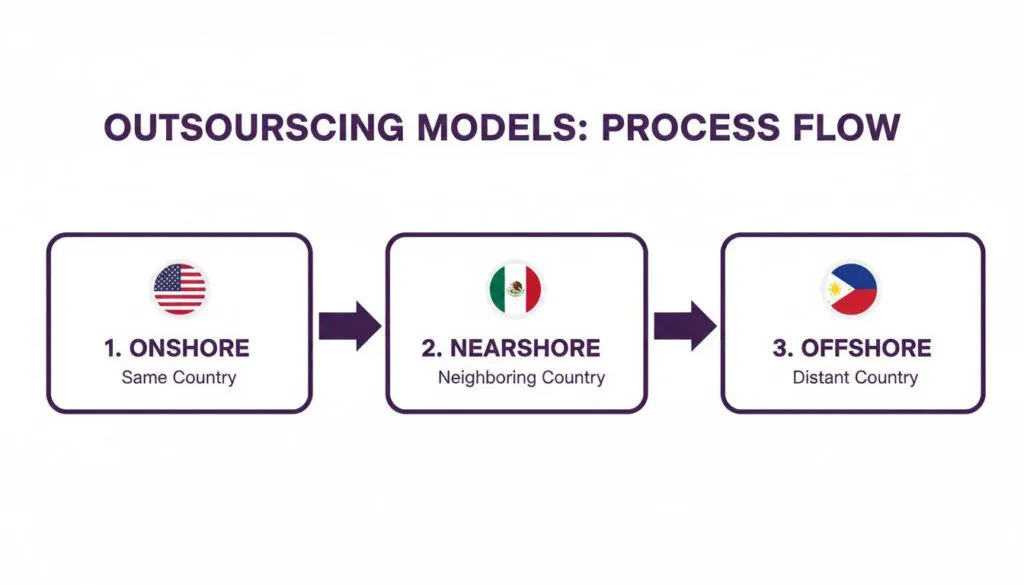
So, you’re ready to explore outsourced back office services. The next big question is: where should your new team be located? This decision impacts your budget, communication, and collaboration. There are three main models, each with distinct advantages.
Onshore Outsourcing: High-Cost Convenience
Onshore means partnering with a provider in your own country. For a U.S. company, this could be a firm in another state. The benefit is seamless alignment—no language barriers, cultural gaps, or time zone issues. However, this convenience comes at the highest cost, often negating the financial advantages of outsourcing.
Offshore Outsourcing: Maximum Savings at a Distance
Offshore involves partnering with a provider in a distant country, such as the Philippines or India, to achieve maximum cost reduction. These regions have vast, educated talent pools. The downside is significant time zone differences (8-12+ hours), which can create communication delays and logistical headaches. Cultural nuances can also lead to misunderstandings if not managed carefully.
Nearshore Outsourcing: The Strategic Sweet Spot
For most North American companies, nearshore outsourcing strikes the perfect balance. This model involves partnering with providers in nearby countries, like Mexico. A nearshore partner like CallZent in Tijuana operates in the same or a similar time zone, eliminating the communication delays that plague offshore relationships. Cultural alignment is also much stronger, leading to smoother teamwork.
For example, a California-based tech company can collaborate with its nearshore back office team in Tijuana in real-time, solving issues on a quick video call instead of waiting 12 hours for an email response from an offshore team.
Nearshore outsourcing offers significant cost savings without sacrificing the accessibility and collaborative energy of an onshore partner. It’s efficiency without the friction.
The data is compelling. U.S. companies have increased their use of nearshore partnerships by 38% since 2010, according to MyOutdesk. While you can explore the latest outsourcing statistics on MyOutdesk.com, the trend is clear: businesses want the cost benefits without the operational friction.
Comparing Outsourcing Models for Your Business
| Factor | Onshore (e.g., USA) | Nearshore (e.g., Tijuana, Mexico) | Offshore (e.g., Philippines) |
|---|---|---|---|
| Cost Savings | Lowest | High | Highest |
| Time Zone | Identical | Aligned (0-2 hr difference) | Opposite (8-12+ hr difference) |
| Communication | Seamless | Excellent (High cultural & language alignment) | Challenging (Potential accent/cultural barriers) |
| Collaboration | Easy | Easy & Real-Time | Difficult (Requires late-night calls) |
| Travel | Simple & Quick | Convenient & Affordable | Complex & Long |
For a deeper analysis, compare the key differences between nearshore and offshore outsourcing.
How to Select the Right Outsourcing Partner
Choosing a partner for your outsourced back office services is about finding a true extension of your team. The right provider becomes a strategic asset, not just another vendor.
Step 1: Define Your Needs and KPIs
Before you start researching, look inward.
- What specific tasks are you offloading?
- What are your biggest operational pain points right now?
- What does success look like in one year? (e.g., “Reduce invoice processing time by 40%.”)
This internal audit is your blueprint for finding the right partner and measuring success later on.
Step 2: Research and Shortlist Potential Partners
With your needs defined, create a shortlist of BPO providers. Look for:
- Industry Expertise: Do they have case studies or testimonials from companies like yours? A partner who understands your industry’s specific challenges is invaluable.
- Security and Compliance: Your data is critical. Ask about their security certifications (like SOC 2 or HIPAA), data encryption, and disaster recovery plans. A trustworthy partner will be transparent.
- Technology Stack: Ensure their platforms can integrate smoothly with your existing systems to avoid creating new workflow bottlenecks.
- Cultural Fit: Look for a partner who shares your communication style and values. This is often the key to a successful long-term relationship.
The global BPO market is projected to hit USD 525 billion by 2030, so you have plenty of options. For more insights, you can [discover more insights about the BPO market on Grandview Research](https://www.grandviewresearch.com/horizon/statistics/business-process- outsourcing-market/manufacturing/back-office-support/global).
Step 3: Ask the Right Questions
Once you have your shortlist, it’s time for in-depth conversations. Use targeted questions to understand how they operate:
- Onboarding: “Walk me through your onboarding process. What is the timeline from signing to go-live?”
- Communication: “What does your standard communication cadence look like? Who will be my main point of contact?”
- Performance: “What kind of performance dashboards or reports do you provide? Can we see a sample?”
- Flexibility: “How flexible are your contract terms if our service needs change?”
A great partner won’t just answer your questions; they’ll ask you insightful questions in return. Their curiosity about your business is a strong indicator of their commitment.
For more on this strategic approach, check out our guide to smart sourcing.
 Measuring the Success of Your Outsourced Back Office Services
How do you know if the partnership is working? Success is measured by performance, efficiency, and clear contributions to your business goals—not just cost savings.
Defining Your Key Performance Indicators (KPIs)
The right KPIs depend on the functions you’ve outsourced. Generic metrics won’t work. A great BPO partner will help you define specific, measurable goals from day one.
Here are a few real-world examples:
- For Data Entry:
- Accuracy Rate: Goal of 99.5% or higher.
- Turnaround Time: Time from receiving data to completion.
- For Accounts Payable/Receivable:
- Days Sales Outstanding (DSO): Average time to collect payment.
- Invoice Processing Cost: The total cost to process a single invoice.
- For HR & Payroll Support:
- Payroll Accuracy: The only acceptable goal is a 100% error-free rate.
- Employee Onboarding Time: Time to process new hire paperwork.
A partnership without clear KPIs is like driving without a dashboard. You’re moving, but you have no idea how fast you’re going or if the engine is about to overheat.
Building a System for Transparency and Improvement
Once KPIs are set, establish a regular rhythm of communication and reporting. Your partner should provide access to real-time dashboards and schedule review meetings. These meetings are your opportunity to spot trends, solve problems proactively, and identify opportunities for continuous improvement.
This data-driven approach ensures your outsourced functions are constantly being optimized for peak performance. The principles are similar to those used in effective call center reporting and metrics dashboards.
Frequently Asked Questions About Back Office Outsourcing
Making the leap to outsourcing is a big move. Here are answers to common questions we hear from business leaders.
How Secure Is My Sensitive Data with an Outsourced Team?
Security depends entirely on the partner you choose. A reputable BPO firm invests heavily in protecting your data with certifications like SOC 2, robust network infrastructure, strict access controls, and ongoing team training. A trustworthy provider will be an open book about their security protocols. If they can’t give you straight answers, walk away.
What Is the Typical Cost of Outsourced Back Office Services?
There’s no single price tag. Costs depend on the complexity of the work, the volume, and where you outsource. A nearshore partner can often deliver savings of 40-60% compared to keeping the work in-house in the U.S., without the communication challenges of an offshore provider. The best way to get an accurate figure is to request a custom quote based on your specific needs.
What Does the Onboarding Process Involve?
A smooth onboarding process is critical. It begins with a deep-dive discovery phase where your new partner learns your current workflows and goals. From there, they map out processes, integrate technology, and train their agents to operate as a seamless extension of your company. A great partner treats onboarding like a collaborative project, not a simple handoff.
Are Outsourced Back Office Services a Good Fit for Small Businesses?
Absolutely. Small and medium-sized businesses often see the biggest benefits. Outsourcing gives them access to enterprise-level efficiency, technology, and specialized skills without the high overhead of a large in-house team. It frees up founders and their core employees to focus on what truly grows the business: developing products, closing sales, and delighting customers.
Frequently Asked Questions About Outsourced Back Office Services
1. What are outsourced back office services?
They involve delegating internal operational tasks to a specialized third party.
2. Are back office services secure?
Yes—when handled by certified providers using SOC 2 controls and encrypted systems.
3. How much can businesses save?
Most companies save between 40–60% compared to in-house teams.
4. Is outsourcing suitable for small businesses?
Absolutely. SMBs often benefit the most.
5. What industries benefit most?
Healthcare, finance, SaaS, e-commerce, and professional services.
6. How fast can onboarding happen?
Typically, within 2–4 weeks.
7. How is performance measured?
Using KPIs such as accuracy, turnaround time, and cost per task.
8. Can services scale seasonally?
Yes—scaling is one of outsourcing’s biggest advantages.
9. Will outsourced teams follow our systems?
Yes, they integrate directly into your tools and workflows.
10. Why choose nearshore outsourcing?
It delivers savings without sacrificing collaboration or control.
Ready to Outsource Your Back Office?
CallZent delivers secure, scalable nearshore back office services that reduce costs, increase efficiency, and free your team to focus on growth.
Ready to build a more efficient, scalable, and focused business? CallZent provides expert nearshore back office solutions that allow you to offload administrative burdens and concentrate on what you do best. Explore how our tailored services can support your growth by visiting us at https://callzent.com.