Skip to content
Call Center Outsourcing
Outsourced Call Center Solutions:
A Strategic Guide to Scaling Customer Support
Learn how outsourced call center solutions help businesses reduce costs, improve customer experience, and scale support operations without sacrificing quality.
Spending more time in customer support queues than growing your business? It’s a common trap. When customer interactions start to feel like a distraction from your core mission, it’s a clear sign you need a better system. Outsourced Call Center Solutions offer a strategic path forward, letting you hand off customer communications to a specialized partner so you can get back to what you do best.
TL;DR — Outsourced Call Center Solutions
- What it is: Partnering with a specialized provider to manage customer calls, emails, chats, and omnichannel support.
- Why it matters: Reduces costs, improves CX, scales instantly, and frees your internal team.
- Key models: Onshore (high cost), Offshore (low cost, higher risk), Nearshore (best balance).
- Bottom line: Outsourcing transforms customer service from a cost center into a growth engine.
Spending more time in customer support queues than growing your business? It’s a common trap. When customer interactions start to feel like a distraction from your core mission, it’s a clear sign you need a better system. Outsourced Call Center Solutions offer a strategic path forward, letting you hand off customer communications to a specialized partner so you can get back to what you do best. It’s a proven way to boost efficiency, enhance customer satisfaction, and tap into expert resources without the crushing overhead.
Why Smart Businesses Outsource Customer Support
Imagine you run a successful e-commerce store known for its unique, handcrafted products. Your focus is on design and quality. But as your brand grows, you’re suddenly spending half your day answering emails about shipping status and processing returns. Instead of hiring an in-house team and investing in expensive support software, you partner with a professional customer service provider. This frees you up to innovate and create, while a team of experts ensures your customers get fast, professional help.
That’s precisely how call center outsourcing works. You focus on your core business, and a BPO partner like CallZent handles the critical, time-consuming work of customer communication. This isn’t just about answering calls; it’s about strategically building a scalable, expert-driven customer experience machine.
From Cost Center to Growth Engine
For too long, customer support was seen as a necessary expense. Today, forward-thinking companies recognize it as a powerful driver of customer loyalty and growth. By partnering with a nearshore provider in a hub like Tijuana, you gain immediate access to a bilingual, culturally-attuned talent pool that understands the North American market.
This strategic move unlocks several powerful advantages:
- Access to Expertise: You instantly gain a team trained in customer service best practices and equipped with modern contact center technology, skipping the steep learning curve.
- Scalability on Demand: A key benefit of our call center outsourcing solutions is flexibility. Seamlessly expand or contract your support team for seasonal demand or new product launches without the HR headaches.
- Significant Cost Efficiency: Slash the heavy overhead costs associated with in-house recruiting, training, infrastructure, and benefits. For a detailed look at the numbers, understanding the ROI of outsourcing call centers is a great starting point.
- 24/7 Coverage: Provide your customers with round-the-clock support. This is a game-changer for customer satisfaction and builds loyalty across different time zones.
The global call center outsourcing market is booming for a reason. Valued at roughly USD 101.77 billion, it’s projected to hit USD 135.05 billion by 2032. This isn’t a trend; it’s a fundamental shift in business strategy. If you’re weighing your options, exploring flexible models like seat leasing BPO solutions can also help you find the perfect operational fit.
“The best outsourcing partnerships aren’t about cutting costs; they’re about buying expertise, scalability, and the freedom to focus on what your business does best.”
Choosing Your Outsourcing Model: Onshore, Nearshore, or Offshore?
Deciding where to outsource is one of the most important strategic decisions you’ll make for your customer operations. The choice between onshore, nearshore, and offshore isn’t just about geography; it directly impacts your costs, communication quality, and the cultural connection with your customers.
Think of it like sourcing ingredients for a restaurant. You could buy from a local farm (onshore), one in a neighboring region (nearshore), or import from halfway across the world (offshore). Each option comes with a different price point, level of freshness, and set of logistical considerations.
This decision tree can help you frame the initial questions.
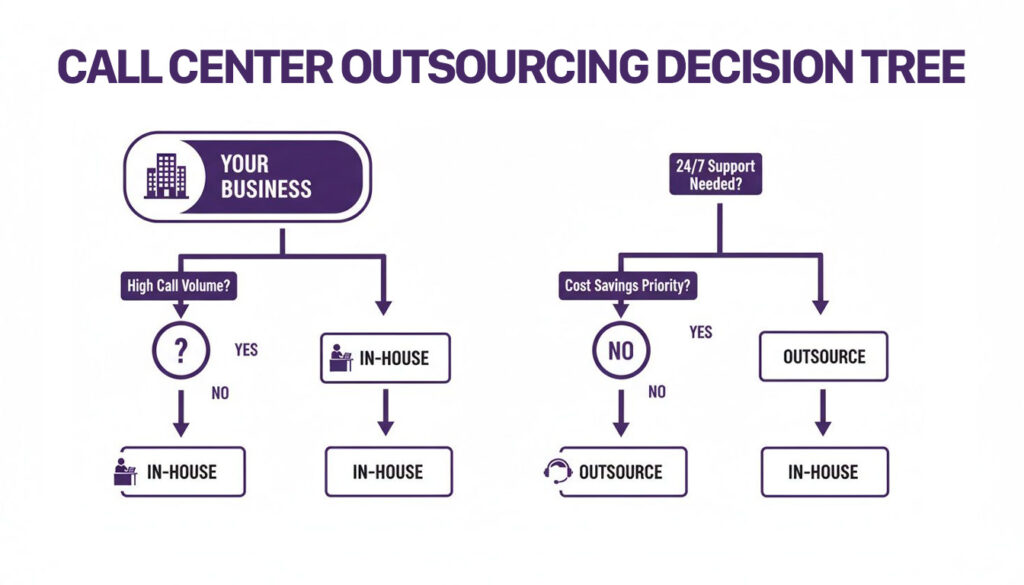
As you can see, the path to outsourcing often begins when an internal team is stretched thin or a business realizes it needs specialized skills it doesn’t possess in-house.
Let’s break down what each model means for your business in practical terms.
Onshore Outsourcing: The Local Expert
Onshore outsourcing means partnering with a call center located within your own country. For a U.S. business, this means working with a firm also based in the United States. The primary advantage is the complete absence of cultural or language barriers, making it a great fit for brands handling highly complex or sensitive issues.
The downside? It’s by far the most expensive option. You are operating in the same high-cost labor and real estate market as your own company.
- Best for: Companies in heavily regulated industries like finance or healthcare, or premium brands where customers expect agents who understand every local nuance.
- Real-World Example: A high-end financial advisory firm in California might use an onshore partner in Texas to handle its wealth management client line, ensuring agents can discuss complex, U.S.-specific financial regulations with absolute confidence.
Offshore Outsourcing: The Global Workforce
Going offshore means partnering with a provider in a distant country, often on the other side of the globe. For North American companies, this typically means locations like the Philippines or India. The main driver for this model is aggressive cost reduction, as labor and operational expenses can be significantly lower.
While you gain access to a massive talent pool and “follow-the-sun” 24/7 support, there are trade-offs. Significant time zone differences, potential language accent barriers, and cultural disconnects can sometimes make building genuine customer rapport a challenge.
- Best for: High-volume, non-voice tasks like data entry or simple, heavily scripted customer service inquiries where budget is the absolute top priority.
- Real-World Example: A global software company might use an offshore team for Level 1 tech support tickets that follow a strict, step-by-step troubleshooting script, resolving common issues at a low cost-per-ticket.
Nearshore Outsourcing: The Strategic Sweet Spot
Nearshore outsourcing strikes the ideal balance between cost-efficiency and high-quality service. It involves partnering with a provider in a neighboring country. For businesses in the U.S. and Canada, this means looking to Latin America, with Tijuana, Mexico, standing out as a premier hub.
This is the model where CallZent excels. Nearshore partners deliver substantial cost savings over onshore options while avoiding many of the challenges associated with offshore. You get agents in the same time zone (we operate on PST/PDT), strong cultural alignment with North American consumers, and a highly skilled, bilingual workforce fluent in both English and Spanish.
By choosing a nearshore partner, you get the best of both worlds: significant operational savings without sacrificing the cultural and logistical alignment essential for a superior customer experience.
For any business serving a diverse customer base, having readily available bilingual agents is a massive competitive advantage. Our proximity also makes site visits simple and collaboration seamless, allowing our team to function as a true extension of yours.
To dig deeper into the financial breakdown, check out this detailed comparison of nearshore vs. offshore outsourcing costs and ROI.
Ultimately, the right call center outsourcing solutions are tailored to your specific business goals, customer expectations, and budget.
The Real Payoff of Outsourcing Your Call Center
The conversation about outsourcing often starts with saving money, but framing it solely as a cost-cutting measure misses the bigger picture. The true value isn’t just about what you save—it’s about what you gain. We’re talking about access to specialized expertise, incredible operational flexibility, and a sharper competitive edge.
This is your opportunity to transform customer service from a reactive cost center into a proactive growth engine.
Let’s move beyond surface-level savings and explore the game-changing advantages that professional call center outsourcing solutions deliver.
Tap Into a Ready-Made Pool of Specialists
Building a high-performing in-house customer service team is a slow, expensive process. You have to recruit, hire, train, and manage them—all while hoping you made the right choices. Outsourcing completely changes the equation, giving you immediate access to a pre-built team of customer service professionals who already live and breathe communication best practices.
You’re not just hiring agents. You are plugging into an entire operational ecosystem, complete with quality assurance specialists, dedicated trainers, and experienced supervisors all focused on one thing: delivering outstanding service.
Get True On-Demand Scalability
Business is never linear. You have seasonal peaks, unexpected viral moments, and slower periods. A rigid in-house team simply can’t adapt to that kind of volatility. Outsourcing provides the elasticity to scale your support capacity up or down at a moment’s notice.
- Practical Example: An online flower delivery service experiences a massive surge in orders around Valentine’s Day and Mother’s Day. Instead of a frantic, costly scramble to hire and train temporary staff, they partner with CallZent. We can instantly scale their team from 10 to 50 agents for those peak weeks, then seamlessly scale back down afterward.
This flexibility offers concrete benefits:
- No hiring headaches: Skip the entire recruitment-to-onboarding cycle for temporary staff.
- Day-one readiness: Your seasonal team consists of trained professionals, ready to perform from the start.
- Controlled costs: You only pay for the expanded capacity when you actually need it.
Offer 24/7 Coverage Without Burning Out Your Team
In today’s global, always-on marketplace, customers expect support on their schedule, not just from 9 AM to 5 PM. Attempting to provide 24/7 coverage with an in-house team is a logistical and financial nightmare that often leads to employee burnout and high turnover.
An outsourced partner can easily deliver round-the-clock support across multiple shifts. This simple strategic move ensures your customers can always reach a real person, which is crucial for building trust and loyalty. It shows you respect their time, no matter where they are. To better understand the impact, you can read more about the benefits of customer care outsourcing.
Gain Instant Access to Enterprise-Level Technology
Running a modern call center requires a sophisticated tech stack—from advanced CRM systems and omnichannel communication platforms to powerful analytics software. For most small and medium-sized businesses, the cost of licensing, implementing, and maintaining this technology is prohibitive.
By partnering with an established BPO, you gain immediate access to their enterprise-grade technology. You get the benefits of a million-dollar tech stack without the upfront investment, instantly leveling the playing field.
This isn’t just about efficiency. Better tools provide deeper insights into customer behavior. You can identify trends, pinpoint common issues, and make data-driven decisions to improve the entire customer journey. Suddenly, outsourcing becomes a direct path to innovation, not just a cost-saving tactic.
Finding the Right Solution for Your Industry
Generic, one-size-fits-all customer support is a relic of the past. Your customers have needs specific to your industry, and they expect your support team to speak their language—whether that involves a healthcare claim, a financial transaction, or an e-commerce return. A specialized call center outsourcing solution becomes a true competitive advantage, not just an operational line item.
The data confirms this shift toward specialization. Research shows the telecommunications sector leads the way, with 78% of companies outsourcing some part of their customer service. Financial services follow closely at 72%, with healthcare at 65%, retail at 61%, and technology at 58%. Digging into these call center outsourcing statistics reveals a clear trend: industry expertise wins.
A partner with deep industry knowledge doesn’t just answer questions—they anticipate them, navigate complex compliance, and build genuine trust. Let’s look at how this works in key industries.
Healthcare Solutions Built on Trust and Compliance
In healthcare, there is zero margin for error. Patient trust is paramount, and data security is non-negotiable. Any outsourced partner must be rigorously trained in HIPAA compliance to protect sensitive patient health information (PHI). There are no shortcuts.
A specialized healthcare call center team operates as a seamless extension of a clinic, handling critical patient interactions with the required empathy and precision.
Here’s what that looks like in practice:
- Appointment Management: Scheduling, confirming, and rescheduling appointments, often integrating directly with a clinic’s EMR/EHR system.
- Patient Inquiries: Fielding questions about insurance coverage, billing, and pre-procedure instructions with accuracy and compassion.
- Follow-up Communications: Proactively reaching out to patients for post-visit feedback or to remind them of essential follow-up care.
Example in Action: A regional network of urgent care clinics was overwhelmed with calls, leading to long hold times and frustrated patients. By partnering with a HIPAA-compliant nearshore team, they offloaded all non-clinical calls. The specialized agents now handle appointment scheduling and insurance verification, freeing up in-house medical staff to focus entirely on patient care. As a result, patient satisfaction scores jumped 15% within three months.
Financial Services Driven by Security and Professionalism
The financial sector operates under intense regulatory scrutiny. Customers expect every interaction to be secure, professional, and accurate. A BPO partner in this space must be fully compliant with standards like the Payment Card Industry Data Security Standard (PCI DSS)—it’s the absolute minimum requirement.
This expertise is crucial for tasks where security is the top priority, like handling account information or processing payments. Professionalism is just as vital, especially when dealing with sensitive areas like collections.
Key Financial Outsourcing Functions:
- Customer Verification: Securely authenticating customer identities before sharing any account information.
- First-Party Collections: Managing early-stage debt collection with a respectful, customer-centric approach designed to preserve the client relationship.
- Application Processing: Guiding customers through loan or credit card applications, ensuring all information is captured correctly and efficiently.
An expert financial services team ensures every call reinforces the institution’s reputation for security and trustworthiness.
E-commerce Support That Boosts Loyalty and Lifetime Value
For an e-commerce brand, the customer journey doesn’t end at checkout. The post-purchase experience is where you either build a loyal advocate or lose a customer forever. Call center outsourcing solutions for e-commerce must manage the entire customer lifecycle, turning potential problems into opportunities to impress.
A great e-commerce team acts as true brand ambassadors, driving sales and resolving issues with a speed and efficiency that encourages repeat business. They aren’t just trained on your product catalog; they’re trained on your brand’s voice and customer promise.
A Scenario of Success: An online apparel store gets slammed with orders during the holiday season. Their outsourced team seamlessly manages the flood of calls and chats about order status, shipping delays, and returns. By providing instant, helpful answers and processing exchanges quickly, they not only save sales but also increase positive reviews by 20%. That proactive support transforms a potentially chaotic period into a huge win for the brand, directly boosting customer lifetime value.
The right outsourcing partner does more than just handle calls; they understand the nuances of your business. Here is a quick look at how different sectors put specialized outsourcing to work.
Industry-Specific Outsourcing Applications
| Industry | Primary Use Case | Key Benefit |
|---|---|---|
| Healthcare | Patient appointment scheduling & insurance verification | Frees up clinical staff to focus on patient care and improves patient satisfaction. |
| Financial Services | Secure customer verification & first-party collections | Ensures PCI compliance and maintains positive customer relationships during sensitive interactions. |
| E-commerce & Retail | Order status inquiries, returns, & seasonal overflow | Turns high-volume periods into loyalty-building opportunities and protects brand reputation. |
| Technology/SaaS | Tier 1 technical support & user onboarding | Provides fast, scalable help for common issues, allowing in-house experts to tackle complex problems. |
| Telecommunications | Billing inquiries & service plan upgrades/downgrades | Reduces churn by offering clear, immediate support for account-related questions. |
As you can see, the goal isn’t just to find an outsourcer, but to find a partner who understands the unique challenges and opportunities within your market. This alignment is what transforms a support function into a powerful driver of growth.
Your Checklist for Choosing the Right Outsourcing Partner
Selecting a BPO partner is one of the most critical business decisions you’ll make. This isn’t just hiring another vendor; it’s integrating an extension of your team. The right choice can accelerate your growth, while the wrong one can create endless operational headaches. Your entire outsourcing strategy depends on making a well-informed decision.
Use this checklist as your guide to cut through sales pitches and identify what truly defines a great partner—one that meets your needs today and can scale with you tomorrow.
Assessing Their Technology and Infrastructure
A potential partner’s technology stack is the central nervous system of their operation. If it’s outdated or insecure, you’re setting yourself up for poor performance, frustrating downtime, and serious data risks. You need a partner who invests in modern, reliable, and secure infrastructure.
Start by asking direct questions about their platform:
- Omnichannel Capabilities: Can they manage customer conversations seamlessly across phone, email, chat, and social media? A fragmented experience is a major deterrent for modern customers.
- CRM and System Integration: How easily can their systems integrate with your existing CRM or other essential software? A clunky integration process can cripple efficiency from day one.
- Security and Redundancy: What are their protocols for data security, disaster recovery, and business continuity? Don’t accept a vague answer. Ask them to detail their plan for an unexpected system outage.
Evaluating Agent Training and Quality Assurance
These agents will become the voice of your brand, so how they are trained and managed is critically important. A generic, one-size-fits-all training program is a red flag. You need a partner committed to deeply understanding your brand voice, company culture, and customer needs.
The single most important question to ask a potential partner is this: “How will you train your agents to sound like us?” Their answer reveals everything about their commitment to becoming a true partner versus just another call center.
Their quality assurance (QA) program must be equally robust. Look for a comprehensive approach that includes call monitoring, customer satisfaction (CSAT) surveys, and consistent performance coaching for agents. A strong QA process isn’t just about catching errors; it’s about ensuring consistency and driving continuous improvement. For more guidance, our guide on how to find and vet the best call center outsourcing companies digs deeper into the right questions to ask.
Verifying Security and Compliance Protocols
For businesses in industries like healthcare and finance, this is non-negotiable. A data breach that occurs on your BPO partner’s watch is still your data breach. You must verify that they adhere to the strictest industry-specific compliance standards.
- Healthcare: Insist on seeing proof of HIPAA compliance. Ask them to detail their specific training for handling Protected Health Information (PHI).
- Finance & E-commerce: They must be PCI DSS compliant to securely handle credit card and payment information. No exceptions.
Beyond industry-specific regulations, review their broader data protection practices. Even if you primarily operate in North America, verifying their GDPR compliance is a smart step for safeguarding customer data and ensuring legal protection.
Scrutinizing Client Testimonials and Case Studies
Finally, demand proof. Don’t just take their word for it. Ask for client references—specifically from companies similar to yours in size and industry. A partner confident in their service will be eager to connect you with happy clients.
When you speak with these references, go beyond generic questions. Ask about the onboarding process, how the partner handles unexpected challenges, and how responsive their account manager truly is. This is where you gain invaluable, firsthand insight into the day-to-day working relationship. A proven track record with businesses like yours is the best indicator of a successful partnership.
How to Ensure a Seamless Transition to an Outsourced Team
A successful outsourcing partnership hinges on a smooth launch. Transitioning to a new support team can seem like a massive undertaking, but with the right plan, it shouldn’t disrupt your business for a single moment.
Think of it like a relay race. The win depends on a perfectly timed, seamless baton pass. A clumsy handover destroys momentum, but a smooth one accelerates you toward the finish line. That’s precisely how we approach implementing call center outsourcing solutions—as a structured, collaborative process designed to ensure your new team hits the ground running from day one.

The journey from signing a contract to going live is a deeply collaborative effort. It’s not about flipping a switch and hoping for the best; it’s a methodical process where we work shoulder-to-shoulder to build a solid foundation for immediate and long-term success.
The Discovery and Strategy Phase
First, we immerse ourselves in your world. Before a single agent is trained, we conduct a deep-dive discovery to understand your business from the inside out. This isn’t just about reading a script; it’s about absorbing your brand’s DNA.
During this discovery phase, we focus on:
- Defining Your Goals: What does success look like for you? Is it reducing response times, improving first-call resolution, or increasing CSAT scores? We establish clear objectives from the start.
- Process Mapping: We meticulously document your current customer service workflows. This allows us to identify existing pain points and opportunities for immediate improvement.
- Brand Voice Immersion: We learn your unique tone and communication style. Our goal is to ensure every agent interaction feels 100% authentic to your brand.
This initial alignment is non-negotiable and prevents misunderstandings down the road.
A smooth launch isn’t an accident. It’s the direct result of a meticulous, collaborative implementation plan where your goals become our roadmap.
Technical Integration and System Setup
With a clear strategy in place, we shift to the technical details. Ensuring our systems communicate seamlessly with yours is critical for a frictionless operation and a smooth customer experience.
Our technical teams work hand-in-hand with yours to manage all key integrations. A primary focus is connecting our contact center platform with your Customer Relationship Management (CRM) software. This vital step equips our agents with the customer history and data they need to provide informed, personalized support from the very first call.
Customized Training and Go-Live Preparation
This is where the real knowledge transfer happens. We develop a custom training curriculum from the ground up, based entirely on our discovery findings. Our agents don’t just learn about your products—they learn your culture.
The intensive, hands-on training program covers:
- Product and Service Knowledge: We dive deep into your offerings so agents can answer detailed questions with complete confidence.
- Brand Voice and Empathy Training: We use role-playing scenarios to train agents on how to handle any interaction with your specific brand voice and tone.
- Systems and Tools: Agents receive hands-on training with the exact software and tools they will use daily.
Finally, we establish the metrics that will govern our partnership. We collaborate with you to define the Key Performance Indicators (KPIs) and Service Level Agreements (SLAs) that matter most. If you’re creating your first SLA, exploring service level agreement best practices can provide a solid framework. This structured approach creates a low-risk, high-reward transition that sets your partnership up for success from day one.
Have Questions About Outsourcing Your Call Center? We’ve Got Answers.
Diving into call center outsourcing for the first time can feel like a major step, and it’s natural to have questions. To provide clarity and help you feel confident, we’ve answered some of the most common questions we hear from business leaders.
How Much Do Call Center Outsourcing Solutions Cost, Really?
This is often the first question, and the honest answer is: it depends. The final cost is determined by the model you choose (onshore is most expensive, offshore is least, and nearshore provides the best value), the complexity of your support needs, and the size of the team required. Most partners bill per-hour, per-interaction, or on a dedicated monthly rate per agent.
The key takeaway? A nearshore partner like CallZent can typically reduce your costs by 40-60% compared to a U.S.-based team, without the common trade-offs in quality or cultural alignment.
How Can I Trust Outsourced Agents to Represent My Brand?
This is a critical and completely valid concern. A premier outsourcing partner addresses this through a deep immersion into your brand’s voice, values, and customer profiles. This isn’t just a quick kickoff meeting; it’s a comprehensive process.
A quality BPO partner doesn’t just hand agents a script. They train them to live and breathe your brand. Through intensive role-playing, culture workshops, and constant coaching, agents become genuine brand ambassadors.
From there, it’s all about rigorous custom training programs and continuous quality assurance. This includes call monitoring, performance dashboards, and regular feedback sessions to ensure every customer interaction is a perfect reflection of your brand.
How Long Does It Take to Get a Team Up and Running?
A well-executed implementation can move surprisingly fast. For most standard customer support projects, a partner like CallZent can take you from a signed contract to a fully trained, live team in as little as four to six weeks.
The timeline typically breaks down into three phases:
- Discovery & Strategy (1-2 weeks): We collaborate to define goals and map out all processes.
- Recruitment & Training (2-3 weeks): Your dedicated team is hand-selected and undergoes a rigorous, custom-built training program.
- Launch & Integration (1 week): We finalize the tech setup, integrate systems, and go live.
With a clear, collaborative roadmap, the transition is swift and smooth, ensuring no disruption to your business operations.
Frequently Asked Questions About Outsourced Call Center Solutions
1. What are outsourced call center solutions?
Outsourced call center solutions involve partnering with a third-party provider to manage customer communications such as phone calls, emails, live chat, and omnichannel support on your behalf.
2. Why do companies outsource their call centers?
Businesses outsource to reduce operational costs, access trained customer service professionals, scale support quickly, and allow internal teams to focus on core business activities.
3. What’s the difference between onshore, offshore, and nearshore outsourcing?
Onshore uses agents in the same country, offshore uses distant countries for lower costs, and nearshore uses neighboring countries—offering the best balance of cost, quality, and cultural alignment.
4. How much can outsourced call center solutions save?
Nearshore call center outsourcing can typically reduce customer support costs by 40–60% compared to maintaining an in-house or onshore team.
5. Will outsourced agents sound like my brand?
Yes—when done correctly. A quality provider trains agents extensively on your brand voice, tone, workflows, and customer expectations so they act as true brand ambassadors.
6. How long does it take to launch an outsourced call center team?
Most outsourcing programs can go live within 4–6 weeks, depending on complexity, integrations, and training requirements.
7. Are outsourced call center solutions secure?
Reputable providers follow strict security protocols and industry compliance standards such as HIPAA for healthcare and PCI DSS for payment processing.
8. Can outsourced call centers scale during peak seasons?
Absolutely. One of the biggest advantages of outsourcing is on-demand scalability, allowing businesses to quickly add or reduce agents as call volume changes.
9. Do outsourced agents work the same time zone as my business?
Nearshore providers like CallZent operate in the same or similar time zones (PST/PDT), enabling real-time collaboration and better customer experiences.
10. Which industries benefit most from call center outsourcing?
Industries such as healthcare, financial services, e-commerce, SaaS, telecommunications, and retail benefit the most due to high customer interaction volumes and the need for scalable support.
Ready to Upgrade Your Customer Support?
CallZent delivers custom nearshore call center outsourcing solutions that improve customer experience, reduce operational costs, and scale seamlessly with your business.
Schedule a Call with CallZent →Ready to see how a strategic nearshore partnership can elevate your customer experience and fuel your growth? At CallZent, we don’t believe in one-size-fits-all. We build custom call center outsourcing solutions designed to achieve your unique business goals. Schedule a consultation today and discover the difference for yourself.