Skip to content

Back Office Outsourcing • BPO Strategy
Outsourcing Back Office Services: A Practical Guide to Scale Without the Overhead
Is your team drowning in administrative work instead of focusing on growth? You’re not alone. Many businesses hit a wall where repetitive back-office tasks—like data entry, payroll, or customer support follow-ups—consume the very resources needed for innovation. Outsourcing these functions isn’t just about cutting costs; it’s a strategic move to reclaim focus, access specialized talent, and build a scalable, efficient operation.
TL;DR — A Summary for Quick Insights
- Why Outsource? Reduce operational costs (typically 15–30%), refocus internal teams on growth, and eliminate capacity bottlenecks.
- What to Outsource: Repetitive, time-consuming, non-core tasks like data entry, order processing, payroll, and HR administration.
- Which Model Works Best? Nearshore outsourcing (such as Mexico) delivers cost savings with real-time collaboration and cultural alignment.
- Choosing a Partner: Evaluate BPO providers on process maturity, security (SOC 2, ISO 27001), technology compatibility, and proven results.
- How to Succeed: Document SOPs, launch a pilot program, define KPIs early, and maintain ongoing performance reviews.
Is your team drowning in administrative work instead of focusing on growth? You’re not alone. Many businesses hit a wall where repetitive back-office tasks—like data entry, payroll, or customer support follow-ups—start consuming the very resources needed for innovation. Outsourcing these functions isn’t just about cutting costs; it’s a strategic move to reclaim focus, access specialized talent, and build a more scalable, efficient operation. This guide provides a practical roadmap for making it happen.
 Why Outsourcing Back Office Services Is a Strategic Advantage
If your team spends more time wrestling with data entry, payroll, or IT tickets than they do engaging customers and driving innovation, you don’t just have a workflow problem—you have a growth bottleneck. Back-office tasks are the engine of your company: essential, yet often invisible. When that engine runs inefficiently, it drains your most valuable resources—time, money, and your team’s creative energy.
Modern outsourcing flips the script, transforming these functions from a necessary cost into a powerful operational advantage. Instead of building and managing internal teams for every administrative need, you gain access to specialists who have already optimized these processes—allowing you to reinvest resources into what you do best.
The Real Reasons Companies Outsource Back Office Functions
Let’s be clear: the motivation to outsource goes far beyond cost savings. The global business process outsourcing market continues to grow, reflecting a strategic shift in how companies operate. While businesses often report operational cost reductions of 15–30%, the real value runs deeper.
A recent industry survey found that 59% of companies outsource to reduce costs, 57% to focus on their core business, and 47% to solve internal capacity challenges. This makes one thing clear: outsourcing isn’t just about offloading work—it’s about redesigning operations for efficiency and sustainable growth.
“The smartest companies no longer view their back office as a cost to be minimized, but as a strategic asset to be optimized. Outsourcing is the key to unlocking that potential.”
This is where a nearshore BPO partner like CallZent stands out. By leveraging specialized back office support nearshore BPO services, you gain cost efficiency alongside cultural alignment and real-time collaboration—advantages traditional offshore models often lack. This proximity helps eliminate administrative overload and enables scalable, high-performance operations.
This guide will walk you through the practical steps to make it happen.
Finding Your Outsourcing Sweet Spot: How to Audit Your Operations
Before selecting a partner, it’s essential to take an honest look at your internal operations. Feeling overwhelmed isn’t enough—you need to translate that pressure into a clear, actionable list of tasks ready for outsourcing. This step is critical to successfully outsourcing back office services.
This isn’t about offloading disliked tasks. It’s a strategic audit designed to identify repetitive, time-intensive activities that don’t define your core value proposition—work that keeps teams busy but doesn’t directly drive growth.
Map Your Internal Workflows to Identify Outsourcing Candidates
Start by documenting daily, weekly, and monthly activities that keep operations running but don’t directly support innovation, sales, or strategy. These are prime candidates for outsourcing.
-
Real-world example: An e-commerce company discovers its internal team is overwhelmed by manual order processing, inventory updates, and returns management. These functions are essential but highly standardized—ideal for a dedicated outsourcing team.
-
Another example: A healthcare provider identifies patient scheduling, insurance verification, and medical billing as administrative bottlenecks that divert focus from patient care.
As you conduct your audit, ask the following questions for each task:
-
Is it repetitive? Does it follow predictable, rule-based steps?
-
Is it time-consuming? How many team hours does it require each week?
-
Is it core to our brand? Does this activity differentiate us in the market?
It’s also wise to explore internal optimization opportunities. Evaluating whether a no-code automation platform could streamline certain workflows is an important step. Some tasks are ideal for automation, while others benefit from the human expertise an outsourcing partner provides.
Create an Outsourcing Scorecard for Clear Decisions
Once potential tasks are identified, use a scoring system to prioritize them. This turns abstract ideas into a clear execution plan and highlights quick wins—functions that deliver strong ROI with minimal transition risk.
Task Scoring Checklist:
-
Volume: How frequently does the task occur?
-
Complexity: Does it require deep institutional knowledge or subjective judgment?
-
Standardization: Can you document it with a clear SOP?
-
Required expertise: Does it demand specialized skills that are difficult or expensive to hire internally?
By the end of this process, you’ll have a prioritized roadmap that guides discussions with BPO providers and supports initiatives to reduce operational costs strategically.
Choosing the Right Model for Outsourcing Back Office Services
Once you’ve identified what to outsource, the next decision is where to outsource it. This choice directly impacts cost, communication, and operational alignment. The three main models—onshore, offshore, and nearshore—each have distinct advantages and trade-offs.
Onshore Outsourcing: The Domestic Partner
Onshore outsourcing involves working with a provider in your home country. For U.S. businesses, this typically means another state. While cultural and legal alignment are strong, cost savings are often limited.
-
Best for: Highly regulated industries or organizations requiring frequent in-person collaboration.
-
Main drawback: Minimal cost reduction, which can undermine the core rationale for outsourcing.
Offshore Outsourcing: The Global Reach
Offshore outsourcing partners are typically located in regions such as India or the Philippines. This model delivers maximum cost savings, making it attractive for high-volume, standardized tasks.
However, these savings come with challenges. Time zone gaps of 10–12 hours slow communication, and cultural or linguistic nuances can impact service quality.
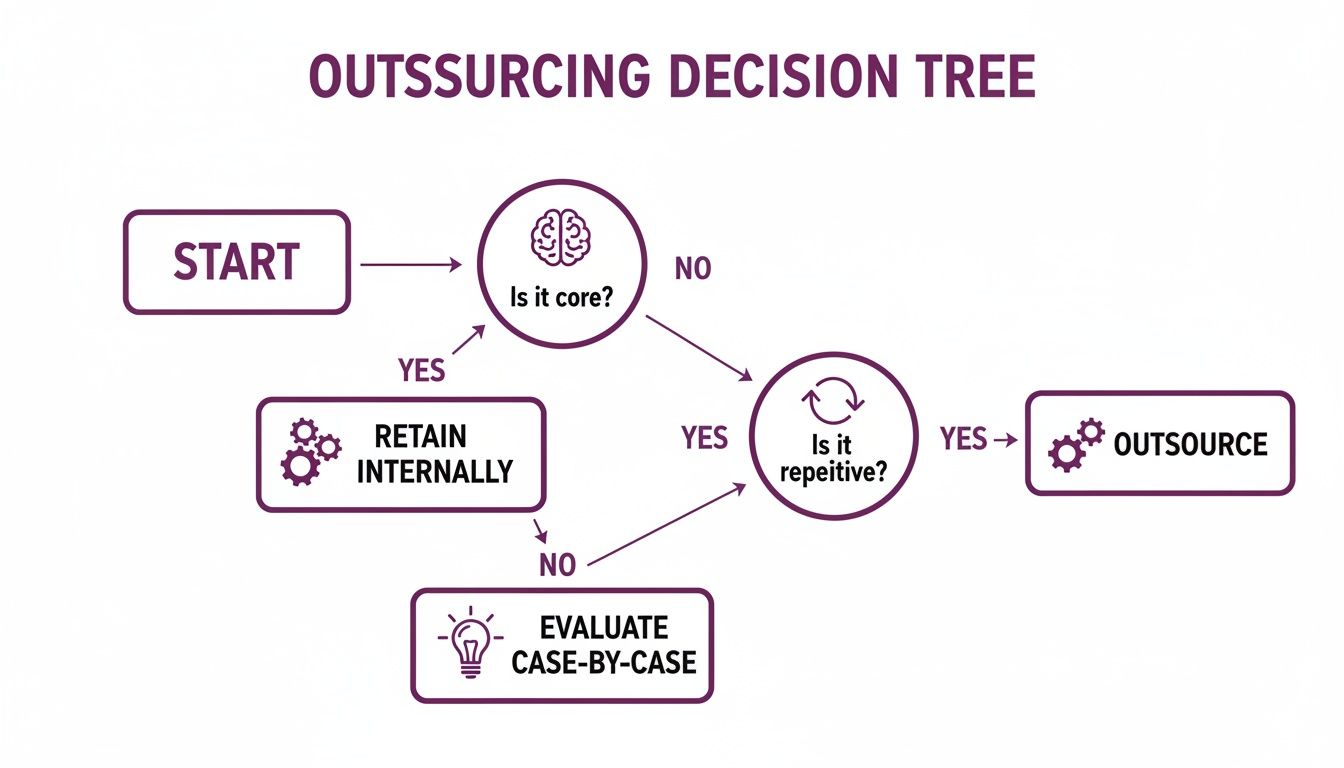
As shown above, non-core, repetitive tasks are ideal outsourcing candidates, freeing internal teams to focus on strategic growth.
Nearshore Outsourcing: The Strategic Sweet Spot
Nearshore outsourcing combines the benefits of cost efficiency and proximity by partnering with providers in nearby countries with aligned time zones. For North American companies, this often means Mexico or Latin America—a model CallZent has perfected in Tijuana.
Nearshore outsourcing isn’t a compromise—it’s a strategic advantage that blends cost savings with real-time collaboration.
Key benefits include:
-
Real-time collaboration: Same or adjacent time zones enable immediate communication.
-
Cultural alignment: Familiarity with North American business practices reduces friction.
-
Balanced economics: Significant savings without the operational challenges of offshore models.
Outsourcing Model Comparison: Nearshore vs. Offshore vs. Onshore
| Factor | Nearshore (e.g., Mexico) | Offshore (e.g., India, Philippines) | Onshore (e.g., USA) |
|---|---|---|---|
| Cost Savings | Significant (40–60%) | Maximum (up to 70%) | Minimal (10–20%) |
| Time Zone | Aligned (0–3 hours) | Opposite (8–12+ hours) | Identical |
| Collaboration | Real-time | Delayed | Seamless |
| Cultural Affinity | High | Varies | Identical |
| Travel | Easy & affordable | Difficult & expensive | Easy |
| Bilingual Talent | Strong | Strong | Varies |
Frequently Asked Questions About Outsourcing Back Office Services
What are back office services?
Back office services include non-customer-facing functions such as data entry, payroll, HR administration, billing, IT support, and operational reporting that keep a business running efficiently.
Why do companies outsource back office operations?
Companies outsource back office tasks to reduce operating costs, free internal teams to focus on growth, improve process efficiency, and gain access to specialized expertise without expanding headcount.
Which back office functions are best suited for outsourcing?
The best candidates are repetitive, standardized, and time-consuming tasks such as data processing, order management, payroll, accounts receivable, HR administration, and customer support follow-ups.
How much can a business save by outsourcing back office services?
Most organizations see cost savings between 15–30%, while nearshore outsourcing can deliver total operational savings of 40–60% compared to fully in-house teams.
Is nearshore outsourcing better than offshore outsourcing?
Nearshore outsourcing offers better time zone alignment, cultural compatibility, and real-time collaboration compared to offshore models, while still delivering significant cost savings.
How do I ensure data security when outsourcing back office work?
Choose a BPO partner that follows strict security standards such as SOC 2, ISO 27001, HIPAA (if applicable), encrypted systems, role-based access controls, and documented compliance protocols.
How long does it take to transition back office services to a BPO?
A typical transition takes 30–90 days, depending on process complexity. This includes documentation, training, pilot testing, and phased rollout.
What KPIs should be used to measure outsourcing success?
Common KPIs include turnaround time, accuracy rate, cost per transaction, SLA compliance, productivity metrics, and overall operational cost reduction.
Will outsourcing reduce control over my operations?
No. With the right partner, outsourcing actually increases visibility through dashboards, KPIs, and regular reporting—giving leadership clearer insight into operational performance.
How does CallZent support back office outsourcing?
CallZent provides secure, nearshore back office services from Mexico with bilingual talent, real-time collaboration, documented SOPs, and performance-driven management.
Turn Your Back Office Into a Growth Engine
Stop letting administrative work slow your business down. CallZent’s nearshore back office solutions help you cut costs, improve efficiency, and refocus your team on what truly drives growth.
For a deeper analysis, explore our guide on nearshore vs. offshore outsourcing costs and ROI.