Skip to content
Call Center Solutions
Outsourcing Bilingual Call Center Services: The Ultimate Guide for Business Growth
Discover how bilingual call center services help businesses expand market reach, boost customer loyalty, and turn multilingual support into a revenue-driving advantage.
TL;DR — Why Bilingual Call Center Services Matter
Bilingual call center services are no longer optional—they are a strategic growth lever. By supporting customers in multiple languages, especially Spanish across North America, businesses unlock new markets, improve customer loyalty, and increase operational efficiency. Nearshore bilingual partners like CallZent combine cultural alignment, real-time collaboration, and cost efficiency to transform customer support from a cost center into a revenue engine.
What if a huge chunk of your customers can’t actually talk to you? In today’s global market, sticking to just one language for customer support isn’t just outdated—it’s a massive missed opportunity. Think of bilingual call center services as a core engine for growth, not just another line item in the customer service budget.
Why Outsourcing Bilingual Support Is a Business Imperative
Picture this: a customer is trying to explain a tricky technical problem or ask about a product, but English isn’t their first language. You can feel the frustration building. This exact scenario leads to abandoned carts, bad reviews, and customers who never come back. It’s a daily reality for companies that haven’t caught up with the linguistic diversity of their own customer base, especially the massive Spanish-speaking community in North America.
This is where dedicated bilingual call center services stop being a luxury and become a strategic must. It’s not just about translating words; it’s about creating a genuine connection. It shows customers you respect them enough to meet them where they are. When someone can communicate effortlessly, their entire experience with your brand gets better.
Unlocking Growth with Multilingual Communication
Adding bilingual support isn’t just about damage control; it’s about actively creating positive moments that deliver real, measurable results. The impact sends ripples across the entire business.
Here’s what that looks like in practice:
- Expanded Market Reach: You instantly open your doors to millions of potential customers who previously felt ignored or simply couldn’t get the help they needed with bilingual call center services.
- Enhanced Customer Loyalty: Speaking someone’s native language builds a level of trust and emotional connection that turns one-time buyers into lifelong fans. In fact, over 70% of consumers are more likely to buy from a company that offers support in their language.
- Improved Operational Efficiency: Agents who are fluent in both the language and the culture solve problems faster and more accurately. This means lower handle times and way more issues solved on the first try.
The Nearshore Advantage for Outsourcing Bilingual Call Center Services
For any business in North America, partnering with a nearshore team in a place like Tijuana is a game-changer. It gives you a cost-effective solution without the headaches of massive time zone differences or the cultural disconnects that often come with traditional offshore models. You get a team that just gets the nuances of your target audience, acting as a true extension of your own brand.
Learn more about the power of bilingual customer support and see how it can completely reshape your operations. At the end of the day, it all comes down to the linguistic skill of the agents. You can even explore what goes into how to become fluent in a language to appreciate the expertise required to deliver truly world-class service.
The takeaway is clear: Investing in high-quality bilingual support isn’t an operational expense; it’s a strategic investment in customer satisfaction, market expansion, and long-term brand resilience.
What Exactly Are Outsourcing Bilingual Call Center Services?
When you hear “Outsourcing bilingual call center services,” it’s easy to picture a team that just answers the phone in two languages. But that’s like saying a master chef just heats up food. A true bilingual partner offers a specialized toolkit, where each service is designed to tackle a specific business challenge and drive real results.
It’s not just about language; it’s about creating a complete, seamless experience for your customers. From the moment they call with a question to the behind-the-scenes work that keeps everything running, these services are the engine that powers your growth into new markets.
Inbound Bilingual Customer Care
This is the bedrock of any solid bilingual support strategy. When a Spanish-speaking customer calls with a question, a problem, or just needs a bit of help, a trained bilingual agent is their first, and hopefully only, point of contact. This is where trust is built or broken.
But a great inbound team does more than just read from a script. They become extensions of your brand, learning your products inside and out to provide an experience that feels authentic and effortless.
- Order Processing: Picture a customer in Mexico City trying to place a big order on your website, but they’re getting tripped up by the shipping costs. A Spanish-speaking agent can jump in, clarify everything, and process the order right then and there—turning potential cart abandonment into a sale.
- Appointment Setting: A patient whose primary language is Spanish needs to book a critical follow-up appointment. A bilingual agent handles the call with the right mix of empathy and precision, making sure the patient feels heard and cared for.
- General Inquiries: A user is getting frustrated trying to figure out your software. Instead of giving up, they connect with a bilingual agent who patiently walks them through it in their native language. That moment of frustration just became a positive brand interaction.
To see how this foundation works in practice, check out our deep dive into how top-tier inbound call center services fuel scalable business growth.
Outbound Sales and Lead Generation
Here’s where bilingual support flips from a defensive necessity to a powerful offensive tool. Outbound services are all about proactively reaching out to customers and prospects to generate revenue and grab more market share.
A skilled bilingual outbound agent can be a game-changer for your sales pipeline. Imagine following up with Spanish-speaking leads who downloaded a whitepaper from your site. An agent can call, answer their questions in a comfortable, natural way, and qualify them for a demo. This targeted, personal touch is what turns lukewarm leads into hot prospects.
Key Takeaway: Bilingual outbound services stop your call center from being just a cost center. They transform it into a revenue-generating machine that opens up customer segments your competition can’t even reach.
Specialized Technical Support
For any company with a complex product—think SaaS, consumer electronics, or specialized software—bilingual tech support is non-negotiable. When a customer is already annoyed with a technical glitch, the last thing you want is to add a language barrier to the mix.
That’s where agents with a unique blend of technical know-how and linguistic fluency shine. They can patiently guide a Spanish-speaking user through complex troubleshooting steps or document a tricky bug report for your dev team with perfect clarity. This dual skill set slashes resolution times and builds incredible customer loyalty.
Bilingual Back-Office Functions
The customer experience doesn’t start and end with a phone call. A lot of crucial work happens behind the scenes, and much of it requires bilingual talent to keep your operations humming. These back-office services are the support system for your frontline teams, ensuring every part of the customer journey is consistent and high-quality.
Comparing Bilingual Call Center Service Offerings
To make it even clearer, let’s break down how these core services directly map to business goals. Each offering is a solution to a specific pain point, designed to produce a measurable outcome.
| Service Offering | What It Solves | Primary Business Outcome |
|---|---|---|
| Inbound Customer Care | High call volume, customer queries, and general support needs. | Improved customer satisfaction (CSAT) and first-call resolution. |
| Outbound Sales | Untapped market potential and unqualified sales leads. | Increased sales pipeline, higher conversion rates, and market expansion. |
| Technical Support | Complex product issues and user frustration across languages. | Faster ticket resolution, reduced customer churn, and enhanced loyalty. |
| Back-Office Support | Administrative bottlenecks and data entry inaccuracies. | Greater operational efficiency and improved data management. |
Ultimately, a comprehensive bilingual strategy integrates all these elements. It creates a system where every customer interaction, whether it’s on the front lines or in the back office, reinforces your brand’s commitment to serving every customer, regardless of their language.
 The Strategic Advantage of Nearshore Partners
Why set up shop with a partner in a place like Tijuana instead of other outsourcing spots? When you’re deciding where to base your bilingual call center, the answer almost always comes down to a powerful mix of cost, culture, and collaboration. It’s all about hitting that sweet spot—getting the financial perks without ever sacrificing the quality of your customer conversations.
This is exactly where the nearshore model, especially from a hub like Tijuana, Mexico, really shines. It offers a clear leg up on the old-school onshore and offshore options, giving you the best of both worlds.
Nearshore vs. The Alternatives
Let’s get straight to it. Onshore outsourcing keeps your team in the country, but it often comes with painfully high labor costs. You’ll also find the talent pool for specialized bilingual skills can be surprisingly shallow. It works, but your budget will feel it.
Then you have the offshore model, which usually means partnering with teams in countries like the Philippines or India. The low initial cost is tempting, but this route is full of hidden challenges. Massive time zone differences can make real-time teamwork a logistical nightmare, and deep cultural gaps often lead to frustrating miscommunications for both your customers and agents.
The nearshore model bridges this gap perfectly.
The Power of Proximity and Agility
A nearshore partner in Tijuana operates in the same or similar time zones as most businesses in North America. This isn’t just a minor perk; it’s a huge operational advantage. Your in-house team can work directly with your call center agents in real-time, making training, feedback, and escalations feel completely seamless.
Imagine you need to urgently brief your agents on a new product feature or an unexpected service outage. With a nearshore team, you just hop on a quick video call. You’re not trying to schedule a meeting for the middle of the night. This kind of agility keeps your customer-facing team perfectly in sync with your business.
To see how this proximity drives better results, check out our deep dive on the CallZent nearshore advantage and see how it helps businesses run leaner and smarter.
Cultural Fluency Beyond Language
This might be the single most important benefit of a nearshore partnership for bilingual call center services. Real bilingual support is so much more than just translating words—it’s about understanding the culture behind them. Agents in Tijuana are naturally immersed in both American and Latin American cultures.
This bicultural fluency means they don’t just speak the language; they get the nuances, the humor, and the social cues that build genuine rapport. They can navigate a conversation with a customer from Los Angeles just as easily as one from Mexico City because they understand the cultural DNA of both places.
- Building Rapport: An agent can pick up on subtle hints, share a relevant cultural reference, or use a friendly tone that truly connects with the customer, making them feel heard.
- De-escalating Issues: When a customer is upset, cultural empathy is everything. A nearshore agent can better grasp the root of the frustration and respond in a way that validates their feelings, leading to a faster, more positive outcome.
- Improving Sales Outcomes: In a sales conversation, understanding cultural buying triggers and communication styles can make a massive difference in conversion rates.
Nearshoring isn’t just about cutting costs; it’s about gaining a strategic partner that acts as a true extension of your brand.
This cultural alignment ensures your outsourced team never feels “outsourced.” They become an integrated part of your organization, sharing a deep understanding of your market and what your customers expect. The end result is a more authentic, effective, and loyal customer support operation that fuels real business growth.
Where Bilingual Services Make the Biggest Impact
It’s one thing to talk about the benefits of bilingual call center services in theory, but it’s another to see them in action. The real power isn’t in a one-size-fits-all approach; it’s in solving specific, high-stakes problems within individual industries.
From the critical world of healthcare to the fast-moving floor of e-commerce, having the right language support isn’t just a “nice-to-have”—it’s a core driver of success. Let’s look at how this plays out in the real world, where the right linguistic and cultural support makes all the difference.
Healthcare: Improving Patient Access and Outcomes
In healthcare, clear communication is everything. It’s not just about good customer service; it’s about patient safety. Language barriers can easily lead to misunderstood diagnoses, missed appointments, or patients failing to follow crucial treatment plans. Bilingual support literally closes these dangerous gaps.
A bilingual call center acts as a lifeline for Spanish-speaking patients trying to navigate a bewildering healthcare system. Agents handle everything from scheduling to billing questions with the empathy required for the field and strict adherence to HIPAA compliance.
Mini-Case Study: Slashing Hospital No-Show Rates
- The Challenge: A regional health clinic was fighting a high rate of missed appointments among its Spanish-speaking patients. This wasted staff time and, more importantly, delayed critical care. Patients told them they were confused by appointment details and pre-visit instructions sent in English.
- The Bilingual Solution: The clinic brought in a nearshore call center to manage appointment scheduling and reminders for this group. Bilingual agents confirmed appointments, walked patients through preparation steps in clear Spanish, and answered questions with cultural understanding.
- The Result: In just three months, the no-show rate for this patient group plummeted by over 30%. Patients felt more respected and prepared, which led to better care and a more efficient clinic.
Finance: Building Trust with Secure Communication
The entire financial services industry is built on a foundation of trust. When your customers are calling about something as sensitive as their bank account, a new loan, or their retirement investments, any communication snag can breed anxiety and mistrust. Speaking their language is the first step to earning that trust.
For banks, credit unions, and fintech startups, bilingual call center services are a must-have for serving a diverse client base securely. Agents need to be sharp, with training not just in language but also in PCI compliance and fraud prevention.
Mini-Case Study: Unsticking Mortgage Applications
- The Challenge: A mortgage lender saw a troubling pattern: Spanish-speaking applicants were abandoning the process in droves during the document collection phase. The complex financial jargon and long forms were clear roadblocks.
- The Bilingual Solution: The lender assigned a dedicated team of bilingual agents to these applicants. The agents became their personal guides, explaining complex terms like “escrow” and “amortization” in simple Spanish and helping them navigate every piece of paperwork.
- The Result: The application completion rate for Spanish-speaking customers jumped by 25%. The personalized, bilingual support removed the friction and intimidation from the process, resulting in more approved loans and a much stronger reputation in the community.
In high-stakes industries like healthcare and finance, bilingual support is not an add-on. It is a core component of risk management, compliance, and customer trust.
E-commerce: Driving Sales and Winning Loyalty
In the cutthroat world of online retail, customer experience is king. One bad interaction is all it takes to lose a customer forever. Bilingual support ensures that a language barrier is never the reason you lose a sale or get a one-star review.
Whether it’s a pre-sale question about a product or a post-sale issue with a return, bilingual agents keep the customer journey seamless from start to finish. This becomes absolutely essential during chaotic peak seasons like Black Friday or the holidays.
Mini-Case Study: Turning Service Calls into Sales
- The Challenge: An online fashion brand was getting slammed with calls from Spanish-speaking customers asking for order status updates. Their existing team could only provide a tracking number, completely missing the chance to build a relationship.
- The Bilingual Solution: The retailer trained a bilingual support team in both customer service and suggestive selling. Now, when a customer called to check on a shipment, the agent would provide the update and then casually mention a matching accessory or a new promotion.
- The Result: The brand saw a 15% lift in average order value from customers who spoke with the new bilingual team. Simple service inquiries were transformed into revenue-generating conversations that boosted both sales and customer satisfaction.
To make sure these efforts are actually working, implementing a robust customer voice analysis is key. It helps you listen to feedback from different linguistic groups and turn those insights into real, actionable improvements. This lets you constantly refine your approach and deliver a better experience in every language.
How to Choose the Right Bilingual Call Center Partner
Picking the right bilingual BPO partner is one of the biggest decisions you’ll make for your brand. This isn’t just about offloading calls; you’re essentially hiring an entire department to be the voice of your company.
A great partner melts into your business, becoming a seamless extension of your team. The wrong one? They can create a Grand Canyon-sized gap between you and your customers. The key is a careful, informed evaluation process that helps you find a partner who’s genuinely invested in your success.
Demand for these specialized teams is exploding. The market for bilingual call center services was valued at $25 billion in 2023 and is projected to smash $45 billion by 2032. This growth isn’t just a number—it shows how critical multilingual support has become for any business that wants to compete.
Assess Agent Training and Cultural Competence
The heart and soul of any call center are its agents. When you’re vetting potential partners, you need to dig deep into their training programs. Don’t let them get away with vague promises. Ask for the nitty-gritty details of how they ensure agents aren’t just bilingual, but truly bicultural.
An agent’s ability to pick up on cultural nuances is just as important as their language skills. It’s what turns a stiff, scripted exchange into a real human connection that builds trust and keeps customers coming back.
Get direct and ask pointed questions like:
- “How do you ensure both linguistic and cultural consistency across your agent training?”
- “Can you walk me through your soft-skills training, especially for empathy and de-escalation?”
- “What does your ongoing agent coaching and professional development look like?”
Evaluate Their Technological Infrastructure
A modern call center is powered by technology. Your partner’s tech stack has a direct line to your operational efficiency, data security, and the experience you deliver to customers. A provider still running on clunky, outdated systems will create more headaches than they solve.
Look for a partner who has invested in a robust and flexible tech foundation that can scale right alongside you. This covers everything from their phone systems to their ability to integrate with your CRM.
Key Takeaway: Your partner’s technology should empower your business, not hold it back. Seamless integration with your existing software stack is non-negotiable.
Prioritize Ironclad Data Security Protocols
We live in an age of constant cyber threats, which makes data security a top priority—especially when you’re handling sensitive customer information. Your bilingual call center partner will have access to private data, so their security measures have to be bulletproof.
This is absolutely critical for industries with strict compliance rules. One slip-up can lead to massive fines and do permanent damage to your brand’s reputation. Make sure any potential partner can back up their security claims with industry-standard certifications.
- For healthcare clients: Verify their HIPAA compliance to ensure protected health information (PHI) stays protected.
- For finance and e-commerce: Confirm they adhere to PCI DSS (Payment Card Industry Data Security Standard) to keep credit card data locked down.
- For all businesses: Ask about their general data protection measures, like encryption, access controls, and their disaster recovery plan.
This decision tree gives you a quick visual on how to prioritize support needs based on your industry.
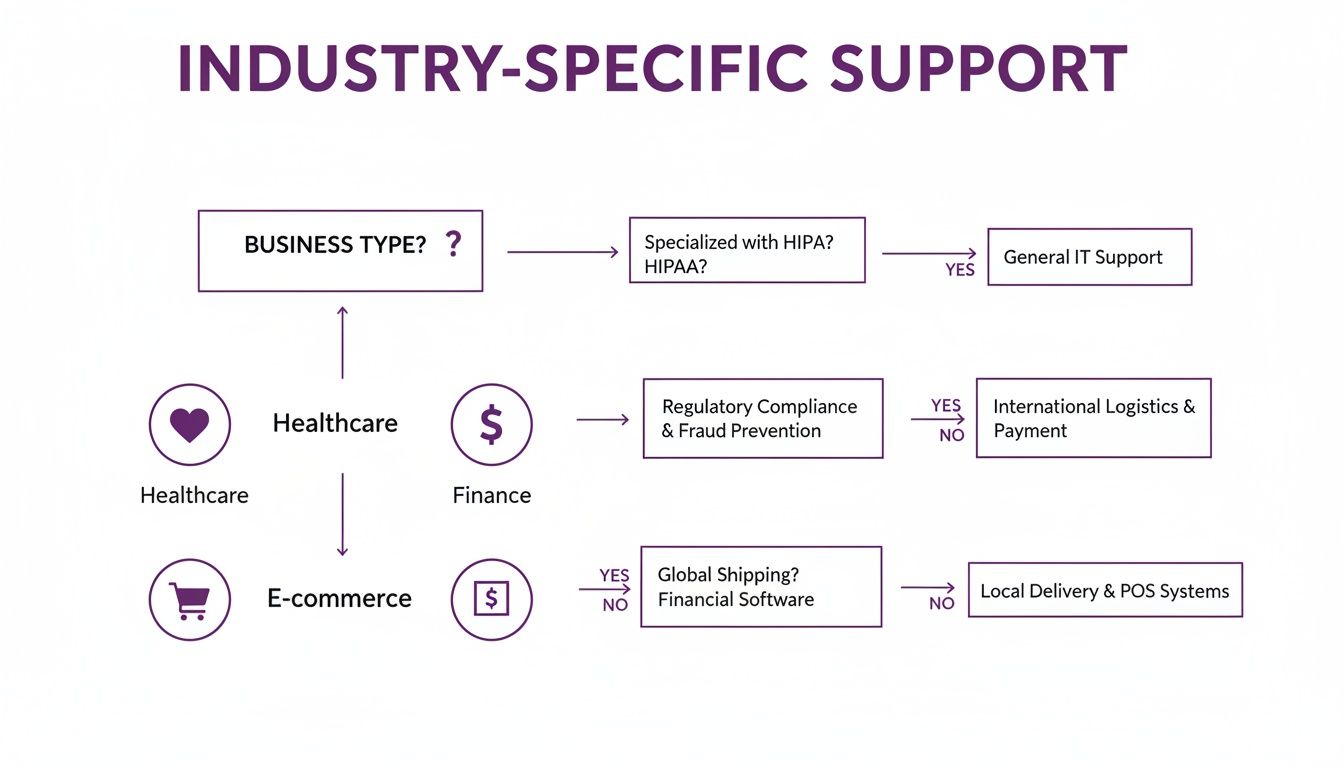
As the chart shows, things like HIPAA for healthcare or PCI for finance aren’t just nice-to-haves; they are foundational requirements when you’re choosing a partner.
Ensure Scalability and Flexibility
Your business isn’t static, and your needs will evolve. You might hit a sudden growth spurt, deal with seasonal rushes, or pivot your strategic goals. The right partner needs to be agile enough to move with you.
Talk about their scalability model right from the start. A truly flexible partner can ramp services up or down as needed, without trapping you in a rigid, long-term contract that no longer makes sense. This ensures your bilingual call center services continue to be a cost-effective tool for growth. For more tips, check out our guide on how to find and vet the best call center outsourcing companies.
Measuring the ROI of Your Bilingual Support
So, you’ve launched your bilingual call center services. That’s a huge step. But how do you actually know if your investment is paying off? Proving its value isn’t about guesswork—it’s about tracking the right metrics to see what’s really happening on the ground.
Measuring the return on investment (ROI) turns abstract goals like “happier customers” into hard data you can act on. It’s the only way to drive continuous improvement and confirm you made the right call.
These numbers give you a clear window into your customer experience, agent performance, and overall operational health. They tell the story of your success.
 Key Metrics for Bilingual Call Center Success
While you could track dozens of data points, a few key performance indicators (KPIs) are absolutely essential for seeing how your bilingual team is performing. Each one reveals a different piece of the puzzle.
- First Call Resolution (FCR): This is the gold standard for efficiency. A high FCR in both English and Spanish tells you that your agents have the training and tools to solve problems on the first try. Fewer callbacks, less frustration, happier customers. Simple as that.
- Customer Satisfaction (CSAT): The classic “How did we do?” survey is powerful when you look at it the right way. By segmenting CSAT scores by language, you can see if your Spanish-speaking customers are getting the same stellar experience as everyone else.
- Net Promoter Score (NPS): This metric goes a step beyond satisfaction to measure pure loyalty. Are your bilingual interactions creating genuine brand fans? Tracking NPS helps you know if you’re building lasting relationships across all your customer groups.
Want to go deeper on these numbers? We break it all down in our complete guide to the most important KPIs in customer service. Getting a handle on these benchmarks is the first step toward making data-driven decisions.
The Role of Quality Assurance and Collaboration
But raw numbers only tell half the story. That’s where Quality Assurance (QA) comes in. Having supervisors review call recordings against a clear, standardized rubric provides the context you just can’t get from a spreadsheet. It shows you how well agents navigate tricky situations, express empathy, and truly represent your brand.
A true partnership goes beyond sending a monthly report. It involves sitting down together, analyzing the data, and co-developing strategies to make the service even better.
This collaborative spirit is what separates a decent vendor from a great partner. The best BPOs don’t just hand you data; they work with you to find trends, pinpoint opportunities, and implement targeted coaching to close any performance gaps.
It’s this continuous feedback loop that ensures your bilingual call center services don’t just meet expectations—they constantly evolve to exceed them and drive your business forward.
Frequently Asked Questions
Thinking about bringing on a bilingual call center partner? You’re not alone. Here are a few of the most common questions we hear from businesses just like yours, with straightforward answers to help you move forward with confidence.
How Long Does It Take to Get a Bilingual Team Up and Running?
You’d be surprised how fast it can happen. While every setup is different, a smooth onboarding process usually takes about 2 to 4 weeks. A good partner isn’t just training agents; they’re focused on getting your team integrated seamlessly.
That means mastering your brand’s voice, getting agents fluent in your products or services, and plugging directly into your CRM. The goal is always to get your bilingual team fully operational and delivering value quickly, without ever cutting corners on quality.
Can Bilingual Call Centers Really Handle Niche Industries?
Yes, absolutely. In fact, that’s where the best providers really shine. Reputable call centers offer specialized training to ensure agents are fully compliant with strict industry regulations, like HIPAA for healthcare or PCI for finance.
These aren’t just one-off workshops. These are intensive programs designed to equip agents with the expertise to handle sensitive information securely and professionally. It’s all about making sure your business stays compliant while still giving customers the specialized care they expect.
What Kind of Tech Should I Be Looking for in a Call Center Partner?
The right technology makes all the difference. You want a partner whose tech stack is built to make every interaction smoother and smarter. Key things to look for include omnichannel tools that let you meet customers on their preferred channel—whether it’s voice, email, or live chat.
You’ll also want to see advanced CRM integration, AI-powered analytics that give you real insights into performance, and ironclad data security. A strong tech stack isn’t just about buzzwords; it means you benefit from smarter workflows, actionable data, and a secure environment you can trust.
Here’s a statistic that really drives the point home: research shows 76% of consumers are more likely to buy a product if the information is in their native language. Even more telling? A striking 40% will flat-out refuse to make a purchase if they can’t get support in their preferred language.
This shift is making bilingual support a must-have for any business that wants to compete on a larger scale.
Frequently Asked Questions
1. What are bilingual call center services?
Bilingual call center services provide customer support in two languages, most commonly English and Spanish.
2. How long does onboarding take?
Most bilingual programs launch within 2–4 weeks, including training and system integration.
3. Are bilingual agents culturally trained?
Yes. Top providers focus on cultural fluency, not just language skills.
4. Can bilingual call centers handle regulated industries?
Absolutely. Reputable providers comply with HIPAA, PCI DSS, and other industry standards.
5. Is nearshore better than offshore?
Nearshore offers better time-zone alignment, cultural understanding, and collaboration.
6. Do bilingual services increase sales?
Yes. Customers are far more likely to buy when supported in their native language.
7. Can services scale seasonally?
Yes. Nearshore partners offer flexible staffing models.
8. What channels are supported?
Voice, chat, email, SMS, and social media.
9. How is quality monitored?
Through call monitoring, QA scorecards, and performance analytics.
10. Is bilingual support cost-effective?
Nearshore bilingual services can reduce costs by up to 60% compared to in-house teams.
Ready to Expand Your Reach
with Bilingual Call Center Services?
CallZent delivers nearshore bilingual call center solutions that help businesses improve customer experience, increase revenue, and scale with confidence.
Ready to unlock new markets and build the kind of customer loyalty that lasts? CallZent provides expert nearshore bilingual call center services designed to help your business grow.