Skip to content
Customer Service Outsourcing
A Guide to Outsourcing Customer Service and Support
Outsourcing customer service and support helps businesses reduce costs, improve CX, scale faster, and operate more efficiently with expert nearshore teams.
TL;DR — Quick Takeaways
- Outsourcing customer service is a powerful strategy for scaling support without draining internal resources.
- Nearshore outsourcing offers the ideal blend of cost savings, cultural alignment, and real-time communication.
- A strategic partner improves quality, efficiency, and customer satisfaction through expertise and technology.
- Choosing the right BPO requires careful vetting, integration planning, and measurement using meaningful KPIs.
Is your customer support team stretched so thin they can barely keep up? It’s a common growing pain for successful businesses: you’re trying to focus on building your company, but customer inquiries are piling up, and your in-house team is drowning. This guide provides actionable insights for outsourcing customer service effectively, helping you enhance support while focusing on core business growth.
This is where outsourcing customer service and support becomes a strategic advantage. It has evolved far beyond a simple cost-cutting move and is now a powerful strategy for growth, scalability, and delivering an exceptional customer experience. It means partnering with a specialized provider to manage your customer interactions, freeing up your internal team to focus on what they do best—driving your core business forward.
Why Smart Companies Outsource Customer Service
Customers don’t just want support; they expect it instantly, around the clock. For a growing business, trying to meet that demand with an in-house team is a monumental task. You’re looking at staggering operational costs, complex hiring processes, and significant management overhead.
This is where strategic outsourcing becomes a total game-changer. You’re not just handing off tasks; you’re gaining a dedicated partner whose entire mission is to deliver exceptional customer experiences on your behalf.
This shift isn’t just a trend; it’s a fundamental change in how modern businesses operate. The global market for BPO and customer service outsourcing is projected to hit roughly $525 billion by 2030. That number alone shows just how much companies are relying on this model to operate efficiently and stay competitive.

The Core Benefits of Outsourcing Customer Service and Support
Working with an expert provider allows you to instantly level up your support game. Instead of the slow, expensive process of building a support department from the ground up, you get immediate access to a trained, scalable team that’s ready to represent your brand from day one.
The key advantages are clear and impactful:
- Significant Cost Efficiency: You slash operational costs by eliminating expenses related to recruitment, training, benefits, and infrastructure. For a deeper analysis, see the ROI of outsourcing call centers on CallZent.com.
- Focus on Core Business Operations: Your internal team can finally redirect their energy toward innovation, product development, and the big-picture strategic goals that actually grow the company.
- Unmatched Scalability and Flexibility: Need to ramp up for a product launch or a holiday rush? No problem. An outsourced partner allows you to scale your support team up or down on demand, without the HR headaches of hiring and firing.
- Immediate Access to Expertise: You’re tapping into a partner’s specialized knowledge in customer service best practices, agent training, and performance management—competencies that would take years and significant investment to build in-house.
“The smartest companies no longer view customer service as a cost center, but as a revenue driver. Outsourcing allows them to deliver a world-class experience that builds loyalty and fuels growth, without distracting from their primary mission.”
Ultimately, outsourcing your customer service is about achieving strategic agility. It empowers your business to deliver superior service, operate more efficiently, and compete on a much larger scale.
The True Financial Impact of Outsourcing Customer Service
It’s easy to look at outsourcing as a simple line-item saving on a spreadsheet, but that misses the bigger picture entirely. The real financial impact of outsourcing customer service and support is much deeper than just labor arbitrage. It creates a powerful ripple effect that touches everything from your operational budget to your long-term growth potential.
Most companies dramatically underestimate the hidden costs of running their own support team. It isn’t just about salaries. It’s a complex web of direct and indirect expenses that can quickly spiral out of control. Outsourcing cuts through that complexity, turning a dozen chaotic variables into one predictable, manageable expense.
Understanding the Hidden Costs of In-House Support
When you decide to build a support team from scratch, you’re signing up for a lot more than just payroll. The initial investment is one thing, but it’s the ongoing, often-overlooked expenses that truly drain your resources.
For example, a growing e-commerce brand decided to build an in-house team of 10 agents. They quickly realized the costs went far beyond salaries. They had to pay for recruiters, expensive CRM software licenses, new office space, and a full-time manager just to oversee the team. Six months in, their “affordable” in-house team was costing nearly double their initial projections.
Think about the full spectrum of what it takes:
- Recruitment and Hiring: The endless cycle of posting jobs, sifting through résumés, interviewing candidates, and onboarding new hires is both expensive and incredibly time-consuming.
- Salaries and Benefits: Beyond competitive wages, you’re on the hook for health insurance, retirement plans, paid time off, and other benefits needed to attract top talent.
- Training and Development: Initial training is just the start. To maintain quality, you need ongoing coaching, skill development programs, and a dedicated quality assurance process.
- Technology and Infrastructure: You have to buy, license, and maintain a whole tech stack—CRM software, phone systems, ticketing platforms, computers, and headsets.
- Management Overhead: A huge chunk of your managers’ time gets eaten up by supervising the support team, handling escalations, and juggling schedules.
- Attrition and Retraining: Agent turnover is a constant battle. Every time someone leaves, you’re right back at square one, paying to recruit and train their replacement all over again.
The Strategic Value of Predictable Costs in Outsourcing
Partnering with an outsourced provider transforms this volatile financial situation into a stable, predictable operational expense. You pay a clear, agreed-upon rate that bundles all those associated costs—from agent salaries and benefits to software licenses and management—into one straightforward figure.
This model gives you a massive strategic advantage. You can forecast your customer service budget with near-perfect accuracy, which allows for much smarter financial planning across the entire organization. For fast-growing companies trying to manage cash flow, that kind of predictability is invaluable.
For instance, a rapidly expanding SaaS company can slash its operational expenses by up to 60% just by switching to a nearshore partner. But the most important part isn’t just saving the money; it’s about what you do with it. That freed-up capital can be funneled directly back into what actually grows the business—product development, marketing campaigns, or expanding your sales team. This is how outsourcing customer service stops being a cost center and becomes a direct catalyst for growth. To get a better handle on the numbers, explore a detailed analysis of how much it costs to outsource a call center.
In-House vs. Outsourced Customer Service Cost Breakdown
To truly see the financial difference, you need to put the costs side-by-side. The table below provides a clear, at-a-glance look at where the savings really come from when you move from an in-house model to a nearshore partner.
| Cost Factor | In-House Team | Outsourced Partner (e.g., Nearshore) |
|---|---|---|
| Recruitment | High costs for job boards, interviews, and onboarding. | Included in the service fee. |
| Salaries & Benefits | Fully burdened cost, including healthcare and retirement. | Included in the hourly or per-agent rate. |
| Training | Significant investment in initial and ongoing training programs. | Handled by the partner, who specializes in agent development. |
| Technology Stack | Requires large capital expenditure and ongoing licensing fees. | Access to enterprise-grade technology is included. |
| Management | Requires dedicated managers and team leads on your payroll. | Management and QA are part of the partner’s service. |
| Scalability | Slow and expensive to scale up or down. | Flexible and immediate scaling based on demand. |
By bundling these complex costs into a single, predictable fee, an outsourced partner not only simplifies your budget but also gives you the financial agility to invest in what matters most: growing your business.
Choosing Your Outsourcing Model: Onshore, Offshore, or Nearshore?
So, you’ve decided that outsourcing customer service and support makes sense for your business. The next critical question is, “where?” The location of your outsourcing partner is just as important as the services they provide. This decision will shape everything from your budget and communication workflows to cultural alignment with your customers.
Think of it like this: you could hire a local provider (onshore), one from a faraway country (offshore), or a team from a neighboring region (nearshore). Each path has distinct trade-offs. Onshore offers maximum control at the highest price, while offshore promises significant cost savings but can introduce communication and cultural hurdles. The nearshore model, however, strikes a powerful and strategic balance.
Figuring this out is one of the most important first steps. This simple chart can help you decide if outsourcing is even the right move for you based on one key factor: cost.
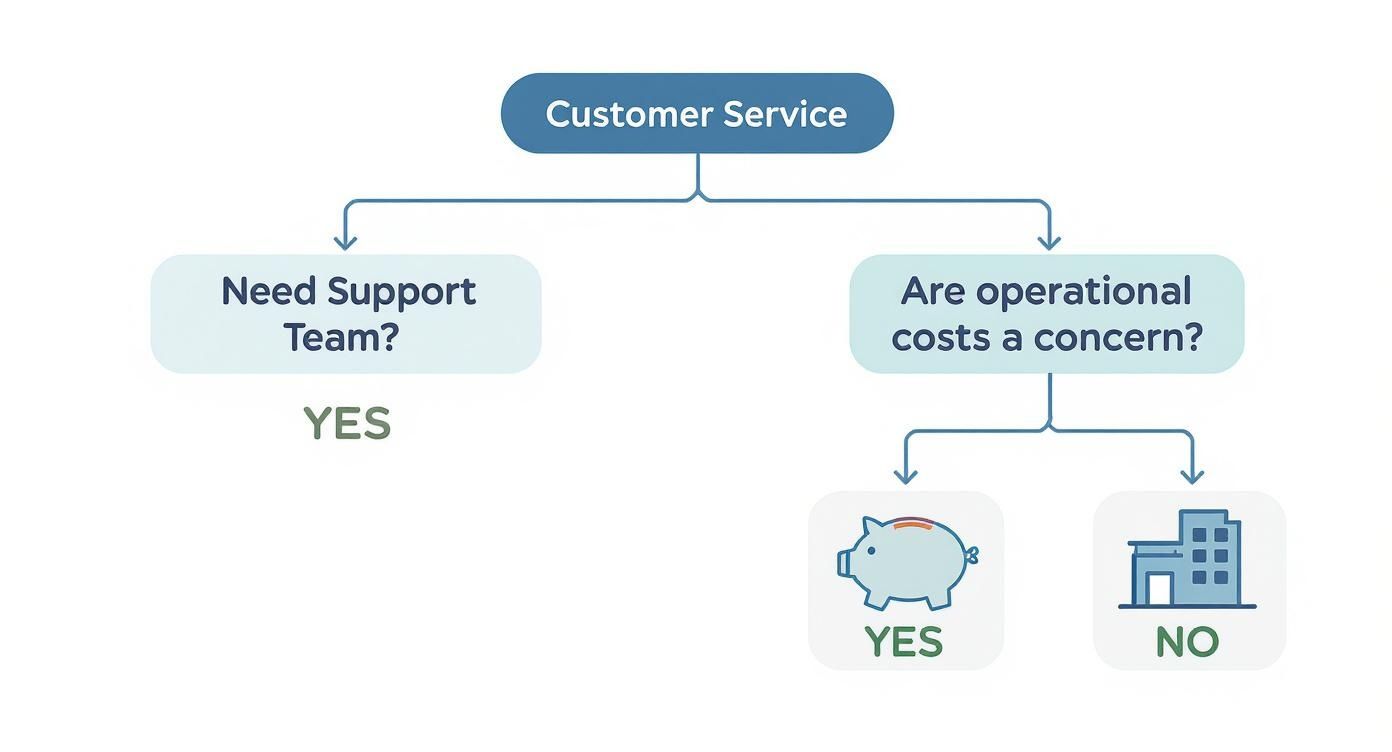
As you can see, budget concerns often point companies toward outsourcing. That’s when you must pick the right model for your specific needs.
Understanding the Three Core Outsourcing Models
To make an informed choice, you must understand what makes each approach different. Each model is built for different business priorities, whether that’s aggressive cost-cutting, close operational oversight, or getting the best of both worlds.
- Onshore Outsourcing: This means hiring a company within your own country. It’s the most expensive option but ensures seamless communication and eliminates cultural gaps.
- Offshore Outsourcing: This model sends your support operations to a distant country, often in a completely different time zone, like India or the Philippines. The primary driver here is maximum cost reduction.
- Nearshore Outsourcing: This is the strategic middle ground, where you partner with a provider in a nearby country. For U.S. businesses, this typically means locations like Mexico or other countries in Latin America.
While every model has its place, the nearshore approach has become the go-to strategy for companies that refuse to sacrifice quality for savings.
Why Nearshore is a Strategic Advantage for Outsourcing Customer Support
For businesses in the United States, a nearshore partner in a location like Tijuana offers a unique blend of benefits that offshore models simply can’t match. This isn’t just about splitting the difference on cost; it’s about gaining a real competitive edge built on proximity, cultural synergy, and talent.
The value of going nearshore boils down to a few key advantages:
- Time Zone Alignment: Your nearshore team works the same hours your in-house staff does. This eliminates communication delays and makes real-time collaboration effortless—a critical factor for resolving urgent customer issues.
- Cultural Affinity: Nearshore agents have a much stronger grasp of U.S. culture, consumer expectations, and conversational nuances. That cultural fluency translates into more natural, empathetic, and effective customer interactions.
- Access to a Bilingual Talent Pool: Hubs like Tijuana are magnets for highly skilled, bilingual professionals who can seamlessly switch between English and Spanish, allowing you to serve a broader customer base effectively.
“Choosing a nearshore partner is about more than just geography; it’s a strategic decision to align your outsourced team with your company’s culture, work schedule, and customer expectations.”
By selecting a nearshore provider, you get the significant cost benefits of outsourcing without the operational headaches that can arise when your team is halfway across the globe. To dive deeper, you can explore a detailed breakdown of nearshore vs. offshore outsourcing models to see exactly how they compare.
Comparing Outsourcing Models: Onshore vs. Offshore vs. Nearshore
To help you sort through your options, let’s compare these models head-to-head on the factors that matter most: cost, communication, and quality.
| Factor | Onshore | Offshore | Nearshore |
|---|---|---|---|
| Cost Savings | Low (Highest operational cost) | High (Lowest labor costs) | Moderate to High (Balanced cost-effectiveness) |
| Time Zone | Fully Aligned | Significant Difference (8-12+ hours) | Aligned or Minimal Difference (0-3 hours) |
| Cultural Affinity | High (Shared national culture) | Low (Significant cultural differences) | High (Strong cultural and market familiarity) |
| Travel & Oversight | Easy and Inexpensive | Difficult and Costly | Easy and Affordable |
| Talent Pool | Competitive, High-Cost | Large, Multilingual | Strong, Bilingual (English/Spanish) |
Ultimately, if your only goal is to cut costs to the bone, offshore might seem appealing. But for businesses seeking a smart, sustainable balance of cost savings, top-tier service, and seamless integration, the nearshore model is the most compelling and strategic choice.
How to Select the Right BPO Partner for Outsourcing Customer Service
Choosing an outsourcing provider is one of the most critical decisions you’ll make for your customer experience. This is a high-stakes choice that goes far beyond a slick sales presentation or a rock-bottom price. Your mission isn’t just to find a vendor who can answer calls; it’s to find a true strategic partner who will act as a guardian of your brand.
The selection process is about looking under the hood to see how they truly operate. You have to learn to spot the difference between a simple call center and a partner who will actively fuel your company’s growth. The good news? The industry is improving, with client satisfaction with outsourcing partners climbing from 6.8 out of 10 in 2018 to 7.6 out of 10 in 2023, signaling a shift toward quality-driven partnerships.

Go Beyond the Sales Pitch: A Practical Vetting Framework
To find the right fit, you need a solid framework for vetting potential BPOs. Your evaluation must focus on the three pillars of great service: their people, their processes, and their technology. A great partner will be an open book, eager to demonstrate how they excel in these areas.
Start by digging into their most valuable asset—their agents. How do they recruit, train, and retain talent? For example, ask them about their average agent tenure. A provider with a positive, agent-first culture and low turnover will almost always have more motivated, high-performing teams who create better experiences for your customers.
“A BPO’s culture is a leading indicator of its performance. An investment in agent happiness and development directly translates into higher quality customer interactions and lower attrition.”
When you’re evaluating potential partners, you have to look at the technology they use. Modern tools like customer service platforms like Gorgias can make a huge difference in how efficiently they handle customer issues, which directly impacts the quality of support you get. Make sure to ask providers about their tech stack and how it empowers their agents to do their best work.
Your Vetting Checklist: Critical Questions to Ask Your Potential Partner
Go into your meetings armed with a checklist of tough, practical questions that slice through the marketing fluff. A top-tier partner will have confident, detailed answers at the ready. Hesitation or vague replies are major red flags.
Here are some essential questions to guide your conversations:
- Agent Training and Culture: “Walk me through your agent training process, from day one to ongoing development. What specific steps do you take to create a positive culture that keeps your team engaged and reduces turnover?”
- Security and Compliance: “Can you provide documentation for your PCI, HIPAA, or SOC 2 compliance? How do you protect our customers’ sensitive data on a daily basis?”
- Disaster Recovery and Business Continuity: “What is your documented plan for business continuity? What happens if your main facility loses power or internet connectivity?”
- Performance Reporting and Insights: “How do you provide actionable insights, not just raw data? Share a specific example of how you helped another client identify and solve a recurring customer issue based on your reporting.”
Asking these kinds of questions forces the conversation away from promises to provable results. For more on this, check out our guide on what smart sourcing for outsourcing really means.
Ultimately, you’re looking for a partner who understands your business goals and demonstrates a genuine commitment to becoming an extension of your team. This careful vetting process is the key to choosing a BPO that will not just manage your support, but actively help you grow.
Integrating Your Outsourced Team for Long-Term Success
The line between a good and a great outsourcing partnership is drawn at integration, not just delegation. Once you’ve selected your BPO partner, the real work begins: weaving their team into the very fabric of your company. The goal is to build a single, unified force driving toward the same goals, completely erasing any “us vs. them” mentality.
Think of it less like handing off a task list and more like welcoming a new department. This process starts with a deliberate, collaborative onboarding that makes your outsourced agents feel like a true extension of your company culture. Success is built on three pillars: shared knowledge, fluid communication, and a unified culture. Getting this right prevents friction, improves customer outcomes, and leads to far better agent retention and performance.

Building a Shared Knowledge Foundation
The bedrock of any solid integration is a comprehensive, co-developed knowledge base. This isn’t just a static FAQ document you email over. It’s a living, breathing resource your partner’s agents will rely on every day to represent your brand accurately and solve real customer problems.
Work hand-in-hand with your partner to build this repository from the ground up. It must include everything—product specifications, troubleshooting guides, your brand’s specific tone of voice, and clear escalation protocols.
- Co-Develop, Don’t Dictate: Involve your BPO partner’s leadership in creating the knowledge base. Their experience is invaluable for structuring information in a way that’s practical for agent training and quick reference.
- Use Real-World Scenarios: Instead of just listing facts, pack the knowledge base with examples of common—and not-so-common—customer issues. A practical, scenario-based approach prepares agents for the reality of live conversations.
- Establish a Feedback Loop: Create a simple process for outsourced agents to suggest updates or flag outdated information. This keeps the knowledge base accurate and continuously improves it over time.
Establishing Fluid Communication Channels
You can’t have a truly integrated team if they feel siloed. Clear, constant communication is non-negotiable.
“Treat your outsourced team leaders as you would your own internal managers. Inviting them to your weekly operational meetings and giving them a seat at the table fosters a ‘one team’ culture and ensures everyone is aligned on goals and challenges.”
Pull them into the same communication platforms your in-house team uses. If your company runs on Slack, create shared channels for your support teams. This simple step enables real-time questions, quick clarifications, and the kind of casual collaboration that builds strong working relationships. If you’re looking for the right platform, you can find great resources that review various remote team communication tools to see what fits your workflow.
Fostering a Unified Team Culture
Finally, you must actively cultivate a shared culture. This is often the most overlooked piece of the puzzle, but it delivers the biggest impact. When outsourced agents genuinely feel connected to your brand’s mission and values, their engagement and performance skyrocket.
It’s often the little things that make the biggest difference. Share company-wide wins and milestones with them. Send them company swag. When you launch a new marketing campaign, ensure they’re among the first to see it. These actions reinforce that the outsourced team is a valued part of the company, not just a vendor. Creating shared performance dashboards also helps get everyone focused on the same metrics, cementing a unified, goal-driven culture.
Measuring the KPIs That Truly Matter for Outsourced Support
You can’t manage what you don’t measure. After you’ve chosen a partner and integrated their team, the final—and arguably most important—step is tracking performance. But this isn’t about drowning in a sea of data. It’s about focusing on the Key Performance Indicators (KPIs) that actually reveal the health of your customer experience.
A great BPO partner doesn’t just email you spreadsheets. They sit down with you to interpret the numbers, understand the story behind the data, and turn raw metrics into a clear roadmap for improvement. This is how you prove the ROI of your partnership and shift your support from a reactive cost center to a proactive source of business intelligence.
Core Metrics That Define Customer Service Success
While you could track dozens of different metrics, a few core KPIs offer the clearest window into your outsourced team’s performance. They don’t just tell you what is happening, but why.
These metrics are the language of great customer service:
- Customer Satisfaction (CSAT): This is your most direct pulse-check on customer happiness. Typically gathered from a quick post-interaction survey (“How satisfied were you with your support?”), it provides immediate feedback on a single interaction. A strong CSAT score, generally aiming for 80% or higher, means your agents are effectively meeting customer needs.
- Net Promoter Score (NPS): While CSAT measures a specific interaction, NPS gauges the bigger picture of customer loyalty. It asks, “How likely are you to recommend our company to a friend?” This metric offers a high-level view of your brand’s health and is a strong predictor of long-term customer retention.
- First Contact Resolution (FCR): This crucial KPI tracks the percentage of customer issues resolved in the very first interaction—no follow-up needed. A high FCR rate (the industry average is around 74%) is a powerful indicator of efficiency and agent expertise. It shows you’re respecting your customers’ time and solving their problems without friction.
“Data is just noise until you give it context. The right partner doesn’t just report on FCR and CSAT; they analyze why a customer had to call back and what you can do to prevent that issue from happening again.”
Moving Beyond Data to Strategic Insights
A true partner like CallZent goes beyond just reporting these numbers. The real value lies in analyzing trends and extracting strategic insights that help you improve your products, services, and the entire customer journey.
For instance, a dip in CSAT scores isn’t just a number—it’s a signal. A skilled partner digs in to find the root cause. This analytical approach is common across industries that live and breathe by customer interactions. The telecommunications sector, for instance, is a leader in outsourcing, with about 78% of companies in the industry outsourcing their support. Financial services and retail aren’t far behind, because they understand the power of data-driven customer service. You can discover more insights about customer support outsourcing market trends on accio.com.
A proactive partner will spot recurring issues from support tickets and feed that intelligence back to your product team. Perhaps they notice that 20% of all calls are about a confusing feature in your software. By flagging this, they’re handing you a clear, data-backed opportunity to improve your product, reduce call volume, and boost customer satisfaction simultaneously. For a deeper look at the metrics that matter most, you can review our complete guide on key customer service performance indicators. This is how outsourcing stops being a simple support function and becomes a powerful engine for continuous business improvement.
Got Questions About Outsourcing? We’ve Got Answers.
Diving into the world of outsourcing customer service and support can feel like a big step. It’s natural to have questions. Here are clear answers to the most common concerns we hear from business leaders.
“Will I Lose Control Over My Brand’s Voice?”
Not if you choose the right partner. A great BPO provider acts as a steward of your brand, not just a service that answers calls. They should dive deep into your company’s voice, values, and goals through intensive training, ensuring every customer interaction feels like it’s coming directly from you.
Think of it as a partnership, not a handoff. Through clear KPIs, constant communication, and transparent quality assurance, you always have your finger on the pulse. You maintain full strategic control over how your customers are treated.
“Isn’t Outsourcing Just for Large Corporations?”
This is a common misconception. In reality, outsourcing is incredibly scalable, and it’s often startups and mid-sized businesses that see the biggest benefits.
For example, a fast-growing tech startup can’t afford to build a 24/7 in-house support team. By partnering with a nearshore provider, they can offer round-the-clock support, matching the service levels of their largest competitors for a fraction of the cost. Outsourcing levels the playing field, allowing smaller companies to deliver a world-class experience and compete head-on with industry giants.
A common myth is that outsourcing means giving up control. In reality, a strategic partnership gives you more control over your budget, scalability, and core business focus, all while elevating your customer experience.
“How Can I Be Sure My Customer Data Is Safe?”
Data security is absolutely non-negotiable, and any potential partner should be ready to prove their credentials. When vetting BPOs, you must ask for proof of compliance with industry-standard regulations relevant to your business.
Look for key certifications like:
- PCI DSS if you handle any credit card information.
- HIPAA for any work involving protected health data.
- SOC 2 for a comprehensive stamp of approval on their data security and privacy controls.
A reputable provider will have invested heavily in secure infrastructure, end-to-end encryption, and regular third-party audits. They should be transparent and eager to show you exactly how they will protect your customers’ most sensitive information.
🚀 Transform Your Customer Service Today
CallZent’s nearshore teams deliver scalable, bilingual, high-quality support built for growth.
Ready to turn your customer service from a cost center into a true growth engine? CallZent delivers high-quality, scalable nearshore solutions designed to fit your brand and your budget. See how our expert teams in Tijuana can transform your customer experience by visiting https://callzent.com today.