Skip to content

Healthcare Outsourcing
Outsourcing Medical Billing: Why It’s the Smartest Move for Modern Healthcare Practices
Learn how outsourcing medical billing can streamline your revenue cycle, reduce costly errors, and help your healthcare practice focus fully on patient care.
TL;DR — Quick Takeaways
- Outsourcing medical billing cuts overhead and boosts revenue cycle efficiency.
- Specialized partners reduce coding errors, denials, and payment delays.
- HIPAA-compliant processes protect sensitive patient data.
- Free your staff to focus on patients instead of paperwork.
Is your practice drowning in paperwork when you should be focused on patients? You’re not alone. For countless healthcare providers, in-house medical billing is a huge drain on time and money, often leading to costly mistakes and frustrating payment delays.
This is where partnering with an outsourcing medical billing company becomes more than just a smart move—it’s a strategic shift that can turn an administrative nightmare into a serious financial advantage.
Why Top Healthcare Practices Outsource Medical Billing
The daily grind for many clinics and hospitals is getting tougher. Administrative tasks keep piling up, insurance rules seem to change overnight, and getting paid what you’re owed feels like a constant battle. This is exactly why bringing in a specialized partner makes so much sense.
It’s not just about trimming costs anymore. It’s about making a fundamental change to improve the financial health of your practice.
When you handle billing in-house, you’re juggling staff salaries, endless training on new coding rules, and paying for expensive software. Even with a great team, human error is always a risk. One wrong code can trigger a claim denial that takes weeks, or even months, to fix, creating a massive clog in your cash flow. This administrative drag pulls focus away from what truly matters: patient care.
This image shows how outsourcing can help organize your practice’s financial operations and boost revenue.
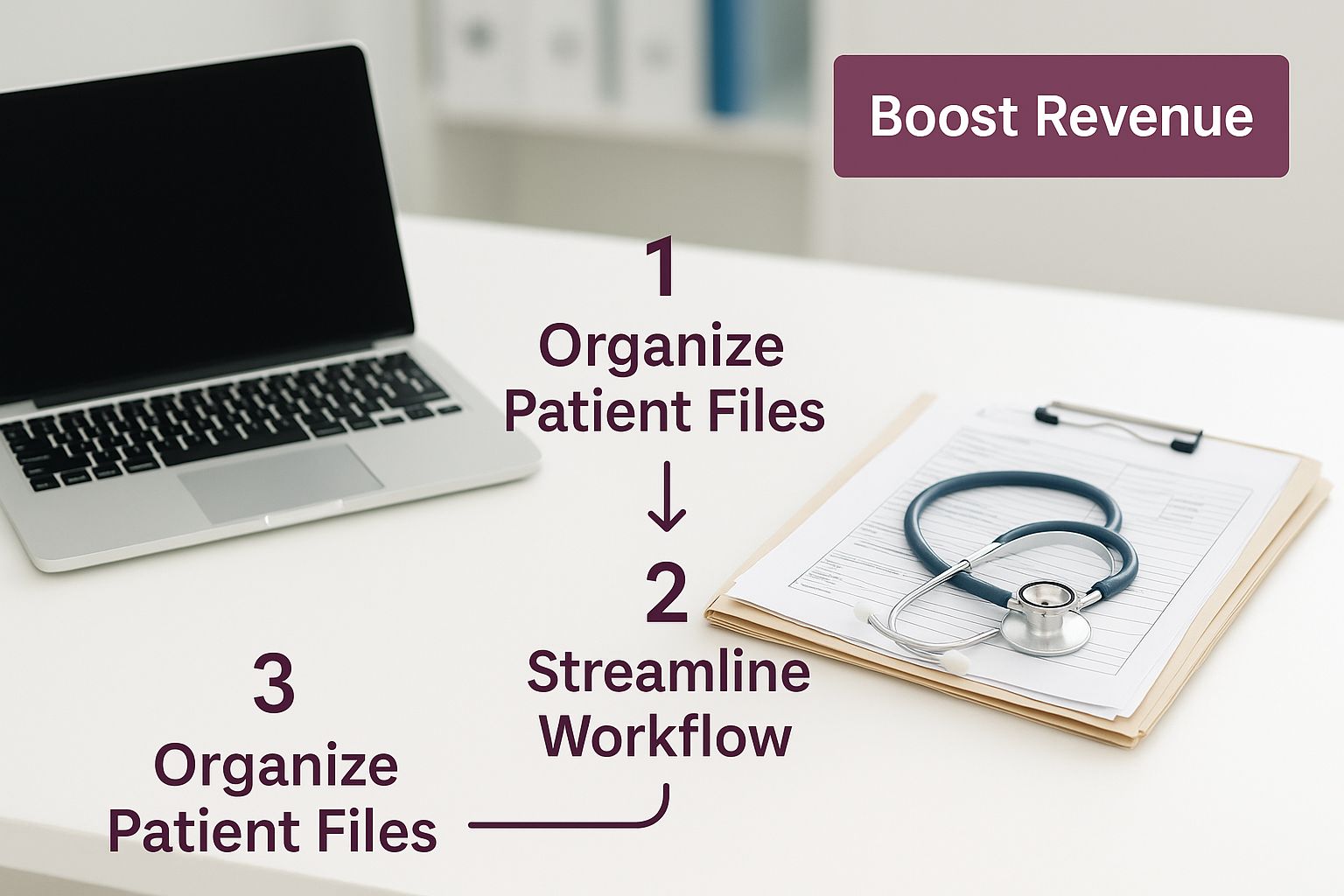
The takeaway here is simple: a clean, organized approach to billing directly leads to a healthier bottom line.
Transforming Your Revenue Cycle
By partnering with an outside expert, you instantly get a team whose only job is to manage your revenue cycle with absolute precision. These are specialists who live and breathe the complicated world of insurance payers. They know exactly how to submit clean claims that get paid on the first try.
This strategic move unlocks several powerful benefits:
- Reduced Operational Costs: You can say goodbye to the overhead of an in-house billing department, from salaries and benefits to software subscriptions.
- Increased Revenue: Medical coding and claims experts work to maximize your reimbursements and slash denial rates, making sure you collect more of what you’ve earned.
- Enhanced Focus on Patients: When your staff is free from billing headaches, they can dedicate their full attention to patient scheduling, care coordination, and creating a better overall experience.
- Improved Compliance: A dedicated partner stays on top of every shifting regulation, like HIPAA and specific payer rules, protecting you from the risk of expensive compliance violations.
The right partnership doesn’t mean losing control of your finances; it means gaining greater visibility and efficiency. By outsourcing, you’re not just offloading a task—you are installing a professional financial engine dedicated to your practice’s success.
Ultimately, exploring the world of business process outsourcing in healthcare gives your practice the power to operate more efficiently, boost profitability, and secure its financial future.
 What a Medical Billing Partner Actually Does
Let’s pull back the curtain on what really happens when you team up with a medical billing company. It’s a lot more than just sending out invoices. Think of them as the dedicated financial engine of your practice, meticulously managing every single step that turns a patient visit into a paid claim.
They essentially take over your entire Revenue Cycle Management (RCM). This is a complex journey that kicks off the moment a patient schedules an appointment and doesn’t end until the final payment is posted. Their sole focus is making sure you get paid fully and promptly for the care you provide.
The Core Functions of Your Financial Partner
A professional billing partner juggles a continuous cycle of crucial tasks. Each step is connected, and one tiny error can throw the whole process off track.
Interestingly, their work often starts long before a claim is even created. It all begins with proactive, front-end management designed to stop problems before they can even start.
- Insurance Eligibility Verification: They confirm a patient’s coverage is active and find out what services are included before the appointment ever happens. This one simple step prevents a massive number of common claim denials right off the bat.
- Pre-Authorizations: For any procedures that need a green light from insurers, your partner handles the entire authorization process. They work to secure the necessary approvals to guarantee you’ll get paid.
This upfront diligence lays the groundwork for a clean claim, kind of like a chef prepping all the ingredients before starting to cook. Getting these details right from the very beginning is absolutely essential.
Transforming Services into Clean Claims
Once a patient visit is complete, your partner’s real expertise kicks in. They translate the clinical notes and documentation into the standardized language that insurance companies demand. This is where deep, specialized knowledge becomes non-negotiable.
Certified coders will review the physician’s notes, assigning the correct CPT (Current Procedural Terminology) and ICD-10 (International Classification of Diseases) codes. Accuracy here is everything—incorrect coding is one of the top reasons for claim rejections and audits.
After coding, they create and “scrub” the claim. Think of claim scrubbing as a spell-check for medical billing. Specialized software scans the claim for errors, missing information, or inconsistencies that would trigger an instant denial. This quality control step gives the claim the highest possible chance of getting accepted on the first try. A key part of a billing partner’s job is to master how to automate invoice processing to ensure both accuracy and speed.
A top-tier billing partner doesn’t just process claims; they perfect them. Their goal is a first-pass acceptance rate above 95%, which means fewer delays and faster revenue for your practice.
The Unseen Work of Collections and Follow-Up
Just submitting the claim is only half the battle. This is where a dedicated partner’s persistence really pays dividends. They relentlessly track every claim they submit, chasing down anything that isn’t paid on time.
- Denial Management: If a claim gets denied, they immediately dig in to find out why, fix the error, and appeal the decision. They know the complicated appeals processes for different payers and will fight to recover the revenue you’ve earned.
- Accounts Receivable (A/R) Follow-Up: Their team is constantly following up on unpaid claims with insurance companies, making sure nothing slips through the cracks. This dogged pursuit of outstanding payments is what keeps your cash flow healthy.
This proactive management is a huge differentiator. It’s no surprise the global medical billing outsourcing market is growing so quickly. By handling all these detailed tasks—from patient calls to claim appeals—a partner turns a frustratingly complex process into a predictable revenue stream. This frees up practices to focus on what they do best, backed by specialists every step of the way. You can even see how dedicated medical call centers fit into this ecosystem to improve patient communication and financial outcomes.
 The Hidden Costs of In-House Billing Errors
A single coding mistake—one wrong number or an old modifier—might not seem like a big deal. But in the world of medical billing, it can set off a disastrous chain reaction of denials, payment delays, and write-offs that quietly drain your practice’s bank account.
These aren’t just random slip-ups; they are a massive, often invisible, hole in your financial health.
The numbers are staggering. A shocking 80% of medical bills in the United States contain errors, causing huge financial losses for providers. This brutal reality is why so many practices now see outsourcing to a dedicated medical billing company not just as a choice, but as a critical strategy for survival.
Why Do These Errors Happen So Often?
Let’s be clear: these mistakes rarely happen because your team isn’t trying hard enough. They’re symptoms of a system that’s stretched thin and forced to navigate an insanely complex maze of rules.
Here are the usual suspects:
- Constantly Changing Payer Rules: Insurance companies are notorious for updating their submission guidelines, coverage policies, and coding requirements. An in-house team, already juggling a dozen other tasks, can easily miss one small change and trigger a wave of denials.
- Staff Burnout and Turnover: Medical billing is a high-pressure, detail-heavy job. That environment leads to burnout, and tired people make mistakes. When a good biller leaves, their years of hard-won knowledge walk right out the door.
- Lack of Specialized Training: A general biller might be great, but do they know the specific coding nuances for cardiology or orthopedics? That lack of deep, specialty-specific expertise is a primary reason claims get kicked back.
- Outdated Technology: Still relying on manual data entry or old software? Without modern, automated claim-scrubbing features, it’s far too easy for errors to slip through the cracks and get sent off to payers.
These factors create the perfect storm for financial leaks. The cost isn’t just the lost money from one denied claim. It’s the hours your staff wastes chasing it down, the hit to your cash flow, and the risk of compliance penalties.
The Real-World Impact of One Incorrect Code
Let’s follow the path of a single coding error to see how it poisons your entire revenue cycle. A physician performs a procedure and documents it perfectly. But the in-house biller accidentally uses a code that was updated last month.
One small mistake doesn’t just delay payment—it multiplies administrative work and freezes revenue that should already be in your account.
First, the claim hits the payer’s automated system and is instantly rejected. Now your team has to drop what they’re doing, dig into the denial, figure out what went wrong, fix the code, and resubmit the whole thing. Just this part of the process can take weeks.
If the denial requires a formal appeal, you could be looking at months of back-and-forth emails and phone calls.
All the while, your practice has already paid for the staff, supplies, and overhead for that procedure. The delayed payment creates a cash flow gap that can make it tough to cover day-to-day operational costs. This vicious cycle is exactly why finding ways to reduce operational costs is so essential.
A dedicated partner’s only job is to prevent these errors from ever happening, making sure you get paid correctly—and on time—the first time around.
How to Choose the Right Medical Billing Partner
Picking a partner for your medical billing is one of the most important financial decisions your practice will ever make. Get it right, and you can unlock incredible efficiency and profitability. Get it wrong, and you could end up with even bigger headaches than you started with.
This isn’t just about finding the cheapest vendor; it’s about finding a true partner. A solid evaluation goes way beyond a simple price sheet. You need to dig into their expertise, their tech, and their track record to make sure they’re a perfect fit for your practice’s unique needs.
Assess Their Specialty-Specific Expertise
General billing knowledge just won’t cut it. Medical billing is incredibly nuanced—what works for a family practice is completely different from the complex coding needed for cardiology, orthopedics, or dermatology. Each specialty has its own unique codes and payer rules.
A partner who’s a pro at billing for a primary care office might be totally lost when it comes to the complexities of durable medical equipment (DME) or claims for an ambulatory surgery center (ASC).
When you’re talking to potential outsourcing medical billing companies, get specific. Ask them direct questions about their experience in your field.
- Case Studies and References: Can they show you real-world examples of how they’ve helped practices just like yours? Ask for references from clients in your specialty. Hearing directly from them is invaluable.
- Certified Coders: Do they have coders on staff who are certified in your specific area? This shows a much deeper commitment and understanding of the codes that drive your revenue.
- Payer Knowledge: How well do they know the major insurance payers in your area and their quirky rules for your services?
Locking in a partner with proven expertise in your niche is the single biggest thing you can do to slash denials and get the reimbursements you’ve earned.
Scrutinize Their Technology and Integration Capabilities
The technology a billing company uses is the engine of their entire operation. If they’re working with outdated software and clunky manual processes, you’re signing up for errors and inefficiency. A modern, effective partner will have a powerful tech stack built to make the entire revenue cycle hum.
Your number one concern here should be how smoothly their system integrates with your existing Electronic Health Record (EHR). A clunky or incompatible setup creates data silos and forces your team into manual workarounds, completely defeating the purpose of outsourcing in the first place.
A true billing partner’s technology should feel like a natural extension of your own systems, providing clear insights without creating extra work for your staff.
Before you even think about signing a contract, confirm they can integrate seamlessly. Ask to see their reporting tools. You absolutely need access to real-time dashboards and detailed monthly reports that give you a transparent, on-demand look at your practice’s financial health. This visibility isn’t a “nice-to-have”—it’s essential for keeping control of your finances.
Vendor Evaluation Checklist for Outsourcing Medical Billing Companies
Choosing the right medical billing partner requires a careful, methodical approach. This checklist is designed to help you compare potential vendors across the most critical areas, ensuring you can distinguish a high-quality partner from one that might cause problems down the road.
| Evaluation Criteria | What to Look For (High-Quality Partner) | Red Flags to Avoid |
|---|---|---|
| Specialty Expertise | Provides case studies & references in your specific medical field. Employs certified coders for your specialty. | Vague answers about their experience. One-size-fits-all approach to billing. |
| Technology & EHR Integration | Demonstrates seamless integration with your current EHR. Offers real-time dashboards and transparent reporting. | Clunky, outdated software. Requires manual data entry from your staff. Lack of clear reporting. |
| HIPAA Compliance & Security | Proudly shares documentation of HIPAA compliance, regular security audits, and staff training protocols. | Hesitant to discuss security measures. No documented proof of compliance or audits. |
| Pricing & Contract Terms | Clear, transparent pricing structure with no hidden fees. Flexible contract terms that align with your goals. | Confusing pricing models. Long, inflexible contracts with steep cancellation penalties. |
| Performance & Results | Provides clear metrics on their average claim acceptance rate, denial rate, and collection times. | Unwilling to share performance data. Makes unrealistic promises of 100% collections. |
| Client Support | Offers a dedicated account manager. Provides responsive and knowledgeable customer service. | Difficult to reach support. High staff turnover. Poor communication during the sales process. |
Using a structured checklist like this ensures you’re making a decision based on objective facts and capabilities, not just a sales pitch. It’s about finding a partner who is truly invested in your practice’s financial success.
Verify Unwavering HIPAA Compliance and Security
Handing over sensitive patient data is a massive responsibility. You have to be 100% certain that any potential partner treats data security with the absolute seriousness it requires. A single data breach could be devastating—not just for your patients, but for your practice’s reputation and financial stability.
A trustworthy partner will be proud of their security measures and happy to talk about them. Don’t be afraid to drill down into the specifics:
- Data Encryption: Is all patient data encrypted, both when it’s sitting on their servers (at rest) and when it’s being sent (in transit)?
- Network Security: What firewalls, intrusion detection systems, and other safeguards do they have to protect their network from hackers?
- Staff Training: How often do they train their team on HIPAA rules and data security best practices? Is it a one-time thing or ongoing?
Partnering with a fully HIPAA-compliant call center and BPO provider is non-negotiable for protecting your practice from huge legal and financial risks. Ask for documented proof of their compliance and evidence of regular security audits. This level of rigor is the mark of a professional, trustworthy firm and is crucial for building a partnership that secures your revenue and protects your patients.
The Role of Technology in Modern Medical Billing
Forget the old image of medical billing—armies of people buried under stacks of paper, manually punching in data. Today’s medical billing is driven by powerful technology designed to squeeze every ounce of accuracy and speed out of the process. This is where forward-thinking outsourcing medical billing companies really shine. They bring a sophisticated tech stack to the table that’s simply out of reach for most in-house teams.
When you partner with a tech-focused BPO, you’re not just hiring people; you’re gaining immediate access to cutting-edge tools without the massive upfront investment. These platforms are built to catch errors before they happen, predict potential issues, and accelerate your entire revenue cycle. It’s like swapping out a basic calculator for a financial supercomputer overnight.
This wave of innovation, especially artificial intelligence (AI), is completely reshaping the medical billing world. AI-powered automation is a game-changer for data entry, coding, and claims processing, slashing manual errors and getting you paid faster.
Automation and AI in Action
The real magic happens when this technology gets applied to the most critical—and frustratingly error-prone—parts of the billing cycle. A top-tier partner will have automation baked into every step to ensure claims are clean and payments are quick.
- AI-Powered Claim Scrubbing: Before a claim even thinks about heading out the door, smart software “scrubs” it for mistakes. It cross-references patient info, validates medical codes, and flags compliance issues that would otherwise lead to an instant denial.
- Intelligent Denial Management: When a claim does get denied, machine learning tools jump in to categorize the reason. This lets the billing team attack the most common problems systematically instead of getting bogged down fighting fires one by one.
- Predictive Analytics: By chewing on historical payment data, these systems can actually predict which claims are most likely to be denied. This gives the team a heads-up to fix potential problems, like a missing pre-authorization, before they can derail the payment.
Understanding how advanced tech streamlines workflows, like with automated invoice processing, is key to seeing the value a modern billing partner delivers.
Gaining a Competitive Edge Without the Cost
Let’s be real: for most healthcare practices, buying, implementing, and maintaining this level of technology is a non-starter. The software licenses alone can run into the tens of thousands, and that’s before you even think about hiring the specialized IT staff needed to manage it all.
By outsourcing, you get all the benefits of a million-dollar tech stack for a fraction of the cost, leveling the playing field with larger healthcare systems.
This is the core value of working with a modern BPO. They’ve already made the huge investment in the best platforms and have expert teams who know how to use them. For any practice looking to boost efficiency, figuring out how to automate repetitive tasks is a smart move, and outsourcing your billing is the ultimate way to put that principle into action.
Ultimately, this tech-first approach leads directly to faster payments, fewer denials, and a much healthier bottom line. It turns medical billing from a reactive, manual chore into a proactive, data-driven financial engine for your practice.
Your Guide to a Smooth Switch
The thought of handing over your entire billing operation can be nerve-wracking. Let’s be honest, most providers picture a chaotic mess of lost data, confused staff, and a cash flow that grinds to a halt. But with the right partner, the switch isn’t a crisis—it’s a carefully planned project built for a seamless handover.
A smooth transition doesn’t just happen. It’s the result of a clear, step-by-step plan that gets ahead of potential roadblocks and builds a solid foundation from day one. A true professional will walk you through this process, making sure your practice barely skips a beat.
Starting with a Deep Dive Analysis
First things first, a good partner will want to do a thorough analysis of your workflow. They’ll sit down with your team to learn exactly how you do things right now—mapping out everything from patient registration and charge entry to the way you currently handle follow-ups.
This isn’t just about them learning your system; it’s a chance to find hidden opportunities for improvement. They might spot bottlenecks you’ve been living with for years or suggest small tweaks that could have a huge impact on your efficiency down the road.
A successful implementation starts with a partnership, not a takeover. The goal is to build a new, improved workflow together, combining their expertise with your practice’s unique needs.
Securely Migrating Your Data
Next up is the part that often causes the most anxiety: moving your data. A reputable partner handles this with the precision it deserves. They’ll work directly with your team to securely transfer all the critical information—patient demographics, historical billing records, and all your payer details.
This entire process is locked down with strict security protocols to guarantee 100% HIPAA compliance. Every piece of data is encrypted, and access is tightly controlled, so you can be confident that sensitive patient information is protected at every single step.
Setting Up for Success in the First 90 Days
Once the data is moved and the systems are talking to each other, the focus shifts to training and communication. Your partner will get your staff up to speed on any new procedures, like how to pull reports or get in touch with their team. They’ll also set up clear communication channels so you always know who to call with a question.
To make sure everyone is on the same page and to track real progress, you need to set realistic Key Performance Indicators (KPIs) for the first 90 days. These numbers give you a clear benchmark for success and keep both teams focused on the same goals.
Here are a few common 90-day KPIs to watch:
- First-Pass Acceptance Rate: You’ll want to aim for a target above 95%. This shows that claims are being submitted cleanly right out of the gate.
- Days in Accounts Receivable (A/R): This tracks the average time it takes to get paid. You should see this number start to drop, proving that cash flow is improving.
- Denial Rate: Keep a close eye on the percentage of denied claims. This helps you and your new partner quickly spot and fix any recurring problems.
This structured approach turns the fear of change into confidence. By choosing one of the top outsourcing medical billing companies, you’re not just offloading a task; you’re bringing on a project manager dedicated to a smooth, successful transition that strengthens your practice’s financial health from the very start.
Common Questions About Outsourcing Medical Billing
Handing over your billing to a partner is a big move. It’s completely natural to have questions, and getting straight answers is the only way to feel confident you’re making the right call for your practice’s financial health.
Let’s tackle the most common questions head-on.
How Is the Cost Determined?
The price tag for outsourcing medical billing companies isn’t a simple, flat rate. It’s usually priced in one of two ways, designed to fit how your practice actually makes money.
- Percentage of Collections: This is the most popular model. The billing company earns a percentage (typically 4-7%) of the money they successfully collect for you. This setup creates a real partnership—they only get paid when you get paid. It’s a win-win.
- Flat Fee Per Claim: Some partners charge a fixed dollar amount for every single claim they process. This gives you predictable, steady costs, which can be a huge plus for practices with a consistent number of claims each month.
Ultimately, the final cost will shift based on things like your medical specialty, how many claims you file, and just how complex your billing is. The best way to think about it isn’t as a “cost” but as an investment in bringing more of your hard-earned revenue back into the practice.
Will I Lose Control Over My Finances?
This is probably the biggest fear we hear, but the reality is the complete opposite. A good billing partner actually gives you more financial control, not less. Instead of having everything bottlenecked with one in-house biller, you get a full team of experts and crystal-clear reporting tools.
Modern BPO partnerships provide more financial transparency, not less. With real-time data and dedicated support, you gain a clearer view of your revenue cycle than ever before.
Any reputable firm will give you secure, 24/7 access to performance dashboards. You can log in anytime to track key numbers like claim status, denial rates, and how long it takes to get paid. You’ll also have a dedicated account manager—a single person you can call directly—who keeps you in the loop and makes sure you’re always in the driver’s seat.
How Is Patient Data Kept Secure?
Protecting patient data is absolutely non-negotiable. Professional billing companies live and breathe HIPAA compliance, building security into every single thing they do.
It’s a multi-layered defense system:
- End-to-End Encryption: All patient information is scrambled with encryption, both when it’s just sitting on a server (at rest) and when it’s being sent somewhere (in transit).
- Secure Infrastructure: Think of it like a digital fortress. They use powerful firewalls, secure networks, and systems that constantly watch for intruders to block any unauthorized access.
- Rigorous Training: Their staff goes through constant, tough training on HIPAA rules and the latest data security tactics. This makes sure every person handling your data knows exactly how to protect it.
On top of all that, they bring in outside experts to run regular security audits. This double-checks that their defenses are working as they should, giving you solid peace of mind that your patients’ sensitive information is locked down tight.
🚀 Transform Your Revenue Cycle with CallZent
Ready to streamline operations, boost reimbursements, and protect patient data? Partner with CallZent’s nearshore healthcare billing experts today.
At CallZent, we provide secure, transparent, and expert back-office solutions that empower healthcare practices to thrive. Discover how our team can optimize your revenue cycle by visiting us at https://callzent.com.