Skip to content

Healthcare BPO
Outsourcing Medical Billing: A Strategic Guide for Healthcare Practices
Is your practice manager buried under denied claims, coding changes, and rising administrative costs?
Outsourcing medical billing transforms revenue cycle management from a daily struggle into a scalable growth engine—without sacrificing compliance or control.
TL;DR: Outsourcing Medical Billing
- Boosts Revenue: Fewer denials, faster reimbursements, stronger cash flow.
- Cuts Costs: Eliminates in-house salaries, benefits, training, and software expenses.
- Enhances Focus: Frees staff to prioritize patient care and experience.
- Ensures Compliance: HIPAA-focused teams stay ahead of payer and coding changes.
- Nearshore Advantage: Real-time collaboration, bilingual agents, and cultural alignment—especially with Mexico-based teams.
Is your practice manager buried under a mountain of denied claims, complex coding updates, and rising administrative costs? This isn’t just a tough month—it’s the daily reality for many healthcare providers. Outsourcing medical billing is more than just hiring help; it’s a strategic decision to partner with a specialized firm to manage your entire revenue cycle, turning an administrative burden into a powerful lever for growth.
 What Outsourcing Medical Billing Really Means for Your Practice
Think of your medical billing process as the financial engine of your practice. When it’s running smoothly, your clinic thrives. But when it sputters due to errors, delays, or inefficiencies, the entire operation feels the strain.
Outsourcing means handing the keys to that engine to a team of expert mechanics. Their entire job is to keep it finely tuned so you don’t have to. This partnership goes far beyond just sending out invoices; a dedicated billing partner manages every critical touchpoint in your revenue cycle.
Key Functions Handled When Outsourcing Medical Billing
- Patient Registration and Insurance Verification: Getting it right from the very first step to prevent downstream denials.
- Medical Coding and Charge Entry: Applying the correct, up-to-date codes for services rendered—a major source of in-house errors.
- Claim Submission and Follow-Up: Submitting clean claims electronically and proactively chasing down any that get delayed or rejected.
- Payment Posting and Denial Management: Accurately posting every payment and systematically fighting every denied claim to recover lost revenue.
In short, you’re gaining a dedicated financial team whose sole mission is to maximize your collections and ensure compliance. This isn’t about losing control; it’s about gaining clarity and deep expertise. You can learn more about how specialized teams support clinics by exploring comprehensive healthcare BPO services.
The single biggest advantage of outsourcing medical billing is shifting your team’s focus from chasing payments to delivering exceptional patient care.
This strategic shift lets your in-house staff concentrate on what they do best: creating a positive patient experience. Instead of getting bogged down by administrative headaches, they can manage appointments, assist patients, and support your clinical team. The result is a more efficient practice, healthier cash flow, and a renewed focus on your core mission of providing excellent healthcare.
Why Smart Practices Choose to Outsource Billing Operations
For many healthcare leaders, the idea of handing over a core financial function feels like a big leap. But smart practices know that outsourcing medical billing isn’t about losing control—it’s about gaining a powerful strategic advantage. Think of it like a local restaurant trying to compete with a massive food distributor. Both can cook, but one has unbeatable systems and specialized tools the other simply can’t match.
An in-house team, no matter how dedicated, often struggles to keep up with the relentless pace of regulatory changes and payer demands. A specialized billing partner, on the other hand, lives and breathes this complexity. Their entire business is built on efficiency, accuracy, and maximizing your revenue, turning an administrative headache into a real asset.
How Outsourcing Medical Billing Accelerates Revenue
One of the most immediate impacts you’ll see is a healthier, more predictable cash flow. Delays in submissions, coding errors, and slow follow-ups on denials can stretch your accounts receivable (A/R) cycle, tying up money your practice needs to operate and grow.
Specialized billing partners attack this problem head-on. Their teams use refined workflows and technology designed to get claims submitted correctly the first time, dramatically reducing the time it takes to get paid.
- Reduced Days in A/R: Expert teams can often shorten the average days in A/R by 15-20 days, injecting vital cash back into your practice much faster.
- Proactive Denial Management: Instead of letting denied claims pile up, outsourced teams have staff who immediately investigate, correct, and resubmit them, recovering revenue that might otherwise be lost forever.
For example, a mid-sized specialty clinic can slash its claim denial rate by 30% within the first six months of partnering with a nearshore provider. That isn’t just a number; it represents thousands of dollars in reclaimed revenue each month.
Drive Significant Cost Savings with BPO
Running an in-house billing department comes with a laundry list of direct and hidden costs that go way beyond salaries. Once you factor in benefits, payroll taxes, constant training, expensive billing software licenses, and the office space required, the true cost can be staggering.
Outsourcing converts all those fixed, unpredictable expenses into a single, manageable operational cost.
Outsourcing transforms medical billing from a costly, unpredictable administrative burden into a strategic asset for sustainable growth.
You get to eliminate the headaches of recruitment, training, and managing billing staff. Better yet, you gain access to enterprise-level technology and expertise without the massive upfront investment. This financial relief allows you to redirect funds toward what really matters: patient-facing initiatives and clinical improvements. You can explore the broader impact of this shift in our guide to business process outsourcing in healthcare.
Refocus Your Team on Patient Care
Perhaps the most crucial benefit is the human one. When your administrative staff is constantly buried under billing complexities, patient care can inadvertently take a backseat. Long calls with insurance companies and endless data entry divert their attention from the people who matter most—your patients.
Freeing your staff from these tasks allows them to focus on creating a positive patient experience, managing appointments, and providing critical support to your clinical team. This shift not only improves morale and reduces burnout but also directly enhances your practice’s reputation and patient loyalty. The global trend confirms it: the market for outsourcing medical billing is projected to hit USD 84 billion by 2035, a clear sign of its proven value. You can read more about these medical billing outsourcing market trends and what they mean for providers.
In-House vs Outsourced Medical Billing: A Head-to-Head Comparison
Deciding between keeping billing in-house or outsourcing is a major strategic choice. This table breaks down the key differences to help you see which model best aligns with your practice’s goals for efficiency, cost, and growth.
| Aspect | In-House Medical Billing | Outsourced Medical Billing |
|---|---|---|
| Cost Structure | High fixed costs (salaries, benefits, software, training, office space) | Variable costs based on a percentage of collections or a flat fee per claim |
| Staffing & Management | Requires recruitment, training, supervision, and retention of specialized staff | No direct staffing burdens; partner manages hiring, training, and performance |
| Technology & Software | Practice must purchase, maintain, and update expensive billing software | Access to enterprise-grade technology and analytics without capital investment |
| Expertise & Compliance | Dependent on the knowledge of a small team; difficult to keep up with changes | Access to a large team of certified coders and billing experts; ensures compliance |
| Focus | Administrative staff are often split between billing tasks and patient-facing duties | Allows in-house team to focus entirely on patient care and experience |
| Scalability | Difficult and expensive to scale up or down with patient volume | Easily scalable; partner adjusts resources to match practice growth or slowdowns |
| Denial Management | Often a reactive process, leading to delays and lost revenue | Proactive and systematic approach to appealing and resubmitting denials quickly |
| Cash Flow | Can be unpredictable due to staffing issues, errors, or slow follow-ups | More consistent and predictable cash flow due to optimized processes and faster payments |
Ultimately, while an in-house team offers direct control, outsourcing provides access to specialized expertise, advanced technology, and significant operational efficiencies that are tough for a single practice to replicate.
Why More Practices Are Outsourcing Their Medical Billing
The move to outsourcing medical billing isn’t just a passing trend—it’s a fundamental shift in how healthcare practices manage their finances. Providers are wrestling with an operational minefield of complex regulations, ever-changing payer rules, and the steep cost of keeping specialized billing talent and technology in-house. Outsourcing has become the go-to solution for these mounting pressures.
At its core, this shift is about simple economics and operational reality. A specialized billing partner operates at a scale an individual practice just can’t match. This allows them to invest heavily in sophisticated AI, automation, and powerful analytics tools—the kind of tech that’s often financially out of reach for a single clinic.
The Power of Technology and Specialization
Modern medical billing is far more than just sending out invoices. It’s a data-driven science where technology gives you a serious competitive edge. Outsourcing partners bring this advantage to your practice without the massive upfront investment.
Imagine an AI-powered coding tool that instantly cross-references millions of claim records to suggest the most accurate codes. This alone can slash common coding errors, directly boosting your bottom line by getting more clean claims paid on the first try.
- AI-Driven Coding: Automated systems analyze clinical notes to ensure accurate and compliant code selection, taking human error out of the equation.
- Predictive Analytics: Smart software can flag claims likely to be denied before they’re even sent, giving you a chance to fix them proactively.
- Robotic Process Automation (RPA): Bots take over tedious, repetitive tasks like payment posting and data entry. This frees up your human experts to tackle the tough stuff, like complex denial management and appeals.
This tech stack is precisely what’s driving the industry’s migration to the outsourced model. Practices that plug into this ecosystem get an instant operational upgrade.
Why Outsourcing Is Now the Majority Model
The numbers don’t lie. Outsourcing is no longer the alternative; for a fast-growing number of providers, it’s the new standard. This dominance is built on real, measurable performance improvements that in-house teams often struggle to achieve.
The decision to outsource medical billing is less about saving money and more about buying access to a superior operational and technological infrastructure that drives revenue.
Coherent Market Insights projects that outsourced medical billing will make up about 53.3% of the global market by 2026, solidifying its status as the primary model. Why? Because AI-enabled and EHR-integrated billing tools have been shown to improve coding accuracy by a staggering 25–30% and cut manual review times in half. You can learn more about the market forces driving this shift and what it means for providers.
This isn’t just about making things run smoother; it’s about building financial resilience. When you partner with an expert firm, you’re plugging into a mature, high-performing system designed to strengthen your practice’s financial health.
Gaining a Competitive Edge Without the Upfront Cost
For a small or mid-sized practice, trying to compete with large health systems on technology and specialized talent is a losing battle. Outsourcing completely levels the playing field. It gives you immediate access to a full team of certified coders, denial management specialists, and compliance experts who live and breathe the latest industry changes.
This kind of partnership lets you tap into the benefits of advanced medical practice management software and finely-tuned workflows without the headache of buying licenses, training staff, or managing system updates. You get all the advantages of a large-scale operation while staying nimble and focused on your patients.
In short, you’re renting a world-class financial back office, freeing you to pour your time and resources into what you do best: delivering exceptional care.
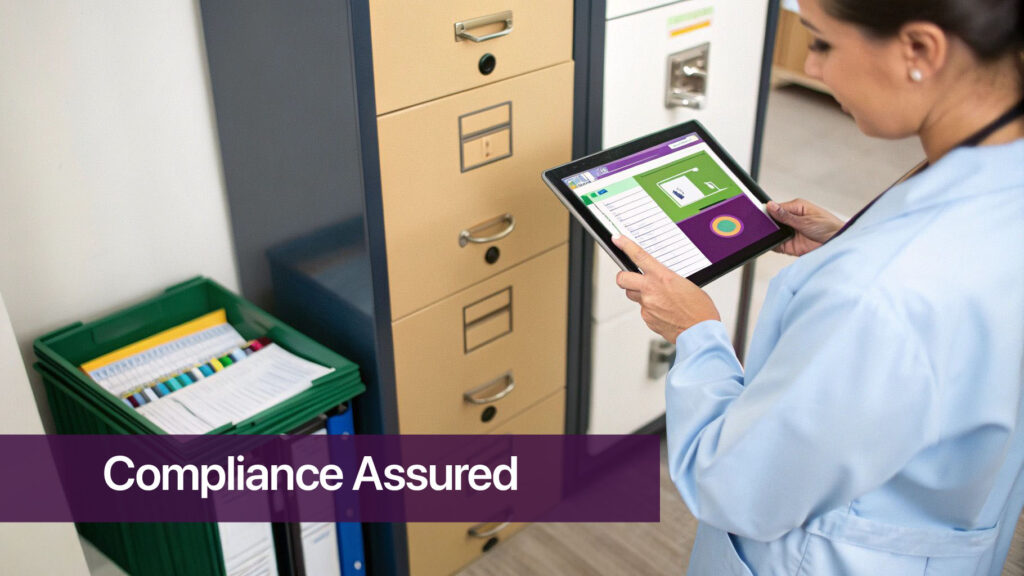 Navigating Compliance When Outsourcing Medical Billing
Handing over sensitive patient data is, without a doubt, the biggest hesitation for any healthcare provider thinking about outsourcing medical billing. Concerns about HIPAA, data breaches, and patient privacy aren’t just valid—they’re non-negotiable.
But there’s a common myth that outsourcing automatically increases your risk. In reality, it’s often the opposite.
Think of it like this: storing cash under your mattress feels safe because you can see it, but a bank vault is exponentially more secure. A specialized billing partner is that bank vault for your patient data. Their security measures are almost always far more advanced than what a private practice can afford to maintain on its own.
The Bedrock of Trust: HIPAA Compliance
For any legitimate billing partner, HIPAA isn’t just a guideline; it’s the foundation of their entire business. A credible firm invests heavily in continuous training, routine audits, and secure infrastructure to protect Protected Health Information (PHI). Their team is made up of specialists in privacy rules, not office managers trying to keep up with changing regulations.
This singular focus ensures every step of the billing cycle—from data entry to claim submission—happens within a secure and compliant framework. It’s their core competency, not an extra chore.
Key Security Credentials to Look For
When you’re vetting a potential partner, don’t just take their word for it. You need to see proof. Certain certifications are clear signs of a company’s dedication to protecting your data.
- SOC 2 Compliance: This audit verifies that a company has rock-solid controls over its systems related to security, availability, confidentiality, and privacy.
- HITRUST Certification: This is a rigorous framework that combines multiple standards, including HIPAA, making it a gold standard for healthcare data protection.
- End-to-End Encryption: This guarantees that all data, whether it’s moving or sitting still, is completely unreadable to anyone without authorization.
These credentials aren’t just fancy badges; they show that an independent third party has audited and signed off on their security.
A top-tier billing partner doesn’t just meet compliance standards—they build their entire operational culture around them, turning security into a core business function.
Actionable Questions for Vetting Billing Partners
To make an informed decision, you need to ask pointed questions that get to the heart of a vendor’s security capabilities. Go beyond a simple “Are you HIPAA compliant?” and dig deeper. To ensure your outsourced medical billing operations remain secure, understanding robust third-party risk management is crucial, as detailed in this guide on Mastering Third-Party Risk Management for Billing Partners.
Here are some critical questions to get you started:
- What are your specific protocols for a data breach response and disaster recovery?
- How often do you conduct third-party security audits and risk assessments?
- What kind of HIPAA training do your employees receive, and how frequently is it updated?
- Can you walk me through the physical and digital security measures at your facilities and on your networks?
A professional, confident partner will have clear, detailed answers ready to go. Their transparency is a direct reflection of their security maturity. By choosing a partner with a proven security framework, like a HIPAA-compliant call center, you’re not adding risk—you’re adding a powerful layer of protection to your practice.
Nearshore vs. Offshore: The Strategic Choice for Outsourcing Medical Billing
Let’s be clear: not all outsourcing medical billing partners are cut from the same cloth. When practices start looking for help, they usually run into two big categories: offshore and nearshore. While both mean handing off the work to another company, where that company is located makes a world of difference for your practice’s day-to-day operations and your bottom line.
Offshore outsourcing usually means you’re working with a team in a faraway place like India or the Philippines. Nearshore, on the other hand, keeps your partners right in our backyard, in countries like Mexico. This isn’t just a geography lesson—it’s a strategic choice that directly impacts how well your team communicates, how efficiently you get paid, and how your patients are treated.
Time Zones and Proximity: Why Being Close Matters
One of the biggest wins with a nearshore partner is simply being in the same time zone, or one very close to it. For any healthcare practice in North America, this is a game-changer. It gets rid of those frustrating 24-hour delays you often find with offshore teams, where a simple question asked on Monday afternoon doesn’t get an answer until Tuesday.
Suddenly, real-time collaboration isn’t a luxury; it’s just how you work.
When your billing team is on the clock at the same time as your clinical staff, urgent problems get fixed in minutes, not days. That seamless flow is the secret to a healthy revenue cycle.
Think about it. A clinic in California has an urgent claim denial that needs to be sorted out before 5 PM. With a nearshore team in Tijuana, the office manager can just pick up the phone and talk to the exact person handling that account. That kind of immediate access crushes bottlenecks and keeps the cash flowing.
The Power of Bilingual Teams and Cultural Understanding
Great communication in medical billing goes beyond just swapping data. It’s about getting the little things right, both with your own staff and, just as importantly, with your patients. Nearshore partners in Mexico have a natural cultural connection to the U.S., which helps cut down on misunderstandings and creates a much smoother, more intuitive partnership.
Even better, a bilingual team is a massive advantage. Having specialists fluent in both English and Spanish means they can talk shop with your English-speaking staff and then turn around and compassionately handle a billing question from a Spanish-speaking patient. This isn’t something most offshore locations can replicate with the same level of cultural fluency. For practices in North America, really grasping the nearshore advantage is key to finding a partner who feels like a true extension of your team.
Your Nearshore Vendor Selection Checklist
Picking the right nearshore partner is everything. The goal is to find a company that feels less like a vendor and more like they’re part of your own office. Use this simple checklist to vet your options and find a firm that’s genuinely aligned with your practice.
- Proven Industry Experience: Have they worked with practices like yours before? Don’t be afraid to ask for specific case studies and to speak with current clients in your specialty.
- Transparent Pricing Models: They should be able to clearly walk you through their fee structure. Whether it’s a percentage of collections or a flat monthly fee, there should be zero surprises.
- Robust Reporting and Analytics: A good partner gives you access to a clear, easy-to-read dashboard. You should be able to see key metrics like claim status, denial rates, and other KPIs in real time.
- HIPAA Compliance and Security: This is non-negotiable. Ask about their security credentials (like SOC 2 compliance) and get specific about how they protect patient data.
- Scalability and Flexibility: Can they grow with you? Ensure they can easily scale their services up or down as your practice’s needs change over time.
Your Roadmap for a Smooth Transition to Outsourcing Medical Billing
Making the switch to an outsourced billing model can feel like a massive undertaking. But a successful transition isn’t about flipping a switch and hoping for the best; it’s a controlled, phased process managed by an expert partner. A solid roadmap breaks the journey into clear, manageable steps, ensuring your practice is supported at every stage.
The goal is to make the entire implementation feel less like a leap of faith and more like a carefully planned project. With the right partner, you aren’t just handed a new system—you’re guided through a strategic rollout designed to minimize disruption and get you results from day one.
The Phased Implementation Process
A smooth transition for outsourcing medical billing always follows a logical sequence. Each phase builds on the last, making sure all the systems, processes, and people are aligned before the official “go-live.” This structured approach helps you sidestep common pitfalls and sets the foundation for a strong, long-term partnership.
- Discovery and Goal Setting: This is where it all starts. Your new partner sits down with you to truly understand your practice’s specific pain points, workflows, and financial goals. Are you trying to slash your Days in A/R, cut denial rates, or simply free up your staff? This is where you define clear, measurable objectives together.
- Vendor Due Diligence and Contracting: After picking a partner, this phase is all about finalizing the service level agreement (SLA). This legal document outlines everything: responsibilities, performance expectations, security protocols, pricing, and the key performance indicators (KPIs) you’ll be tracking.
- System Integration and Data Migration: Now the technical teams get to work, connecting the billing partner’s systems with your existing Electronic Health Record (EHR) software. A skilled partner ensures this is a seamless process, securely migrating patient data and old billing records without interrupting your daily operations.
- Team Training and Workflow Alignment: Your in-house staff gets trained on any new processes. This is crucial for clarifying who does what—for example, how the front desk will pass new patient info to the billing team—and making sure everyone is on the same page.
- Go-Live and Performance Monitoring: Once everything is in place, the new system is officially live. From here on out, the focus shifts to tracking performance against the goals you set back in the discovery phase.
The following infographic really drives home the strategic advantages of a nearshore collaboration model, highlighting how things like time zone and cultural alignment can streamline this entire transition.

As you can see, a nearshore model naturally supports a smoother transition because of real-time communication and shared cultural context—two things that are absolutely vital during implementation.
Key Performance Indicators You Must Track
You can’t improve what you don’t measure. A transparent billing partner will give you access to a dashboard to monitor critical KPIs, giving you constant visibility into your practice’s financial health.
A successful outsourcing partnership isn’t about giving up control; it’s about gaining unprecedented clarity into your revenue cycle through robust data and expert analysis.
Here are the essential metrics you need to be watching:
- Days in Accounts Receivable (A/R): This tells you the average number of days it takes to collect payments. A lower number means faster cash flow for your practice. Simple as that.
- Clean Claim Rate (CCR): This is the percentage of claims accepted by payers on the very first submission. A high CCR (you should be aiming for 95% or more) is a direct indicator of accuracy and efficiency.
- Net Collection Rate (NCR): This KPI shows what percentage of reimbursement you actually collect out of the total amount you’re contractually allowed. It’s the ultimate measure of how effective your billing really is.
By focusing on this roadmap and keeping a close eye on these KPIs, the transition to outsourcing medical billing becomes a controlled, predictable process that puts your practice on a clear path to financial strength.
FAQs: Your Questions on Outsourcing Medical Billing Answered
It’s totally normal to have questions before making a big change to your practice’s financial operations. Let’s face it, handing over your billing is a major decision. Here are the straight answers to the questions we hear most often.
How Much Does Outsourcing Medical Billing Cost?
The most common setup is the percentage-of-collections model. Your billing partner takes a cut of the revenue they successfully bring in for you, which usually lands somewhere between 4% to 8% of net collections. We love this model because it means our success is tied directly to yours—we only get paid when you do.
You might also see other structures:
- Flat-Fee-Per-Claim: You pay a set price for every single claim filed. It’s predictable, but it can get pricey if you have a high claim volume.
- Hybrid Models: This is a mix, usually a lower percentage fee plus a small flat fee for each claim.
The right model really comes down to your practice’s size, specialty, and how many claims you’re processing each month.
Will I Lose Control Over My Billing Process?
That’s a common fear, but the reality is often the complete opposite. A good partner gives you more visibility, not less. Modern billing firms provide access to real-time reporting dashboards where you can see everything—from the status of a claim to denial rates and payment postings.
Think of it this way: instead of managing people and piles of paperwork, you’re managing performance through clear, actionable data. It actually gives you a much higher level of strategic control over your revenue cycle.
How Long Does the Transition Process Take?
Getting everything switched over and running smoothly typically takes between 30 to 90 days. The exact timeline depends on a few things, like the complexity of your practice, the size of your patient database, and how easily the new system can integrate with your current Electronic Health Record (EHR).
Can a Nearshore Provider Handle My Complex Specialty?
Absolutely, as long as you pick the right one. The trick is to find a nearshore partner with proven, hands-on experience in your specific field, whether that’s cardiology, orthopedics, or mental health. Always ask potential vendors for case studies and references from practices in your specialty. A partner who’s already been in the trenches will know the unique coding challenges and payer rules for your services right out of the gate.
Choosing a HIPAA-compliant call center often provides stronger protection than in-house operations.
FAQs: Outsourcing Medical Billing
1. How much does outsourcing medical billing cost?
Most providers charge 4%–8% of net collections, aligning incentives with performance.
2. Will I lose control of my billing?
No. You gain visibility through dashboards, KPIs, and reporting.
3. Is outsourcing medical billing HIPAA compliant?
Yes—when working with certified, audited partners.
4. How long does implementation take?
Typically 30–90 days, depending on practice size and EHR complexity.
5. Can outsourcing handle specialty practices?
Yes. Many partners specialize in cardiology, orthopedics, mental health, and more.
6. What KPIs should I track?
Days in A/R, clean claim rate, denial rate, and net collection rate.
7. How does outsourcing reduce denials?
Through certified coding, payer rule monitoring, and proactive appeals.
8. Is nearshore better than offshore?
For North American providers, nearshore offers better communication and compliance alignment.
9. Can outsourced teams work with my EHR?
Yes. Most integrate seamlessly with major EHR and practice management systems.
10. When should a practice outsource billing?
If denial rates are rising, A/R is stagnant, or staff is overwhelmed—now is the right time.
Ready to Take Control of Your Revenue Cycle?
CallZent delivers secure, nearshore medical billing outsourcing that improves collections, reduces costs, and keeps your team focused on patient care.
Ready to finally get a real handle on your revenue cycle? At CallZent, we offer specialized, nearshore medical billing that cuts costs and boosts collections, so you can get back to focusing on your patients. Learn how our expert teams can support your practice’s financial health.