Skip to content
Call Center IT Insights
Outsourcing Nearshore: The Smart Choice for Scaling Customer Support
Discover why nearshore outsourcing strikes the perfect balance—cost efficiency, cultural alignment, and real-time collaboration—helping businesses scale support without sacrificing quality.
📌 TL;DR — Why Nearshore Outsourcing Works
- The Best of Both Worlds: Combines cost savings with cultural and time-zone alignment.
- Real-Time Collaboration: Minimal time difference enables instant communication and faster resolution.
- Cultural Connection: Shared values and familiarity create smoother customer interactions.
- Top Talent Access: Skilled bilingual professionals at significantly lower costs than domestic hiring.
- Smart Savings: 30–50% cost reduction compared to onshore, without offshore communication gaps.
Is your business trying to scale customer support without sacrificing quality or breaking the bank? For years, the only options seemed to be paying premium prices for an in-house team or rolling the dice with an offshore partner halfway around the world. But smart leaders are now embracing a powerful middle ground: outsourcing nearshore. This strategic approach delivers the perfect blend of cost-efficiency, cultural alignment, and real-time collaboration that modern businesses need to thrive.
Think of it this way: it’s the difference between working with a team in a neighboring city versus one on a completely different continent. With a nearshore partner, communication is instant, cultural nuances are understood, and your outsourced team truly feels like an extension of your own.
Why Businesses Are Choosing Nearshore Outsourcing

The conversation around outsourcing has fundamentally changed. For years, the primary driver was slashing costs, which often pushed companies to partners halfway across the globe. While this offshore model saved money upfront, it frequently came with hidden costs: frustrating communication breakdowns, significant time zone delays, and cultural gaps that ultimately damaged the customer experience.
Today, the strategy has shifted. The focus is now on a more balanced approach where value, agility, and customer satisfaction are just as critical as the bottom line. This is precisely where nearshore outsourcing excels, especially for customer-facing operations like call centers.
The Strategic Shift to Proximity and Value
So, what exactly is nearshore outsourcing? It simply means partnering with a service provider in a neighboring country that shares similar time zones and cultural values. For a U.S. company, this means working with a team in a location like Mexico or Colombia instead of the Philippines or India.
This seemingly small geographical adjustment makes a massive difference in day-to-day operations. Instead of waiting overnight for an answer to a simple question, your teams can collaborate in real-time. For example, if a customer has a complex billing inquiry, a nearshore agent can instantly connect with your internal finance department to resolve it on the first call. That immediate feedback loop is a game-changer for solving customer problems efficiently and maintaining high quality standards.
The real win with nearshore isn’t just about saving a few bucks. It’s about gaining a responsive, culturally-aligned extension of your own team that works when you do.
And the data supports this shift. The nearshore market is booming, particularly in regions like Latin America, which has seen a 20% jump in popularity. Companies report 90% better outcomes with their nearshore teams compared to offshore partners, achieving an impressive 80% project success rate versus the 60% average for offshore models.
In this guide, we’ll break down exactly how this model works, why it’s gaining so much momentum, and how you can leverage it to build a stronger, more effective customer support operation that gives you a true competitive advantage.
Comparing Onshore, Nearshore, and Offshore Models
Choosing an outsourcing model isn’t just about finding the lowest price—it’s a strategic decision that must align with your business goals. When it comes to locating your customer support, you have three primary paths: onshore, offshore, or the strategic middle ground of outsourcing nearshore. Each comes with its own distinct advantages and trade-offs.
Let’s explore them with a practical call center scenario. Imagine a customer calls with a complex technical issue that requires escalation to your internal engineering team. How each outsourcing model handles this situation reveals everything you need to know.
The Onshore Model: Keeping It Local
Onshore outsourcing means partnering with a call center within your own country. For a company based in California, this could mean working with a provider in Texas or Ohio.
The primary benefit is a seamless cultural and linguistic connection. Your agents and customers are on the same page, understanding local idioms and cultural references, which often leads to exceptionally smooth customer interactions. In our scenario, the onshore agent can collaborate effortlessly with the engineering team during the same business hours.
However, this premium experience comes at a premium price. You’re paying domestic wages and dealing with higher operational costs, making it a challenging model to scale for budget-conscious businesses.
The Offshore Model: Maximizing Cost Savings
Offshore outsourcing involves partnering with a provider in a distant country, typically one with significantly lower labor costs. A common example is a U.S. company setting up its call center in the Philippines or India.
The main driver here is cost reduction. You can achieve savings of 50% or more compared to an onshore model. This budget relief can enable companies to offer 24/7 support that would otherwise be financially unfeasible.
But these savings often come with challenges. A 10-12 hour time difference means our customer’s technical issue might not be seen by the engineering team until the next business day, leading to frustrating delays. Cultural and language gaps can also lead to misunderstandings that negatively impact customer satisfaction.
Outsourcing Nearshore: The Strategic Balance
This is where nearshore outsourcing provides a brilliant balance. It means partnering with a provider in a neighboring country, such as a U.S. business teaming up with a call center in Mexico or Colombia.
With nearshore, you gain significant cost savings over the onshore model while avoiding the major drawbacks of offshore. Because your nearshore partners operate in similar or identical time zones, real-time collaboration is simple and effective.
When a customer has an urgent problem, a nearshore agent can hop on a quick call with your in-house team and get it solved right then and there. No waiting overnight for an email response.
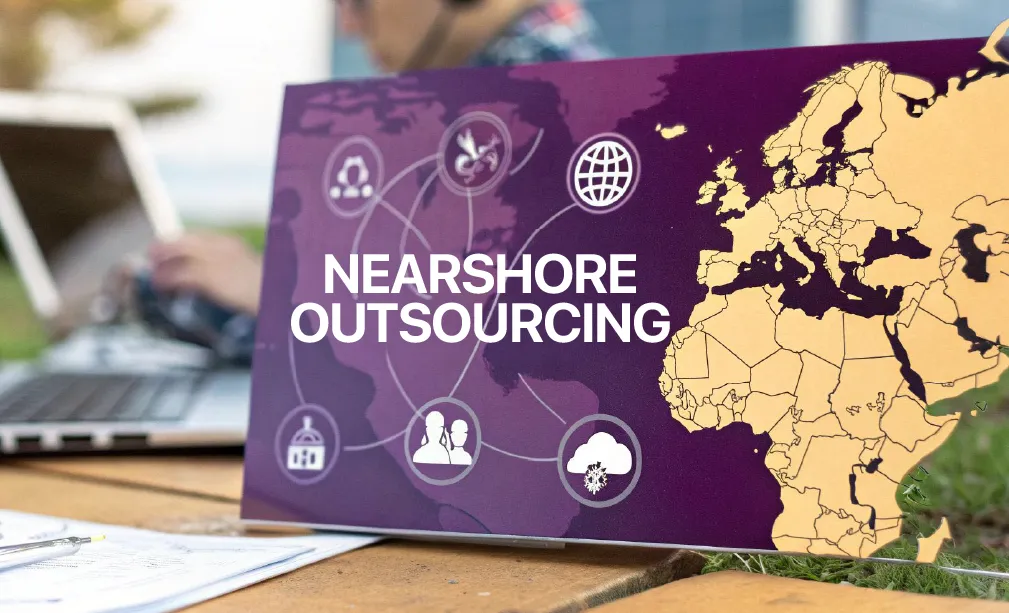
This infographic highlights why the nearshore model is such a compelling option for businesses that demand both quality and efficiency.
As you can see, factors like real-time collaboration and cultural familiarity aren’t just nice-to-haves; they directly contribute to better business outcomes. For companies looking to build a truly integrated and high-performing support team, that synergy is a game-changer. For a deeper look into how we achieve this, explore CallZent’s approach to custom-fit BPO solutions.
Comparison of Outsourcing Models: Onshore vs. Nearshore vs. Offshore
To make the decision clearer, let’s compare these three models side-by-side across the factors that matter most for a call center operation.
| Factor | Onshore Outsourcing | Nearshore Outsourcing | Offshore Outsourcing |
|---|---|---|---|
| Cost | Highest | Moderate (30-50% less than onshore) | Lowest (Often 50%+ less than onshore) |
| Time Zone | Identical | Minimal Difference (0-3 hours) | Significant Difference (8-12+ hours) |
| Communication | Seamless, no barriers | High, minimal language/cultural gaps | Potential for significant barriers |
| Cultural Affinity | Perfect alignment | Strong alignment and familiarity | Low alignment, potential for friction |
| Talent Pool | High quality but expensive | Skilled, bilingual, and cost-effective | Large but variable skill levels |
| Travel & Visits | Easy and inexpensive | Quick and affordable flights | Long, complex, and expensive |
So, what’s the verdict?
The best choice depends on your priorities. If budget is no issue and you require a perfect cultural match, onshore is the way to go. If cost reduction is your absolute top priority and you have robust systems to manage communication hurdles, offshore might work.
However, for a growing number of businesses, outsourcing nearshore is the smartest path forward. It delivers the talent, efficiency, and collaborative energy needed to provide an exceptional customer experience without inflating your budget.
Key Benefits of an Outsourcing Nearshore Partnership
Choosing an outsourcing partner is about more than just trimming expenses. A strategic outsourcing nearshore partnership delivers tangible, long-term value that directly enhances your customer experience and makes your business more agile. It’s a move to gain a competitive edge, not just to cut a line item on a spreadsheet. The benefits ripple through your entire customer support operation, from agent performance to your ability to scale effectively.
Seamless Collaboration with Time Zone Synchronization
One of the most immediate and impactful benefits of a nearshore partner is time zone alignment. Unlike offshore models where a 12-hour time difference can bring collaboration to a standstill, nearshore teams operate on a schedule that closely mirrors your own.
This isn’t a minor convenience—it’s a massive operational advantage.
- Real-time problem-solving: Imagine a software company’s customer support agent in Costa Rica needs help from a U.S.-based developer to fix a user’s bug. Because they work the same hours, they can collaborate on a video call and resolve the issue in minutes, not days.
- Integrated team meetings: Your nearshore team can participate in daily stand-ups and weekly planning sessions, ensuring everyone is aligned on goals and priorities.
Time zone alignment transforms your outsourced team from a separate vendor into a truly integrated extension of your business, working in lockstep with your core staff.
Stronger Connections Through Cultural Alignment
Cultural familiarity is another critical advantage of the nearshore model. When your agents understand the subtle nuances, conversational styles, and cultural context of your customers, they build rapport more easily. This shared understanding leads to more empathetic, natural, and successful conversations.
For instance, a nearshore agent in Mexico supporting a U.S. retail brand will naturally understand references to holidays like Thanksgiving or major events like the Super Bowl. This allows for more authentic and relatable conversations, making the customer experience feel personal and genuine—a huge win for building brand loyalty.
Access to a Deep Pool of Bilingual Talent
Nearshore hubs, particularly in Latin America, are rich with highly skilled, educated, and often bilingual professionals. This provides instant access to a workforce that can flawlessly serve both English and Spanish-speaking customers—a critical advantage for any business operating in the North American market.
This talent pool offers several benefits for your call center:
- Scale Quickly: Add skilled agents to your team without the long, expensive recruitment cycles of domestic hiring.
- Maintain High Quality: Tap into a workforce known for a strong work ethic and commitment to excellence.
- Support Diverse Customers: Offer top-tier bilingual support that meets the needs of a broader customer base.
Accessing this level of talent without the premium domestic price tag is a core reason why outsourcing nearshore provides such a strong return on investment.
Significant Yet Smart Cost Advantages
While nearshore outsourcing isn’t solely about money, the financial benefits are undeniable. It offers a smart middle ground, delivering cost savings typically 30-50% lower than onshore options. Crucially, these savings come without the operational headaches and quality risks often associated with offshore models.
This trend extends beyond call centers. Market analysis shows a major shift across industries, with approximately 80% of North American companies now considering nearshore partnerships for IT and software solutions. This is part of a global trend where software development now constitutes 64% of all outsourced services. You can explore the data further in these nearshore market development statistics.
Ultimately, outsourcing nearshore is about achieving superior value. You reduce operational overhead while simultaneously improving collaboration, accessing top talent, and enhancing the customer journey. At CallZent, we specialize in demonstrating how these benefits apply to your unique business needs. See our approach to building custom support solutions.
Finding the Right Outsourcing Nearshore Location
Choosing a nearshore partner isn’t just about selecting a company; it’s about picking the right country. The world of outsourcing nearshore is composed of specialized hubs, each offering unique advantages. The location of your partner can significantly impact collaboration, talent availability, and your overall success.
For any business in North America, Latin America has emerged as the premier destination for nearshore call center services. Countries like Mexico, Colombia, and Costa Rica offer a powerful combination of benefits that align perfectly with the U.S. market.
Latin America: The Top Choice for North American Businesses
The time zone alignment is a primary advantage. Most of the region overlaps directly with U.S. business hours, eliminating late-night calls and frustrating communication delays. It fosters a sense of a single, unified team. Furthermore, Latin America boasts a massive, highly skilled talent pool fluent in both English and Spanish—a game-changer for serving a diverse customer base.
Consider a U.S. e-commerce brand preparing for its busiest holiday season. By partnering with a call center in Tijuana, Mexico, they can onboard bilingual agents who inherently understand American consumer culture. These agents can handle everything from customer inquiries to order processing in real-time during peak hours because they operate on the same schedule. This operational synergy is what makes the region so effective.
Key advantages include:
- Bilingual Excellence: Access a deep well of professionals who are not just fluent but also culturally attuned to both English and Spanish-speaking customers.
- Cost-Effective Talent: Tap into a highly educated and motivated workforce at a fraction of domestic costs.
- Easy Collaboration: Short flight times make site visits and in-person strategy sessions simple and affordable.
Eastern Europe: A Powerhouse for European Companies
Meanwhile, for companies based in Europe, the nearshore landscape looks different. Eastern European countries like Poland, Romania, and Bulgaria have become dominant players, offering a compelling set of benefits tailored to the EU market. They feature a multilingual, highly educated workforce that is well-versed in Western business practices.
The secret to great nearshoring is finding a location that feels like a natural extension of your home office, both culturally and operationally.
By 2025, the global lines for outsourcing nearshore have been clearly drawn. For UK and EU businesses, Eastern Europe is the ideal fit. Time zone differences are minimal (usually just one or two hours), and you’ll find a workforce with stellar English skills. This strategic advantage is something experts highlight in the complete guide to nearshore outsourcing.
These hubs also offer robust data security, with many providers being fully GDPR compliant—a non-negotiable requirement for handling European customer data. Understanding these regional strengths allows you to make a smarter choice and find a partner perfectly positioned to help you grow. Check out our insights on building the ideal nearshore team to see just how much location can impact performance.
How to Implement Your Nearshore Strategy
Embarking on a nearshore partnership without a clear plan is a recipe for failure. A successful launch is the result of a deliberate strategy that guides you from concept to execution. We’ve broken the process down into four essential stages to help you build a solid foundation for a powerful, long-term collaboration.
1. Define Your Goals and KPIs
Before you start searching for a partner, you must know what success looks like. Vague goals like “improve customer service” are not enough. You need to define specific Key Performance Indicators (KPIs) that will measure the effectiveness of your nearshore operation.
Start by asking targeted questions:
- What problems are we solving? (e.g., High call abandonment rates, long wait times impacting CSAT scores, insufficient bilingual support).
- What are our primary goals? (e.g., Reduce operational costs by 30%, increase First Call Resolution to 85%, achieve a Customer Satisfaction score of 9.5/10).
- How will we measure success? (e.g., Daily performance dashboards, weekly KPI reviews, monthly business check-ins).
Setting these benchmarks upfront provides a clear scorecard from day one. If your goal is to reduce average handle time, you can track it meticulously. For guidance on setting up effective tracking, resources like the guide on analytics implementation for developers can show how to structure your data correctly.
2. Find the Right Nearshore Partner
With your goals defined, it’s time to find the right partner. This requires thorough due diligence. Don’t let price be your only criterion. Investigate their industry experience, security protocols, and—most importantly—their cultural fit with your company.
Your vetting process should include:
- Requesting Client References: Speak with their current or former clients to get an unfiltered account of their performance.
- Reviewing Case Studies: Ask for examples of how they’ve helped companies similar to yours solve comparable challenges.
- Assessing Security and Compliance: Verify their certifications, such as SOC 2 or ISO 27001, to ensure your data will be protected.
- Evaluating Their Training Program: Understand their process for training agents on your brand, products, and systems.
A great nearshore partner doesn’t just act like a vendor; they act like an extension of your team. Look for a provider who is as invested in your success as you are.
3. Manage the Transition Seamlessly
Once you’ve selected your partner, the real work begins. A successful transition depends on crystal-clear communication and comprehensive training. A well-managed onboarding process is the difference between a smooth launch and chaos.
Develop a detailed transition plan with key milestones and responsibilities. This plan should include a hands-on training schedule to familiarize the nearshore team with your tools and products. Establish daily communication channels, like a shared Slack channel or brief stand-up meetings, from the very first day to foster a sense of one cohesive team.
4. Build a True Partnership for the Long Term
The final stage is ongoing. It’s about cultivating a genuine, collaborative partnership. Your nearshore team should not feel like outsiders. Treat them as part of your company.
Include them in company updates, celebrate their successes, and provide regular, constructive feedback. This approach builds loyalty and motivation. When your nearshore team feels valued, they become passionate advocates for your brand, turning a simple service agreement into a strategic asset that fuels sustainable growth.
FAQs: Your Questions on Outsourcing Nearshore Answered
Transitioning to a nearshore model is a significant business decision, and it’s natural to have questions. Getting clear, practical answers is crucial for making the right choice for your company. Let’s address some of the most common inquiries we receive about outsourcing nearshore.
What is the real cost difference between nearshore and offshore?
While offshore rates may appear lower on paper, they often don’t reflect the total cost of ownership. Nearshore outsourcing consistently delivers better overall value.
You can typically expect nearshore rates to be 30-50% lower than those of an onshore team. The true financial advantage, however, comes from avoiding the hidden costs that frequently accompany offshore partnerships. With a nearshore model, you benefit from:
- Minimal time zone complications.
- Natural cultural alignment.
- Higher agent retention rates.
These factors contribute to a smoother operation, lower total costs, and superior results, making nearshore the smarter long-term financial decision.
How is data security handled with a nearshore partner?
Data security is a non-negotiable priority for any reputable nearshore provider. The best partners demonstrate their commitment by adhering to rigorous international standards.
When vetting a provider for outsourcing nearshore services, demand proof of their security posture. Look for key certifications that validate their data protection practices:
- SOC 2: Confirms they have effective controls in place to safeguard client data.
- ISO 27001: The global benchmark for information security management.
- GDPR / CCPA Compliance: Essential for handling customer data from Europe or California.
The geographical proximity of nearshore partners is also an advantage, as their legal frameworks and data privacy regulations are often similar to those in the U.S., simplifying compliance.
A trustworthy nearshore partner doesn’t just promise security; they prove it with globally recognized certifications and transparent protocols that protect your business and your customers.
What does the onboarding process for a nearshore team look like?
A structured and efficient onboarding plan is key to integrating your new team and ensuring they perform from day one. While each partnership is customized, the process generally follows a clear path.
It begins with a deep-dive discovery phase where your partner learns about your brand, goals, and specific needs. Next, they handle recruitment, selecting agents who are an ideal fit for your company culture. Once the team is assembled, they undergo intensive training on your products, systems, and brand voice.
Typically, this entire process takes approximately 4-6 weeks. This timeline ensures that from their very first customer interaction, your new agents are fully prepared to represent your brand with the same level of expertise and care as your in-house team.
FAQs: Your Questions on Outsourcing Nearshore Answered
What is the real cost difference between nearshore and offshore?
While offshore rates may appear lower on paper, they often don’t reflect the total cost of ownership. Nearshore outsourcing consistently delivers better overall value.
How is data security handled with a nearshore partner?
Reputable nearshore providers follow strict international standards (SOC 2, ISO 27001, GDPR/CCPA) to protect customer data. CallZent is actively preparing for SOC 2 compliance as part of its commitment to security.
What does the onboarding process for a nearshore team look like?
Typically 2-6 weeks: discovery → recruitment → training → go-live. The process ensures agents are fully prepared to represent your brand from day one. (In some cases we can get everything setup in 1-2 weeks)
Why Trust CallZent?
- Located in Tijuana & Hermosillo, Mexico (nearshore advantage for U.S. clients).
- Specializing in bilingual (English-Spanish) customer support.
- Commitment to compliance (SOC 2 readiness, data security policies).
- Trusted by clients across retail, insurance, solar, legal, and SaaS industries.
Ready to see how a nearshore strategy can directly benefit your business? At CallZent, we specialize in creating custom-fit call center solutions that reduce costs while elevating your customer experience. Let’s build your ideal team together.
👉 Discover CallZent’s Nearshore Solutions
Ready to scale your customer support with CallZent? Let’s build your nearshore team today. Schedule a consultation here. Book 30 minute meeting.
Need a quote? Get one here