Skip to content

PROPERTY MANAGEMENT / OUTSOURCING
Property Management Outsourcing Guide
for Nearshore BPO Selection
Learn how property management outsourcing works, which functions to outsource, how to choose a nearshore bilingual BPO partner, and how to launch a low-risk pilot.
TL;DR — Quick Takeaways
- Outsource repeatable work: Tenant support, maintenance coordination, leasing admin, and back-office tasks.
- Protect team focus: Internal staff should prioritize revenue-driving and strategic work.
- Improve response coverage: Avoid missed calls and inconsistent follow-through.
- Scale without chaos: Build structured processes, not just headcount.
Your portfolio can grow faster than your operations. That sounds like a good problem until leasing paperwork piles up, maintenance calls hit after hours, vendors need updates, and someone still has to reconcile payments correctly.
At this point, property management outsourcing becomes useful. Not as a shortcut, and not as a way to hand off responsibility, but as a way to build capacity without forcing your internal team to carry every routine task themselves.
Is Your Property Portfolio Outpacing Your Operations?
A familiar scene plays out in growing property teams. One person is answering resident calls at night. Another is chasing maintenance updates the next morning. Lease files sit in one system, invoices in another, and accounting gets cleaned up at month end under pressure.

This strain is not happening in a small niche. The U.S. property management services market reached USD 122.02 billion in 2025 and is projected to grow to USD 184.25 billion by 2033, representing a CAGR of 5.4%, driven by rental demand as homeownership becomes less affordable, according to Grand View Research’s U.S. property management services market report.
The problem is not growth itself. The problem is unmanaged complexity.
TLDR for busy property managers
- Outsource repeatable work: Tenant support, maintenance coordination, leasing admin, and back-office tasks do not always need in-house handling.
- Protect team focus: Internal staff should spend more time on owner relations, renewals, acquisitions, and portfolio strategy.
- Improve response coverage: A structured outsourced team can help you avoid missed calls, delayed updates, and inconsistent follow-through.
- Scale without chaos: Good outsourcing gives you process discipline, not just extra hands.
Key takeaway: Property management outsourcing works best when it restores control, not when it moves work somewhere else.
What operational overload looks like in practice
A small operator may start with a manageable portfolio, then add units quickly. At first, everyone improvises. That works for a while.
Then the cracks show:
- After-hours strain: Emergency calls land on the owner or property manager directly.
- Admin drag: Lease packets, renewals, notices, and payment records eat into the workday.
- Vendor bottlenecks: Maintenance updates depend on whoever remembers to follow up.
- Resident frustration: Tenants do not judge your org chart. They judge whether someone answered and solved the issue.
Teams often wait too long to fix this because outsourcing sounds like a loss of control. In reality, the opposite can be true when the operating model is designed properly. A partner becomes an extension of your team, with defined workflows, reporting, and accountability.
If you are evaluating what that kind of support looks like, the background on CallZent’s approach and operating model helps frame what a nearshore BPO relationship is supposed to look like.
What is Property Management Outsourcing Really?
The simplest way to think about property management outsourcing is this. You are not handing your business to someone else. You are assigning clearly defined operational work to a specialized external team that runs inside your rules, systems, and service standards.
That distinction matters.
A lot of property managers hear “outsourcing” and picture a disconnected vendor reading scripts with no context. That is a bad setup. Modern property management outsourcing is closer to building a remote department for specific functions you do not need to staff fully in house.
It is an operating model, not just a labor decision
Outsourcing can cover one function or several. Some firms start with overflow calls and after-hours support. Others expand into leasing administration, maintenance coordination, or financial support.
Three-quarters of property management companies reported increases in labor, insurance, and materials costs, and 63% planned to raise rents or fees in 2025 to compensate, according to Buildium’s 2025 property management industry trends. Those cost pressures explain why more operators are rethinking who should do what internally.
Two common ways teams use property management outsourcing
Functional outsourcing
This is the lower-risk starting point.
You keep leadership, resident policy, owner communication, and local decision-making in house. The outside team handles defined tasks such as:
- Inbound tenant support
- Maintenance intake and dispatch coordination
- Lease document prep
- Payment follow-up
- Reporting support
This model works well when your systems are decent but your team is overloaded.
Extended team outsourcing
This model is broader. The provider acts like a managed support layer across front-office and back-office work. It can include phone coverage, email handling, CRM updates, document workflows, and reporting.
For many operators, benefits compound here because tasks stop falling between departments.
A good outsourced team should feel less like a vendor and more like a specialized branch office with tighter process discipline.
Why skeptical operators end up using it anyway
Property managers do not outsource because it sounds trendy. They do it because the alternatives are worse.
Common triggers include:
- Managers doing admin work instead of revenue work
- Inconsistent resident communication
- Slow vendor follow-up
- Difficulty hiring bilingual support
- Backlogs in paperwork and reporting
If you want a clean primer on the broader model itself, this overview of what business process outsourcing is provides the business context behind the property management use case.
The strategic value is simple. Your internal team keeps the high-judgment work. The outsourced team handles high-volume execution with structure.
Weighing the Strategic Benefits Against Potential Risks
Property management outsourcing has real advantages. It also has real failure modes. Both need to be discussed plainly.
The upside is easy to see when a portfolio is growing. Calls get answered. Work orders are logged consistently. Lease documents move faster. Internal teams stop spending their best hours on repetitive admin.
The downside appears when the partner is a poor fit. Then you get slow communication, weak follow-through, scattered reporting, and the uncomfortable feeling that your team no longer knows what is happening.
The biggest risk in outsourcing is not the model itself. It is choosing the wrong partner.
Where property management outsourcing offers significant advantage
The benefits are strongest in four areas.
Coverage
Residents call when they call. Pipes do not wait for office hours. Vendors need updates when jobs change. An outsourced support function gives you steadier coverage across phone, email, and workflow tasks.
Scalability
A portfolio rarely grows in a neat, predictable line. New units, new markets, or seasonal leasing spikes create uneven demand. Outsourcing lets you add operational support without rebuilding your org chart every time.
Specialized execution
Teams need people who can handle tenant communication, admin accuracy, reporting discipline, and bilingual interactions. That combination is difficult to hire for repeatedly, especially when your core team is already stretched.
Leadership focus
Every hour a senior property manager spends chasing a maintenance callback is an hour not spent on retention, owner reporting, portfolio growth, or process improvement.
The risks are real, and they are usually operational
The standard objections are not irrational.
- Loss of control: You worry decisions will get made without enough visibility.
- Communication gaps: Updates arrive late, or key context gets lost.
- Quality inconsistency: The outsourced team may follow the script but miss the underlying issue.
- Brand mismatch: Residents feel like they are talking to a generic call center, not your company.
These are not reasons to avoid outsourcing. They are reasons to design it carefully.
 Why nearshore usually solves problems that offshore can create
For North American property teams, the nearshore model is more practical because the work depends on fast communication and close coordination. Shared workdays matter. Cultural alignment matters. English and Spanish fluency matter.
According to RentLife’s discussion of outsourcing trade-offs in property management, nearshore bilingual BPO providers can reduce communication challenges and loss of control by 40 to 60 percent compared to offshore options because of proximity, cultural alignment, and real-time collaboration.
That tracks with what operators experience on the ground. If your internal team can reach the outsourced team during the same business day, review issue queues together, and adjust priorities in real time, the relationship feels manageable. If there is a long delay between request and response, small problems turn into resident complaints.
Nearshore support is not valuable because it is near. It is valuable because your team can work together in real time when priorities change.
What works and what does not
A few patterns show up consistently.
| Approach | What happens |
|---|---|
| Clear workflows with named owners | Fewer dropped requests and better visibility |
| Shared systems and daily reporting | Faster escalation and easier supervision |
| Bilingual tenant-facing support | Better resident experience in mixed-language markets |
| Cheap vendor chosen on price alone | Confusion, rework, and strained internal trust |
| No process documentation | Outsourced staff improvise, quality falls |
| No service boundaries | Everyone assumes someone else owns the task |
A nearshore partner should not remove your control. It should give your control structure.
Which Property Management Functions Should You Outsource?
Not every task belongs outside your company. High-judgment work, owner relationships, local compliance interpretation, and final decision-making usually stay internal.
The best candidates for property management outsourcing are repeatable, process-driven, communication-heavy tasks that require consistency more than senior executive attention.
Tenant support and communication
This is the first place to start because the pain is obvious. Calls come in at unpredictable times. Residents want answers quickly. The issue may be simple, urgent, or emotional.
Typical outsourced functions include:
- Inbound inquiry handling: Rent questions, office hours, payment directions, portal help, and general policy clarification.
- After-hours call coverage: Capturing emergencies, triaging urgency, and routing serious issues correctly.
- Viewing coordination: Confirming availability, collecting prospect information, and scheduling tours.
- Follow-up communication: Sending reminders, status updates, and appointment confirmations.
A practical example is a mixed-use portfolio where weekday front-desk staff can handle most calls, but evenings and weekends create a backlog. An outsourced team can absorb those contacts, document the issue, and escalate only what requires manager involvement.
Leasing administration and resident file management
Leasing creates a lot of friction because every step has a document trail. Applications come in. Background checks must be ordered and tracked. Lease terms need to be prepared correctly. Renewals have deadlines.
This work is highly structured, which makes it a strong outsourcing fit.
Good outsourcing candidates in leasing
- Application intake and completeness checks
- Background screening coordination
- Document collection and file organization
- Lease packet preparation
- Renewal reminders and scheduling
The key is process mapping. If your in-house team has five different ways of preparing a lease file, outsourcing will expose that inconsistency fast.
Maintenance coordination and vendor follow-up
Maintenance is where many operators lose time. Not because the work is technically hard, but because the communication chain is messy.
A disciplined outsourced team can:
- Log requests consistently
- Categorize urgency
- Dispatch approved vendors
- Track appointment windows
- Follow up for completion notes
- Close the loop with the resident
That does not mean the outsourced partner decides who replaces a roof or approves major capital work. It means they keep the workflow moving so your internal team is not buried in status chasing.
If residents feel ignored during maintenance, the issue is often not the repair itself. It is the silence between updates.
Financial support and reporting workflows
Money processes require more caution, but that does not mean they must stay manual and in house. Support functions around finance are ideal for outsourcing when controls are clear.
Examples include:
- Rent reminder communication
- Payment posting support
- Vendor invoice routing
- Monthly statement preparation support
- Data entry into accounting or property systems
- Document cleanup for audits and reconciliations
Accuracy matters here. Teams that want tighter reporting discipline often pair outsourced support with better dashboards, cleaner naming conventions, and stricter approvals. If you are refining rent and occupancy reporting, this resource on optimizing income through effective rent roll management is a useful companion to workflow redesign.
If your bottleneck is administrative throughput, structured back-office support outsourcing is the most practical place to begin.
Data analytics and predictive support
Property management outsourcing gets more strategic here.
Emerging outsourcing models now include data support for predictive tenant management. According to Second Nature’s review of property management outsourcing benefits, using data analytics to predict lease expiries can reduce vacancies by 15 to 20 percent. For teams that do not want to build this capability internally, a nearshore partner can support the reporting workflows, data cleanup, and operating cadence behind it.
That matters because a lot of portfolios have the raw data. The issue is not data absence. It is data usability.
A partner with property operations experience can help organize:
- Lease expiry tracking
- Renewal risk lists
- Maintenance pattern reviews
- Resident communication queues
- Portfolio exception reporting
What not to outsource first
Some functions should stay with internal leadership until your model is mature.
| Keep internal early on | Why |
|---|---|
| Owner relationship management | Requires trust, nuance, and judgment |
| Final compliance decisions | Needs local legal and policy oversight |
| Capital expenditure approvals | High financial impact |
| Escalated resident disputes | Brand and legal sensitivity |
| Market strategy and acquisitions | Core leadership function |
Good property management outsourcing removes noise. It should not remove accountability.
The Ultimate Checklist for Choosing a Nearshore BPO Partner
Most outsourcing problems begin before launch. They begin during vendor selection, when operators focus on headcount cost and skip the harder questions about fit.
If your portfolio serves residents, vendors, owners, and internal teams across North America, you need more than labor. You need reliable operating compatibility.
Essential Requirements
A nearshore BPO partner should match your business in ways that become visible only after go-live. Can they work in your hours. Can they communicate naturally with residents. Can they function inside your systems. Can they maintain clean process discipline when volumes rise.
This evaluation guide from how to find and vet the best call center outsourcing companies is useful as a broader framework, but property operations require extra scrutiny.
Nearshore BPO vendor selection checklist
| Evaluation Criteria | What to Look For | Red Flags |
|---|---|---|
| Time zone alignment | Same-day overlap for standups, escalations, and workflow reviews | Delayed responses because the team works opposite hours |
| Bilingual proficiency | Natural English and Spanish communication for resident-facing tasks | Scripted language, weak listening skills, awkward escalation notes |
| Property workflow familiarity | Comfort with leasing, maintenance intake, vendor follow-up, and resident communication | Generic contact center experience with no operational context |
| System compatibility | Ability to work inside your PMS, ticketing tools, email platforms, and reporting stack | Reliance on manual copying between systems |
| Quality control | Call reviews, QA scoring, issue tagging, coaching cadence, and documented SOPs | No clear feedback loop or supervisor visibility |
| Data handling discipline | Defined permissions, secure file practices, audit trails, and compliance awareness | Shared logins, ad hoc file transfers, vague security answers |
| Scalability | Clear ramp plan for adding units, markets, or support channels | No training bench or inconsistent staffing plan |
| Implementation method | Structured onboarding, pilot scope, escalation matrix, and reporting plan | “We can start tomorrow” with no discovery work |
| Management transparency | Named account leads, regular reporting, and operational reviews | Hard to identify who owns performance |
| Cultural fit | Communication style that feels natural for your residents and internal staff | Transactional interactions that sound detached |
Questions worth asking in live vendor conversations
Some questions reveal more than a polished sales deck.
- Show me how you document a maintenance issue from intake to closure.
- How do you distinguish urgent, routine, and non-urgent after-hours requests?
- How do supervisors review quality for resident conversations?
- What happens when our process changes next month?
- How do you train agents on our property rules, not just generic call handling?
One practical option for North American operators is a nearshore provider such as CallZent, which offers bilingual call center and back-office support from Tijuana for businesses that need close collaboration across U.S. time zones. The value of a model like that depends less on location alone and more on whether it can plug into your daily operating rhythm.
The right partner does not just answer “yes” to your checklist. They can show you how the work will run on Monday morning.
From Plan to Pilot Your Outsourcing Implementation Roadmap
Most outsourcing launches fail for ordinary reasons. Scope is vague. The handoff is rushed. Nobody agrees on what success looks like. The solution is not complexity. It is sequencing.
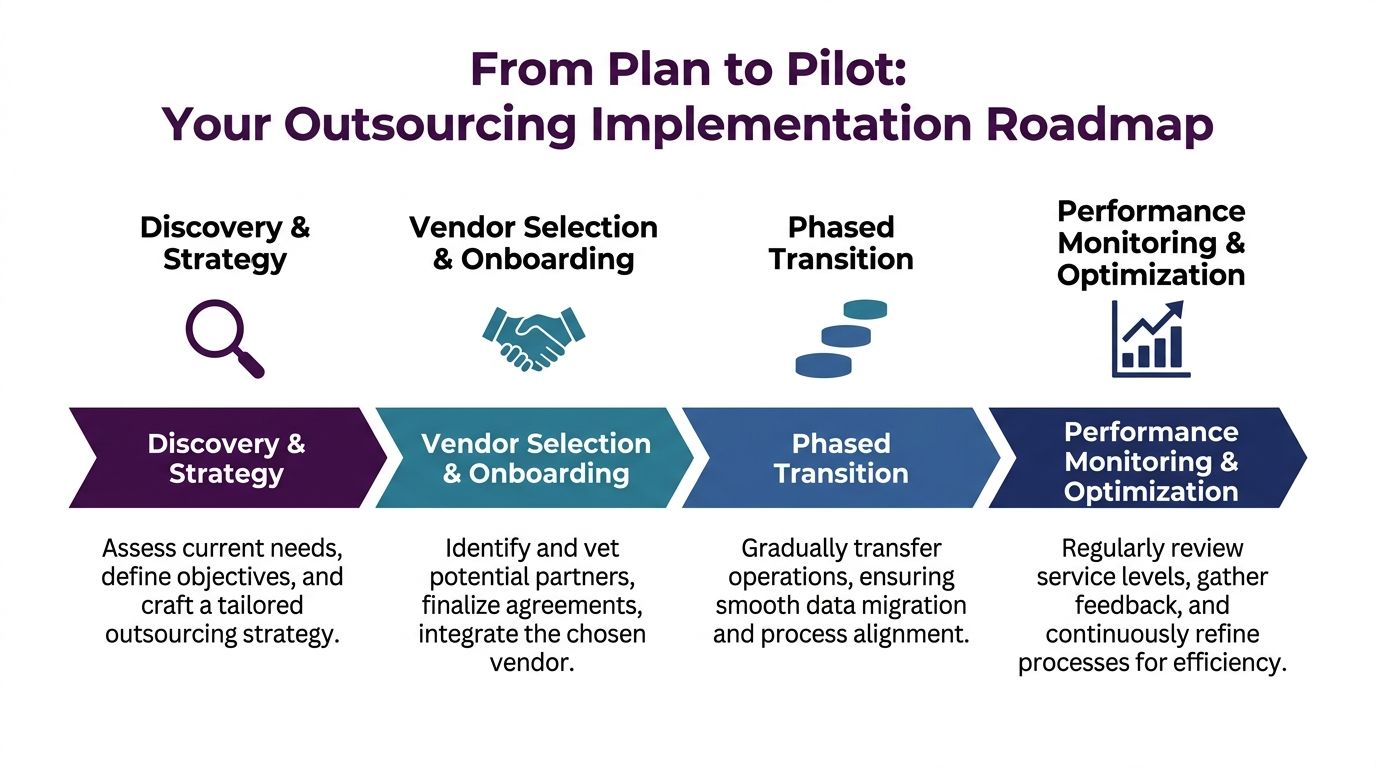
A practical rollout starts small, stays measurable, and expands only after the workflow is stable.
Phase 1 discovery and strategy
Start with one operational problem, not ten.
Examples:
- Missed after-hours calls
- Slow maintenance follow-up
- Lease admin backlog
- Poor documentation consistency
Map the current process as it happens, not as you wish it happened. Identify where requests enter, who touches them, what system records them, and where they stall.
If your team struggles with delegation and role clarity, this guide on how to delegate tasks effectively is useful because outsourcing magnifies weak ownership structures if you do not fix them early.
Phase 2 onboarding and training
During this phase, operational trust is built.
The partner needs:
- Access rules
- Escalation thresholds
- Property-specific FAQs
- Approved vendor lists
- Brand tone guidance
- Examples of good and bad issue handling
Do not train only on scripts. Train on judgment boundaries. Agents need to know what they can solve, what they must document, and what they must escalate immediately.
Phase 3 pilot with a controlled scope
A pilot should be narrow enough to manage but large enough to expose friction.
Good pilot scopes include:
- After-hours support for one property group
- Maintenance intake only
- Lease renewal admin for a single region
- Bilingual inbound support for one portfolio segment
Run the pilot long enough to identify recurring issues in workflow, system permissions, note quality, and escalation speed.
Phase 4 scale and optimize
Once the pilot is stable, expand by function or portfolio segment. Avoid expanding by everything at once.
A clean scale-up adds one of these next:
- More hours of coverage
- More properties
- Another communication channel
- A second workflow such as lease admin or payment support
What to measure from day one
The most useful KPIs are the ones that expose operational reliability, not vanity.
According to Silver Bell Group’s guidance on real estate outsourcing success metrics, critical KPIs include data accuracy in financial reports and lease agreements, response time for tenant inquiries, and first-call resolution rate. It also notes that delays beyond 3 days erode trust, and that 72% of multifamily executives prioritize data integration to support this level of tracking.
That points to a practical scorecard:
| KPI | Why it matters |
|---|---|
| Response time | Residents notice speed before they notice process sophistication |
| First-call resolution | Measures whether issues are being solved, not just acknowledged |
| Data accuracy | Prevents reporting problems, rework, and compliance risk |
| Escalation quality | Shows whether the right issues reach the right people with enough context |
| Resident sentiment | Reveals whether communication feels helpful or transactional |
A pilot succeeds when your internal team trusts the process enough to stop checking every task manually.
Property Management Outsourcing in Action Industry Examples
The fastest way to understand outsourcing is to see where it fits in real operations. Not in theory, but in day-to-day use.
A small residential portfolio that needed nights back
A local operator managing about 50 residential units had the same issue many growing landlords hit. Every evening brought texts, calls, maintenance questions, and lease inquiries. None of those alone were unmanageable. Together, they kept the owner stuck in reaction mode.
The fix was simple. After-hours tenant support and maintenance intake moved to an outsourced team with clear triage rules. Routine issues were logged and queued for the next business day. True emergencies were escalated immediately.
The owner did not lose visibility. They gained a cleaner morning. Instead of waking up to scattered voicemails and half-documented texts, they reviewed one organized queue.
A regional retail portfolio with too much lease admin
A retail company with multiple locations did not think of itself as a property operation. But every site generated leases, vendor invoices, repair coordination, and landlord communication.
The problem was inconsistency. Different locations handled paperwork differently. Deadlines were missed. Payment support became a monthly cleanup project.
They outsourced lease administration support and vendor payment workflow handling. Standardized intake, naming conventions, and tracking made the portfolio easier to manage centrally. The gain was not just efficiency. Leadership finally had a more reliable operating picture.
For teams handling property leads, appointments, or location coordination, support models like real estate appointment scheduling call center services can fit naturally into that structure.
A healthcare provider balancing compassion and operations
A healthcare organization managing transitional housing had a different challenge. Communication quality mattered as much as administrative accuracy. Staff needed residents onboarded properly, follow-up calls documented, and non-clinical communication handled consistently without pulling clinicians into repetitive coordination work.
An outsourced support team took on onboarding calls, recurring check-ins, scheduling coordination, and documentation support. Clinical staff stayed focused on care. The housing workflow became more organized.
This is a good reminder that property management outsourcing is not only for landlords and PM firms. Healthcare, retail, financial services, and multi-site businesses all face similar operational drag when property-related communication and admin work grow faster than internal capacity.
Turn Operational Drag into a Strategic Advantage
Property management outsourcing is often framed as a staffing decision. That is too narrow. Done well, it is an operating decision that gives your team more control over response times, workflow consistency, and portfolio scalability.
The strongest results come from selective outsourcing, not total handoff. Keep judgment-heavy work inside. Move structured, repeatable, communication-heavy tasks to a nearshore team that can work in sync with your staff.
If you are also improving your internal process design, this guide to property management workflow automation is worth reviewing alongside your outsourcing plan. Better automation and better outsourcing support the same goal, which is reducing manual friction without losing oversight.
The ultimate test is simple. At the end of a month, does your team have more clarity, cleaner data, faster follow-through, and more time for higher-value work. If the answer is yes, outsourcing is doing its job.
🚀 Scale Your Property Operations Without Chaos
Work with CallZent’s nearshore bilingual teams to streamline tenant support, maintenance coordination, and back-office workflows.
Schedule a CallIf you are evaluating property management outsourcing for tenant support, maintenance coordination, leasing administration, or back-office workflows, CallZent can help you assess fit, define a practical pilot scope, and build a nearshore bilingual support model around your existing operation.