Skip to content

Call Center Quality & Performance
Quality Assurance Best Practices for Call Centers: A Practical Guide to Continuous Improvement
Learn how modern call centers use structured QA frameworks to improve agent performance,
reduce churn, ensure compliance, and deliver consistently exceptional customer experiences.
TL;DR — Top 10 Call Center QA Best Practices
- Consistent call monitoring and evaluation
- Actionable agent coaching and feedback
- Clear QA scoring and metrics frameworks
- Regular QA calibration sessions
- Customer feedback and sentiment integration
- Compliance and regulatory monitoring
- Real-time QA and technology support
- QA team training and competency development
- First Contact Resolution (FCR) analysis
- Agent-centric quality culture
Is your call center’s quality assurance program truly driving improvement, or is it just checking boxes? In a world where one bad interaction can lose a customer forever, the difference between a thriving BPO and a struggling one often comes down to the rigor and intelligence of its QA framework. Simply handling calls isn’t enough; success is measured by the quality of every single interaction.
Without a structured QA program, you’re navigating without a compass, risking customer churn, compliance penalties, and a disengaged workforce. A powerful QA strategy doesn’t just find faults; it actively uncovers coaching opportunities, identifies friction in the customer journey, and systematically elevates agent performance. This guide provides actionable, real-world quality assurance best practices call center leaders use to transform their operations from reactive cost centers into proactive, strategic assets that build brand loyalty.
Let’s dive into the essential practices that will fortify your customer service operations.
1. Implement Consistent Call Monitoring and Evaluation
A cornerstone of any effective quality assurance program is a systematic approach to listening to and analyzing recorded or live calls. This practice involves QA specialists or team leaders reviewing a representative sample of interactions to assess agent performance against established standards. It’s a foundational activity that provides direct, unfiltered insight into the customer experience, agent skill gaps, and compliance adherence.
For a bilingual call center like CallZent, this process is twofold, evaluating not only procedural correctness and soft skills but also language proficiency and cultural nuance in both English and Spanish. For effective and scalable call monitoring, leveraging advanced audio to text AI technology can transform raw call recordings into searchable and analyzable data, allowing for deeper insights. This is one of the most crucial quality assurance best practices a call center can implement for immediate impact.
 How to Implement Regular Call Monitoring
To move beyond just listening, a structured evaluation process is key. For example, a healthcare BPO might use call monitoring to ensure agents consistently follow HIPAA protocols when handling patient data. Similarly, an e-commerce client would monitor calls to evaluate how well agents handle complex product inquiries and identify upselling opportunities.
Here are actionable tips to maximize the effectiveness of your call monitoring:
- Use Blind Evaluations: To ensure objectivity, have evaluators score calls without knowing which agent handled them. This removes unconscious bias and focuses purely on the interaction quality.
- Create Tailored Scorecards: Develop different evaluation rubrics for various interaction types. An inbound technical support call requires a different skillset and criteria than an outbound sales call.
- Share Positive Examples: Don’t just focus on errors. Highlight and share recordings of excellent calls during team meetings to provide a clear model of what success looks like.
- Communicate the ‘Why’: Be transparent with your team about what is being monitored and how the data will be used for professional development, not punishment.
By establishing a consistent and fair monitoring system, you transform quality assurance from a simple checklist into a powerful tool for agent growth and customer satisfaction. You can learn more about how to implement a successful call monitoring program to refine your strategy.
2. Develop Actionable Agent Coaching and Feedback Programs
A truly effective quality assurance program doesn’t stop at scoring calls; it uses that data to fuel growth. Structured agent coaching and feedback is the process of transforming QA findings into personalized, actionable development sessions. Instead of just highlighting errors, this practice focuses on providing agents with supportive guidance, targeted skill-building exercises, and clear development plans to elevate their performance.
For a nearshore operation like CallZent, this continuous development is critical for building an empowered, confident team that drives both retention and superior client outcomes. Moving from evaluation to empowerment is one of the most impactful quality assurance best practices a call center can adopt, as it directly invests in its most valuable asset: its people.
 How to Implement Agent Coaching and Feedback
Effective coaching turns abstract feedback into tangible improvements. For example, a tech support team can use role-playing scenarios during coaching to improve first-call resolution rates. Similarly, a debt collection BPO can coach agents on empathetic communication strategies to maintain compliance while improving collection success. The goal is to create a supportive loop where monitoring informs coaching, and coaching enhances performance.
Here are actionable tips to build a powerful coaching program:
- Use Real Call Examples: Base coaching sessions on the agent’s own calls. This makes the feedback highly relevant and provides concrete examples of both successes and areas for improvement.
- Focus on 1-2 Key Areas: Avoid overwhelming agents with a long list of corrections. Concentrate on one or two specific skills per session to allow for focused practice and measurable progress.
- Implement Peer Coaching: Empower your top performers by having them mentor colleagues. This not only builds leadership skills but also fosters a collaborative and supportive team environment.
- Document and Track Progress: Keep a record of each coaching session, including goals set and action items. Regularly review this history to track an agent’s development journey and adjust strategies as needed.
By integrating coaching directly with your QA process, you build a system of continuous improvement that benefits agents, your company, and your clients. You can explore more advanced call center coaching techniques to further refine your approach.
3. Establish a Clear Quality Assurance Scoring and Metrics Framework
A robust quality assurance scoring and metrics framework is the engine that translates abstract goals into measurable outcomes. This system defines what “quality” means for your organization through a set of specific, weighted metrics that directly align with business objectives. It provides a structured, data-driven way to move beyond subjective observations and generate quantifiable scores for agent performance and customer experience.
For a BPO like CallZent serving diverse industries, this framework must be adaptable. A single, one-size-fits-all scorecard is ineffective; instead, frameworks are tailored to client-specific needs. This ensures that observations from call monitoring are consistently and objectively converted into actionable data, forming a core component of quality assurance best practices for any call center.
How to Implement a Scoring and Metrics Framework
To build a framework that drives real improvement, you must move from simply tracking metrics to strategically selecting them. For instance, a financial services client would prioritize metrics like regulatory compliance adherence and first-call resolution for complex account queries. In contrast, an e-commerce operation might heavily weight metrics related to product knowledge accuracy and successful upselling.
Here are actionable tips to develop an effective scoring framework:
- Involve Your Team: Collaborate with frontline agents and managers when designing the framework. Their input ensures the metrics are realistic and relevant to their daily work, which dramatically increases buy-in.
- Start with Core Metrics: Avoid metric bloat by initially focusing on 4-6 key performance indicators. This keeps the evaluation focused on what truly matters, such as customer satisfaction, compliance, and efficiency.
- Assign Strategic Weights: Not all metrics are created equal. Assign higher weights to criteria that have the biggest impact on your business goals, like customer retention or compliance adherence.
- Establish a Reporting Cadence: Share individual scores with agents weekly to provide timely feedback. Use monthly and quarterly trend reports to inform management and guide broader strategic adjustments.
By creating a clear and relevant scoring system, you provide agents with a precise roadmap to success and give leadership the data needed to make informed decisions. You can discover more about essential customer service performance indicators to build out your framework.
4. Run Consistent Quality Assurance Calibration Sessions
A quality assurance program is only as credible as its consistency. Calibration sessions are structured meetings where QA evaluators, team leads, and sometimes agents, collectively score the same calls. The goal is to align on the application of scoring standards, ensuring every evaluator assesses interactions using the same objective criteria. This practice eliminates the “it depends who scores my calls” mentality and builds trust in the QA process.
For a bilingual BPO like CallZent, this is a non-negotiable step. Calibration ensures that the nuances of both English and Spanish conversations, including cultural context and language proficiency, are judged consistently across the entire QA team. Holding regular calibration sessions is one of the most vital quality assurance best practices a call center can adopt to maintain fairness and objectivity.
How to Implement Quality Assurance Calibration Sessions
Effective calibration moves beyond simple agreement and becomes a forum for refining standards. For example, a healthcare client might use these sessions to ensure all evaluators interpret HIPAA compliance requirements identically. Similarly, a financial services company can use them to align on what constitutes a compliant versus a non-compliant disclosure statement.
Here are actionable tips to maximize the effectiveness of your calibration sessions:
- Schedule with Consistency: Hold sessions at a regular cadence, such as weekly or bi-weekly, to keep standards top of mind and address new scenarios promptly.
- Focus on ‘Edge Cases’: Select calls that are not clearly good or bad. Use borderline interactions to challenge evaluators and clarify gray areas in the scorecard.
- Track Inter-Rater Reliability: Use metrics to identify evaluators whose scores consistently deviate from the group average. This data helps pinpoint who may need additional training.
- Involve Supervisors and Agents: Periodically invite team leaders and top-performing agents to participate. This fosters buy-in and provides valuable frontline perspective to the QA team.
By making calibration a core part of your QA workflow, you create a unified understanding of what “quality” means, leading to more reliable data and a stronger, more consistent customer experience. This process is fundamental to building a high-performance call center culture rooted in fairness and continuous improvement.
5. Integrate Customer Satisfaction and Sentiment Analysis
A truly comprehensive quality assurance program looks beyond internal metrics and incorporates the most important voice of all: the customer’s. This practice involves integrating direct customer feedback, such as CSAT and NPS scores, and AI-powered sentiment analysis directly into the evaluation process. Instead of just measuring adherence to a script, this approach validates whether agent actions are genuinely creating positive customer outcomes and building loyalty.
For a bilingual BPO, this integration must be culturally and linguistically nuanced. Sentiment analysis tools need to be calibrated to accurately interpret phrases and emotional tones in both English and Spanish to be effective. Merging this direct customer feedback with internal evaluations provides a 360-degree view of performance, making it one of the most impactful quality assurance best practices a call center can adopt to drive meaningful improvements.
How to Implement Customer Feedback Integration
The goal is to connect a customer’s perception of an interaction directly with the agent’s performance on that specific call. For example, an insurance company can track sentiment trends during claims processing calls to identify points of friction, while an e-commerce brand might correlate an agent’s empathetic tone with a reduction in product returns or an increase in positive reviews.
Here are actionable tips to effectively integrate customer feedback into your QA process:
- Link Feedback to Interactions: Whenever possible, tie survey results or sentiment scores directly to the specific call recording and agent. This provides crucial context for coaching and removes ambiguity.
- Use Sentiment to Identify Top Performers: Analyze calls with the highest positive sentiment to pinpoint specific techniques, phrases, and empathetic approaches used by your best agents. Use these as training examples.
- Share Positive Feedback: Publicly recognize agents who receive outstanding customer comments. This reinforces desired behaviors and boosts morale far more than a high score on a form.
- Make Coaching More Impactful: Frame coaching sessions around customer feedback. Saying “A customer felt frustrated on this call” is more powerful and objective than “You sounded impatient.”
By systematically integrating the customer’s voice, you shift the focus of quality assurance from simple compliance to the ultimate goal: creating exceptional experiences that foster loyalty and drive business growth.
6. Build Robust Compliance and Regulatory Monitoring Programs
Beyond general call quality, a specialized quality assurance function must focus on ensuring strict adherence to industry regulations, legal requirements, and client-specific contractual obligations. This practice moves past soft skills and procedural efficiency to address the high-stakes world of compliance. It’s an essential layer of risk management, particularly for BPOs serving regulated industries.
For a nearshore provider like CallZent, whose clients operate in sectors like healthcare, finance, and insurance, this is non-negotiable. A robust compliance monitoring program is critical for avoiding costly fines, legal action, and reputational damage. Integrating this focus is one of the most important quality assurance best practices a call center can adopt to protect both itself and its clients.
How to Implement a Compliance Monitoring Program
A successful program requires more than a simple checklist; it demands specialized knowledge and dedicated processes. For a financial services client, this means monitoring every interaction for adherence to the Telephone Consumer Protection Act (TCPA) and Fair Debt Collection Practices Act (FDCPA). For a healthcare account, QA must rigorously check for HIPAA violations in how agents handle protected health information.
Here are actionable tips for building a strong compliance monitoring framework:
- Create Industry-Specific Checklists: Develop detailed compliance scorecards for each client. A checklist for a telecommunications client verifying Do-Not-Call registry compliance will look very different from one for an insurance client focused on Fair Lending Act rules.
- Implement Automatic Violation Flagging: Use speech analytics tools to automatically scan call transcripts for keywords or phrases that indicate potential compliance breaches, allowing for immediate review.
- Establish Clear Escalation Paths: Define a strict protocol for when a compliance violation is detected. This should detail who is notified, what immediate corrective action is taken, and how the incident is documented for audit purposes.
- Conduct Continuous Training: Regulations change frequently. Implement quarterly compliance refreshers for all agents and specialized training for the QA team to ensure everyone stays current on the latest legal requirements.
By embedding regulatory oversight directly into your QA process, you transform it into a powerful shield against risk. You can learn how to ensure data security and compliance to further strengthen your operational framework.
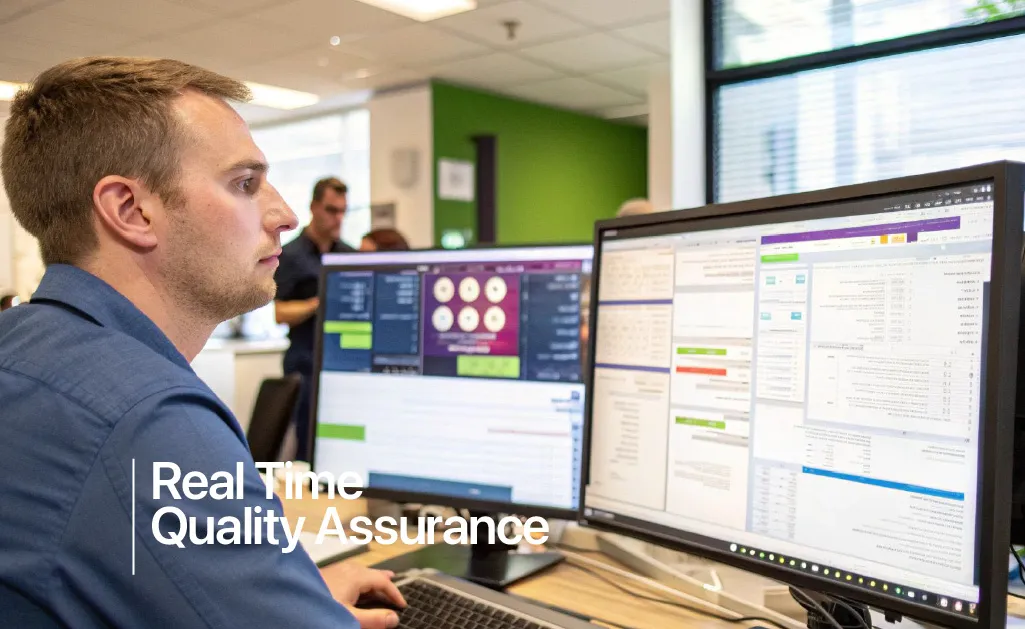 7. Leverage Real-Time Quality Assurance and Technology
Moving beyond retroactive call reviews, real-time quality assurance involves a proactive approach where agent performance is monitored and supported during live interactions. This method combines immediate supervision with a strategic technology stack, including tools for speech analytics, CRM integration, and instant coaching. It empowers supervisors to intervene, provide guidance, and correct issues on the spot, transforming QA from a historical analysis into a dynamic, in-the-moment support function.
This blend of human oversight and technology is one of the most impactful quality assurance best practices a call center can adopt to reduce time-to-correction and scale support. For a bilingual operation like CallZent, real-time analytics can flag language-specific compliance phrases or customer sentiment shifts, enabling supervisors to provide targeted support to agents serving either English or Spanish-speaking customers.
How to Implement Real-Time QA
Implementing a real-time QA program requires both the right technology and a supportive culture. For instance, a financial services firm can use keyword-spotting technology to alert a supervisor if an agent forgets to read a mandatory compliance disclosure, allowing for immediate correction. Similarly, an e-commerce operation can use screen monitoring to see if an agent is struggling to find product information and send them the correct details via a private chat.
Here are actionable tips to effectively integrate real-time QA and technology:
- Balance Support with Trust: Frame real-time monitoring as a supportive tool for agent success, not a surveillance tactic. Transparency about how and when monitoring occurs is crucial for maintaining agent morale and trust.
- Use Alerts Selectively: Configure your system to flag only critical issues like compliance breaches or high levels of customer frustration. Overloading supervisors with non-essential alerts leads to fatigue and reduces the system’s effectiveness.
- Prioritize Whisper Coaching: When intervention is needed, use whisper coaching where only the agent can hear the supervisor. This allows for discreet guidance without disrupting the customer’s experience, unlike a full barge-in.
- Integrate Your Tech Stack: Choose a platform that integrates call recording, analytics, and workforce management. A unified system provides a complete view of performance and simplifies workflows.
By leveraging technology for immediate intervention, you create a more agile and responsive quality assurance framework that prevents errors, supports agents, and consistently delivers a superior customer experience.
8. Invest in Quality Assurance Training and Competency Development
A quality assurance program is only as effective as the people running it. This best practice involves a dedicated approach to training QA specialists themselves, ensuring they are consistent, competent, and highly skilled in evaluating agent performance. This meta-quality approach treats the QA function as a critical performance area requiring its own development framework, not just an administrative task.
This process ensures that those responsible for upholding standards are experts in evaluation methodologies, coaching techniques, and the specific client services they oversee. This is a crucial quality assurance best practice call center leaders must prioritize for long-term success.
How to Implement QA Training and Competency Development
A structured development plan elevates the QA team from mere call scorers to true performance partners. For instance, a financial services BPO would require its QA team to undergo regular training on new regulatory changes, ensuring their evaluations accurately reflect compliance needs.
Here are actionable tips to build a highly competent QA team:
- Invest in Certifications: Support QA team members in obtaining recognized credentials like the COPC (Customer Operations Performance Center) QA Specialist certification to ground their skills in industry-wide standards.
- Create an Internal Competency Framework: Develop clear progression levels for QA staff, outlining the skills, knowledge, and responsibilities required for advancement from junior to senior analyst.
- Prioritize Coaching Skills: Train your QA team not just to identify errors but to deliver constructive, motivational feedback that genuinely improves agent performance.
- Ensure Bilingual Proficiency: For bilingual operations like those at CallZent, implement a validation process to certify that QA evaluators possess the necessary language and cultural fluency for both languages they score.
- Foster Peer Learning: Establish regular team meetings where QA specialists can share challenging calls, discuss scoring discrepancies, and learn from one another’s expertise.
By investing in the skills of your quality team, you create a ripple effect that enhances the performance of the entire contact center. You can learn how agent training can transform your call center and apply similar principles to your QA staff.
9. Focus on First Contact Resolution (FCR) Monitoring and Analysis
A core objective for any customer service operation is resolving issues efficiently and effectively. First Contact Resolution (FCR) monitoring is a quality assurance practice focused entirely on this goal. It measures the percentage of customer inquiries that are fully resolved in the first interaction, eliminating the need for frustrating callbacks, transfers, or follow-up communications. FCR is a powerful metric that directly links operational efficiency with customer satisfaction.
For a nearshore partner like CallZent, a high FCR rate demonstrates value by reducing customer effort and lowering the client’s cost-per-interaction, making it one of the most critical quality assurance best practices a call center can master.
How to Implement FCR Monitoring and Analysis
To successfully improve FCR, you must move from simply tracking the metric to actively diagnosing and solving the underlying problems. For instance, a telecommunications provider can analyze non-FCR calls related to billing disputes to discover a confusing invoice design. Similarly, an e-commerce company might find that a high number of repeat calls are due to agents lacking the authority to process refunds over a certain amount, indicating a policy review is needed.
Here are actionable tips to maximize the effectiveness of your FCR program:
- Define FCR Clearly: Establish a consistent, company-wide definition. Does it mean the issue is resolved and the customer is satisfied? Is there a time window (e.g., no repeat contact on the same issue within 7 days)? Make the rules clear to everyone.
- Use Post-Call Surveys: The most direct way to measure FCR is to ask the customer. A simple automated survey asking, “Was your issue completely resolved today?” provides immediate and accurate data.
- Analyze Non-FCR Calls: Your QA team should prioritize reviewing calls that resulted in a callback or transfer. Identify patterns: Was it a knowledge gap, a system limitation, or an overly complex process?
- Empower Your Agents: Ensure agents have the training, resources, and authority needed to resolve common issues. This includes access to a robust knowledge base and the discretion to make decisions that satisfy the customer.
By systematically monitoring and analyzing FCR, you shift your quality assurance focus from merely evaluating agent performance to actively improving the entire customer journey.
10. Cultivate an Agent-Centric Quality Management Culture
A truly transformative quality assurance program goes beyond scores and metrics; it fosters a culture where agents feel supported, empowered, and motivated to excel. An agent-centric quality management culture reframes QA from a punitive “gotcha” system into a collaborative tool for professional development.
“When agents trust the process, they become more engaged, receptive to coaching, and proactive in their own development. This shift is fundamental to building a high-performing team.”
This philosophy creates psychological safety, where agents view feedback as a valuable opportunity to improve rather than a threat. This shift is one of the most impactful quality assurance best practices a call center can adopt for long-term success, especially in a nearshore BPO environment where a positive culture becomes a key competitive advantage in retaining top talent.
How to Implement an Agent-Centric Culture
Building this culture requires a deliberate shift in communication and process. For instance, companies like Zappos and The Ritz-Carlton build legendary customer service by empowering their employees to own quality. They invest heavily in a supportive culture, knowing that happy, engaged agents naturally deliver superior customer experiences.
Here are actionable tips to cultivate an agent-centric quality culture:
- Lead with Positives: Always start feedback sessions by highlighting what the agent did well. Acknowledging strengths builds confidence and makes agents more receptive to constructive criticism.
- Involve Agents in the Process: Invite agents to participate in quality calibration sessions or to help refine scorecards. Giving them a voice fosters a sense of ownership and fairness in the QA process.
- Celebrate Quality Wins: Publicly recognize individuals and teams who demonstrate excellence. Share positive customer feedback widely and create peer-recognition programs that celebrate quality achievements.
- Frame Feedback as a Belief in Potential: Instead of saying, “You did this wrong,” try, “Here’s an area where I know you can excel with a small adjustment.” This shifts the tone from criticism to supportive coaching.
By making agents partners in the quality process, you not only improve metrics but also build a more resilient, engaged, and effective workforce. This is a core part of how we approach our call center solutions, ensuring our teams are set up for success from day one.
Ready to Transform Your Call Center’s Quality?
World-class quality assurance is not a static checklist; it’s a dynamic, living system that fuels continuous improvement. It requires a commitment to consistency, a willingness to adapt, and a genuine investment in your most valuable asset: your agents. When you combine fair metrics with actionable, supportive coaching, you do more than just improve KPIs—you build a resilient, motivated team that sees quality as a shared goal. This cultural shift is the ultimate outcome of implementing these quality assurance best practices call center wide.
Your Action Plan for QA Excellence
So, where do you begin? Progress is made one step at a time. Here is a practical roadmap to get you started:
- Step 1: Audit Your Current State. Review your existing QA scorecards, coaching workflows, and reporting. Are they aligned with your business goals? Identify the one or two areas from this article that represent your biggest gaps.
- Step 2: Prioritize a Pilot Program. Don’t try to overhaul everything at once. Select a single team to pilot a new approach. For example, introduce bi-weekly calibration sessions or test a new scorecard focused on First Contact Resolution (FCR).
- Step 3: Empower Your Team Leads. Provide your frontline leaders with dedicated training on how to deliver effective, motivational coaching. Equip them with the data they need to have meaningful conversations with their agents.
- Step 4: Communicate Transparently. Explain the “why” behind any changes. When agents understand the goal is their development and improved customer outcomes, you will foster buy-in rather than resistance.
- Step 5: Measure, Iterate, and Expand. Use your pilot program to gather data and feedback. Refine your process based on these findings before rolling it out to the entire call center.
Adopting these quality assurance best practices in your call center is a commitment to excellence that reverberates across your entire organization. It reduces agent attrition, boosts customer satisfaction, and ultimately protects your brand’s reputation with every single interaction.
Frequently Asked Questions
1. What is call center quality assurance?
Call center QA is the process of evaluating customer interactions to ensure service quality,
compliance, and consistent customer experience.
2. How often should calls be monitored?
Best practice is a representative weekly sample per agent, adjusted for volume and risk.
3. What metrics matter most in QA?
FCR, CSAT, compliance adherence, empathy, accuracy, and resolution effectiveness.
4. How does QA improve agent performance?
QA data enables targeted coaching, skill development, and clear performance expectations.
5. Is QA only for large call centers?
No. Even small teams benefit from structured QA to scale consistently.
6. How do calibration sessions help?
They ensure scoring fairness and increase trust in the QA process.
7. What role does technology play in QA?
Speech analytics, CRM integration, and real-time monitoring accelerate improvement.
8. How does QA support compliance?
QA identifies violations early, reducing legal and financial risk.
9. Can QA improve customer retention?
Yes. Consistent quality directly impacts loyalty and lifetime value.
10. How long does it take to see QA results?
Most teams see measurable improvements within 30–60 days.
Ready to Build a World-Class QA Program?
CallZent delivers nearshore call center solutions built on proven quality assurance
best practices—combining compliance, coaching, and performance optimization.
Ready to elevate your customer support without the operational overhead of building it all from scratch? At CallZent, our nearshore BPO services are built upon a foundation of these exact quality assurance best practices, delivering exceptional, bilingual support that strengthens your brand. Partner with us to implement a world-class QA framework that drives results from day one. Learn more about our customized call center solutions at CallZent.