Skip to content
Call Center Quality
What Is Quality Assurance in a Call Center? A Strategic Guide for Modern CX
Learn how quality assurance call center drives customer loyalty, ensures compliance, and transforms support operations into revenue-generating assets.
Is every customer conversation building brand loyalty—or quietly chipping away at it? For many business leaders, the answer is a blind spot. Understanding what quality assurance call center means. Is the key to delivering consistent, compliant, and brand-aligned customer experiences at scale.
TL;DR — Quality Assurance Call Center Explained
Quality Assurance (QA) in a call center is the structured process of monitoring, evaluating, and improving agent interactions. It uses scorecards, coaching, and technology to ensure compliance, consistency, and exceptional customer experience. A strong QA program boosts CSAT, reduces risk, improves efficiency, and increases revenue.
Is every customer conversation building brand loyalty or chipping away at it? For many business leaders, the answer is a blind spot. But the key to consistent, exceptional customer experiences lies in truly understanding what quality assurance means in a call center. This isn’t about ticking boxes; it’s the strategic framework that ensures every interaction is compliant, effective, and perfectly aligned with your brand.
 What is a Quality Assurance Call Center? A Deeper Look
Think of Quality Assurance (QA) like a professional sports team reviewing game tapes. The goal isn’t to nitpick every mistake but to find what works, refine the strategy, and make sure the whole team is playing at a championship level.
In the same way, QA is the backbone of operational excellence and customer trust. It’s the systematic process of monitoring, evaluating, and improving agent interactions to guarantee consistently high-quality service. At its core, this means listening to calls, scoring them against clear criteria—like courtesy and first-call resolution—and using that feedback to help agents grow.
Beyond Simple Call Monitoring
Modern QA has moved way beyond the old days of manually spot-checking a few random calls. Today, it’s a sophisticated, often AI-powered, system that analyzes patterns across thousands of interactions, turning raw customer conversations into actionable business intelligence.
A well-oiled QA program delivers clear answers to critical questions:
- Are our agents genuinely reflecting our brand voice?
- Are there frustrating bottlenecks in our customer service process?
- Are we meeting all the necessary compliance standards for our industry?
By answering these questions, QA shifts from a simple procedural task to a strategic function that directly impacts your bottom line. It’s the engine that ensures the promises made in your marketing campaigns are actually delivered in your contact centers.
The Foundational Principles of QA
“Quality assurance is fundamentally a proactive process. It’s about designing a system that prevents errors and builds excellence into every interaction, rather than just reacting to mistakes after they happen.”
This proactive mindset is what builds a resilient customer service operation. The concept isn’t unique to call centers, either. You can see strong parallels in the fundamental principles of Quality Assurance in software development, where the focus is on creating repeatable processes to guarantee a consistent, high-quality outcome.
Whether it’s flawless code or a stellar customer experience, the goal is the same: build a system where every agent is equipped and guided to resolve issues effectively and leave customers feeling heard and valued.
Key Components of Call Center QA
This table offers a quick summary of what makes a quality assurance program tick, explaining each component and its main objective.
| QA Component | Description | Primary Goal |
|---|---|---|
| Scorecards & Metrics | Standardized forms and key performance indicators (KPIs) used to evaluate agent interactions consistently. | Ensure objective, fair, and consistent evaluation across all agents and interactions. |
| Call Sampling | The process of selecting a representative set of interactions (calls, chats, emails) for review. | Gain accurate insights into overall team performance without reviewing 100% of interactions. |
| Calibration Sessions | Regular meetings where QA analysts and team leads score the same interaction to align on standards. | Maintain scoring consistency and ensure everyone interprets the scorecard criteria the same way. |
| Agent Coaching | Structured, one-on-one feedback sessions based on QA scores and insights. | Drive agent improvement, reinforce positive behaviors, and address areas for development. |
| QA Technology | Software platforms used for call recording, automated scoring, speech analytics, and reporting. | Increase efficiency, uncover deep insights from 100% of interactions, and streamline the entire QA workflow. |
By integrating these components, a QA program becomes more than just a review process—it becomes a powerful engine for continuous improvement and operational excellence.
Why Quality Assurance Is a Revenue Multiplier, Not a Cost Center
The real lightbulb moment comes when you stop seeing QA as a cost center and start treating it like a powerful revenue multiplier. Too many leaders think of QA as a reactive measure—a way to keep customers from getting angry. The truth is, a disciplined QA process is one of the highest-ROI investments you can make, directly boosting customer lifetime value, operational efficiency, and your brand’s reputation.
This process goes so much deeper than just checking if an agent was polite. A well-designed QA framework digs up insights that fuel real business growth. By actually analyzing customer conversations, you can pinpoint the exact moments that create friction or inspire loyalty. Suddenly, everyday service calls become strategic assets.
Connecting Quality to Your Bottom Line
Every single interaction a customer has with your team either builds up your brand or chips away at it. There are no neutral moments. When QA is done right, it creates a positive feedback loop that generates real, measurable financial returns. This isn’t just theory; we see it happen with our partners every single day.
Here’s how a strategic QA program directly drives revenue:
- Increased Customer Lifetime Value (CLV): Happy customers don’t just stick around; they buy more. QA ensures agents are not just closing tickets but are actively building relationships. They learn to spot organic opportunities to upsell or cross-sell in a way that feels genuinely helpful, not pushy.
- Reduced Agent Turnover: Good QA is a coaching tool, not a hammer. When you give agents clear, constructive feedback, you’re investing in their success. This boosts morale and dramatically cuts the high costs of recruiting, hiring, and training new people. A stable, experienced team is a high-performing team.
- Minimized Compliance Risks: For businesses in finance or healthcare, one slip-up can mean massive fines and a PR nightmare. QA is your first line of defense. It systematically checks that agents are sticking to regulatory scripts and procedures, protecting your business from devastatingly expensive errors.
A Real-World Example of QA in Action
Let me give you a concrete example. We once partnered with an e-commerce client drowning in product returns. Their first assumption was a product defect. But when we dug into their customer service calls with our QA process, a completely different story emerged.
We found that the agents, while perfectly friendly, were consistently giving out incomplete or slightly inaccurate details about product dimensions and compatibility. It was a tiny knowledge gap causing a huge problem: customers were ordering the wrong things. Armed with this insight, we created targeted training and updated their knowledge base. The result? A 15% drop in product returns in a single quarter, which saved them thousands in shipping and restocking fees right away.
Effective quality assurance doesn’t just monitor calls; it multiplies revenue by building a loyal customer base that advocates for your brand.
This kind of proactive approach transforms a contact center from a reactive cost center into a strategic intelligence hub. Great quality assurance not only grows revenue but is also a critical tool for managing your company’s public image, an area where guidance from AI reputation management consultants can add another layer of insight.
When you focus on consistent excellence in every conversation, you build a brand that people trust. And that trust is the bedrock of sustainable growth, proving that an investment in quality is truly an investment in future revenue. To get a better handle on the numbers that drive this growth, take a look at our deep dive on customer service performance indicators.
The Building Blocks of an Effective QA Program
So, you’re sold on why quality assurance matters. Now, let’s pull back the curtain on how a world-class QA program actually gets built. It’s not some mysterious art form; it’s a methodical process made up of distinct, interconnected parts. Getting a handle on these building blocks is crucial for any leader looking to partner with a BPO or sharpen their in-house operations.
A truly effective program goes way beyond simple pass/fail grades. It’s a complete system designed for consistency, fairness, and—most importantly—continuous improvement. Each piece has a specific job, from defining what “good” looks like to making sure every agent gets the support they need to hit that mark.
Crafting Balanced QA Scorecards
The QA scorecard is the bedrock of the entire system. Think of it as the detailed rubric that defines exactly what a successful customer interaction looks like for your brand. A common trap is focusing too heavily on purely objective, easy-to-measure metrics like Average Handle Time (AHT) or sticking to a script.
A scorecard that actually works strikes a critical balance:
- Objective Metrics: These are the non-negotiables. Did the agent solve the problem on the first try (First Call Resolution)? Did they follow mandatory compliance and disclosure steps? These are essential for efficiency and keeping risk in check.
- Qualitative Metrics: This is where your brand’s personality shines through. Did the agent show genuine empathy? Did they use your specific tone of voice? Were they actively listening and making the customer feel heard? These are the moments that build loyalty and set you apart.
Without this balance, you risk creating a team of fast, robotic agents who hit their time targets but leave customers feeling cold and rushed. A great scorecard rewards both efficiency and the human touch.
This infographic shows the straight line connecting a structured QA process to real business results.
By systematically improving one interaction at a time, a solid QA program directly cultivates the customer loyalty that fuels sustainable growth.
The Science of Interaction Sampling
Historically, call centers just grabbed a random handful of an agent’s calls each month and hoped for the best. While better than nothing, that approach can easily miss toxic trends or agents who are quietly struggling. The game really changed around 2015 with the widespread adoption of 100% interaction recording. Suddenly, we moved from random spot-checks to having a complete data set.
Even with the ability to record everything, you still need a smart sampling strategy for manual reviews. A modern approach blends a few methods:
- Random Sampling: Still has its place for getting a baseline of overall performance.
- Targeted Sampling: This means zeroing in on high-stakes interactions—think calls from brand-new customers, conversations about cancellations, or thorny technical support issues.
- AI-Driven Sampling: Using technology to automatically flag calls with negative customer sentiment or specific keywords related to compliance risks. This lets human reviewers focus their time where it matters most.
Running Effective Calibration Sessions
How do you make sure every single QA analyst scores calls the same way? The answer is calibration.
Think of it like the judges at an Olympic diving competition. Before the event, they all get together, watch sample dives, and agree on exactly what a “9.5” performance looks like. This ensures every athlete is judged by the same fair, consistent standard. In a call center, it’s no different.
“Calibration sessions are the single most important activity for maintaining the integrity of a QA program. Without them, scoring becomes subjective, feedback becomes inconsistent, and agent trust erodes.”
During a calibration session, all the QA analysts, team leads, and sometimes even clients listen to the same call and score it on their own. Afterward, they compare scores and hash out any differences. This process smooths out different interpretations of the scorecard and guarantees that an “excellent” rating means the exact same thing to everyone, every single time.
Designing Impactful Agent Coaching Workflows
The final—and you could argue, most important—piece of the puzzle is the coaching workflow. All the scores and data you collect are worthless if you don’t use them to help agents get better. An effective coaching session isn’t a lecture; it’s a collaborative meeting focused on development.
This workflow is what turns data into action:
- Review the Scorecard: The manager and agent go over the scored interaction together, highlighting both what went well and where there’s room to grow.
- Listen to the Call: They play back key parts of the call audio. This often allows the agent to hear for themselves where they could have handled things differently.
- Set Clear Goals: Instead of vague advice like “be more empathetic,” they set a specific, actionable goal. For example, “Acknowledge the customer’s frustration by saying ‘I understand that must be difficult’ before offering a solution.”
- Schedule Follow-Up: They agree on a time to check back in on progress, closing the loop and creating accountability.
This structured process is the engine of agent growth. To build a program that truly moves the needle, explore our guide on specific call center coaching techniques that empower agents for long-term success.
 How Technology Is Revolutionizing Call Center QA
The old-school approach to quality assurance has a serious blind spot. It’s built on manual reviews of a tiny, random sample of calls, which is a bit like trying to understand an entire ocean by looking at a few buckets of water. You get a hint of what’s going on, but you miss the deep currents and hidden trends that truly matter.
But today, technology is completely flipping that script.
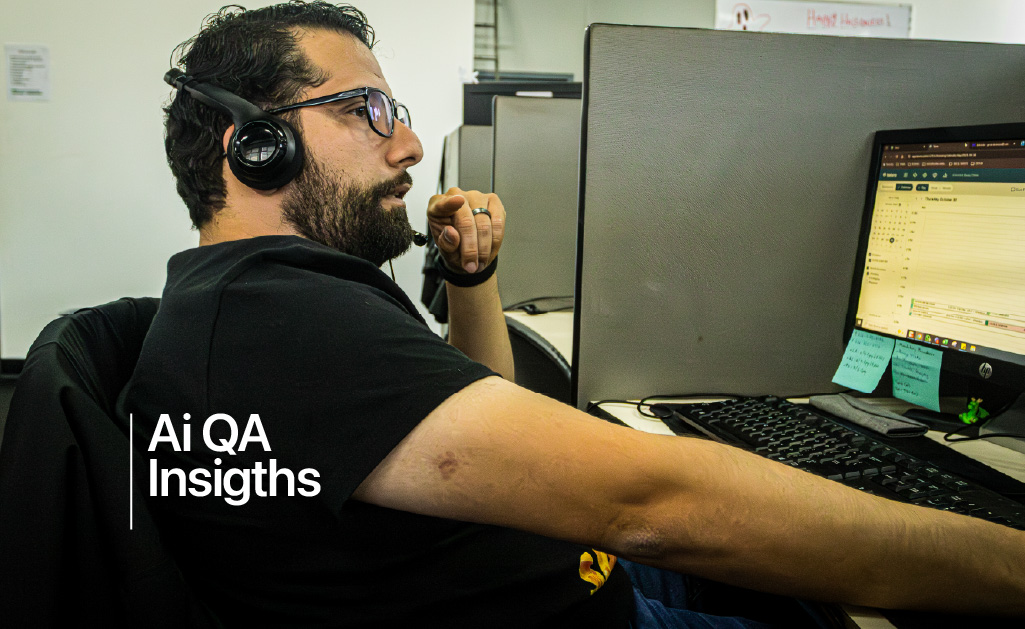
Modern QA isn’t just a human process with a little tech support; it’s a technology-powered engine guided by human expertise. This shift unlocks a level of insight and speed that was simply impossible before, turning QA from a backward-looking report card into a forward-looking strategic tool. And the biggest driver of this change is artificial intelligence.
The Power of 100 Percent Interaction Analysis
AI-powered QA tools shatter the limits of manual sampling by analyzing 100% of interactions—every single call, email, and chat session. With that kind of comprehensive coverage, nothing important gets missed.
Instead of just hoping to catch a critical compliance error or a recurring customer pain point by chance, you have a system that flags these issues automatically. This is a game-changer for understanding what is quality assurance in a call center. It’s no longer about spot-checking performance; it’s about gaining a complete, unbiased view of your entire customer service operation.
You can learn more about how we integrate these powerful tools by exploring our insights on automation and artificial intelligence in call centers.
This level of analysis unlocks powerful features that make QA more proactive and genuinely impactful:
- Real-Time Sentiment Analysis: AI can detect subtle emotional cues in a customer’s voice or text, flagging calls where frustration or dissatisfaction is on the rise while they’re still happening.
- Automated Compliance Monitoring: The system automatically scans every interaction for mandatory disclosures or keywords tied to regulatory requirements, ensuring nothing slips through the cracks.
- Automated Agent Scoring: AI can score interactions against predefined scorecards, giving agents immediate, objective feedback instead of forcing them to wait weeks for a manual review.
From Reactive Problems to Proactive Solutions
Let’s put this into a real-world context. Imagine an AI-powered system analyzing a live call and detecting a sharp spike in negative customer sentiment. The system instantly pings a supervisor, providing a transcript and highlighting the exact phrases that triggered the alert.
Instead of learning about a major customer issue days later from a bad survey, the supervisor can intervene immediately—offering support to the agent or even joining the call to de-escalate the situation before it damages the customer relationship.
This is the core strategic shift. Technology lets us move from reactive problem-solving to proactive experience management. It gives leaders the power to fix issues before they blow up, identify agent coaching opportunities in the moment, and uncover valuable business intelligence that was once buried in thousands of daily conversations.
By building this technology right into our QA process, we give our clients a serious competitive advantage built on smarter, data-driven insights.
How We Deliver Nearshore QA Excellence at CallZent
Knowing what quality assurance is in a call center is one thing. Actually building a team that lives and breathes it every day is something else entirely. At CallZent, our entire nearshore model is built around a QA framework that isn’t just about ticking boxes—it’s about creating a growth engine for our partners.
We combine deep bilingual expertise with a coaching philosophy that puts agents first. Our location in Tijuana gives us a huge advantage. We’re not just in a convenient time zone; we have a genuine cultural connection to the North American market. This fluency is baked right into our QA scorecards, making sure our agents don’t just fix problems—they connect with customers in a way that reflects your brand’s voice.
A Culture of Coaching, Not Criticism
Let’s be honest: in many call centers, QA is used to punish agents, creating a culture of fear where everyone is afraid to make a mistake. We think that’s a fundamentally broken model. It’s no wonder agent turnover is such a massive headache in the BPO industry.
Our approach is designed to solve that exact problem. We treat QA as a tool for empowerment, not criticism.
- We Start with the Wins: Every coaching session kicks off by highlighting what the agent did right. This reinforces positive habits from the get-go.
- Goals are a Team Sport: We work with our agents to pinpoint specific, actionable areas for improvement. It’s a partnership, not a lecture.
- Support is a Constant: Our managers are trained to be coaches. They provide the encouragement and resources needed for every single team member to grow.
This agent-first culture is our secret weapon. It creates an environment where people feel valued, which translates directly into lower turnover and, more importantly, a much higher quality of service for your customers.
When you invest in your agents’ success, they invest their best efforts in your customers’ experience. It’s the most direct path to sustainable quality and loyalty.
It’s a Partnership—And We’ve Got the Proof
We don’t believe in a “set it and forget it” mentality. Our clients are deeply involved in the QA process, from the first strategy session to daily performance tracking. This creates a powerful feedback loop and keeps us perfectly aligned with your business goals.
For example, we started working with a growing e-commerce brand that was struggling with inconsistent customer satisfaction scores. Instead of just sending them reports, we brought their team right into our calibration sessions and set up a shared dashboard for real-time visibility.
By working together, we refined scripts and pinpointed customer friction points. The result? A 20% jump in their Customer Satisfaction (CSAT) score in just three months. That didn’t happen because of better monitoring; it was the direct result of a true strategic partnership. This is how we work—not as a vendor, but as an extension of your team, turning every customer interaction into a win.
Frequently Asked Questions About Call Center QA
Even after you’ve got a handle on the basics, a few practical questions always pop up when it’s time to actually build out a quality assurance program. Let’s tackle some of the most common ones we hear from business leaders.
How Often Should We Be Doing QA Reviews?
The classic approach is to review a handful of calls for each agent, every week. But honestly, that’s more of a starting point than a hard rule.
The real answer depends on the agent and the situation. A brand-new hire? They might need reviews a few times a week to get them up to speed. Your seasoned, top-performing veteran? A couple of reviews a month might be all they need. The frequency should adapt to performance, tenure, and your immediate business goals.
Plus, technology is changing the game. Modern AI tools can now analyze 100% of interactions, flagging coachable moments in real-time. This shifts the model from random spot-checks to continuous, data-driven improvement. You can dive deeper into this in our guide on how to implement call monitoring the right way.
What’s The Real Difference Between Quality Assurance and Quality Control?
This trips a lot of people up, but the distinction is actually pretty simple. Imagine a chef in a high-end kitchen:
Quality Assurance (QA) is proactive. It’s the chef tasting the sauce while it’s simmering on the stove, making sure the flavor is perfect before it ever touches the plate. QA is all about designing processes that prevent mistakes from happening in the first place.
Quality Control (QC) is reactive. This is the final check of the finished dish right before it goes out to the customer. It’s about catching a mistake after it’s already been made. A great QA program means you’ll need a lot less reactive QC.
Can a Small Business Actually Afford a Serious QA Program?
Yes, absolutely. In fact, it often pays for itself surprisingly quickly. Building an in-house QA team from scratch, complete with analysts and enterprise-level software, can be a massive investment.
But outsourcing flips that equation on its head.
When you partner with a BPO like CallZent, you get instant access to our entire QA framework—the experienced analysts, the proven scorecards, and the powerful AI tools—without any of the upfront capital cost. It makes world-class quality accessible for businesses of any size.
How Do You Make Sure QA Scoring Is Fair and Not Biased?
Fairness is the absolute cornerstone of a QA program that agents will actually buy into. If they don’t trust the scoring, coaching becomes impossible.
We ensure objective scoring with a few key methods. First, we run regular calibration sessions where every analyst scores the exact same calls and discusses their reasoning to make sure everyone is perfectly aligned. Second, our scorecards use crystal-clear definitions to eliminate any gray areas. For high-stakes calls, we often have multiple analysts review them for a second opinion. This systematic approach builds trust and makes the feedback land effectively.
A Coaching-First QA Culture
- Performance feedback starts with strengths
- Clear, achievable improvement goals
- Continuous manager support
When agents feel supported, quality becomes sustainable—not forced.
Frequently Asked Questions About Quality Assurance Call Center
1. What is quality assurance in a call center?
QA is the process of evaluating and improving customer interactions to ensure consistency, compliance, and CX excellence.
2. How often should QA reviews be conducted?
Typically weekly, but frequency should adapt to agent performance and tenure.
3. What’s the difference between QA and quality control?
QA is proactive and process-driven; quality control is reactive and outcome-focused.
4. Can small businesses afford QA programs?
Yes—outsourcing makes enterprise-grade QA accessible without heavy investment.
5. How does QA improve customer satisfaction?
By ensuring agents resolve issues correctly, empathetically, and consistently.
6. Does QA reduce agent turnover?
Yes—coaching-based QA improves morale and performance clarity.
7. Is QA required for compliance?
In regulated industries like healthcare and finance, QA is essential.
8. What tools are used in modern QA?
Speech analytics, AI scoring, dashboards, and call monitoring software.
9. Can QA identify upsell opportunities?
Yes—QA reveals patterns where agents can add value organically.
10. Why is nearshore QA effective?
Nearshore teams offer cultural alignment, real-time collaboration, and cost efficiency.
Ready to Build a World-Class QA Program?
CallZent helps brands turn quality assurance into a growth engine with nearshore, bilingual teams and AI-powered QA frameworks.
Schedule a Call with CallZent →At CallZent, we don’t just offer QA as a service; we’ve built our entire nearshore operation on a foundation of transparent, coaching-focused quality. Discover how our partnership approach can elevate your customer experience and drive measurable growth.