Skip to content
Call Center Quality
Quality Assurance in Call Center
Operations: A Complete Strategic Guide
Learn how quality assurance in call center operations improves CSAT, boosts efficiency, ensures compliance, and transforms customer service into a growth engine.
TL;DR — Quick Takeaways
- What it is: Quality Assurance (QA) is the structured evaluation of customer interactions against defined service and compliance standards.
- Why it matters: QA directly improves CSAT, FCR, compliance, and agent performance using objective data.
- How it works: Effective QA combines scorecards, calibration, call sampling, and KPI tracking.
- What’s new: AI-powered QA enables 100% interaction analysis and real-time insight.
- Why nearshore wins: Bicultural QA teams ensure authentic bilingual quality across English and Spanish interactions.
Is your call center just answering calls, or is it building your brand? Beyond the basic metrics like handle times and call volume, what’s the actual experience like for your customers? That’s where a robust quality assurance program, or Quality Assurance in call center operations, becomes a game-changer. It’s the framework you use to systematically listen to, evaluate, and improve agent interactions, ensuring they meet your standards for service, compliance, and overall effectiveness.
QA is how you stop guessing and start knowing. It transforms whispers of feedback and anecdotal evidence into hard data you can actually use to coach agents, delight customers, and drive real business growth.
TL;DR: Why QA in Your Call Center is a Must
- What it is: Quality Assurance (QA) is the systematic process of reviewing agent-customer interactions (calls, chats, emails) against a set of predefined standards.
- Why it matters: It directly improves customer satisfaction (CSAT), boosts operational efficiency (like First Call Resolution), reduces business risk, and provides concrete data for agent coaching and development.
- Key Components: An effective QA program is built on clear KPIs, a balanced QA scorecard, consistent call sampling, and regular calibration sessions to ensure fairness.
- The AI Revolution: AI technology now allows for the analysis of 100% of interactions, uncovering deep insights into customer sentiment and agent performance that were previously impossible to track.
- The Nearshore Advantage: A bicultural, nearshore QA team provides nuanced, culturally fluent evaluations for both English and Spanish interactions, ensuring authentic customer connections.
What Is Call Center Quality Assurance and Why Does It Matter?
Imagine trying to coach a sports team without ever watching the game tapes. You know the final score, but you have no idea why you won or lost. A call center without a QA program is in the same boat. You’re definitely busy, but are you actually moving closer to your business goals?
Quality assurance is your game tape. It’s the strategic process that aligns what your agents are doing day-to-day with your biggest business goals. And let’s be clear: this isn’t about catching people making mistakes. It’s about systematically elevating the customer experience, one conversation at a time.
For example, a customer calls about a simple billing error. A basic interaction gets the problem solved. But a high-quality interaction, guided by a solid QA framework, does much more. The agent not only fixes the mistake quickly but also shows genuine empathy, confirms the customer understands the fix, and leaves them feeling heard and valued. QA is the engine that makes that exceptional level of service a consistent reality across your entire team.
The Strategic Value of Quality Assurance
A well-run QA program gives you a clear, objective window into what’s happening on your front lines. It’s the difference between assuming your team is performing well and knowing it, with the data to prove it.
Here’s why a formal QA in a call center is so critical:
- Drives Customer Loyalty: People remember how you make them feel. Consistently positive interactions build the kind of trust that keeps customers coming back. In fact, one study found that 86% of buyers are willing to pay more for a great customer experience, and QA is what delivers it.
- Boosts Operational Efficiency: By spotting common customer issues, knowledge gaps, and broken processes, QA helps you streamline everything. It directly improves core metrics like First Call Resolution (FCR) and helps get Average Handle Time (AHT) under control by eliminating repeat calls.
- Reduces Business Risk: For companies in regulated industries like finance or healthcare, sticking to compliance scripts isn’t optional. QA provides a documented, systematic way to ensure agents follow critical protocols, protecting your business from hefty fines and legal trouble.
- Empowers Agent Development: This is where the magic really happens. Effective QA delivers specific, data-driven feedback that helps agents actually grow. It pinpoints the exact skills they need to work on, making coaching sessions far more productive and truly impactful.
Ultimately, a strong QA process transforms your support team from a necessary expense into a powerful engine for growth. To get a handle on the numbers that prove this, check out our guide to call center reporting and metrics dashboards. It’s the first step toward building an operation that doesn’t just answer calls, but builds your business.
The Building Blocks of an Effective Quality Assurance Program
A great quality assurance program doesn’t just happen. It’s not built on guesswork; it’s a carefully engineered structure made of several core components working in sync. For QA in a call center to truly move the needle, it needs a solid foundation that turns abstract goals like “better service” into a tangible, repeatable process for improving every customer interaction.
This map shows how QA acts as the central hub, directly connecting agent performance, customer satisfaction, and the overall health of your business.
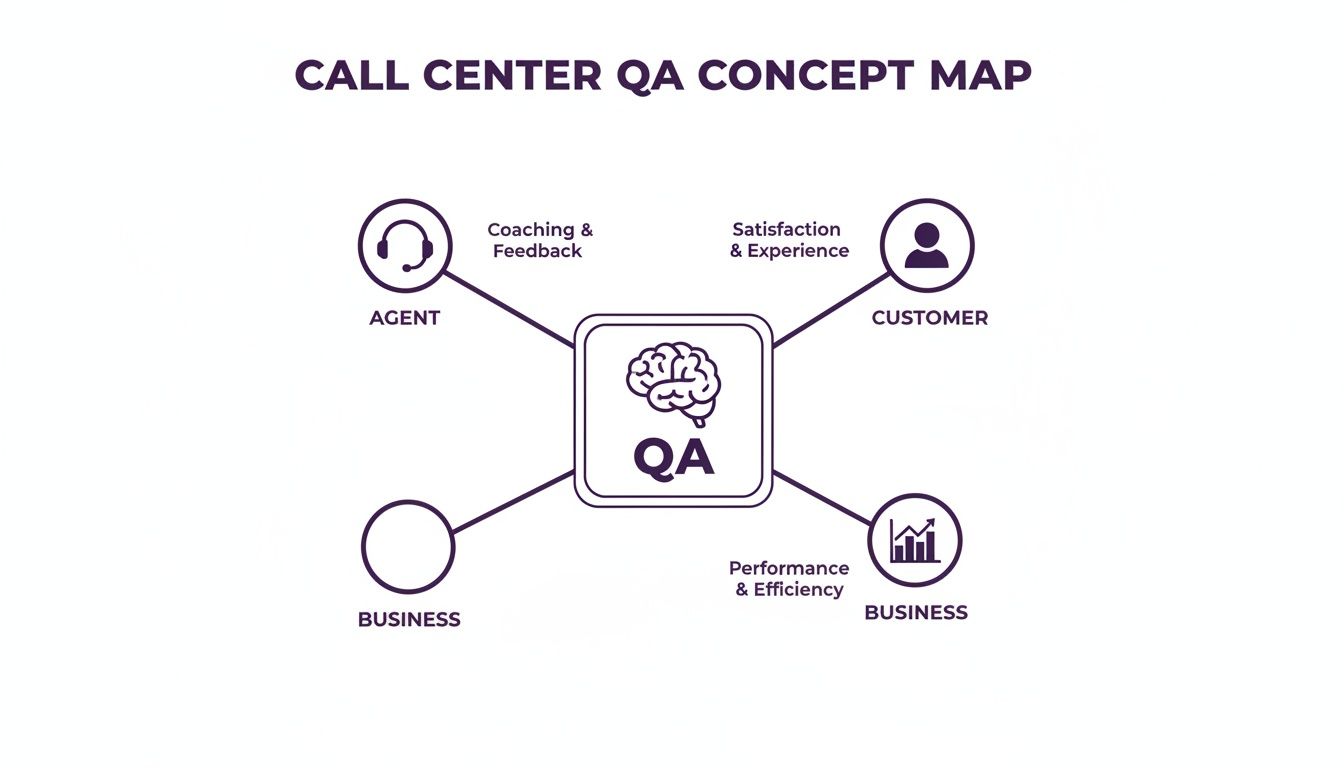
As you can see, everything flows back to a central QA strategy. Quality isn’t just a department—it’s the engine driving the entire operation.
Key Performance Metrics: The Scoreboard
First things first: you need to know how to keep score. Key Performance Indicators (KPIs) are the specific, measurable stats that tell you if you’re winning. Without them, you’re flying blind.
- Customer Satisfaction (CSAT): This is the most direct pulse check on customer happiness, usually captured in a quick post-call survey. A high CSAT score is a clear sign that agents are hitting the mark.
- First Call Resolution (FCR): This tracks the percentage of issues solved in a single touchpoint. High FCR is a huge win for efficiency and customer experience because it means customers aren’t stuck calling back about the same problem.
- Average Handle Time (AHT): AHT measures the total time an interaction takes. While a low AHT looks good on paper, it has to be balanced with FCR and CSAT. Rushing customers off the phone is a recipe for disaster.
Quality Assurance Scorecards: The Blueprint for Quality Assurance in a Call Center
If metrics are your scoreboard, the QA scorecard is the blueprint for a perfect interaction. It’s a standardized checklist that evaluators use to grade calls fairly and objectively. Think of it like a pilot’s pre-flight checklist; it ensures every critical step is followed, every single time. A solid scorecard breaks down a call into key behaviors like professionalism, problem-solving, and communication, assigning a score to each.
Call Sampling and Calibration: The Consistency Check
Manually reviewing every single call is impossible. That’s where a smart sampling strategy comes in. Call sampling means reviewing a representative set of interactions to get an accurate picture of performance. You can pull calls randomly for a general overview or be more targeted, focusing on new agents or complex call types. You can dive deeper into setting this up in our guide on how to implement call monitoring.
The goal of calibration isn’t just agreement; it’s to create a shared understanding of what “excellent service” truly means for your brand, ensuring every evaluator applies the same high standard.
To keep everything fair, calibration sessions are non-negotiable. This is where your QA team gets together to review the same call and score it independently. Afterward, they compare notes and discuss any differences. This process stamps out subjectivity and guarantees every agent is measured against the exact same yardstick. From there, all this data feeds into the coaching loop, which is where real improvement happens.
How to Build a Powerful QA Scorecard
If performance metrics are the scoreboard for your call center, then the Quality Assurance (QA) scorecard is the playbook. It’s easily the most important tool in your QA kit because it turns subjective opinions about a call into objective, measurable data. A solid scorecard means every agent is measured against the same high standard, keeping the whole QA in call center process fair, consistent, and genuinely useful.
Think of it like a recipe. A chef follows a recipe to ensure a dish comes out perfectly every time. A QA scorecard does the same by breaking down a complex customer interaction into its core ingredients—like professionalism, problem-solving, and process adherence—so you can measure and improve each part.
Designing a Scorecard That Drives Results
A truly effective scorecard is balanced and tied directly to what your business is trying to achieve. It shouldn’t just be a laundry list of nitpicky rules. Instead, it needs to reflect what actually matters to your customers and your bottom line. A scorecard bloated with dozens of subjective questions will just burn out your agents and evaluators. The best ones are clear, concise, and focused on behaviors that make a real difference.
A well-designed scorecard is the blueprint for a perfect customer interaction. It defines what “good” looks like and gives your team a clear path to get there.
Before you start, pull your agents and supervisors into the creation process. Getting their input is critical for buy-in and ensures the criteria are realistic and speak to their daily challenges. When agents have a hand in building the standards they’re measured against, they’re far more likely to see feedback as helpful, not hostile. To learn more about connecting your scorecard to bigger business goals, check out our guide on customer service KPIs that power real results.
A Practical Template for Your QA Scorecard
Starting from scratch can be tough, so here’s a simple but powerful template you can adapt for your team. It hits the core competencies that apply to almost any customer service role. The key is that each category has specific, non-negotiable criteria that are easy to score objectively.
This foundational template will give you a great starting point:
Sample Call Center QA Scorecard Template
A foundational template business leaders can use to build a balanced and effective QA scorecard, covering key areas of a customer interaction.
| Category | Evaluation Criteria | Scoring (Example: 1-5) | Comments |
|---|---|---|---|
| Opening & Professionalism | Greeted the customer professionally? Used a positive and empathetic tone? | ||
| Problem Resolution | Accurately identified the customer’s issue? Provided a correct and complete solution? | ||
| Communication Skills | Spoke clearly and confidently? Actively listened without interrupting? | ||
| Compliance & Process | Followed all required security and verification steps? Accurately documented the interaction? | ||
| Closing | Summarized the resolution? Confirmed the customer was satisfied? Ended the call professionally? |
This structure gives you a well-rounded view of an agent’s performance, covering everything from soft skills to procedural must-dos. By keeping it simple, you’re not just creating a checklist; you’re building a powerful tool for consistent coaching and measurable improvement across your team.
How AI Is Revolutionizing Call Center QA
For decades, the standard approach to QA in call centers had a massive blind spot. Quality teams would manually review a tiny fraction of interactions—typically just 1-2%—leaving the other 98% completely unchecked.
Think of it like trying to understand an entire movie by watching only two minutes of it. You might get a glimpse of the plot, but you’ll miss the whole story.
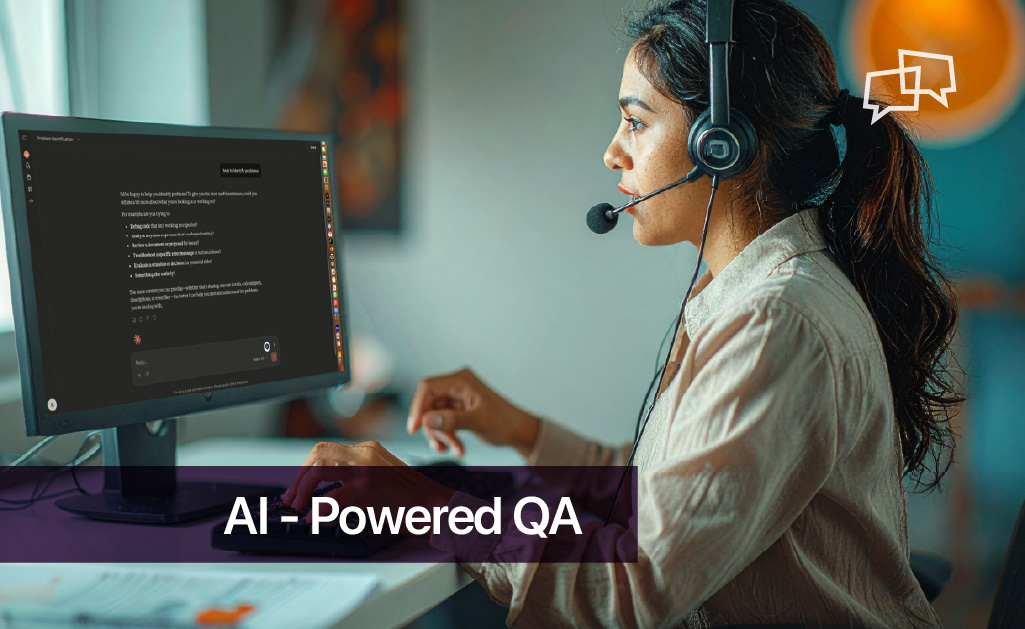
Today, that old model is obsolete. Artificial intelligence isn’t just another buzzword; it’s a fundamental shift in how quality and performance are managed, giving leaders unprecedented visibility into their operations.
From Sampling to 100% Analysis
The single biggest change AI brings to the table is the ability to analyze every single interaction—every call, every chat, every email. Modern QA platforms automatically scan conversations to detect sentiment, flag critical keywords, and score interactions against your scorecard in real time.
This allows leaders to finally connect the dots and directly correlate QA scores with crucial KPIs like First Call Resolution (FCR) and Customer Satisfaction (CSAT). It provides a clear, data-backed link between agent behavior and actual business results.
With this level of insight, QA moves from a reactive, compliance-focused chore to a proactive, strategic function. Instead of just catching mistakes after the fact, you can identify patterns, predict customer needs, and fine-tune processes based on a complete data set.
Key AI Capabilities in Modern QA
AI-powered QA isn’t just about listening to more calls; it’s about gaining deeper insights that were impossible to uncover at scale before. For a powerful example of how AI is changing customer interactions, just look at Capital One’s AI implementation to cut call center volume.
Here are a few core capabilities that make all the difference:
- Sentiment Analysis: AI can detect subtle emotional cues in a customer’s voice or text, flagging conversations where someone is frustrated, confused, or delighted. This helps teams identify specific coaching opportunities for agents struggling with de-escalation.
- Keyword and Topic Spotting: The system automatically flags interactions where specific words or phrases are mentioned. This is invaluable for monitoring compliance with required disclosures, identifying emerging product issues, or even spotting hidden sales opportunities.
- Automated Scoring: AI can score interactions against your custom scorecard, ensuring every agent is evaluated with complete objectivity. This eliminates human bias and frees up supervisors to focus on high-value coaching instead of tedious manual reviews.
AI-driven QA turns every single customer conversation into a data point, transforming quality assurance from an occasional audit into a continuous source of business intelligence.
This kind of technology is no longer reserved for massive enterprises. Through partners like CallZent, businesses of any size can tap into the power of AI. Discover more about automation and artificial intelligence in call centers and see how you can gain a competitive edge.
The Nearshore Advantage in Bilingual QA
When your customers are spread across North America, quality assurance is more than just ticking boxes on a scorecard. It’s about connection. If you’re serving both English and Spanish speakers, a direct, word-for-word translation of your script just won’t cut it. Real quality in a bilingual call center means capturing cultural nuances and linguistic subtleties—and that’s exactly what a specialized QA in call center program is built to do.

Beyond Translation to True Connection
A top-tier bilingual QA program ensures agents project the right tone and brand voice in both languages, not just recite a script. This is where the nearshore advantage really shines. A bicultural QA team, immersed in both U.S. and Latin American cultures, can pick up on subtle context shifts that an automated system or a non-native speaker would miss.
Think about it: a phrase that sounds perfectly polite in English could come off as blunt or even rude in Spanish if it isn’t phrased with the right formality. On the flip side, a common Spanish turn of phrase might sound unprofessional in a formal English business conversation. A nearshore QA analyst from Tijuana gets these subtleties instinctively.
Quality assurance in a bilingual environment is about guaranteeing authenticity. It ensures that your brand’s message and values resonate equally, regardless of the language being spoken.
This deep cultural fluency is what sets a great nearshore partner apart. It’s the difference between a call center that’s merely functional and one that builds genuine rapport with every single customer.
Why Bicultural QA Delivers Superior Results
Having a QA team that lives and breathes both cultures offers tangible benefits that directly boost customer satisfaction and protect your brand’s reputation. They can tell if an agent is truly connecting with a customer or just going through the motions.
A bicultural team can accurately evaluate things like:
- Tone and Empathy: Is the agent’s tone appropriately empathetic for a Spanish-speaking customer in California versus an English-speaking customer in New York?
- Regional Nuances: Can the agent recognize and adapt to regional dialects or local expressions, making the customer feel truly heard and understood?
- Cultural Context: Does the agent’s approach align with cultural expectations for politeness and formality in each language?
By leveraging this expertise, businesses ensure their customer service feels local, personal, and authentic. Understanding how different outsourcing models enable this is key; you can dive deeper into nearshore vs. offshore bilingual call centers to see how cultural fluency drives higher-quality interactions.
The Real Business Impact of World-Class QA
So, what’s the actual return on this investment? A world-class QA in call center operations isn’t a cost center. It’s a powerful profit driver that directly feeds your bottom line through smarter efficiency and happier, more loyal customers.
Think about the ripple effect. When QA systematically improves agent performance, it directly impacts First Call Resolution (FCR). Every time a customer has to call back about the same problem, your operational cost for that issue effectively doubles. A strong QA program digs in to find the root causes of those repeat calls—whether it’s a knowledge gap or a clunky process—and stamps them out with targeted coaching. That’s money straight back into your budget.
From Metrics to Revenue
The line between high QA scores and a healthy balance sheet is clearer than you might think. Better agent performance naturally leads to higher customer satisfaction (CSAT), which is the bedrock of customer retention. When your customers have consistently positive and effective interactions, they simply have no reason to look elsewhere.
The data tells the story. A “good” CSAT score typically sits between 75–84%, but a tiny 5% of centers ever reach the world-class tier of 85% or higher. It’s the same with FCR: a good rate is 70–79%, with only 5% hitting that elite 80%+ mark. QA programs are what close that gap. They standardize what your best agents do and turn average teams into top performers. For a deeper dive, you can check out the latest call center performance standards on Plivo.com.
Investing in QA is investing in your customer lifecycle. It minimizes churn, boosts loyalty, and turns your service center into a predictable engine for sustainable growth.
On top of that, rock-solid security and compliance are direct results of great QA, shielding your business from both financial hits and reputational damage. This comprehensive guide to call center payment security solutions is a great resource if you want to explore that further. By partnering with an expert nearshore provider like CallZent, you get a QA framework built not just to check boxes, but to drive real, tangible business results.
Got Questions About Call Center QA?
Even with a solid plan, leaders often have questions when putting a quality assurance program into action. Here are a few of the most common ones we hear from businesses trying to make QA in the call center a real success.
How Often Should We Conduct QA Reviews?
There’s no magic number that fits everyone, but a great starting point is four to five evaluations per agent per month.
This frequency provides enough data to spot performance trends without burying your QA team in reviews. For new hires or agents struggling with certain metrics, you’ll want to increase that number. More frequent check-ins provide the intensive coaching they need to get up to speed. The goal is a consistent feedback loop that keeps everyone improving.
What Is the Difference Between QA and Agent Training?
Think of it like this: QA is the diagnosis, and training is the prescription.
QA’s job is to systematically review an agent’s performance to find specific gaps—whether in skills, product knowledge, or process adherence. Agent training is the solution you prescribe to fix those gaps. It’s the targeted coaching session or workshop designed to address the specific opportunities your QA process uncovered. The two work together in a powerful cycle of continuous improvement.
Can a Small Business Afford a Sophisticated QA Program?
Absolutely. Building an in-house QA program from scratch with advanced technology can be expensive. But partnering with a nearshore BPO like CallZent makes top-tier quality assurance completely accessible.
You get immediate access to enterprise-grade QA technology, experienced analysts, and proven scorecards—all without the massive overhead. It’s one of the smartest ways for small and mid-sized businesses to roll out a world-class QA in call center program and compete with the big players on customer experience.
🚀 Ready to Build a World-Class QA Program?
CallZent delivers nearshore quality assurance solutions powered by expert analysts, AI tools, and proven frameworks.
Ready to transform your customer experience with a data-driven QA program? CallZent provides expert nearshore solutions that deliver measurable results and empower your team for success. Learn more about how our quality assurance services can drive growth for your business at https://callzent.com.