Skip to content

Call Center Operations
Quality Assurance Team: Structure, Roles & Best Practices
Learn how a high-performing quality assurance team improves CSAT, FCR, and compliance. Discover structure models, AI tools, and QA best practices.
TL;DR — Quick Takeaways
- A strong quality assurance team protects your brand and improves customer satisfaction.
- Structured QA processes turn customer interactions into measurable performance data.
- AI-powered tools allow modern QA teams to analyze 100% of conversations.
- Nearshore BPO partners like CallZent build scalable, tech-enabled QA programs.
Ever wonder what separates a good customer service call from a great one? The secret is almost always a dedicated quality assurance team. These specialists are the guardians of your brand’s reputation, ensuring every customer interaction hits the mark for excellence and accuracy. Without them, service quality can drift, leading to shaky customer experiences and unnecessary risk.
 The Hidden Engine of Your Customer Experience
It’s easy to think of a QA team as just call monitors, but that’s selling them short. A modern QA team is a strategic partner in your business’s success. Think of them as a powerful feedback engine that meticulously analyzes interactions to spot trends, find coaching opportunities for agents, and flag processes that need a tune-up. This group is ultimately responsible for the integrity of your customer service, ensuring agents stick to company policies, follow compliance rules, and consistently represent your brand.
Core Functions of a Modern Quality Assurance Team
A high-performing quality assurance team brings immense strategic value that directly impacts your bottom line. They are the essential bridge between your big-picture operational goals and the real conversations happening on the front lines every single day. Their insights help drive decisions that boost both efficiency and customer loyalty. Here’s a quick look at their core functions:
| Function | Primary Goal | Real-World Business Impact |
|---|---|---|
| Performance Monitoring | Review interactions (calls, chats, emails) against set quality standards. | Ensures consistent service quality and brand representation across all channels. |
| Actionable Feedback & Coaching | Provide agents with specific, constructive feedback to build skills and fix errors. | Improves agent performance, boosts morale, and reduces costly churn. |
| Trend Analysis & Reporting | Identify recurring issues, customer pain points, and agent knowledge gaps. | Provides leadership with data to make strategic process improvements. |
| Compliance & Risk Management | Ensure all interactions meet legal and regulatory requirements. | Protects the business from fines and reputational damage. |
“A great QA team doesn’t just find problems; they cultivate solutions. They transform agent performance from a series of individual interactions into a consistent, brand-defining experience.”
Their work directly moves the needle on critical metrics like Customer Satisfaction (CSAT) and First Call Resolution (FCR). This proactive approach is fundamental to building an outstanding overall contact center experience, turning what could be a simple cost center into a powerful engine for growth.
Structuring Your Quality Assurance Team for Maximum Impact

An effective quality assurance team doesn’t just happen—it’s built with purpose. The way you structure your QA department directly impacts its ability to drive real, meaningful change. Think of it as creating a blueprint for a high-performance engine; every part needs to be in the right place for it to run smoothly. This structure creates a powerful feedback loop where insights flow seamlessly from individual agent calls up to strategic planning, ensuring that what you learn leads to measurable improvements.
Key Roles Within a Quality Assurance Team
A well-oiled QA team typically has a few key players, each with a distinct job to do. It’s a lot like a sports team—every position is vital if you want to win.
- QA Analyst: These are your frontline specialists. QA Analysts are in the trenches, reviewing agent interactions—calls, emails, chats—and scoring them against a detailed scorecard. Their job is to be objective and detail-oriented, providing the specific, actionable feedback that helps agents improve one conversation at a time.
- QA Team Lead or Supervisor: This role is the bridge between the analysts and upper management. The Team Lead oversees the day-to-day work of the analysts, runs calibration sessions to ensure scoring consistency, and often handles tricky escalations. They are the go-to mentors for the analyst team.
- QA Manager: The QA Manager is the strategist. They look at the big picture, analyzing trends across the entire operation. This person designs the QA program, sets quality standards, and reports key findings to leadership to help shape broader business decisions.
Choosing an Organizational Model for Your QA Team
Once you’ve defined the roles, the next question is how to organize them. Most contact centers, including successful BPOs, lean on one of two primary models. The right fit depends on your company’s size, culture, and operational goals.
1. The Centralized Model
In this setup, the entire quality assurance team operates as a single, independent department. It reports up to a central quality or customer experience leader, not to individual operations managers.
- Advantage: This model is all about objectivity. Since QA is separate from operations, there’s no conflict of interest. Standards are applied consistently across all teams, giving you a truly reliable measure of quality.
- Real-World Example: A large e-commerce company with several product lines would use a centralized QA team to ensure the brand’s voice and service standards are rock-solid, no matter which agent a customer talks to.
2. The Embedded (or Decentralized) Model
Here, QA analysts are placed directly into the operational teams they support. An analyst might sit with a specific group of 15-20 agents and report directly to that team’s operational manager.
- Advantage: This approach builds a stronger, more collaborative relationship between QA and the agents. Analysts get a deep, firsthand look at a team’s unique challenges and can provide immediate, relevant coaching.
- Real-World Example: A BPO handling technical support for multiple clients might embed QA analysts within each client-specific team. This lets the analyst develop expert-level product knowledge and give highly specialized feedback to agents tackling complex technical problems.
“The structure of your quality assurance team isn’t just an organizational chart—it’s the blueprint for how feedback flows, how improvements are made, and how your brand’s promise is kept with every customer.”
Choosing the right structure is a critical first step. To see how this fits into the bigger picture of operational excellence, check out our guide on performance management best practices. The goal is always the same: create a system that elevates your agents and the entire customer experience.
Turning Customer Interactions Into Actionable Insights
How does a single customer call transform from a routine chat into a powerful piece of business intelligence? The magic happens within the quality assurance process. This is the structured system that distills raw conversations into clear, actionable data, letting the quality assurance team drive real improvements across the entire operation. It all starts with a foundation of fairness and consistency, where everyone is aligned on what “good” looks like.
Building and Calibrating the QA Scorecard
The heart of any QA program is the scorecard. This isn’t just a checklist; it’s a strategic tool that reflects your company’s values and business goals. A balanced scorecard goes beyond simple yes/no questions to measure the full spectrum of what makes an interaction successful.
For example, a good scorecard is often broken down into key categories:
- Problem Resolution: Did the agent resolve the customer’s issue on the first try? This is a direct line to your First Call Resolution (FCR).
- Process Adherence: Did the agent follow all required steps, from account verification to proper note-logging? This keeps you compliant and operationally sound.
- Customer Empathy and Tone: Did the agent build a connection, show genuine empathy, and sound like your brand? This is essential for building customer loyalty.
- Communication Clarity: Was the agent’s language clear, professional, and easy for the customer to follow?
Once the scorecard is built, the most critical step is calibration. During these sessions, all QA analysts score the same interaction and then discuss their results to iron out any differences in interpretation. This ensures every agent is evaluated against the exact same standard, building trust in the entire program.
A well-designed scorecard turns subjective interactions into objective data. Here’s a look at what criteria you might find.
| Category | Evaluation Criteria Example | Potential Score |
|---|---|---|
| Opening & Closing | Agent used approved greeting and closing statement. | 5 Points |
| Verification | Agent correctly followed the two-step identity verification process. | 10 Points |
| Active Listening | Agent paraphrased the customer’s issue to confirm understanding. | 10 Points |
| Problem Resolution | Agent provided the correct and complete solution to the customer’s problem. | 25 Points |
| Process Adherence | Agent documented the interaction accurately in the CRM. | 15 Points |
| Empathy & Tone | Agent maintained a positive and empathetic tone throughout the call. | 15 Points |
| Compliance | Agent provided all legally required disclosures. | 10 Points |
| Hold/Transfer Protocol | Agent followed correct procedure for placing the customer on hold. | 5 Points |
From Raw Data to Performance Trends
With a calibrated scorecard, the quality assurance team can start gathering data. But collecting scores is only step one. The real value is unlocked when this information is analyzed to spot patterns and trends that would otherwise remain invisible.
“Data from your quality assurance team is the voice of your customer and your agents combined. It tells you not only what happened in an interaction but why it happened, providing a clear path to improvement.”
By pooling scores over weeks and months, a QA Manager can pinpoint specific challenges. For instance, if multiple agents consistently lose points on a particular product question, that’s not an agent problem—it’s a training gap. This insight allows leadership to roll out targeted training instead of wasting time on generic coaching. To see how this data comes to life, check out our guide on call center reporting and metrics dashboards.
Closing the Loop: How a QA Team Delivers Feedback
The final—and most important—piece of the puzzle is turning insights into coaching. Data that just sits in a report is useless. A great QA program ensures feedback gets to agents in a way that’s constructive, supportive, and timely.
Here’s how it works in the real world:
- Individual Coaching: A QA analyst sits down with an agent to review their scorecard, even playing back snippets of a call to highlight specific moments. The focus is on celebrating wins and identifying one or two concrete areas for improvement.
- Team-Level Huddles: A team lead might spot a common trend—like agents fumbling with a new CRM workflow—and address it in a quick team huddle, sharing best practices for everyone.
- Process Improvement Tickets: If QA keeps flagging an issue caused by a broken process (like a confusing policy), they escalate it to the right department to get it fixed for good.
This disciplined cycle of monitoring, analyzing, and coaching is what enables a quality assurance team to directly boost key metrics like CSAT, FCR, and even agent retention.
 Amplifying QA Performance with AI and Technology
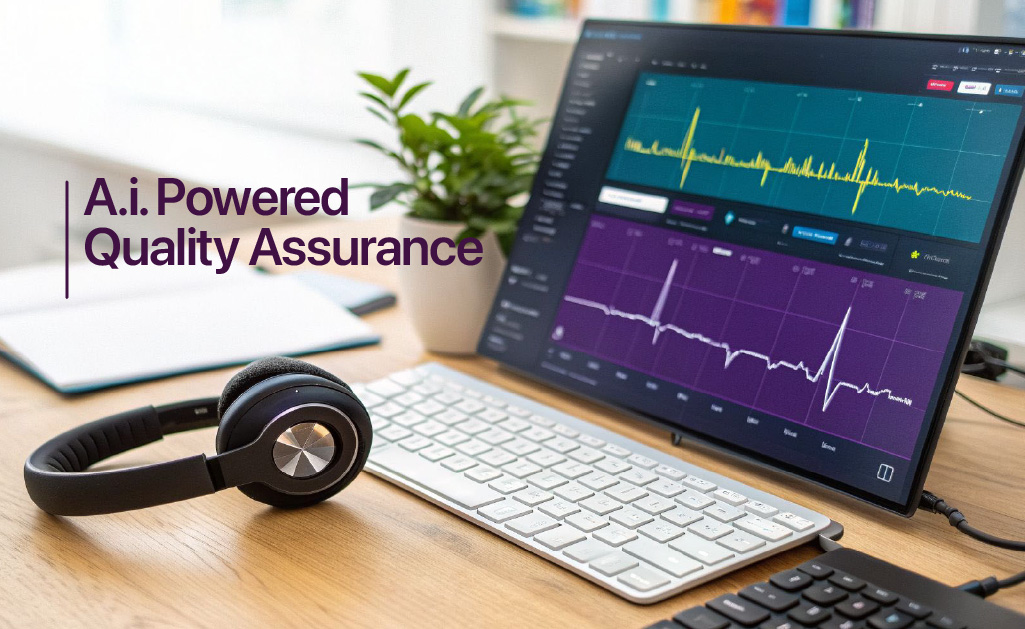
Manually reviewing a handful of calls is a thing of the past. In a world of sky-high customer expectations, a quality assurance team can’t get the full picture by sampling just 2-3% of interactions. Technology, especially artificial intelligence, is completely rewriting the rules for quality assurance. Modern QA platforms are driving a monumental shift—moving from spot-checking a few random calls to analyzing 100% of all customer interactions.
From Manual Sampling to 100% Analysis
When you embed artificial intelligence into your quality assurance process, you move from guessing based on small sample sizes to knowing based on comprehensive data. AI-powered QA systems analyze every single conversation, detecting subtle shifts in a customer’s tone, pinpointing missed procedural steps, and spotting early warning signs of frustration. This total visibility transforms QA from a reactive, check-the-box function into a proactive engine for driving performance improvements.
How AI Empowers Your Quality Assurance Team
AI doesn’t replace the human touch of a great QA team; it supercharges it. By handling the heavy lifting of data analysis, technology lets QA analysts evolve into genuine performance coaches.
Here’s how AI tools make a practical difference on the floor:
- Automated Scoring: AI can instantly score interactions based on predefined criteria, like sticking to the script, using required disclaimers, or flagging negative keywords. This provides a consistent, unbiased first look at every conversation.
- Sentiment Analysis: The technology can detect customer sentiment—frustration, happiness, confusion—by analyzing tone of voice and word choice, flagging emotionally charged calls that need immediate human review.
- Keyword and Topic Spotting: QA managers can set up alerts for specific keywords or phrases, like “cancel my account” or mentions of a competitor. This allows the team to jump on churn risks or service issues immediately.
- Compliance Monitoring: In regulated industries, this is a game-changer. AI can automatically scan every interaction for compliance slip-ups, ensuring agents provide necessary disclosures and avoid prohibited language.
“Technology transforms the quality assurance team from auditors into strategists. When 100% of interactions are analyzed, you’re no longer just looking for mistakes—you’re uncovering deep, actionable insights that drive the entire business forward.”
A Practical Example of Tech-Powered QA
Let’s make this real. Imagine an e-commerce company sees a sudden spike in calls about a specific product arriving damaged. Manually, it might take a QA team weeks to piece this trend together from their small sample of calls. By then, hundreds of frustrated customers have been impacted.
With an AI-powered platform, the system would immediately flag an increase in keywords like “broken,” “damaged,” or “cracked” across hundreds of calls. The quality assurance team gets an alert, listens to a few of the flagged interactions to confirm the problem, and escalates it to the warehouse team—all within a single day. The problem gets fixed before it snowballs and tanks your customer satisfaction scores.
This proactive approach is what a modern QA program is all about. By using technology, a quality assurance team can spend less time hunting for problems and more time solving them. To learn more about how CallZent puts these powerful tools to work, check out our deep dive into automation and artificial intelligence in call centers.
 Recruiting and Training Your World-Class QA Team
You can have the most advanced AI and the slickest scorecards, but a QA program is only as good as the people running it. Building an exceptional quality assurance team is about finding and nurturing the perfect mix of analytical skill and human insight. This is where a nearshore partner like CallZent gives you a serious advantage. By tapping into the deep, bilingual, and bicultural talent pool in Tijuana, we build QA teams that not only master your operational standards but also understand the nuances of the North American customer.
Core Qualities of a Great QA Analyst
The best QA analysts are part performance detective, part empathetic coach. They have a unique combination of hard and soft skills that lets them pinpoint areas for improvement without making agents feel criticized.
When building your ideal candidate profile, look for these traits:
- Critical Thinking: A great analyst doesn’t just tick boxes. They understand the why behind what happened and connect an agent’s actions to the customer’s reaction.
- Deep Empathy: They must be able to step into both the agent’s shoes and the customer’s, allowing them to deliver feedback that feels supportive and fair.
- Masterful Communication: The ability to explain complex feedback in a clear, constructive way is non-negotiable. They must motivate agents to improve.
- Objectivity and Consistency: A QA program lives or dies on trust. Analysts must apply scoring standards evenly and without bias.
How to Train a High-Performing QA Team
Once you’ve hired the right people, training is the next make-or-break step. A world-class training program for a quality assurance team goes beyond teaching company policies; it’s about cultivating the art of delivering feedback that empowers agents.
A powerful training curriculum should always include:
- Calibration Mastery: Intensive sessions where new analysts score the same interactions as seasoned vets, discussing their reasoning until scoring is perfectly aligned with team standards.
- Role-Playing Scenarios: Staging mock coaching sessions where analysts practice delivering tough feedback builds confidence and sharpens communication skills in a safe environment.
- Root Cause Analysis Training: Teaching analysts to dig deeper than surface-level mistakes. Instead of just flagging an error, they learn to ask, “Was this a knowledge gap, a process flaw, or a behavioral issue?”
“The goal of a QA training program isn’t to create perfect scorekeepers. It’s to cultivate expert coaches who can elevate the performance of every agent they work with, creating a positive ripple effect across the entire contact center floor.”
This focus on human-centered coaching is also a powerful tool against agent turnover. QA programs that champion constructive coaching can reduce churn significantly, delivering a clear return on investment. Ultimately, building a great quality assurance team is about investing in people who can build up others. To streamline your recruitment, it’s worth exploring the best talent acquisition software platforms.
Partnering for QA Excellence with a Nearshore BPO
Your quality assurance team is the guardian of the promise you make to your customers. A modern QA program isn’t a cost center; it’s a strategic asset that fuels growth by ensuring every interaction builds loyalty. This is where a dedicated nearshore BPO partner becomes a powerful extension of your own team. A top-tier partner takes all the best practices we’ve discussed—a well-defined team structure, robust processes, modern tech, and a people-first training approach—and weaves them into a seamless, unified strategy.
The Power of Collaborative Quality Assurance
The right BPO partner doesn’t just listen to calls; they get in the trenches with you to shape a program that delivers measurable results. This partnership is built on transparency and shared goals.
Here’s what this collaborative approach looks like in action:
- Customized Scorecards: We build the QA scorecard from the ground up, using your business goals as the foundation. This ensures every evaluation measures what truly matters to you.
- Integrated Reporting: You get a crystal-clear view of performance trends through shared dashboards and regular check-ins. No surprises.
- Aligned Calibration: Your internal stakeholders are always invited to join calibration sessions, guaranteeing our understanding of “quality” is perfectly in sync with yours.
“A nearshore partnership transforms quality assurance from an internal task into a shared mission. It combines your deep brand knowledge with the BPO’s operational expertise to create a program that is truly greater than the sum of its parts.”
This integrated model ensures that the quality assurance team is actively steering your business toward success. As you look at external partners, it’s worth considering how to build smarter with offshore software development teams to gain similar advantages. By working with a specialized partner, you can boost customer loyalty, improve operational efficiency, and gain a serious competitive edge. To see how our dedicated QA teams can help you hit your goals, learn more about our nearshore call center operations.
Common Questions About Call Center QA Teams
Even with the best strategy, questions always come up when building a quality assurance program. Let’s tackle some of the most common ones we hear from leaders trying to build a high-impact quality assurance team.
What is the ideal ratio of QA analysts to agents?
The industry benchmark is often cited as one QA analyst for every 25 to 30 agents, but this isn’t a one-size-fits-all rule. The perfect ratio depends on your goals.
For example, a highly regulated industry like finance might need a tighter ratio, perhaps 1:15, to ensure strict compliance. However, if you use AI tools to handle initial scoring and keyword flagging, your human analysts are freed up to focus on high-value coaching and can effectively manage a larger group of agents.
How do you measure the ROI of a quality assurance team?
Measuring the ROI of a QA team goes beyond hitting quality score targets. The real value shows up in core business metrics that affect your bottom line. You have to connect their work directly to financial results.
“To prove your QA team’s worth, you have to connect their work directly to financial results. Show how better first-call resolution lowers operational costs, and how higher CSAT scores translate into real dollars through customer retention and lifetime value.”
To build a solid business case, track how your QA team’s efforts impact:
- First Call Resolution (FCR): Higher FCR means fewer repeat calls, which directly cuts operational costs.
- CSAT and NPS: Happier customers stick around longer, reducing churn and increasing revenue.
- Agent Turnover: Great coaching from the QA team builds agent confidence and job satisfaction, which lowers costly hiring and training expenses.
- Compliance Fines: In regulated fields, a sharp QA team is your best defense against expensive penalties. Every fine they help you avoid is pure ROI.
Should the QA team report to Operations?
This is a critical structural decision. Having the quality assurance team report directly to Operations is common and can make the feedback loop very fast. The downside is a potential conflict of interest, where operational pressures might influence quality evaluations.
To guarantee impartiality, many top-performing organizations have their QA team report to an independent department, like a central Customer Experience or Quality division. A popular hybrid model that works well is having QA report independently but maintain a “dotted line” relationship to Operations. This fosters a collaborative partnership focused on shared goals without sacrificing the team’s unbiased perspective.
🚀 Strengthen Your Quality Assurance Strategy
Discover how CallZent’s nearshore quality assurance team can elevate your customer experience, improve compliance, and increase operational efficiency.
Talk to an ExpertAt CallZent, our approach to quality assurance is built on partnership and transparency. We don’t just audit calls; we integrate our expert QA teams into your workflow to deliver the insights and coaching that genuinely elevate performance and build customer loyalty.
Ready to see how our tailored nearshore solutions can strengthen your brand’s promise? Learn more about CallZent’s approach.