Skip to content
10 Proven Strategies to Reduce Call Center Costs
By CallZent Outsourcing Strategy Team • Updated September 2025
Are your call center’s operational expenses spiraling out of control? You’re not alone. Many leaders believe that cutting costs means sacrificing service quality, but what if the opposite were true? The secret to a leaner, more effective operation isn’t about slashing budgets—it’s about spending smarter.
True efficiency comes from a strategic approach that sharpens performance, boosts agent morale, and, believe it or not, creates a superior customer experience.
TL;DR: How to Reduce Call Center Costs
The fastest way to reduce call center costs is to focus on strategic improvements, not just budget cuts. Key strategies include:
- Optimizing workforce scheduling and flexibility
- Leveraging AI and automation to cut repetitive work
- Adopting cloud technology to reduce infrastructure expenses
- Boosting First Call Resolution (FCR) to lower rework
- Reframing outsourcing as a strategic partnership
Bottom line: Smarter processes mean lower costs and happier customers.
Are your call center’s operational expenses spiraling out of control? You’re not alone. Many leaders believe that cutting costs means sacrificing service quality, but what if the opposite were true? The secret to a leaner, more effective operation isn’t about slashing budgets—it’s about spending smarter.
True efficiency comes from a strategic approach that sharpens performance, boosts agent morale, and, believe it or not, creates a superior customer experience.
Understanding Your True Call Center Costs
Before you can make smart changes, you need a solid baseline of your current spending. It’s no secret that a typical call center budget is heavily weighted toward labor, but technology, infrastructure, and training also eat up a significant chunk of the pie. Knowing the percentages is the first step to spotting the biggest opportunities for savings. If you need a complete expense breakdown, our guide to call center costs is a great place to build that foundation.
Primary Call Center Cost Drivers at a Glance
To get a clearer picture, let’s break down where the money typically goes. This table highlights the main expense categories and where you can find the most impactful savings.
| Cost Category | Typical Budget Allocation (%) | Key Area for Savings |
|---|---|---|
| Labor & Staffing | 60-70% | Workforce optimization, scheduling efficiency, reducing attrition. |
| Technology & Licensing | 10-20% | Consolidating software, adopting automation, negotiating contracts. |
| Infrastructure & Facilities | 5-15% | Shifting to remote/hybrid models, reducing physical footprint. |
| Training & Onboarding | 5-10% | Streamlining programs, using micro-learning, improving agent retention. |
This breakdown makes it obvious why staffing is always the first place leaders look to cut costs, but it also shows there are serious gains to be made elsewhere.
Where Does the Budget Go? A Deeper Look
As you can see, labor costs—salaries, benefits, and training—consistently chew up the largest slice of the budget, often accounting for 60-70% of total expenses. This makes workforce optimization a non-negotiable priority. But if you only focus on labor, you’re leaving money on the table.
Let’s look at the other big-ticket items:
- Technology & Licensing: Your CRM, contact center platform (CCaaS), and analytics tools are powerful, but their costs can creep up fast. A simple audit can reveal if you’re paying for features you don’t use.
- Infrastructure & Facilities: This covers everything from rent and utilities to hardware. It’s an area ripe for savings, especially with the proven success of remote and hybrid work models.
- Training & Onboarding: Good training is an investment, not an expense. However, inefficient programs drag out the time it takes for new agents to become productive, creating hidden costs.
“The big takeaway here is that you don’t have to slash budgets arbitrarily. The real win is reallocating resources from bloated, inefficient processes to high-impact areas that make your team more productive and your customers happier.”
The right technology can be a game-changer. Take a look at how specific tech adoptions can drive major savings and efficiency boosts.
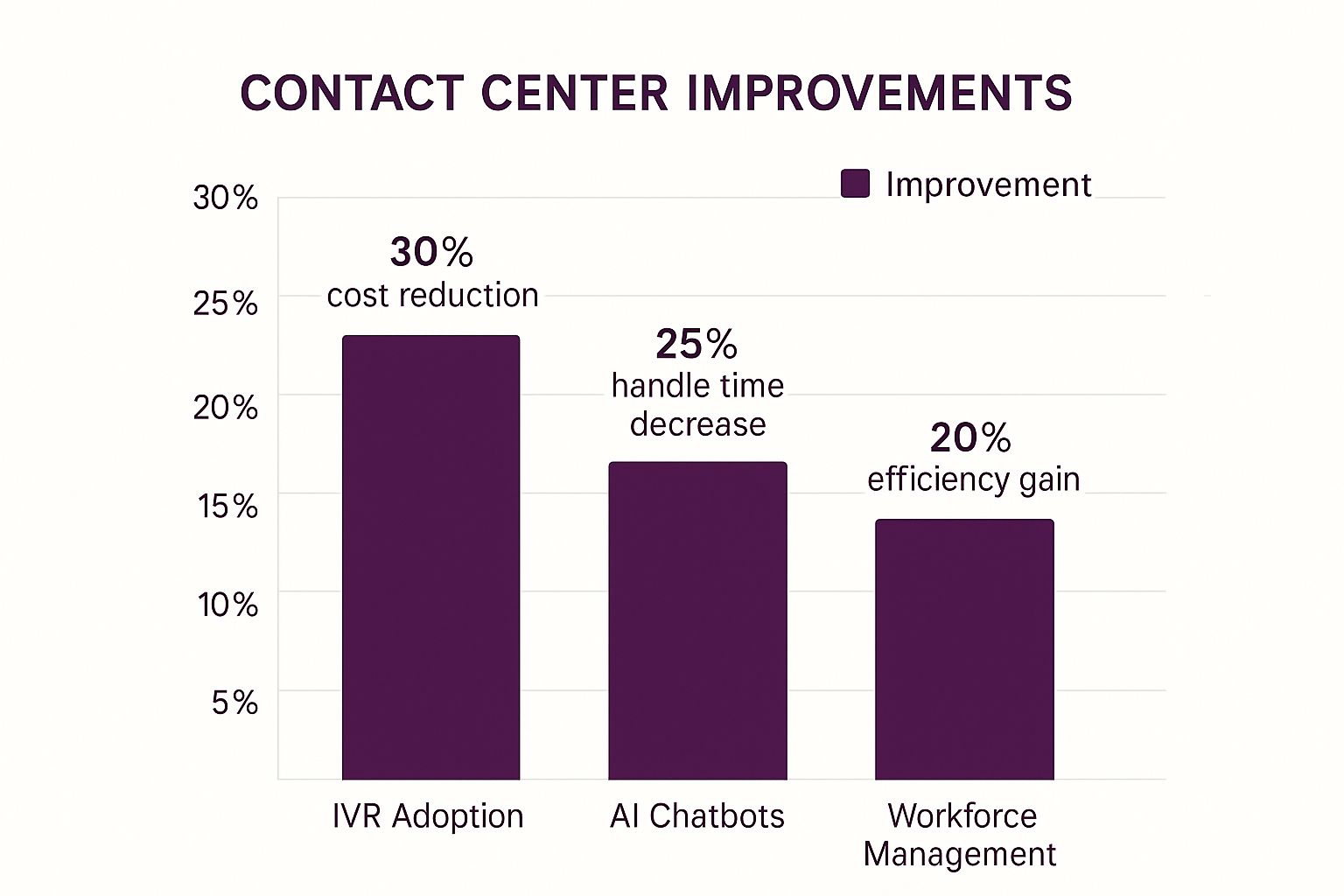
This data proves that automation and smarter tools are powerful levers for trimming costs without asking your agents to simply “do more with less.”
For a wider view, it’s also helpful to look at how to reduce operational costs across your entire business. Many of those broader strategies can be adapted to fit your call center’s specific needs. Once you’ve pinpointed your primary cost drivers, you’re in the perfect position to make informed, strategic decisions that deliver real, lasting financial benefits.
How to Reduce Call Center Costs in Labor with Smart Workforce Optimization
Since labor is the heavyweight champion of call center expenses, even small, strategic tweaks to how you manage your workforce can lead to significant savings. The goal isn’t just about cutting hours—it’s about perfectly aligning your staffing with customer demand. This prevents you from paying for idle agents during quiet spells or losing frustrated customers to long wait times during a rush.
With wages and compliance costs on the rise, getting your workforce optimization right isn’t just a nice-to-have; it’s a must-do for survival. Modern workforce management (WFM) tools are a game-changer here. They analyze historical data to predict call volumes with surprising accuracy, helping you dodge the twin disasters of overstaffing and understaffing.
1. Implement Flexible Scheduling Models
The rigid nine-to-five schedule is dead. To make a real dent in your staffing costs, you need to be agile. Flexible scheduling lets you match your team’s availability to your call volume peaks and valleys with incredible precision.
Consider introducing these powerful alternatives:
- Split Shifts: Perfect for covering morning and evening rushes. An agent works a few hours, takes a long break, and returns for the evening surge. This way, you aren’t paying for a full eight-hour shift to cover two distinct busy periods.
- Part-Time Roles: Hire part-time agents specifically for your busiest days or peak hours. It’s a cost-effective way to get reinforcements without committing to full-time salaries.
- Compressed Workweeks: Offering options like four 10-hour days can be a huge morale booster and helps you cover longer service windows without paying for expensive overtime.
The key is to stop forcing your demand curve to fit a standard workday and start building schedules that mirror your customers’ behavior.
2. Cross-Train Your Agents for a More Versatile Team
Running a team of single-skilled specialists is an expensive habit. What happens when your “billing expert” calls in sick? Do those calls just sit in the queue? That’s a costly bottleneck. Cross-training turns your team into a multi-skilled, adaptable unit that can handle a wider variety of issues. This directly cuts costs by reducing the need for niche hires and minimizing downtime.
This approach also does wonders for agent retention and the value of stability. When you invest in your people by giving them new skills, they see a clearer path for growth and are more likely to stick around.
Real-World Example: A retail call center preparing for the holiday rush cross-trained its core team on order processing and return policies. Instead of scrambling to hire and train a dozen temporary workers, they handled the surge with experienced staff, saving thousands in recruiting and onboarding costs.
Put AI and Automation to Work to Reduce Costs
Technology isn’t just a background tool anymore; it’s a core part of running an efficient, modern call center. When you strategically integrate AI and automation, you can pull repetitive, low-value work off your agents’ plates, freeing them to focus on the complex, high-stakes conversations where they truly make a difference. This isn’t about replacing people—it’s about empowering them.
For a closer look at this, our detailed guide covers the role of automation and artificial intelligence in call centers.
3. Use Speech Analytics to Find Hidden Savings
One of the most powerful tools you can add to your kit is speech analytics. This technology listens to 100% of your calls to pinpoint customer friction points, identify agent coaching opportunities, and ultimately boost your first-call resolution rate. It’s the difference between guessing and knowing.
Real-World Example: A financial services firm used speech analytics and discovered that hundreds of calls were coming in about a single, confusing clause in their loan agreements. They rewrote the clause and saw a nearly 30% drop in related calls, saving a huge amount of agent time.
4. Automate After-Call Work (ACW) and Repetitive Tasks
The benefits don’t stop with customer-facing interactions. So many internal processes are begging to be automated, giving your agents precious time back to focus on customers. A great place to start is with Robotic Process Automation (RPA), which can handle repetitive back-office work and cut down your labor expenses.
Consider automating these common call center chores:
- After-Call Work (ACW): Instead of an agent manually typing call notes, an AI tool can generate an accurate summary and log it in the CRM, shrinking ACW from minutes to seconds.
- Data Entry: Let RPA bots handle the tedious job of moving information between systems, eliminating human error.
- Ticket Creation: Automatically create support tickets from call transcripts or chatbot logs to ensure no issue gets lost.
“The real goal of automation isn’t to get rid of the human touch, but to save it for the moments it’s needed most.”

Adopt Cloud Technology and Strategic Outsourcing
The days of being shackled to expensive, clunky on-premise hardware are over. If you’re still managing server rooms and dealing with hefty maintenance contracts, you’re fighting an unnecessary battle that’s draining your budget.
5. Move to the Cloud to Lower Infrastructure Costs
Moving to cloud-based platforms is one of the most direct ways to reduce call center costs and gain incredible operational agility. Legacy systems demand a huge upfront capital expenditure (CapEx). Cloud solutions, on the other hand, operate on a flexible operational expenditure (OpEx) model. You pay for what you use, turning a massive capital investment into a predictable monthly expense.
Real-World Example: A retail business can instantly scale up cloud resources to handle the holiday rush and then scale right back down in January—all without the massive expense of over-provisioning hardware that sits idle most of the year.
6. Reframe Outsourcing as a Strategic Partnership
For too long, outsourcing has been viewed purely as a tactic for slashing labor costs. The modern approach is to see it as a strategic partnership that provides a competitive advantage. It’s about gaining expertise, not just saving a few dollars.
“A true BPO partnership isn’t about offloading problems; it’s about onboarding expertise. You gain instant access to a highly skilled talent pool and top-tier technology without the massive upfront investment.”
Partnering with a trusted BPO provider like CallZent gives you access to a team that is already trained, managed, and equipped with the latest technology. This completely bypasses the costly and time-consuming process of recruiting, hiring, and training an in-house team from scratch.
7. Leverage a BPO Partner’s Technology Stack
A strategic BPO partnership offers a faster path to operational excellence and predictable costs. Instead of buying your own licenses for expensive CCaaS platforms, workforce management tools, and analytics software, you tap into your partner’s existing tech stack. This gives you enterprise-grade capabilities without the enterprise-grade price tag. You can discover more about the benefits of a full-featured Contact Center as a Service for customer engagement on our site.
Refine Internal Processes for Peak Efficiency
You can have the best agents and the latest tech, but if your internal processes are clunky, you’re leaking money. These small operational roadblocks quietly inflate your budget and hamstring your team’s potential. The goal isn’t to rush agents off calls; it’s about removing the friction that slows them down.
8. Boost First Call Resolution (FCR)
Every time a customer has to call back, it’s a failure of the initial process—and a completely avoidable expense. Improving First Call Resolution (FCR) is one of the single most effective ways to slash costs because you’re literally eliminating rework. In fact, a 1% bump in FCR can cut your operational costs by a corresponding 1%. To get there, your agents need instant access to customer history and clear answers.
9. Optimize Average Handle Time (AHT) the Smart Way
Everyone wants to lower their Average Handle Time (AHT), but not at the expense of good service. A smart way to do this is to focus on reducing After-Call Work (ACW). Tools that auto-generate call summaries or use AI to tag call reasons can slice ACW down to under a minute, freeing up agents to take the next call. Those seconds and minutes, saved consistently, add up to massive labor cost savings.
“Operational excellence is the foundation upon which all other cost-saving strategies are built. Fine-tuning your internal workflows creates a ripple effect that improves every other aspect of your call center performance.”
10. Conduct a Workflow Audit
To spot these opportunities, you need to audit your current workflows. Look for bottlenecks that frustrate agents and customers. Is your call routing sending people to the wrong department? Getting this right is critical. You can learn how to optimize call routing for faster service to stop those unnecessary transfers.
Here’s a practical checklist to get you started on your audit:
- Knowledge Access: How many clicks does it take for an agent to find a standard policy?
- System Integration: Are agents still copying and pasting information between apps?
- Call Escalation: Is the path for escalating a tough issue crystal clear?
- After-Call Work: Which manual tasks can you automate?
Your Top Questions About Reducing Call Center Costs, Answered
When you start digging into ways to make your call center more cost-effective, a bunch of questions inevitably pop up. Let’s walk through some of the most common questions we hear and get you some clear, straightforward answers.
How can I reduce costs without hurting customer satisfaction?
Shift your mindset from “cutting” to “improving efficiency.” The goal is to make life easier for both your customers and your agents. For example, setting up a self-service knowledge base doesn’t just deflect calls; it empowers customers who prefer to find their own answers. It’s a better experience for them and cheaper for you. Focusing on First Call Resolution (FCR) is another win-win. When an agent solves an issue on the first try, the customer is happy, and you’ve eliminated the cost of a follow-up call.
What’s the first step to take for the quickest impact?
If you’re looking for a quick win, dive into your call data. Find out why people are calling. Are your phones ringing off the hook with simple, repetitive questions like order status checks or password resets? These are perfect candidates for automation. You can set up an intelligent IVR or a basic chatbot to handle them, which will immediately reduce call volume and lower your cost per call.
“Remember, the quickest wins often come from automating the predictable. Solve the simple problems with technology so your talented agents can focus on the complex human interactions where they add the most value.”
How do I calculate the ROI of new technology?
Figuring out the return on investment for a new platform means looking beyond the sticker price. You have to account for both direct and indirect savings.
- Direct Savings: This is the easy math. Think reduced labor costs due to lower call volume, a shorter Average Handle Time (AHT), and lower training costs from higher agent retention.
- Indirect Savings: These are just as important. We’re talking about the value of higher customer satisfaction, improved FCR rates, and more productive agents.
Real-World Example: Let’s say a new tool costs $2,000 a month but saves 100 agent hours. At $25/hour, your direct savings are $2,500 right off the bat. That’s a positive ROI from day one, even before factoring in the long-term value of happier customers.
Ready to Lower Call Center Costs Without Sacrificing Quality?
At CallZent, we build efficient, high-performing support operations that lower expenses while boosting customer satisfaction.
At CallZent, we build efficient, high-performing support operations that tackle these challenges head-on. Our nearshore solutions are designed to lower your costs while actually improving the customer experience. Ready to see how the right partner can change the game for your budget and your service quality? Explore our custom-fit call center services.