Skip to content

Call Center Workforce Strategy
How to Reduce Call Center Employee Turnover with Proven Retention Strategies
In the high-stakes BPO world, it’s easy to accept turnover as inevitable.
But keeping your best people has nothing to do with ping-pong tables or free snacks.Real retention comes from competitive pay, clear career paths,
and managers trained to lead — not just supervise.
If you’re ready to stop the churn and build a team that stays,
it starts with facing the hard truth about how much turnover is really costing you.
TL;DR: How to Reduce Call Center Employee Turnover
High employee turnover silently drains profits through lost productivity,
recruiting costs, and damaged morale.
To reduce churn, focus on five core areas:
- Diagnose the Root Cause: Go beyond exit interviews with engagement surveys and stay interviews.
- Hire for Fit, Not Just Skill: Attract candidates aligned with your culture and master the first 90 days.
- Train Managers to Coach: Turn supervisors into leaders who inspire and develop talent.
- Build Clear Career Paths: Create growth opportunities beyond management roles.
- Foster an Agent-Centric Culture: Prioritize feedback, recognition, and work-life balance.
Is the revolving door of agents just another cost of doing business? In the high-stakes BPO world, it’s easy to fall into that trap. But keeping your best people isn’t about ping-pong tables or free snacks; it’s about creating a place where they genuinely want to build a career. That means competitive pay, clear growth paths, and managers who are trained to lead, not just supervise.
If you’re ready to stop the churn and build a team that sticks around, it all starts with facing the hard truth about how much turnover is really costing you.
Why High Turnover Is Costing Your Call Center More Than You Think
Is the revolving door of agents just a cost of doing business? A lot of call center leaders seem to think so, but that mindset ignores a massive, silent profit killer. The constant churn isn’t just an HR headache; it’s a huge operational drag that hits everything from team morale to the quality of your customer service.
When you lose a seasoned agent, you’re not just losing a person. You’re losing all the unwritten knowledge and experience they’ve built up over months or years. A new hire, no matter how bright, can’t replace that overnight. It takes time. And that time costs money—a lot of it. The true cost to replace an employee is often pegged at 50% to 200% of their annual salary. When you multiply that across a year’s worth of departures, the number is staggering.
The Hidden Financial Drains of Attrition
To really get a handle on the financial hit, you have to look past the obvious line items. The real damage is in the indirect costs that ripple through your entire operation.
- Productivity Loss: It’s not just the new agent who isn’t fully productive. Think about the team members and managers who have to stop their own work to train them. Productivity dips for everyone involved as they adjust to the new dynamic.
- Training and Onboarding Expenses: You’ve got direct costs like training materials and facilitator time. But you’re also paying a new hire’s full salary during their ramp-up period when they aren’t yet contributing to the bottom line.
- Recruitment and Administrative Costs: Posting the job, sifting through resumes, endless interviews, and all the HR paperwork—it all adds up, consuming valuable time and resources.
- Impact on Team Morale: High turnover is a morale killer. The agents left behind get saddled with a heavier workload, which leads to burnout and, you guessed it, more people updating their resumes. It’s a vicious cycle.
This infographic breaks down some of the biggest cost centers when an agent leaves.
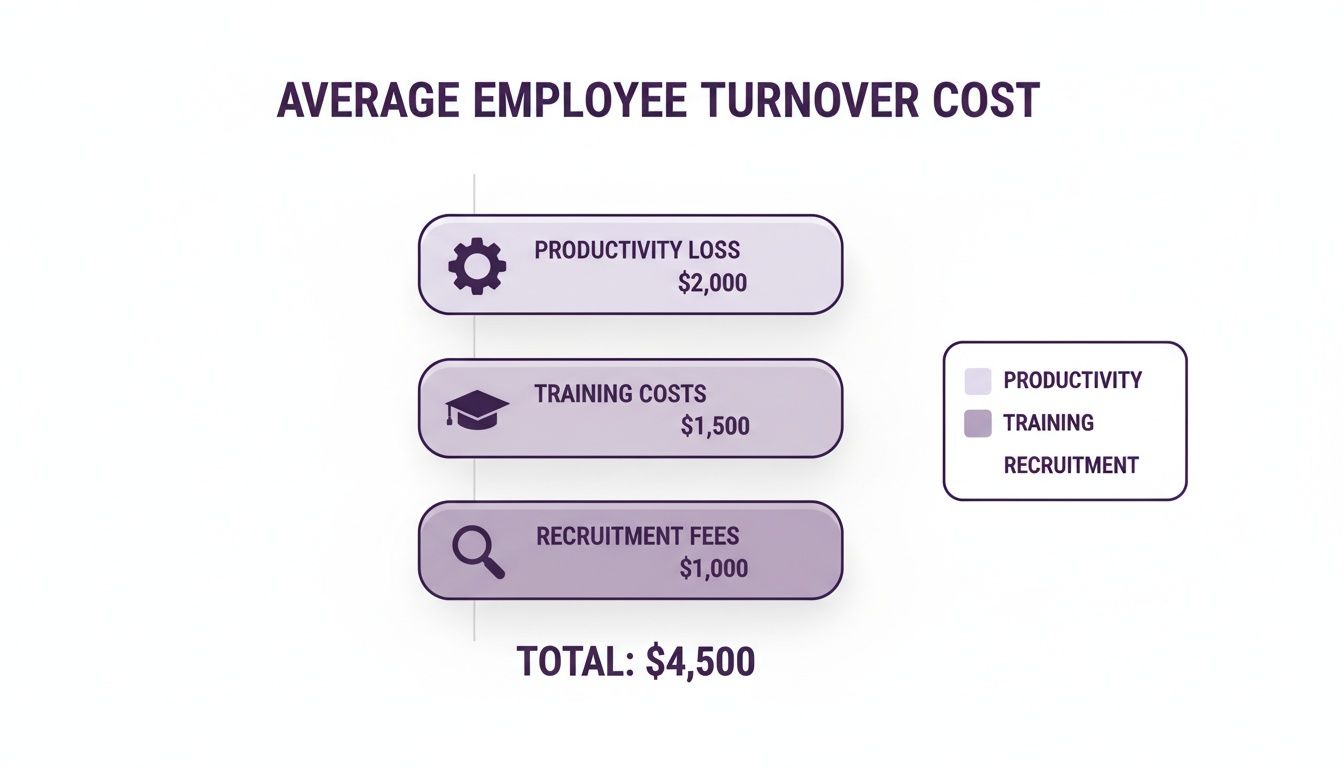
As you can see, the hit from lost productivity is often the biggest piece of the pie, dwarfing even the more obvious recruiting and training expenses. This is why a stable, experienced team isn’t a luxury; it’s a financial necessity.
Let’s break down these costs even further to see how they apply to replacing a single agent.
Calculating the True Cost of Agent Turnover
| Cost Category | Description | Estimated Financial Impact (Example) |
|---|---|---|
| Direct Replacement Costs | Hard costs like job board fees, background checks, HR admin time, and signing bonuses. | $1,500 |
| Training & Onboarding | Salary for the new hire during their non-productive training period, plus the cost of trainers and materials. | $2,500 |
| Lost Productivity (New Hire) | The gap between a new hire’s output and a fully proficient agent’s output during their first 3-6 months. | $5,000 |
| Lost Productivity (Team) | Time spent by managers and peers on training and support, diverting them from their own tasks. | $2,000 |
| Impact on Customer Experience | Errors, longer handle times, and lower FCR from an inexperienced agent can lead to customer churn. | $1,000+ (Variable) |
| Negative Morale & Burnout | The cost of increased workload on remaining staff, leading to disengagement and potential for more turnover. | Difficult to quantify, but significant |
When you add it all up, the true cost isn’t just a few thousand dollars—it can easily climb into five figures for a single employee, making retention a critical business strategy.
How to Reduce Employee Turnover by Diagnosing the Root Causes
If you want to know how to reduce employee turnover, you have to stop guessing and start diagnosing. Exit interviews are a decent start, but let’s be honest, they’re often filtered. Departing employees don’t want to burn bridges, so you get polite, surface-level answers instead of the whole story.
“The first step to reducing turnover is to stop guessing. You need to dig deep into your data and culture to understand why people are leaving, not just that they are leaving.”
A better approach is to use a few different tools. Dig into your historical data for patterns. Are agents bailing right around the 90-day mark? Is one team’s turnover rate double the others? That points to a specific manager or process issue.
Combine that hard data with anonymous engagement surveys and, more importantly, “stay interviews.” Asking your top performers what keeps them here and what might make them leave gives you a proactive roadmap for improvement. Understanding agent retention and the value of stability is the foundation of a resilient workforce. Once you pinpoint the real issues—a broken onboarding process, a dead-end career path, or poor management—you can build a solid business case for investing in a culture that actually keeps your best people.
 Build Retention from Day One with Smarter Hiring
If you’re only thinking about retention when an employee hands in their notice, you’re already playing catch-up. The most effective way how to reduce employee turnover doesn’t start with exit interviews; it starts long before an agent ever takes their first call. It’s about a fundamental shift from just filling seats to intentionally hiring people who are set up for success from the get-go.
This means looking past the resume. While experience has its place, it’s a poor predictor of who will actually stick around. The real secret is finding people who genuinely align with your company’s core values—they’re far more likely to feel a sense of belonging and commit for the long haul.
Attracting Talent That Aligns with Your Culture
Hiring for cultural fit isn’t about creating a team of clones. It’s about finding people whose personal values and working style genuinely complement your environment. This all kicks off with crafting job descriptions that are both detailed and brutally honest. Our guide on creating effective call center job descriptions is a great place to start, as it helps you set crystal-clear expectations from the very first interaction.
Once you get to the interview, ditch the generic questions. Focus on behavior-based inquiries that dig into past actions.
- Instead of asking, “Are you a team player?” try, “Describe a time you disagreed with a teammate. What was the situation and how did you resolve it?”
- Instead of, “How do you handle stress?” ask, “Tell me about your busiest day in a previous role. What strategies did you use to manage your workload and stay on track?”
These kinds of questions give you a real glimpse into how a candidate actually operates, offering a much clearer picture of their potential fit than a canned, rehearsed answer.
Mastering the First 90 Days
A new hire’s first three months are make-or-break. This is the window where they decide if they’ve made the right move. A sloppy or disorganized onboarding process is a one-way ticket to early turnover, wasting all the time and money you just spent hiring them.
A great onboarding plan is more than a week of classroom training; it’s a structured 90-day journey designed to build both confidence and connection. Think of it as immersion, not just instruction.
Effective onboarding isn’t just about teaching a new hire the job. It’s about proving to them, from day one, that you are invested in their long-term success with your company.
A solid plan should be broken down into clear, manageable phases:
- Week 1: Nail the essentials—company culture, key systems, and introductions. Assign a mentor or a work buddy to help them navigate the unwritten rules and answer those small, informal questions they might be afraid to ask a manager.
- First 30 Days: Gradually introduce them to their role with frequent, informal check-ins. Set clear, achievable micro-goals and provide plenty of constructive feedback.
- Days 31-90: Start giving them more autonomy but keep the support channels wide open. The manager should be holding weekly one-on-ones to track progress, tackle challenges, and start planting the seeds for their future career path.
Investing in Growth from the Start
Speaking of career paths, you have to show new hires a future, not just a job. So many good people walk away simply because they feel stuck in a dead-end role with no obvious next step. This is especially true for today’s workforce.
In fact, a lack of professional development is now a top reason employees leave—even beating out work-life balance issues. With younger generations making up over half the workforce and changing jobs more often, BPOs absolutely must show a clear ladder to climb.
By mapping out potential career lattices during the onboarding process—from agent to specialized roles like QA analyst, trainer, or team lead—you immediately show them there’s a long-term plan. This proactive approach proves you see them as more than just a number, making them far more likely to invest their future in your company. For a deeper dive into the real cost of losing good people and why this initial investment pays dividends, this resource offers some fantastic insights.
Turn Your Managers into Retention Champions
It’s an old saying for a reason: people don’t quit jobs, they quit managers. In the high-pressure world of a call center, your agents are the front line of your business. The quality of their direct supervisor is often the single biggest factor in whether they stay or go.
Simply put, an investment in your managers is a direct investment in your retention rate.

Think about how most team leads get promoted. They were probably rockstar agents—fantastic at hitting KPIs and navigating tough customer issues. But the skills that make a great agent are completely different from those needed to be a great leader.
Without the right training, these new managers often fall back on what they know: focusing only on metrics and performance, not the people behind the numbers. That’s where the disconnect happens, and that’s when your best agents start looking elsewhere.
Poor leadership is a massive driver of turnover, contributing to 50% of voluntary exits. According to Gallup’s research, half of all employees who leave do so because of their direct supervisor. This stat hits particularly hard in BPO environments where burnout is a constant threat.
From Supervisor to Coach
The key to fixing this is to shift your managers’ mindset from being a metric-focused supervisor to a people-centric coach. A supervisor manages tasks; a coach develops people. This requires a deliberate effort to build the soft skills that our data-driven industry often ignores.
A coach’s number one job is to create trust and psychological safety. This means building an environment where an agent feels comfortable admitting they’re struggling, asking a “silly” question, or even sharing that a personal issue is affecting their work. When agents feel safe, they’re more engaged, more resilient, and way less likely to be polishing up their resume.
To get them there, you’ll need to invest in comprehensive leadership development programs that provide the structure and content for this transformation.
Essential Skills for Retention-Focused Leaders
Training can’t be a one-and-done event. It needs to be an ongoing process focused on practical skills your managers can use on the call center floor tomorrow.
- Empathetic Communication: This is about more than just listening. It’s about truly understanding the agent’s point of view, especially on a bilingual team where cultural nuances matter. For instance, a manager could learn to ask, “How did that difficult call make you feel?” instead of just, “What was your handle time?”
- Delivering Constructive Feedback: So many managers either avoid giving feedback to be “nice” or are so blunt they crush an agent’s motivation. Good feedback is specific, timely, and focuses on behavior, not personality. Instead of, “Your CSAT scores are low,” a trained manager would say, “On that last call, I noticed the customer seemed rushed. Let’s brainstorm some ways to make them feel more heard right at the start.”
- Proactive Conflict Resolution: In a busy call center, small disagreements can fester and poison a team’s morale. Managers need training to spot the early signs of conflict and step in to facilitate a constructive conversation before it blows up.
Redefining the One-on-One Meeting
The weekly or bi-weekly one-on-one is the most powerful retention tool a manager has. Too often, it’s wasted on a simple review of performance stats. To turn these meetings into retention drivers, they must become development conversations.
“A great one-on-one should be 20% about past performance and 80% about the agent’s future. It’s their time to talk about career goals, challenges, and well-being—not the manager’s time to recite stats.”
A more effective one-on-one agenda might look like this:
- Personal Check-in: Start by asking how they’re doing outside of work. This builds real rapport and shows you care about them as a person.
- Celebrate a Win: Kick things off with positive reinforcement. Acknowledge a specific success from the past week, no matter how small.
- Discuss Challenges (Their Perspective First): Ask them, “What was the biggest roadblock for you this week?” Let them lead before you jump in with your own observations.
- Focus on Growth: This is the most important part. Ask questions like, “What skills are you hoping to develop?” or “What part of the team lead role interests you?” Connect their daily tasks to their long-term goals. For more ideas on structuring these talks, check out our guide to performance management best practices.
When you turn your managers into champions for their team’s growth, you build a supportive foundation that makes your call center a place where top talent actually wants to stay and build a career.
Create Career Paths That Inspire Loyalty
When an employee can see a real future with your company, they’re far more likely to stick around. But if they see their role as just another job—a temporary stop on the way to something better—you’re already fighting a losing battle against turnover.
The best way to kill that “dead-end job” perception is to build clear, achievable career pathways that genuinely inspire loyalty.

This goes way beyond the old-school corporate ladder. In a fast-paced call center, a flexible career lattice is a much more powerful model. It gives your high-performing agents room to grow in multiple directions, not just straight “up,” allowing them to find a path that fits their unique strengths and interests.
Beyond the Ladder: The Power of a Career Lattice
A career lattice is built on a simple, powerful idea: not every great agent wants to become a manager. So, it creates parallel growth tracks that are just as valued and rewarded. This structure sends a clear message that you’re invested in their professional journey, no matter which path they take.
In a BPO setting, some of the most effective non-managerial growth paths include:
- Quality Assurance (QA) Specialist: This role is perfect for agents who have a sharp eye for detail and a rock-solid grasp of your quality standards. They shift from handling calls to evaluating them, making a direct impact on service quality across the entire team.
- Trainer or Mentor: Do you have top agents who are fantastic communicators and love helping others? Make them trainers for new hires. This puts their practical, on-the-ground knowledge to good use and fosters a culture of peer-to-peer learning.
- Subject Matter Expert (SME): For your most complex accounts, you need agents who are the absolute authority. Promoting a senior agent to an SME for a specific client or product line rewards their deep expertise and creates an invaluable resource for everyone else.
By building out these alternative pathways, you provide real, tangible next steps for your best people. Suddenly, building a career with you looks a lot more appealing than starting over somewhere else.
Linking Compensation to Skills and Performance
Growth opportunities only work if they’re backed by a fair and transparent pay structure. Ditching a purely tenure-based pay scale for a skill-based compensation model is a total game-changer for retention.
Here’s how it works: as agents pick up new skills—like mastering new software, earning a certification, or becoming fluent in a new service line—their pay increases to match.
This approach nails two critical goals at once:
- It directly rewards employees for investing in their own development.
- It builds a more capable, multi-skilled team that can adapt to whatever your clients need next.
But you have to be transparent. Promotion criteria can’t be a secret. Create a clear, documented rubric that lays out the exact skills, metrics, and behaviors required to get to the next level. When an agent knows exactly what they need to do to earn that raise or promotion, their motivation skyrockets.
“Total Rewards is about creating an employee value proposition that is more than just a paycheck. It’s the combination of competitive pay, meaningful benefits, and a culture of recognition that makes your company a place people don’t want to leave.”
Your ultimate goal should be to create a comprehensive Total Rewards package. This holistic view of compensation goes beyond just a salary and bonuses. It’s the entire ecosystem of pay, benefits, recognition, and professional development that makes an employee feel genuinely valued. A strong Total Rewards strategy sends a powerful message: we invest in you because we want you to succeed here. That’s how you turn just another call center job into a long-term career destination.
Foster an Unbeatable Agent-Centric Culture
Culture is the invisible force that holds your team together. It’s not about beanbag chairs or free snacks; it’s the environment you create where people feel respected, supported, and connected to something bigger than their individual KPIs. An agent-centric culture is a powerful competitive advantage that naturally helps reduce employee turnover.
Think of your culture as your call center’s operating system. When it’s running smoothly, everything else—from customer satisfaction to agent performance—just clicks. But when it’s buggy and slow, it creates friction that eventually leads to your top talent crashing and looking for a better system elsewhere.
Go Beyond the Annual Survey
Most companies run an annual employee engagement survey, but that’s where the effort usually stops. They collect the data, glance at the results, and file them away. Frankly, this token effort does more harm than good, signaling to agents that their feedback doesn’t actually matter.
To make surveys a genuine retention tool, you have to create a transparent feedback loop. It’s not that hard, but it does require commitment.
- Share the Results: Don’t hide the data. Hold a team meeting to openly discuss the findings—both the good and the bad. Just acknowledging the rough spots builds a surprising amount of trust.
- Collaborate on Solutions: Turn that feedback into action. Instead of management dictating solutions from on high, create small focus groups with agents to brainstorm practical fixes for the issues they raised. They’re the ones on the front lines; they often have the best ideas.
- Follow Up and Communicate: Once you implement a change based on their feedback, shout it from the rooftops. Send an email saying, “You told us X was a problem, so we’re doing Y to fix it.” This single step proves you’re listening.
“Culture isn’t a poster on the wall. It’s the sum of a thousand small actions that show your team you value them as people first and employees second. That’s the secret to building a place people don’t want to leave.”
By transforming surveys from a passive data-gathering exercise into an active, ongoing conversation, you give your agents a real stake in building a better workplace.
Celebrate Wins and Build Community
In the high-pressure world of a call center, burnout is a constant threat. One of the best defenses is a culture that actively and consistently celebrates success. This creates positive energy and reinforces the behaviors you want to see.
Don’t just wait for annual reviews. A peer-to-peer recognition program where agents can give each other “shout-outs” for a job well done is incredibly effective. For example, set up a dedicated Slack channel where anyone can publicly thank a colleague who helped them with a tough customer or shared a useful tip. These small, frequent acknowledgments are pure gold.
Beyond individual recognition, you have to create opportunities for genuine connection that aren’t tied directly to work. This could be something as simple as a monthly team lunch, a friendly competition between teams, or even just remembering to celebrate personal milestones like birthdays and work anniversaries. These activities build the social fabric that turns a group of employees into a true community.
Promote Genuine Work-Life Balance
The term “work-life balance” gets thrown around a lot, but in a call center, it has to be more than a buzzword. It requires intentional policies and, more importantly, managers who lead by example. Your agents are dealing with demanding customers all day; they absolutely need to be able to fully disconnect to recharge.
Start by protecting their time off. This means having clear policies against contacting agents on their days off except for true, hair-on-fire emergencies. Managers need to model this behavior by not sending emails or messages after hours.
Additionally, empower your managers to be flexible when life happens. If a reliable agent needs to leave early for a child’s school event, a culture of trust means the answer is “of course,” not a lecture about schedule adherence. For a deeper look at how these cultural elements work together, you can learn more about how to improve employee engagement in a call center. When your agents know you have their back, they’ll bring their best selves to work every day.
Unpacking Your Top Turnover Questions
When you’re trying to get a handle on employee retention, a lot of questions pop up. It’s a complex issue, and the “right” answers aren’t always obvious. Let’s break down some of the most common things leaders ask when they’re figuring out how to reduce employee turnover.
What Is a Good Employee Turnover Rate to Aim For?
Everyone dreams of a zero-turnover workplace, but let’s be realistic—that’s not going to happen. What’s considered “good” really depends on your industry. For BPO and call centers, for example, seeing annual turnover between 30% and 45% is pretty common, which is way higher than most other fields.
Instead of chasing a magic number, focus on consistent improvement. The real goal is to beat your industry average and, even more importantly, to be better this year than you were last year. Generally speaking, a rate between 10% and 20% is a healthy sign. It means you’re keeping a solid core of experienced people while still bringing in fresh talent.
How Can a Small Business Reduce Turnover with a Limited Budget?
You don’t need a huge budget to keep your people. In my experience, some of the most powerful retention strategies are low-cost and focus on improving your culture, not just throwing money at flashy perks.
- Train Your Managers: The single best investment you can make is in your frontline leaders. Training managers on how to give real, constructive feedback and run effective one-on-one meetings is a high-impact move that costs very little.
- Show Them a Future: You don’t need to promise immediate promotions to give people hope. Simply mapping out and sharing potential career paths—even lateral moves—shows employees there’s a future for them with your company.
- Make Recognition a Habit: A peer-to-peer recognition program can work wonders for morale. Something as simple as a dedicated Slack channel for “shout-outs” costs nothing but builds a ton of goodwill.
“Retention isn’t always about spending more money; it’s about investing more thought into your people. A culture of respect and clear communication will always outperform a culture built on expensive but empty perks.”
How Does Partnering with a Nearshore BPO Help Reduce Turnover Risks?
Working with an experienced nearshore BPO like CallZent is a direct solution to the turnover headache. Our entire model is built around creating the kind of stable, agent-focused culture that huge, impersonal call centers just can’t replicate. That stability leads directly to better agent performance and a more consistent experience for your customers.
We manage the entire employee journey, from hiring people who fit our values to providing deep onboarding and continuous professional development. Because keeping our agents is core to our business, we’ve fine-tuned the systems that keep them engaged and committed.
For our clients, this means you get a seasoned, motivated team without the financial risk and operational drain of high internal turnover. We focus on building careers, not just filling seats, which creates a resilient workforce that becomes a genuine extension of your brand.
Frequently Asked Questions About Reducing Call Center Employee Turnover
1. What causes high employee turnover in call centers?
High call center turnover is typically caused by poor management, lack of career growth,
burnout, insufficient training, low engagement, and unclear performance expectations.
2. What is a healthy turnover rate for a call center?
While industry averages often range from 30% to 45%, high-performing call centers
aim for an annual turnover rate between 10% and 20%.
3. How does employee turnover impact call center performance?
High turnover increases costs, lowers productivity, hurts morale,
and negatively affects customer satisfaction and service consistency.
4. How can better management reduce call center turnover?
Managers trained to coach, communicate empathetically, and support career development
significantly improve retention and employee engagement.
5. Does onboarding affect employee retention?
Yes. Structured onboarding during the first 90 days builds confidence,
reduces early attrition, and increases long-term employee commitment.
6. How important are career paths for reducing turnover?
Clear career paths show employees a future with the company,
increasing loyalty and reducing the likelihood of job-hopping.
7. Can compensation alone solve call center turnover?
Compensation matters, but retention improves most when pay is combined
with growth opportunities, recognition, and supportive leadership.
8. How does company culture influence retention?
An agent-centric culture that values feedback, recognition,
and work-life balance creates an environment employees want to stay in.
9. Can small or mid-sized call centers reduce turnover on a budget?
Yes. Low-cost strategies like manager training, regular feedback,
recognition programs, and clear expectations are highly effective.
10. How does a nearshore BPO help reduce employee turnover?
Nearshore BPOs like CallZent specialize in retention-focused hiring,
leadership development, and career growth, delivering more stable,
engaged teams for clients.
Ready to Reduce Turnover and Build a Stable Call Center Team?
CallZent helps businesses reduce call center employee turnover through
nearshore teams built for retention, performance, and long-term growth.
Stop the churn and start building careers.
Ready to build a more stable, high-performing customer support team without the headaches of high turnover? At CallZent, we specialize in creating dedicated nearshore teams that deliver exceptional results. Discover how our agent-centric culture can become your competitive advantage.