Skip to content
REMOTE CUSTOMER SUPPORT
Remote Customer Service Agents:
The Ultimate Growth Lever in 2026
Learn how remote customer service agents reduce costs, improve customer experience, and scale operations with nearshore support strategies.
TL;DR — Quick Takeaways
- Remote customer service agents turn support into a scalable growth engine.
- Businesses gain cost savings and access to global, bilingual talent.
- Nearshore teams improve speed, collaboration, and customer satisfaction.
- Technology and performance management are critical to success.
What if your next big growth opportunity isn’t a flashy new product or a nine-figure marketing campaign? What if it’s hiding in plain sight, right in your customer support queue?
More and more businesses are realizing that remote customer service agents are a massive strategic advantage. They’re transforming support from a necessary cost into a powerful engine for growth. This shift lets you tap into a global talent pool, scale up or down on demand, and deliver incredible service without the crippling overhead of a traditional office.

Your Next Growth Engine
is Remote Customer Service
Are you struggling to keep up with customer questions, especially after your 9-to-5 team has clocked out? It’s a classic growing pain, especially for e-commerce brands where customers shop 24/7.
Picture this: an online clothing brand in Los Angeles is getting swamped with support tickets from East Coast customers late into the evening. Their small, local team is drowning. The result? Slow response times, frustrated shoppers, and abandoned carts.
This is exactly where the strategic power of remote customer service comes in. By bringing on a nearshore team in a place like Tijuana, the brand instantly extends its support coverage by hours.
Suddenly, they have a scalable, bilingual workforce operating in a perfectly compatible time zone. Late-night shoppers get immediate, professional help in English or Spanish, turning would-be complaints into happy customers and completed sales.
This isn’t just about plugging a leak; it’s about fundamentally upgrading your entire operation. Integrating remote agents makes your business more responsive, culturally dialed-in, and financially efficient. You can see how this transition works in our guide on outsourced customer support services.
The core takeaway is clear: Remote agents are not just a cost-saving tactic; they are the key to unlocking superior service quality, operational agility, and sustainable business growth.
This model gives you a clear path to running a smarter business and expanding your market, all while letting you focus on what you do best.
At a Glance: Why Remote Customer Service
Agents Are a Strategic Move
For a quick look at the benefits, this table breaks down the main advantages of bringing remote agents onto your team, especially regarding cost, talent, and operational flexibility.
| Benefit Category | Key Advantage | Impact on Your Business |
|---|---|---|
| Cost Efficiency | Reduced overhead from office space, utilities, and hardware. | Significantly lower operational expenses, freeing up cash for growth. |
| Talent Access | Ability to hire skilled, bilingual professionals from a global pool. | A wider, more diverse talent base with specialized skills for any market. |
| Scalability | Quickly scale your support team up or down based on demand. | Easily handle seasonal peaks or new launches without long-term hiring commitments. |
| Business Continuity | A geographically distributed team ensures resilience against local disruptions. | Minimized service interruptions from weather or outages, ensuring consistent support. |
In short, a remote agent strategy gives you a competitive edge that’s tough to beat with an in-house-only model.
The Strategic Benefits of Remote Agent Teams
Most people start thinking about remote customer service agents for one reason: to save money. And while the financial upside is definitely there, focusing only on the price tag is like buying a Ferrari just to get groceries. You’re missing out on what makes it truly powerful.
The real value of a remote team goes way beyond your bottom line.
Of course, the financial perks are a great starting point. Remote agents have been a total game-changer for businesses looking to cut operational costs without seeing a dip in quality. Research from Global Workplace Analytics shows companies can save a massive $11,000 per year on each remote worker by cutting out expenses like office space, utilities, and furniture.
Access an Unbeatable Talent Pool of
Remote Customer Service Agents
Beyond the cost savings, the single biggest advantage is the talent. When you’re not stuck hiring within a 30-mile radius of an office, you can find the absolute best person for the job. Period. This is a massive win for companies serving the diverse North American market.
Think about it: a U.S.-based e-commerce brand can partner with a nearshore team in Tijuana and instantly onboard a crew of highly skilled, bilingual agents. These pros aren’t just fluent in English and Spanish; they get the cultural nuances of both U.S. and Latin American consumers. This unlocks some serious benefits:
- Expanded Market Reach: You can offer native-level support to the fast-growing U.S. Hispanic market, a demographic with huge purchasing power.
- Improved Customer Experience: Bilingual remote customer service agents can switch languages on the fly, solving problems faster and building genuine rapport with a much wider range of customers.
- Time Zone Alignment: A nearshore team in a city like Tijuana operates on a compatible time zone. This means you can extend your support hours to cover customers coast-to-coast without forcing anyone to work a graveyard shift.
You’re not just hiring agents; you’re building a more capable, culturally-aware customer service machine. You can explore more of how this strategy drives growth with these powerful business process outsourcing benefits.
Building Operational Resilience
A geographically scattered team of remote agents also makes your business incredibly resilient. When your entire support team is under one roof, you’re completely vulnerable to local problems—power outages, freak weather, you name it.
Imagine a major snowstorm shuts down your city. An in-house call center would grind to a halt, leaving your customers stranded. With a remote team, agents in unaffected areas just keep working. No interruptions, no chaos. Your business stays online.
This distribution of people is basically a built-in disaster recovery plan. It insulates your customer experience from local events and guarantees service continuity right when your customers—and your business—need it most.
By spreading your team across different locations, you create a much stronger, more flexible support system that can handle whatever comes its way. That resilience protects your revenue and your brand.
Ultimately, shifting to a remote agent model is a major strategic move. The true power of remote agents isn’t just in saving money, but in building a more resilient, skilled, and scalable customer service operation. It’s how you turn your support function from a cost center into a real competitive advantage.
The Technology Powering
High-Performing Remote Teams
An elite team of remote customer service agents doesn’t just happen. It runs on a seamless, interconnected tech stack that turns a scattered workforce into a unified, high-performing powerhouse. Without this digital backbone, even the most talented agents will struggle.
Think of it like an orchestra. Each instrument is vital, but it’s the conductor—the technology—that makes sure they all play in perfect harmony. From the moment a customer reaches out to the final resolution, every step is guided and supported by a specific piece of software. It’s what makes remote support not just possible, but often better than old-school, on-site models.
How Technology Empowers Remote Customer Service Agents
Let’s get practical. Imagine a remote agent in Tijuana working for a client in San Francisco. A customer calls with a tricky issue. Instantly, the agent pulls up the customer’s entire history—every purchase, every past conversation—from a cloud-based CRM like Salesforce.
The agent realizes they need a supervisor’s input. No problem. Using a collaboration hub like Microsoft Teams, they start a quick chat, share their screen, and get real-time advice without missing a beat. The whole interaction is logged and later reviewed on a Quality Assurance (QA) platform, giving them valuable feedback to get even better.
This isn’t some futuristic vision; it’s how top-tier remote teams operate today. The tech erases borders, making it feel like everyone is working side-by-side. For a deeper look at the infrastructure that makes this all possible, you can explore our flexible cloud call center solutions.
The magic of a great remote setup is making geography irrelevant. The right tech stack empowers agents with the same—or even better—information and support as their in-office counterparts.
This seamless integration is what lets an agent hundreds of miles away resolve a complex problem on the first call, creating an experience that keeps customers coming back.
Essential Tech Stack for Remote Customer Service
To build this kind of powerful remote operation, you need a few key technologies working together. Each one plays a distinct but critical role in the support lifecycle.
Here’s a breakdown of the core tools that make up an efficient and effective remote customer service engine.
| Technology Category | Purpose | Example Tools |
|---|---|---|
| Cloud-Based CRM | Serves as the single source of truth for all customer data, history, and interactions. | Salesforce, HubSpot, Zoho |
| Collaboration Hub | Enables real-time communication, file sharing, and teamwork among agents and supervisors. | Microsoft Teams, Slack |
| Contact Center Software | Manages all inbound and outbound communications across channels like phone, chat, and email. | Genesys Cloud, Five9, NICE CXone |
| Quality Assurance (QA) Platform | Used for call monitoring, interaction scoring, and providing structured agent feedback. | Klaus, MaestroQA, Observe.AI |
Each piece of this puzzle is essential. The CRM provides the “who,” the contact center software manages the “how,” the collaboration hub connects the team, and the QA platform ensures continuous improvement.
Meeting Modern Customer Expectations
Let’s be clear: this tech isn’t just about making your internal operations run smoothly. It’s about meeting the sky-high expectations of today’s customers, who demand fast, convenient, and personalized support on whatever channel they prefer.
The data backs this up. Live chat is now the preferred support channel for 41% of consumers, pulling ahead of phone calls (32%) and email (23%). This shift alone highlights the need for a tech stack that can handle multiple chats at once without breaking a sweat.
AI is also becoming non-negotiable. An incredible 90% of CX leaders report a positive return on their AI investments. But the human touch is still crucial—64% of consumers say they trust AI more when it has a friendly, human-like feel.
Ultimately, a well-designed tech stack is the engine of a successful remote customer service operation. It empowers agents, delights customers, and gives your business a powerful competitive edge in 2026 and beyond.
Managing Remote Agents for Peak Performance
So you’ve hired a team of talented remote customer service agents. That’s a huge first step, but it’s really only half the battle. The question that keeps leaders up at night is a valid one: how do you guarantee quality and drive productivity when your team isn’t under one roof?
The answer is to stop managing by presence and start managing by results. It’s a deliberate shift that requires building a solid management framework—one that combines crystal-clear expectations, consistent feedback, and a genuinely supportive remote culture. It’s not about surveillance; it’s about empowerment.
Setting Clear Expectations with KPIs
You can’t improve what you don’t measure. For remote teams, Key Performance Indicators (KPIs) are the north star, giving both agents and managers objective benchmarks to aim for. They turn vague goals like “provide good service” into concrete, trackable metrics.
Some of the most critical KPIs for remote customer service agents include:
- First Contact Resolution (FCR): What percentage of customer issues get solved in the very first interaction? A high FCR is a powerful sign of agent knowledge and efficiency.
- Customer Satisfaction (CSAT): Are your customers actually happy with the support they received? This is usually measured with a simple post-interaction survey and gives you a direct line to agent performance.
- Average Handle Time (AHT): On average, how long does it take to resolve a customer issue? You don’t want agents to rush, but a healthy AHT shows they’re working efficiently.
- Ticket Volume: How many tickets is an agent handling per day or week? This helps you understand workload distribution and spot potential burnout risks before they become a problem.
These metrics create a clear, data-driven picture of performance, allowing you to spot top performers and identify exactly where extra coaching is needed.
The Art of Fostering a Strong Remote Culture
A great remote culture doesn’t just happen; it has to be built intentionally. Without the natural “water cooler” moments of an office, you have to create opportunities for connection and support. Regular video one-on-ones are non-negotiable—they are a vital touchpoint for feedback, career growth, and simple human connection.
For a deeper dive into leadership strategies and daily operations, check out A Calm Guide to Managing Remote Teams.
A supportive remote culture is your best defense against agent churn. When agents feel seen, heard, and valued—not just like a number on a dashboard—their performance and loyalty skyrocket.
This focus on human connection is more important than ever. The rise of remote work is directly tackling one of the industry’s biggest problems: agent burnout and sky-high turnover. Recent data shows that 77% of customer service reps say their workloads have surged, with a staggering 56% experiencing burnout. This is where smart management and the right tools make all the difference.
Implementing a Robust Quality Assurance Framework
A structured Quality Assurance (QA) program is the backbone of consistent service. It involves systematically reviewing agent interactions—calls, chats, and emails—against a predefined scorecard to make sure everyone is hitting company standards for tone, accuracy, and procedure.
But a modern QA framework is more than just a “pass/fail” report card. It’s a coaching tool. For example, a QA specialist might notice a remote agent in Tijuana consistently struggles with a specific product question. Instead of just marking them down, they can schedule a quick coaching session, provide an updated script, and follow up to make sure the agent feels confident.
This proactive approach turns QA from a dreaded review into a genuine development opportunity. As you refine your own strategies, you may want to explore our guide on how to manage remote teams effectively.
Empowering agents also means giving them the right tech. An astounding 79% of support agents believe AI “copilots” supercharge their abilities by handling repetitive tasks. This frees them up to focus on the high-value, empathetic interactions where they truly shine. By combining clear metrics, a strong culture, and a supportive QA process, you create an environment where remote agents can truly thrive.
How to Hire Elite Remote
Customer Service Talent

Let’s be blunt: you can have the best tech stack and a perfect management plan, but without the right people, your remote customer service will fail. Finding top-tier talent is the single most important part of building a successful remote operation.
Hiring for a remote role is a completely different ballgame than filling an office seat. You have to look past a polished resume and identify the core traits that allow someone to thrive in an autonomous setting. The best remote agents are a rare breed—part disciplined professional, part-sharp communicator, and part-resourceful problem-solver. They don’t just work independently; they excel at it.
Defining the Elite Remote Agent
When you’re building a remote team, you need a new hiring checklist. The old interview process overvalues personality and on-paper experience. For remote roles, you have to dig deeper to find candidates who can perform without a manager looking over their shoulder.
Here are the four key characteristics you absolutely must screen for when hiring remote customer service agents:
- Self-Discipline and Autonomy: Can this person actually manage their own time? Will they stay focused in a home environment and hold themselves accountable? This is non-negotiable.
- Stellar Written Communication: A huge chunk of their day will be text-based—chat, email, and internal Slack messages. Their ability to write clearly, concisely, and with the right tone is critical.
- Tech-Savviness: How fast can they learn new software? Are they comfortable troubleshooting minor tech hiccups on their own? A great remote agent sees technology as a tool, not a roadblock.
- Proactive Problem-Solving: Do they wait for instructions, or do they hunt for solutions? The best agents see a customer’s problem and take full ownership until it’s resolved.
Asking the Right Interview Questions
To find these traits, you have to ditch the standard questions. Move past “tell me about your skills” and use situational questions that force candidates to show you how they think and act.
To find elite talent, you must test for autonomy, not just experience. Ask questions that reveal how a candidate thinks and acts when no one is watching.
Here are a few questions designed to cut through the fluff and test for those essential remote work traits:
- To Test Self-Discipline: “Walk me through your ideal daily routine when working from home. How do you structure your day to make sure you hit all your goals without direct supervision?”
- To Test Problem-Solving: “Tell me about a time you had to solve a tricky customer issue with limited information. What were the exact steps you took, and what was the outcome?”
- To Test Tech-Savviness: “You’re using a new CRM for the first time and get stuck. What are the first three things you do?”
For a much deeper dive into the recruitment process, check out these proven strategies for mastering virtual hiring for remote employees.
The BPO Partner Advantage: The Talent Lifecycle
Let’s face it, hiring is a full-time job. Sourcing candidates, running multiple interview rounds, and onboarding new team members is a massive drain on your time and money. This is where a nearshore BPO partner becomes a powerful strategic move.
A specialized partner like CallZent manages the entire talent lifecycle for you. We handle all the heavy lifting—from recruiting and vetting to in-depth training and continuous performance management. We’ve already built a pipeline of elite, bilingual remote agents, saving you the headache and uncertainty of finding them yourself.
This frees up your internal team to focus on growing your core business, giving you complete confidence that your customers are in expert hands.
When to Partner with a Nearshore BPO
Deciding between building your own remote customer service team and partnering with a specialist can feel like a tough call for any growing business. While an in-house team gives you direct control, there are clear moments when bringing on a nearshore Business Process Outsourcing (BPO) partner isn’t just an alternative—it’s the smartest move you can make.
Knowing these trigger points is the key to making the right decision for your growth. A partnership becomes the obvious choice when your needs start to outpace your internal resources.
The Strategic Triggers for Partnership
If any of these scenarios sound familiar, it’s a strong signal that a BPO partner is your most effective path forward:
- You Need to Scale Rapidly: Your business is taking off, but you can’t hire and train quality support staff fast enough. A nearshore partner gives you instant access to a pre-built, scalable team, letting you handle massive growth without the operational whiplash.
- You Require 24/7 or Bilingual Support: Offering round-the-clock service or catering to a Spanish-speaking market is complex and expensive to build from scratch. A nearshore BPO in a location like Tijuana provides cost-effective, culturally aligned bilingual support and extended hours almost effortlessly.
- You Lack Internal Management Resources: Effectively managing remote agents demands specialized skills, technology, and a solid quality assurance framework. If your leadership team is already stretched thin, outsourcing this function to experts ensures peak performance without piling on more overhead.
- You Aim to Reduce Operational Overhead: The costs of recruitment, training, benefits, and technology for an in-house team add up fast. A partner rolls all these expenses into a predictable operational cost, freeing up capital for your core business activities.
Choosing a nearshore partner isn’t about giving up control; it’s about gaining strategic capabilities you don’t have the time or resources to build yourself.
Think about a real-world example: A mid-sized healthcare provider was drowning in patient appointment scheduling. Their in-house team was overwhelmed, leading to long hold times and frustrated patients.
By partnering with a nearshore team, they instantly expanded their capacity. The BPO’s remote customer service agents, already trained in healthcare compliance, handled scheduling with empathy and efficiency. The result? They cut wait times by over 60% and saw a dramatic improvement in patient satisfaction. This is the kind of tangible impact a strategic partnership delivers. For a closer look at how this works, learn more about our nearshore outsourcing management services.
Answering Your Questions About Remote Agents
Even with all the benefits laid out, it’s normal to have a few lingering questions before you dive in. Let’s tackle the most common ones we hear from leaders just like you, so you can move forward with total confidence.
What Is the Real Difference Between Nearshore and Offshore?
While both are outsourcing models, the day-to-day reality is worlds apart. Offshore usually means partnering with a team in a distant country, which often brings significant time zone headaches and cultural disconnects. A U.S. company working with a team in Asia, for instance, could be grappling with a 12+ hour time difference and communication styles that just don’t click with their customer base.
Nearshore is a different ballgame. It means partnering with a provider in a neighboring country, like our teams right here in Tijuana. This unlocks some critical advantages:
- Time Zone Alignment: Our agents are on the clock during your business hours. This means seamless collaboration and extended coverage for your customers across North America. No more late-night calls to your support manager.
- Cultural Affinity: Our agents live and breathe U.S. consumer culture. This translates to more natural, relatable, and effective conversations with your customers.
This flowchart helps visualize when building in-house makes sense versus when a BPO partner becomes the clear winner.
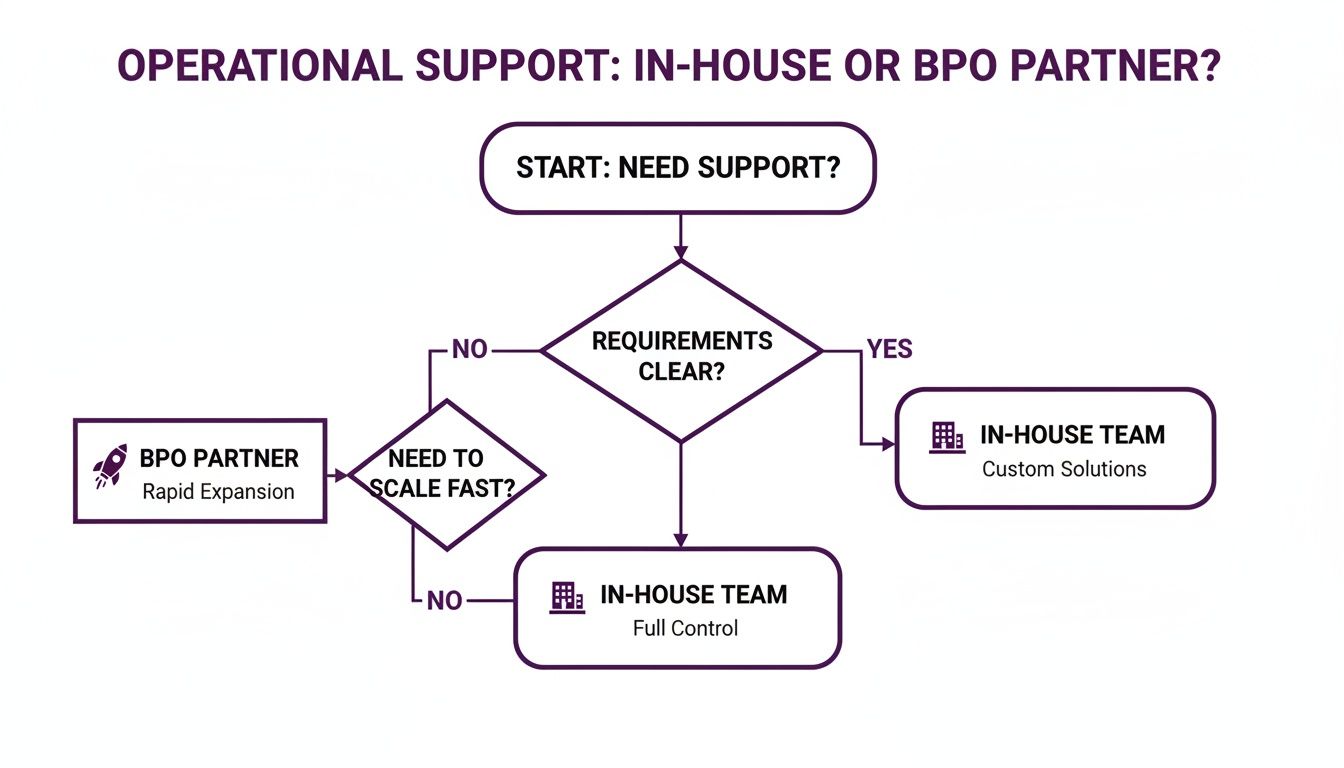
The takeaway? When you need speed, specialized skills, or the ability to scale on a dime, a BPO partner is your best bet.
How Do You Guarantee Data Security with a Remote Team?
This is a big one, and for us, data security is completely non-negotiable. It’s a core pillar of how we operate, and we protect your data with a combination of strict compliance, smart tech, and disciplined agent protocols.
Robust security isn’t just a promise; it’s a system. We combine secure-by-design technology with continuous agent monitoring and training to protect your data at every touchpoint.
Our security framework is layered. We use secure VPNs, endpoint protection on all devices, and granular access controls to ensure data is only seen by those who need to see it. On top of that, our agents get continuous training on data privacy standards like PCI and HIPAA. Every interaction is monitored through our QA platforms to ensure 100% compliance.
How Quickly Can We Launch a Remote Team of Customer Service Agents?
This is where working with a BPO partner really pays off. If you were to build an in-house team from scratch, you’d be looking at months of recruiting, hiring, training, and tech setup. It’s a huge undertaking.
With a specialized partner like CallZent, you can get a fully trained and operational remote team up and running in a matter of weeks.
We already have a pipeline of vetted, skilled agents and a battle-tested onboarding process ready to go. This speed allows you to solve your support needs almost instantly, turning what could be a major operational headache into a fast, effective solution.
🚀 Ready to Transform Your Customer Support?
Partner with CallZent to access bilingual remote agents, reduce costs, and scale your operations with confidence.
Schedule a CallReady to see how quickly a dedicated team of remote customer service agents can elevate your business? At CallZent, we build custom support solutions that drive growth. Contact us today for a free consultation.