Skip to content
Customer Support Technology
SaaS Help Desk Solutions:
The Future of Smarter Support
Discover how SaaS help desk solutions streamline customer support with automation, AI, and collaboration tools that empower modern businesses to scale smarter.
TL;DR — Quick Takeaways
- SaaS help desk solutions centralize multi-channel customer support into one system.
- Automation and AI reduce manual tasks and improve efficiency.
- Key features include ticketing, knowledge bases, and reporting dashboards.
- Integration with CRM tools creates a seamless customer experience.
Is your team still trying to manage customer support from a chaotic, overflowing email inbox? It feels like an air traffic controller trying to land planes without a radar—requests get lost, responses are delayed, and pretty soon, you have a lot of unhappy customers. This is where SaaS help desk solutions come in, acting as the command center that brings order to the chaos.
Why Modern Businesses Need SaaS Help Desk Solutions
Picture this: a customer emails you with an urgent problem. At the exact same time, another DMs you on social media, and a third calls your support line. Without a central system, each of these conversations is stuck in its own silo. The email gets buried, the social media message is missed for hours, and the phone call details? They live only in the head of the agent who took the call. It’s a recipe for disaster.
A SaaS help desk changes the game by acting as a single, unified hub for every customer conversation. It grabs every email, social media message, phone call, and live chat, then neatly organizes them into tickets on one dashboard. Nothing falls through the cracks. Ever.
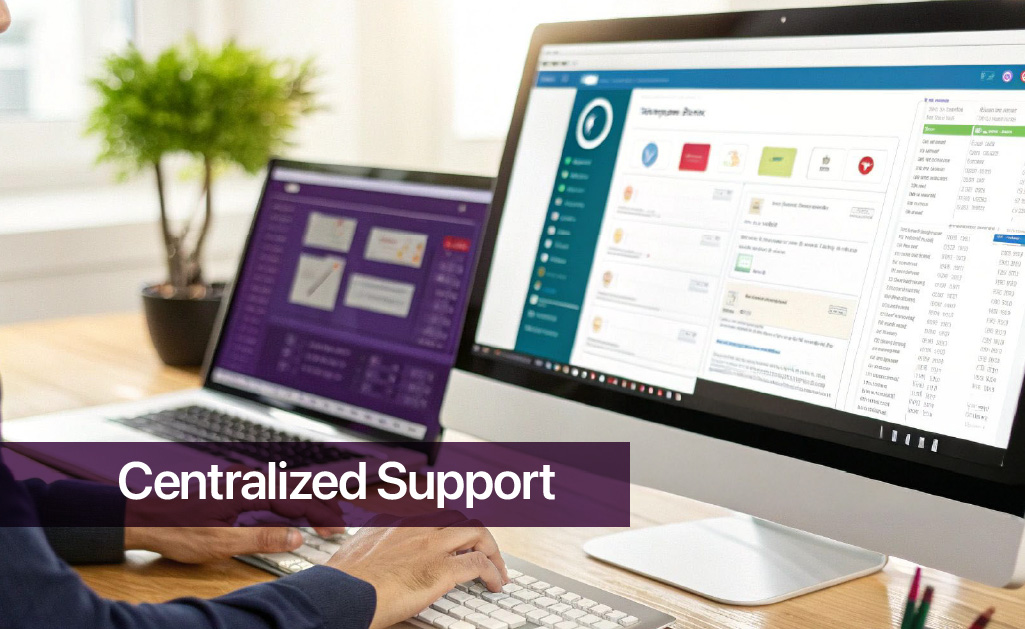
From Scattered Inboxes to a Centralized Command Center
Making the switch from manually tracking support issues to using a real help desk platform isn’t a luxury anymore—it’s essential for any business that wants to grow. The numbers tell the story. Back in 2016, only about 26% of customer service teams were using dedicated help desk software. Fast forward to 2024, and that figure has jumped to 53%. That’s a 103% increase in just a few years, all because businesses need to work smarter and keep customers happy. Discover more insights about help desk trends on desku.io.
This shift delivers real, immediate benefits that you can feel across your entire operation. Key advantages include:
- Complete Visibility: Every single interaction is tracked. Managers can finally see what’s going on, monitor agent performance, spot bottlenecks, and actually understand what customers are struggling with.
- Improved Efficiency: Automation takes over the grunt work. Things like routing tickets to the right person or sending status updates happen automatically, freeing up your agents to focus on solving the tough problems.
- Consistent Service Quality: With shared knowledge bases and pre-built response templates, every customer gets the same high-quality service, no matter which agent they talk to.
The True Cost of Inaction
Sticking with the old way of doing things has hidden costs that can seriously hurt a business. Your agents get burned out trying to keep up with the disorganized workflow, which leads to higher turnover. Even worse, bad customer experiences lead directly to churn. When people feel ignored or have to repeat their story to five different agents, their loyalty disappears in a flash.
A SaaS help desk solution is not just an IT tool; it’s a strategic investment in customer retention and operational excellence. It provides the structure needed to deliver fast, reliable, and personalized support at scale.
By centralizing all your communications and automating workflows, you give your team the power to do their best work—whether they’re in-house or a BPO partner like CallZent. This one foundational system can transform customer support from a messy cost center into a powerful engine for building relationships and driving your business forward.
What Core Features Define SaaS Help Desk Solutions?
To really get why SaaS help desk solutions are such a big deal, you have to look past the sales pitch and see what’s actually powering them. These core features aren’t just bullet points on a pricing page; they’re the gears that turn customer support from a chaotic mess into a smooth-running operation. Let’s break down what these tools actually do for you.
The absolute heart of any help desk platform is its ticketing system. You can think of it as the air traffic control for every single customer question. It grabs every request—whether it’s an email, a phone call, or a social media message—and turns it into a unique, trackable ticket.
This simple act of organizing everything is a game-changer. It’s the end of lost emails and forgotten DMs. Every customer issue gets logged, assigned, and tracked until it’s 100% solved. That’s the foundation of reliable support.
Strengths and Limitations of Email-Only Help Desk Solutions
Email-only help desk tools—think platforms like Gmelius—can be surprisingly powerful, especially for SaaS businesses that already rely heavily on Google Workspace or similar ecosystems. Instead of forcing your team to learn a brand-new tool, these solutions layer essential support features right into the Gmail inbox everyone already lives in. It’s a streamlined, low-friction way to bring order to chaotic customer emails.
The main advantages here are convenience and simplicity:
- Familiarity: Teams use the interface they already know, slashing onboarding time and minimizing friction.
- Collaboration: Features like shared inboxes, easy ticket assignment, and auto-routing (think round robin or load balancing) help keep everyone in sync—even as your support volume grows.
- Performance Tracking: Basic reporting and automated workflows (including AI-powered replies or sorting) bring a level of visibility and efficiency you’ll never get from regular email.
But there are some clear trade-offs to consider:
- Limited Channels: These tools are laser-focused on email—they typically don’t handle chat, social media, or offer a built-in knowledge base. If your customers want to reach you on every channel, you’ll hit walls quickly.
- Scalability: While perfect for small or early-stage SaaS businesses, email-only platforms can start to feel cramped as your support operations become more complex or your team diversifies.
- Customization: You may miss out on advanced automation, flexible workflows, or deep integrations that more robust help desk platforms provide.
In short, an email-first help desk can be a smart, pragmatic move for early-stage SaaS teams looking to get organized fast—just know there’s a ceiling when it comes to channel coverage and long-term scale.
The Power of a Unified Ticketing System
A ticketing system creates a single source of truth for every customer conversation. Instead of your agents fumbling around in separate inboxes, they get a shared dashboard showing every request, its status, and its history. This teamwork prevents two agents from accidentally working on the same problem and makes handoffs a breeze when an issue needs to be escalated.
Let’s paint a quick before-and-after picture:
- Before: A customer sends an urgent DM on Twitter about a billing mistake. The social media manager sees it hours later, takes a screenshot, and emails it to the general finance inbox. It gets buried. The customer is left hanging, getting more frustrated by the minute.
- After: That same Twitter DM is automatically converted into a high-priority ticket. The system’s rules engine instantly routes it to a billing specialist. They see the customer’s entire history in one click and fix the issue in minutes.
This is the kind of efficiency that defines great support. It’s also why our BPO agents at CallZent can slot so seamlessly into our clients’ workflows—we all work from the same playbook on a shared platform. To see how all the pieces fit together, you can dig deeper into our IT help desk solutions.
How Zendesk Supports Complex Organizational Workflows
Now, if you’re running a fast-growing SaaS company—or, frankly, any business with sprawling teams and layers of approval—you need a help desk platform that bends but doesn’t break. Here’s where Zendesk comes in swinging. Unlike a lot of more basic options, Zendesk is built to handle the nitty-gritty of enterprise operations.
What sets Zendesk apart is its ability to adapt to just about any workflow you throw at it. Whether you have dozens of teams spread across different countries or need airtight compliance for data privacy, there’s a solution baked in. Zendesk offers:
- Custom Workflows & Permissions: Tweak every stage of your support pipeline, from ticket routing to escalations, with role-based controls so only the right people see sensitive info.
- App Marketplace: Tap into a vast library of integrations—Slack, Salesforce, Jira, you name it—with over a thousand apps to plug into every corner of your stack.
- Rock-Solid Compliance: Enterprise standards like SOC 2, HIPAA, and GDPR are built-in, plus a global network of data centers to keep you covered wherever you operate.
- Deep Insights: Detailed analytics and journey dashboards so you can track every conversation, flag bottlenecks, and spot trends before they become headaches.
- Scalability: Whether you’ve got five agents or five hundred spread out worldwide, Zendesk keeps everyone working off the same, reliable playbook.
In short, Zendesk is engineered for businesses that refuse to let support operations slow them down, no matter how complex their org chart gets.
Empowering Customers with a Knowledge Base
While ticketing is all about managing issues that come in, a knowledge base is about stopping them from ever being created. This feature is essentially a self-service library—a central hub of FAQs, how-to articles, and troubleshooting guides that customers can use anytime, day or night.
When you empower customers to find their own answers, you slash the number of routine tickets your agents have to deal with. That frees them up to tackle the complex, tricky problems that actually need a human expert.
A well-stocked knowledge base is one of the most impactful features you can have. It makes customers happier and your support team more efficient at the same time.
And it’s not just for customers. A great knowledge base is a secret weapon for your internal team, too. New hires can use it to get up to speed fast, and veteran agents can reference it to make sure the advice they give is always consistent and accurate.
Meeting Customers on Their Turf with Multi-Channel Support
People today expect to reach you on whatever channel they feel like using, whether that’s email, phone, live chat, or social media. A standout feature of modern SaaS help desk solutions is multi-channel support, which pulls all of these different conversations into one place.
This means an agent can see a customer’s recent email, their live chat from yesterday, and their tweet from last week, all neatly organized in the same ticket thread. Having that 360-degree view is how you deliver truly personal and effective support. Customers don’t have to repeat their life story every time they switch channels, creating a seamless experience that builds real loyalty and trust.
Driving In-App Engagement and Proactive Support
Let’s talk about one of the most compelling shifts in SaaS customer support: meeting your users right inside your product, exactly when and where they need you most. Modern help desk platforms like Intercom, Zendesk, and Freshdesk have embraced this approach, making proactive engagement a core part of the support experience.
With features like in-app messaging, these solutions let you send personalized messages, offer guided onboarding tours, or launch interactive tutorials—all within the product interface. Instead of waiting for customers to run into trouble and open a support ticket, you can anticipate their needs and offer help before they even know they need it.
Here’s how leading platforms make it work:
- In-App Messaging: Trigger helpful pop-ups, hints, or chat prompts as customers navigate your product. This could mean nudging new users through setup or surfacing tips for advanced features just when they become relevant.
- Intelligent Chatbots: AI-powered bots (like Intercom’s Fin or Zendesk’s Answer Bot) provide instant, context-aware answers right inside the app. That means faster resolutions and round-the-clock assistance, even when your team is offline.
- User Segmentation & Targeting: Segment users by behavior, plan, or lifecycle stage to serve up just-the-right messages or onboarding flows. Want to help free-tier users discover paid features? Or guide new customers through their first login? The right help desk tools let you automate those touchpoints.
- Guided Product Tours: Step-by-step walkthroughs reduce friction for first-time users and drive product adoption. They also cut down on repetitive “how do I…?” tickets, freeing up your human agents.
- Unified Conversation History: Agents can see every in-app chat, email, or conversation in one thread, so nobody’s left piecing together the puzzle from three different tabs.
This proactive style doesn’t just resolve issues—it turns support into a driver for product retention and growth. Engage customers before frustration sets in, and you’ll build loyalty while keeping routine requests off your team’s plate.
With these tools in your arsenal, you’re not just reacting to problems—you’re designing smooth, intuitive experiences that keep customers moving forward.
Integrating with Modern Communication Channels
Now, let’s talk about how today’s leading help desk platforms play nicely with the many places your customers and team already hang out—think Slack, Microsoft Teams, Discord, and good old-fashioned email.
Most SaaS-focused help desk tools make channel integration their bread and butter. Instead of forcing every conversation into a rigid email ticket, these solutions flex to meet you (and your customers) wherever you work. Here’s how they do it:
- Unified Inboxes: Modern platforms pull messages from chat apps like Slack and Teams, social channels like Twitter, and traditional email, consolidating everything into one streamlined dashboard. No more tab-hopping or missing messages in a sea of notifications.
- Direct Channel Support: Instead of redirecting your users from Slack or Discord to email, some solutions let your team respond right inside those workspaces. Customers never have to leave the tools they already love, making support frictionless and immediate.
- Automated Routing: With built-in automations, conversations from each channel can be instantly assigned to the right team or agent—whether it’s a billing question from Teams, a bug report in Slack, or feedback via email.
- Developer-Friendly APIs: For teams wanting custom workflows, API-first help desk platforms let you deeply embed support inside your product, pipe messages in from anywhere, or push notifications out to tools like Jira or GitHub.
- Omnichannel Context: The magic happens when an agent can see the entire customer journey—whether it started as a Discord DM, continued via email, and wrapped up on Teams—all in a neatly organized conversation thread.
The upshot? Instead of juggling five different tools, you get a single workspace that brings every conversation together. Your agents stay organized, nothing falls between the cracks, and your customers get fast, personal replies—wherever they reach out.
This tight channel integration isn’t just nice-to-have; it’s the engine behind modern, responsive SaaS support. And it’s a big part of what makes these platforms a game-changer for scaling teams.
Top Help Desk Software Picks for SaaS in 2025
So, what should you be looking at if you’re shopping for help desk software this year? The landscape for SaaS companies in 2025 is full of robust options tailored to different needs—whether you want plug-and-play simplicity, developer-level customization, or even seamless integration with tools like Slack or Gmail.
Here’s a quick rundown of the standout platforms making waves:
- For teams focused on ease of use and affordability: There are platforms with intuitive interfaces and straightforward pricing, perfect for fast-moving support teams that don’t want to spend weeks in training.
- If you live in Slack or Teams: Some solutions are built to bake support right into your favorite collaboration tools, so your agents never need to juggle a dozen tabs.
- Dev-first environments: Look for help desks that offer deep API access, custom workflows, and a no-nonsense approach—these are gold for developer-driven teams that want flexibility above all else.
- Craving the AI advantage? Several platforms now come with smart AI features, from automated ticket classification to suggested replies, which seriously boost agent productivity.
- Managing the whole customer journey: Some help desks double as customer lifecycle management tools, helping you stay on top of every touchpoint from onboarding to renewal.
- In-app engagement pros: If chatbots, pop-up guides, and seamless in-app communication are on your wishlist, there are solutions built just for that.
- Teams hooked on Gmail: Yes, there’s even help desk software that feels like an extension of your inbox, keeping things familiar while adding powerful ticketing features.
- Need to support thousands of users? Enterprise-grade help desks offer scalability, security, and advanced analytics—everything you need to keep complex operations running smoothly.
With these choices, there’s never been a better time for SaaS companies to find a help desk that’s the perfect fit for their workflow and customer base.
Supporting Customers Where They Already Work: Slack, Teams, and Beyond
But what if your SaaS customers prefer chatting in Slack or Teams over sending emails or filling out web forms? For teams that want to meet users right where they collaborate, there are help desk solutions purpose-built for this style of support. Instead of turning every question into a traditional email ticket, these tools embed your support experience directly into platforms like Slack, Microsoft Teams, and even Discord.
With these solutions, there’s no need to nudge users out of their workflow or ask them to visit a separate support portal. Agents can field customer issues, monitor conversations, and even surface context—such as recent activity, renewal dates, or product usage—all from a single dashboard. AI-powered features like instant triage, reply suggestions, and dynamic knowledge surfacing make it easy for teams to stay efficient while still delivering that high-touch, personal experience.
Why might this matter for your SaaS company?
- Reduced friction: Customers stay in their preferred workspace to get help, making the support process feel like a natural extension of their daily tools.
- Centralized insights: Agents get real-time access to usage stats, health scores, and open issues without toggling between tabs or systems.
- AI assistance: Modern platforms can draft replies, suggest knowledge base articles, or generate custom reports—sometimes simply by asking a question.
- Omnichannel reach: Besides Slack and Teams, many of these platforms handle email and chat, consolidating everything into one unified view.
And because regulatory requirements are never far from mind, these solutions often come with the gold standard in compliance—think SOC 2, ISO 27001, HIPAA, and GDPR—so you can scale support with peace of mind.
In short, if your customers live in collaborative platforms, your support should, too. The right help desk for these channels brings all the structure and insight of a traditional ticketing system, but with the effortless user experience people now expect right inside their chat apps.
Supercharging Your Support with Third-Party Integrations
Another unsung hero in the world of modern SaaS help desk solutions is the sheer power of third-party integrations. Imagine being able to plug in tools like Slack, Salesforce, Shopify, or even Jira—right into your support platform. That’s the reality with leading solutions like Zendesk and similar platforms.
What’s the big deal? Integrations let you:
- Customize your workflow to fit unique business needs, whether you’re a five-person startup or wrangling support across continents.
- Automate repetitive tasks—think syncing sales data, pulling in purchase history, or escalating tickets to engineering—all without switching tabs or copying info from one system to another.
- Extend support platform capabilities by tapping into a huge marketplace of specialized apps, covering everything from customer surveys (SurveyMonkey, Typeform) to advanced analytics (Google Analytics, Power BI) and payment solutions (Stripe, PayPal).
The result? You get a support operation that’s not just organized, but also tailored to the way your team works best—boosting both speed and customer satisfaction.
Why Zendesk Stands Out for Enterprise-Scale SaaS Companies
For SaaS businesses playing on the big stage—think multiple teams, multi-region support, and bulletproof compliance—a platform like Zendesk comes into its own. It’s not just a help desk; it’s a command center designed for complex operations and stringent industry standards.
Here’s what lifts Zendesk above the crowd for enterprise-level SaaS:
- True Omnichannel Muscle: Zendesk unifies conversations from email, chat, phone, and social media into a cohesive thread, no matter where your customers are reaching out from. That means your global support teams always have the full picture at their fingertips.
- Compliance You Can Count On: Heavily regulated industry? No sweat. With options for SOC 2, HIPAA, and other compliance essentials, Zendesk gives large-scale SaaS companies peace of mind (especially handy if you’re dealing with sensitive data or operating in healthcare or finance).
- Integration Galore: Over 1,500 integrations and apps? Check. This let’s you connect the dots between your favorite CRM, analytics, project management tools, and, honestly, just about everything else you use to run your business.
- Custom Workflows for Every Scenario: Big companies rarely work “out of the box.” Zendesk offers workflow customization and automation that adapts to even the most labyrinthine org charts—so whether you’re routing high-priority tickets or rolling out new processes across global teams, the platform bends, never breaks.
- Crystal-Clear Analytics: The built-in reporting and analytics aren’t just for show; they let you spot bottlenecks, monitor service quality across regions, and get ahead of emerging trends before they become issues.
- Scalability: Whether you’re doubling in size or rolling out support in a new country, Zendesk’s infrastructure is built for growth. It’s the kind of reliability that means you don’t outgrow your own help desk tech.
Of course, all this power brings a bit of a learning curve—and smaller teams might feel buried in features they’ll never use. But for enterprise SaaS firms, that depth is exactly why Zendesk makes sense. When you need robust functionality, rock-solid uptime, and a support experience you can standardize at scale, Zendesk delivers the goods.
How AI and Automation Are Changing the Game in Customer Support
Artificial intelligence and automation are no longer just fancy buzzwords; they’re the engine room for top-performing customer support teams. These tools aren’t here to replace human agents. Instead, they supercharge their abilities, freeing them up to focus on what people do best—tackling tricky problems and building real customer relationships.
Modern SaaS help desk solutions bake AI and automation right into their core to take on all those repetitive, soul-crushing tasks. This shift completely changes how support teams work, moving them from a reactive “firefighting” mode to becoming proactive champions for their customers.
Smarter, Faster Support with AI-Powered Tools
Take Zendesk as a real-world example of AI in action. They’ve woven AI into nearly every step of the support journey:
- Ticket Intelligence: Their system can automatically sort, categorize, and prioritize incoming tickets—no more sifting through mountains of requests by hand.
- Agent Assist: Need a quick draft reply? Zendesk’s AI can suggest responses on the fly, flag the urgency of an issue, and even detect the true intent behind a customer’s message.
- Trend Spotting: Managers get powerful dashboards that use AI to highlight recurring issues and spot patterns across huge volumes of conversations.
The upshot? Enterprise support teams can move at lightning speed and respond consistently, even as ticket volume swells. This does mean putting in some initial effort to fine-tune the setup, and it’s worth noting that some of the more advanced AI features are packaged as add-ons. But for SaaS businesses aiming for best-in-class support, these AI-powered boosts are a serious game-changer.
The Rise of Smart Self-Service and Chatbots
One of the most obvious ways AI shows up is with intelligent chatbots. Forget the clunky, frustrating bots from a few years ago. Today’s AI-powered chatbots can actually understand what people are asking, pull answers from knowledge bases, and solve common issues on the spot, 24/7. To really get a feel for how this works, it helps to understand the tech behind it, like conversational AI. You can dig deeper with this great explanation of What Is Conversational AI and How It Works.
Getting an instant answer around the clock is a massive win for customer happiness. It also means your human agents don’t have to spend their day answering the same questions like “Where’s my order?” or “How do I reset my password?” for the hundredth time.
Automating the Grunt Work Out of Support
Beyond the customer-facing bots, automation is the unsung hero working tirelessly behind the scenes. Automated workflows are the secret weapon for an efficient support operation, intelligently managing a ticket from the moment it comes in until it’s resolved, often without anyone lifting a finger.
Here’s what that looks like in the real world:
- Smart Ticket Routing: A new ticket comes in. Automation instantly scans its content and keywords to send it to the right person or team. An urgent email with the word “outage” can be automatically flagged as high-priority and shot straight to the tech support queue.
- Automated Status Updates: Instead of an agent manually typing, “We’re on it,” the system can fire off automatic updates to customers as their ticket progresses. This keeps them in the loop and cuts down on “just checking in” emails.
- SLA Management: Automation acts like a watchdog for your service level agreements (SLAs). It can automatically escalate tickets that are about to miss their deadline, ensuring you always respond on time.
The results speak for themselves. As of 2025, over 40% of initial customer interactions are handled by AI, and machine learning can increase a service desk’s capacity by up to 30%. Good chatbots can resolve up to 80% of routine questions, and all this automation saves agents an average of 25% of their time.
A Real-World Example from E-Commerce
Picture an online store during the madness of a holiday sale. In past years, their small support team was completely buried under an avalanche of questions about shipping, returns, and order status. Wait times shot up, and customers got angry.
This year, they switched to a SaaS help desk solution packed with AI and automation. An AI chatbot on their site handled thousands of common questions instantly, deflecting a huge chunk of their ticket volume. Meanwhile, automated workflows sorted incoming emails, making sure the truly critical issues—like a loyal customer with a damaged delivery—got escalated right away.
The difference was night and day. The support team wasn’t just surviving; they were delivering amazing, personal service to customers with complex issues, building even more loyalty during their most chaotic season.
This is the perfect snapshot of what these tools can do. It makes it crystal clear how automation and artificial intelligence in call centers are essential for growing your support without letting quality slip. By letting the machines handle the predictable stuff, you empower your people to shine where it really matters.
A Practical Guide to Choosing Your Help Desk Solution
Picking the right SaaS help desk solution can feel like a massive decision—because it is. This platform will become the central hub for your entire customer service operation. But don’t let the pressure get to you. With a clear, structured approach, you can easily find a solution that fits your business like a glove.
The first step is always to look inward. Seriously, before you even glance at a vendor’s flashy website, take the time to map out your current support processes. How are tickets coming in? Who’s handling them? What are the biggest roadblocks slowing your team down right now?
When you understand your unique workflow, you get a crystal-clear picture of what you actually need. Don’t get distracted by a laundry list of features you’ll never touch. The goal is to find a tool that solves your real, day-to-day headaches.
Key Criteria for Evaluating SaaS Help Desk Solutions
Once you know what you’re solving for, you can start looking at potential platforms. While every business has its own quirks, there are a few non-negotiable criteria that should guide your decision. A great solution is more than just a ticketing system; it’s a partner that helps you grow.
Your evaluation should really zero in on these three pillars:
- Scalability for Future Growth: The tool that works for your five-person team today has to work for your fifty-person team tomorrow. A truly scalable platform grows with you, making it painless to add agents, open new support channels, and handle a growing mountain of tickets.
- Crucial Integration Capabilities: Your help desk doesn’t live on an island. It needs to play nicely with your other critical tools, especially your CRM. When your help desk and CRM are talking to each other, your agents get a full 360-degree view of the customer, giving them all the context they need to provide truly personal support.
- User-Friendliness for Rapid Onboarding: The most powerful software in the world is completely useless if your team finds it too confusing to use. Look for a clean, intuitive interface that your agents can pick up quickly. This cuts down on training time and lets your team start helping customers from day one.
But don’t stop there—there are a few more make-or-break factors you’ll want to weigh as you compare options:
Additional Factors to Consider
- Customer Channels: Ask yourself: Where do your customers actually reach out? Are they sending emails, pinging you on Slack, DMing on social, or opening tickets right inside your app? The right solution should make it easy to meet customers wherever they are—not force them to change their habits.
- Team and Company Maturity: Startups often crave simplicity and speed, while larger or more established teams may demand robust customization, deeper analytics, or compliance support. Be honest about where you are today and where you’re headed.
- Compliance Needs: If you’re operating in a regulated industry or handling sensitive data—think HIPAA, GDPR, or SOC 2—make sure your help desk checks the compliance boxes so you don’t run into surprises down the road.
- Pricing Model: Don’t let sticker shock catch you off guard. Some tools charge per user, others by team or by contact volume. The best pricing model will map to your growth plans and the way you support your customers.
This graphic breaks down a simple decision-making process for routing customer inquiries—deciding when an AI chatbot can handle it versus when it needs a human touch.
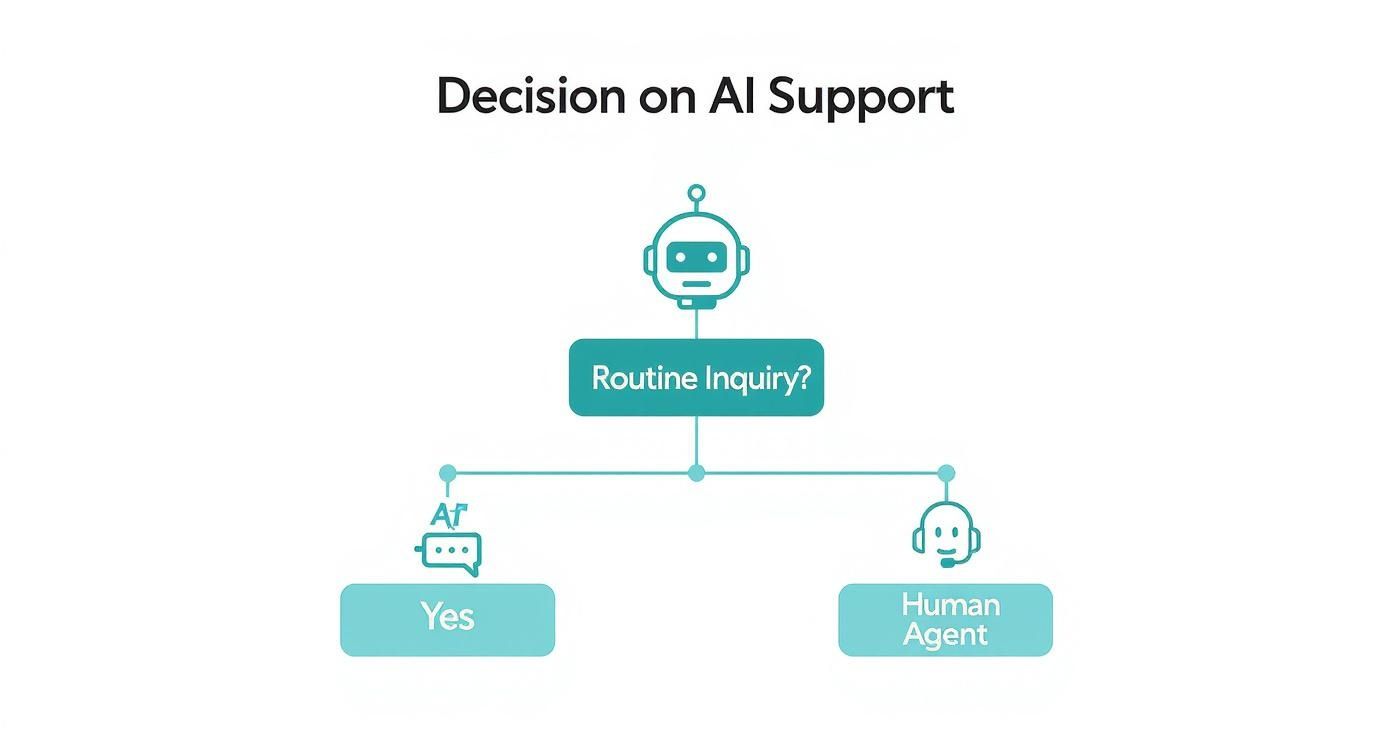
The big takeaway here is that a well-designed help desk system does the heavy lifting of triage for you, sending routine questions to automated systems and saving your skilled agents for the complex issues where they shine.
Aligning Your Help Desk Choice with Team Skills and Company Growth
Here’s where things get interesting: the “right” SaaS help desk isn’t one-size-fits-all—it depends heavily on both your team’s skillset and your plans for the future.
If your company runs lean and your team is mostly non-technical, you’ll want software that’s intuitive right out of the box. Look for platforms that keep things simple, serve up clean dashboards, and don’t require a three-week boot camp to get started. Shared inboxes, drag-and-drop automations, and built-in templates are your friends.
On the other hand, if you’ve got a savvy, technically-minded crew (think developers who love to tinker), you might need deeper customization. Robust APIs, advanced workflow builders, and options to tailor the system to your exact way of working become essential. The best solutions here let your team push the boundaries—integrating with everything from Slack and Jira to bespoke internal tools.
Scalability is the second pillar. Maybe you’re a small team today, but your growth plans are bold. Make sure your help desk can keep pace as you scale—whether that means handling an influx of international users, adding complex roles and permissions, or meeting heightened security standards (hello, SOC 2 and GDPR). Don’t let your support backbone become a bottleneck as you level up.
Ultimately, the key is honesty about your current technical comfort zone and where you’re headed. Choose a desk that matches your reality now, but won’t hold you back when your ambitions get bigger.
Best Help Desk Tools for Developer-First SaaS Teams
If your company is run by engineers—with support deeply tied into your product and technical ecosystem—you need a very different sort of help desk solution. For these teams, flexibility, programmability, and seamless tech stack integration aren’t just nice-to-haves; they’re essential.
A developer-first help desk empowers your team to:
- Build highly custom workflows via robust APIs, letting you tailor every aspect of the support process.
- Integrate directly with tools your developers live in—think GitHub, Linear, Jira, Slack, Teams, and Discord—so nothing slips through the cracks.
- Embed support experiences right inside your app, shaped by your own code and surface, rather than just a vendor’s interface.
- Leverage AI-powered triage and automated routing to keep the flood of messages organized and ensure engineers only see the tickets that matter.
What does this look like in practice? Imagine a support platform where every feature is programmable. Your engineers can automate repetitive tasks, design unique ticket sorting logic, and even trigger escalations based on real-time product data. Instead of being forced into a prebuilt workflow, you’re handed the keys to make the system work the way your team works best.
These tools typically offer:
- API-first architecture for ultimate customization
- Unified inboxes spanning chat, email, and dev channels
- Built-in connections to developer staples like GitHub, Linear, and Jira
- Minimal, distraction-free interfaces designed with technical users in mind
- AI-assisted routing to maximize team efficiency
One caveat: This power comes with a trade-off. Non-technical teams might find these platforms less intuitive, as their real magic is unlocked through engineering muscle.
If your support team is made up of product-savvy engineers, or you want to deeply embed customer support in your development process, choosing a developer-first help desk platform will set you up for scalable, seamless support operations down the road.
Matching the Solution to Your Business Size
The market for SaaS help desk solutions is huge, with options built for scrappy startups and massive global enterprises. What works for one would be a disaster for the other. Knowing the key differences between these categories is the secret to narrowing down your search.
Small business tools are all about simplicity and affordability. They give you the core essentials—like ticketing and a knowledge base—in one easy-to-use package. Enterprise platforms, on the other hand, are built for complexity. They offer things like advanced security, deep customization options, and the power to manage intricate support operations across the globe.
To make this a little clearer, here’s a table breaking down what separates solutions for small businesses from those built for the enterprise crowd.
Comparing SaaS Help Desk Solutions for Different Business Sizes
| Consideration | Small Business Solutions | Enterprise Solutions |
|---|---|---|
| Primary Focus | Simplicity, ease of use, and quick setup. | Advanced features, deep customization, and robust security. |
| Key Features | Essential ticketing, basic automation, shared inbox, knowledge base. | Multi-brand support, advanced analytics, AI-powered workflows, and compliance management. |
| Ideal Use Case | Teams needing a centralized system to move beyond a shared email inbox. | Large organizations requiring a powerful platform to manage complex, high-volume support operations. |
| Pricing Model | Often includes a free tier or low-cost per-agent monthly plans. | Custom pricing based on extensive feature sets, support needs, and agent count. |
Pricing Models: What Really Scales?
- Per-user, team-based, or contact-based pricing can dramatically impact how your help desk solution grows with you. Think about your support model and customer base: Are you a lean team supporting thousands of users, or a large group managing a select group of high-touch clients? If you anticipate rapid growth or seasonal spikes, contact-based pricing may be more predictable. Team-based pricing is often attractive for startups hoping to keep things simple, while per-user pricing can make sense for organizations that want precise control over costs as they scale.
At the end of the day, remember this: the right choice isn’t about finding the platform with the most features; it’s about finding the platform with the right features for you.
Ultimately, your selection should be driven by data. As you weigh your options, make sure you’re tracking the right metrics to see how your team is performing and where you can improve. You can get a head start by learning more about the key customer service performance indicators every support leader should have on their dashboard. Making a smart, informed choice now will pay off for years to come in the form of happier customers and a much more efficient team.
Comparing the Unique Advantages of Top SaaS Help Desk Solutions
With so many SaaS help desk options out there, it’s easy to feel overwhelmed by all the feature lists. Instead, let’s zoom in on what actually sets each platform apart—and more importantly, the kinds of teams and scenarios where each really shines.
Help Desk Solutions Made for Seamless Onboarding and Simplicity
If your priority is getting up and running fast with a tool that doesn’t require a PhD to operate, there are platforms built for ease of use and cost-effectiveness. These are tailor-made for lean SaaS teams or startups that want to move on from a basic shared email inbox without inheriting the complexity of old-school enterprise solutions. Look for systems that blend intuitive interfaces with just the right amount of scalability, so you can start small and add new support channels or workflow automation as your business evolves.
Ideal for: Early-stage teams, rapid onboarding, and keeping overhead low.
Slack and Teams Integration for Real-Time Support
For SaaS companies that live and breathe inside digital collaboration tools, certain help desk platforms go beyond email to provide support directly within Slack, Microsoft Teams, or Discord. These tools remove the friction of switching between applications and allow agents to jump into conversations where customers already spend their time. Many of these solutions also bring AI-driven triage and custom reporting, so customer context is consolidated—and actioned on—in real time.
Ideal for: Teams providing high-touch service and quick responses within modern chat platforms.
Developer-First Customizability
Engineering-driven SaaS businesses often want support workflows as flexible as their codebase. Some help desks are built API-first, giving technical teams the freedom to program custom integrations, deeply embed widgets inside their product, and automate just about everything. With a minimalist UI and direct integrations with developer tools, these platforms trade user-friendliness for sheer programmable power.
Ideal for: Technical, developer-led organizations looking to build completely customized support stacks.
Advanced AI to Power Customer Conversations
If your goal is to blend the familiarity of traditional channels like email with next-gen AI assistance, some modern help desks stand out for their AI-augmented collaboration features. These platforms equip agents with tools to summarize conversations, automate simple replies, and even surface quality trends—freeing up your team’s time for more valuable, complex tickets.
Ideal for: SaaS organizations balancing fast, consistent responses at scale with a personal touch.
Deep CRM and Lifecycle Integration
Some platforms take customer support a step further, tying every interaction to a single CRM and giving your team visibility into the entire customer journey—from marketing to renewal. These solutions allow you to connect support metrics directly to revenue impact, with AI-powered personalization and extensive marketplace integrations for automating workflows across your business.
Ideal for: Teams already invested in a unified CRM ecosystem who want support tightly woven into sales and marketing.
In-App Messaging and Product-Led Growth
For SaaS companies focused on in-app engagement, the best help desk solutions enable contextual messaging, onboarding flows, and automated bots right inside your product. Rather than relying on customers to open a ticket, you can guide, educate, and support users before they ever realize they need help. With robust targeting and behavioral segmentation, these tools turn support into a lever for product adoption and retention.
Ideal for: Product-led growth teams driving user engagement directly inside their applications.
Gmail-Native Simplicity
Finally, if your team already spends their day in Gmail and doesn’t want to learn a brand new interface, there are platforms designed to layer ticketing, collaboration, and workflow automation on top of your existing inbox. These solutions are especially handy for early-stage SaaS startups seeking a no-fuss transition from lone-wolf email support to a shared, trackable system.
Ideal for: Startups using Google Workspace, or teams needing a simple, Gmail-integrated ticketing workflow.
No matter which direction you go, focus on aligning the platform’s core strengths with your team’s real-world habits—so your help desk becomes an engine for better service, not just another shiny tool.
The Challenges of Complex Platforms for Small Teams
But there’s a flip side to all those advanced capabilities—sometimes, more isn’t better, especially for growing SaaS companies. Platforms known for their depth, like Zendesk, pack in a dizzying array of features, configurations, and automation rules. While this can be powerful for a sprawling enterprise, small teams often find themselves wrestling with an overwhelming number of options.
For many, navigating complex triggers and automations can become a time sink, with steep learning curves and a real risk of accidental misconfigurations. Instead of empowering your agents, an overly complicated toolset can slow everyone down, introduce extra costs, and crowd out the straightforward workflows your business needs.
If your goal is speed, clarity, and getting new agents productive fast, it pays to think twice before embracing a platform designed for heavyweight operations. Sometimes, keeping it simple is the real power move.
Unifying Your BPO Partnership with the Right Software
Which Help Desk Platforms Fit Startups, Enterprises, and Technical Teams?
Just as there’s no one-size-fits-all in running a business, the help desk platforms that work for scrappy startups are a world apart from those that power sprawling enterprise support teams—or satisfy the pickiest developer crowd.
- Startups: If you’re bootstrapped, lean, or founder-led, simplicity is your best friend. Platforms like Zendesk or Freshdesk offer straightforward ticketing, a shared inbox, and easy setup—perfect for keeping costs down and getting customer support up and running without an IT degree. These are built for teams that want the basics to “just work” so they can focus on growth, not extensive configuration.
- Enterprises: For organizations supporting massive user bases or juggling multi-brand operations, tools like Salesforce Service Cloud or ServiceNow bring robust security controls, advanced automations, compliance options, and the ability to integrate deeply with existing business systems. These solutions scale with you and help keep even the most complex support operations humming along.
- Technical Teams and Developer-Led Companies: Sometimes, you need a platform as customizable as your own product. For businesses that prioritize flexibility and integrations, look for tools like Jira Service Management or Zendesk (with open APIs) that offer granular configuration, developer-friendly documentation, and plenty of opportunities to build out workflows, automations, and custom dashboards.
The bottom line: Match your help desk software to your business’s current size and your team’s technical appetite. Consider how much you want to customize, what integrations you need, and the level of reporting or compliance required. Knowing your priorities up front makes it much easier to find the platform that will grow with you—and keep those support headaches at bay.
Unifying Your BPO Partnership with the Right Software
Choosing to bring on a Business Process Outsourcing (BPO) partner is a huge strategic move. But the success of that relationship often boils down to one thing: the technology connecting your teams. The right SaaS help desk solution acts as the bridge that turns a simple vendor agreement into a true, seamless extension of your company.
Think of this software as the central nervous system for your entire support operation. It creates a single, shared workspace where your in-house staff and your nearshore BPO team operate as one unit. Suddenly, there are no information silos and no “us versus them”—just one team driving toward the same goal: delivering fantastic customer experiences.
Creating a Seamless, Integrated Support Team
When your BPO partner logs into the exact same platform as your internal team, the physical distance between you simply melts away. This kind of integration delivers real, tangible benefits that you’ll see in your efficiency and quality metrics.
Here’s what that looks like in practice:
- Streamlined Onboarding: New agents at a BPO location get up to speed incredibly fast. They’re tapping into the same knowledge base, macros, and ticket history as your veteran employees, making sure they absorb your processes and brand voice from day one.
- Consistent, Unified Reporting: All your performance data—from first response time to customer satisfaction scores—is tracked in one place. You get a complete, transparent view of your entire support operation, making it easy to spot trends and identify areas for improvement across every team.
- A Single Brand Voice: With shared templates and a unified knowledge base, every single customer interaction is consistent. It doesn’t matter if the agent is sitting in your headquarters or at a nearshore location like CallZent in Tijuana; the customer gets the same high-quality, on-brand support every single time.
A Practical Example of BPO Integration
Imagine a fast-growing e-commerce company in the U.S. that’s struggling to keep up with customer inquiries. They decide to partner with CallZent to bring our bilingual support agents into the mix. Before making the leap, it’s smart for them to weigh all the advantages and risks of outsourcing to make a truly informed decision.
Once they decide to move forward, the integration is surprisingly simple. The company just grants our agents access to their existing SaaS help desk. Immediately, our team in Tijuana is on the exact same page.
When a customer ticket comes in, it’s handled based on skill and availability, not location. Every note, every escalation, and every resolution is logged in the shared system, creating a completely transparent workflow.
This setup lets the client’s managers see our agents’ performance in real-time, right alongside their in-house team. The customer never knows the difference; they just get fast, effective support. That’s the power of using modern SaaS help desk solutions to unify your BPO partnership.
By investing in the right platform, you lay the foundation for a successful, scalable support strategy. To see how this integration works firsthand, learn more about our flexible customer service outsourcing solutions and how we become a tech-enabled extension of your team.
Tying It All Together: Your Help Desk and the Future of Support
To really get why a modern help desk is so crucial, you have to zoom out and look at the bigger picture. The boom in SaaS help desk solutions isn’t happening in a bubble. It’s a direct result of the explosive growth of the entire Software as a Service world. Think about it—businesses today run on a whole collection of cloud-based tools, from accounting and payroll to project management and marketing.
As companies lean more and more on this cloud software stack, a central hub for support shifts from a “nice-to-have” to an absolute necessity. It’s the mission control center that connects all the moving parts, making sure your customer-facing teams have everything they need to deliver in a pretty complex digital environment.
Why SaaS Support Isn’t Like Anything Else
Supporting customers in SaaS is a whole different ballgame compared to traditional service industries. Instead of just cranking through a high volume of simple, transactional tickets, you’re dealing with customers who rely on your software to run their business. That means:
- Complex Issues: Support isn’t just about password resets or basic troubleshooting—customers come to you with nuanced, multi-faceted problems that often require digging into the specifics of their configuration.
- Multiple Stakeholders: You’re not just talking to one person per customer; you might work with entire teams, each with their own needs and levels of technical know-how.
- Unique Environments: No two customers use your SaaS in quite the same way. Customizations, integrations, and unique workflows are the norm, not the exception.
All of this means your support team needs powerful tools to keep track of every detail, collaborate seamlessly, and deliver answers that actually solve problems—not just close tickets. A modern SaaS help desk isn’t just about efficiency; it’s about empowering your team to tackle the real-world complexity your customers face every day.
More Than a Tool, It’s an Investment in Your Future
Putting money into modern support technology isn’t just buying software; it’s a strategic play that pays off big time in customer loyalty and lifetime value. When your support is quick, sharp, and consistent, customers don’t just stay—they thrive. They buy more, tell their friends about you, and become your biggest fans. Suddenly, customer service stops being a cost center and turns into a serious engine for growth.
The numbers don’t lie. The global SaaS market is on track to hit a staggering $299 billion by 2025. A huge slice of that pie is help desk automation, which is expected to jump from $6.14 billion in 2024 to $8.13 billion in 2025. And while big companies still account for over 60% of SaaS spending, small businesses are all in—by 2025, an estimated 85% will be running on SaaS solutions. You can read more about these market trends on statista.com.
Building Your Competitive Edge with SaaS Help Desk Solutions
In a market where customers have a million choices, the quality of your support is what makes you stand out. A solid help desk platform gives you the power to create the kind of seamless, personal experiences that build loyalty for the long haul. It makes sure every single interaction shows your customers that you’re committed to them.
Your help desk software is not just an expense; it’s a critical investment in building a sustainable competitive advantage.
This is doubly true when you bring a BPO partner into the mix. A shared SaaS platform means every agent—whether they’re in your office or at a nearshore center—is reading from the same script. This unified system is the foundation for a cohesive Contact Center as a Service customer engagement strategy and is key to delivering consistently great results.
When you start seeing your help desk as a strategic asset, justifying the investment becomes a no-brainer. You’re not just buying another piece of software; you’re future-proofing your customer relationships and cementing your place in a competitive, digital-first world.
Frequently Asked Questions About SaaS Help Desk Solutions
Diving into the world of SaaS help desk solutions is a big step, and it’s natural to have a few questions. Getting straight answers is the only way to feel confident you’re making a call that’ll pay off for your team and your customers down the line.
Let’s tackle some of the most common things business leaders ask us.
How secure is my customer data on a SaaS platform?
This is usually the first question people ask, and for good reason. The top SaaS providers live and breathe security—they often invest more in it than any single company could afford to. They rely on heavy-duty measures like end-to-end data encryption, airtight access controls, and frequent security audits to keep everything locked down.
On top of that, they’re compliant with major standards like GDPR and SOC 2. You should always ask a vendor for their security certifications, but you can be sure that reputable platforms make data protection their absolute top priority. Your information is incredibly safe.
How does Zendesk ensure compliance for regulated industries, such as SOC 2 and HIPAA?
Compliance is non-negotiable, especially when you’re working in healthcare, finance, or any highly regulated industry. Zendesk knows this and offers enterprise-grade features designed to meet even the strictest standards.
They support major compliance frameworks like SOC 2, HIPAA, and GDPR—ensuring your data remains protected and your operations above board, no matter where your customers are. Zendesk’s robust global infrastructure and dedicated data centers help companies stay in line with regional privacy laws, whether you’re serving clients in the EU, the U.S., or beyond.
Keep in mind, access to some advanced compliance features may require an enterprise-level plan. Always double-check which certifications and support come with each pricing tier so you know exactly what’s covered. In regulated spaces, this due diligence pays off with peace of mind and a rock-solid foundation for building trust with your clients.
Can we migrate data from our current system?
Absolutely. You shouldn’t have to start over from square one. Most modern help desk platforms come with built-in tools or offer hands-on support to get your existing data moved over. We’re talking about the important stuff, like:
- Customer contact details
- Full ticket and conversation histories
- Your entire knowledge base
A smooth switch hinges on a well-planned migration. Make sure to bring this up early with any potential vendor to see what the process looks like and what kind of help they offer.
What is the typical implementation time?
Honestly, this can range from just a few days to a few weeks. The real timeline depends on the size of your team and how complex your current support setup is.
A small team with simple needs? You could be up and running in no time. But if you’re a large company that needs custom integrations with a bunch of other systems, it’s naturally going to take a bit longer to get everything rolled out just right. Any good provider will give you a clear onboarding plan and be there to guide you through it.
🚀 Ready to Streamline Your Support?
Partner with CallZent to integrate expert bilingual agents into your SaaS help desk. Elevate efficiency and deliver outstanding customer experiences today.
Ready to bring your support operations together with a partner that gets both tech and people? CallZent merges expert bilingual agents with seamless integration into your chosen SaaS help desk, acting as a powerful extension of your own team. Discover our BPO solutions today.