Skip to content
BPO Performance & SLA Management
Service Level Agreement Metrics :
The Call Center KPIs That Actually Matter
Are you measuring what really matters in your call center? Too many organizations track vanity numbers instead of the core
service level agreement metrics and performance that define speed, quality, and accountability in a high-performing BPO partnership.
This guide breaks down the SLA metrics that truly move customer satisfaction and operational efficiency.
TL;DR: Key Service Level Agreement Metrics
A Service Level Agreement (SLA) defines the performance standards your call center or BPO partner must meet.
The right SLA metrics focus on speed, quality, and efficiency—not vanity numbers.
- Speed Metrics: Service Level (e.g., 80/20), Average Speed of Answer (ASA), Abandonment Rate
- Quality Metrics: First Contact Resolution (FCR), Customer Satisfaction (CSAT), Net Promoter Score (NPS), QA scores
- Efficiency Metrics: Agent Occupancy, Schedule Adherence, System Uptime
- Winning SLAs: Require clear baselines, consistent reporting, and defined action plans.
Nearshore partners often outperform offshore models due to time-zone and cultural alignment.
Are you measuring what really matters in your call center? Too often, businesses get caught up tracking vanity numbers instead of the core service level agreement metrics that form the very foundation of a successful BPO partnership. Shifting your focus to the right metrics is the fastest way to transform customer satisfaction and operational efficiency.
Why Your Business Needs Clear Service Level Agreement Metrics
A Service Level Agreement (SLA) is so much more than just another document in a contract. Think of it as the official rulebook for your customer service game—a promise you make to your customers and a clear benchmark for your BPO partner. Without it, your team is playing without a scoreboard, completely in the dark about whether they’re winning or losing. These metrics spell out clear, measurable expectations for performance, getting everyone from your agents to your clients on the same page about what success actually looks like.
SLAs bring much-needed clarity for customers and, just as importantly, create accountability for your teams. They shift your operations from guesswork to a data-driven strategy, letting you spot issues and fix them long before they can tarnish your brand’s reputation. For any business that’s serious about customer experience, these aren’t just nice-to-haves; they’re absolutely essential.
The Foundation of Performance
Getting your service level agreement metrics right helps you accomplish a few critical things:
- Set Clear Expectations: When you define specific targets for things like response times and resolution rates, you get rid of ambiguity. For example, promising to answer 80% of calls within 20 seconds sets a concrete goal that builds trust with your customers.
- Drive Team Accountability: Measurable goals are incredibly motivating for agents and managers, connecting their day-to-day efforts with the company’s bigger goals. If you want to dive deeper, you can learn more about which customer service performance indicators pack the biggest punch in our detailed guide.
- Improve Operational Efficiency: Tracking metrics like First Contact Resolution (FCR) helps you pinpoint bottlenecks in your processes. That leads directly to smarter workflows and lower operational costs.
“SLAs are the guardrails of customer service excellence. They don’t just measure performance; they guide it, ensuring every customer interaction is consistent, reliable, and aligned with your brand promise.”
Ultimately, the goal is to build a framework that supports both your team and your customers. To get a better handle on how to quantify great service, check out these essential KPIs for customer service success for a fantastic overview.
The Core Service Level Agreement Metrics for Speed and Accessibility
In the world of customer service, speed isn’t just a goal—it’s a promise. When customers reach out, they expect a prompt, efficient answer. This section breaks down the foundational service level agreement metrics that measure just how responsive and accessible your call center really is, from the first ring to the final goodbye.
Service Level: Your Commitment to Timeliness
Think of your Service Level as the headline promise you make to your customers. It’s a commitment to answer a specific percentage of calls within a set timeframe. The classic industry standard is the “80/20” rule: answering 80% of calls within 20 seconds.
This single metric tells you a ton about your staffing and resource planning. If your service level starts to slip, it’s a massive red flag. It means your team is likely underwater, wait times are creeping up, and customer frustration is just around the corner.
- Formula: (Number of calls answered within the threshold / Total number of calls offered) x 100
- Industry Benchmark: The classic 80% in 20 seconds is a great starting point, but it’s not one-size-fits-all. A technical support queue might aim for 80/60, while a high-stakes sales line could shoot for an aggressive 90/15.
- Practical Example: A retail company heading into the holiday season might adjust their SLA from 80/20 to 80/30 to account for the massive surge in call volume, setting a realistic expectation for both agents and customers.
Average Speed of Answer: How Quickly You Say “Hello”
While Service Level gives you the big picture, Average Speed of Answer (ASA) gets down to the nitty-gritty of the typical customer wait. It measures the average time from when a call first hits the queue to the moment an agent picks up.
Here, every single second counts. A low ASA immediately tells a customer you value their time and are ready to jump in and help. The link between a snappy ASA and high satisfaction is undeniable—a 15-second wait feels a world away from a two-minute one. Getting this right is a huge part of managing your overall customer service response time.
Across BPO and call‐center outsourcing, SLA metrics have evolved from simple handle‐time targets into multi‐dimensional scorecards that blend speed, quality, and experience. Executives increasingly care not only that 80–90% of calls are answered within 20–30 seconds, but also that post‐interaction CSAT regularly exceeds 85–90%. You can explore more on how the SLA management market is growing and changing on auxis.com.
Average Handle Time: The Balance of Efficiency and Quality
Average Handle Time (AHT) tracks the entire lifecycle of an interaction. It starts the second an agent picks up and ends only after they’ve completed all the post-call work, like logging notes or sending a follow-up email. It bundles together talk time, hold time, and wrap-up time.
AHT is probably one of the most misunderstood service level agreement metrics out there. It’s tempting to push for a lower AHT to prove efficiency, but forcing agents to rush is a recipe for disaster. Rushed calls kill service quality. The goal should never be the fastest calls, but the most effective ones.
- Formula: (Total Talk Time + Total Hold Time + Total Wrap-Up Time) / Total Number of Calls Handled
- Industry Benchmark: This metric varies wildly by task. A simple password reset might clock in at 2-3 minutes, but a complex technical issue could easily take 15-20 minutes.
- Practical Example: Instead of a blanket AHT target, a software company sets different AHTs: 4 minutes for billing inquiries and 12 minutes for advanced troubleshooting calls. This reflects the real-world complexity of each task.
Abandonment Rate: The Cost of Waiting Too Long
What happens when a customer gives up? That’s what your Abandonment Rate tells you. It’s the percentage of callers who hang up or ditch the queue before ever reaching an agent. This metric is a direct measurement of customer frustration and a massive warning sign for your operation.
A high abandonment rate is almost always a symptom of a deeper problem, like poor staffing or clunky call routing. Each abandoned call isn’t just a statistic; it’s a lost sale, an angry customer, or an unresolved problem that’s bound to resurface later—and probably escalate. It’s one of the most crucial health indicators for your entire customer access strategy.
Driving this number down means making sure your team is staffed correctly and has the tools to meet demand. It’s about turning those moments of potential frustration into positive resolutions.
Measuring Quality Beyond the Stopwatch
Speed gets the call answered, but quality is what builds lasting customer loyalty. While the previous metrics focus on “how fast,” this section shifts to “how well” your team actually resolves issues. These are the service level agreement metrics where true customer relationships are forged, moving beyond the stopwatch to measure effectiveness, satisfaction, and the overall experience.
Answering quickly is table stakes. Solving the problem correctly on the first try? That’s what defines excellent service. When you measure quality, you get a real look into the health of your customer relationships and the true efficiency of your operation.
First Contact Resolution: The Gold Standard of Efficiency
First Contact Resolution (FCR) is arguably one of the most powerful metrics in a call center’s arsenal. It measures the percentage of customer issues that are completely resolved during the very first interaction—no follow-up calls, no emails, no transfers needed.
A high FCR is a win-win. For the customer, it means a frictionless, satisfying experience where their problem is solved without any hassle. For your business, it signals incredible operational efficiency, slashing repeat call volume and freeing up agents to handle new inquiries.
- Formula: (Number of issues resolved on the first contact / Total number of issues) x 100
- Industry Benchmark: A good FCR rate typically falls between 70% and 79%, but top-performing centers can and do exceed 80%.
- Practical Example: An e-commerce customer calls because their package hasn’t arrived. An agent with access to real-time tracking confirms the package was delivered to a neighbor, provides the details, and closes the ticket. That’s a perfect FCR.
Customer Satisfaction and Net Promoter Score: Gauging Perception
While FCR measures what your team did, Customer Satisfaction (CSAT) and Net Promoter Score (NPS) measure how your customer felt about it. These are your direct feedback channels, capturing the voice of the customer right from the source.
CSAT usually involves a simple post-interaction survey asking customers to rate their satisfaction on a scale (like 1 to 5). It’s a fantastic real-time pulse check on individual agent performance and specific interactions.
NPS, on the other hand, asks a much bigger question: “On a scale of 0-10, how likely are you to recommend our company to a friend or colleague?” This metric gauges overall brand loyalty, not just satisfaction with a single touchpoint.
“Focusing solely on speed metrics is like timing a chef on how fast they can cook, without ever tasting the food. Quality metrics like CSAT and NPS are the taste test—they tell you if the final product actually satisfies the customer.”
For a healthcare provider, a high CSAT score after a billing call might show the agent was empathetic and clear. A high NPS score, however, suggests the entire patient journey—from making the appointment to that follow-up call—was a positive one.
Quality Assurance Scores: The Objective View
Customer feedback is invaluable, but it can be subjective. Quality Assurance (QA) Scores bring an objective, internal measure of agent performance into the mix. A dedicated QA team reviews interaction recordings (calls, chats, emails) against a predefined scorecard.
This scorecard assesses the critical elements of the interaction. Did the agent use the proper greeting? Did they show empathy? Did they stick to compliance protocols? This process provides a structured way to ensure your brand standards are being met consistently, on every single call. Building a robust system is key, and understanding the principles behind call center quality assurance for service excellence is the first step.
The insights from QA aren’t just for performance reviews; they are a goldmine for targeted coaching. To expand on this, there’s a modern guide for productive teams beyond the stopwatch that explores methods beyond traditional time-based tracking. When you combine subjective customer feedback with objective QA data, you finally get a complete, 360-degree view of your service quality.
Driving Efficiency with Agent Performance Metrics
So, we’ve covered how quickly you answer (speed) and how well you solve the problem (quality). But there’s a third, equally critical group of service level agreement metrics that looks inward at the engine of your entire operation: your agents. These are the metrics that keep your call center running like a well-oiled machine, balancing raw productivity with long-term sustainability.
Think of it like this: if customer-facing metrics are about the what—what the customer actually experiences—then agent performance metrics are about the how. How do you actually make it all happen day in and day out? Nailing this part is non-negotiable for long-term success because it’s what prevents agent burnout, keeps costs in check, and makes sure your team is always ready to handle whatever comes their way.
Agent Occupancy and Utilization
People often throw the terms “Occupancy” and “Utilization” around as if they’re the same thing, but they measure two very different aspects of an agent’s day. Getting the distinction right is key to managing a team that’s both productive and healthy.
- Agent Occupancy: This is all about how busy an agent is when they’re logged in and available to take calls. It measures the percentage of time they spend on call-related work (talking, holding, and after-call wrap-up) versus how much time they’re sitting idle, waiting for the next interaction. A good target is typically 85-90%, but pushing it much higher is a recipe for burnout.
- Agent Utilization: This one takes a broader view. Utilization looks at the percentage of an agent’s paid time that’s spent on productive work—not just calls, but also essential off-phone tasks like training sessions, coaching, and team meetings.
A happy, well-managed team is the true engine of excellent customer service. Metrics like occupancy and adherence aren’t about squeezing every second out of an agent; they’re about creating a balanced environment where they can thrive and deliver their best work.
The real goal here is finding the sweet spot. You want your team to be productive, but not so slammed that they have no time for the training and development that will make them better. That’s where tracking utilization becomes so important—it ensures you’re building in that crucial breathing room.
Schedule Adherence
Ever tried to plan a big party but had no idea who was going to show up or when? That’s what running a call center without tracking Schedule Adherence feels like. This metric is simple: it measures how well your agents stick to their assigned schedules—from their start time to their breaks and log-off time.
High schedule adherence is the absolute backbone of accurate staffing and forecasting. When people deviate even a little, it creates a ripple effect, causing unexpected staff shortages that send wait times through the roof and drag your service levels down. It’s a direct measure of how reliable and disciplined your team is.
Just think about it: if ten agents are five minutes late coming back from lunch, you’ve just lost 50 minutes of available agent time. If that happens during a peak rush, that small gap can cause a massive drop in your service level and a huge spike in your abandonment rate.
Uptime and System Availability
Finally, let’s be honest: none of the other metrics matter if your customers can’t even reach you. Uptime and Availability are the technical promises that underpin everything else. These service level agreement metrics measure the reliability of your core systems—your phone lines, your CRM, your chat platform, all of it. This is where your promise to “be there” for your customers gets real, fast.
In any modern service contract, uptime is a headline metric, and expectations are only getting higher. A decade ago, 99.5% uptime was pretty standard. Today, 99.9% is the baseline for any serious provider. That tiny numerical difference has a massive real-world impact: 99.5% uptime allows for over 3.5 hours of downtime a month, while 99.9% slashes that to just 44 minutes.
For a bilingual nearshore operation like CallZent, being able to prove a verifiable 99.9% uptime isn’t just a feature; it’s a huge competitive advantage. You can check out more benchmarks for fair performance standards on blog.termscout.com.
For industries like healthcare or finance, a dropped call isn’t just an inconvenience—it could have serious consequences. For them, this metric is about trust and reliability. Making sure your BPO partner has a rock-solid infrastructure to guarantee high availability isn’t just a good idea; it’s non-negotiable.
Building Your SLA Reporting Framework
Picking the right service level agreement metrics is only half the battle. What truly drives improvement and accountability is a rock-solid system for tracking and reporting on them. Without a framework to measure, analyze, and act on the data, your SLAs are just numbers collecting dust in a contract.
A strong reporting framework turns your partnership from a simple service agreement into a strategic collaboration. It builds transparency, fosters trust, and gets everyone on the same page about what success actually looks like. This is where you move from theory to practice, turning raw data into actionable insights that sharpen performance week after week.
Establishing Baselines and Setting Targets
Before you can measure progress, you need a starting line. The very first step is to establish clear baselines for each of your key metrics. This means digging into your historical performance data—usually over 30 to 90 days—to get a real sense of what “normal” looks like for your operation.
Once you have your baseline, you can set targets that are both realistic and challenging. Don’t just pick numbers out of thin air. Use your baseline data, industry benchmarks, and your specific business goals to make an informed decision.
- Actionable Tip: Start with a modest improvement goal. If your baseline First Contact Resolution (FCR) is 65%, aiming for 68% in the first quarter is far more achievable—and motivating—than setting an unrealistic target of 80% overnight.
This isn’t just about the high-level goals; it’s also about the foundational agent metrics that make them possible.
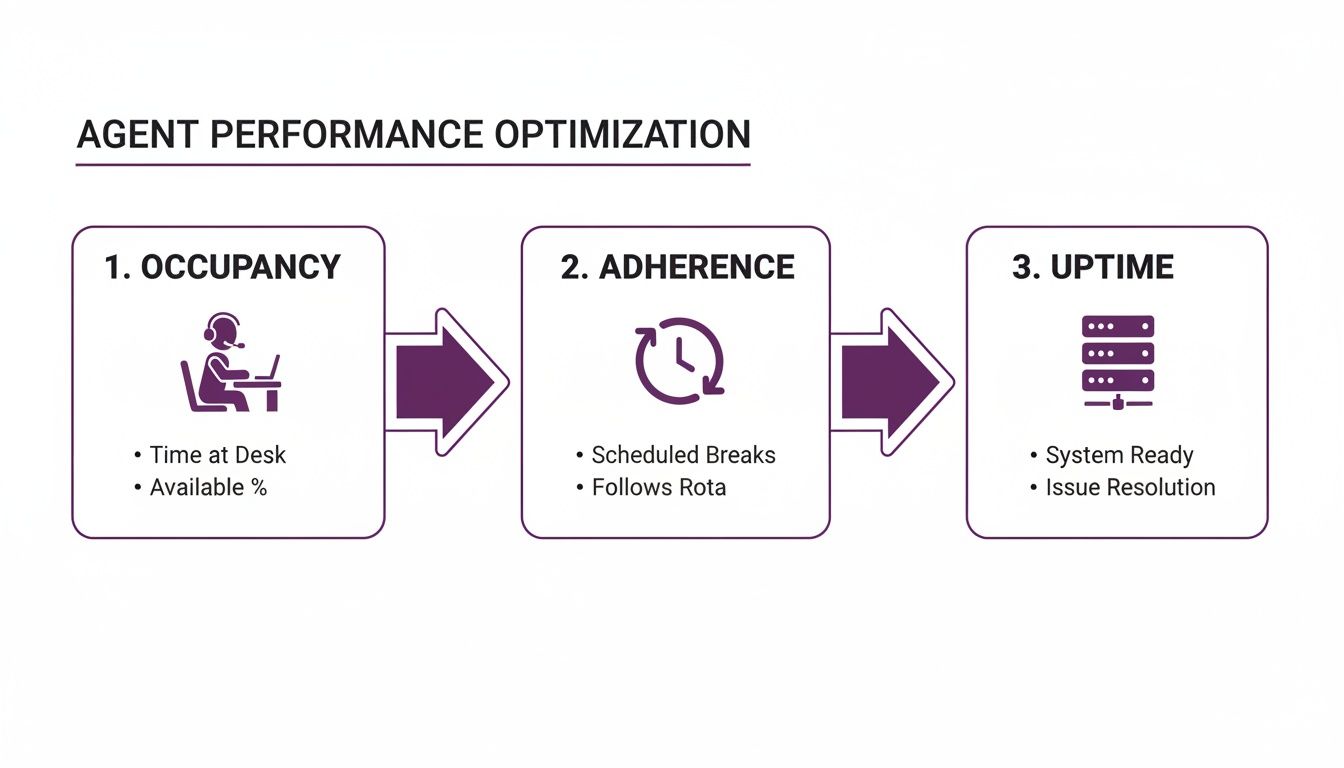
As you can see, metrics like agent Occupancy, Adherence, and system Uptime are the pillars supporting a high-performing team capable of hitting those ambitious targets.
Choosing the Right Reporting Cadence
How often you review your SLA data is just as important as what you review. A one-size-fits-all approach is a recipe for failure; different metrics demand different levels of attention. The key is to match the reporting frequency to the metric’s purpose.
Think of it like driving a car. You glance at your speedometer (real-time data) constantly, but you only check the engine oil (strategic data) every so often. The same logic applies to your SLAs.
- Real-Time Dashboards (Daily): Absolutely essential for tactical, on-the-floor management. Metrics like Service Level, ASA, and agent adherence need to be visible in real time so supervisors can make immediate adjustments to staffing or queues.
- Deep-Dive Reports (Weekly/Monthly): Perfect for spotting trends. This is where you analyze FCR, CSAT, and QA scores to identify patterns, celebrate wins, and pinpoint areas that need coaching.
- Strategic Reviews (Quarterly): These are the high-level meetings with stakeholders to review overall performance against targets, talk through challenges, and adjust the SLA framework if business goals have shifted.
A solid reporting structure is built on clear dashboards and KPIs. For a deeper look, check out our guide on essential call center reporting and metrics dashboards.
Planning for When Things Go Wrong
Let’s be realistic: no operation is perfect, and from time to time, you will miss a target. What separates great partnerships from merely good ones is having a plan for when that happens. SLA breach protocols are simply pre-agreed action plans that outline exactly what happens when a metric falls below its target.
Transparency isn’t just about sharing the wins; it’s about owning the misses. A clear SLA breach protocol turns a potential problem into an opportunity for collaborative problem-solving and strengthens trust.
This isn’t just about uptime anymore. Response and resolution times are now central to how performance is judged. Real-world analysis shows that breach patterns can be wildly uneven; one support organization found its Level 2 team had a 22% SLA breach rate, while its Level 1 team had only 4%. This is the kind of data that demands proactive monitoring, ensuring that when you claim 90–95% of contacts are handled within SLA windows, it’s a verifiable fact.
Practical Example: A retail client was stuck with an FCR rate of just 62%. By putting weekly SLA reviews in place with their CallZent team, they quickly identified that agents lacked access to a specific order modification tool. After granting access and providing some targeted training, their FCR jumped to 77% within six weeks. That’s a 15% improvement driven entirely by transparent reporting and collaborative action.
How a Nearshore Partner Helps You Crush Your SLAs
Setting the right service level agreement metrics is one thing. Actually hitting them, day in and day out, is another game entirely. To do that, you need a partner who feels like a true extension of your team—not just a vendor checking boxes.
This is where a nearshore provider really shines. Choosing the right partner isn’t about offloading tasks; it’s about gaining a strategic edge that directly boosts your performance.
The Proximity and Culture Advantage
A nearshore partner in a hub like Tijuana offers a powerful blend of proximity, cultural alignment, and bilingual talent that you just can’t find with traditional offshore options. At CallZent, this combo has a direct, positive impact on the metrics that matter most.
Our agents aren’t just fluent in English and Spanish; they’re deeply tuned in to North American customer expectations. This cultural fluency smooths out interactions, naturally leading to higher CSAT scores. It means our team doesn’t just read from a script—they build real rapport, which is the secret sauce for hitting high First Contact Resolution rates.
Plus, our location is a game-changer. Sharing time zones with our U.S. clients makes collaboration feel effortless. Real-time meetings and strategy huddles are simple, not a logistical nightmare. This fosters a true partnership where we can pivot quickly to meet your needs and fine-tune our approach to smashing your SLA goals.
“A successful BPO partnership goes beyond meeting contractual numbers. It’s about a shared commitment to your brand’s promise, where your partner’s team is as dedicated to your customers’ success as your own.”
Here at CallZent, we don’t just send you reports. We get in the trenches with you to set meaningful goals and deliver transparent, actionable insights that drive real improvement. Think of us as your strategic advisors, using our expertise to build a custom SLA framework that fits your business perfectly.
To see how our location and team synergy can work for you, check out The Nearshore Advantage.
Got Questions About SLA Metrics? Let’s Clear Them Up.
Even with a solid plan in place, a few questions always pop up when you’re digging into the details of service level agreement metrics. We see them all the time. Let’s tackle the most common ones so you can manage your call center partnerships with total confidence.
What’s the Real Difference Between an SLA and a KPI?
This is a big one, but it’s simpler than it sounds. Think of it this way: an SLA is the promise you make to your client, while a KPI is how you prove you’re keeping it.
- An SLA (Service Level Agreement) is the external contract. It’s the handshake deal that says, “We will answer 80% of calls within 20 seconds.” This is the commitment your customers and partners see.
- A KPI (Key Performance Indicator) is your internal report card. It’s the metric on your dashboard that shows your team is actually hitting (or missing) that 80/20 goal.
Basically, you use your internal KPIs to make sure you’re always on track to deliver on your external SLA promises. One is the goal, the other is the progress report.
How Often Should We Be Reviewing Our SLA Metrics?
There’s no single right answer—it all depends on what you’re trying to achieve with each metric. A tiered approach is usually your best bet.
- Daily Huddles: These are perfect for real-time, in-the-moment metrics like Service Level and Average Speed of Answer. Quick daily check-ins give your frontline managers the info they need to make immediate adjustments to staffing or queues.
- Weekly/Monthly Check-ins: Use this time to look at trends for metrics like FCR and CSAT. This is where you’ll spot bigger patterns, identify coaching opportunities for your agents, and find processes that need a tune-up.
- Quarterly Business Reviews: These are your high-level, strategic meetings. Get your key stakeholders together to discuss overall performance and ask the big question: “Do our current SLAs still align with our business goals?”
Can We Change SLAs After the Contract Is Signed?
Yes, and you absolutely should if the business demands it. Your SLA shouldn’t be a dusty document set in stone. It needs to be a living agreement that breathes with your business. Markets shift, customer expectations change, and your strategy will evolve.
A static SLA is an obsolete SLA. The strongest partnerships treat the agreement as a dynamic framework—one that’s reviewed and adapted together to make sure it always reflects the current reality of the business.
The key is that any changes have to be a conversation, not a command. If your data shows a target is constantly being missed (or is way too easy to hit), it’s time to talk to your partner. Renegotiating SLAs based on real performance data and changing business needs isn’t a sign of failure; it’s a sign of a healthy, mature partnership.
Frequently Asked Questions About Service Level Agreement Metrics
1. What are service level agreement (SLA) metrics in a call center?
Service level agreement metrics are measurable performance standards defined between a business and its call center or BPO partner.
They track speed, quality, efficiency, and system reliability to ensure consistent customer service delivery.
2. What is the most important SLA metric?
There is no single most important metric. High-performing call centers balance
Service Level, First Contact Resolution (FCR), and
Customer Satisfaction (CSAT) to deliver both speed and quality.
3. What is a standard service level benchmark?
The most common benchmark is the 80/20 rule—answering 80% of calls within 20 seconds.
However, benchmarks vary depending on industry, channel, and call complexity.
4. What’s the difference between an SLA and a KPI?
An SLA is the external performance commitment made to clients or customers.
KPIs are the internal metrics used to track whether your operation is meeting those SLA commitments.
5. How often should SLA metrics be reviewed?
Speed and staffing metrics should be monitored daily or in real time.
Quality and experience metrics are best reviewed weekly or monthly,
while overall SLA performance should be evaluated quarterly.
6. What happens when SLA targets are missed?
Mature SLA frameworks include breach protocols such as root-cause analysis,
corrective action plans, retraining, or process adjustments—focused on improvement, not penalties.
7. Can SLA metrics be changed after a contract is signed?
Yes. SLAs should be living agreements. As business needs, call volumes,
or customer expectations evolve, SLA metrics should be reviewed and adjusted collaboratively.
8. How do nearshore call centers improve SLA performance?
Nearshore partners offer time-zone alignment, cultural compatibility,
and bilingual agents—leading to faster response times, higher CSAT,
and stronger First Contact Resolution.
9. Which SLA metrics most impact customer satisfaction?
Metrics such as Average Speed of Answer, Abandonment Rate,
FCR, and CSAT have the most direct impact on how customers perceive your brand.
10. How do SLA metrics help reduce call center costs?
By improving resolution rates, reducing repeat contacts,
optimizing staffing through adherence and occupancy,
and preventing service failures that escalate costs.
Ready to Turn SLA Metrics Into a
Competitive Advantage?
At CallZent, we don’t just track service level agreement metrics—we help you design,
manage, and continuously optimize them. Our nearshore teams work as an extension of your business,
delivering measurable performance, transparency, and customer experiences that scale.
Ready to build a partnership that crushes your performance goals? At CallZent, we work with you to create and manage a custom SLA framework that drives real results. Let’s build your SLA together.