

Customer Service Skills
Top Skills for Customer Service Success in 2026
Discover the 10 essential skills for customer service, including empathy, communication, and bilingual fluency, with practical strategies to build high-performing teams.
TL;DR — Quick Takeaways
- The most important customer service skills include listening, empathy, problem-solving, and communication.
- Strong teams combine soft skills with product knowledge and operational discipline.
- Bilingual and nearshore teams provide a competitive advantage for North American companies.
- Customer service skills are trainable, measurable, and directly tied to business outcomes.
What separates good service from a great customer experience?
It usually isn’t effort. Personnel often try hard. The gap is that many businesses still treat customer support like a staffing problem instead of a skills problem. If your team can answer tickets but can’t calm a frustrated caller, explain a policy clearly, or solve an unusual issue without bouncing the customer around, you’re not building loyalty. You’re just processing volume.
The most effective skills for customer service are trainable, measurable, and tightly connected to business outcomes. Emotional intelligence matters because service work is emotional work. Omnichannel fluency matters because customers don’t think in departmental silos. Product knowledge matters because empathy without answers still creates friction. In practice, strong support teams combine people skills with systems discipline, then coach both consistently.
For companies trying to scale support without lowering quality, these skills are often the clearest signal of whether to build internally, hire selectively, or outsource to a partner that already has the training infrastructure in place. This guide breaks down the ten most important skills for customer service, with practical examples, hiring cues, and coaching ideas you can use right away. CallZent applies this approach every day through its customer service solutions built for North American brands that need bilingual, nearshore support.
Exceptional customer service isn’t a department. It’s a culture built on specific, honed skills that drive business results.
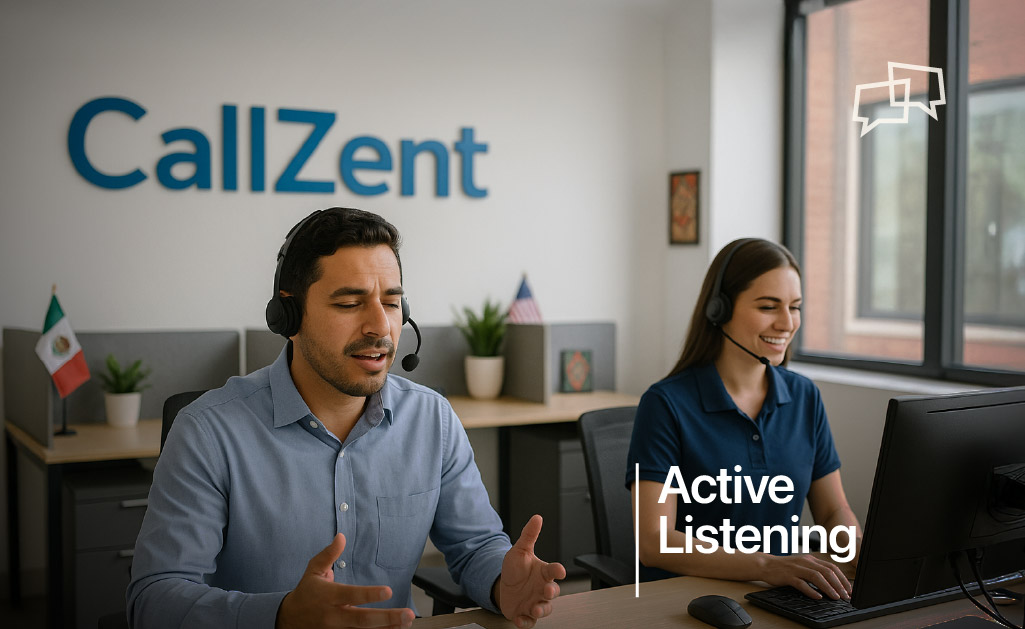 1. Active Listening The Foundation of Understanding
A lot of teams say they listen. Fewer teams prove it in the way they handle a live interaction.
Active listening means the agent hears the stated problem, catches the emotional context, and confirms the actual need before trying to solve anything. On a phone call, that can be as simple as pausing to summarize: “Let me make sure I have this right. The shipment arrived, but the item inside wasn’t the one you ordered, and you need a replacement before Friday.” That short recap prevents a long wrong turn.
In nearshore support, listening also protects quality across accents, dialects, and code-switching. An English-Spanish conversation can go off track fast if the agent only grabs keywords and misses intent.
What good listening looks like in practice
A strong agent does a few things consistently:
- Confirms the issue early: They restate the problem in plain language before opening systems or quoting policy.
- Listens for what isn’t said: A customer asking about cancellation may really want reassurance, urgency, or a workaround.
- Takes usable notes: Good notes help the next touchpoint start with context instead of repetition.
One of the easiest ways to test this skill is call review. If the customer had to repeat the issue twice, the agent probably wasn’t listening closely enough the first time.
Practical rule: If an agent starts solving before they can summarize the issue clearly, coaching should start there.
Teams that want stronger listening habits should build role-play around ambiguity, not just easy scripts. Give agents messy scenarios with incomplete information. Then score them on how well they clarify, summarize, and confirm next steps. For a deeper look at how this works in operations, CallZent breaks it down in the power of active listening in call centers.
Even outside customer support, the same core habits show up in coaching and communication training, including these essential active listening tools for parents. The context is different, but the discipline is the same. Listen first, interpret carefully, respond second.
 2. Empathy and Emotional Intelligence Connecting on a Human Level
What keeps a frustrated customer from becoming a lost customer?
In support operations, the answer is often empathy backed by control. Emotional intelligence is the skill that lets an agent recognize stress, adjust their tone, and respond in a way that lowers friction instead of raising it. That makes it more than a personality trait. It is a trainable service skill with a direct effect on CSAT, escalation rates, retention, and QA consistency.
The business value shows up fast. An agent who can read emotional cues usually gets to cooperation faster, especially in billing disputes, delays, damaged orders, or sensitive account issues. The policy may stay the same, but the customer is far more likely to accept the outcome when they feel heard and guided.
A simple example makes the difference clear. One agent says, “Refunds take five business days.” Another says, “I understand why waiting feels frustrating. I’m checking the status now, and I’ll explain what happens next so you know what to expect.” Both agents gave the same answer. Only one reduced uncertainty.
That distinction matters in a BPO environment, where leaders have to scale quality across shifts, channels, and client programs. If empathy depends on personality alone, performance stays inconsistent. If empathy is defined, coached, and scored, it becomes an operating asset. Managers can build it into hiring rubrics, QA forms, calibration sessions, and side-by-side coaching.
I usually look for three behaviors in call reviews:
- The agent names the customer’s concern in plain language.
- The agent keeps their tone steady, even if the customer is upset.
- The agent moves from acknowledgment to a concrete next step without sounding rehearsed.
Those behaviors are measurable. They also help bilingual and nearshore teams stand out. Agents serving customers across English and Spanish interactions need more than language fluency. They need cultural awareness, pacing control, and the judgment to know when directness helps and when reassurance matters more. That is one reason emotional intelligence in customer service operations deserves a place in training, not just in soft-skills workshops.
There is also a real trade-off here. Over-index on efficiency, and agents can sound cold. Over-index on warmth, and handle time climbs while resolution gets vague. Strong teams coach both. They teach agents to validate the emotion quickly, then take ownership of the process. That balance protects AHT without making the interaction feel transactional.
For healthcare, finance, insurance, and other high-stress sectors, this skill carries even more weight. Customers often arrive worried, defensive, or embarrassed before the conversation starts. In those cases, empathy is not extra polish. It helps the agent keep the call productive, protect compliance, and reduce repeat contacts.
 3. Deep Product and Service Knowledge The Source of Confidence
Customers can tell when an agent is guessing.
Deep product knowledge doesn’t mean memorizing a script or reading from a knowledge base faster. It means understanding how the product works, where customers typically get stuck, which exceptions are allowed, and when a policy explanation needs translation into plain English. This is one of the most underappreciated skills for customer service because businesses often assume a friendly tone can compensate for shallow knowledge. It can’t.
A common failure pattern looks like this. The agent is warm, polite, and eager to help. But they give partial instructions, open the wrong ticket type, or transfer the customer because they don’t understand the root process. The customer leaves thinking the company is disorganized, even if the agent was pleasant.
What managers should train for
Product training is strongest when it goes beyond onboarding documents.
- Use real scenarios: Train on failed payments, damaged shipments, duplicate charges, account lockouts, and policy exceptions.
- Teach system logic: Agents should know why the workflow exists, not just what button to click.
- Require explanation in plain language: If an agent can’t explain a feature without jargon, they don’t know it well enough yet.
Many outsourcing relationships break down. The vendor may provide headcount, but not operational depth. A strong BPO partner invests in continuous product refreshers, update briefs, and QA tied to accuracy, not just call handling.
Key takeaway: Empathy builds trust quickly. Product knowledge keeps that trust from collapsing.
A practical example: in e-commerce support, a customer who says “my discount didn’t apply” may be dealing with coupon exclusions, item-level restrictions, timing rules, or account segmentation. A confident agent can sort that out in one conversation. An undertrained agent will apologize, stall, and escalate.
When you’re hiring or auditing a team, ask agents to explain a complicated policy as if they were speaking to a first-time customer. That’s a better test than asking them to repeat policy language.
4. Problem-Solving and Critical Thinking Moving Beyond the Script
What happens when the customer’s issue does not fit the workflow your team trained for?
That moment exposes whether problem-solving is a real operational skill or just a hiring buzzword. In customer service, critical thinking is a measurable asset. It affects first contact resolution, escalation rate, average handle time, refund leakage, and customer effort. Teams that diagnose root causes well solve more issues in one interaction and create fewer repeat contacts.
The pattern shows up every day. A customer asks for a password reset, but the account is tied to an old email. A patient disputes a bill, but the underlying issue is insurance coordination. A telecom customer asks to cancel because a plan change was processed incorrectly. The request is only the surface. Strong agents investigate the condition behind it.
What strong critical thinking looks like in operation
Managers should listen for behaviors that produce cleaner resolutions, not just polite conversations:
- They clarify the timeline: They ask when the issue started, what changed, and whether the problem is consistent or intermittent.
- They verify the customer’s diagnosis: They treat the customer’s explanation as useful context, not confirmed fact.
- They compare fix paths: They choose the resolution that meets policy, reduces effort, and avoids an unnecessary transfer.
- They know when to escalate: Good judgment includes recognizing risk, compliance limits, and exceptions that should not stay on the front line.
This skill matters more as automation absorbs simple contacts. Zendesk reports that AI is changing customer expectations and shifting human agents toward higher-value interactions that require judgment and context handling (Zendesk Customer Experience Trends). For BPO leaders, that changes hiring and coaching priorities. Script compliance still matters, but exception handling matters more.
I usually advise clients to treat problem-solving as a QA category, not a vague soft skill. Score whether the agent identified the root issue, selected the correct resolution path, and prevented a repeat contact. If a team sounds courteous but still drives transfers and callbacks, the operation has a diagnosis problem.
A practical training method is root-cause calibration. Pull a sample of unusual tickets from the last 30 days. Ask agents to identify the actual issue, list the approved fix options, and explain which option creates the lowest-friction outcome for the customer and the business. That exercise quickly shows who can work through ambiguity and who only recognizes familiar scripts.
For nearshore and bilingual teams, this skill has extra value. Agents often handle customers who describe the same problem differently across languages, regions, or levels of technical comfort. Bicultural fluency helps, but it only pays off when the team can interpret intent accurately and choose the right operational response.
In complaint-heavy environments, problem-solving also drives recovery. Teams that know how to resolve customer complaints consistently do more than close a ticket. They identify failure patterns, feed them back to QA and training, and reduce avoidable volume over time.
5. Clear Communication The Art of Being Understood
How often does a contact get marked resolved while the customer still is not fully sure what happened next?
That gap is usually a communication failure, not a knowledge failure. Agents may understand the system, the policy, and the correct resolution path, yet still explain it in internal language that makes sense to the business and not to the customer. In a BPO environment, that shows up fast in repeat contacts, low CSAT, unnecessary escalations, and longer handle time on follow-up interactions.
Clear communication should be treated as a trainable operational skill. It can be measured in QA, coached in calibration, and tied directly to first-contact resolution. The standard is straightforward. By the end of the interaction, the customer should understand what happened, why it happened, and what happens next.
What clarity looks like across channels
Phone, chat, and email each require a different pace, but the structure should stay consistent:
- Start with the outcome: Give the answer before the background.
- Add only the context the customer needs: Enough to build trust, not enough to slow the interaction.
- Close with specific next steps: State who will do what, and by when if timing matters.
An effective email sounds like this: “Your order shipped in two packages. The first has arrived. The second is still in transit, and the tracking details are below. If it has not arrived by Tuesday, reply here and we will open a carrier trace.” That message reduces effort for the customer and for the next agent who may need to review the case.
The cost of unclear messaging rises in high-volume support teams because customers contact you again almost immediately when the first answer leaves room for doubt.
Customers do not need more words. They need clearer ones.
For managers, this skill belongs in hiring and QA, not just onboarding. Score whether agents avoid jargon, organize information in the right order, and confirm understanding before closing. In bilingual nearshore teams, this matters even more. Agents often need to translate not just language, but intent, tone, and process expectations across markets. A strong team can simplify a policy without making it inaccurate, which protects compliance while improving customer understanding.
One coaching method works especially well. Pull five weak transcripts each week and ask agents to rewrite them in plain language for phone, chat, and email. That exercise exposes where communication breaks down: wordy explanations, vague ownership, soft next steps, or channel mismatch.
Clear communication also improves internal execution. Precise case notes, handoff summaries, and callback commitments reduce duplicate work and shorten resolution time. That makes this skill more than a soft trait. It is a measurable business asset that improves customer confidence and helps the operation run cleanly.
6. Patience and Stress Management The Key to Consistency
What happens to service quality when volume spikes, queues build, and every difficult contact lands with the same few agents?
Patience is what keeps performance stable under that pressure. In operations, it shows up in fewer avoidable escalations, cleaner case handling, and more consistent customer sentiment from the first hour of a shift to the last. Stress management supports the same outcome. It helps agents stay accurate, regulated, and usable at scale instead of burning through energy halfway through the day.
This skill is trainable, and it should be measured that way.
A patient agent does not just sound calm. They give the customer enough space to explain the issue, keep control of the interaction without sounding rushed, and stay steady when the caller repeats themselves, vents, or struggles to follow instructions. That behavior protects first-contact resolution because the agent gathers the right information before acting. It also reduces repeat contacts caused by avoidable mistakes.
The operating environment is getting harder, not easier. As routine requests shift to automation, human agents are left with more of the emotionally loaded and exception-based work. McKinsey notes that generative AI is changing contact center workflows and reshaping the role of human agents toward higher-complexity interactions in its customer care and AI research. That raises the value of patience from a personality trait to a staffing and coaching requirement.
On the floor, resilience usually shows up in three places:
- Pacing: The agent slows down during high-risk moments such as identity verification, payment explanations, or policy exceptions.
- Emotional control: The agent does not absorb the customer’s frustration and send it back.
- Recovery between contacts: The previous call does not shape the tone of the next one.
In a bilingual nearshore team, that control matters even more. Agents often manage emotional nuance across languages, accents, and different customer expectations around urgency or politeness. A strong team can keep tone steady while switching between English and Spanish workflows, which helps protect CSAT without extending handle time more than necessary.
A practical example makes the trade-off clear. In healthcare scheduling or insurance support, a customer may arrive after a failed self-service attempt, a long hold, and a confusing prior answer. If the agent rushes, the call gets longer anyway because details are missed and trust drops. If the agent slows the interaction at the right point, confirms the issue, and resets the tone, the conversation usually becomes easier to control.
Managers should coach this skill with the same discipline used for compliance or resolution quality. Review calls for interruption rate, dead air under pressure, signs of audible frustration, and whether the agent regains structure after a difficult moment. Pair that with practical tools: brief between-call reset habits, better note templates, realistic occupancy targets, and scenario training for emotionally charged contacts. Teams that need more structure can also use proven de-escalation techniques for customer service to reinforce calm, repeatable behaviors.
Patience protects consistency. Stress management protects capacity. Together, they help support teams maintain quality under load, which is exactly what customers and managers both notice first.
7. Conflict Resolution and De-escalation Turning Problems into Praise
What turns an upset customer into a promoter instead of a public complaint?
Usually, it is not a policy exception. It is an agent who can lower tension fast enough to keep the interaction productive. Conflict resolution is a trainable operating skill. In a BPO setting, it affects supervisor escalations, save rates, QA scores, churn risk, and the amount of rework one difficult contact creates across channels.
The sequence matters. De-escalation comes first. Resolution follows after the customer believes the agent understands the problem and is taking control of the next step. Teams that miss that sequence often create longer calls, more transfers, and lower CSAT even when the final answer is technically correct.
The behaviors are observable and coachable:
- Acknowledge the friction early: Name the issue and the impact on the customer without sounding scripted.
- Create structure fast: Explain what will be checked, what can be resolved now, and what happens next.
- Control tone and pace: Short sentences, precise language, and a steady voice help reduce resistance.
- Protect ownership: Customers calm down faster when one person stays accountable instead of pushing them toward another queue too early.
What hurts performance is predictable. Arguing facts before the customer is ready to hear them slows resolution. Reciting policy in the opening minute can sound dismissive. Over-apologizing without giving direction also backfires, because it adds emotion but not progress.
I have seen this most clearly in billing disputes, service outages, claims support, and retention calls. The customer often arrives after a failed self-service attempt or a prior conversation that did not solve the issue. In that moment, the agent’s job is not to win the debate. The job is to restore enough trust to move the case forward while protecting handle time from spiraling.
That makes this skill measurable. Review contacts for escalation rate, transfer rate, repeat contact after a complaint, save outcomes, and whether the agent re-established control within the first part of the interaction. For bilingual nearshore teams, managers should also listen for whether the same calming structure holds across English and Spanish conversations, because tone control and word choice can change how firm or respectful the agent sounds.
Teams that need a more repeatable method can coach from practical de-escalation techniques for customer service. The business goal is clear. Reduce friction, contain avoidable escalations, and turn a high-risk moment into a resolved case the customer remembers for the right reason.
8. Time Management and Multitasking Driving Efficiency and Focus
How do you reduce handle time without creating more repeat contacts?
The answer is disciplined time management. In a live support environment, that means the agent can guide the conversation, use the right systems quickly, document the case clearly, and still keep the customer confident that progress is happening. This skill affects operating cost, service level, after-call work, and first-contact resolution at the same time.
On a typical interaction, the agent is listening, verifying details, checking the CRM, reviewing order or billing history, and deciding what needs to be documented before the call ends. Multitasking matters, but only when it stays organized. If the workflow is messy, customers hear long pauses, get placed on hold, or have to repeat information. Each one adds friction and extends the queue.
The trade-off is practical. Pushing agents to finish faster can lower average handle time for a week and still hurt performance if customers call back because notes were incomplete or next steps were unclear. Strong teams treat time management as a quality skill with measurable output, not a speed contest.
That is why workflow design matters as much as agent effort.
A useful benchmark comes from SQM Group’s research on first call resolution, which found that resolving the issue on the first contact is one of the strongest drivers of customer satisfaction. Time discipline supports that outcome because agents who control the interaction well are less likely to miss a step, transfer unnecessarily, or create avoidable follow-up work.
The strongest habits usually look like this:
- Prepare the workspace early: Open the systems and references the agent is most likely to need before the interaction becomes complex.
- Document while the details are fresh: Short, accurate notes reduce after-call work and prevent the next agent from starting from zero.
- Use holds selectively: A brief hold with a clear reason is fine. Repeated holds usually point to weak system knowledge or poor screen flow.
- Close with confirmation: Restate the resolution, timeline, and next action so the customer does not leave unsure about what happens next.
Managers should coach this skill by watching the work, not just scoring the call recording. Screen review shows where time is lost. It reveals whether the agent is searching across too many tabs, hesitating in the CRM, or following a process that adds avoidable steps. In many programs, what looks like an agent performance issue is really a workflow issue.
This becomes even more important in bilingual operations. Agents switching between English and Spanish may need different knowledge base articles, templates, or verification language during the same shift. Teams built through a bilingual call center in Mexico often gain an efficiency advantage here because they can support North American customers in both languages from the same operating model, with less handoff risk and tighter staffing coverage.
Measure this skill the same way you would measure any other business asset. Review handle time, after-call work, repeat contact, hold time, note quality, and whether the agent completed the required steps without losing control of the conversation. If those numbers improve together, the team is not just working faster. It is working better.
9. Bilingual and Bicultural Fluency The Nearshore Advantage
Speaking two languages isn’t the same as delivering bilingual service well.
Bilingual and bicultural fluency means the agent can explain policies, build trust, and read tone appropriately in more than one cultural context. That includes vocabulary, formality, pacing, and cultural judgment. For North American brands, this is a business asset, not a nice extra.
A Spanish-speaking customer may fully understand the words an agent uses and still feel friction if the tone is too abrupt, too literal, or culturally off. That’s why a bilingual support operation needs more than language testing. It needs coaching on nuance.
Why this matters in real operations
This skill becomes especially visible in healthcare, finance, telecom, and retail support.
A bilingual agent may need to explain account verification in Spanish, switch to English for a technical term, then return to Spanish without making the conversation feel disjointed. They also need to know when a direct translation sounds unnatural or confusing. In practice, that kind of fluency shortens friction and builds confidence.
One RingCentral summary highlights an underserved gap in the industry: many standard customer service skill lists mention multilingual ability but don’t go deep on cultural nuance. It also notes that 41 million native Spanish speakers in the U.S. drive $2.8 trillion in spending. If your service model ignores that audience, you’re not just missing inclusivity. You’re missing revenue.
Language fluency handles words. Bicultural fluency handles trust.
Nearshore teams in Tijuana have a natural operational advantage here because they often work closer to U.S. business hours, customer expectations, and communication norms than far-off offshore teams. That doesn’t remove the need for training, but it does improve alignment.
For businesses evaluating support partners, this is one of the clearest differentiators. CallZent explains the model in more detail through its bilingual call center in Mexico approach, where English-Spanish support is built around both language skill and customer context.
10. Adaptability and Commitment to Learning The Skill for the Future
What happens to service quality when yesterday’s top agents are still using last quarter’s playbook?
Support operations change faster than annual training cycles can keep up. New channels appear, policies shift, AI handles simple contacts, and agents are left with the cases that need judgment. In that environment, adaptability is not a soft trait. It is a measurable operating asset that affects ramp time, QA scores, escalation rates, and customer satisfaction.
An agent can communicate well and know the product cold, but performance still drops if that agent cannot adjust to a new workflow, absorb policy updates quickly, or use new tools correctly under pressure. I have seen this firsthand in BPO transitions. The teams that learn fastest usually stabilize service levels faster too.
Why learning now has operational value
As noted earlier, automation is taking more routine work. That changes the mix of tickets human agents receive. The remaining contacts are less predictable, more sensitive, and harder to resolve with scripts alone.
Training budgets reflect that shift. DataIntelo reports that the global customer service training market was valued at USD 9.2 billion in 2024 and is projected to reach USD 18.4 billion by 2033. Companies are spending more because static onboarding does not support a service operation where tools, policies, and customer expectations keep changing.
For managers, the implication is straightforward. Adaptability should be hired for, trained for, and measured like any other service skill.
What adaptable teams do differently
Adaptable teams build learning into daily operations instead of treating it as a separate event.
- They shorten the gap between change and execution. Product updates, billing changes, compliance rules, and workflow revisions reach agents quickly, with clear guidance on what changes in live conversations.
- They coach in tight cycles. Short QA reviews, targeted refreshers, and scenario practice improve performance faster than occasional long workshops.
- They train judgment alongside tools. Agents need to know how to use AI suggestions, when to verify them, and when to override them.
- They track learning as an operations metric. Speed to proficiency, error reduction after updates, and post-training QA movement all show whether training is working.
A good test case is e-commerce chat support during a peak season. A retailer changes its return window, adds a promotion, and tightens fraud screening in the same week. Rigid teams keep using old macros, give conflicting answers, and create repeat contacts. Adaptable teams update knowledge content the same day, rehearse the edge cases, and protect both CSAT and handle time.
Nearshore bilingual teams can give managers a practical advantage. Shared time zones make update rollouts faster. Language coverage helps teams absorb changes once and apply them across English and Spanish support. Cultural proximity also reduces the lag between a policy change and a customer-ready explanation that sounds natural, not translated.
The business case is simple. Teams that keep learning handle change with less disruption, fewer errors, and better customer trust. That is what makes adaptability the skill for the future, and a clear hiring and training priority right now.
Top 10 Customer Service Skills Comparison
| Skill | Implementation Complexity 🔄 | Resource Requirements & Speed ⚡ | Expected Outcomes 📊 | Ideal Use Cases & Tips 💡 | Key Advantage ⭐ |
|---|---|---|---|---|---|
| 1. Active Listening: The Foundation of Understanding | Moderate, structured coaching & call review cycles | Low–Moderate resources (recordings, facilitator); ⚡ moderate speed gains in resolution | 📊 ↑FCR, ↑CSAT, ↓repeat contacts | 💡 Frontline bilingual calls; use “three-level” call review to train layers of listening | ⭐ Builds accuracy, rapport, and empathy |
| 2. Empathy & Emotional Intelligence: Connecting on a Human Level | Moderate, behavior change through role-play and feedback | Moderate resources (coaching, quality monitoring); ⚡ may add time per interaction but reduces escalations | 📊 ↑CSAT & NPS, ↓agent burnout, improved retention | 💡 De-escalation and sensitive industries; use empathy mapping exercises | ⭐ De-escalates conflict and strengthens loyalty |
| 3. Deep Product & Service Knowledge: The Source of Confidence | High, continuous, client-specific training & KMS upkeep | High resources (KMS, SMEs, regular refreshes); ⚡ significant AHT reduction when mastered | 📊 ↑FCR, ↓escalations, ↓AHT | 💡 Complex products / multi-client BPOs; run “teach a teammate” sessions | ⭐ Increases credibility and speeds accurate resolution |
| 4. Problem-Solving & Critical Thinking: Moving Beyond the Script | High, scenario-based training and delegated authority | Moderate resources (simulations, coaching); ⚡ improves handling of unique cases | 📊 ↓escalations, ↑FCR, ↑customer ease | 💡 Technical support and exception handling; use “broken process” scenarios | ⭐ Enables frontline resolution of novel problems |
| 5. Clear Communication: The Art of Being Understood | Low–Moderate, language coaching and QA standards | Low resources (writing guides, brief coaching); ⚡ reduces repeat contacts and clarifications | 📊 ↓repeat contacts, ↑understanding, ↑CSAT | 💡 Omnichannel interactions; run “no jargon” challenges | ⭐ Minimizes confusion and improves efficiency |
| 6. Patience & Stress Management: The Key to Consistency | Moderate, wellness programs and resilience coaching | Moderate resources (wellness support, flexible scheduling); ⚡ long-term consistency gains | 📊 ↓turnover, ↓absenteeism, stable QA scores | 💡 High-volume/24-7 centers; use “reframe the narrative” workshops | ⭐ Sustains agent resilience and service consistency |
| 7. Conflict Resolution & De-escalation: Turning Problems into Praise | High, advanced role-play, legal/compliance training | Moderate–High resources (supervision, role-plays); ⚡ prevents costly escalations and reputational damage | 📊 ↓supervisor escalations, ↑retention, improved sentiment metrics | 💡 Debt collection, claims; practice “broken record” and choice-offering techniques | ⭐ Converts conflicts into recovered loyalty |
| 8. Time Management & Multitasking: Driving Efficiency and Focus | Moderate, system training and process coaching | Low–Moderate resources (tooling, hotkey training); ⚡ notable AHT & throughput gains | 📊 ↓AHT, ↓ACW, ↑adherence and throughput | 💡 High-volume omnichannel support; run hotkey/gamified challenges | ⭐ Drives measurable operational efficiency |
| 9. Bilingual & Bicultural Fluency: The Nearshore Advantage | High, language assessment, cultural training, targeted hiring | High resources (bilingual recruitment, training, cultural coaching); ⚡ improves conversions and CSAT for non-English speakers | 📊 ↑CSAT by language, ↑market reach, comparable FCR across languages | 💡 Nearshore/multicultural markets; role-play cultural nuance scenarios | ⭐ Enables authentic, accurate cross-cultural support |
| 10. Adaptability & Commitment to Learning: The Skill for the Future | Moderate, continuous learning culture and pilot programs | Moderate resources (pilot teams, coaching, learning platforms); ⚡ accelerates time-to-proficiency | 📊 ↓time-to-proficiency, ↑tool adoption, sustained performance improvement | 💡 Rapid-change environments; create volunteer pilot teams to champion new tools | ⭐ Future-proofs the workforce and eases client transitions |
Turn Skills into Your Competitive Advantage with the Right Partner
These ten skills for customer service aren’t abstract traits. They’re operating levers. When a team listens actively, communicates clearly, manages conflict well, and knows the product thoroughly, you see the difference in everyday performance. Fewer repeat contacts. Better handoffs. Stronger customer confidence. Less wasted time.
That is the shift many companies need to make. Stop viewing service skills as personality traits that people either have or don’t have. Treat them as business assets that can be hired for, coached, measured, and improved. Once you do that, support stops looking like a cost center and starts acting like a retention engine.
The challenge is execution. Building this capability in-house takes more than posting jobs and writing a training deck. You need recruiting standards, onboarding systems, QA discipline, coaching capacity, and managers who understand both customer psychology and operational flow. Most companies can build that. Fewer can build it quickly, consistently, and at scale.
That is where a nearshore BPO relationship can make sense. The right partner gives you trained talent, management infrastructure, bilingual coverage, and process maturity without forcing you to build everything from scratch. For North American companies, nearshore support also improves collaboration. Time zone alignment, easier communication, and cultural proximity make day-to-day management simpler than many offshore arrangements.
This matters even more now because the support role is changing. AI is handling more routine interactions, while human agents are left with more nuanced, emotional, and exception-heavy work. That means your remaining human interactions matter more, not less. If the team behind those moments lacks empathy, judgment, or product confidence, automation won’t save the customer experience.
A strong partner should be able to show how it trains these skills in practice. Ask how agents are coached on difficult calls. Ask how product updates are rolled into live operations. Ask how bilingual quality is evaluated. Ask how performance is tracked beyond speed alone. If the answers are vague, the service quality will be too.
CallZent is one relevant option for companies that want bilingual nearshore support from Tijuana with customer service and back-office capabilities for North American markets. Its model is built around trained agents, operational collaboration, and support that can be adjusted according to industry and workflow. If you’re comparing models, it helps to review CallZent pricing across the U.S., Mexico, India, and the Philippines so you’re looking at labor strategy and service design together, not just hourly rates.
The most practical next step is to map your current support gaps against these ten skills. Where are customers repeating themselves? Where are escalations rising? Where do agents sound unsure? Where does bilingual service break down? Those answers will tell you whether you need tighter coaching, better systems, or a different operating partner.
Strong customer support doesn’t happen by accident. It comes from building the right skills into the team, then reinforcing them every day. If you’re ready to close that gap, start with the skills that most directly affect customer trust and operational efficiency, then build from there. And if your business needs help scaling that capability, you can contact the CallZent team to explore a support model that fits your operation.
🚀 Build a High-Performance Customer Service Team
CallZent helps companies scale customer support with bilingual nearshore teams trained in the skills that drive real results.
Talk to an ExpertIf you’re evaluating how to strengthen your support operation, CallZent can help you assess the skills, staffing model, and bilingual coverage needed to support your customers more effectively.