Skip to content

Home ›
Blog › Nearshore Outsourcing
5 Reasons to Outsource Your Call Center Operations to Mexico
From flexibility and bilingual talent to cost efficiency and scalability, discover why Mexico has become the #1 nearshore outsourcing destination for U.S. businesses.
📌 TL;DR — Why Outsource Call Center Operations to Mexico?
- This article breaks down nine powerful strategies for outsourcing to help you make an informed decision. We cover:
- Nearshoring: Leveraging nearby countries for time zone and cultural alignment.
- Offshore Development Center (ODC): Building a dedicated, long-term team abroad.
- Multi-vendor: Diversifying risk by using multiple specialized providers.
- Build-Operate-Transfer (BOT): A partner builds and runs a center, then transfers it to you.
- Hybrid Model: Blending in-house teams with outsourced partners for flexibility.
- Centers of Excellence (CoE): Partnering with specialized hubs for elite expertise.
- Outcome-Based Models: Paying vendors based on achieving specific business results.
- Cloud-First: Prioritizing cloud technology for scalability and agility.
- Multisourcing: Building a best-of-breed network across vendors.
Updated: August 15, 2025 • About CallZent
- Near-shoring Strategy
- Offshore Development Center (ODC)
- Multi-vendor Strategy
- Build-Operate-Transfer (BOT)
- Hybrid Outsourcing Strategy
- Centers of Excellence (CoE)
- Outcome-Based Outsourcing Strategy
- Cloud-First Outsourcing Strategy
- Multisourcing Strategy
- Outsourcing Strategies Comparison Matrix
- Choosing Your Path: How CallZent Can Help
- FAQs
Is your in-house team stretched thin, struggling to keep up with customer demands while costs continue to climb? You’re not alone. Many businesses hit a wall where scaling customer support internally becomes a major roadblock to growth. While “outsourcing” is the common answer, a one-size-fits-all approach rarely delivers. The real solution lies in choosing the right strategic approach tailored to your specific business goals.
This guide moves beyond the basics to explore sophisticated strategies for outsourcing that can transform your customer experience, optimize operational costs, and unlock new levels of efficiency. We’ll provide the actionable insights you need to make a confident, informed decision. Whether you are a healthcare provider needing specialized patient support or an e-commerce brand looking for expert sales agents, the right framework is critical.
Each strategy offers unique benefits, from cost savings to accessing specialized talent. The best choice depends on your specific business needs, goals, and desired level of control.
Deciding Between Onshore, Offshore, Nearshore, and Homeshore Call Centers
Choosing the optimal call center model depends on a blend of your operational priorities, budget, and the nature of your customer experience goals. Each option—onshore, offshore, nearshore, and homeshore—brings its own advantages and trade-offs. Here’s how to break down the decision:
1. Onshore Call Centers:
If your top priority is exceptional customer experience aligned closely with your customers’ language and culture, onshore solutions may be ideal. These centers excel when:
- Proximity or direct oversight is crucial.
- Regulatory or legal compliance requires local resources.
- Your audience is sensitive to cultural nuance.
- Team size remains manageable within budget.
- Fluency and deep cultural knowledge are non-negotiable for customer satisfaction.
Onshore centers tend to cost more but deliver an unrivaled brand connection and smoother interactions—often a smart investment if your market justifies the extra spend.
2. Offshore Call Centers:
For businesses seeking to scale quickly, stretch limited budgets, or access a wider array of customer service functions, offshore options can unlock major savings. Consider offshore if:
- You need large-scale support at lower cost.
- Multilingual coverage is required for global brands.
- Proximity isn’t essential for quality.
- Your audience is comfortable with some cultural diversity in service.
- Your primary goal is maximizing operational efficiency.
The trade-off: While cost-effective, offshore centers can present challenges in communication, time zones, or customer expectations.
3. Nearshore Call Centers:
Nearshoring often offers the best of both worlds—a balance of reduced costs and operational alignment. This approach fits when:
- Overlapping time zones and geographic closeness matter.
- You value frequent, real-time collaboration with your partner.
- English or bilingual (Spanish/French) proficiency is key.
- Traveling to the site for management, training, or quality checks is important.
- You’re aiming for cultural alignment but have a tighter budget than onshore allows.
Countries like Canada, Mexico, and Puerto Rico are popular nearshore destinations due to both language skills and strong ties to US culture.
Pros and Cons of Nearshore Call Center Outsourcing
When evaluating nearshore call centers, it’s important to weigh their advantages and limitations so you know whether this route supports your broader business goals.
Key Benefits of Nearshore Solutions
- Cost Savings Without Sacrificing Quality: Nearshore options typically come in at a lower price point than onshore centers, yet maintain strong service quality—helping businesses stretch their budgets without major trade-offs.
- Cultural and Linguistic Synergy: Many agents in countries like Canada, Mexico, or Puerto Rico bring a level of cultural awareness that’s tough to match offshore. Agents often have firsthand experience with US culture, sometimes having lived, studied, or worked in the States.
- Language Proficiency: English remains a primary or official language in destinations such as Canada and Puerto Rico. For US-based companies, this creates smoother communication, with added flexibility from teams fluent in Spanish and French for broader customer reach.
- Time Zone Compatibility: Operating in similar or overlapping time zones makes live collaboration, management oversight, and real-time problem-solving much easier—especially when compared to operations located halfway around the world.
- Ease of Site Visits: If in-person training, relationship-building, or quality checks are on your list, traveling to a nearshore location is far simpler and less expensive than trekking across oceans.
Potential Drawbacks to Consider
- Not the Cheapest Option Available: While more cost-effective than onshore, nearshore centers are usually pricier than offshore alternatives. If rock-bottom pricing is your priority, you may need to look farther afield.
- Vendor Pool Is Smaller: Because nearshore is limited to certain geographic regions, your choices of providers and available workforce are naturally more restricted.
- Possible Lingering Cultural Gaps: Even with strong cultural alignment overall, occasional language or communication quirks might pop up—though these are generally much milder than with offshore teams.
Bottom line: Nearshore call centers are often a sweet spot for businesses that want to balance budget, quality, and regional familiarity. If your team needs regular collaboration or travel, or your customers value nuanced service, this approach delivers clear advantages—without the steep onshore price tag.
4. Homeshore (Virtual) Call Centers:
If flexibility, rapid scalability, and lower overhead are must-haves, homeshore solutions are worth considering. This model is a fit when:
- You want agents based in your own country, but without centralized office costs.
- Seasonal spikes or unpredictable demand require agile staffing.
- Cultural and linguistic familiarity need to be baked into every interaction.
- You seek to minimize fixed costs while maximizing service reach.
Homeshore call centers combine the benefits of onshore language skills with the cost saving and scalability of a virtual workforce.
Maximizing Value: Best Call Center Choices for Budget-Conscious Companies
If your primary driver is cost-efficiency, there are a couple of stand-out models to keep your service high while your spending stays low. Here’s what to consider:
- Offshore Call Centers:
For organizations needing to scale support quickly or stretch a limited budget, offshore centers are often the most cost-effective solution. Well-established locations such as the Philippines or India offer robust customer service infrastructure with competitive labor rates. Offshore teams excel at handling high call volumes, multilingual requirements, and provide the depth to serve global audiences—just be aware of the potential challenges around time zones and cultural nuances. - Homeshore (Virtual) Call Centers:
If remaining onshore is critical but budget is tight, homeshore call centers deliver flexibility without the expense of a centralized brick-and-mortar facility. By leveraging a remote workforce, you can tap into onshore language skills and cultural familiarity on an as-needed basis. This is a smart option for companies with fluctuating call volumes or those seeking to minimize fixed costs while keeping quality and regulatory alignment front and center. - Nearshore Call Centers:
If you’re seeking a balance between operational control and cost, consider nearshore solutions in countries like Mexico, Colombia, or Canada. These centers typically offer competitive pricing—often lower than full onshore—with the added benefit of cultural alignment, overlapping time zones, and simpler travel for site visits and training if necessary.
Ultimately, offshore and homeshore models tend to lead in affordability, while nearshore provides a middle ground for those who value proximity and real-time collaboration without a premium price tag. By aligning your service expectations with your financial boundaries, you can select a model that helps your business deliver consistently, even on a shoestring budget.
Choosing the Right Path
In the end, weigh your needs for proximity, oversight, language, and budget. For some, brand reputation makes onshore investment worthwhile; for others, nearshore or offshore maximizes scale and savings. Virtual homeshore teams can flex with your business cycles while ensuring alignment with your customers’ expectations.
Let your business objectives, target audience, and budget shape the right fit—and remember: the right model today can evolve as you grow or shift your market focus.
What Is an Onshore Call Center?
An onshore call center refers to a customer support team that operates within the same country as the business it serves. While the team is based domestically, it doesn’t need to be in the same city—or even time zone—as your headquarters. For instance, a tech company based in San Francisco might partner with a call center located in Dallas or Atlanta.
The key advantage? Onshore call centers provide cultural and language alignment, making it easier to deliver seamless customer interactions that match local expectations. This model is often preferred when you need high-touch service, compliance with specific national regulations, or want to keep your operations “close to home.”
Homeshore vs. Onshore, Nearshore, and Offshore: How Do They Stack Up?
When considering the right call center strategy for your business, it’s crucial to weigh not just costs, but also service quality, customer experience, and operational flexibility. Here’s how homeshore call centers measure up against their onshore, nearshore, and offshore counterparts:
Homeshore Call Centers:
Homeshore centers leverage remote agents working from within the same country as your business, blending the advantages of onshore support with enhanced flexibility. Because agents are local, you’re likely to see strong communication skills, better alignment with cultural nuances, and a familiarity with regional specifics—all without the overhead of maintaining a central physical facility. This often means lower costs than traditional brick-and-mortar onshore centers, while still delivering the “local touch” customers appreciate.
Onshore Call Centers:
Onshore models keep everything in-country, typically through a centralized call center. They’re known for providing stellar service, rapid responsiveness, and seamless cultural alignment. However, they do command the highest price tag, especially in places like the U.S., Canada, or the UK.
Offshore Call Centers:
Offshoring pushes support operations to distant regions—think the Philippines or India—where labor costs are much lower. The tradeoff? Potential challenges with language fluency, cultural differences, and time zone gaps, which can occasionally impact customer satisfaction or resolution speed. Still, for straightforward or high-volume support, offshore centers can unlock significant savings.
Nearshore Call Centers:
Nearshoring splits the difference, tapping into nearby countries (for example, a U.S. company outsourcing to Mexico or Colombia) to optimize for time zone overlap, cultural familiarity, and cost-efficiency. While not always as inexpensive as offshoring, nearshore solutions bridge many of the gaps in communication and accessibility.
In short:
- Homeshore balances cost savings with localized service by leveraging remote domestic talent.
- Onshore offers premium service and cultural fit—at a premium price.
- Offshore maximizes cost savings, but may introduce language and cultural hurdles.
- Nearshore offers a sweet spot, improving collaboration and communication while keeping costs in check.
Understanding these nuances will help you zero in on the optimal fit for your support model, whether you’re prioritizing localized expertise, budget, or operational agility.
Onshore Outsourcing Strategy
For some organizations, onshore outsourcing emerges as the smartest call center solution—especially when seamless collaboration and zero cultural hurdles are top priorities.
Here’s why businesses might lean into this model:
- Shared Time Zones & Easy Access: Working within the same country means schedules align naturally. Face-to-face meetings or urgent syncs aren’t a logistical headache, making projects nimble and responsive.
- Regulatory Simplicity: There’s confidence knowing all parties operate under the same legal framework. U.S. businesses, for instance, benefit from strict adherence to privacy laws like HIPAA and PCI-DSS without translation errors or compliance guesswork.
- Cultural Alignment: No risk of missteps in customer conversations—local partners understand idioms, values, and expectations from day one.
- Frictionless Communication: Language barriers disappear, speeding up project launches, reducing errors, and supporting a collaborative partnership in real time.
Onshore outsourcing is ideal when consistency, quality control, and deep cultural or regulatory alignment are mission-critical for your customer experience.
Challenges of Homeshore Call Centers
While homeshore call centers offer notable benefits—such as tapping into local talent and reducing overhead—they’re not without their own set of unique obstacles. Here are a few potential challenges to keep in mind as you consider a homeshore approach:
- Training and Management Hurdles: Managing an all-remote team presents complexities, especially when it comes to onboarding, coaching, and retaining staff. Without in-person interaction, building strong team cohesion, monitoring engagement, and providing timely feedback can require new processes or investments in collaboration tools.
- Variable Productivity: Remote work can be a double-edged sword. While many agents thrive outside the office, others may struggle to stay focused or motivated without direct oversight. Monitoring productivity and performance metrics (KPI tracking, call quality, etc.) often demands additional digital infrastructure and specialized management skills.
- Security and Compliance Risks: Security takes on a new level of importance when agents are dispersed and working from personal devices or unsecured networks. Sensitive information—especially in regulated sectors like finance and healthcare—demands rigorous protocols, strong data encryption, and continuous security training to ensure compliance and protect customer privacy.
- Professional Development and Engagement: Remote roles can sometimes feel isolating, making it more challenging to foster growth, learning, and career development. Companies may need to invest in virtual training programs, mentorship initiatives, and regular check-ins to keep morale and engagement high.
Bottom line: Homeshore call centers can deliver flexibility and cost efficiency, but they also require deliberate strategies around remote management, data security, and workforce development. Organizations must weigh these considerations—especially if operating in highly regulated industries—when evaluating whether homeshore is the right fit for their customer service needs.
Homeshore (Virtual) Call Centers Explained
A homeshore, or virtual, call center is a modern outsourcing model where customer service agents work remotely from within the same country as your business—think agents spread across the U.S. if you’re Stateside, rather than clustered in a single large office. Instead of commuting to a traditional brick-and-mortar center, these professionals handle calls from home offices, connected by secure technology platforms like Genesys or Five9.
Why go homeshore? This model keeps operating costs lean since you’re not footing the bill for office space, utilities, or onsite infrastructure. It also eliminates the hassle of coordinating in-person visits, letting you focus on collaboration without geographic constraints.
But beyond the bottom line, the major win is local expertise. With agents located in your home market, you sidestep the language and cultural challenges sometimes found in offshore models. The result: smoother customer interactions, higher satisfaction, and brand experiences that feel authentic and familiar to your clients.
What Security and IT Risks Come With Homeshore Call Centers?
When considering homeshore call centers, it’s crucial to recognize the distinctive risks around technology and data protection. Unlike traditional brick-and-mortar centers with centralized, tightly managed IT infrastructure, homeshore agents often use their personal devices and home networks. This increased reliance on consumer-grade equipment can open the door to vulnerabilities:
- Data Exposure: Sensitive customer information is more susceptible when agents work from unsecured or shared networks at home, rather than protected corporate environments.
- Device Security Gaps: Personal laptops or tablets may lack enterprise-grade antivirus, firewalls, or endpoint protection, leaving critical data exposed to malware or hacking attempts.
- Compliance Headaches: Sectors with strict regulations—think HIPAA for healthcare or PCI DSS for payments—face significant compliance challenges. Verifying and maintaining privacy standards across dozens or hundreds of home offices becomes a monumental task.
If you operate in banking, healthcare, or any industry handling confidential data, it’s essential to rigorously assess how a virtual or homeshore setup will address these security concerns. Robust training, mandatory use of secure connections (such as VPNs), and continuous monitoring should all be non-negotiable parts of any homeshore call center solution.
1. Near-shoring Strategy
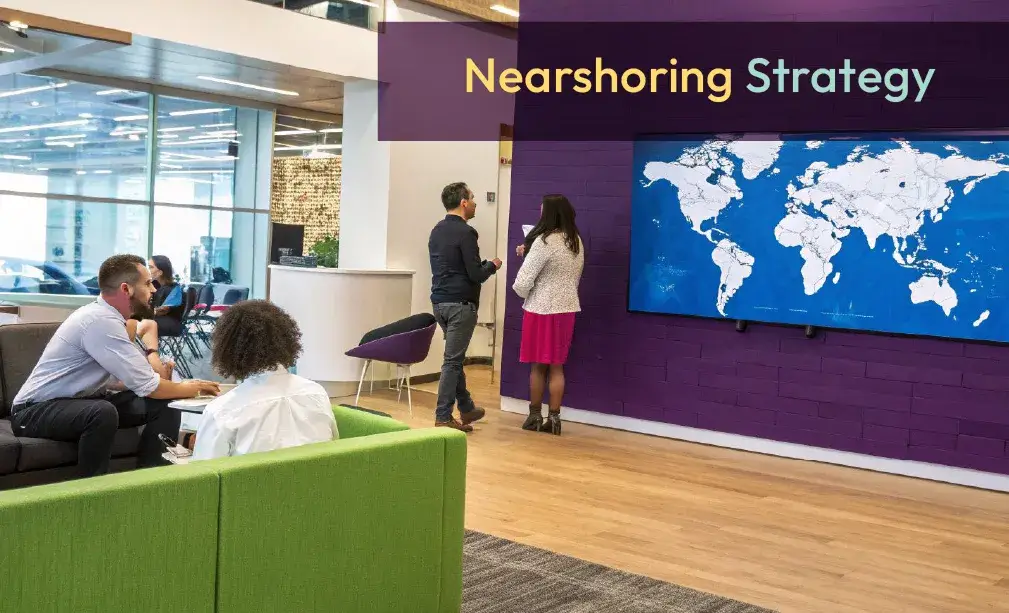
Near-shoring is a strategic approach that involves delegating business processes, like call center services, to companies in nearby countries. Unlike traditional offshoring, which might involve partners on the other side of the globe, near-shoring focuses on geographic proximity. This strategy offers a compelling balance, providing significant cost savings while minimizing the challenges of long-distance collaboration, making it one of the most effective strategies for outsourcing available today.
For a U.S.-based company, this often means partnering with firms in Mexico, Canada, or Latin American countries like Colombia or Costa Rica. The primary advantage is the alignment of time zones, which streamlines communication and allows for real-time collaboration. This proximity also fosters stronger cultural affinity, reducing misunderstandings and building more cohesive team dynamics.
Why Choose a Near-shore Approach?
This strategy is ideal for businesses that require high levels of interaction and real-time collaboration. For roles like customer service, technical support, or sales, having a team that operates during your core business hours is a huge operational advantage. For example, an e-commerce company can use a near-shore call center to provide immediate, bilingual support to its customers, enhancing the overall customer experience without the communication delays of a far-shore team.
How to Implement This Outsourcing Strategy
Successfully adopting a near-shore model requires careful planning. Follow these actionable steps for a smooth transition:
- Conduct a Thorough Cultural Assessment: Beyond language, assess work ethics and communication styles. A partner that understands these nuances will integrate more effectively.
- Establish Clear Communication Protocols: Use tools like Slack, Microsoft Teams, and regular video calls to keep teams connected. Schedule weekly check-ins to review performance and address issues proactively.
- Invest in Relationship Building: Geographic proximity makes travel more affordable. Plan periodic site visits to build rapport and reinforce a shared company culture. This is crucial for maintaining a strong and motivated outsourced team.
- Start with a Pilot Project: Before committing to a large-scale engagement, test the partnership with a smaller, well-defined project. This allows you to evaluate compatibility and quality without significant risk.
Understanding Offshore Call Centers
An offshore call center is a customer support operation set up in a country far from your business headquarters—think a U.S. company leveraging teams in India or the Philippines. This model is popular among organizations looking to reduce costs while scaling their support capabilities quickly. Offshore centers often appeal to businesses seeking round-the-clock coverage, as the time zone difference makes it easier to provide overnight or 24/7 service for markets like the U.S..
The primary draw of the offshore model is its cost efficiency. Operating in regions with lower labor costs allows businesses to maximize budget without sacrificing headcount. Plus, countries known for offshore support, such as India and the Philippines, boast a vast, multilingual talent pool, making it easier to staff up for large-scale operations or support a global customer base.
However, there are important considerations:
- Communication and Cultural Fit: Language barriers can sometimes slow interactions, leading to longer call handle times or misunderstandings. It’s worth evaluating the English proficiency and cultural alignment of prospective partners.
- Control and Oversight: Managing a team from afar requires additional trust. With less direct oversight, companies should prioritize clear protocols and regular performance check-ins to maintain brand consistency.
- Data Privacy: Offshore centers must comply with your data protection requirements—always assess a partner’s security standards before onboarding.
For many companies, especially those expanding globally, offshore call centers deliver an effective blend of scale, affordability, and multilingual support. When managed strategically, they serve as an integral part of a modern, distributed customer service program.
When Is an Onshore Call Center the Right Fit?
While onshore call centers typically involve higher costs, there are scenarios where the advantages clearly outweigh the price tag. So, which companies should lean toward an onshore solution?
Opt for an onshore call center if your business:
- Needs hands-on oversight or close geographic proximity to your customer support team.
- Operates in a regulated industry and requires customer service staff within the same legal jurisdiction (think healthcare, finance, or government contracts).
- Serves a market that’s highly sensitive to cultural nuances or demands absolute fluency in the local language.
- Can achieve its customer service goals with a relatively small, focused team.
- Seeks to deliver a white-glove experience where local expertise and familiarity are critical for customer satisfaction.
For example, a luxury retailer serving a U.S. audience may turn to onshore agents to ensure brand consistency and seamless communication, or a regional healthcare provider may need local reps to navigate complex legal compliance.
If your business places a premium on customer experience, cultural alignment, and real-time collaboration—and your budget allows—investing in an onshore call center could be a strategic move that pays dividends in loyalty and brand reputation.
Onshore Call Center Strategy
Onshore call centers—those based within your own country—offer a distinct set of advantages and challenges for businesses considering their outsourcing options.
Advantages of Onshore Call Centers
Choosing an onshore model can deliver powerful benefits for companies that prioritize seamless communication and alignment with their customer base. The most notable pros include:
- No Language or Cultural Barriers: Support agents are fluent in the local language and deeply familiar with cultural norms, ensuring conversations flow naturally and customer issues are fully understood.
- Greater Time Zone Alignment: With teams operating in the same or similar time zones, scheduling becomes a breeze and real-time collaboration is maximized.
- Easier In-Person Engagement: Whether you need to provide hands-on training or build rapport through team visits, traveling domestically is easier and more cost-effective than managing overseas trips.
- Compliance Confidence: Onshore partners are typically more attuned to local data privacy laws and industry regulations, which is essential for sectors like healthcare and finance.
These factors often lead to shorter call handle times, faster resolutions, and higher customer satisfaction—since customers feel their needs are clearly understood and addressed by someone who “gets it.”
Drawbacks of Onshore Call Centers
Of course, these advantages come with a tradeoff. The primary challenge is cost. Running an onshore call center usually means higher expenses across the board—from wages and benefits to office space and technology investments. Whether you opt for a fully in-person operation or a hybrid remote model, stateside talent commands a premium.
For many organizations, this increased spend is justified by the improved efficiency and customer experience. But for others with tighter margins or less specialized needs, it may limit capacity or growth potential.
When Does Onshore Make Sense?
The onshore approach excels when your brand reputation hinges on nuanced, culturally connected support—think luxury retailers aiming for concierge-level service or healthcare organizations needing agents well-versed in complex regulatory requirements. If customer satisfaction and first-contact resolution are top priorities and budget allows, onshore centers are hard to beat.
Why Consider a Homeshore Call Center?
A homeshore call center model—where agents work remotely within your own country—offers a distinctive blend of advantages, especially for organizations seeking both flexibility and local expertise.
- Access to Local Talent: By recruiting agents who understand your country’s culture, language nuances, and customer expectations, you’re able to deliver a support experience that feels seamless and authentic to your customers.
- Lower Overhead and Infrastructure Costs: Remote work reduces the need for large physical offices, slashing expenses typically spent on rent, utilities, and onsite management.
- Greater Scalability and Flexibility: This model makes it easy to adjust your team size to match seasonal spikes or changing business needs. You can increase capacity during busy periods or scale down, only paying for the services you truly require.
- Enhanced Employee Engagement: Remote positions tend to attract a wider pool of qualified applicants who value the flexibility of working from home. This can lead to higher retention and a more motivated team.
- Improved Customer Experience: Leveraging cloud-based contact center solutions, a homeshore team can provide omnichannel support, ensuring faster response times and smoother issue resolution—without the delays that sometimes stem from international outsourcing.
For industries with complex compliance needs or highly localized customer bases, a homeshore strategy brings the benefits of outsourcing without sacrificing quality or control.
Why Homeshore Call Centers Offer Flexibility and Scalability
Homeshore call centers—those with agents working remotely within your own country—offer unmatched agility for businesses navigating fluctuating demands. By leveraging a virtual workforce, you eliminate the need for physical office space and associated overhead, freeing up resources and enabling you to allocate budget where it matters most.
This domestic model naturally eases collaboration thanks to shared linguistic and cultural backgrounds, ensuring customer interactions remain seamless and on-brand. Perhaps most importantly, the flexibility of a homeshore approach shines when your needs change unexpectedly. Whether you’re ramping up for peak season, responding to marketing surges, or testing new campaigns, you can swiftly scale your team up or down without the hurdles of traditional hiring, onboarding, or office logistics.
For example, a retail brand facing an annual holiday rush can onboard additional remote agents in just weeks, then scale back as order volumes normalize—no long-term contracts or infrastructure changes required. This ability to match staffing to real-time business demands makes the homeshore model particularly attractive for companies seeking both cost efficiency and responsive support.
2. Offshore Development Center (ODC) Strategy
An Offshore Development Center (ODC) is a strategic model where a company establishes a dedicated, long-term team with an outsourcing partner in a foreign country. This approach goes beyond simple project delegation; the ODC functions as a direct extension of your in-house team. It provides dedicated resources, infrastructure, and specialized talent focused exclusively on your projects, offering significant cost savings and access to a global talent pool. This is one of the more integrated strategies for outsourcing, fostering deep collaboration.
Much like offshore call centers—where a US-based business might outsource customer support to countries like India or the Philippines—an ODC places your technical or development team in a distant location, often in regions renowned for their skilled labor and cost efficiencies. While offshore call centers typically handle support or service functions, ODCs are meant for complex, ongoing projects such as software development, product engineering, or research and development.
This model has been popularized by technology giants that operate major development hubs in countries like India or the Philippines. These companies leverage ODCs to tap into vast tech talent, accelerate development cycles, and maintain a 24/7 operational footprint, all while managing costs effectively. The ODC gives you direct oversight over team structure, project management, and daily operations.
By establishing an ODC, you effectively create an overseas branch of your own team—one that works closely with your domestic staff, shares your processes, and is deeply invested in your organization’s long-term goals. This is especially valuable for companies needing continuous innovation, scalability, and a seamless workflow across borders.
What Are the Benefits and Drawbacks of Offshore Call Centers?
Offshore call centers have long been a cornerstone of international business process outsourcing—think vast teams in the Philippines or India supporting global brands. As with any model, they come with a unique set of advantages and potential hurdles. Let’s break them down:
Key Benefits:
- Significant Cost Savings: Operating costs in many offshore locations are far lower than in North America or Western Europe, allowing companies to stretch their budgets without sacrificing coverage.
- Scalable Talent Pool: Countries like India, the Philippines, and South Africa offer a steady stream of skilled call center professionals, making it easy to staff large teams or flex up quickly as your business grows.
- 24/7 Customer Support: Thanks to time zone differences, offshore teams can cover nights, weekends, and even holidays—enabling around-the-clock support for your customers.
- Multilingual Capabilities: Many offshore providers boast agents fluent in multiple languages, which is indispensable for companies serving global markets or diverse customer bases.
- Breadth of Service Offerings: The competitive landscape among offshore vendors means many offer specialized services at affordable rates—anything from technical support to order processing.
Notable Drawbacks:
- Cultural and Linguistic Barriers: Despite bilingual skills, offshore agents may not always be attuned to local slang, humor, or customer expectations, sometimes leading to misunderstandings or longer resolution times.
- Oversight Challenges: The physical distance can make it harder to directly oversee training, quality, and day-to-day operations, requiring a greater degree of trust and robust management systems.
- Brand Alignment Concerns: There’s a risk that your outsourced team may not fully grasp or embody your brand values, resulting in less personalized or inconsistent customer experiences.
- Data Privacy Considerations: Handling sensitive customer data across borders can present compliance headaches, especially with regulations like GDPR or CCPA in play.
Ultimately, offshore call centers are a compelling option for businesses aiming to maximize efficiency, scale rapidly, and control costs. However, they demand thoughtful management, clear communication protocols, and carefully chosen partners to realize their full potential.
Why Choose an ODC Approach?
The ODC model is best for companies with long-term, large-scale development needs or those looking to scale technical capabilities rapidly without the high costs of domestic hiring. It is ideal for ongoing software development, product maintenance, and R&D initiatives. For example, a fintech company can establish an ODC to handle the continuous development and support of its trading platform, ensuring consistent expertise and innovation.
But is an ODC the right fit for your business goals and resources? Consider this approach if your organization:
- Requires dedicated, large-scale operations with the flexibility to grow
- Needs to maximize budget efficiency, accessing specialized talent at a lower cost than domestic hiring
- Seeks a wider array of technical services—from development and QA to DevOps and product support—without piecemeal outsourcing
- Is comfortable delegating daily management to a trusted partner while maintaining strategic oversight
- May benefit from multilingual or globally distributed teams, especially if you serve an international customer base
- Has less need for physical proximity but values consistent communication and integration
Ultimately, the ODC model works best when your project demands long-term collaboration, a scalable team, and continuous knowledge transfer. Weigh the advantages of broad technical capability and affordability against your needs for hands-on control and cultural alignment to determine if this strategic outsourcing solution is the right fit for your organization.
How to Implement This Outsourcing Strategy
Setting up a successful ODC requires a significant commitment to integration and communication. A well-planned implementation is key.
- Establish a Clear Governance Framework: Define roles, responsibilities, and reporting structures from the outset. Create a clear project management process that aligns the ODC with your company’s internal workflows.
- Invest Heavily in Communication Tools: Bridge the distance with a robust suite of collaboration tools like Jira, Slack, and video conferencing platforms. Regular, scheduled meetings are essential for keeping both teams synchronized.
- Focus on Cultural Integration: An ODC is part of your company, not just a vendor. Invest in activities that build a shared culture. This includes virtual team-building events and periodic visits to foster personal connections.
- Implement Robust Security Measures: When dealing with sensitive data, security is paramount. Ensure your partner has stringent security protocols, NDAs, and compliance certifications in place to protect your assets. This is a critical aspect of managing an outsourced team.
3. Multi-vendor Strategy
A multi-vendor strategy is a diversification approach where a company distributes its outsourcing needs across multiple specialized service providers instead of relying on a single one. This method involves segmenting different business functions among various vendors to mitigate risk, drive competitive pricing, and access best-in-class expertise for each task. It is one of the most robust strategies for outsourcing for complex, large-scale operational needs.
For example, a large financial institution might use one provider for its IT helpdesk, another for customer-facing call center services, and a third for its back-office data processing. This ensures that a failure with one vendor does not cripple the entire operation. This approach moves away from a “one-size-fits-all” partnership, allowing businesses to build a custom ecosystem of specialized talent.
Why Choose a Multi-vendor Approach?
This strategy is ideal for businesses that require diverse skill sets and want to avoid vendor lock-in. It fosters a competitive environment where providers must consistently deliver high-quality results to retain business. For instance, an e-commerce brand can partner with one agency for digital marketing and another for handling its inbound sales and customer support calls, ensuring each function is managed by a specialist.
How to Implement This Outsourcing Strategy
Managing multiple partners requires a strong governance framework to ensure consistency. Follow these actionable steps to effectively coordinate a multi-vendor ecosystem:
- Develop a Comprehensive Vendor Management Framework: Create a central playbook that outlines rules of engagement, communication channels, and performance expectations for all partners.
- Establish Clear Performance Metrics and SLAs: Define specific Key Performance Indicators (KPIs) and Service Level Agreements (SLAs) for each vendor. This ensures you can objectively measure their performance.
- Create Integration Standards: Ensure all vendors use compatible technologies and follow standardized data-sharing protocols to facilitate seamless collaboration and avoid operational silos.
- Implement Centralized Governance: Appoint an internal team or manager to oversee all vendor relationships. This central point of contact is crucial for resolving disputes and ensuring all partners are aligned with your business goals.
4. Build-Operate-Transfer (BOT) Model
The Build-Operate-Transfer (BOT) model is a dynamic, phased outsourcing strategy where a service provider builds a dedicated operation, operates it for a predetermined period, and then transfers ownership and control back to the client. This approach allows a company to leverage external expertise for the complex setup and stabilization phases while retaining the option for long-term, in-house control. It is one of the more sophisticated strategies for outsourcing for establishing new capabilities with reduced upfront risk.
For example, a large financial firm wanting to establish a new call center without the initial internal expertise can partner with a BPO provider. The provider would handle everything from site selection and staffing to process optimization. Once the operation is mature and stable, the entire asset, including personnel and processes, is transferred to the firm.
The infographic below illustrates the clear, three-stage progression of the BOT model.
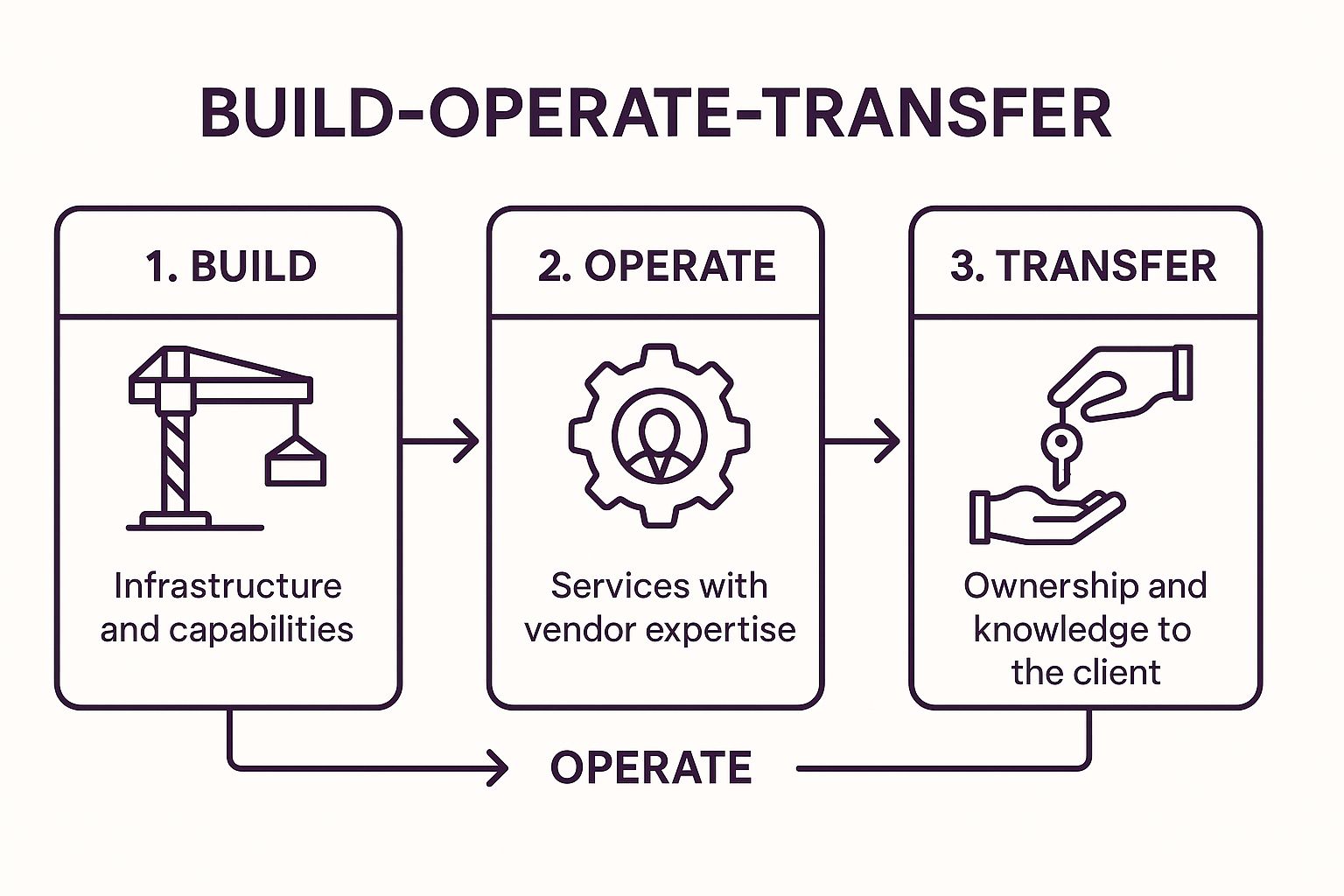
This structured flow ensures the client receives a fully functional and optimized operation at the end of the contract period.
Why Choose a BOT Approach?
This model is best suited for large-scale, complex projects where a company lacks the immediate internal resources but desires eventual ownership. It’s ideal for entering new markets or establishing a critical operational center. The initial partnership mitigates the risks associated with setup, hiring, and operational ramp-up, allowing the client to focus on their core business.
How to Implement This Outsourcing Strategy
A successful BOT engagement hinges on meticulous planning and a clearly defined agreement that governs all three phases.
- Define Clear Transfer Criteria: Establish specific, measurable success metrics from the start. What does a “successful” transfer look like? This could include performance benchmarks, staff competency levels, and operational stability milestones.
- Ensure Comprehensive Documentation: Maintain detailed records of all processes, workflows, and technical configurations throughout the build and operate phases. This documentation is crucial for a seamless knowledge transfer.
- Plan for Extensive Knowledge Transfer: The transfer phase requires a structured plan for training your in-house team, shadowing key vendor personnel, and gradually shifting responsibilities.
- Include Retention Incentives: To prevent the loss of critical talent during the transfer, build retention bonuses for key vendor employees who will transition to your organization. This is vital for maintaining customer service continuity.
5. Hybrid Outsourcing Strategy
A hybrid outsourcing strategy offers a flexible, best-of-both-worlds approach by combining in-house teams with external service providers. This blended model involves keeping core, strategic functions internal while delegating non-core or specialized activities to an outsourced partner. This allows a company to maintain direct control over its most critical operations while leveraging the cost efficiencies and scalability of an external team, making it one of the most balanced strategies for outsourcing.
For example, a technology company might keep its product design and core engineering teams in-house but outsource its customer support and IT helpdesk. Similarly, a bank would retain its risk management departments while outsourcing call center operations. This model ensures that mission-critical knowledge remains within the company, while supplementary functions are handled by specialists.
Why Choose a Hybrid Approach?
This strategy is perfect for businesses that want to scale efficiently without losing control over their brand identity. It allows companies to tap into specialized talent for specific tasks, like 24/7 customer service, without the overhead of building those departments from scratch. For instance, an e-commerce brand can keep its marketing team in-house while using an outsourced call center to handle order processing and post-sale inquiries.
How to Implement This Outsourcing Strategy
Executing a successful hybrid model depends on creating a seamless connection between your internal and external teams.
- Clearly Define Boundaries: Create a detailed document outlining the specific responsibilities of the in-house team versus the outsourced partner. This prevents overlap and ensures everyone knows their role.
- Establish Strong Communication Channels: Implement unified communication platforms like Slack or Microsoft Teams so that both teams can collaborate in real-time. Schedule regular joint meetings to foster a one-team mentality.
- Implement Unified Reporting Systems: Use shared dashboards and project management tools to track performance across both teams. This provides a single source of truth for all stakeholders.
- Create Shared Performance Metrics: Develop Key Performance Indicators (KPIs) that apply to both your internal and outsourced team. This promotes mutual accountability and a shared commitment to achieving business goals.
- Workforce Structure: If your company already operates with a remote or distributed team, integrating a homeshore call center can be a natural extension, allowing for smooth collaboration and minimal cultural adjustment.
- Budget Constraints: Organizations looking to maintain onshore customer service without breaking the bank may find that homeshore solutions offer a solid balance between quality and cost. Leveraging remote agents can often reduce overhead expenses compared to traditional brick-and-mortar centers.
- Flexibility and Scalability: Businesses experiencing seasonal spikes or unpredictable growth may benefit from the scalability of a homeshore model. It’s much easier to ramp teams up or down when you’re not tied to a physical location or fixed headcount.
- Management Approach: If your leadership style doesn’t hinge on in-person supervision or on-site training, a homeshore setup can work well. Many remote teams thrive using tools like Zoom, Slack, or Microsoft Teams for training, meetings, and real-time support.
- Access to Talent: Sometimes, specialized skills or language capabilities are best found by casting a wide net across the country. Homeshore models let you recruit talent from anywhere within your borders, not just a specific city.
If these factors resonate with your operating style and goals, a homeshore call center could be an efficient—and strategic—choice for your business.
6. Centers of Excellence (CoE) Strategy
A Center of Excellence (CoE) strategy involves partnering with a vendor that has established a specialized unit dedicated to a specific business function. This approach goes beyond standard outsourcing by concentrating top-tier talent, best practices, and innovative technologies into a single, focused hub. This concentration of expertise allows the CoE to deliver superior quality and drive innovation, making it a powerful choice among strategies for outsourcing.
Major BPO and consulting firms have popularized this model, creating CoEs for fields like healthcare support, financial services, and technical helpdesks. When you engage a CoE, you aren’t just hiring a team; you are accessing an entire ecosystem built around mastery of a specific discipline. This provides a strategic advantage by tapping into a level of knowledge that would be difficult and expensive to develop in-house.
Why Choose a CoE Approach?
This strategy is ideal for businesses needing deep, specialized expertise to tackle complex challenges. It’s particularly effective for mission-critical functions where best-in-class performance is non-negotiable. For instance, a financial services firm could partner with a compliance CoE to navigate complex regulations, gaining access to cutting-edge protocols. Similarly, an e-commerce company could leverage a data analytics CoE to optimize its supply chain and personalize customer experiences.
How to Implement This Outsourcing Strategy
Partnering with a CoE requires a strategic alignment of goals and a commitment to collaborative innovation.
- Align CoE Capabilities with Strategic Goals: Ensure the vendor’s specialization directly supports your long-term business objectives. If your goal is improving customer retention, partner with a CoE that has a proven track record in customer experience.
- Establish Clear Innovation Metrics: Go beyond standard performance KPIs. Define targets for innovation, such as developing new process improvements or implementing new technologies.
- Ensure Regular Knowledge Transfer: Create a formal process for the CoE to transfer best practices back to your internal teams. This builds your organization’s own capabilities.
- Evaluate CoE Maturity and Track Record: Before committing, rigorously assess the CoE’s history, case studies, and client testimonials. A mature CoE will have well-defined processes and a portfolio of successful projects.
Industries Requiring Enhanced Security and Compliance
Certain industries face especially stringent requirements when it comes to customer security and data privacy in virtual call centers. Financial institutions, including banks and credit unions, must adhere to strict regulations like GLBA and PCI DSS to protect sensitive client information. Healthcare providers are similarly bound by HIPAA, making robust data protection essential for safeguarding patient records.
Other sectors, such as insurance, government services, and legal firms, also handle confidential information that demands rigorous compliance protocols. For these industries, choosing a virtual call center partner with expertise in advanced cybersecurity measures and regulatory compliance isn’t just a preference—it’s a necessity. Careful due diligence around encryption standards, access controls, and compliance certifications will ensure your organization remains protected against data breaches and regulatory penalties.
7. Outcome-Based Outsourcing Strategy
Outcome-based outsourcing is a results-driven model that shifts the focus from processes to performance. In this approach, vendors are compensated based on achieving specific, pre-defined business outcomes rather than for the hours worked. This strategy directly aligns the service provider’s incentives with the client’s business objectives, ensuring both parties are invested in delivering measurable value.
This strategy links payment directly to tangible results like increased sales, higher customer satisfaction scores, or reduced operational costs. For instance, a healthcare BPO provider might have its compensation tied to improved patient satisfaction scores. This makes it one of the most accountability-focused strategies for outsourcing.
Why Choose an Outcome-Based Approach?
This strategy is ideal for businesses that want to guarantee a return on their outsourcing investment. It is particularly effective for complex, long-term projects where the end result is more critical than the specific tasks involved. For example, a company might engage a sales call center on an outcome-based contract where payment is a percentage of the revenue generated from new leads, directly tying the vendor’s success to the company’s bottom line.
“The goal of outsourcing is not just to delegate tasks, but to build a strategic partnership that amplifies your company’s strengths and accelerates its growth.”
How to Implement This Outsourcing Strategy
A successful outcome-based partnership requires meticulous planning and transparent communication.
- Define Clear and Measurable Metrics: Identify specific KPIs that genuinely reflect business success. These must be quantifiable, achievable, and directly influenced by the outsourced team’s performance.
- Establish Baseline Performance Levels: Before the partnership begins, document current performance. This baseline is essential for accurately measuring the improvements delivered by your partner.
- Create a Balanced Scorecard: Avoid focusing on a single metric. Use a balanced scorecard that includes multiple performance dimensions, such as quality, efficiency, and customer satisfaction.
- Implement Regular Review Mechanisms: Schedule frequent reviews to assess progress against the defined outcomes. This allows for proactive adjustments and ensures the partnership remains aligned with evolving business needs and customer service trends.
8. Cloud-First Outsourcing Strategy
A Cloud-First Outsourcing Strategy prioritizes cloud-based solutions and services, shifting call center infrastructure from on-premise hardware to scalable cloud platforms. This modern approach involves partnering with vendors who deliver services through cloud-native architectures. By leveraging the power of providers like AWS, Google Cloud, and Microsoft Azure, businesses can achieve unparalleled flexibility, scalability, and cost-efficiency, making it one of the most transformative strategies for outsourcing today.
This model moves beyond simply renting server space; it’s about outsourcing entire technological functions like CCaaS (Contact Center as a Service), data storage, and AI-driven analytics. Companies like Netflix and Spotify exemplify this strategy by outsourcing their platform needs to focus purely on product innovation. This allows them to scale services for millions of users globally without managing physical data centers.
Why Choose a Cloud-First Approach?
This strategy is perfect for businesses aiming for rapid growth, agility, and innovation without the burden of massive capital expenditures on IT infrastructure. It is particularly effective for any organization looking to modernize its operations. For example, a startup can launch a new customer support channel by leveraging a cloud provider’s infrastructure, paying only for the resources it consumes. This eliminates the upfront cost of purchasing and maintaining servers.
How to Implement This Outsourcing Strategy
Transitioning to a cloud-first model requires a clear roadmap to maximize benefits and mitigate risks.
- Develop a Comprehensive Cloud Governance Framework: Before migrating, define clear policies for security, compliance, and cost management. This framework will guide your partnership and ensure your cloud environment is secure and optimized.
- Prioritize Data Security and Compliance: Work with your outsourcing partner to ensure all data handling practices meet industry standards like GDPR, HIPAA, or PCI DSS. Implement robust encryption and access controls.
- Plan for a Multi-Cloud or Hybrid Strategy: To avoid vendor lock-in and enhance resilience, consider using multiple cloud providers or a hybrid model that combines public cloud services with private infrastructure.
- Implement Rigorous Cost Monitoring: Utilize cloud cost management tools to track spending in real-time. A key aspect of a successful BPO partnership is establishing transparent financial oversight to prevent unexpected expenses.
What Is Homeshoring in the Context of Call Centers?
Homeshoring—sometimes called “in-country outsourcing”—is an approach where customer service agents work remotely from their own homes, but are based in the same country as the company they represent. Instead of gathering employees in a single, centralized call center office, homeshoring enables businesses to tap into a geographically dispersed workforce without sacrificing language fluency, cultural alignment, or familiarity with local regulations.
For instance, a U.S. company might employ a network of skilled agents working from various locations nationwide, providing the flexibility and localized support often needed for high-touch customer interactions. This model helps businesses maintain strict quality control and data compliance standards, all while offering agents the benefits of remote work.
Homeshoring is particularly attractive for organizations seeking to combine the advantages of “onshore” outsourcing—such as strong customer rapport and faster response times—with the scalability and cost efficiencies that remote work arrangements can provide.
What Are the Benefits of Homeshore (Virtual) Call Center Outsourcing?
Homeshore—or virtual—call center outsourcing can be a strategic game-changer for companies seeking both top-tier customer support and streamlined operations. Instead of relying on a centralized office, agents work remotely from within your own country, delivering a unique set of advantages.
Why consider homeshore outsourcing? Let’s break down the main benefits:
- Significant Cost Savings: With no need to maintain large office spaces or cover travel expenses for site visits, overhead costs drop dramatically. You invest solely in talent and technology, not in physical infrastructure.
- Cultural and Linguistic Alignment: Since agents are based locally, there’s natural alignment in language proficiency and cultural nuance. This leads to more effective communication and more satisfying customer interactions—no need to explain the local lingo or holidays.
- Greater Flexibility and Scalability: Virtual call centers can quickly ramp staffing up or down in response to seasonal spikes, product launches, or unexpected surges. Think of it as “on-demand” customer service support—ready to expand or contract as your needs change.
- Enhanced Business Continuity: Geographic dispersion of agents means fewer disruptions from local outages or unforeseen events. If one region goes down, others can seamlessly pick up the slack, just as a distributed team at a global leader like Shopify might do.
- Access to a Nationwide Talent Pool: Forget the limitations of local hiring. Homeshore call centers tap into talent from coast to coast, unlocking diverse perspectives and expertise that can be tailored to specialized roles.
Ultimately, if your goal is to provide high-quality service while staying nimble and cost-effective, homeshore outsourcing offers an appealing path. You can maintain strong oversight, ensure your agents understand your customer base, and adapt swiftly to whatever the market throws your way.
Remote Work Considerations for Homeshore Call Centers
With the rise of remote work, homeshore call centers are adopting new strategies—but not without unique challenges and opportunities for productivity and staff development.
On one hand, many agents report higher productivity in remote settings thanks to fewer workplace distractions and reduced commute times. However, not everyone thrives in a home office environment. Some staff may struggle to maintain focus or adapt to self-directed workflows, making robust performance monitoring essential.
To address this, your call center management—whether internally managed or with an outsourcing partner—must have deep expertise in remote leadership and agent support. Providing clear expectations, regular feedback, and targeted virtual training sessions helps agents develop key skills and maintain engagement from home.
Security is another critical consideration. With agents handling sensitive information from personal devices and home networks, the risk of data breaches increases. Companies dealing with highly sensitive data, such as those in banking, finance, or healthcare, need to establish strict protocols. This includes:
- Strict authentication and endpoint security measures
- Mandated use of secure, company-approved devices when possible
- Training agents on data privacy compliance (GDPR, HIPAA, PCI DSS)
- Ongoing audits to detect and patch vulnerabilities
Ultimately, while remote work can empower and develop staff, it places new demands on management, training, and IT. By prioritizing strong virtual supervision and rigorous security protocols, businesses can harness the benefits of remote teams without sacrificing service quality or data protection.
9. Multi-sourcing Strategy
Multi-sourcing is an advanced outsourcing model where a business diversifies its partnerships by engaging multiple specialized vendors for different functions rather than relying on a single provider. This “best-of-breed” approach allows a company to select the ideal partner for each specific task, from IT support to customer service. It is one of a company’s most flexible strategies for outsourcing, mitigating risk and maximizing performance.
Instead of putting all your eggs in one basket, multi-sourcing lets you build a customized network of experts. For example, a tech startup might partner with one firm for its expert bilingual call center services, another for its cutting-edge cybersecurity, and a third for its agile software development. This diversification ensures that each business function is handled by a provider that excels in that specific domain.

Why Choose a Multi-sourcing Approach?
This strategy is particularly effective for companies with diverse operational needs that a single vendor cannot optimally fulfill. It reduces dependency on one supplier, which lowers the risk of service disruption. Furthermore, fostering competition among vendors can lead to better pricing and higher service levels. A financial services firm, for instance, could use one agency for inbound customer queries and a different, specialized agency for outbound debt collection, ensuring both tasks are managed by experts.
How to Implement This Outsourcing Strategy
Effective multi-sourcing requires strong governance to manage multiple relationships seamlessly.
- Establish a Robust Governance Model: Create a central vendor management office (VMO) or assign a dedicated manager to oversee all partnerships. This role is crucial for coordinating efforts and ensuring all vendors align with your business goals.
- Define Clear Service Level Agreements (SLAs): Each vendor contract must have detailed, measurable SLAs and key performance indicators (KPIs). This clarity ensures every partner understands their specific responsibilities.
- Standardize Communication and Reporting: Implement a unified communication platform and standardized reporting templates for all vendors. This streamlines information flow and makes it easier to compare performance.
- Foster a Collaborative Environment: While vendors may compete, encourage collaboration where their services intersect. Regular joint meetings can help align strategies and ensure a seamless end-user experience.
Outsourcing Strategies Comparison Matrix
| Strategy | Implementation Complexity | Resource Requirements | Expected Outcomes | Ideal Use Cases | Key Advantages |
|---|---|---|---|---|---|
| Nearshoring | Moderate: Cultural and legal considerations | Moderate: Skilled regional talent pool | Improved communication and faster response | Companies needing proximity and cultural fit | Better oversight, collaboration, and control |
| ODC | High: Setup, management across time zones | High: Dedicated infrastructure & team | Cost savings and scalability | Long-term projects requiring dedicated teams | Large cost reduction, control, and skill access |
| Multi-vendor | High: Managing multiple vendors and integration | High: Multiple vendor management resources | Risk mitigation and optimized service quality | Organizations needing risk diversification | Reduced vendor dependency and competitive pricing |
| BOT Model | High: Multi-phase setup and knowledge transfer | High: Vendor investment and client involvement | Gradual ownership with operational control | Infrastructure or capability build with transfer | Access to expertise, eventual full ownership |
| Hybrid Outsourcing | Moderate to High: Coordination between teams | Moderate: Balanced internal and external resources | Control over core, cost-efficiency on support | Firms wanting control and flexibility | Control retention with cost and skill leverage |
| CoE | Moderate: Vendor specialized centers setup | Moderate: Access to specialized expertise | High-quality outputs and innovation | Organizations needing deep specialization | Expertise concentration and continuous improvement |
| Outcome-Based | High: Complex contracts and measurement | Moderate: Focused on results, not resources | Value-driven results aligned with goals | Businesses focused on measurable outcomes | Alignment on results, incentivizes innovation |
| Cloud-First | Moderate: Cloud integration and governance | Moderate: Cloud platform and expertise | Scalable, flexible cloud-based services | Companies prioritizing agility and cloud adoption | Scalability, cost efficiency, latest technologies |
| Multi-sourcing | High: Requires strong vendor management | High: Coordination and integration efforts | Optimized performance through specialization | Companies with diverse, complex needs | Access to best-in-class expertise, reduced risk |
Call Center Outsourcing Models: Common Challenges to Expect
While choosing an outsourcing model is a strategic decision, it’s equally important to weigh the operational and managerial hurdles each approach may present. Here’s a summary of common pitfalls and obstacles associated with major call center outsourcing models:
Onshore Call Centers
Onshore solutions—where your call center partners operate in the same country as your business—offer clear advantages in alignment and familiarity. However, several challenges persist:
- Higher Operating Costs: Salaries, real estate, and technology expenditures are generally higher in mature markets like the US or Western Europe. This makes onshore call centers the priciest option.
- Scalability Concerns: Rapidly expanding your support team can be difficult, as local talent pools may be limited compared to global alternatives.
- Regulatory Complexity: While local compliance is a strength, strict employment and labor laws can slow down hiring, realignment, or downsizing efforts.
Offshore Call Centers
Shifting operations to countries with significant cost advantages—think India, the Philippines, or South Africa—can dramatically reduce expenses. Still, these savings come with trade-offs:
- Language and Cultural Gaps: Even with language training, subtle differences in communication style or cultural references can impact customer satisfaction.
- Oversight and Control: Distance—both geographical and managerial—means less direct supervision, making quality assurance and team cohesion more demanding.
- Data Security and Compliance: Offshore partners may operate under different legal standards for data privacy and security. This elevates the risk of non-compliance with standards like HIPAA or GDPR.
- Brand Consistency: Ensuring that offshore agents embody your brand voice and values may require extra training and vigilant monitoring.
Nearshore Call Centers
Nearshoring—outsourcing to nearby countries with close time zones and cultural affinity, like a US company working with partners in Mexico or Canada—offers a middle-ground. Still, there are considerations:
- Limited Vendor Options: The pool of qualified vendors may be much smaller than offshore alternatives, potentially restricting your ability to negotiate or scale.
- Residual Language Barriers: While generally less pronounced, some linguistic and cultural differences can still crop up, particularly with more nuanced customer interactions.
- Cost vs. Value: Nearshore solutions tend to be less expensive than onshore models but more costly than offshore. Balancing budget against outcomes is essential.
- Resource Constraints: The regional talent market may not offer the depth of specialized skills found in larger offshore hubs.
Homeshore (Virtual/Remote) Call Centers
When agents work remotely within your own country, organizations gain flexibility, but not without unique hurdles:
- Management and Integration: Coordinating a dispersed team requires robust digital infrastructure, strong internal processes, and effective remote management tools.
- Quality Assurance: Maintaining consistent service quality and company culture across a virtual workforce can be tricky.
- Security Risks: Dispersed access increases exposure to data security threats, necessitating strong protocols and ongoing training.
Navigating these potential barriers is critical to realizing the advantages of each outsourcing strategy. Careful planning, ongoing oversight, and a willingness to adapt will set your call center partnership up for long-term success.
Understanding the Nuances: Which Outsourcing Model Fits Your Needs?
Choosing the right outsourcing strategy is about more than just cost—it’s about aligning your business needs with the strengths of each model. Here’s a closer look at key types, drawing on real-world best practices to clarify when each approach is the right fit:
Nearshoring
Nearshoring brings your outsourced team closer to home, often in a neighboring country or similar time zone. For a U.S.-based company, this could mean partnering with providers in Canada, Puerto Rico, or Mexico. The advantage? Easier collaboration, fewer time zone headaches, and a higher likelihood of shared cultural or linguistic understanding. Many nearshore agents are bilingual, having lived, worked, or studied in the U.S., making them especially valuable for companies seeking a balance between cost and cultural fit. While not always as affordable as offshore options, nearshoring often delivers smoother communication and control—ideal for businesses that want proximity without paying onshore rates.
Offshore
Offshore outsourcing is synonymous with scale and savings. By leveraging talent in distant regions—think India or the Philippines—companies can access large pools of skilled agents at a lower cost. Offshore is best for organizations looking for extensive coverage and multilingual support on a tighter budget. While there may be some linguistic or cultural gaps, these centers excel at delivering a wide array of services efficiently. Offshore is well suited for businesses less concerned about proximity and more focused on affordability and breadth of services.
Onshore
Onshore outsourcing keeps your call center within your own borders. This solution is perfect for companies that require maximum control, need to comply with local regulations, or serve customers who demand native language fluency and cultural familiarity. Onshore models tend to command a higher price, but the payoff is often superior customer experience and satisfaction—especially for sensitive or highly regulated industries.
Homeshore / Virtual
Homeshore (sometimes known as virtual or remote call centers) enlists agents working from their own homes within your country. This model offers impressive flexibility and cost savings, as you avoid the overhead of physical centers. Homeshore is ideal for businesses needing rapid scaling or seasonal surge support, with the added benefit of reducing linguistic and cultural barriers.
Key Considerations for Each Model
- Proximity vs. Cost: Onshore delivers the closest collaboration, but at a premium. Offshore maximizes savings, while nearshore strikes a balance.
- Cultural and Linguistic Fit: Nearshore and onshore often provide agents with stronger cultural ties and language fluency. Offshore excels in scalability and multilingual support for global brands.
- Level of Control: The closer the team, the more oversight and flexibility you retain.
- Scalability & Flexibility: Offshore and homeshore models scale quickly. Nearshore and onshore typically offer more direct control but may be limited by regional talent pools.
By understanding the nuances of each outsourcing strategy—from nearshoring and offshore to onshore and virtual—you can align your approach with your company’s goals, customer expectations, and budget. The matrix above provides a quick snapshot of what to expect, helping you zero in on the model that will deliver both immediate value and lasting results.
Choosing Your Path: How CallZent Can Co-Create the Perfect Outsourcing Strategy
Navigating the landscape of outsourcing can feel overwhelming, but it doesn’t have to be. As we’ve explored, the power of outsourcing lies not in a single solution but in selecting the right model for your specific business needs. There is no magic bullet; the optimal choice among the diverse strategies for outsourcing depends entirely on your unique objectives, operational requirements, and long-term vision.
The strategies detailed here, from the geographical precision of a nearshoring model to the innovative flexibility of a hybrid approach, represent a powerful toolkit for growth. Each one offers a distinct path toward enhancing efficiency, accessing specialized talent, and ultimately, driving your business forward. The crucial first step is to move from understanding these concepts to applying them. This process starts with an honest assessment of your internal capabilities and a crystal-clear definition of what success looks like for your organization.
Matching Models to Your Goals
Each outsourcing model has its own strengths—and understanding these is key to making a smart choice:
- Onshore and Homeshore: If top-tier customer service, minimal language or cultural barriers, and a high-touch approach are essential, onshore and homeshore models shine. Onshore provides the highest level of support and familiarity, while homeshore can reduce costs without sacrificing these core benefits.
- Nearshore: Striking a balance between cost-effectiveness and cultural alignment, nearshore outsourcing is a strong contender for businesses wanting affordability with fewer communication challenges. Proximity often means similar time zones and greater day-to-day collaboration.
- Offshore: For organizations with tighter budgets or large-scale support needs, offshore models can deliver significant savings. However, it’s important to weigh these benefits against potential language or cultural hurdles, which can impact customer satisfaction and efficiency.
Aligning the Model to Your Business Objectives
- If leveraging advanced technology, cloud platforms, or omnichannel solutions is a priority, onshore or homeshore providers may offer the sophistication and infrastructure you need.These models are particularly well-suited for businesses seeking robust cloud-based systems, advanced reporting capabilities, and seamless integration across channels—ensuring customers can reach you via phone, chat, email, or social media without missing a beat.
- For consistent support at scale—especially for enterprises—offshore centers can provide the necessary workforce and cost advantages.
- When the goal is to improve customer experience and satisfaction above all else, onshore models often deliver the best results.
No matter which path you choose, remember that your customer support center is more than a cost center—it’s a strategic investment in long-term business growth. Delighted customers become loyal advocates, drive repeat business, and fuel word-of-mouth referrals.
Still not sure which outsourcing model aligns with your business goals? Consider consulting with an experienced outsourcing partner who can help you cut through the noise and craft a strategy tailored to your unique needs.
Key Takeaways for Building Your Outsourcing Framework
Mastering these strategies for outsourcing is more than an operational exercise; it’s a strategic imperative. The right approach transforms outsourcing from a simple cost-saving measure into a dynamic engine for innovation and competitive advantage.
Remember these core principles as you move forward:
- Clarity Precedes Success: Before you select a partner, you must have an unwavering understanding of your goals. Are you aiming to reduce operational costs, improve customer satisfaction, access a specialized skill set, or scale your operations rapidly?
- Partnership Over Transaction: The most successful outsourcing relationships are built on collaboration and shared goals. Look for a partner who invests time in understanding your business and functions as a true extension of your team. This is a critical component of a strong vendor management strategy.
- Flexibility is a Superpower: The business world is constantly changing. The strategy you choose today must be agile enough to adapt to tomorrow’s market demands. Models like hybrid outsourcing offer inherent flexibility, allowing you to pivot as your business needs evolve.
- Communication is the Bedrock: No strategy can succeed without a robust communication protocol. This involves establishing clear channels, setting expectations for reporting, and fostering a culture of transparency.
Taking the Next Actionable Steps
The journey to effective outsourcing begins with a single, decisive step. Armed with the insights from this article, you are now equipped to make an informed decision that aligns with your strategic objectives. Whether you’re a healthcare provider needing specialized patient support or an e-commerce brand looking to perfect your customer service outsourcing plan, the principles remain the same.
Start by evaluating your core business functions and identifying which areas would benefit most from external expertise. Consider the cultural and logistical implications of different models, like nearshoring versus offshoring, and how they fit with your team’s workflow. This initial analysis will illuminate the path forward and help you craft a tailored plan that leverages the best of what outsourcing has to offer, ultimately leading to a more resilient and efficient organization.
And remember, regardless of which outsourcing model you choose, investing in a customer support center isn’t just about efficiency or savings—it’s an investment in your overall business growth. Customers who have a positive experience are far more likely to purchase again, spread the word to others, and become loyal advocates for your brand. By thoughtfully implementing these strategies for outsourcing, you can unlock new levels of performance and focus on what you do best: growing your business.
About the Author
Written by the CallZent Outsourcing Strategy Team, a U.S.-owned & operated nearshore provider. We deliver bilingual customer support, sales, and specialized programs for healthcare, fintech, insurance, and e-commerce. Security note: SOC 2 & ISO 27001 programs are in implemented with strict security & fraud prevention controls.
Advantages of Onshore Call Centers
Onshore call centers offer several distinct benefits for U.S.-based organizations, including:
- Minimal concerns about language barriers or cultural misunderstandings
- In-depth familiarity with your audience’s regional nuances and preferences
- Greater overlap in time zones, making real-time collaboration easier
- Simplified travel for training and in-person meetings when needed
- Increased likelihood of compliance with U.S. data laws, industry regulations, and security standards
These advantages can be especially valuable for companies requiring seamless communication, regulatory adherence, and a team that truly understands the local customer base.
Ready to speak to get started in your outsourcing journey? Schedule a call with us: 30 – minute call
What is the best outsourcing strategy for small businesses?
Small businesses often benefit from a hybrid model—keep core functions in-house and outsource non-core tasks (such as 24/7 customer support) to a specialist nearshore partner for flexibility and cost control.
How does nearshoring differ from offshoring?
Nearshoring uses geographically close partners for time-zone and cultural alignment, enabling real-time collaboration. Offshoring typically involves larger time-zone gaps and more cultural distance, which can impact communication cadence.
To put this in perspective, let’s break down the key types of outsourcing arrangements:
- Onshore: This means partnering with an outsourced call center located within your own country. It’s ideal for businesses prioritizing local knowledge and minimal language barriers.
- Offshore: Here, the call center is based in a distant country, often on another continent. While this can be cost-effective, it can also introduce significant time-zone differences and cultural nuances that require extra attention.
- Nearshore: As mentioned, nearshore outsourcing involves working with teams in neighboring countries or within your region—think U.S. companies working with partners in Mexico or Canada. The proximity often results in similar business hours and cultural touchpoints, smoothing out communication and collaboration.
- Homeshore: This is an onshore solution where agents work remotely from their homes. It combines the benefits of local talent with the flexibility of remote work.
Understanding these distinctions helps businesses choose the right model for their goals, balancing cost, communication, and customer experience.
What is an outcome-based outsourcing model?
In outcome-based contracts, vendors are paid based on achieving predefined, measurable business results (e.g., CSAT, conversion rate, AHT reduction), aligning incentives with your goals.
© 2025 CallZent. All rights reserved. • Privacy Policy •