Skip to content

SUPPORT & MAINTENANCE SERVICES
Proactive Support & Maintenance Services:
From Cost Center to Growth Engine
Discover how proactive support & maintenance services reduce downtime, cut costs, and boost customer satisfaction with nearshore outsourcing strategies.
TL;DR — Quick Takeaways
- Reactive support quietly drains revenue through downtime, churn, and inefficiency.
- Proactive support & maintenance services prevent issues before they impact customers.
- Nearshore outsourcing can reduce support costs by 50%+ while improving quality.
- Tiered support models increase efficiency and maximize technical resources.
Are you watching your operational costs climb while customer satisfaction scores dip? The culprit might be a reactive support strategy—one that’s quietly draining your resources without creating any real value. This guide is about ditching the old “break-fix” mindset for good.
We’re reframing support & maintenance services as a powerful engine for growth, not just another line item on your expense report. Let’s dig into how proactive support slashes the hidden costs of downtime, builds rock-solid customer loyalty, and finally frees up your team to focus on what they do best: innovation.
Is your Support Strategy Costing you Customers?
A reactive support model, where you only jump in to fix problems after they happen, is a silent killer of budgets and customer relationships. It’s a costly game of whack-a-mole.
Every unexpected system failure or service disruption sends out ripples. It’s not just about the immediate cost of the fix. It’s about the lost sales, the frustrated customers, and the slow erosion of your brand’s reputation. Businesses that wait for things to break are constantly on the defensive—an exhausting and expensive way to operate.
For example, an e-commerce site that crashes during a holiday sale doesn’t just lose an hour of revenue. It loses the future business of every customer who swears off the brand after a terrible experience. When a financial services platform goes down, it chips away at client trust, which is far more valuable than the hardware it runs on.
The Hidden Costs of a Reactive Approach to Support &
Maintenance Services
The true cost of a reactive strategy goes way beyond the obvious repair bills. The real financial bleeding happens in places that are harder to see but far more damaging.
- Lost Revenue: Every minute your systems are down is a minute you can’t make a sale or serve a customer. It’s that simple.
- Customer Churn: Bad service is a top reason customers leave. And as the saying goes, acquiring a new customer can cost five times more than keeping one you already have.
- Decreased Productivity: Your internal teams get pulled from their core duties to fight fires. Innovation grinds to a halt while everyone is in emergency mode.
- Reputational Damage: In the age of instant reviews and social media, bad news travels fast. A single major outage can hurt your ability to attract new business for a long time.
Moving from a reactive, break-fix mentality to proactive support & maintenance services isn’t just an operational tweak. It’s a fundamental business strategy for survival and growth in 2026.
This guide will show you how to get there—moving from constant firefighting to future-proofing your business. We’ll show you how smart outsourcing, especially with a nearshore partner like CallZent, can transform your efficiency and customer experience. By leaning on proactive call center services, you can turn a costly problem into a serious competitive advantage.
What are Proactive Support and Maintenance Services?
Let’s get one thing straight: waiting for something to break is not a strategy. It’s a gamble. Think of your business operations like a high-performance race car. A reactive, ‘break-fix’ approach is like waiting for the engine to blow out mid-race—it’s disruptive, expensive, and you’re guaranteed to lose.
Proactive support & maintenance services, on the other hand, are your dedicated pit crew. They’re constantly tuning the engine, checking the tires, and analyzing performance data to spot trouble before it ever happens. This isn’t just about fixing things; it’s about making sure they never break in the first place.
This is a fundamental shift from firefighting to future-proofing. It’s all about anticipating needs and resolving potential issues before they ever touch your customers or your bottom line. You maintain system health, optimize performance, and build a business that’s resilient and ready for anything.
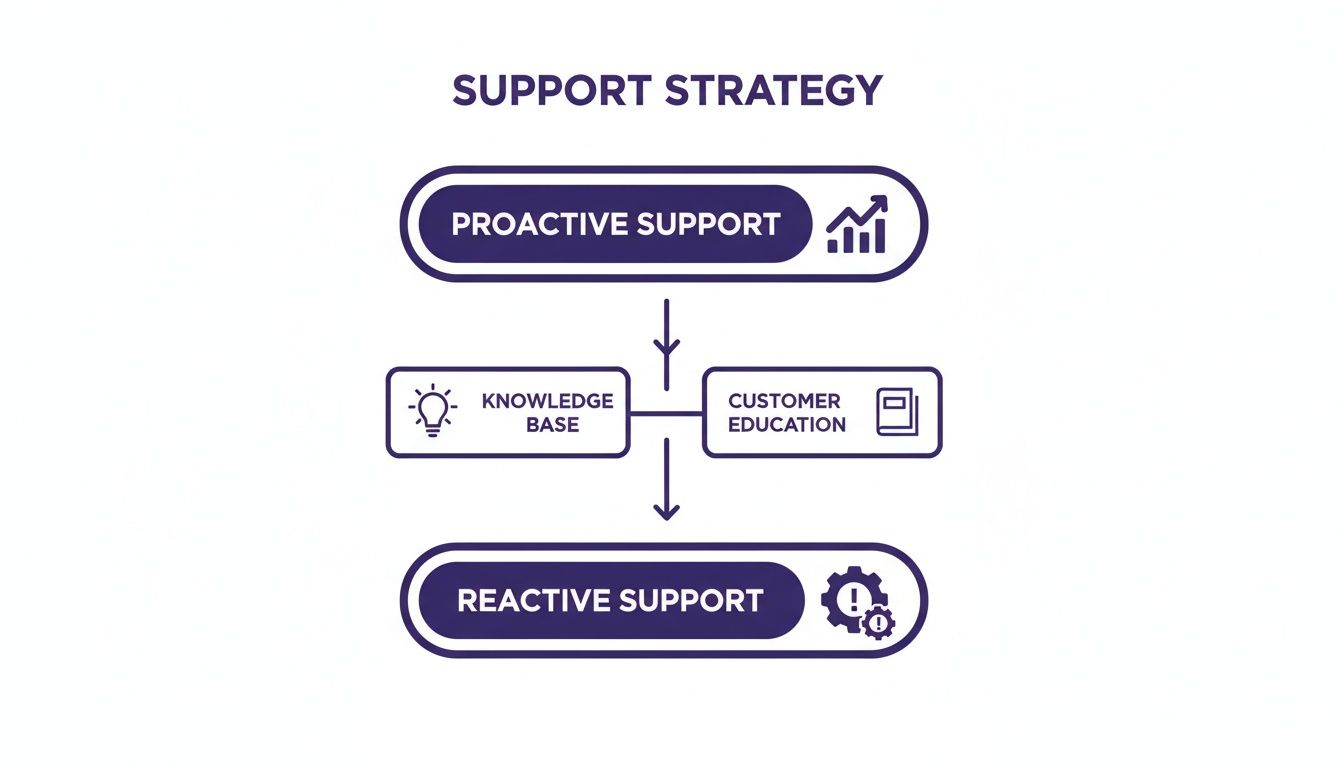
As you can see, a proactive strategy is built on a foundation of system monitoring and customer education, designed to prevent issues. A reactive one is simply damage control.
How Tiered Support & Maintenance Services Work
To make this all work efficiently, support is organized into tiers. This layered system makes sure issues land with the right people at the right speed, which saves you both time and money. Here’s a quick breakdown of a standard tiered structure:
- Level 1 (L1) Support: This is your frontline. L1 agents handle common, straightforward issues like password resets or basic account questions. Their job is to resolve a high volume of simple tickets fast, usually with the help of a knowledge base.
- Level 2 (L2) Support: When an issue is too complex for L1, it gets escalated to L2. These are technicians with deeper product knowledge who can dig into technical problems, make configuration changes, or analyze your software to find the root cause.
- Level 3 (L3) Support: This is the top of the pyramid, made up of expert engineers and product specialists. They tackle the most critical and complex problems—things that might require bug fixes, digging into source code, or dealing with database issues that need a specialist’s touch.
A tiered support model is the engine of efficiency. It ensures that your most skilled (and most expensive) resources are focused only on the problems that truly need their expertise, while routine issues are resolved quickly and cost-effectively.
This structure does more than just fix things faster. It creates a framework for constant improvement. By analyzing data from all three levels, a good partner can spot recurring problems and build permanent solutions. You can dive deeper into this process in our application maintenance and support playbook. This feedback loop is what turns support from a reactive cost center into a strategic asset that actually drives your business forward.
The Real Payoff: Outsourcing your Support & Maintenance Services
Thinking about outsourcing your support and maintenance? It’s a move that goes way beyond just clearing a few tasks off your plate. When done right, partnering with an external team is a strategic play that delivers real results: major cost savings, access to world-class talent without the HR nightmare, and a huge leap in service quality.
When you hand off the critical but routine work of support & maintenance services, you stop pulling your best people into the daily grind of troubleshooting and firefighting. Imagine them focused on innovation, big-picture planning, and work that actually grows your business. That’s what smart outsourcing is all about—turning a cost center into a growth engine.

Unlocking Major Cost Reductions
Let’s talk money. The most obvious win from outsourcing is the cost savings. Building an in-house support team isn’t just about salaries. You’ve got recruitment fees, endless training, benefits, office space, and all the tech that goes with it. Those overheads stack up fast and can make scaling a total non-starter.
Outsourcing flips the script. You swap all those unpredictable capital costs for a single, predictable operational expense. Suddenly, you have a fully trained, fully equipped team ready to go for a fraction of what it would cost to build from scratch. That frees up cash to pour back into the parts of your business that are geared for growth. Digging into the full list of business process outsourcing benefits really shows how much of a game-changer this can be.
To make this concrete, let’s compare the real-world costs of running a small, 10-person support team in-house versus partnering with a nearshore provider like CallZent. The numbers speak for themselves.
In-House vs. Nearshore Support Team: A Cost Comparison
| Expense Category | In-House Team (Annual Estimate) | Nearshore BPO Partner (Annual Estimate) | Key Advantage |
|---|---|---|---|
| Agent Salaries & Benefits | $550,000 | Included in Service Fee | Massive direct labor savings. |
| Recruitment & Training | $75,000 | Included in Service Fee | Eliminates HR overhead and time-to-hire. |
| Office Space & Utilities | $120,000 | Included in Service Fee | Zero real estate and facility costs. |
| Technology & Licensing | $50,000 | Included in Service Fee | Access to top-tier tech without the investment. |
| Management & Supervision | $100,000 | Included in Service Fee | Expert management is part of the package. |
| Total Estimated Cost | $895,000 | $360,000 | Over 50% in potential annual savings. |
The takeaway is clear: outsourcing to a nearshore partner doesn’t just trim the budget—it fundamentally changes your cost structure, allowing for smarter, more flexible financial planning.
The Nearshore Advantage: Better Than Offshore
Here’s a critical point: not all outsourcing is the same. The “Nearshore Advantage” is about working with a partner in a nearby country—like CallZent in Tijuana, Mexico. This model hits a sweet spot that offshore locations in faraway time zones just can’t touch.
- Time Zone Alignment: Your nearshore team works when you work. No more waiting overnight for an answer or taking calls at midnight. It’s real-time collaboration, plain and simple.
- Cultural Fluency: Proximity creates a natural cultural link. Agents get the nuances of the North American market, which makes for smoother, more effective customer conversations.
- Cost-Effectiveness: It strikes the perfect balance between cost and quality. While it may not be the absolute cheapest option on the planet, the value you get is exponentially higher.
“Nearshore outsourcing isn’t just about saving money. It’s about gaining a strategic partner who operates as a seamless extension of your own team, sharing your time zone, culture, and commitment to excellence.”
This approach removes the usual friction of outsourcing. It feels less like hiring a vendor and more like opening a new, highly efficient branch of your own company.
Enhancing Service Quality and Uptime
Handing your support to a specialized provider gives you immediate access to skills and systems that could take you years and a small fortune to build yourself. These firms are obsessed with support. They have battle-tested processes, advanced ticketing systems, and intensive training programs all designed to solve problems quickly and professionally.
For instance, top providers are already deep into predictive maintenance to keep systems running smoothly. This proactive approach helps slash repair times, kill unplanned downtime, and improve upkeep on aging equipment—a lifesaver for industries like finance and healthcare that rely on legacy systems. That kind of expert management means your systems stay online, your operations run without a hitch, and your customers remain loyal.
What’s Included in Support & Maintenance Service Agreements?
When you sign on with a support and maintenance provider, you’re not just buying a service—you’re investing in specific, tangible outcomes. Getting a clear picture of what you’ll receive and how the billing works is the single most important step in building a successful partnership.
Let’s cut through the jargon and break down exactly what you should expect from a provider’s deliverables and how their pricing models actually work.
Understanding Core Deliverables in Support & Maintenance Services
When you’re vetting a potential partner, their service menu can feel a bit like a restaurant’s. It’s crucial to know what each item means for your business and what you actually need.
- 24/7 System Monitoring: Think of this as a digital night watchman. Your partner keeps a constant eye on your critical systems, using specialized tools to spot issues like server slowdowns or application bugs before they escalate into a full-blown crisis.
- Multi-Channel Helpdesk Support: This is all about meeting your customers where they are. Whether they prefer phone, email, live chat, or social media, a unified helpdesk ensures they get a consistent, high-quality experience every single time.
- Proactive Patch Management: Instead of scrambling when a security threat appears, your partner stays ahead of the game. They actively manage software updates and security patches, keeping your systems buttoned-up, secure, and compliant.
- Performance Reporting: You can’t manage what you can’t measure. You’ll get regular, detailed reports on key metrics—think ticket resolution times, customer satisfaction scores, and system uptime—giving you a transparent view of exactly how things are running.
How Pricing Models for Support Services Work
Once you’ve nailed down what you’re getting, the next big question is how you’ll pay for it. The right pricing model isn’t just about the numbers; it has to align with your business needs, budget, and growth trajectory.
Choosing a pricing model isn’t just a financial decision; it’s a strategic one. It aligns your partner’s incentives with your business goals, whether that’s predictable costs, flexible scaling, or paying only for what you use.
Here are the most common pricing structures you’ll run into:
- Fixed-Fee: This is as straightforward as it gets. You pay a set price each month for a clearly defined scope of services. It’s a perfect fit for businesses that need predictable budgets, like a financial firm that requires consistent monitoring and support without any billing surprises.
- Time & Materials (T&M): With this model, you pay an hourly rate for the actual work performed. It offers maximum flexibility, making it ideal for businesses with fluctuating needs or for one-off projects, like a complex software migration where the full scope isn’t yet known.
- Tiered or Per-User: This model is designed to grow with you. You either pay based on the number of users or devices being supported, or you choose a service tier (e.g., Bronze, Silver, Gold) that offers increasing levels of support. A fast-growing e-commerce brand would find this incredibly useful, as their support costs scale directly with their customer base.
Digging into the different call center outsourcing costs and pricing models in more detail will help you pinpoint the structure that delivers the best value for your operation. The goal is to find a plan that fuels your growth, not one that holds it back.
How Support Services Drive Success: Real-World Examples
Theory is one thing, but seeing support & maintenance services in action is what really drives the value home. How does proactive support actually translate into wins for a business like yours? The impact looks different from one industry to the next, since every sector has its own unique pressures and customer expectations.
Let’s look at a few real-world examples. These stories show how targeted support solves very specific problems—highlighting the issue, the outsourced fix, and the bottom-line results.
E-Commerce: Slashing Cart Abandonment
- Problem: A fast-growing online fashion brand was bleeding sales. Shoppers were abandoning their carts at high rates, especially on evenings and weekends, because support was only available 9-to-5 to answer questions about sizing, shipping, or returns.
- Solution: The retailer partnered with a nearshore call center to launch 24/7 bilingual support via live chat and phone. Agents were trained on the product catalog and policies to help hesitant buyers click “purchase.”
- Outcome: Cart abandonment rates fell by 18% in three months. Even better, the average order value for customers who used support was 22% higher as agents were able to upsell and cross-sell complementary items.
Healthcare: Ensuring Compliant Patient Support
- Problem: A regional healthcare network rolled out a new patient portal but needed round-the-clock, HIPAA-compliant help. Their internal IT team was already swamped.
- Solution: They outsourced all Level 1 support to a specialized BPO with deep healthcare experience. This partner provided a dedicated team of HIPAA-trained agents to handle password resets, appointment scheduling, and basic portal navigation, all tracked within a robust ticketing system CRM.
- Outcome: The internal IT team saw their ticket volume for portal issues drop by over 70%, freeing them for critical infrastructure projects. Patient satisfaction with the new portal jumped, and the network stayed fully HIPAA compliant. You can learn more about how we assist with healthcare BPO services.
Financial Services: Guaranteeing Platform Uptime
- Problem: A boutique investment firm’s entire operation hinged on its proprietary trading platform. Any downtime—even for minutes—meant steep financial losses and a blow to client trust. Their small in-house IT team simply couldn’t monitor it 24/7.
- Solution: The firm hired a provider for proactive infrastructure monitoring and L2 technical support. The partner’s team used sophisticated tools to watch server performance, network latency, and application health around the clock, backed by aggressive SLAs for incident response.
- Outcome: By catching and fixing potential issues before they caused an outage, the firm hit 99.99% platform uptime over the following year. That rock-solid stability became a powerful selling point, helping them attract new high-net-worth clients who demanded reliability.
Choosing the Right Support and Maintenance Partner
Picking a partner for your support & maintenance services is one of the biggest decisions you’ll make. This isn’t about finding a temporary vendor; it’s about bringing on a long-term partner who will operate as a true extension of your team.
Get it right, and you’ll accelerate growth. Get it wrong, and you’re stuck with operational drag and customer frustration. The process is more than just comparing price sheets. You need a partner who gets your industry, gels with your company culture, and has the technical chops to keep you running smoothly.

A Checklist for Vetting Your Support & Maintenance Services Partner
- Proven Technical Expertise: Can they prove their skill? A slick sales presentation means nothing if their team can’t navigate your software. If your applications are built on Java, for example, it’s non-negotiable to work with a team that can hire Java developers with real-world experience. Ask for case studies and references from clients with a similar tech stack.
- Industry-Specific Experience: A partner who has never worked in your sector will have a steep learning curve. Look for a provider with a proven track record. For example: in healthcare, do they live and breathe HIPAA? In finance, are they fluent in PCI DSS?
- Scalability and Cultural Fit: Your business isn’t static, and your support partner needs to be able to grow with you. Ask potential partners how they handle scaling their teams up or down. Just as important is the cultural fit—a partner who shares your commitment to excellence will feel like a natural part of your organization.
- A Clear Onboarding Process: A well-structured onboarding process is a sign of a professional partner. It should include discovery, tailored agent training, a pilot program, and full implementation with clear KPIs.
A partner’s technical ability is the foundation of the relationship. Without it, even the best communication and cultural fit will fall short when a critical system fails.
A partner with deep industry experience will onboard faster and start delivering strategic value from day one. You can learn more about how to evaluate different technology support companies to get a better sense of what to look for.
Your Top Questions About Support and Maintenance, Answered
Thinking about bringing on an outsourced partner is a big step, and it naturally comes with some important questions. When it comes to support & maintenance services, getting clear answers is key to moving forward with confidence.
Let’s break down the most common questions we hear from business leaders.
What Is the Difference Between Managed Services and Support Services?
This is a great question. The simplest way to think about it is reactive vs. proactive.
- Support services are reactive. When a customer can’t figure out a software feature or a system glitches, your support team jumps in to fix it. They’re the experts you call when something breaks.
- Managed services are proactive. A managed services provider (MSP) takes ownership of a part of your business, like your IT infrastructure. Their main job isn’t just fixing problems—it’s preventing them from happening in the first place through monitoring and optimization.
Think of it this way: support fixes the flat tire. A managed service owns the car and makes sure you never get a flat tire to begin with.
How Long Does It Take to Onboard With a Nearshore Partner?
You’re ready to make a move, but you can’t afford months of disruption. While every project is different, a well-oiled nearshore partner like CallZent can get you fully up and running in about four to eight weeks.
Here’s what that timeline usually looks like:
- Discovery & Knowledge Transfer (1-2 weeks): We dive deep into your world, learning your products, processes, and brand voice.
- Recruitment & Training (2-4 weeks): We hand-pick agents and run them through a custom training program built for your business.
- System Integration & Pilot (1-2 weeks): We connect all the tech and launch a small-scale pilot to smooth out any wrinkles before the full go-live.
A structured onboarding process is a sign of a mature partner. It ensures a seamless transition and sets the foundation for a successful long-term relationship from day one.
Can We Outsource Support for Our Custom Software?
Absolutely. In fact, it’s one of the most common reasons companies look for a specialized support partner. The secret is finding a partner with real technical chops and a proven process for knowledge transfer. They’ll work with your developers to build a robust knowledge base and a tiered support structure (L1, L2, L3) to handle everything from basic user questions to escalating complex bugs to your engineering team.
How Do You Ensure Data Security and Compliance?
For any serious provider, data security is non-negotiable. It’s the foundation of the entire partnership. Reputable nearshore partners tackle security with a combination of people, processes, and technology.
Here’s what you should demand:
- Certifications: Look for key security certifications like SOC 2 Type II and ISO 27001. For specific industries, compliance with regulations like HIPAA (healthcare) and PCI DSS (finance) is a must.
- Secure Infrastructure: This means encrypted data, secure networks, and physically restricted access to the facilities where your team works.
- Agent Training: Every agent should go through rigorous and continuous training on data privacy, security protocols, and your specific compliance needs.
Partnering with a provider who lives and breathes this stuff is the only way to protect your business and your customers.
🚀 Turn Support Into Your Competitive Advantage
CallZent helps businesses scale with proactive, bilingual support teams that reduce costs and improve customer experience.
Talk to an ExpertReady to transform your customer support from a cost center into a growth engine? The team at CallZent has over two decades of experience building high-performing, bilingual support teams that operate as a seamless extension of your business. Contact us today to discover how our nearshore solutions can help you scale efficiently and delight your customers.