Skip to content
Customer Experience BPO
Top-Rated BPO Call Center: Smarter Customer Support for Scale your Business
A Complete Guide to How Outsourcing Transforms Customer Experience
TL;DR: What Is a BPO Call Center?
A BPO (Business Process Outsourcing) call center is a third-party partner that manages a company’s customer interactions—both inbound (support, order processing) and outbound (sales, lead generation). Outsourcing to a BPO reduces costs, improves efficiency, provides specialized talent, and allows businesses to scale quickly without building an in-house team.
Struggling to manage customer calls while trying to actually grow your business? You’re not alone. Many businesses hit a point where handling customer inquiries in-house starts to drain resources and distract from core goals. This is where a strategic partner can change the game. A BPO call center is a specialized team you hire to manage all your customer communications, from support calls to sales outreach. This move frees up your team to focus on the innovation and strategy that truly drives your business forward.
What Is a BPO Call Center and Why Does It Matter?
Let’s use a real-world example. Imagine you run a thriving online retail store. During a holiday sale, orders are pouring in, but so are customer questions about shipping, returns, and product features. Instead of pulling your marketing or development teams away from their critical tasks to answer phones, you partner with a Business Process Outsourcing (BPO) call center.

This external team operates as a seamless extension of your brand, professionally handling every call, email, and live chat. They’re trained on your products and brand voice, ensuring every customer interaction is positive and helpful.
That’s the core of what a BPO call center does: it takes a specific business function—customer communication—and manages it expertly on your behalf. This isn’t just about offloading work; it’s a strategic decision to improve efficiency and gain a competitive advantage. You can learn more about the fundamentals by reading what Business Process Outsourcing is in our detailed guide.
Breaking Down the BPO Call Center Concept
At its heart, a BPO call center combines two powerful ideas:
- Business Process Outsourcing (BPO): This is the practice of hiring a third-party company to handle specific operational tasks. Businesses outsource everything from accounting and HR to IT management and customer support.
- Call Center: This is the centralized hub dedicated to managing inbound and outbound telephone calls from current and potential customers. Modern call centers are often “contact centers” that also handle email, chat, and social media.
When you merge these two, you get a highly specialized service provider that lives and breathes customer interaction. They come equipped with trained agents, cutting-edge technology, and proven strategies, often at a fraction of the cost of building the same capabilities in-house.
A BPO call center is far more than just an answering service. Think of it as a strategic partner that plugs directly into your operations to manage customer relationships, letting you scale up efficiently and stay focused on what you do best.
A Practical Example of BPO in Action
Consider a software-as-a-service (SaaS) startup that needs to provide 24/7 technical support to a global user base. Building an in-house, around-the-clock support team is a massive undertaking—it’s expensive, complex to manage, and requires significant infrastructure.
Instead, they partner with a nearshore BPO call center in Tijuana.
Instantly, they have a dedicated team of skilled technical support agents ready to assist customers in any time zone. This move not only boosts customer satisfaction but also frees up the startup’s engineers from handling basic troubleshooting tickets. Now, they can focus on their primary job: improving the software. It’s an actionable insight that allows them to compete with larger, more established companies without the crippling overhead.
 Exploring Core BPO Call Center Services
Understanding what a BPO call center is provides the blueprint, but seeing what it does reveals its true value. These partners are built to handle a wide spectrum of communication tasks, which are typically grouped into three categories: inbound, outbound, and back-office support.
Each category serves a distinct purpose, yet they all work together to create a seamless customer experience and improve your operational efficiency. When you outsource these functions, you’re tapping into a dedicated team that is already an expert at managing every stage of the customer journey.
Inbound BPO Services: Handling Customer-Initiated Contact
Inbound services are reactive—they are all about responding to the customer. When a customer calls with a question, needs technical assistance, or wants to place an order, they are connecting with an inbound agent.
For example, a healthcare provider might partner with a BPO to handle inbound calls for appointment scheduling and billing inquiries. This ensures patients receive prompt, professional assistance while allowing the in-house administrative staff to focus on patient care and operations.
Common inbound services from a BPO call center include:
- Customer Service: The front line for answering account questions, resolving issues, and providing general information.
- Technical Support: A specialized helpdesk for troubleshooting product issues and guiding users through technical problems.
- Order Processing: Taking orders over the phone, processing payments, and managing sales inquiries from start to finish.
Outbound BPO Services: Proactively Reaching Out
Outbound services are proactive. Here, BPO agents are the ones making calls on your behalf to customers or potential leads. It’s about initiating contact, not just waiting for the phone to ring.
These services are the engine for growth-focused activities like generating new business, conducting market research, or gathering customer feedback. The goal is to achieve specific business objectives through direct, purposeful communication. For a full list of what this includes, see the top 10 services provided by call centers in Tijuana.
Outbound BPO call center services often cover:
- Lead Generation: Contacting potential customers to gauge interest and qualify them as new sales leads.
- Telemarketing and Sales: Directly pitching products or services to a targeted list of prospects.
- Customer Surveys: Gathering valuable feedback on customer satisfaction to identify strengths and areas for improvement.
Back-Office Support: The Unseen Operations
Beyond direct customer calls, BPO centers are powerhouses for critical back-office support. These are the essential, behind-the-scenes administrative tasks that keep a business running smoothly but don’t typically involve direct customer interaction.
Handing off these tasks ensures accuracy and efficiency, freeing up your internal team to concentrate on high-level strategy and growth initiatives. A BPO call center can handle tasks like data entry, transaction processing, and content moderation.
Inbound vs. Outbound in a BPO Call Center
| Aspect | Inbound Services | Outbound Services |
|---|---|---|
| Primary Goal | Resolve customer-initiated inquiries and provide support. | Proactively reach out to customers for sales or feedback. |
| Communication Flow | Customer to Business | Business to Customer |
| Key Metrics | First Call Resolution, Average Handle Time, CSAT Score. | Conversion Rate, Leads Generated, Call Connection Rate. |
| Common Examples | Technical support helpdesk, billing inquiries, order taking. | Telemarketing campaigns, appointment setting, surveys. |
Whether you need a team to manage incoming queries or a proactive crew to drive sales, a well-rounded BPO has you covered.
The Strategic Benefits
of a BPO Call Center Partnership
Why do so many successful companies partner with a BPO call center? The decision is far more than a simple delegation of tasks. It’s a strategic move to build a more efficient, scalable, and resilient business, turning a major operational cost center into a powerful asset.
This strategic shift explains why the industry is expanding so rapidly. The global call center market is a testament to its value in modern business strategy.
Driving Efficiency Through Cost Reduction
The most immediate benefit is a significant reduction in operational costs. Building an in-house call center requires a substantial upfront investment in office space, technology, and recruitment. On top of that, you have ongoing expenses like salaries, benefits, and continuous training.
A BPO partner eliminates these burdens. You gain immediate access to a fully equipped, state-of-the-art facility without any capital expenditure on infrastructure. This smart financial move frees up capital for core growth activities like product development or marketing. To understand the financial impact, it’s worth exploring the ROI of outsourcing call centers to save time and money.
Instant Access to Specialized Expertise and Technology
Imagine you’re launching a new product and need expert, 24/7 technical support from day one. Hiring and training a specialized, round-the-clock team on short notice is a slow, expensive, and often frustrating process.
Partnering with a BPO call center gives you instant access to a team of highly trained, experienced agents who are already experts in customer engagement. They also bring the right technology to the table immediately:
- Advanced CRM Systems: Providing agents with a complete view of every customer’s history.
- Omnichannel Platforms: Ensuring a seamless customer experience across phone, email, chat, and social media.
- Analytics and Reporting Tools: Offering deep insights into customer behavior and satisfaction.
This isn’t just about saving money; it’s about gaining a competitive edge. You get a world-class support operation without the headaches of building it yourself.
Unmatched Flexibility and Scalability
Business demands can change in an instant. A seasonal rush, a successful marketing campaign, or a new product launch can cause call volumes to skyrocket. An in-house team can easily become overwhelmed, leading to long wait times and frustrated customers. When managing these fluctuations, businesses often weigh Automation vs. Outsourcing to find the best solution.
BPO call centers are designed for this kind of agility. They can scale your support team up or down at a moment’s notice to match demand perfectly, ensuring you only pay for the resources you actually need. This flexibility keeps you responsive and helps you maintain excellent service, no matter the circumstances.
Nearshore vs. Offshore: Choosing Your BPO Model
Deciding where your BPO call center is located is a critical strategic choice. This decision impacts your budget, customer satisfaction, and the overall success of the partnership. Understanding the differences between onshore, nearshore, and offshore models is the first step to finding the perfect fit for your business.
Each model offers a unique mix of cost, cultural alignment, and operational efficiency. The right choice feels like an extension of your own team, while the wrong one can lead to communication gaps and a disjointed customer experience.
The infographic below highlights the primary reasons companies choose to outsource, many of which guide their decision toward a specific BPO model.
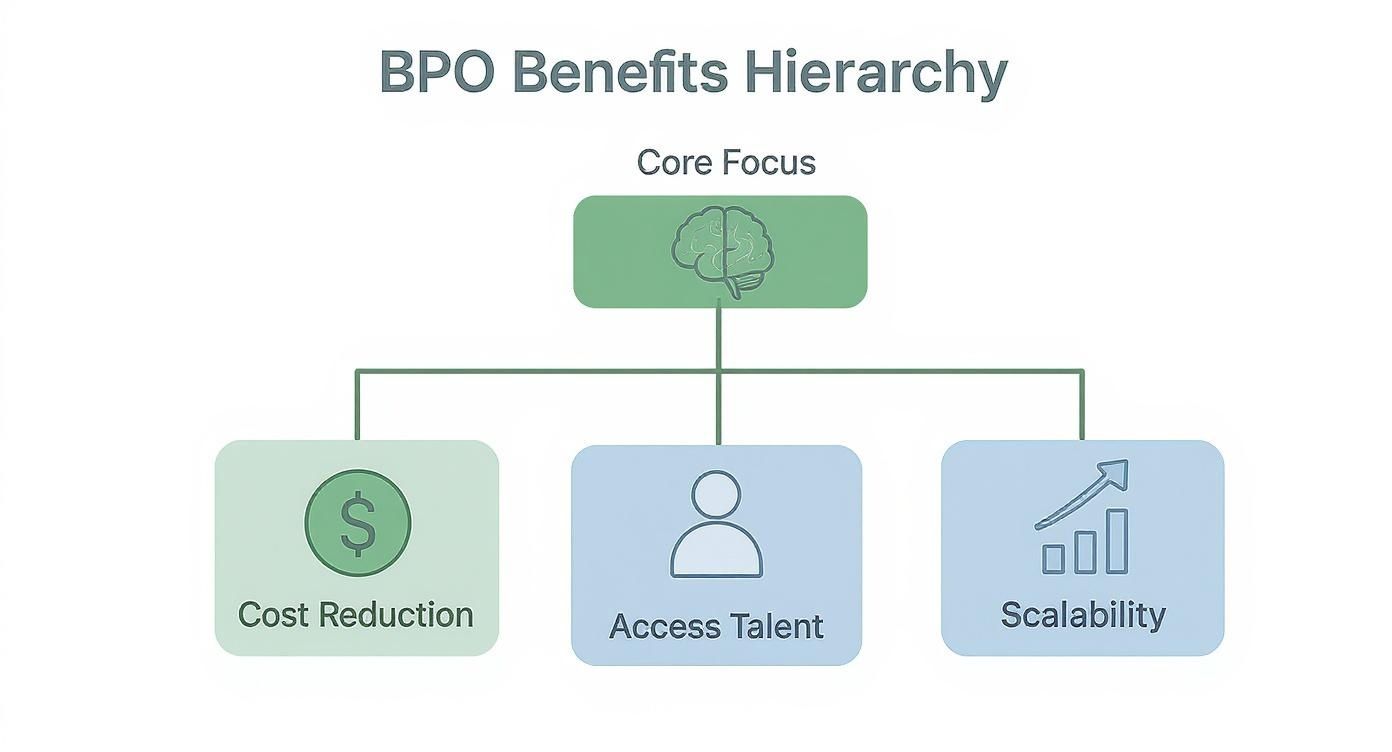
As you can see, outsourcing is about empowering a business to focus on its core competencies—whether by reducing costs, accessing top-tier talent, or scaling operations seamlessly.
What is a BPO Call Center Location Model?
Let’s define these terms from the perspective of a U.S.-based company:
- Onshore BPO: Your BPO partner operates within the United States. This model offers perfect cultural and linguistic alignment but comes at the highest cost.
- Offshore BPO: Your provider is located in a distant country, such as the Philippines or India. The primary advantage is significant cost savings, but this can be offset by large time zone differences and potential cultural barriers.
- Nearshore BPO: This model offers a strategic balance. The BPO is located in a neighboring country, like Mexico. It provides substantial cost savings compared to onshore options while maintaining time zone alignment and strong cultural affinity with U.S. customers.
Onshore vs. Nearshore vs. Offshore
BPO Models Compared
| Factor | Onshore (Domestic) | Nearshore (Neighboring Country) | Offshore (Distant Country) |
|---|---|---|---|
| Cost | Highest | Moderate (Significant Savings vs. Onshore) | Lowest |
| Time Zone Alignment | Perfect | Excellent (Same or similar time zones) | Poor (Often 8-12+ hours difference) |
| Cultural Affinity | Perfect (Shared national culture) | High (Strong cultural similarities & influence) | Low to Moderate (Can require extensive training) |
| Travel & Collaboration | Easy (Short domestic flights) | Easy (Short, inexpensive flights) | Difficult (Long, expensive international flights) |
| Bilingual Talent Pool | Varies by location | Excellent (Large, naturally bilingual pool) | Varies (English is often a second language) |
| Ideal For… | Highly sensitive data, U.S. government contracts, premium brand experiences. | Businesses seeking a balance of cost and quality with a U.S. customer base. | High-volume, non-voice tasks, or 24/7 “follow-the-sun” support models. |
The “best” model truly depends on your specific priorities. For most businesses seeking a blend of quality, cultural alignment, and cost-effectiveness, the nearshore model is the clear winner.
The Strategic Advantage of a Nearshore
BPO Call Center
For a growing number of U.S. companies, the nearshore model represents the “best of both worlds.” A partner in a city like Tijuana, Mexico, operates in the same time zones as U.S. businesses, making real-time collaboration effortless—no more late-night or early-morning conference calls.
More importantly, nearshore agents are often culturally fluent. They understand the nuances, humor, and expectations of American consumers, leading to more natural and effective interactions. This level of connection is difficult to replicate from across the globe. This powerful combination of cost savings and cultural compatibility is a true game-changer. You can learn more by exploring the differences between nearshore vs. offshore bilingual call centers.
How Technology Shapes
the Modern BPO Call Center
The old image of a call center—rows of agents in cubicles with basic headsets—is long gone. Today’s leading BPO call centers are sophisticated technology hubs. This tech stack is what transforms a good BPO partner into a true competitive advantage for your business.
This isn’t just about having the latest software; it’s about leveraging technology to create faster, smarter, and more personalized customer interactions.
When a customer calls, for instance, an advanced CRM can instantly display their entire history—past purchases, previous support tickets, and recent interactions. This 360-degree view empowers the agent to provide a personalized solution without making the customer repeat themselves. That’s the power of a modern, tech-forward BPO.
Core Technologies in a BPO Call Center
A tech-driven BPO call center utilizes an integrated ecosystem of software to make every customer touchpoint seamless and effective.
Key components include:
- Omnichannel Platforms: These systems unify communications across phone, email, live chat, and social media, allowing customers to switch channels without losing context.
- Advanced CRM Integration: Direct integration with your Customer Relationship Management (CRM) software gives agents real-time access to customer data, fueling informed and personal conversations.
- AI and Automation Tools: From chatbots that handle routine inquiries 24/7 to predictive analytics that anticipate customer needs, automation and artificial intelligence in call centers are revolutionizing the industry. They free up human agents to focus on complex, high-value issues.
The right technology doesn’t just support agents; it empowers them. It transforms them from simple problem-solvers into proactive brand ambassadors who can build stronger customer relationships.
Why a Tech-Forward Partner Matters
Choosing a BPO with a strong technological foundation provides direct, measurable benefits. You get faster resolution times, higher customer satisfaction (CSAT) scores, and a wealth of data to improve your products and services.
Of course, this advanced tech stack relies on a robust infrastructure. Reliable Internet and Phone for Small Business Bundles form the bedrock of all seamless communication.
Ultimately, partnering with a provider that invests in technology means you’re not just outsourcing calls. You’re gaining a strategic asset that helps you exceed customer expectations and stay ahead of the competition.
How to Find the Right BPO
Call Center Partner
Choosing a BPO partner is a major business decision. You’re not just hiring a vendor; you’re selecting a team that will become the voice of your brand. The right partner acts as a true extension of your company, embracing your values and dedicating themselves to your customers’ success.
To make the right choice, you need a clear evaluation plan. Look beyond the sales pitch and dig into the details that truly matter, from their industry experience to their agent training programs.
Key Criteria for Evaluating a BPO Call Center
When assessing what a BPO call center can do for your business, focus on these non-negotiable criteria:
- Industry Expertise: Does the provider understand the unique challenges and customer expectations in your sector, whether it’s e-commerce, healthcare, or SaaS? A partner with relevant experience can add value from day one.
- Robust Security and Compliance: Your customer data is invaluable. Ensure any potential partner holds critical certifications like PCI DSS (for payment card industry data) or HIPAA (for healthcare information). Ask for proof of their security protocols.
- Proven Agent Training Programs: How does the BPO recruit, train, and retain top talent? Look for a structured quality assurance process that ensures agents are not only skilled but also aligned with your brand’s tone and mission.
Your BPO partner should function as a seamless extension of your brand. Their commitment to your values and dedication to your customers’ success is paramount.
Looking Beyond the Price Tag
While cost is an important factor, the cheapest option is rarely the best value. Instead, focus on finding a partner with a transparent and scalable pricing model that can adapt as your business grows. The ideal BPO partner will offer clear terms with no hidden fees, allowing you to budget with confidence.
Ultimately, you are looking for a provider who invests in a collaborative relationship. They should be proactive, sharing insights from customer interactions and working with you to continuously improve the customer experience. This approach transforms the partnership from a simple service agreement into a powerful engine for your growth.
Answering Your Top Questions About BPO Call Centers
Considering a BPO call center is a smart strategic move. But before you proceed, you likely have practical questions about cost, data security, and implementation time. These are the critical questions every business leader should ask. Here are some straight answers to help you move forward with confidence.
How Much Does a BPO Call Center Cost?
The cost of a BPO call center partnership varies. Pricing depends on the specific services you need, your expected call volume, the required agent skill level, and the BPO’s location. Common pricing models include per-hour, per-agent, or per-interaction rates.
Nearshore providers offer a compelling value proposition here. They provide significant cost savings compared to U.S.-based centers without the time zone and cultural challenges that can arise with offshore partners. It’s the ideal balance of quality and cost-effectiveness.
How Is My Company’s Data Kept Secure?
Data security is non-negotiable. Any reputable BPO partner will prioritize it.
Top-tier providers will have industry-standard compliance certifications, such as PCI DSS for handling payment data or HIPAA for sensitive health information. They should be able to detail their security measures, which must include encrypted networks, strict access controls, and regular third-party audits. A good partner treats your data with the same care you do.
How Quickly Can We Get Started?
The implementation timeline depends on the complexity of your needs. A straightforward customer service campaign can often be up and running in just a few weeks. More complex operations involving multiple channels (phone, email, chat), extensive training, and system integrations might take one to two months to launch. A reliable partner will provide a transparent onboarding roadmap from the start, so you know exactly what to expect.
Ready to Elevate Your Customer Experience?
Partner with CallZent and discover how a nearshore BPO call center
becomes a seamless extension of your brand.
Ready to see how a nearshore BPO partner can elevate your customer experience and drive real growth? Contact CallZent today to explore our custom-fit call center solutions and discover how we can become a seamless extension of your team.