Skip to content
Outsourcing Call Center Companies: A Practical Guide to Scalable Growth
Learn how the right outsourcing call center company can reduce costs, improve customer experience, and scale your operations without operational chaos
TL;DR:
- Why Outsource? Outsourcing call center companies help businesses scale fast, cut costs, and access trained talent.
- Best Model: Nearshore outsourcing offers the best balance of savings, cultural alignment, and time zone compatibility.
- Bilingual Advantage: English–Spanish agents expand market reach and boost customer satisfaction.
- How to Choose: Focus on compliance, agent retention, technology, transparent KPIs, and strong SLAs.
Are you trying to scale customer support without your operational costs spiraling out of control? If you’re considering an outsourcing call center company, you’re already on the right track. For many businesses, it’s the single most powerful way to scale up customer support, slash operational costs, and tap into specialized talent—all without the headache and massive overhead of building a team from the ground up.
Think of it as plugging into a high-performance engine instead of trying to build one from scratch. This guide provides actionable insights to help you choose the right partner, whether you’re a startup or a seasoned enterprise.
What is Call Center Outsourcing?
In today’s world, customer experience can make or break a brand. But let’s be honest: running a 24/7, in-house customer service department is a monumental task. It demands huge investments in hiring, constant training, technology, and office space. This is exactly where outsourcing call centre companies come in. They become strategic partners who handle all your customer interactions.
From inbound calls and technical support to outbound sales and lead generation, an outsourced partner takes on the heavy lifting. This frees up your core team to focus on what they do best—innovating and growing your business. The market reflects this shift loud and clear. The global call centre outsourcing market was valued at a staggering USD 102.59 billion in 2024 and is expected to soar to USD 242.80 billion by 2034, according to Precedence Research. It’s not just a trend; it’s the new standard for businesses that want to deliver exceptional service without breaking the bank.
The Big Wins: Why Partnering with Outsourcing Call Center Companies Just Makes Sense
Bringing on an external call centre provider is about so much more than just saving a few bucks. It’s a strategic play to boost your efficiency and elevate the quality of your customer service. For most companies, the benefits are immediate and hit hard.
Here’s what you stand to gain:
- Serious Cost Savings: You can dramatically cut down on expenses like salaries, benefits, office rent, and expensive tech. A good partner gives you a full operational framework for a fraction of what it would cost to build it yourself.
- Instant Access to Experts: Forget the long hiring process. You immediately get a team of trained professionals who live and breathe customer communication. These agents already have the skills to handle all kinds of customer needs, right out of the gate.
- Scale Up or Down, On-Demand: Need to ramp up for the holiday season or a big product launch? No problem. You can easily scale your support team up or down to match demand without the HR nightmares of hiring and firing.
“The right outsourcing partner doesn’t just answer calls; they become an extension of your brand, elevating the entire customer experience and driving loyalty.”
At the end of the day, the goal is to find a partner that genuinely clicks with your brand’s values and operational style. This guide will walk you through the different models out there, helping you figure out which approach is the perfect fit for your company. To get a head start, you can learn more about our comprehensive call center outsourcing solutions and see how we help businesses not just survive, but thrive. Making this one decision can turn your customer support from a necessary cost into one of your most powerful drivers of growth.
Choosing Your Path: Onshore, Nearshore, and Offshore Models
Once you’ve made the call to bring in an external team, the next big question is where that team should be. This decision is about much more than just picking a spot on a map; it fundamentally shapes your costs, communication style, and even how well the agents connect with your customers.
Think of it as choosing a strategic base of operations. Each option—onshore, offshore, and nearshore—comes with its own unique set of trade-offs. Getting this right is the key to finding a partner that fits your budget, your brand, and what your customers have come to expect from you.
The Onshore Model: Closer to Home
Going onshore means you’re partnering with a call center right in your own backyard—or at least within the same country. For a U.S. company, that means working with a center in another American city.
The biggest win here is the seamless cultural and linguistic fit. There are no language barriers to navigate, no tricky time zone conversions to manage, and the agents just get the local market nuances. This makes collaboration feel natural and site visits a breeze. The downside? This convenience comes at a premium, as you’ll be paying domestic labor rates, which are almost always the highest option.
The Offshore Model: Maximizing Cost Savings
The offshore model is all about distance and savings. Here, you’re partnering with a company in a faraway country, often in places like Asia or Eastern Europe. The primary driver is the dramatic cost reduction—you can expect labor rates to be 50-70% lower than what you’d pay for an onshore team.
That financial upside is incredibly tempting, but it’s not without its challenges. Significant time zone differences can turn real-time communication into a logistical headache. More importantly, the cultural and linguistic gaps can sometimes lead to miscommunications or a customer experience that feels just a little bit off-brand.
The Nearshore Model: The Strategic Sweet Spot
This is where the nearshore model comes in, striking a powerful balance between the other two options. It involves partnering with a provider in a neighboring country—for instance, a U.S. business working with a team in Mexico. For many companies, this approach offers the perfect blend of benefits.
Here’s why so many businesses are finding nearshore to be the ideal fit:
- Cost-Effectiveness: You get major cost savings compared to an onshore partner, but without the extreme logistical hurdles that can come with going fully offshore.
- Cultural Affinity: Geographic proximity breeds a strong cultural connection. A team in Tijuana, for example, is already immersed in and understands American consumer culture and expectations.
- Time Zone Alignment: Working in similar or identical time zones means your outsourced team is on the clock when you are. It makes collaboration, management, and quick problem-solving feel effortless.
- Easy Travel: The ability to hop on a short flight for a site visit—whether for training, a strategy session, or a quality check—is a massive operational advantage.
A nearshore partner offers the cost benefits of a global model with the cultural alignment and operational ease of a domestic one.
Imagine a fast-growing e-commerce brand based in California getting slammed during the holiday season. By partnering with a nearshore team in Tijuana, they can scale up to meet the surge. The agents not only handle the volume but do so with an intuitive grasp of American shopping habits. The brand gets top-tier, scalable support without paying top-dollar.
This kind of strategic decision is exactly how businesses pave the way for sustainable growth. This decision tree helps visualize when outsourcing becomes the right move.
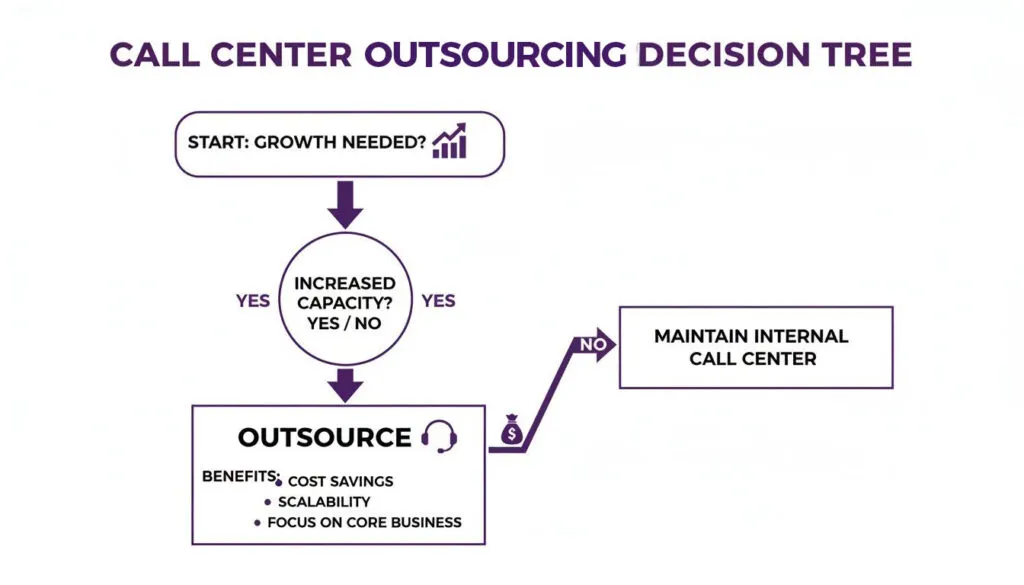
As the graphic shows, when your internal capacity is stretched thin, outsourcing becomes a direct path to unlocking major benefits like cost savings and greater efficiency.
To really dig into the numbers behind these models, check out our guide on nearshore vs. offshore outsourcing costs, risks, and ROI. At the end of the day, choosing the right model is all about finding that perfect equilibrium between cost, quality, and control for your business.
The Strategic Edge of a Nearshore, Bilingual Call Center
If you’re looking to capture the diverse North American market, partnering with a nearshore, bilingual outsourcing call centre company isn’t just an operational tweak—it’s a serious growth play. We’re moving beyond simple translation here. This is about building genuine trust and expanding your market reach in a way that truly connects with people.
Bilingual agents who are fluent in both English and Spanish have a unique ability to create an inclusive, supportive customer experience. They effortlessly navigate cultural nuances, which builds loyalty and makes every single customer feel heard and respected.

Connecting With a Diverse Customer Base
The simple act of speaking a customer’s native language is a massive competitive advantage. It removes all the friction from the support process, leading to faster resolutions and much higher satisfaction scores. This becomes even more critical when the conversations are complex or sensitive.
Think about these real-world examples:
- Healthcare Providers: A bilingual agent can patiently walk a Spanish-speaking patient through confusing insurance benefits or pre-op instructions, providing clarity and reducing their anxiety. That kind of empathetic support is everything for building patient trust.
- E-commerce Brands: When a customer has a frustrating experience with a return or a technical glitch, communicating in their preferred language can turn a negative moment into a positive one. You don’t just resolve an issue; you save the sale and keep a loyal customer.
- Financial Services: Explaining loan terms, investment options, or fraud alerts requires absolute clarity. A bilingual agent ensures nothing gets lost in translation, protecting both the customer and your institution.
This is exactly why so many businesses now actively choose to outsource bilingual customer support. It has a direct impact on the bottom line by improving customer retention and strengthening brand perception.
The Proximity Advantage of Nearshore Partners
Beyond language skills, the geographic proximity of a nearshore location like Tijuana brings clear operational benefits that offshore alternatives just can’t replicate. This closeness turns a typical vendor-client dynamic into a real partnership.
“A nearshore bilingual team isn’t just a vendor; they are an accessible, culturally aligned extension of your brand, building connections that resonate deeply with a wider audience.”
Being close means you can actually collaborate. It makes site visits for hands-on training, strategy sessions, and quality checks incredibly easy. When your own leadership team can meet the agents representing your brand face-to-face, it builds a cohesive, motivated, and aligned unit. Problems get solved faster, feedback loops are tighter, and your outsourced center starts to feel like a seamless part of your own organization.
The Business Case for a Nearshore Bilingual Model
The North American market is a powerhouse in call center outsourcing, accounting for over 30% of the global market share. This demand is fueled by industries like e-commerce, finance, and healthcare that absolutely require high-quality, compliant support.
For any company serving this market, nearshore solutions in Mexico strike the perfect balance between cost-efficiency and close collaboration. It’s common to see cost reductions of 20-40% compared to domestic options, all while maintaining the robust data security you need.
Ultimately, choosing a nearshore bilingual partner is a strategic move that delivers a powerful trifecta of benefits. You get significant cost savings, access to a talented and culturally attuned workforce, and the ability to build a more inclusive brand—all without sacrificing the close collaboration needed to deliver an exceptional customer experience.
Your Checklist for Vetting Outsourcing Call Center Companies
Choosing the right partner from a sea of outsourcing call center companies can feel like searching for a needle in a haystack. Every sales pitch sounds great, but a lasting partnership depends on what lies beneath the surface. This is your due diligence toolkit—a practical checklist to help you move past the flashy presentations and figure out what truly matters.
Think of this process like hiring a key executive. You wouldn’t make that decision based on a résumé alone; you’d hold multiple interviews, check references, and make absolutely sure it’s the right cultural fit. You need to apply that same level of rigor when selecting a call center partner that will become the voice of your brand.

To help you get organized, we’ve put together a checklist covering the most critical areas of evaluation. Use these questions as a starting point to guide your conversations and dig deeper than the standard sales pitch.
Vendor Vetting Checklist
| Evaluation Area | Key Questions to Ask | Red Flags to Watch For |
|---|---|---|
| Industry Expertise & Compliance | Can you provide case studies or client references from our industry? What specific compliance certifications (e.g., HIPAA, PCI DSS) do you hold? | Vague answers about industry experience; inability to produce relevant certifications; generic, one-size-fits-all solutions. |
| Agent Training & Retention | What is your agent attrition rate? Can you walk me through your new hire and ongoing training programs? How do you manage and coach agents for performance? | High turnover rates (>30% annually); minimal or generic training; no clear process for continuous agent development. |
| Technology & Security | Can your systems integrate with our CRM? What security measures protect our data (encryption, access controls)? Do you have a disaster recovery plan? | Outdated technology stack; resistance to discussing security protocols in detail; no documented business continuity plan. |
| Performance & Reporting | What KPIs do you recommend tracking for a business like ours? Can we see a demo of your client dashboard? How often will we have performance review meetings? | A lack of proactive KPI suggestions; unclear reporting or infrequent updates; reluctance to agree to a detailed Service Level Agreement (SLA). |
Let’s unpack these key areas so you know exactly what to look for.
Scrutinize Industry Specialization And Compliance
Not all call centers are created equal. A partner that’s a rockstar in e-commerce support might not have the specialized chops required for healthcare. Your first filter should be verifying their experience and certifications in your world.
For instance, a healthcare provider must confirm that a potential partner is fully HIPAA-compliant. This isn’t just a talking point; it’s a legal necessity that protects patient data and shields your organization from massive penalties. Likewise, a financial services firm needs a partner with PCI DSS certification to handle sensitive payment info securely.
Ask for case studies and, more importantly, client references from your industry. A truly experienced partner will be proud to show off their track record.
Evaluate Agent Training And Retention Programs
The agents you outsource are, for all intents and purposes, your agents. They’re the voice of your brand. Their performance is a direct reflection of the company that hires, trains, and motivates them. That’s why high agent turnover is a huge red flag. It often points to a poor work environment, which always leads to inconsistent service.
Get into the weeds on their HR practices. Ask sharp questions about their training programs:
- Initial Onboarding: How do they get new agents up to speed on both general customer service skills and your specific products or services?
- Ongoing Development: What does continuous education look like? How do they keep skills sharp?
- Performance Management: How do they track agent performance and give constructive feedback to help them improve?
A low agent attrition rate is one of the strongest indicators of a well-managed, high-performing call center. Happy, engaged agents deliver better customer experiences.
A partner that invests in its people is investing in your success. They get that a motivated, well-trained team is the backbone of great service.
Assess Technology And Security Infrastructure
In this day and age, technology and security are completely non-negotiable. An outdated tech stack creates friction and frustration for everyone involved—agents and customers alike. A security breach, on the other hand, can be absolutely catastrophic for your brand’s reputation.
Your vetting process must include a thorough shakedown of their technical capabilities. Here are the key things to probe:
- Omnichannel Support: Can they fluidly manage customer conversations across phone, email, live chat, and social media?
- CRM and System Integration: How easily can their systems plug into your existing CRM and other business tools?
- Data Security Protocols: What measures are in place for data encryption, network security, and physical access to their facilities?
- Disaster Recovery Plan: What’s their game plan for keeping things running if there’s an outage or emergency?
Define Performance Metrics And Reporting
A great partnership is built on transparency and shared goals. You need to know exactly how success will be measured and how you’ll see the results. This is where a crystal-clear Service Level Agreement (SLA) becomes your best friend.
Before you even think about signing a contract, have a serious talk about the Key Performance Indicators (KPIs) that matter most to your business. This could include metrics like:
- First Call Resolution (FCR): The percentage of customer issues solved in one touch.
- Average Handle Time (AHT): The average length of a customer interaction.
- Customer Satisfaction (CSAT): Scores gathered from those quick surveys after a call or chat.
- Service Level: The percentage of calls answered within a specific time (e.g., 80% of calls in 20 seconds).
A transparent partner will give you a real-time dashboard to monitor these metrics and set up regular meetings to talk about performance and find ways to get even better. Taking the time to understand Service Level Agreement best practices is essential for setting clear expectations from day one. Using this checklist, you can confidently pick an outsourcing partner that truly clicks with your operational needs and your vision for the future.
Getting Down to Brass Tacks: Pricing, Onboarding, and Long-Term Success
Once you’ve narrowed down your list of potential partners, the conversation inevitably turns to the practical stuff: money, setup, and making sure the whole thing actually works. Let’s be honest, this is where a great partnership is made or broken. Getting clear on costs, how you’ll get started, and how you’ll measure success is non-negotiable.
Think of this phase as building the foundation for your partnership. It’s about translating your big-picture goals into a real-world, functioning relationship. We’ll start with pricing, move into the nuts and bolts of onboarding, and wrap up with how to keep the partnership strong for the long haul.
Decoding Common Pricing Models for Outsourcing Call Centre Companies
Call center pricing isn’t like buying something off a shelf with a single price tag. It’s more flexible, designed to fit different kinds of businesses and their unique call patterns. Knowing the main models helps you pick the one that gives you the most bang for your buck.
Here are the four most common models you’ll run into:
- Per-Agent/Dedicated Model: You pay a flat monthly rate for each agent who is 100% dedicated to your account. This is a fantastic fit for businesses with steady, high call volumes that need agents to become true product experts. It gives you predictable monthly costs, which is great for budgeting.
- Per-Hour Model: Simple and straightforward. You pay an hourly rate for the time an agent is actively working for you, whether they’re on calls, sending follow-up emails, or doing other tasks. This model works well for companies with a fairly predictable workload that might have some peaks and valleys.
- Per-Minute/Per-Call Model: This is a pure pay-as-you-go model. You’re only billed for the exact number of minutes or calls handled. It’s the perfect solution for businesses with really low or unpredictable call volumes, like handling after-hours calls or taking overflow during a surprise rush.
- Performance-Based Model: This one really aligns your goals with your partner’s. Pricing is tied directly to specific outcomes—think sales closed, appointments booked, or stellar customer satisfaction scores. It gives your outsourced team serious skin in the game.
The right model really just depends on what your day-to-day operations look like. For a much deeper dive into what you can expect to spend, checking out a detailed guide on call center outsourcing costs can really help you nail down your budget.
Mapping the Onboarding Journey
A truly great partnership kicks off with a smooth, well-planned onboarding process. This isn’t just about flipping a switch and hoping for the best. It’s a team effort to weave the outsourced team into the fabric of your company so they feel like a genuine extension of your brand.
A solid onboarding plan usually unfolds in a few key stages:
- Discovery and Strategy Session: This is where your partner becomes a student of your business. They’ll do deep dives to understand your brand voice, your ideal customer, your business goals, and how you do things now.
- System Integration and Tech Setup: Time to get the tech talking. Your partner’s IT folks will sync up with yours to connect their systems to your CRM, helpdesk, and any other tools you rely on. The goal is one seamless workflow.
- Agent Training and Nesting: This is where the magic happens. Agents get intensive training on your products, services, and company culture. Then comes the “nesting” period—they start taking live calls and chats, but with a safety net of close supervision and coaching.
- Go-Live and Hypercare: Once everyone feels ready, the team officially goes live. The first few weeks are often called a “hypercare” period, which means extra monitoring and daily check-ins to iron out any wrinkles fast.
“A thorough and collaborative onboarding process is the foundation of a successful outsourcing partnership. It transforms a vendor into an integrated team member.”
Managing for Long-Term Success with SLAs and KPIs
The real work begins after launch. Keeping a partnership thriving for years comes down to constant performance management, built on clear agreements and metrics that actually matter. This is where your Service Level Agreement (SLA) becomes your best friend.
An SLA isn’t just another document; it’s the rulebook for your partnership. It spells out the specific, measurable standards your outsourcing partner has to hit, which takes all the guesswork out of what “good” looks like.
A strong SLA should always include:
- Key Performance Indicators (KPIs): These are the metrics you’ll live and breathe by. Think First Call Resolution (FCR), Average Handle Time (AHT), and Customer Satisfaction (CSAT).
- Service Levels: This is where you get specific. A classic example is a target of answering 80% of calls within 20 seconds.
- Reporting Cadence: You’ll decide how often you get performance reports—daily, weekly, or monthly.
- Governance Structure: This outlines who talks to whom and the official channels for escalating and resolving issues.
By putting this framework in place from the start, you build a relationship on a bedrock of transparency, accountability, and a shared goal of getting better every day. Regular performance reviews stop being dreaded meetings and start becoming chances to celebrate wins, find new opportunities for growth, and fine-tune your customer experience together.
Got Questions About Outsourcing Call Centers? We’ve Got Answers.
When you’re thinking about partnering with an outsourcing call centre company, a few key questions always pop up. It’s a big strategic move, and you need to be confident in your decision. Let’s tackle the most common concerns we hear from business leaders.
How Much Does It Cost to Outsource a Call Center?
There’s no single price tag—costs swing wildly depending on the model you pick, how complex your needs are, and the pricing structure of the partner. Onshore providers in the US will always be the most expensive, while offshore offers the lowest rates but often comes with communication and logistical headaches.
Nearshore is where you’ll find the sweet spot. A nearshore partner can slash your operational costs by 30-50% compared to keeping a team in-house. But the real win isn’t just the hourly rate; it’s the total value you get back. A high-quality nearshore team that’s also cost-effective will boost customer satisfaction and keep them coming back, which has a much bigger impact on your bottom line. Always ask for a detailed quote tailored to your specific needs.
What’s the Difference Between a Call Center and a BPO?
Think of it like this: a call center is a specialist, while a BPO is a general contractor for your business operations. A classic call center is laser-focused on one thing: managing customer conversations over the phone, both inbound and outbound.
A Business Process Outsourcing (BPO) company, however, has a much broader toolkit. They can handle all the functions of a call center but also take on back-office tasks like data entry, payment processing, content moderation, and a whole lot more. A specialized BPO like CallZent goes a step further by managing your entire customer communication world, not just the phone calls.
How Do I Make Sure Our Data Is Secure When Outsourcing?
This one is non-negotiable. Data security should be at the very top of your list when you’re vetting potential partners. Any reputable outsourcing provider will have invested heavily in serious security measures and the compliance certifications to prove it.
Make sure you see credentials that matter for your industry:
- PCI DSS: Absolutely essential if you’re handling credit card or payment information.
- HIPAA: A legal must-have for protecting sensitive patient health information in healthcare.
- SOC 2: This verifies that a provider has the systems in place to securely manage data and protect their clients’ privacy.
“A trustworthy partner will be completely transparent about their security protocols, from physical facility access and data encryption to agent background checks and ongoing compliance training.”
Don’t be shy about asking for their documentation. A good partner will be happy to walk you through their security framework in detail.
Can a Small Business Really Benefit from Call Center Outsourcing?
Absolutely. In fact, small and medium-sized businesses often have the most to gain. Outsourcing gives you instant access to a professional, 24/7 customer support operation without the massive upfront cost and headache of building it all from scratch.
It’s a game-changer. It lets smaller companies punch above their weight, offering the kind of enterprise-level customer experience that builds loyalty. You can scale up or down in a heartbeat to handle busy seasons or sudden growth, letting you compete with the big players. By teaming up with a nearshore provider, a small business can tap into top-tier technology and a skilled talent pool for a fraction of the cost, turning customer service from a cost center into a true competitive edge.
Ready to Scale Customer Support Without the Overhead?
CallZent delivers bilingual, nearshore call center solutions from Tijuana—designed for performance, compliance, and growth.
Frequently Asked Questions
How much does it cost to outsource a call center?
Nearshore outsourcing typically reduces costs by 30–50% compared to in-house teams, depending on complexity and model.
Is outsourcing secure?
Yes—when partners are PCI DSS, HIPAA, and SOC-2 compliant with strong data protection protocols.
Can small businesses benefit from outsourcing?
Absolutely. Outsourcing gives SMBs access to enterprise-level support without enterprise-level costs.
Ready to see how a dedicated nearshore partner can elevate your customer experience and drive real growth? CallZent provides custom-fit, bilingual call center solutions from our state-of-the-art facility in Tijuana. Learn more about our services and let’s build a strategy that works for you.