Skip to content

Customer Experience
What Defines Excellent Customer Service (And How to Deliver It)
Learn what defines excellent customer service, from FCR and CSAT to empathy and personalization, and how to turn support into a growth engine.
TL;DR — Quick Takeaways
- Excellent customer service combines efficiency, empathy, and personalization.
- First Contact Resolution (FCR) and Customer Satisfaction (CSAT) are critical metrics.
- Empathy and proactive service create long-term customer loyalty.
- Nearshore BPO partners like CallZent help scale high-quality service efficiently.
Is your customer service a cost center or a growth engine? The answer to that question truly defines your company’s future.
Excellent customer service is no longer about just being friendly. It’s a strategic business function that builds rock-solid loyalty, drives revenue, and lowers operational costs.

As nearshore BPO experts in Tijuana, we see every day how this strategic approach transforms businesses. This guide breaks down exactly what defines excellent customer service and provides actionable insights to help you build a support operation that becomes a competitive advantage.
Moving Beyond Basic Support to Define Excellent Service
The definition of “good service” has evolved. Simply answering calls or replying to emails is no longer enough. Today, what defines excellent customer service is the ability to make every single interaction seamless, positive, and valuable.
This means you have to truly understand the customer’s journey and anticipate their needs. It’s the critical difference between a one-time transaction and a long-term, loyal relationship. We explore this concept further in our article covering the differences between customer service and customer experience.
Excellent customer service isn’t a department; it’s a philosophy that defines your entire brand.
This new standard requires a perfect mix of human skill and technology. A friendly agent is great, but a friendly agent who solves a complex problem on the first try because they have the right information at their fingertips? That’s a game-changer. For a deeper dive into the principles of great service, check out this resource on What Is Customer Service Excellence?.
The Four Pillars That Define Excellent Customer Service
So, what does excellent customer service actually look like day-to-day? It boils down to four key pillars that work together to create an experience that customers remember—and that directly impacts your bottom line.
Here’s a quick overview of the core components that define a superior customer service experience.
| Pillar | What It Means for the Customer | Why It Matters for Your Business |
|---|---|---|
| Responsiveness | My time is valued, and my problem gets solved quickly, often on the first try. | Builds immediate trust and boosts efficiency metrics like First Contact Resolution (FCR). |
| Personalization | I feel like a person, not a ticket number. The company knows my history. | Deepens the customer relationship and makes them feel seen, increasing loyalty. |
| Proactivity | The company anticipates my needs and alerts me to issues before I even notice. | Turns potential negatives (like a shipping delay) into trust-building moments. |
| Empathy | The agent genuinely understands my frustration and wants to help me solve it. | This is the irreplaceable human touch that turns upset customers into brand advocates. |
Ultimately, when these four pillars come together, they transform your support team from a reactive expense into a proactive engine for business growth and unwavering customer loyalty.
Defining Excellence Through First Contact Resolution (FCR)
The single greatest sign of respect for a customer’s time is solving their problem on the very first try. This is the heart of First Contact Resolution (FCR), a non-negotiable cornerstone of efficient service. It’s more than just an industry acronym; it’s a promise you make to every customer.
When FCR is a priority, you eliminate the soul-crushing experience of repeat calls. Customers no longer have to retell their stories to three different agents. The goal is to make every interaction the only one they need.
 How High FCR Defines Excellent Customer Service for the Customer
Think about a patient calling their healthcare provider about a complex billing error. They’re already stressed. A poorly handled call would trap them in a maze of long holds and transfers, their anxiety climbing with each new person they have to start over with.
Now, imagine that same call with an FCR-first approach. A single, well-trained agent picks up. They have access to an integrated knowledge base and the authority to act. They don’t just pass the buck—they dig into the billing system, pinpoint the mistake, fix it, and confirm the new balance with the patient. All in one go.
This is how you turn a moment of high stress into a moment of profound trust. The customer hangs up not just with a solved problem, but with the feeling of being genuinely heard, valued, and respected.
This is exactly what separates adequate service from truly excellent service. It proves your entire system is built around the customer’s needs, not your own internal roadblocks.
The Business Case for First Contact Resolution
High FCR isn’t just a “feel-good” metric; it’s a massive driver of business performance. Here’s why FCR is a key part of what defines excellent customer service:
- Reduced Operational Costs: Fewer callbacks mean your agents are freed up to handle more unique customer issues, making the whole operation far more efficient.
- Increased Customer Loyalty: Customers who get their problems fixed right away are dramatically more likely to stick around. FCR is a top predictor of customer retention.
- Improved Agent Satisfaction: Empowering agents to solve problems completely boosts their confidence and job satisfaction, leading to lower employee turnover.
Industry benchmarks show that while the average FCR is 70%, top-performing contact centers are hitting an impressive 85%. As the single strongest predictor of customer satisfaction, every percentage point improvement in FCR can slash repeat contacts by up to 20% and directly boost loyalty. You can find more details on these service benchmarks and discover what they mean for your business goals.
Ultimately, a high FCR rate is a clear signal that your company is serious about delivering on its promises. For organizations looking to elevate their support, it’s essential to improve first call resolution with proven call center tactics that empower agents and streamline workflows.
Measuring the Emotional Impact with Customer Satisfaction (CSAT)
Fixing a problem on the first call is great for efficiency, but it doesn’t tell you the whole story. The real magic happens when you measure the feeling your service leaves behind. This is where Customer Satisfaction (CSAT) comes into play, giving you a direct look at the emotional connection you’re building.
CSAT cuts through the noise and gets straight to sentiment. It’s usually measured with a simple, direct question right after an interaction: “On a scale of 1-5, how satisfied were you today?” This gives you a powerful, in-the-moment snapshot of how a customer feels about your brand.
How High CSAT Defines Excellent Customer Service
Think about an e-commerce customer who needs a last-minute exchange during the chaos of the holiday season. They’re stressed and bracing for a difficult process.
An average agent might handle the return by the book. But an agent who truly understands what defines excellent customer service does more. They not only process the exchange but also proactively check if a nearby store has the item for a faster swap. When they see it’s not in stock, they expedite the shipping for the new item and toss in a small gift card for the trouble.
That single interaction doesn’t just fix a problem; it creates a loyal fan. That’s exactly how you earn a 5-out-of-5 CSAT score. It’s about more than just checking boxes—it’s about adding unexpected value and showing you genuinely care.
This is the emotional hook that turns a routine service call into something memorable. Of course, you need the right tools to capture this data, and you can learn more about the best customer satisfaction measurement methods to get it done.
Connecting CSAT to Tangible Business Outcomes
High CSAT scores are far more than just a nice-to-have metric; they’re a direct signal of your company’s health and future growth. In fact, a hallmark of what defines excellent customer service is delivering CSAT scores that are consistently above 85%.
Top-tier teams maintain 85%+ CSAT, calculated by dividing positive responses (4s and 5s on a 5-point scale) by the total number of surveys. This isn’t just a number—it signals genuine delight. Research confirms that 89% of consumers are more likely to buy again after a superior customer service experience, tying high CSAT directly to retention. You can explore detailed findings on customer service metrics to see the full impact.
When you make customer satisfaction a priority, you’re directly investing in:
- Increased Customer Lifetime Value (CLV): Happy customers simply buy more, more often.
- Powerful Word-of-Mouth Marketing: A delighted customer becomes your best advocate, leaving glowing online reviews.
- Stronger Brand Loyalty: An emotional connection builds loyalty that a competitor’s discount can’t easily break.
To get a complete picture, it’s essential to regularly review your customer’s feedback and satisfaction scores to track trends. At the end of the day, CSAT isn’t just about measuring happiness. It’s about understanding the direct line between the quality of your service and your company’s long-term success.
Defining Great Service with Empathy and Personalization
Metrics like FCR and CSAT will tell you what happened during a service interaction. But the human elements—empathy and personalization—are what deliver the “wow” factor that keeps customers coming back.
Technology provides speed and data, but the genuine connection between an agent and a customer is what truly separates good service from great service. These aren’t just soft skills; they’re strategic tools for building your brand.
Beyond the Script: How Empathy Defines the Experience
Empathy is all about moving past the script to connect with a customer’s emotional state. It’s about listening to what they’re saying (and not saying) and showing them you see a person, not just a problem.
Imagine a customer calling, frustrated because their internet is down during an important workday.
-
A Scripted Response: “I see there’s an outage in your area. Our technicians are working on it and service is estimated to be restored in four to six hours.”
-
An Empathetic Response: “I completely understand how disruptive that is, especially when you’re relying on it to work from home. That must be incredibly frustrating. Let’s look at the details together and see what we can do to get you back online as soon as possible.”
The second response instantly de-escalates the situation by validating the customer’s feelings. This human touch is irreplaceable. To build a team that masters this, it’s vital to understand the role of empathy in customer service and how it wins hearts.
Using Personalization to Elevate the Conversation
If empathy is about understanding feelings, personalization is about understanding history. Today, 40% of customers say they want better human service—they want to be treated like an individual, not a ticket number.
This doesn’t mean being overly familiar. It means being contextually aware. When an agent has a customer’s history at their fingertips, they can tailor the entire conversation and find better solutions, faster.
“It’s time to consider an entirely different approach: Building human-centric customer service through great people and clever technology. So, get to know your customers. Humanize them. Humanize yourself. It’s worth it.”
Here’s what personalization looks like in the real world:
-
For an e-commerce customer: An agent sees they’re a loyal shopper. When they call about a delayed package, the agent says, “I see you’ve been a valued customer with us since 2019, and I’m very sorry for this delay. Let me not only track this down but also apply a credit to your account for your next purchase as a thank you for your loyalty.”
-
For a B2B software client: A support specialist notes the user’s company just upgraded. When the user calls, the agent says, “Welcome to the enterprise plan! I see you’re exploring the new reporting features. Let’s walk through this, and I can also point you to a specific webinar we have for new enterprise users that you might find helpful.”
In both scenarios, the agent used data to show the customer they were seen and valued. This simple step turns a standard service call into a powerful demonstration of your company’s commitment.
A Practical Framework for Excellent Customer Service
Great customer service doesn’t just happen. It’s built with a clear plan. This is your blueprint for moving from theory to action and creating a service operation that delivers, whether you build it yourself or partner with a nearshore expert like CallZent.
The journey starts with getting crystal clear on what “excellent” actually means for your business and your customers.
Step 1: Define Your Service Standards
Before you can improve, you have to know what success looks like. Vague goals like “improve service” lead to inconsistent results. Instead, lock in on specific, measurable targets.
- Set a First Contact Resolution (FCR) Goal: Give your team a number to rally around. If your current FCR is 60%, aiming for 70% in the next quarter is a powerful, motivating goal.
- Establish a Customer Satisfaction (CSAT) Benchmark: Decide what a “good” score means. This could be a target like maintaining an average CSAT of 4.5/5 or ensuring 85% of survey responses are a 4 or 5.
Once these standards are in place, every agent knows their mission: solve the problem on the first call and make sure the customer hangs up happy.
Step 2: Empower Your Team with Tools and Culture
Your agents are the heart of your service. The best strategy will fall flat if your team isn’t equipped and motivated to bring it to life.
This flow shows the difference between a rigid, scripted call and one built on real empathy.
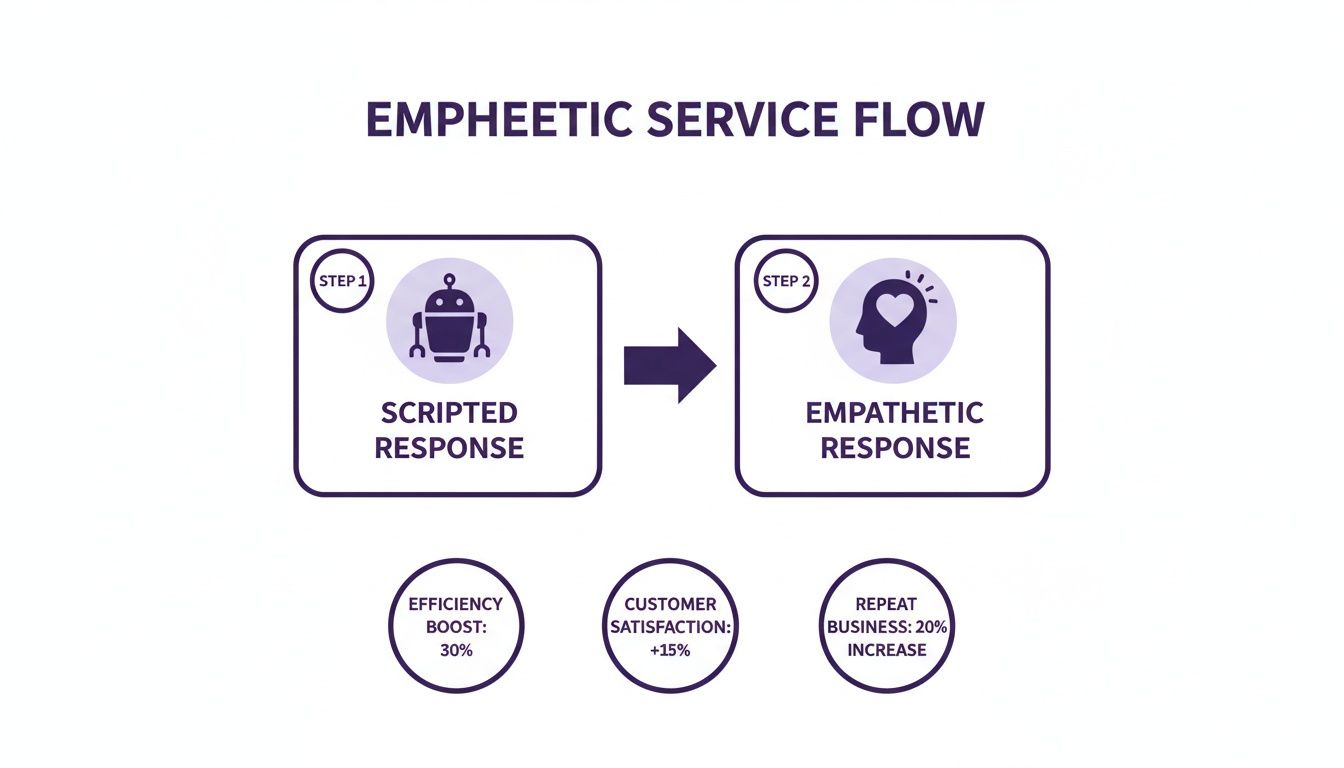
As you can see, the magic happens when agents move beyond scripts to genuinely understand and validate a customer’s feelings. To get there, you need to focus on three key areas:
- Continuous Training: Regular training in active listening, de-escalation, and deep product knowledge is key.
- Modern Technology: Give them the tools to win, like a solid CRM that shows the entire customer history and AI-assist tools that serve up real-time suggestions.
- A Culture of Celebration: When an agent turns a tough situation around, make it a big deal. Celebrate those wins publicly to reinforce the right behaviors.
Step 3: Implement a Cycle of Continuous Improvement
Great service is a journey of constant fine-tuning. The last part of the framework is creating a feedback loop that fuels nonstop improvement. It’s a simple but powerful cycle: Measure, Analyze, and Act.
What defines excellent customer service is a relentless commitment to getting better. It’s about listening to feedback, identifying patterns, and having the courage to change what isn’t working.
First, measure your KPIs like FCR and CSAT. Next, analyze that data to spot patterns and find the “why” behind the metrics. Finally, act on what you find by updating training, tweaking processes, or flagging product bugs. This process ensures your service evolves with your customers, building a truly resilient, customer-first organization.
How a Nearshore Partner Helps Define Your Service Excellence
Trying to deliver consistently great customer service is tough, especially as your company grows. Building an in-house team that can nail First Call Resolution (FCR), earn glowing CSAT scores, and build real human connections is a massive operational headache.
That’s where a strategic nearshore partner in Tijuana becomes your smartest move. This isn’t just about cutting costs; it’s about gaining a serious competitive edge. The right partner works like a seamless extension of your own team.
The Nearshore Model Built for Excellence
The very things that define excellent customer service—efficiency, empathy, and personalization—are exactly what a top-tier nearshore model delivers. A partner in a location like Tijuana brings unique advantages that directly boost your service quality.
What defines excellent customer service in a partnership is alignment. It’s when your partner’s team operates with the same cultural understanding, time-zone synergy, and brand passion as your own employees.
Think about these key benefits:
- Cultural and Time-Zone Alignment: Agents in Tijuana share a close cultural affinity with North American customers. Conversations feel more natural, and operating in the same time zones ensures fast responses.
- Highly Skilled Bilingual Talent: Tijuana is a hub for educated, bilingual professionals who view customer service as a career path, giving you access to sophisticated communication and problem-solving skills.
- Cost-Effective Scalability: You get a world-class team without the overhead of an in-house operation, allowing you to scale your support up or down instantly based on demand.
Partnering with a nearshore call center is an investment in your ability to scale excellence. By bringing on a team that acts as an extension of your brand, you free up internal resources to focus on innovation and growth. You can dig deeper into the strategic benefits of nearshore outsourcing and see how it helps companies build lasting customer loyalty.
Frequently Asked Questions
You’ve got questions, and we’ve got answers. When you’re on the path to building exceptional service, a few common roadblocks and queries always pop up. Let’s clear the air on some of the most frequent ones.
What Is the First Step to Improving Customer Service?
The first step is to define and measure what success looks like. You can’t improve what you don’t measure.
Set clear, measurable goals like hitting a First Contact Resolution (FCR) rate of 75% or a Customer Satisfaction (CSAT) score of 85%. Measure your current performance to get a baseline. This gives you a starting point and a clear goal to aim for.
How Can a Small Business Measure Service Excellence on a Budget?
You don’t need a six-figure software budget. Small businesses can get a solid read on their service quality with a few low-cost tactics:
- Use free survey tools like Google Forms to send simple CSAT surveys.
- Track repeat inquiries manually. If the same customer contacts you multiple times about the same issue, that’s a red flag for your FCR.
- Monitor online reviews and social media mentions. This is your unsolicited, brutally honest feedback channel.
Will AI Replace Personalized Customer Service?
Not a chance. Think of AI as a powerful assistant, not a replacement. The best approach is a hybrid one where AI handles simple, repetitive tasks (password resets, order tracking), freeing up your human agents to tackle the complex, high-empathy problems where a real connection matters. The goal isn’t to automate your team away; it’s to augment them so they can do their best work.
Why Choose a Nearshore Call Center Over Offshore?
For a North American company, it boils down to two things: alignment and quality. A nearshore partner in a place like Tijuana operates on the same time zones, so customers get help during their business hours. More importantly, the cultural alignment is huge. Agents get the nuances of a conversation, which leads to more empathy and better outcomes, making the service feel like a seamless extension of your own brand.
🚀 Ready to Deliver Excellent Customer Service?
CallZent helps businesses build scalable, high-performance support teams with nearshore expertise and bilingual agents.
Talk to an ExpertReady to elevate your customer experience with a team that gets it? CallZent provides high-quality, scalable nearshore solutions from Tijuana that drive loyalty and growth. Learn how our empowered agents can become your competitive advantage at https://callzent.com.