Skip to content
Call Center Technology
What is Call Routing? Strategies to Improve CX & Efficiency
Learn what call routing is, how it works, and how businesses use it to reduce wait times, boost first-call resolution, and improve customer experience.
TL;DR — Quick Takeaways
- Call routing automatically directs calls to the right agent based on rules like skills, time, or customer data.
- It reduces wait times, improves first-call resolution (FCR), and boosts customer satisfaction.
- Strategies like skills-based, time-based, and round-robin routing serve different operational goals.
- AI-powered predictive routing is transforming call centers by anticipating customer needs.
Ever called a company and been magically connected to the exact person who could help, skipping the endless game of phone tag? That’s not magic. It’s call routing—the intelligent, behind-the-scenes process that directs incoming calls to the perfect agent or department based on a predefined set of rules.

Your Guide to Understanding What Call Routing is and Why it Matters
Think of call routing as the digital traffic controller for your business. Instead of letting calls pile up in a single, chaotic queue, it acts like a hyper-efficient postal service. It doesn’t just drop off a package; it hand-delivers it to the one person best equipped to handle it, whether that’s a Spanish-speaking agent, a tech support guru, or a senior account manager.
This automated system follows a programmed set of rules to sort and direct every call with incredible speed and precision. The goal is simple: get the customer to the best possible resource on the very first try.
Why Call Routing Is Essential for Modern Business
In a world where customer experience is king, effective call routing is the foundation of your kingdom. It has a direct, measurable impact on both your operational efficiency and your customers’ happiness.
- Slashes Customer Wait Times: Getting callers to the right agent fast means less time on hold. Less hold time equals much happier customers.
- Boosts First-Call Resolution (FCR): When a customer connects with an expert who solves their problem right away, there’s no need for frustrating transfers or callbacks. This is a primary benefit of understanding what is call routing.
- Supercharges Agent Productivity: Your team only gets the calls they’re trained to handle. This lets them work more efficiently and avoids the stress of juggling issues outside their expertise.
- Creates a Personal Touch: Advanced systems can use caller data to send high-value clients to dedicated agents, delivering a premium, white-glove experience.
A well-designed call routing strategy transforms your contact center from a cost liability into a powerful engine for customer retention and growth.
This kind of system isn’t just for massive corporations anymore. Modern tech makes sophisticated routing accessible for businesses of any size. At CallZent, we use these advanced systems as a core part of our cloud call center solutions to deliver seamless, efficient, and bilingual support. By strategically directing every interaction, we ensure each conversation is productive and positive, reinforcing your brand’s promise of excellent service.
The Core Types of Call Routing Strategies
Once you see call routing as your system’s command center, the next question is simple: how do you want it to operate? Different strategies achieve different goals. The most effective contact centers don’t just pick one; they blend several to create a truly intelligent system.
Think of these strategies less as rigid options and more as flexible tools in your customer experience toolkit.
Choosing the right approach is critical. It’s the difference between a customer getting their problem solved in two minutes and hanging up in frustration after being transferred three times. Let’s break down the most impactful strategies.
What is Skills-Based Call Routing?
Skills-based routing is the specialist of the call routing world. Instead of sending a call to just any available agent, this method matches a caller’s needs to the agent with the specific expertise to solve their problem.
This is the gold standard for first-call resolution.
Imagine a customer calling your financial services firm about a complex retirement account. A basic system just looks for an open line. With skills-based routing, the system identifies the call’s purpose (perhaps through an IVR menu) and routes it directly to a certified retirement planning specialist who is also fluent in Spanish, if needed.
The benefits are immediate:
- The customer is happy because they get an expert on the first try.
- The agent is confident because they’re handling an issue they are trained for.
- The business wins by resolving the issue faster, reducing handle times and boosting loyalty.
Key Takeaway: Skills-based routing stops the frustrating “let me transfer you” cycle by treating every customer interaction as an opportunity for expert-level service.
What is Time-Based Call Routing?
Time-based routing is a simple but powerful strategy that directs calls based on the time of day, day of the week, or even holidays. It’s essential for any business operating across different time zones or looking to provide after-hours support without burning out its local team.
For example, a national e-commerce brand can use time-based routing to ensure 24/7 coverage. When the East Coast support team signs off at 6 PM EST, the system automatically begins sending all incoming calls to our nearshore call center in Tijuana.
This provides seamless, uninterrupted support for West Coast customers and late-night shoppers without the high cost of a dedicated overnight staff.
This strategy is perfect for:
- Providing follow-the-sun support for global companies.
- Directing after-hours calls to a dedicated voicemail or an on-call agent.
- Managing holiday schedules by routing calls to teams that are still operational.
What is Round-Robin Call Routing?
While skills-based routing focuses on expertise, round-robin routing prioritizes fairness and balanced workloads. This method distributes calls evenly among available agents in a cyclical pattern. If you have five agents, the first call goes to Agent 1, the second to Agent 2, and so on, until it circles back around.
This approach is incredibly effective for teams where all agents have a similar skill set, like general customer service or outbound sales campaigns.
It prevents one or two agents from being overwhelmed while others sit idle—a major cause of agent burnout. By ensuring everyone takes a fair share, you keep your team fresh and engaged. It also connects callers to an available agent quickly, cutting down their time in the queue.
For outbound teams, this strategy pairs perfectly with technology that maximizes connection rates. As you can explore in our guide on boosting outbound productivity with predictive dialing, distributing leads fairly is key to maintaining team momentum.
To help you decide which is best for your business needs, here is a quick comparison of these common call routing methods.
A Comparison of Common Call Routing Methods
| Routing Method | Best For | Primary Benefit | CallZent Use Case |
|---|---|---|---|
| Skills-Based | Complex inquiries, technical support, bilingual needs, high-value customers. | First-Call Resolution. Connects customers to the right expert immediately. | Routing a Spanish-speaking customer with a billing issue directly to a Tier 2, Spanish-fluent billing specialist. |
| Time-Based | Businesses with 24/7 support needs, multiple locations, or global customers. | Continuous Coverage. Ensures no call goes unanswered, regardless of time. | Directing all calls received after 6 PM EST from a U.S. client to our 24/7 nearshore team in Tijuana. |
| Round-Robin | General customer service teams, outbound sales campaigns, or any group with similar skills. | Balanced Workload. Prevents agent burnout and ensures fair call distribution. | Evenly distributing inbound leads for an appointment-setting campaign among a dedicated team of agents. |
Each of these strategies serves a distinct purpose, but their true potential is unlocked when they are combined into a sophisticated, multi-layered system.
At CallZent, we rarely use just one of these strategies in isolation. The real power comes from combining them. We might use time-based routing to direct calls to our Tijuana center after 5 PM, apply skills-based routing to sort those calls by language and issue type, and finally use round-robin distribution within each specialized agent group.
This multi-layered approach ensures every single call is handled with maximum efficiency and expertise, no matter when it comes in or what it’s about.
The Technology Powering Intelligent Call Distribution
Ever wonder how a caller with a billing question instantly gets to the right person? It’s not magic. It’s a smart stack of technology working behind the scenes to make every customer connection feel effortless.
Even if you’re not a tech guru, the basics are easy to understand. The two workhorses doing the heavy lifting in any modern call routing system are the Automatic Call Distributor (ACD) and the Interactive Voice Response (IVR).
Automatic Call Distributor (ACD)
Think of the Automatic Call Distributor (ACD) as the engine of your call routing setup. Once your system figures out where a call should go (based on the rules you set), the ACD is what physically sends that call to the right agent or department. It’s the traffic cop that executes the plan, making sure every call flows exactly where it needs to, without anyone lifting a finger.
So, when a routing rule flags that a caller needs Spanish support, the ACD is the piece of tech that finds an available, Spanish-speaking agent and connects the call. Simple as that.
Interactive Voice Response (IVR)
The Interactive Voice Response (IVR) is the first voice your customers hear. It’s that automated menu that greets callers and helps sort out their needs—the classic “Press 1 for Sales, Press 2 for Support.”
By asking those first few questions, the IVR gathers the essential details the ACD needs to make a smart decision. A good IVR doesn’t trap customers in a robotic maze; it empowers them by quickly getting them on the right path.
These two systems are the building blocks, but the real game-changer is what’s being built on top of them with artificial intelligence.
The New Frontier: AI and Predictive Routing
The next step in call routing is already here, and it’s all about AI and machine learning. This is where things get really interesting, moving from simply reacting to a customer’s menu choice to proactively predicting why they’re calling in the first place. We call this predictive call routing.
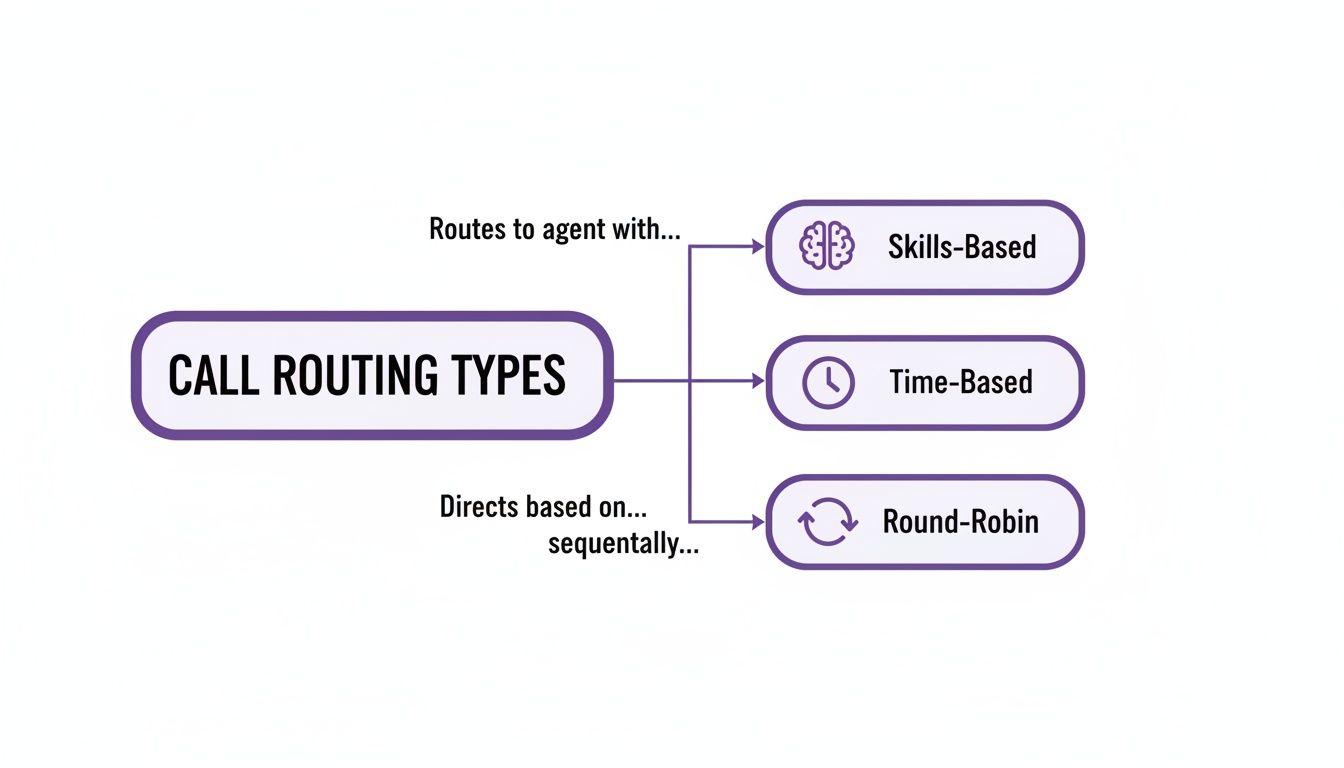
While that graphic shows the fundamentals like skills-based routing, AI adds a powerful layer of intelligence over everything.
Instead of just waiting for a customer to punch numbers into an IVR, predictive routing digs into the data you already have—like their purchase history, recent website visits, or past support tickets—to figure out the reason for their call before they even say a word.
Predictive routing doesn’t just ask, “Why are you calling?” It aims to answer, “Based on what we know, why are you most likely calling?”
Imagine this: a customer’s payment just failed on your website. They pick up the phone to call you. The system instantly recognizes their phone number, sees the failed payment in your CRM, and routes them directly to a billing specialist who can fix it. The customer gets to the right expert without pressing a single button. That’s a huge win for reducing handle times and creating a fantastic customer experience. It’s a key part of how we use automation and artificial intelligence in our call centers to get better results.
The market’s adoption of this tech tells the story. The global Call Routing Software market is on track to hit $7.92 billion in 2025, growing at a 13.5% CAGR. Businesses are clearly investing heavily in smarter call management to get a competitive edge.
Of course, all this advanced software relies on solid foundational tech. Understanding the underlying telephony and data connectivity solutions is key to making any routing strategy work. At CallZent, our tech stack is built on this principle, combining powerful ACD and IVR systems with the predictive brain of AI to make every customer interaction count.
How Strategic Call Routing Benefits Your Business
Smart call routing isn’t just a technical tweak; it’s a core business strategy that delivers a clear return on your investment. Let’s move past the “how” and get straight to the “why”—because that’s where its power to transform your business really shines. An intelligent routing strategy directly impacts your customer experience, operational efficiency, and, of course, your bottom line.
The most immediate win is a massive leap in customer experience (CX). When customers get to the right person on the first try, you eliminate the two things they despise most: long waits and getting bounced between departments. This efficiency is the bedrock of our approach to inbound call center services that boost FCR and CSAT.
That kind of seamless experience builds trust and loyalty, turning a simple support interaction into a moment that strengthens your brand.
Enhancing Operational Efficiency and Reducing Costs
While your customers are enjoying faster resolutions, your business is quietly reaping some major operational rewards. Strategic routing cuts down on agent burnout by making sure they get calls that actually match their skills. This boosts job satisfaction and brings down costly employee turnover.
More than that, it leads to a direct drop in operational costs.
- Lower Average Handle Time (AHT): When experts handle the problems they know best, they solve them faster. Simple as that.
- Reduced Call Transfers: Every transfer you avoid saves time for both the customer and the two (or more) agents involved.
- Optimized Staffing: The data from your routing system shows you exactly when and why people are calling, allowing for smarter, more cost-effective agent scheduling.
This isn’t just about saving a few bucks. It’s about putting your resources where they can do the most good and empowering your team to be more focused and productive. The physical environment plays a role here too, with setups like Call Center One Surface Cubicles designed to support an efficient workflow.
A Real-World Example in E-commerce
Imagine an online retailer is struggling with a high rate of abandoned shopping carts. Customers often have last-minute questions about shipping, sizing, or payment. Without smart routing, these high-intent buyers get dumped into a general support queue, stuck waiting behind someone with a password reset issue.
By setting up a system that flags sales-related questions—maybe with an IVR option like “Press 3 for questions about placing an order”—the company can send these valuable callers directly to its best sales agents.
The result? The shopper gets a quick, confident answer and clicks “buy.” The company slashes its cart abandonment rate, boosts revenue, and delivers a completely frictionless buying experience. The investment in call routing pays for itself by closing more sales.
Effective call routing transforms your call center from a cost center into a powerful engine for customer retention and growth.
This strategic approach is a clear sign of a mature and effective support operation. It’s no surprise the broader contact center market is booming. The global call center market was valued at $40.2 billion in 2026 and is projected to hit $83.2 billion by 2036, growing at a 7.4% CAGR. This massive investment shows just how seriously businesses are taking their support infrastructure. You can read the full research about the call center market growth to see the trends driving this expansion.
As a nearshore BPO partner, we at CallZent deliver these benefits for our clients every single day. Our location in Tijuana allows us to provide highly-skilled bilingual agents who can be integrated into complex routing strategies, ensuring both English and Spanish-speaking customers get the exceptional service they deserve. We don’t just answer calls; we design the intelligent systems that make every call count.

Implementing Call Routing With a Nearshore Partner
Knowing the theory behind call routing is one thing. Putting it into practice is where the real work—and the real value—begins. A successful rollout isn’t as simple as flipping a switch. It’s a strategic project that demands clear goals, the right tech, and a genuine understanding of your customer’s journey.
This is where partnering with a nearshore expert like CallZent makes all the difference. We handle the entire process, helping you sidestep the common and costly mistakes that come with a DIY setup. We bring the technology, talent, and hard-won expertise to the table from day one, so you can perfect your customer communications without taking focus off your core business.
Your Roadmap to Effective Implementation
Launching a call routing system follows a few critical steps. Whether you go it alone or work with a partner, this fundamental process doesn’t change. Getting these steps right is what unlocks the ROI you’re looking for.
Here’s the practical roadmap we follow with our clients:
- Define Clear Business Goals: What exactly are you trying to accomplish? Is it about cutting wait times, boosting first-call resolution, or driving more sales conversions? Your answer shapes every single decision that comes next.
- Map the Customer Journey: We dig into every touchpoint to figure out why your customers are calling and what they truly need. This insight lets us design routing rules that anticipate their needs, not just react to them.
- Select the Right Technology Stack: Based on your goals, we configure the ideal mix of IVR, ACD, and AI-powered routing. You get immediate access to our advanced infrastructure with zero capital investment.
- Develop and Train Your Team: Our bilingual agents in Tijuana are trained not only on your products but on the specific call flows and escalation paths we design together. They quickly become a true extension of your brand.
A successful call routing implementation isn’t a one-time task; it’s a collaborative partnership focused on continuous improvement and measurable results.
The Strategic Advantage of a Nearshore BPO
Working with an experienced partner like CallZent gives you a serious edge over trying to build a routing system from the ground up. We’ve built complex systems for clients in demanding industries like healthcare and finance, so we know what works—and what doesn’t. You can learn more about how we manage these sophisticated setups in our guide to nearshore call center operations.
The key benefits really come down to this:
- Immediate Access to Technology: You get our entire enterprise-grade tech stack on day one. No long procurement cycles, no complicated software installations to bog you down.
- A Deep Bilingual Talent Pool: Our Tijuana location gives you access to a highly-skilled, culturally aligned team fluent in both English and Spanish. This is a game-changer for building a skills-based routing strategy that can serve a diverse customer base.
- Proven Expertise and Best Practices: We bring over two decades of experience to your project. We’ve seen the pitfalls and know how to design, test, and fine-tune call flows to make sure they perform flawlessly under real-world pressure.
Ultimately, this collaborative approach means your call routing system is perfectly fitted to your business needs. We handle all the technical heavy lifting so you can enjoy the strategic benefits: happier customers, more efficient operations, and a healthier bottom line.
Measuring and Optimizing Your Call Routing Strategy
Getting your call routing strategy off the ground is one thing, but making sure it actually works—and keeps working—is a whole different ballgame. Think of it less like a “set it and forget it” machine and more like a high-performance engine that needs constant tuning. The real magic happens when you start measuring, tweaking, and refining based on what the data tells you.
Without this feedback loop, you’re flying blind. You have no way of knowing where customers are getting stuck or why your agents might be struggling. By continuously monitoring performance, you turn raw data into a roadmap for a better customer experience and a smarter, more efficient operation.
How to Tell If Your Call Routing Is Working
To get a clear picture of what’s going on, you need to track a few core Key Performance Indicators (KPIs). These numbers tell a story about customer satisfaction, agent effectiveness, and the overall health of your support system.
- First Call Resolution (FCR): This is the big one. Are you connecting customers to the right person who can solve their problem on the first try? A high FCR rate is a clear sign your routing is dialed in. If it’s low, you know something’s off.
- Average Handle Time (AHT): When AHT starts to creep up, it’s often a symptom of misrouted calls. An agent who isn’t the right fit for a specific problem will naturally take longer to solve it. Getting the right calls to the right experts is the fastest way to bring this number down.
- Customer Satisfaction (CSAT): Unhappy customers often point to routing issues. Long waits and getting bounced between departments are classic routing fails that tank CSAT scores. This metric gives you a direct look at how your routing strategy is impacting the customer experience.
Turning Numbers into Smarter Decisions
Once you’re tracking these KPIs, the next step is to act on them. If you notice a low FCR for a certain type of call, it’s time to look at the skills you’ve assigned to that queue. Maybe the IVR menu is confusing people, causing them to choose the wrong option from the start.
Your routing data is a roadmap. It shows you exactly where the bumps are in your customer experience and gives you the directions to smooth them out.
For instance, let’s say you see a flood of call transfers from your Tier 1 team to Tier 2 specialists every single afternoon. That’s a signal. You can adjust your routing rules to send more of those complex calls straight to the Tier 2 team during those peak hours, improving both AHT and CSAT in one go.
This data-driven approach is quickly becoming the industry standard. AI-powered predictive call routing is exploding in popularity, generating $477.3 million in 2024 and is on track to hit $1,595.7 million by 2030. You can discover more insights about predictive call routing’s growth and see how it’s reshaping performance.
At CallZent, we’re obsessed with this. We give our clients clear, real-time dashboards that track these critical KPIs. But we don’t just hand you a report and walk away. We partner with you to analyze what the numbers mean and proactively recommend changes to keep your call routing strategy—and your business—ahead of the curve.
Frequently Asked Questions About What Is Call Routing
When we talk about call routing, a few key questions always come up. Let’s clear up some of the most common points of confusion with straightforward answers.
What Is the Difference Between Call Routing and an ACD?
It’s easy to get these two mixed up, but the distinction is simple. Think of call routing as your playbook—the overall strategy you design. For example, a rule like, “Send all technical support calls to our Level 2 agents.”
The Automatic Call Distributor (ACD) is the technology that runs the play. It’s the system that physically directs incoming calls based on the rules you’ve laid out. Call routing is the “what,” and the ACD is the “how.”
How Does Call Routing Improve Customer Satisfaction?
At its core, smart routing drastically reduces customer effort. That’s the magic.
When a caller connects with the right agent on the very first try, you eliminate long wait times and kill the dreaded “let me transfer you” loop. This immediately boosts the odds of first-call resolution and creates a smooth, painless experience that customers remember.
Key Takeaway: A seamless support experience is a massive driver of customer loyalty. Smart call routing is the engine that powers it.
Can Small Businesses Benefit From Call Routing?
Absolutely. You don’t need a massive team to see huge benefits from intelligent what is call routing strategies.
Even simple setups make a huge difference. Time-based routing can handle after-hours inquiries, while skills-based routing can ensure your top salesperson gets every hot lead. It helps a small team punch above its weight, making you look more organized and ensuring no opportunity slips through the cracks.
🚀 Ready to Optimize Your Call Routing?
Discover how CallZent’s nearshore call center solutions can reduce costs, improve CX, and boost your operational efficiency.
Talk to an ExpertAt CallZent, we specialize in designing and implementing advanced call routing strategies that deliver real business results. From boosting customer satisfaction to improving your bottom line, our team has the expertise to build a system that fits your unique needs.
Ready to see how a smarter approach can transform your customer communications? Learn more about our solutions at CallZent.com.