Skip to content

What Is Quality Assurance in a Call Center? A Complete Guide to Building World-Class Service
Ever wondered what separates a frustrating customer service call from an exceptional one? It’s not luck. The secret weapon behind consistently great service is a powerful Quality Assurance (QA) program. For any call center, QA is the strategic framework used to monitor, evaluate, and continuously improve agent interactions—ensuring every conversation strengthens customer loyalty.
TL;DR — What Is Quality Assurance in a Call Center?
- Definition: QA is a proactive system for monitoring and improving agent-customer interactions.
- Core Components: Scorecards, performance monitoring, structured coaching, and data-driven process improvement.
- Main Goals: Increase CSAT, improve FCR, enhance agent performance, and ensure consistent service delivery.
- Big Picture: A strong QA program transforms a call center from a cost center into a strategic growth engine.
Ever wondered what separates a frustrating customer service call from an exceptional one? It’s not luck. The secret weapon behind consistently great service is a powerful Quality Assurance (QA) program. For any call center, QA is the strategic framework used to monitor, evaluate, and continuously improve agent interactions, ensuring every conversation strengthens customer loyalty.
 What Quality Assurance In a Call Center Really Means
Let’s cut through the jargon. Quality Assurance in a call center is the strategic blueprint for engineering positive customer outcomes. It’s not about punishment or catching agents doing something wrong. Think of it as a continuous coaching and improvement cycle designed to make your entire operation smarter and more effective.
A solid QA program is proactive. It’s a structured system designed to sharpen agent skills, streamline processes, and guarantee your brand’s promise is delivered consistently—one conversation at a time. This is the difference between hoping for great service and actively building a system that delivers it.
For a deeper dive into the overall concept of fostering quality, this comprehensive guide to quality in call center operations is a great resource.
The Core Pillars of Call Center Quality Assurance
At its heart, an effective QA program is built on a few fundamental pillars. These components create a powerful feedback loop connecting agent performance directly to customer satisfaction and your business goals.
The table below breaks down these core elements.
| Pillar | Description | Practical Example |
|---|---|---|
| Performance Monitoring | The systematic review of agent interactions across all channels (calls, chats, emails) using scorecards and analytics. | A QA specialist listens to five calls per agent each week, scoring them against a predefined scorecard for greeting, problem diagnosis, and resolution accuracy. |
| Agent Coaching | Providing specific, actionable, and constructive feedback to agents based on monitored interactions. | During a 1:1 meeting, a team lead plays back a portion of a call and says, “Here, you did a great job empathizing, but let’s brainstorm a clearer way to explain the refund process next time.” |
| Process Improvement | Analyzing QA data to spot recurring issues, knowledge gaps, or inefficiencies in workflows and procedures. | QA data shows 30% of agents are struggling with a new software update. The QA team works with training to create a one-page job aid and a short video tutorial. |
| Customer Satisfaction Alignment | Aligning QA metrics with customer feedback (like CSAT and NPS) to ensure agent actions truly meet customer needs. | The QA scorecard is updated to include a section on “Building Rapport” after NPS comments reveal customers feel rushed. |
Ultimately, these pillars support a single, powerful purpose: ensuring every customer interaction is a positive reflection of your brand.
The Main Goals of a QA Program
When you get down to it, a strong quality assurance program is designed to achieve a few critical business objectives.
Its primary goals are to:
- Boost Customer Satisfaction: By making sure agents are empathetic, knowledgeable, and efficient, QA directly elevates the customer experience.
- Enhance Agent Performance: QA delivers the specific, actionable feedback agents need to grow their skills, build confidence, and feel more invested in their roles.
- Drive Operational Consistency: It ensures every customer gets the same high level of service, no matter which agent they speak to, reinforcing your brand promise.
- Pinpoint Training Gaps: By spotting recurring issues, QA helps create targeted training programs that actually solve problems instead of just guessing at them.
The ultimate goal of QA is to transform your call center from a cost center into a strategic growth driver. By systematically improving every interaction, you build a loyal customer base that champions your brand.
By putting these principles into action, we help clients achieve world-class quality in call centers, turning every customer touchpoint into an opportunity.
Understanding QA Versus Quality Control
It’s a common mix-up in the call center world: using Quality Assurance (QA) and Quality Control (QC) as if they mean the same thing. But they’re two different—though equally important—parts of a great customer service operation. Getting this distinction right is the first step to building a quality program that actually works.
Think of it like building a car. QA is the engineering team that designs the assembly line and trains the workers to build the car perfectly every time. QC is the inspector at the end of the line who checks for scratches and makes sure the doors fit properly. One is proactive and system-focused; the other is reactive and product-focused.
The Proactive Approach of Quality Assurance
Quality Assurance is all about playing the long game. It’s a strategic, process-driven approach designed to prevent mistakes before they can ever reach a customer. QA looks at the entire customer service ecosystem to build a solid foundation for consistent, high-quality interactions.
A strong QA program is busy:
- Improving Agent Training: Creating rock-solid onboarding and ongoing learning that gives agents the skills they need from day one.
- Refining Scripts and Workflows: Making sure the processes agents follow are clear, smart, and actually lead to happy customers.
- Establishing Clear Quality Standards: Defining exactly what a “great” interaction looks like, so everyone is aiming for the same target.
For example, a QA specialist might spot a recurring issue where customers are confused about a new return policy. Instead of just marking down agent errors (that’s QC’s job), they’d work with the training department to update the manuals and host a quick workshop. This one proactive move prevents hundreds of future bad calls.
The Reactive Role of Quality Control
Quality Control, on the other hand, is the immediate, in-the-moment check. Its job is to inspect the final “product”—a finished call, chat, or email—to see if it meets the standards QA helped create. If QA builds the system, QC inspects what comes out of it.
QC activities are what most people picture when they think of call center quality:
- Reviewing recorded calls to score agents against a detailed scorecard.
- Scanning chat transcripts for accuracy, tone, and policy adherence.
- Pinpointing specific times an agent missed a crucial step or gave wrong information.
While QC is absolutely essential for catching mistakes, it can’t fix the root cause. It tells you what went wrong, but not why. That’s when the baton gets passed back to QA to fix the underlying process. To learn more about creating a system that gets the best of both worlds, check out our guide on contact center quality assurance best practices.
A business that relies only on Quality Control is always playing catch-up, fixing problems after they’ve already damaged the customer experience. A strong Quality Assurance program dramatically reduces the number of mistakes QC has to find, saving time, money, and your company’s reputation.
How to Build a Call Center QA Process That Works
Building a solid Quality Assurance program from the ground up might feel like a huge undertaking, but it boils down to a few logical steps. A successful QA process isn’t about complexity; it’s about clarity, consistency, and a commitment to helping your team improve. Following a structured approach lets you create a framework that delivers real results.
The very first step is to define what “quality” means for your business. Don’t just grab a generic template. Instead, work backward from your main business goals. Is your top priority to boost customer retention? Then your quality standards should be heavily weighted toward empathy and First Call Resolution (FCR).
Once you know what you’re aiming for, you can build those standards into a QA scorecard. This is the document that turns your definition of quality into concrete, measurable criteria that evaluators use to score agent interactions. It’s the bedrock of your entire QA program, making sure everyone is measured by the same ruler.
Creating Your QA Scorecard: What to Measure
A well-balanced QA scorecard is the heart of your entire program. It needs to be clear, concise, and focused on behaviors that directly impact the customer experience and your business goals. The key is to avoid creating a massive checklist that nitpicks every detail. Focus on what truly matters.
Here are the essential components of a scorecard that works:
- Critical, Non-Negotiable Items: This covers compliance and legal must-dos, like reciting necessary disclosures or correctly verifying a customer’s identity. These are typically pass/fail.
- Customer Experience Elements: This is where you measure the “soft skills.” Did the agent show genuine empathy? Were they actively listening and building a connection? Was their tone professional and reassuring?
- Business Process Adherence: Did the agent follow the correct workflow for the customer’s issue? Did they log the interaction correctly in the CRM and use the proper disposition codes?
- Resolution and Accuracy: Most importantly, was the customer’s problem solved—correctly and on the first try? This section gets to the heart of an agent’s problem-solving skills and product knowledge.
This infographic is a great visual reminder of how QA and QC play different, but complementary, roles in the big picture of quality management.
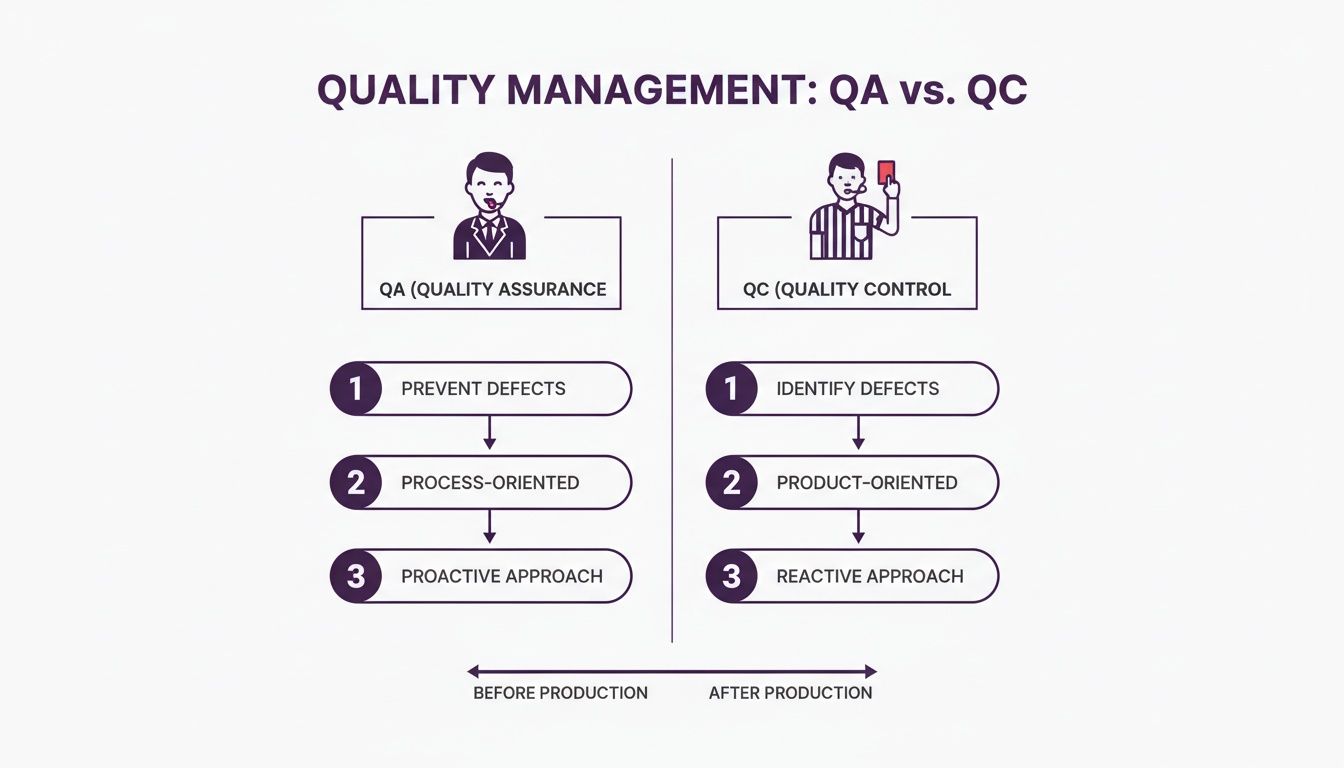
As the image shows, you can think of QA as the coach, focused on improving the process and preventing errors, while QC is the referee, focused on inspecting the final outcome.
Calibrating and Delivering Feedback
Creating the scorecard is only half the battle. To ensure your evaluations are fair and consistent, you must hold calibration sessions. In these meetings, all QA specialists and team leads listen to the same call and score it independently. Afterward, they discuss why they scored the way they did, aligning on what a “good,” “average,” or “poor” rating looks like for each item. This removes subjectivity and builds trust in the process.
Without regular calibration, your QA process will fall apart. Consistency is the key to building agent trust and ensuring that feedback is perceived as fair and objective, not subjective.
The final—and most important—step is delivering feedback. This should never be a simple score drop in an email. It must be a constructive coaching conversation centered on development. When you’re ready to get this up and running, our deep-dive guide on how to implement call monitoring gives you actionable steps for turning these observations into powerful coaching moments.
Always use specific examples from the call and work with the agent to create an action plan for improvement. This is how you transform QA from something that feels like an audit into a genuine tool for professional growth.
Measuring Success with Essential Call Center KPIs
A quality assurance program without the right metrics is like flying blind. Without clear, measurable data, any effort to improve performance is just guesswork. Key Performance Indicators (KPIs) are the lifeblood of an effective QA system, giving you a real-time pulse on your operational health and, more importantly, how your customers feel. They turn abstract goals like “better service” into concrete numbers you can act on.
The right KPIs help you see what’s really happening on the front lines. Tracking them shows you how well your agents are solving problems, what customers think about their interactions, and how efficiently your team is operating. This isn’t just data for a report; it’s the foundation for targeted coaching and smart process improvements.
The Most Important Call Center Quality Metrics
While you could track dozens of different numbers, a few stand out as non-negotiable for any serious QA program. These core KPIs offer a balanced view of efficiency, effectiveness, and customer sentiment.
- First Call Resolution (FCR): This is the holy grail of call center metrics. It measures the percentage of customer issues resolved in a single conversation, with no need for a follow-up call, chat, or email. A high FCR is a direct sign of skilled agents and streamlined processes.
- Customer Satisfaction (CSAT): Usually measured with a quick post-interaction survey asking something like, “How satisfied were you with your service today?” CSAT gives you immediate feedback on a specific interaction, offering a direct line into the customer’s perception of quality.
- Average Handle Time (AHT): This KPI tracks the total time an agent spends on an interaction, from start to finish, including any after-call work. While a low AHT might look like efficiency, you must balance it with FCR and CSAT. Rushing customers off the phone without solving their problems is a recipe for disaster.
- Net Promoter Score (NPS): This metric looks at long-term customer loyalty by asking, “How likely are you to recommend our company to a friend or colleague?” It provides a big-picture view of your brand’s health and the overall strength of your customer relationships.
You cannot improve what you do not measure, and in a call center, FCR is the pulse of your operational health.
Why First Call Resolution Is a Top Priority for Quality Assurance
Of all the KPIs, FCR often delivers the biggest impact. When you solve an issue on the first try, you’re not just making a customer happy—you’re saving a significant amount of money. Every follow-up call burns additional agent time, uses up resources, and adds to customer frustration.
Industry benchmarks show that world-class call centers aim for 90% FCR rates, while the typical average sits between 70-79% across major markets. A strong FCR is directly tied to both happy customers and a healthy bottom line. In fact, some studies show that high rates can slash repeat call volume and cut operational costs by up to 30%. You can find more detailed call center statistics and insights at Xima Software.
Ultimately, mastering these KPIs is about building a data-driven culture of excellence. Our guide on how to measure and improve call center KPIs offers more strategies for turning these numbers into real, actionable results.
The Role of AI and Technology in Modern QA
The old way of doing quality assurance in a call center is on its last legs. For years, the standard was for a manager to grab a tiny, random sample of calls—maybe 2%—and hope it gave them a decent picture of overall performance. It was slow, riddled with human bias, and simply couldn’t scale.
Today, that approach just doesn’t cut it. Technology, especially artificial intelligence, has completely changed the game. Instead of relying on guesswork from a handful of calls, AI-powered tools now make 100% interaction monitoring not just possible, but practical.
These systems analyze every single conversation across every channel—calls, chats, and emails. They can automatically check for sentiment, spot compliance risks, and identify key agent behaviors, giving you a complete, objective view of what’s really happening. It’s a massive leap from random spot-checks to total operational awareness.
How AI Elevates Call Center Quality Assurance
The real power of AI isn’t just in analyzing more conversations; it’s about the depth and speed of those insights. AI platforms can pick up on subtle trends and find the root cause of issues a human evaluator might miss—all in near real-time. This means leaders can be proactive, fixing small problems before they become big ones.
Here’s where AI is making a huge difference in modern QA:
- Automated Scoring: AI automatically scores every single interaction against your quality standards, removing the subjectivity that arises when different managers grade calls differently.
- Real-Time Agent Assistance: Modern systems can act as a co-pilot for agents, offering live guidance during a call. For instance, it might suggest the right answer to a tricky question or flag a missed compliance step, right when the agent needs it.
- Predictive Analytics: By crunching data from thousands of interactions, AI can spot brewing trouble—like a spike in customer frustration around a new product—long before it shows up in your CSAT scores.
This isn’t some future concept; it’s happening now. The move toward AI in call center QA is well underway, with 81% of leaders already investing in voice and text analytics. This shift from manual sampling to 100% coverage is boosting efficiency by up to 45% by catching trends and compliance issues humans simply can’t.
Technology transforms QA from a simple compliance check into a strategic intelligence engine, delivering deep, data-driven insights that fuel continuous improvement.
Exploring solutions like an Ultimate Guide to AI Receptionists can show just how much artificial intelligence is streamlining call handling and boosting service quality across the board. By embracing these advancements, nearshore partners like CallZent deliver a smarter, more effective approach to quality assurance. Learn more about how we integrate automation and artificial intelligence in call centers to drive superior results for our clients.
Frequently Asked Questions About Call Center QA
Even with a solid plan, questions always come up when dialing in a quality assurance program. To clear things up, we’ve tackled some of the most common questions leaders ask about implementing call center QA on the ground.
How many calls should we monitor for QA in a call center?
The old-school approach was to manually review a tiny, random sample—maybe 2-5% of all calls. But with modern technology, that’s ancient history. The new gold standard is 100% interaction monitoring.
When you analyze every single call, chat, and email with AI-powered tools, you eliminate the guesswork of random sampling. You get the full, unvarnished picture of performance and compliance. A human QA specialist might still perform deep dives on a few complex calls for in-depth coaching, but technology now does the heavy lifting, ensuring no critical insights slip through the cracks. This turns QA from a simple spot-check into a real business intelligence powerhouse.
What is the biggest challenge in a call center QA program?
Hands down, the single biggest hurdle is getting agent buy-in. If your team sees QA as a “gotcha” system designed to catch them making mistakes, they’ll resent it. Real success happens when agents view the process as a tool for their own growth and professional development.
Getting there requires a shift in culture.
- Frame feedback for growth: Ditch the red pen. Focus coaching on improvement, not just on the score.
- Ensure consistency: Use regular calibration sessions with your evaluators to eliminate bias and ensure everyone is grading fairly.
- Celebrate wins: When an agent handles a difficult call perfectly, use that recording as a best-practice example for the whole team.
When agents trust the system and understand its value, QA stops being a chore and becomes a collaborative effort to win together.
How does quality assurance work for bilingual call centers?
For a bilingual operation, an effective QA program must go beyond direct translation. You need native-level evaluators who understand not just language proficiency but also cultural nuance. A phrase that’s perfectly polite in one dialect might come across as abrupt or rude in another.
A solid bilingual QA program focuses on key areas:
-
- Fluency and Clarity: Did the agent’s language sound natural, confident, and professional?
- Cultural Appropriateness: Did their tone and choice of words fit the customer’s cultural context? For example, using the formal usted versus the informal tú in Spanish at the right time.
- Consistent Terminology: Was company-specific jargon and branding translated accurately and used correctly every time?
Frequently Asked Questions (FAQs)
1. How many calls should be monitored?
Modern AI systems enable 100% monitoring, replacing outdated random sampling models.
2. What is the biggest QA challenge?
Agent buy-in. QA must be positioned as a growth tool, not a disciplinary system.
3. How often should calibration sessions happen?
At least monthly, or more frequently in high-compliance environments.
4. What is a good FCR benchmark?
Industry averages range from 70–79%, with world-class centers reaching 85–90%.
5. Should QA focus more on soft skills or compliance?
A balanced scorecard ensures both compliance and customer experience excellence.
6. How does QA impact CSAT?
By reinforcing empathy, clarity, and effective resolution, QA directly improves satisfaction scores.
7. Can QA reduce operational costs?
Yes. Higher FCR reduces repeat contacts and unnecessary handle time.
8. How does QA work in bilingual environments?
It requires native-level evaluators and cultural nuance assessment.
9. What tools support modern QA?
AI analytics, call monitoring platforms, CRM integrations, and performance dashboards.
10. How long does it take to see QA improvements?
Most organizations see measurable gains in CSAT and FCR within 60–90 days of structured implementation.
Ready to Elevate Your Call Center Quality?
At CallZent, quality assurance isn’t an afterthought—it’s built into the DNA of our nearshore and bilingual BPO solutions. We combine expert QA teams with AI-driven analytics to transform every interaction into a brand-building moment.
Schedule a Strategy Call →This level of detail ensures a high-quality, seamless experience for every customer, no matter what language they speak.
At CallZent, we don’t just offer quality assurance as a service—we build it into the core of our nearshore and bilingual BPO solutions. Our expert teams and smart technology ensure every customer interaction strengthens your brand. Learn how our solutions can elevate your customer experience today.