Skip to content

Call Center Quality & Performance
World-Class Quality in Call Centers: How to Measure, Improve, and Turn Support Into Revenue
Learn how modern call centers measure quality beyond speed. This guide explains the KPIs, QA frameworks, technology, and coaching strategies that transform call centers from cost centers into growth engines.
TL;DR: A Summary of World-Class Quality in Call Centers
- Modern Quality Defined: True quality blends efficiency, effectiveness, and customer experience. It’s not about ending calls faster—it’s about resolving issues and strengthening customer trust.
- Key Quality Metrics: Move beyond Average Handle Time (AHT). Focus on First Call Resolution (FCR), Customer Satisfaction (CSAT), and Net Promoter Score (NPS).
- Robust QA Framework: A strong Quality Assurance program evaluates compliance, soft skills, and problem-solving using balanced scorecards and calibrated scoring.
- Leverage Technology: AI-powered speech analytics and modern QA platforms analyze 100% of interactions to uncover risks and improvement opportunities.
- Actionable Coaching: Structured coaching models like GROW turn QA data into measurable agent performance gains and lower attrition.
What’s the difference between a call center that costs you money and one that makes you money? For years, the answer was simple: speed. But that industrial-era mindset, focused on answering more calls in less time, completely misses the point of modern customer service.
This guide provides a comprehensive framework for defining, measuring, and improving quality in call centers. It moves beyond outdated metrics like Average Handle Time (AHT) to focus on what truly matters: First Call Resolution (FCR), Customer Satisfaction (CSAT), and building a robust Quality Assurance (QA) program. You will learn how to leverage technology like speech analytics and implement effective agent coaching to transform your call center from a cost center into a strategic asset for customer loyalty and growth.
 What Does World-Class Quality in Call Centers Really Mean?
True World-Class quality in call centers isn’t just about how fast an agent can hang up the phone; it’s about the value delivered during that call. It’s the perfect blend of operational smoothness, accurate problem-solving, and the genuine human connection that turns a frustrated customer into a loyal advocate.
The modern measure of quality is not how quickly you handle a customer, but how well you solve their problem and how they feel about your brand afterward.
Getting this right requires a major strategic shift. Instead of viewing the call center as a cost center judged by speed, forward-thinking businesses see it as a hub of customer intelligence. Every single interaction is a chance to strengthen customer relationships, gather priceless feedback, and protect your revenue.
The Three Pillars of Modern World-Class Call Center Quality
To truly understand quality, it helps to break it down into three core components. Think of them as the legs of a stool—if one is weak, the whole thing topples over.
- Efficiency: This is about respecting everyone’s time—both the customer’s and yours. It means having streamlined processes, knowledgeable agents, and the right tech to prevent maddening delays or repeat calls.
- Effectiveness: This pillar asks one simple question: did we actually solve the problem? An efficient call that ends without a resolution is a complete failure. Effectiveness is defined by accuracy, first-call resolution, and solid agent competency. For example, an agent who quickly provides a refund but fails to explain the company’s return policy is efficient but not effective, leading to future confusion.
- Experience: This is the emotional layer of the interaction. Did the agent show real empathy? Did the customer feel heard and valued? A positive experience can salvage a tough situation and is the key differentiator between basic customer service and a truly superior customer experience.
Ultimately, achieving high quality means finding the perfect harmony between these three pillars. Lean too heavily on one, and you create imbalance. A hyper-efficient center might leave customers feeling rushed and ignored, while an overly empathetic but ineffective one fails to actually get things done.
Old Metrics vs. New Realities: A Shift in Measuring World-Class Call Center Quality
This modern definition of quality demands a completely new way of measuring success. Many of the metrics that once defined a “good” call center are now seen as incomplete or, worse, totally misleading. When we stop obsessing over pure speed, we can start focusing on what really matters.
Here’s a look at how the old, efficiency-focused metrics stack up against the modern indicators that truly reflect quality.
Efficiency Metrics vs. True Quality Indicators
| Metric Category | Traditional Metric (Efficiency-Focused) | Modern Metric (Quality-Focused) |
|---|---|---|
| Resolution | Average Handle Time (AHT) | First Call Resolution (FCR) |
| Customer Feedback | Call Volume | Customer Satisfaction (CSAT) / NPS |
| Agent Performance | Calls Handled Per Hour | Quality Assurance (QA) Score |
| Responsiveness | Average Speed of Answer (ASA) | Service Level Adherence (SLA) |
| Customer Loyalty | Abandonment Rate | Customer Effort Score (CES) |
As you can see, the shift is clear. We’re moving away from counting calls and seconds and toward measuring resolution, satisfaction, and loyalty. It’s about outcomes, not just output.
The Core Metrics That Actually Define Quality
While the idea of “quality” can feel a bit fuzzy, measuring it doesn’t have to be. To get a real handle on quality in call centers, you have to look past simple call volume and dig into the key performance indicators (KPIs) that tell the true story of your customer interactions. These aren’t just random numbers on a screen; they’re direct reflections of your team’s skill, your customers’ happiness, and the overall health of your operation.
Think of these core metrics as the diagnostic tools for your entire service engine. A doctor uses vital signs to check a patient’s health, and a call center leader uses these KPIs to find strengths and spot hidden issues before they turn into bigger problems.
First Call Resolution (FCR): The Ultimate Competency Check
If you could only pick one metric to track, First Call Resolution (FCR) would be a serious contender. It’s simple: FCR tracks the percentage of customer problems that get completely solved on the very first try—no follow-up calls, emails, or chats needed. It’s the ultimate measure of competence and efficiency rolled into one.
A high FCR rate is a win for everyone. Your customers are happy because their issue vanished quickly and without a headache. And for the business, it’s a huge operational victory. It breaks the frustrating and expensive cycle of repeat calls that clog up your phone lines and burn out your agents.
FCR has become a non-negotiable metric, and the industry benchmarks show a huge gap between the best and the rest. A “good” FCR rate today is somewhere between 70% and 79%, while world-class centers are pushing for 80% or higher. The tough reality? Only 5% of call centers ever hit that elite benchmark, which tells you just how many businesses are stuck dealing with repeat calls.
CSAT and NPS: Gauging Happiness and Loyalty
While FCR tells you what you did, Customer Satisfaction (CSAT) and Net Promoter Score (NPS) tell you how the customer felt about the experience. These two metrics give you a powerful look into both immediate feelings and long-term loyalty to your brand.
- Customer Satisfaction (CSAT): This is usually measured with a quick, post-call survey asking something like, “How satisfied were you with our service today?” CSAT is your real-time pulse check on customer happiness after a specific interaction. A SaaS company, for example, might send a CSAT survey after a support call about a new feature to instantly see how well their agents are explaining it.
- Net Promoter Score (NPS): This one asks the bigger question: “How likely are you to recommend our company to a friend or colleague?” It’s less about a single interaction and more about overall brand loyalty. A rising NPS score is a sign that your call center isn’t just putting out fires—it’s actively creating loyal fans for your brand.
Average Handle Time (AHT): A Diagnostic Tool, Not a Target
For too long, Average Handle Time (AHT) was used as a blunt instrument to measure agent productivity. This led to agents rushing through calls, leaving customers frustrated and problems unsolved. The modern, quality-first approach sees AHT for what it really is: a valuable diagnostic tool, not a target to be blindly chased.
Instead of asking, “Why is this agent’s AHT so high?” ask, “What is causing this agent’s AHT to be high?”
A sudden spike in AHT across your team might not mean your agents are slow. It could signal a new, tricky customer issue, a broken internal process, or a gap in training that needs your attention. By digging into the why behind the number, you can fix the root of the problem instead of punishing agents for taking the necessary time to deliver a great resolution.
To see how these KPIs fit into a bigger picture, exploring how to master operational efficiency metrics can offer some great insights. You can also get more details in our complete guide on call center reporting and metrics.
How to Build a Robust Quality Assurance Framework
Great quality doesn’t just happen. It’s the result of a deliberate, well-designed system. Simply tracking metrics won’t cut it. To really move the needle, you need a structured Quality Assurance (QA) framework that defines what “good” looks like and maps out a clear path to get there.
Think of a QA framework as the blueprint for your service operation. Without one, you’re just guessing. With one, you can build a consistent, high-performing team that methodically improves the customer experience and elevates the overall quality in call centers.
Designing a QA Scorecard That Matters
The heart of any QA program is the scorecard. All too often, these are treated like simple compliance checklists. “Did the agent say the customer’s name?” “Did they read the closing script?” While that stuff can be important, a truly effective scorecard digs much deeper. It measures the skills that separate an average agent from a truly great one.
A modern QA scorecard has to be balanced, looking at a mix of critical areas:
- Procedural Adherence: These are the non-negotiables. Think following compliance scripts in a regulated industry or correctly logging case details in the CRM.
- Soft Skills and Empathy: This is where the magic happens. Did the agent actively listen? Did they show genuine empathy for the customer’s situation?
- Problem-Solving and Accuracy: This is all about effectiveness. Did the agent correctly diagnose the issue and give an accurate, complete resolution?
- Brand Representation: Did the agent’s tone and language actually sound like your company? This ensures customers get a consistent brand experience every single time.
This hierarchy of metrics shows what a strong QA program ultimately influences.
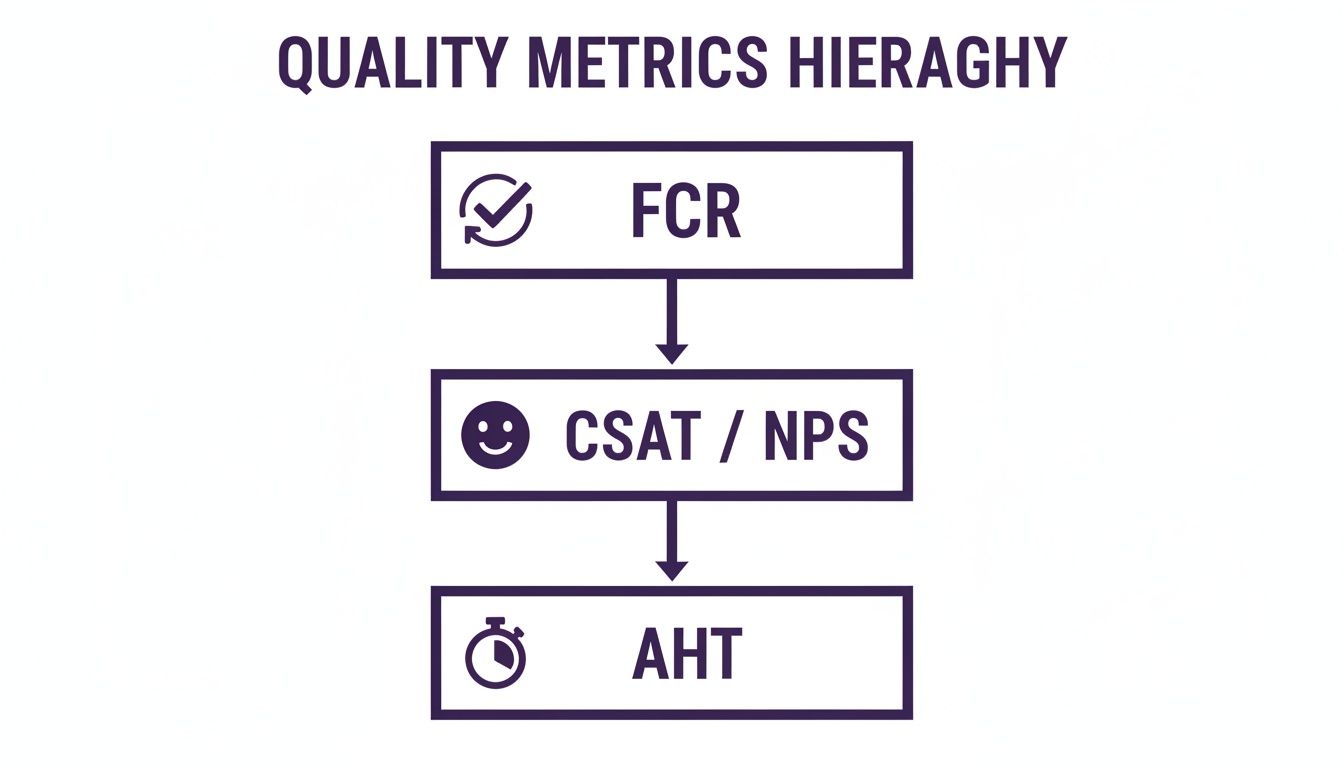
As you can see, solving the customer’s problem the first time (FCR) is the biggest driver of customer happiness (CSAT/NPS), with efficiency (AHT) playing a supporting role.
Choosing the Right Call Sampling Strategy
You can’t listen to every single call, so how you choose which ones to review is critical. Your sampling method should be directly tied to your goals. At its core, any solid approach to customer service quality assurance goes way beyond just basic monitoring.
There are a few solid ways to approach sampling:
- Random Sampling: This gives you an unbiased, big-picture view of performance. It’s perfect for establishing a baseline.
- Targeted Sampling: This means zeroing in on specific types of interactions. You might pull all the calls that got a low CSAT score, conversations that went way over the average handle time, or calls from new agents who need more support.
- High-Stakes Sampling: If you’re in finance or healthcare, you can focus on interactions involving high-value transactions or sensitive compliance topics to minimize risk.
For a deeper dive, our guide on how to implement call monitoring breaks down the practical steps for getting your process up and running.
The Power of Calibration Sessions
A scorecard is only as good as the people using it. To keep things fair and consistent, calibration sessions are an absolute must. In these meetings, QA analysts, team leads, and even agents listen to the same call and score it on their own.
Then, they come together to talk about why their scores were different. This process is vital for getting everyone on the same page about what makes an interaction a “10/10” versus a “7/10.” It pulls subjectivity out of the equation and makes sure every agent is measured against the same clear, consistent standard.
 Using Technology to Elevate Call Center Quality
Let’s be honest: manual call sampling and clunky spreadsheets just don’t cut it anymore. If you want a real competitive edge, technology is your ultimate force multiplier for improving quality in call centers. It gives you the power to see, understand, and act on what customers are really saying at a scale that was once impossible.
Instead of guessing what works, modern tools give you a clear, data-driven path forward. They swap out tedious manual effort for intelligent automation, turning mountains of raw interaction data into gold—insights you can actually use to transform agent coaching, fix broken processes, and radically improve the customer experience.
Uncovering Hidden Truths with Speech and Text Analytics
Imagine if you could analyze every single customer conversation, not just the tiny 2% a human QA team might get to review. That’s exactly what AI-driven speech and text analytics tools do. They “listen” to 100% of calls and read 100% of chats and emails, flagging trends that would otherwise be completely invisible.
For example, an e-commerce brand might use speech analytics to catch a sudden spike in customers mentioning a “broken zipper” on a new product. That early warning signal lets them fix the manufacturing issue weeks before it snowballs into a full-blown PR crisis, saving them a fortune and protecting their brand reputation.
AI analytics turns your customer interactions into a live, searchable database of insights, flagging everything from churn risks and compliance gaps to competitor mentions and emerging product issues.
These tools go way beyond just spotting keywords. They can accurately measure customer sentiment by analyzing a person’s tone of voice, detecting subtle hints of frustration or delight. This gives you a much richer, more human understanding of the customer journey, helping you pinpoint the exact moments that create friction or build lasting loyalty. Getting a handle on how automation and artificial intelligence in call centers works is the key to unlocking this power.
Modernizing Evaluations with QA Software
For years, quality assurance programs were stuck in the dark ages, running on messy, inconsistent spreadsheets. Modern Quality Assurance (QA) software completely changes the game by creating a single, streamlined hub for all your evaluation activities. Here’s why this is a massive upgrade for maintaining high quality in call centers:
- Consistent Scoring: Customizable, digital scorecards make sure every agent is measured against the same objective standards, kicking bias to the curb.
- Efficient Workflows: Analysts can find, review, and score interactions all in one place, complete with audio playback perfectly synced to the transcript. No more jumping between systems.
- Actionable Feedback: Evaluation results are automatically tied to agent profiles, making it incredibly easy for managers to deliver targeted, data-backed coaching that actually sticks.
This structured approach makes the entire QA process more efficient, fair, and—most importantly—far more effective at driving real performance improvement.
Real-Time Dashboards for Instant Visibility
Finally, real-time dashboards are all about empowering your team with immediate visibility. Supervisors and agents can see key metrics at a glance, allowing them to make adjustments on the fly. Service Level Performance is a classic example, showing how quickly calls are being answered.
The old industry standard was to answer 80% of calls within 20 seconds. Today, many top-tier organizations are pushing the envelope, aiming for 90% of calls answered in just 15 seconds.
These dashboards bring those numbers to life, helping everyone stay on track. When agents can see their own performance in real-time, they can self-correct throughout the day. And when supervisors can spot team-wide issues as they happen, they can step in and fix problems before they ever impact a customer.
 Turning Agent Feedback Into Performance Growth
Gathering data on agent performance is only half the battle. The real magic happens when you turn those numbers into meaningful action that helps your team grow. True quality in call centers isn’t about punitive critiques; it’s about building a coaching culture focused on getting better every single day.
This is where measurement connects with real, lasting improvement. Data should be the start of a conversation, never the end of it. When a manager sees a low score, the goal isn’t to scold the agent but to dig into the “why” behind the number. A supportive coaching environment creates psychological safety, making agents feel comfortable enough to be honest about their struggles and open to guidance.
From Feedback to Forward Momentum
Effective coaching is structured, specific, and collaborative. Vague advice like “be more empathetic” doesn’t help anyone. Instead, great coaches use hard data and specific call recordings to show exactly what excellence looks like and where an agent can sharpen their approach. This transforms feedback from a fuzzy idea into a tangible skill they can actually practice.
One of the best ways to keep these conversations on track is by using a proven coaching model. These frameworks ensure every session is productive and ends with a clear, actionable plan.
A popular and highly effective model is GROW:
- Goal: What does the agent want to achieve? (e.g., “I want to improve my First Call Resolution rate by 10% this quarter.”)
- Reality: Where are things right now? (e.g., “My FCR is currently 65%, and my QA scores are lowest in product knowledge.”)
- Options: What are the possible paths forward? (e.g., “I could review recent successful calls, shadow a top performer, or take a new training module.”)
- Will (or Way Forward): What specific steps will the agent commit to? (e.g., “This week, I will listen to three ‘gold standard’ calls and schedule a 30-minute session with a mentor.”)
This model puts the agent in the driver’s seat of their own development, making them an active participant in their success.
Building a Culture of Continuous Learning
Great coaching isn’t a once-a-month chore; it’s woven into the daily fabric of the operation. Modern call centers support this by making learning accessible and ongoing. This is a core part of effective performance management best practices.
The goal is to shift from isolated training events to a continuous learning ecosystem where agents are constantly honing their skills.
For instance, a telecom company might create a “call of the week” library, curating real recordings of exceptional service. New and veteran agents alike can listen to these calls to understand precisely how to handle tough situations with grace and expertise. This kind of peer-to-peer learning is incredibly powerful.
Customer Satisfaction Score (CSAT) is another fantastic coaching tool. With 80% of organizations using CSAT to measure customer experience, it’s a vital metric. When a call gets a low score, it becomes a perfect, real-world coaching opportunity to dissect what went wrong and how to improve next time. As you analyze feedback, you can get a better sense of how your team compares to the average US CSAT score of 73% and aim for the industry benchmark of 75% to 84%.
Your Actionable Checklist for Evaluating World-Class Call Center Quality
Okay, let’s turn all this theory into something you can actually use. Whether you’re auditing your own team or grilling a potential BPO partner, this is the checklist you need. Think of it as a guide to cut through the sales fluff and see who’s genuinely committed to providing high quality in call centers.
Use these questions to steer your conversations. The answers you get will paint a very clear picture of a center’s maturity, its culture, and whether its dedication to the customer experience is real or just talk. This framework will help you make a decision you can feel good about.
Metrics and Reporting
The data a call center obsesses over tells you everything about its philosophy. If they’re all about speed over substance, that’s a massive red flag. You need to dig in and see if their reporting actually encourages the right behaviors.
- What are your top three most important KPIs? You want to hear them talk about First Call Resolution (FCR) and CSAT before they even mention Average Handle Time (AHT). This shows they get what really matters: solving problems and keeping customers happy.
- How do you use AHT? The best partners treat AHT as a diagnostic tool. They use it to spot broken processes or training gaps, not as a weapon to bully agents into rushing off the phone.
- Can we see a sample of your performance dashboards? A partner who believes in transparency won’t hesitate. They’ll be happy to show you how they visualize data, which gives you a real peek into how they track performance day-to-day.
Quality Assurance and Coaching
A solid QA program is the engine that drives continuous improvement. It’s not about playing “gotcha” with agents; it’s about systematically building skills and creating consistency across the board.
- What does your agent feedback and coaching process look like? Get specific here. Ask them how often they meet with agents, what the format is (one-on-ones are a must), and if they use actual call recordings to give targeted, actionable feedback.
- How often do you conduct calibration sessions? Look for weekly or bi-weekly calibrations. This is non-negotiable. It’s the only way to ensure every evaluator is scoring calls fairly and holding everyone to the exact same standard.
A world-class call center doesn’t just measure quality; it actively cultivates it through a structured, supportive coaching framework that empowers agents to succeed.
Technology Stack
The right tech is what separates a modern, efficient operation from one that’s stuck in the past. It’s the secret sauce for delivering amazing quality, especially as you scale.
- Are you leveraging AI-powered speech or text analytics? This is a huge differentiator. The ability to analyze 100% of customer interactions is a game-changer. It uncovers trends, pain points, and opportunities that manual sampling will always miss.
- What QA software do you use? Dig into their platform. Does it automate parts of the evaluation process? More importantly, does it link coaching workflows directly to QA scores? Closing that loop between insight and action is critical.
People and Culture
At the end of the day, a call center is just a group of people. A positive, supportive culture isn’t just a “nice-to-have”—it translates directly into better customer conversations and lower agent turnover.
- What is your average agent attrition rate? A revolving door of agents is a giant warning sign. High turnover points to a toxic work environment and guarantees inconsistent service for your customers.
- How do you invest in ongoing agent development? Good centers don’t stop after initial onboarding. Ask about their career pathing programs, specialized skills training, and mentorship opportunities. It shows they see their agents as assets to be developed, not cogs in a machine.
Ready to see what a high-quality partnership looks like? Contact us for a personalized quality assessment and let us show you the CallZent difference.
Common Questions About World-Class Call Center Quality
Even with a solid plan, you’re bound to have questions when you start digging into quality. Let’s tackle some of the most common ones we hear from businesses, so you can move forward with confidence.
What Is the Single Most Important Metric for Wold-Class Call Center Quality?
If I had to pick just one, it would be First Call Resolution (FCR). While every metric tells part of the story, FCR is often the most powerful.
Why? It’s the ultimate win-win. When you solve a customer’s problem on the very first try, their satisfaction skyrockets. At the same time, you’re slashing your operational costs by preventing repeat calls. FCR is a direct reflection of both your efficiency and your effectiveness, proving your agents have the right knowledge and your processes actually work. It’s a true cornerstone of a high-quality service operation.
How Does a Nearshore Call Center Maintain Quality for US Clients?
This is a great question, and the answer goes far beyond just language skills. Top-tier nearshore centers like CallZent don’t just mimic quality; we build it into our DNA through a multi-layered approach.
- Intensive Cultural Affinity Training: Our agents aren’t just bilingual; they’re bicultural. We train them on the nuances of the markets they serve, so conversations feel natural, empathetic, and genuinely helpful.
- Enterprise-Grade Technology: There’s no compromise here. We invest in the exact same advanced QA software, analytics platforms, and CRM systems that leading domestic call centers use.
- Rigorous QA Frameworks: Our quality assurance process is built on collaboration. We run regular calibration sessions with our clients to make sure our standards are perfectly aligned with your brand’s voice and expectations.
Our strategic location in Tijuana also means we operate in the same time zones as our clients, making us a seamless extension of your team, not a distant vendor.
Is Investing in a Formal Quality Assurance Program Worth It?
Without a doubt. A quality assurance program isn’t a cost center—it’s an investment with a clear, compelling ROI. A well-run QA program is the engine that drives better FCR, boosts customer retention, and even lowers agent turnover.
Think of it this way: the long-term cost of poor quality—lost customers, a damaged brand reputation, operational chaos—is always far, far greater than the investment in a proactive QA framework. It’s the most reliable way to build a customer-centric operation that lasts.
10 FAQs About Call Center Quality
- What is the most important quality metric? First Call Resolution.
- Is AHT still relevant? Yes—but only as a diagnostic tool.
- How often should QA be conducted? Weekly with regular calibration.
- What’s a good CSAT score? 75–84% is strong performance.
- Can nearshore centers maintain US-quality standards? Yes, with proper training, QA, and technology.
- How does QA reduce attrition? Through fair scoring and growth-focused coaching.
- Should agents see their QA scores? Absolutely—transparency drives improvement.
- How many calls should be reviewed? Enough to identify trends—analytics can cover 100%.
- Is QA worth the investment? Yes—poor quality always costs more.
- What role does culture play? A massive one—happy agents create better customer experiences.
Ready to Turn Quality Into Growth?
CallZent builds performance-driven, nearshore call center solutions designed around quality, accountability, and measurable ROI.
Ready to see what a true partner dedicated to measurable quality can do for your customer experience? CallZent builds custom-fit BPO solutions that deliver real results. Learn more about our BPO pricing and let’s start building service excellence together.