

24/7 Call Center Services
24/7 Call Center Services for 2026: A Nearshore Bilingual Support Guide
Learn how 24/7 call center services help businesses protect revenue, improve customer experience, support bilingual coverage, and scale operations.
TL;DR — Quick Takeaways
- 24/7 call center services keep your business reachable at all hours, with real service standards instead of a voicemail-only fallback.
- Always-on support helps protect sales, reduce after-hours friction, support urgent requests, and improve customer experience.
- Nearshore bilingual delivery is especially useful for North American companies that need English-Spanish support without building a full internal night operation.
- The right setup is not just “hire more people.” It requires routing, escalation rules, workforce management, QA, workflows, and trained agents.
- Regulated industries such as healthcare, finance, and insurance need more than coverage. They need secure handling, clear compliance controls, and language precision.
24 Hour Call Center Services for Always-On Support
A 24 hour call center gives customers access to live support at any time of day, including nights, weekends, and holidays. Businesses can use 24-hour coverage for customer service, technical support, order assistance, appointment scheduling, urgent requests, and bilingual English-Spanish support without building a full overnight team in-house.
A customer lands on your site at 10:14 PM, adds items to cart, then pauses at checkout because shipping rules aren’t clear. They call. No one answers. By morning, the customer has already bought from someone else.
That’s the operating reality for a lot of businesses now. Buyers shop after work. Patients need help outside office hours. Account holders notice problems on weekends. If your support model still assumes business happens mainly from nine to five, you’re not just creating inconvenience. You’re leaving revenue, trust, and service continuity exposed.
Introduction Why Your Business Can No Longer Afford a 9-to-5 Mindset
For years, after-hours support felt optional. Many companies treated it as a premium layer they’d add later, once they got bigger. That logic doesn’t hold up anymore. Customers don’t separate “your office hours” from “their moment of need.” They just remember whether you were available when they reached out.
A practical 24/7 model changes that. It gives customers a path to help at the moment they’re ready to buy, book, ask, or solve a problem. For businesses, that means fewer missed opportunities, steadier service levels, and less pressure on internal teams to stretch beyond what they can realistically cover. If you’re weighing whether always-on support is worth it, it helps to look at 24/7 customer service options through an operational lens, not just a staffing lens.
Bottom line: A 24/7 support model works best when it’s built as a service system, not just a night shift.
Some companies need full inbound coverage. Others need after-hours overflow, technical triage, bilingual order support, appointment handling, or emergency dispatch logic. The right fit depends on your call patterns, risk profile, and what a delayed response costs your business.
What Exactly Are 24/7 Call Center Services
A lot of business owners hear “24/7 call center” and picture a basic answering service, a phone tree, or a thin overnight shift reading from a script. That’s not what mature 24/7 support looks like.
At a practical level, 24/7 call center services mean customers can reach your business any time, and the experience still meets a defined service standard. The customer shouldn’t feel like they caught your company during the off-hours version of itself.
In 2026, continuous support isn’t treated like a premium anymore. 75% of customers expect 24/7 service availability, and 57% expect the same rapid response time at night and on weekends as during standard business hours, according to industry coverage citing 2026 customer service data.
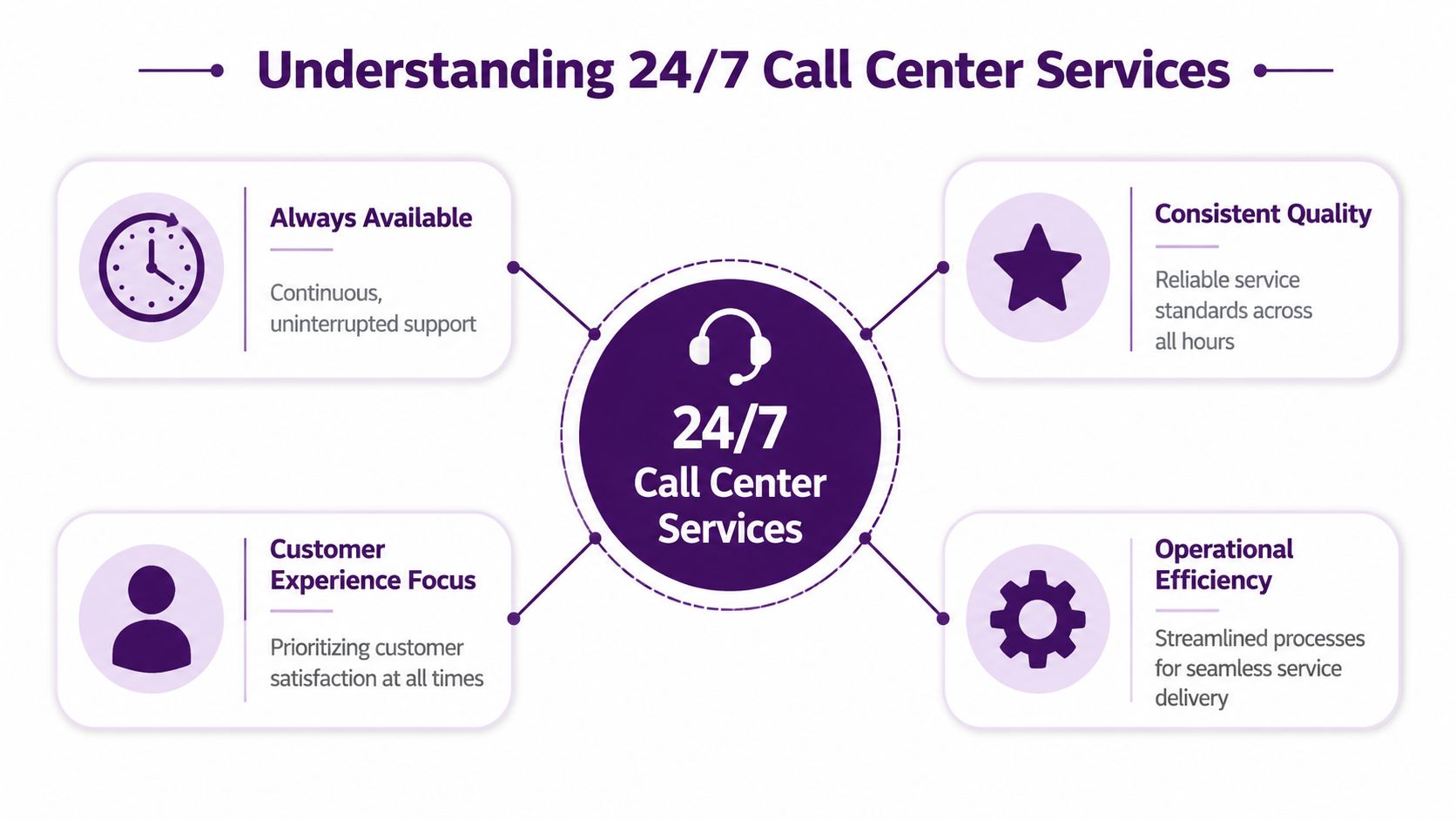
Availability is only part of the job
Being open all day and night isn’t enough if the overnight queue is slow, undertrained, or disconnected from the rest of your operation. Good 24/7 support has to preserve quality across time blocks.
That includes:
- Clear response standards so customers aren’t guessing what happens after they contact you
- Consistent scripting and knowledge access so overnight agents don’t improvise
- Escalation paths for urgent issues that can’t wait until morning
- Coverage across channels if your customers use calls, chats, forms, and tickets interchangeably
A business looking for a more structured setup usually needs a real call center solutions provider rather than a simple message-taking service.
The modern model is hybrid
Strong 24/7 operations don’t put humans on every repetitive interaction. They also don’t dump everything into automation and hope customers tolerate it. The best setups divide the work intentionally.
Routine contacts such as order status checks, account verification steps, FAQ-type questions, and simple triage can move through automation or guided workflows. Human agents step in for exceptions, emotionally charged situations, technical troubleshooting, billing disputes, or anything where judgment matters.
A 24/7 operation should feel seamless to the customer, even when multiple systems and teams are working behind the scenes.
That’s the accurate definition worth using. Not “someone answers eventually,” but “the business remains usable, responsive, and accountable at any hour.”
The Strategic Benefits of Never Closing Your Doors
The payoff from 24/7 coverage isn’t abstract. It shows up in the moments businesses usually lose momentum. A buyer hesitates. A patient needs scheduling help. A customer’s card payment fails. A policyholder wants clarification before moving forward. If nobody responds, the next step often disappears.
Revenue protection after hours
For e-commerce and service businesses, a lot of intent happens outside traditional office hours. People compare options late at night, place orders on weekends, and ask final questions when your internal team is offline.
If support is available, the business has a chance to keep that sale moving. If support isn’t available, the customer often makes the decision without you. In practice, that usually means they choose the vendor who removed the friction fastest.
A common example is order support. A customer calls because a promo code doesn’t apply or a shipping promise looks unclear. A trained agent resolves it, confirms the order, and prevents the cart from being abandoned. That’s not “support” in the narrow sense. That’s revenue preservation.
Better customer experience when timing matters
Customers don’t judge service quality only by whether you solved the issue. They judge how much effort it took to get help. Immediate assistance lowers frustration and keeps the problem from getting bigger overnight.
A healthcare practice sees this clearly with appointment intake. A patient who needs help changing an appointment after hours doesn’t want a dead end. A live support path keeps the patient engaged and lowers the chance that the problem rolls into the next day as a complaint, missed visit, or scheduling conflict.
Here’s where many businesses go wrong:
- They rely on voicemail and assume callers will wait
- They overuse scripts that don’t match real customer questions
- They route every issue the same way instead of separating urgent from routine
- They treat nights and weekends as low-value traffic
Brand trust gets built in inconvenient moments
Most companies sound customer-focused during business hours. Customers remember the ones that are still responsive when something goes wrong at 8 PM on a Saturday.
That matters for retention. It also matters for reputation. Reliable access sends a simple message: your business is organized enough to support customers when they need you, not only when it’s convenient for your team.
24/7 support isn’t an expense; it’s an investment in customer loyalty and revenue assurance.
A company that stays reachable earns something competitors often miss. Not just more conversations, but more confidence.
Exploring the Types of 24/7 Call Center Services
Not every business needs the same version of 24/7 support. Some need full customer care. Others need overflow coverage, tech support, emergency response handling, or outbound follow-up. The smart move is matching service design to the business event you’re trying to control.
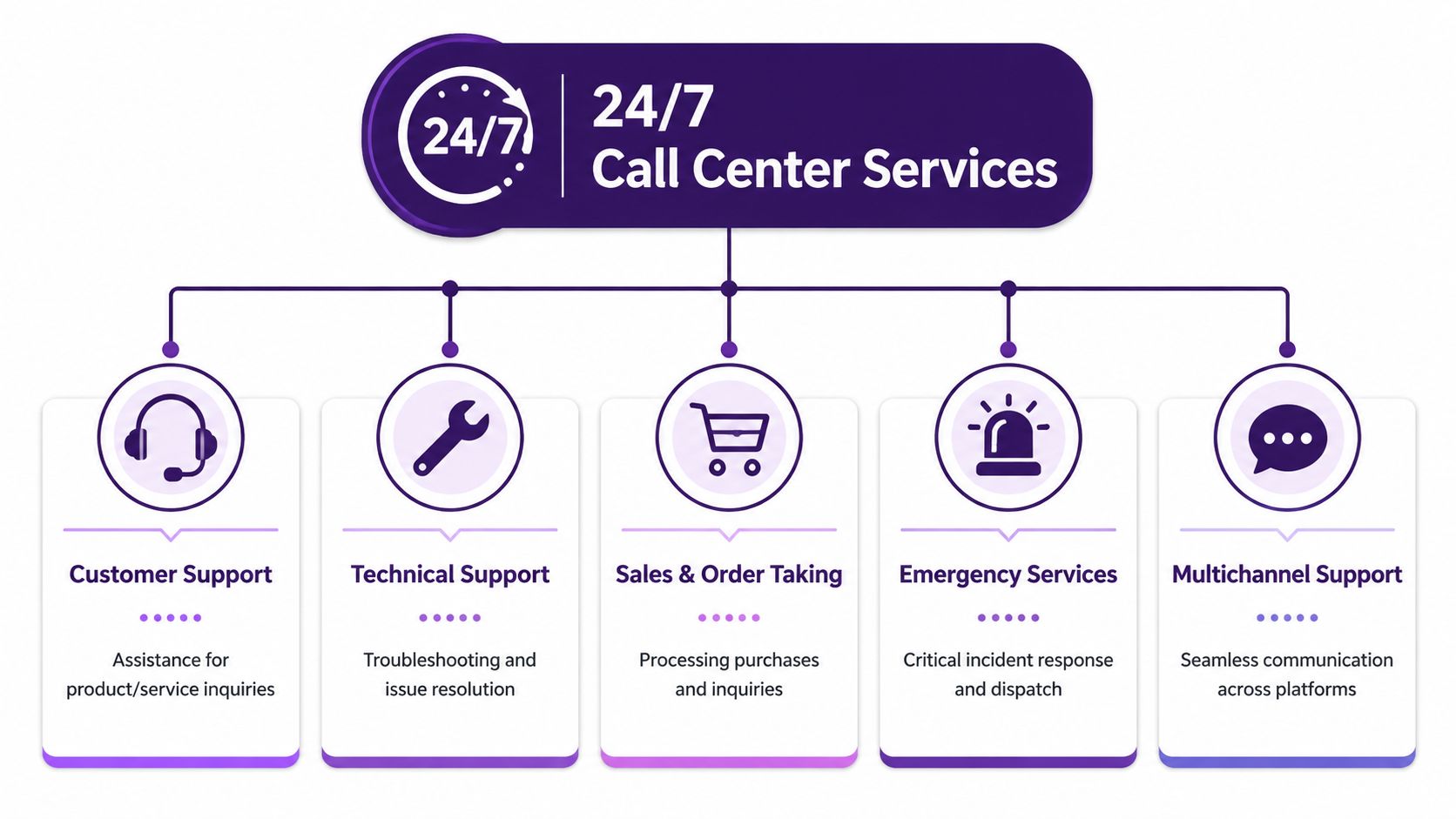
Inbound services that keep operations moving
Inbound support is usually the starting point. It covers the calls and contacts your customers initiate when they need answers, action, or reassurance.
Common examples include:
- Customer service support for billing questions, account help, returns, order tracking, and general issue resolution
- Technical support for troubleshooting, device setup, software guidance, and incident intake
- Order taking and reservation management for businesses that convert calls directly into revenue
- Emergency or urgent response handling where calls must be prioritized, screened, and escalated correctly
Process design is a critical factor. The best 24/7 environments don’t send every interaction into the same queue. According to Zendesk’s guidance on round-the-clock support architecture, mature operations use layered routing, intelligent automation, escalation protocols, and channel-to-urgency mapping so routine issues are handled efficiently while complex and critical matters reach the right human support.
Outbound and blended models
Some businesses need 24/7 help on the outbound side too. That can mean lead qualification, callback campaigns, payment reminders, follow-up after service events, or re-engagement with customers who didn’t complete a purchase.
A blended operation combines inbound and outbound work. That setup is useful when your business needs both service continuity and active pipeline support. A reservation business might answer booking calls overnight while also following up on incomplete reservations the next day. A finance team might field account questions while managing structured outbound reminders.
A broader service catalog for outsourced support teams helps if you’re trying to map functions by business objective rather than by department name.
What works and what doesn’t
What works is specialization. A technical support queue needs different training from an order desk. A healthcare scheduler shouldn’t handle every kind of billing call without a clear decision tree.
What doesn’t work is forcing one generic script across every interaction type.
Operational rule: Design queues around outcomes, not convenience. The customer wants resolution, not a transfer chain.
When businesses define call types, escalation triggers, and service ownership clearly, 24/7 support becomes manageable. When they don’t, the same “always available” promise turns into long handle times, confused callers, and preventable mistakes.
The Nearshore Advantage Why Location Matters for 24/7 Support
At 11:40 p.m., a patient wants to reschedule a morning appointment, a cardholder needs help with a flagged transaction, and an online buyer is asking in Spanish whether an order went through. The question is not whether your business can answer those contacts. The question is whether the team handling them can do it accurately, in the right language, and with enough overlap to involve your managers when something falls outside script.
A 24/7 operation succeeds or fails on control. Shift coverage, supervisor availability, training refreshers, QA calibration, and escalation speed all get harder when the partner sits too far outside your business day. Teledirect’s overview of what happens behind the scenes in a 24/7 call center makes that point clearly. Around-the-clock service depends on staffing discipline, process consistency, and systems that can support volume swings and multilingual work.

Why nearshore works operationally
For North American companies, nearshore support solves a practical coordination problem. Teams in Mexico can work in close time alignment with U.S. and Canadian operations, which makes live coaching, same-day issue reviews, and faster policy updates much easier than in a far-off offshore model.
That difference shows up in small operational moments. A compliance script changes at 3 p.m. Central. A lender needs the overnight team retrained before evening volume starts. A healthcare group wants QA to review Spanish-language call recordings the next morning with its own managers on the call. Nearshore teams can usually support that cadence without the lag that comes from a wider time gap.
Cost still matters. It just should not be the only filter. Buyers who discover nearshore outsourcing advantages usually find that the true value is in easier communication, tighter oversight, and fewer execution misses.
Bilingual support changes the economics of after-hours service
For many SMBs and regulated businesses, bilingual coverage is no longer a nice add-on. It affects containment rates, call accuracy, and customer trust. A late-night billing concern, intake question, or account access issue moves faster when the caller can explain the problem in the language they use at home.
That matters even more after hours, when callers are often dealing with urgency, fatigue, or stress. In those moments, language friction creates repeat calls, longer handle times, and avoidable escalations. A nearshore bilingual model reduces that risk because Spanish support is built into hiring, coaching, and QA, rather than patched in through a separate overflow queue.
Businesses reviewing nearshore call center support should ask operational questions, not just pricing questions:
- How are bilingual agents certified for different queue types?
- Who approves after-hours exceptions and escalations?
- How are shift handoffs documented and audited?
- What happens when call volume jumps on nights or weekends?
- How is language accuracy scored in QA for regulated interactions?
Why proximity matters more in regulated environments
Retail can tolerate some delay. Healthcare, financial services, insurance, and other regulated sectors usually cannot. Those programs depend on tighter scripting, cleaner documentation, and faster supervisor intervention when a call moves outside standard scope.
Nearshore teams give SMBs a more manageable version of 24/7 coverage. Leaders can visit the operation more easily, launch training faster, and stay closer to quality control without carrying the full cost of building an internal night shift. That combination is often what makes 24/7 support realistic, not just available.
24/7 Support in Action Use Cases Across Key Industries
The value of 24/7 support changes by industry. The service model that helps an online store isn’t identical to the one a medical practice or lender needs. The best way to evaluate fit is to look at the actual events that happen after hours.
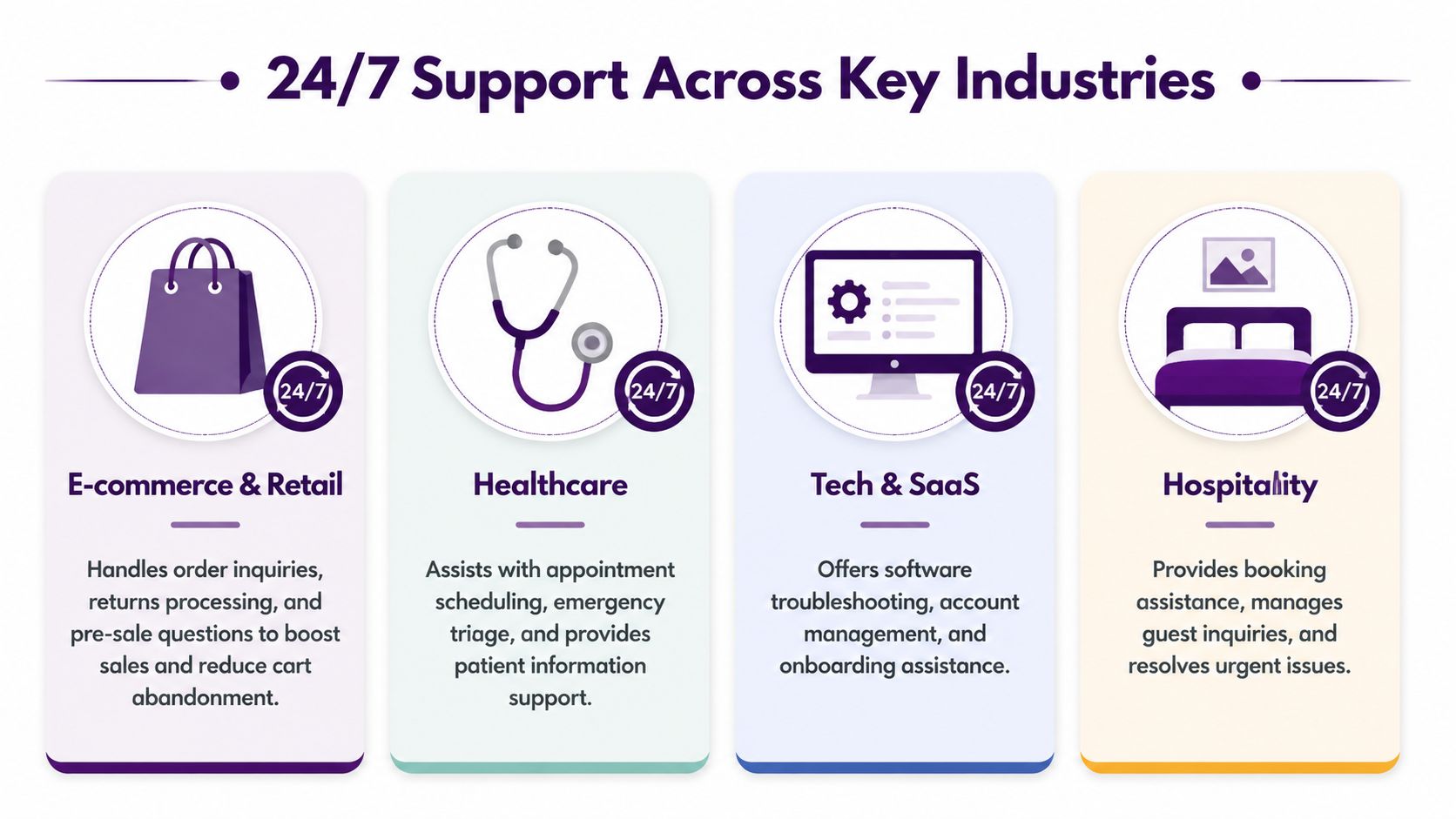
E-commerce and retail
A shopper checks out late at night, notices a payment issue, and wants reassurance before placing the order. Or they need return instructions on a weekend before committing to a replacement purchase. If help is available, the business keeps the conversation alive at the point of decision.
For retail, 24/7 support usually handles:
- Pre-sale questions about sizing, availability, shipping, or policies
- Post-purchase requests such as tracking, exchanges, and returns
- Order recovery moments when a transaction fails or a customer hesitates
The result is straightforward. Less friction when the buyer is ready.
Healthcare and regulated patient communication
Healthcare has different stakes. Calls may involve appointment scheduling, intake details, non-clinical patient questions, or urgent message routing. In this environment, availability matters, but compliance and precision matter just as much.
According to industry discussion of nearshore compliance in after-hours service models, leading nearshore centers in Mexico align with data protection laws that mirror U.S. standards and may hold certifications such as ISO 27001 and HITRUST to support HIPAA compliance and data sovereignty. That same source notes a 35% increase in U.S. healthcare providers seeking nearshore solutions.
A healthcare organization looking into healthcare call center outsourcing should examine not only call handling quality, but also how bilingual agents document information, authenticate callers, route urgent messages, and avoid language-based errors in sensitive workflows.
Healthcare support after hours should never rely on vague “we’re compliant” promises. The operating model has to show how data is handled, who can access it, and how bilingual workflows are controlled.
Finance and insurance
Financial and insurance contacts often happen under stress. A card issue appears overnight. A policyholder has a claim question on a weekend. An applicant needs help finishing a form. These situations call for calm agents, strong authentication practices, and clean escalation logic.
What works here is controlled scripting plus judgment. Customers need clear answers, but they also need a support team that knows when the issue belongs in fraud review, claims intake, account servicing, or a secure callback process.
SMBs that need enterprise-style responsiveness
For small and midsize businesses, 24/7 support acts as a force multiplier. It lets a lean internal team stay focused during business hours while customers still get a live path after hours.
That can mean:
- Capturing leads instead of losing them to voicemail
- Booking appointments while staff is off the clock
- Managing overflow during promotions, outages, or seasonal spikes
For many SMBs, always-on support is how they compete with larger brands without building a full internal night operation.
Your Roadmap to Implementing 24/7 Call Center Services
Most companies don’t need to launch a massive 24/7 operation all at once. They need a controlled rollout with clear priorities, realistic coverage rules, and reporting that shows whether the model is working.
Questions to ask before choosing a partner
Start with operating discipline, not sales language. Ask vendors how they handle queue design, training, QA, escalation, reporting, and system access.
Use a checklist like this:
- Reporting clarity Ask what reports you’ll receive, how often, and which service issues they surface early
- Training depth Ask how agents learn your scripts, tools, products, and exceptions
- Quality assurance Ask how calls are reviewed, scored, and corrected
- Escalation design Ask what happens when a contact is urgent, sensitive, or unresolved
- Bilingual consistency Ask how language accuracy is monitored across English and Spanish interactions
- Workforce management Ask how they forecast staffing and respond to volume shifts
A partner’s answer to staffing and scheduling questions usually tells you a lot. If you need a primer on the operational side, this overview of workforce management in a call center is a useful place to start.
Comparing 24/7 Call Center Pricing Models
| Model | How It Works | Best For |
|---|---|---|
| Per-hour | You pay for staffed support hours | Predictable coverage windows and steady service needs |
| Per-call | You pay based on handled interactions | Lower or inconsistent call volume |
| Dedicated agent | Specific agents or team members are assigned to your account | Complex workflows, regulated environments, and brands needing deep process familiarity |
A practical rollout sequence
-
Define the core need
Identify which calls require 24/7 coverage. Don’t start by covering everything. Start with the interactions that risk lost revenue, poor customer experience, or compliance exposure. -
Build scripts and decision trees
Separate routine calls from edge cases. Decide what agents can resolve immediately, what gets escalated, and what belongs in a next-business-day workflow. -
Launch in phases
Many companies begin with after-hours only, weekend coverage, overflow support, or one business line. That’s usually smarter than a full overnight launch across every queue. -
Review and refine
Listen to calls. Audit handoffs. Check whether the overnight experience matches your daytime standard. If not, fix the process before adding scope.
One option businesses can evaluate is CallZent, which provides bilingual nearshore inbound and outbound support for North American organizations that need scalable 24/7 coverage.
🚀 Ready to Build 24/7 Support Without Overloading Your Team?
CallZent helps North American companies build nearshore 24/7 support programs for customer service, technical support, bilingual coverage, lead handling, appointment support, and back-office workflows.
Talk to an ExpertIf your business is missing calls, delaying responses after hours, or trying to patch together nights and weekends internally, it may be time for a more structured model. CallZent works with North American companies that need bilingual nearshore support across customer service, technical support, lead handling, and back-office workflows. A practical first step is a conversation about your call patterns, risk points, and which 24/7 coverage model actually fits your operation.