
Call Center Training Programs
Call Center Training Programs That Reduce Attrition and Improve Performance
Learn how to build call center training programs that reduce attrition, improve FCR, AHT, and CSAT, and strengthen bilingual nearshore operations.
TL;DR — Quick Takeaways
- Strong call center training programs improve retention, service quality, and readiness to scale.
- The best programs connect training to business outcomes such as lower repeat contacts, better customer experience, and more predictable staffing.
- High-performing teams train for six areas: onboarding, product knowledge, communication skills, systems fluency, compliance, and language development.
- In practice, the strongest design starts with baseline performance, then ties learning goals to operating metrics and manager coaching.
- Script memorization rarely prepares agents for live conversations. Scenario-based coaching, call calibration, and AI simulations produce better judgment.
- Training should continue after certification. Early coaching cadence often has a bigger impact than the classroom itself.
- Measurement matters. Teams should track changes in FCR, AHT, CSAT, and retention after rollout.
- In bilingual operations, language coaching has to cover tone, phrasing, and cultural nuance, not just translation.
Training belongs in the growth plan, not the expense column.
Operators that treat training as a one-time onboarding task usually pay for it later through lower consistency, weaker customer outcomes, and constant hiring pressure. The better model is to treat training as infrastructure. At CallZent, that means building programs around agent confidence, manager visibility, and measurable operating results from day one.
That shift matters even more in a nearshore bilingual environment. Serving North American customers in English and Spanish requires more than product knowledge and script familiarity. Agents need judgment, language precision, cultural context, and the ability to stay consistent across channels and call types. Training has to produce business control, not just course completion.
Key takeaway: The fastest path to a more stable operation is usually better training, tighter coaching loops, and clearer standards for the team already on the floor.
The True Cost of Untrained Agents
Training is not a support function. It is a margin, retention, and customer experience strategy.
I have seen the same pattern across growing support teams. When agents hit production without enough product context, system fluency, or live-call practice, the operation pays for it in places leaders track every week. Handle time rises. Repeat contacts stack up. QA scores spread wider. Team leads spend their day rescuing calls instead of coaching performance. In a BPO setting, those misses also weaken client confidence because inconsistency shows up fast in reporting.
The cost is operational drag. Recruiting stays active because new hires leave before they build confidence. Senior agents become a backstop for avoidable questions. Supervisors reteach basics that should have been covered before nesting. A weak training model turns labor into rework.
That is why smart operators tie training directly to cost control. If you are trying to protect service levels and margin at the same time, reduce avoidable call center costs by cutting preventable errors, lowering repeat volume, and giving agents enough preparation to solve issues cleanly the first time.
Why the losses compound fast
Poor training creates pressure in layers.
First, the customer feels it. Answers sound uncertain, holds get longer, and simple issues turn into callbacks. Then the floor feels it. Team leads become escalation desks, QA shifts from calibration to correction, and experienced agents carry work that should never have reached them. Finally, the finance team feels it through extra hiring, slower ramp time, and lower productivity from classes that never fully stabilize.
In bilingual environments, the risk is even higher. An agent may know the policy but still miss the right tone, phrasing, or cultural cue. That gap hurts resolution quality and brand trust, especially on high-emotion calls. CallZent’s agent-centric philosophy matters here because bilingual performance is not just language coverage. It is judgment, confidence, and cultural precision under pressure.
For a broader operational view, the team at DialNexa Labs on reducing churn offers a useful read on why BPO attrition is rarely just an HR issue. It’s often a design issue.
What trained teams do differently
Trained agents create predictability. They know how to diagnose the issue, where to find the answer, and when to escalate without creating extra work.
Consider a billing dispute. A prepared agent understands the CRM workflow, the policy rule behind the charge, and the language needed to explain the outcome clearly in English or Spanish. That agent can verify the account, resolve or route the issue correctly, document the interaction, and close with confidence. An untrained agent usually puts the customer on hold, checks with a lead, misses part of the workflow, and creates a second contact.
That difference is why training should be treated as a growth driver, not a classroom event. A stable, well-trained floor scales faster, protects client relationships, and gives leaders cleaner performance data to manage.
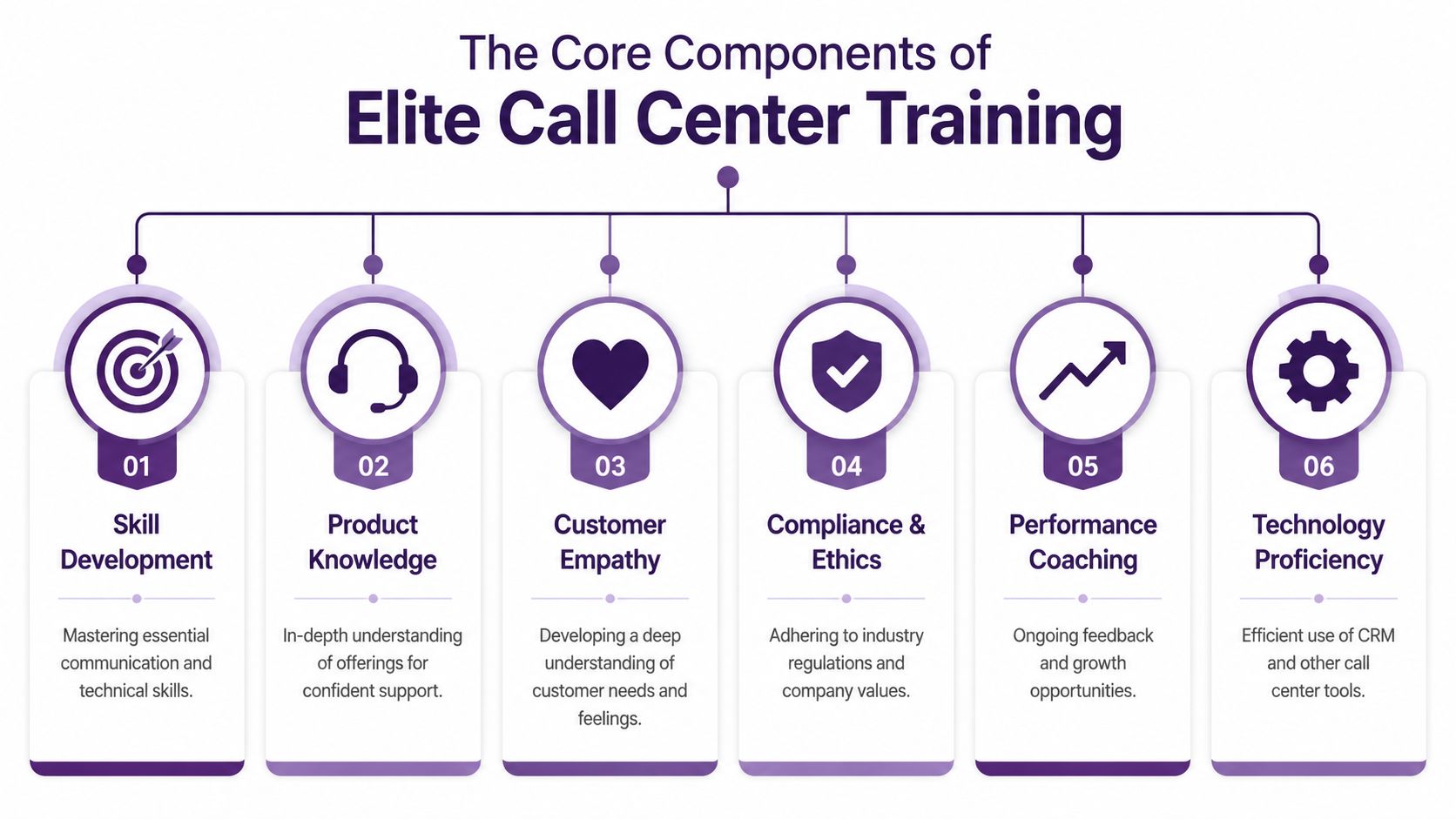
The Core Components of Elite Call Center Training
A strong curriculum has to do more than push people through onboarding. It has to build confidence in the exact order agents need it.
This is the framework I’d use to evaluate any training program. If one of these six parts is weak, performance usually dips somewhere else.
Foundational onboarding
Onboarding is the slab under the building. If it’s rushed, everything above it cracks.
New hires need more than logins and a company overview. They need a clear picture of what good performance looks like, how the team communicates, where to find answers, and how calls flow in production. The risk of weak onboarding is simple. Agents hit the floor before they’ve built confidence, then learn bad habits under pressure.
A practical example. In healthcare support, if an agent learns the escalation path but not the documentation standard, they may route the issue correctly and still create compliance or continuity problems in the customer record.
Deep product knowledge
Product knowledge is what lets an agent sound credible without sounding rehearsed.
This goes beyond memorizing features. Agents need to understand common failure points, edge cases, policy limits, and what customers usually mean when they describe a problem imprecisely. In e-commerce, “my package is missing” could mean delayed carrier scan, wrong unit number, porch theft, or split shipment confusion. Product training should prepare agents to diagnose, not guess.
Empathetic soft skills
Soft skills are not decorative. They change outcomes.
Agents need to know how to listen without interrupting, lower tension, ask clarifying questions, and set expectations clearly. However, many centers underinvest. They teach process but not tone. That creates interactions that are technically correct and emotionally poor. For a deeper look at this capability, customer service soft skills training is one of the clearest investments a support leader can make.
Practical rule: If an agent can complete the workflow but can’t calm the caller, training is incomplete.
Technical systems fluency
Agents shouldn’t be learning tool navigation while a customer waits.
They need hands-on practice inside the CRM, ticketing platform, phone system, knowledge base, and any verification or payment workflows tied to the role. The goal isn’t exposure. The goal is muscle memory. If a rep has to think about where to click, their listening quality drops.
A good systems lab includes live scenario drills such as:
- Account lookup: Find the right customer record without relying on one identifier.
- Disposition accuracy: Close interactions correctly so reporting stays clean.
- After-call work: Document notes that the next agent can use.
Compliance and security
Compliance training has to be operational, not theoretical.
Agents need to know what they can say, what they can’t request, how to verify identity, when to pause, and how to escalate sensitive cases. In finance, insurance, and healthcare, this training protects customers and the business. But even outside regulated sectors, security habits matter. A single shortcut in identity verification can turn a routine call into a trust issue.
Nuanced language coaching
Bilingual or customer-facing language coaching is often the hidden differentiator.
This isn’t only about grammar. It’s pacing, tone, pronunciation clarity, word choice, and knowing which phrases sound natural to customers. A bilingual agent may be technically fluent in English and Spanish and still need coaching on customer-friendly phrasing in both languages. That’s especially true in nearshore environments where rapport and clarity matter as much as speed.
How to Design Your High-Impact Training Program
Most training programs fail before the first session starts. Not because the trainer is weak, but because the design is vague.
High-impact call center training programs start with operational evidence, not assumptions. Then they set a business target. Then they choose methods that match real call complexity.
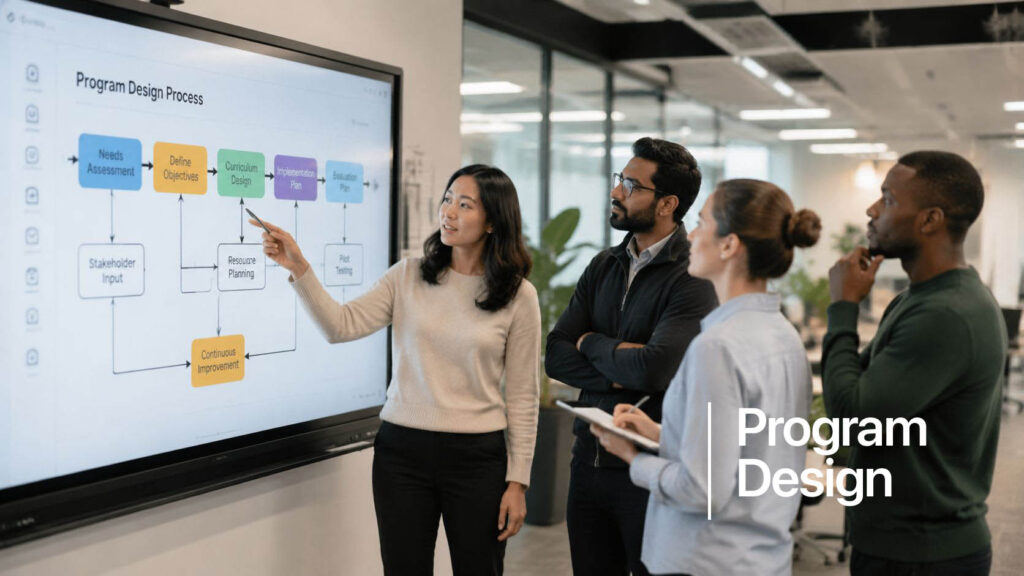
Phase one needs analysis
Start with the floor, not the slide deck.
Pull recent QA reviews, escalations, repeat contact patterns, and supervisor observations. Look for specific failure points. Are agents missing verification steps? Struggling to explain policies? Sounding robotic on upset calls? Taking too long in systems? You’re not trying to identify everything. You’re trying to identify the smallest number of issues creating the biggest service drag.
This is also where blended learning becomes practical instead of trendy. Enthu’s guidance on call center training recommends microlearning sessions of 20 to 30 minutes, built as a 2 to 3 minute explainer video, followed by a 3 to 5 question quiz and a role-play application, ideally delivered once or twice weekly. That structure works because it fits how contact center teams retain information. Short sessions are easier to schedule, easier to revisit, and easier to connect to current QA findings.
Phase two SMART goals tied to business metrics
Once you know the problem, define the outcome in business terms.
Programs should use SMART goals, and each goal should connect directly to a metric. NICE’s training guidance gives a clean example. A goal might target a 15% increase in first-call resolution within 30 days. That’s specific, measurable, achievable, relevant, and time-bound. It also tells operations exactly what success looks like.
A weak goal sounds like this: “Improve agent confidence.”
A strong goal sounds like this: “Improve first-call resolution by focusing on product diagnosis and objection handling.”
Phase three choose methods that match real calls
Many programs here cling to outdated habits.
Rigid script memorization sounds efficient, but it breaks the moment a customer asks an unusual question. Traditional role-play has value in small doses, yet it often depends on the imagination and consistency of the trainer. Callflow’s analysis of why traditional call center training fails makes the stronger case. Replace overreliance on call shadowing and static role-play with AI simulations that expand scenario variety, and move away from script memorization in favor of framework-based training that helps agents adapt.
Teach structure, not recitation. Agents need a path through the call, not a line-by-line crutch.
A practical framework might include:
- Open and verify with control and warmth.
- Clarify the issue using targeted discovery.
- Confirm the root problem before offering action.
- Resolve or escalate with clear next steps.
- Close with ownership so the customer knows what happens next.
That kind of framework holds up in telecom, healthcare scheduling, retail service, and technical support because it gives agents decision support without making them sound scripted.
Building a World-Class Bilingual Training Program
Bilingual training fails when companies treat it as translation.
A world-class bilingual program teaches agents how to manage meaning, tone, and trust in two languages. That’s different from knowing the equivalent word for “refund,” “deductible,” or “troubleshooting.” Customers don’t judge fluency on vocabulary alone. They judge it on whether the conversation feels smooth, respectful, and culturally aware.
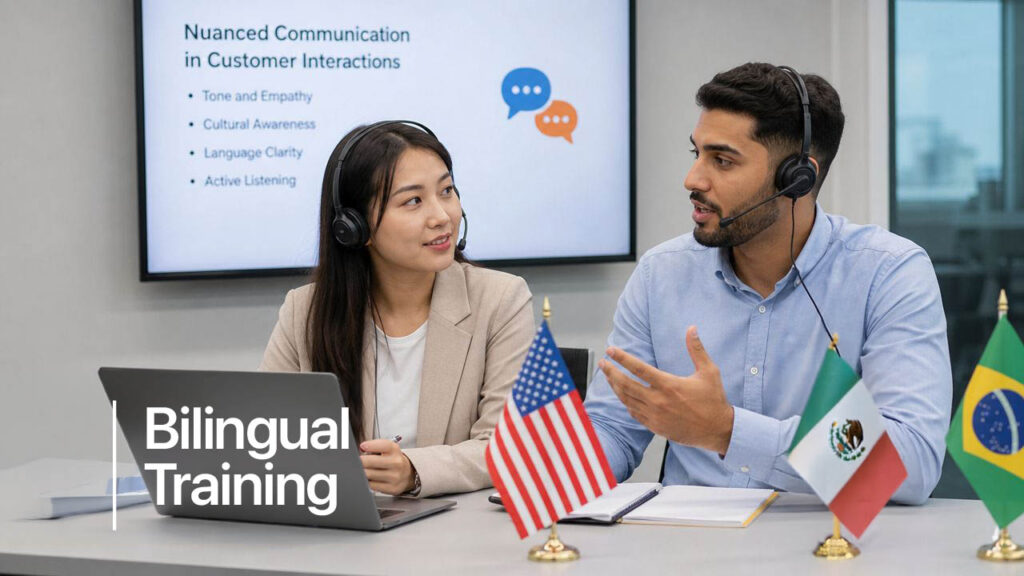
Translation is not the same as rapport
An English-speaking customer may respond well to direct, concise phrasing like, “I can fix that for you today.” A Spanish-speaking customer might respond better when the same idea carries a warmer setup and clearer reassurance, depending on region and context.
That difference matters in live service. An agent who translates word-for-word can sound abrupt, overly formal, or oddly distant. An agent trained for cultural fluency knows when to soften language, when to add context, and when a phrase that is technically correct still sounds unnatural.
Examples help:
- English phrasing: “Let me pull up your account and check what happened.”
- Spanish phrasing with natural service tone: “Permítame revisar su cuenta para explicarle exactamente qué pasó.”
Both communicate the same action. Only one feels fully localized to the interaction.
What bilingual coaching should actually cover
The strongest bilingual call center training programs coach across four layers:
- Language precision: Correct terminology for products, billing, service steps, and policies.
- Pronunciation clarity: Speech that customers can follow easily over the phone.
- Cultural nuance: Formality level, pacing, courtesy markers, and expectation setting.
- Channel adaptation: Voice, chat, and email require different writing and speaking styles.
For teams serving both U.S. and Spanish-speaking audiences, resources that focus on real phone conversations can help trainers sharpen examples. One useful reference for phrase-level practice is how to speak Spanish confidently on the phone.
Why the environment matters
Bilingual quality improves faster when agents work in a setting where both languages are active and coached daily.
That’s one reason nearshore environments perform well for North American service coverage. Agents hear real customer language patterns, switch registers naturally, and build confidence in context instead of in isolated language drills. A closer look at how bilingual agents are trained shows why language development works best when culture, service expectations, and live operations are aligned.
The goal isn’t perfect translation. The goal is a conversation that feels native to the customer.
A Sample Call Center Training Curriculum and Timeline
A training plan should be simple enough to run and structured enough to repeat. If managers can’t explain the timeline clearly, agents won’t know what mastery looks like.
Here’s a practical four-week onboarding model that works across customer service, support, reservations, and back-office assisted roles. Adjust the product depth and compliance layers by industry, but keep the progression intact.
Sample 4-Week Agent Onboarding Curriculum
| Week | Focus Area | Key Topics |
|---|---|---|
| Week 1 | Foundation and culture | Company values, customer promise, attendance standards, communication expectations, basic policies, workflow overview, system access |
| Week 2 | Tools and core call handling | CRM navigation, phone system use, ticketing, documentation habits, authentication steps, call opening and closing framework |
| Week 3 | Product and scenario practice | Product knowledge, common issue trees, escalation rules, objection handling, difficult conversations, bilingual phrasing drills if applicable |
| Week 4 | Production readiness | QA calibration, live simulations, supervised nesting, after-call work quality, knowledge base use, coaching on real interaction patterns |
What each week should feel like
Week one should remove uncertainty. Agents need clarity on the operation, who supports them, and where to go when they’re stuck.
Week two should slow down and get hands-on, allowing trainers to catch system hesitation before it shows up on live calls. Week three sees an increase in complexity. Agents work through edge cases, not just ideal scenarios. Week four should feel like a controlled bridge to production, not a ceremonial graduation.
A real-world example. In an e-commerce support queue, a nesting agent might handle a basic order status contact alone, then pull in a lead for split-shipment exceptions or refund disputes. That’s a better readiness model than sending agents live on every call type at once.
Training cannot end at go-live
One of the biggest mistakes I see is treating certification as the finish line. It isn’t. Nextiva’s call center training guidance recommends weekly coaching huddles during the first 60 to 90 days of an agent’s tenure, followed by monthly reviews thereafter to adjust content and cadence using real performance data.
That cadence matters because early floor behavior hardens quickly. If an agent starts improvising weak verification habits in week two on the floor, waiting months to coach it is too late.
For leaders trying to tighten onboarding discipline and improve retention, this article on preventing new hire turnover is also worth reading. The core idea is familiar to anyone who has run a contact center. Early support shapes staying power.
New hires don’t decide whether they belong at the company on graduation day. They decide it in the first few weeks of live work.
Measuring Training Success With the Right KPIs
If training can’t be measured, it will eventually be cut.
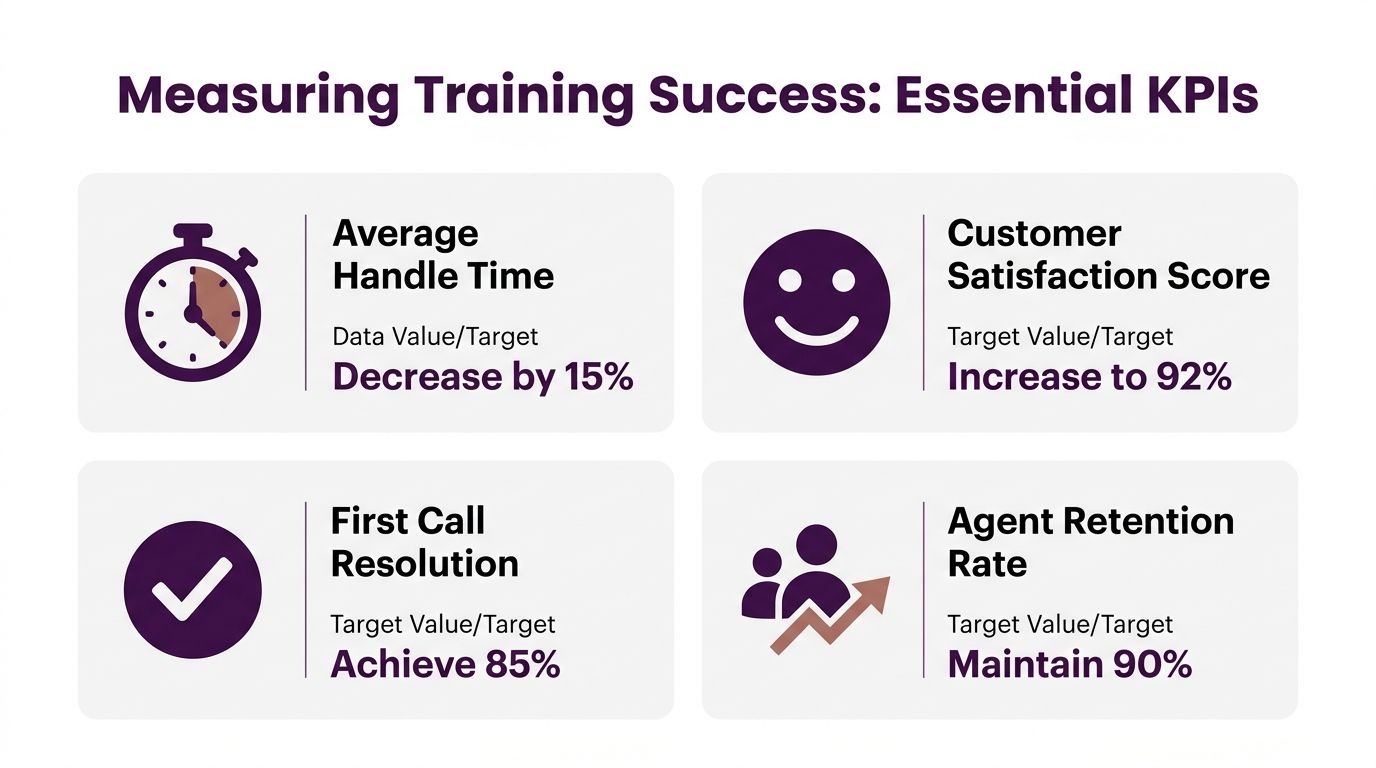
The right way to protect training budget is to tie it to operational metrics that leaders already trust. That means starting with a baseline, then checking the same measures on a fixed rhythm after training goes live.
Start with baseline measurement
Before any new program begins, managers should establish baseline metrics for first-call resolution, average handle time, and customer satisfaction, then track those same KPIs after training and compare trained groups against untrained groups where possible, as outlined in Capacity’s call center training measurement guidance.
That comparison matters. If FCR improves after training, you want confidence that the lift came from the training and not from a product change, lower call complexity, or a seasonal mix shift.
A clean evaluation setup usually includes:
- Baseline period: Capture current FCR, AHT, and CSAT before rollout.
- Training cohort: Identify exactly which agents received the new curriculum.
- Comparison group: Use an untrained team or alternate methodology when possible.
- Review cadence: Check trends weekly or monthly instead of waiting for a quarterly surprise.
If your operation already uses dashboards, training should sit inside the same reporting ecosystem. Strong call center reporting and KPI dashboards make it easier to spot whether the program is improving behavior or merely increasing completion rates.
Watch for skills decay
Completion is not capability. Agents can pass quizzes and still drift on live calls.
That’s why post-training reinforcement matters. Chatty’s discussion of call center training highlights the problem of skills decay and the need for structured coaching loops. The practical version is simple. Coaches review recent calls, identify one or two behaviors tied to performance, then give targeted feedback within days of training, not months later.
Here’s what a coaching loop can look like in practice:
- QA flags a pattern, such as poor expectation setting.
- A coach reviews recent calls from the same agent.
- The coach gives focused feedback on that behavior only.
- The agent practices the corrected approach.
- The next set of calls is reviewed for application, not just attendance.
Measure leading and lagging indicators
The strongest programs look at both early signs and business outcomes.
Leading indicators include quiz scores, completion rates, and QA behavior checks. Lagging indicators include post-training QA trends, customer sentiment patterns, and voluntary turnover. If leading indicators look strong but lagging indicators stay flat, the training content may be easy to consume and hard to apply.
Good measurement answers one question clearly. Did the training change what agents do on live customer interactions?
Why Nearshore Partners Elevate Your Training Strategy
Building strong call center training programs takes more than content. It takes recruiting discipline, bilingual coaching, QA alignment, floor leadership, and the ability to keep improving the program after launch.
That’s why nearshore partnerships can outperform do-it-yourself models, especially for North American companies that need English and Spanish support with tighter collaboration. A nearshore team usually works in closer time alignment, understands customer expectations more intuitively, and can coach language nuance in a way offshore translation-heavy models often miss.
The other advantage is operational maturity. A proven nearshore provider already has trainers, QA structures, nesting support, and performance routines in place. Instead of inventing the entire system internally, you plug into one that’s already built to support retention, service consistency, and ramp speed.
For businesses evaluating this route, a nearshore call center partner offers more than labor coverage. The right partner gives you a repeatable training engine, bilingual capability, and an agent-centric culture that supports quality over the long haul.
The biggest shift is strategic. Training stops being a side project owned by HR or operations. It becomes part of how the business protects customer experience while scaling efficiently.
🚀 Build a Better-Trained Nearshore Support Team
If you’re evaluating how to build stronger bilingual support, reduce preventable turnover, and create a training model that improves live performance, CallZent can help. As a nearshore BPO in Tijuana with an agent-centric philosophy, CallZent combines bilingual talent, operational rigor, and customer-focused training to support North American brands that need quality and flexibility at the same time.
Talk to an ExpertIf you’re evaluating how to build stronger bilingual support, reduce preventable turnover, and create a training model that improves live performance, CallZent can help. As a nearshore BPO in Tijuana with an agent-centric philosophy, CallZent combines bilingual talent, operational rigor, and customer-focused training to support North American brands that need quality and flexibility at the same time.