
Customer Retention Strategies
Customer Retention Strategies: 10 Practical Ways to Reduce Churn and Build Long-Term Loyalty
Discover 10 practical customer retention strategies for SMBs, from personalized communication and proactive support to loyalty programs, omnichannel service, feedback loops, and nearshore customer care.
TL;DR — Top Customer Retention Strategies
- Use data for personalized communication.
- Implement proactive support to prevent issues.
- Create loyalty programs that are rewarding.
- Integrate omnichannel support for a smooth experience.
- Monitor customer health scores to predict and prevent churn.
- Enable support agents to become brand ambassadors.
- Build feedback loops that drive meaningful change.
- Offer VIP tiers to reward high-value customers.
- Foster community to build emotional investment.
- Use strategic offboarding and win-back programs.
Why spend so much energy chasing the next customer while current customers already know your product, your process, and your value?
Retention usually produces better economics than constant acquisition. Existing customers buy again faster, need less education, and are more likely to refer others when the experience stays consistent. Companies that ignore that reality often create an expensive cycle. Marketing keeps filling the top of the funnel while support and service teams continually lose customers who were already won.
That costs more than revenue. It creates avoidable pressure on operations, forecasting, staffing, and cash flow. For small and mid-sized businesses, churn is rarely just a sales problem. It is a service delivery problem, a communication problem, and often a follow-through problem.
Customer retention improves margins because it reduces preventable friction. It also gives leadership better control. Teams can forecast demand more accurately, spot service issues earlier, and build stronger account value over time instead of replacing lost business every quarter.
A lot of retention advice stays too high level. It tells companies to personalize, automate, and stay engaged, but execution usually breaks down at the customer contact layer. CallZent fills that gap by giving SMBs a bilingual nearshore team that can handle voice, chat, email, follow-up campaigns, and back-office support with the context retention work requires. Paired with tools like conversational intelligence for customer service teams, that execution becomes measurable instead of aspirational.
For another perspective on why this matters, see Reddog Consulting’s retention strategies.
1. Personalized Customer Communication Through Data Analytics
Generic follow-up loses people. Customers notice when every email, call, and chat sounds like it was written for a list instead of for them.
The strongest customer retention strategies start with context. If a support agent can see order history, language preference, previous complaints, and recent product activity before saying hello, the conversation changes immediately. The customer feels known, and the agent can skip the usual back-and-forth that makes support feel like work.

What this looks like in practice
An e-commerce brand can prompt agents to mention compatible products based on prior purchases. A healthcare provider can flag a patient’s preferred name and accessibility needs before an appointment reminder call. A telecom company can route high-usage customers to agents trained to discuss plan fit instead of just billing issues.
In a nearshore setup, this gets stronger when agents are bilingual and culturally fluent. A Spanish-speaking customer who receives natural, respectful communication in their preferred language is more likely to stay engaged than one who gets a translated script.
Practical rule: Personalization should feel helpful, not invasive. Use information that improves the interaction. Skip anything that makes the customer wonder why you know it.
Where companies get it wrong
Teams typically don’t fail because they lack data. They fail because their data is stale, siloed, or dumped into the conversation awkwardly. An agent reading a CRM note word for word sounds robotic. An agent using the same note to guide a natural conversation sounds prepared.
A few execution basics matter:
- Pull context before contact: Integrate CRM and support systems so agents see history before the call begins.
- Train for natural delivery: Coach agents to use customer data conversationally, not like a script.
- Audit data quality: Wrong names, outdated addresses, and bad notes hurt trust.
- Review conversation patterns: Tools like conversational intelligence help teams spot where personalization sounds authentic and where it breaks down.
2. Proactive Customer Support and Issue Prevention
Reactive support fixes damage. Proactive support prevents it.
That distinction matters more than most companies realize. If customers only hear from you when something breaks, they start associating your brand with friction. Proactive outreach changes the tone. It tells customers you’re paying attention before they have to chase you.
Catch issues before they become churn triggers
A cloud software provider can warn a client that storage is nearing capacity. A healthcare practice can send appointment reminders early enough to reduce missed visits. An insurance broker can call after a major life event to confirm whether coverage still fits. These are simple moves, but they protect the relationship because they reduce effort for the customer.
This is especially useful in bilingual support operations. A nearshore team can reach English- and Spanish-speaking customers in the right language, with the right timing, instead of treating outreach as a one-size-fits-all campaign.
The key is restraint. Not every account needs a call. Routine reminders may work better through email or SMS, while high-risk or high-value cases deserve a live conversation.
How to make proactive support feel useful
Customers welcome outreach when it solves a problem they already care about. They ignore it when it feels like marketing disguised as service.
A practical model looks like this:
- Automate the obvious: Use email or SMS for reminders, deadlines, and simple alerts.
- Reserve calls for nuance: Billing confusion, coverage reviews, feature adoption, and service degradation are better handled by trained agents.
- Respect preferences: Some customers want a call. Others want a short message and a link.
- Support continuity: A retention-minded team should tie outreach to the broader service plan, not run it as a disconnected campaign. That’s where services like support and maintenance operations become part of retention, not just service delivery.
A telecom provider, for example, can contact customers when network performance drops in a specific area. That one call won’t erase the outage, but it can prevent the anger that builds when the customer feels ignored.
3. Loyalty Programs and Rewards Systems
A loyalty program only works when customers care about the reward. If the structure is confusing or the benefits feel cheap, enrollment numbers may look fine while retention stays flat.
This is why loyalty needs to be designed around behavior, not around what the business wants to give away. According to The Sales Collective’s customer retention data, loyalty programs are the most effective customer retention strategy for 59% of sales leaders in the USA, and 48% say personalized outreach is the top driver for improving retention right now. That pairing matters. Rewards alone rarely carry the whole strategy.
Keep the reward simple and visible
Retail brands do this well when they give members early sale access, easier returns, or member-only bundles instead of burying benefits behind too many rules. Financial services firms can use fee waivers or account perks for long-term customers. Healthcare practices can package preventive visits or wellness check-ins in a way that rewards continuity instead of one-time transactions.
A call center plays a bigger role here than many companies expect. Agents can remind customers they’re enrolled, explain how to redeem benefits, and surface offers at the right moment. That’s often the difference between a program that exists and one that influences behavior.
If a customer can’t understand the value of your loyalty program in a few seconds, your agents will spend every call explaining it instead of using it to strengthen the relationship.
What works better than points overload
Most underperforming programs share the same problem. They’re built for finance teams, not for customers.
A better approach:
- Use clear milestones: Customers should know what they get and when they get it.
- Match rewards to preferences: Some customers want discounts. Others care more about access, convenience, or service.
- Make redemption easy: Extra steps kill momentum.
- Equip agents with visibility: Call center teams should see loyalty status during every relevant interaction.
A retailer with bilingual support can use nearshore agents to explain benefits naturally in English and Spanish. That sounds simple, but it matters. If a customer doesn’t fully understand the reward, they won’t change their buying behavior because of it.
4. Omnichannel Support Integration
Customers don’t think in channels. They think in problems that need to get solved.
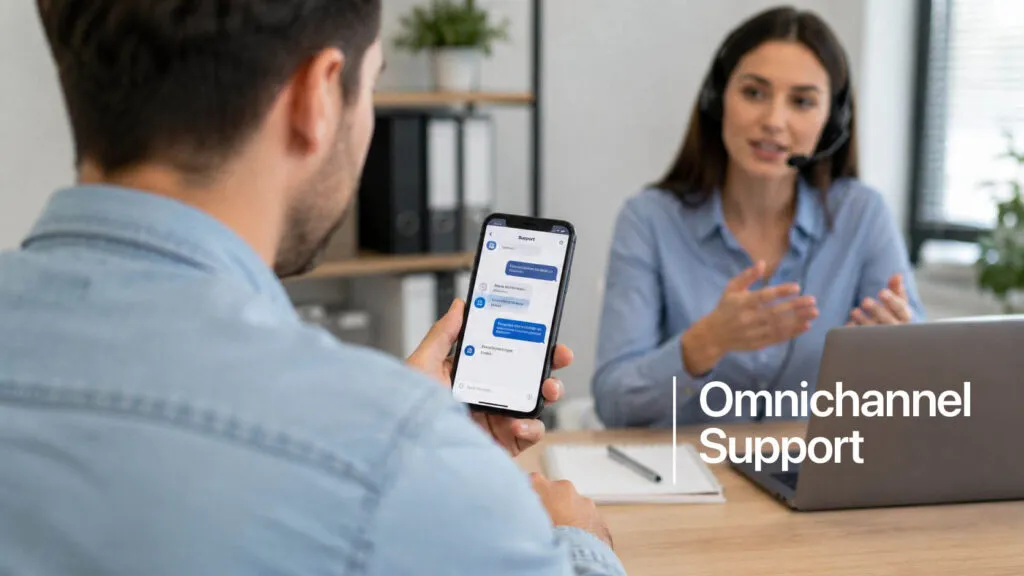
When someone starts on chat, follows up by phone, and receives a confirmation by email, they expect that continuity to feel smooth. If they have to repeat the issue every time, your systems are telling them your company works in silos.
Seamless support lowers friction
For retention, omnichannel isn’t about being everywhere. It’s about preserving context across the channels you choose to support.
An e-commerce customer might start with a chatbot to track an order, then call when the shipment stalls. A financial services client may email a document question, then need a secure phone conversation to finish the issue. An insurance customer may post frustration on social media, then respond better to a direct callback from a skilled agent.
InMoment notes that personalization at scale and omnichannel support, paired with AI-driven chatbots for real-time assistance, help businesses address pain points before customers churn, in its discussion of customer retention practices.
How nearshore teams help execute omnichannel well
Many SMBs overbuild this. They launch too many channels too early, then fail to connect them. A better move is to master two or three channels first and make sure agents can see prior interactions without hunting through separate systems.
That often means:
- Using one contact center platform: Fragmented tools create fragmented service.
- Setting routing rules carefully: Billing disputes, technical issues, and VIP requests shouldn’t follow the same path.
- Training agents for context carryover: They need to reference prior chat or email notes naturally.
- Supporting both languages consistently: A bilingual nearshore team can deliver the same experience in Spanish and English, which is especially important for North American brands serving mixed customer bases.
A common failure point is treating chat as “light support” and phone as “real support.” Customers don’t see it that way. They just remember whether your business made them start over.
5. Customer Success and Health Scoring
Some customers show they’re about to leave long before they cancel. They log in less, buy less often, open fewer messages, or contact support with a different tone. If you wait for the cancellation request, you waited too long.
Health scoring helps teams act earlier. It gives customer service, sales, and account teams a way to spot risk before the relationship collapses.
Start simple and make it operational
A SaaS company might track feature adoption, login frequency, unresolved support issues, and renewal timing. An e-commerce company might watch repeat purchase patterns, return behavior, and inactivity periods. A healthcare provider might monitor missed appointments and declining engagement with care reminders.
Zendesk notes that a strong customer retention rate often falls between 85% and 90% or higher, depending on the model, and emphasizes segmenting retention data by tenure and using predictive analytics to forecast churn risk with over 85% confidence in its guide to customer retention benchmarks and strategies. The takeaway for operators is practical. You don’t need a fancy dashboard if nobody knows what action follows a low score.
What to score and what to do next
The best health score is not the most complicated one. It’s the one your team trusts enough to use.
Good starting inputs usually include:
- Usage or purchase frequency: A visible drop often signals risk.
- Support history: Repeated friction matters more than a single issue.
- Payment behavior: Delays or changes can indicate broader dissatisfaction.
- Engagement level: Sales leaders use engagement level as the leading metric for grouping customers for retention planning in data referenced by The Sales Collective.
Once risk is visible, the response should change. High-risk customers need proactive outreach, more experienced agents, and tighter follow-up. Teams measuring long-term value should connect retention actions to customer lifetime value analysis so they can prioritize the accounts where intervention matters most.
6. Training and Empowering Support Agents as Brand Ambassadors
Retention often rises or falls with the person who answers the phone.
That’s not just a service issue. It’s a management issue. When agents are undertrained, micromanaged, or forced to escalate every exception, customers feel the friction immediately. When agents understand the business, know their authority, and care about the outcome, they can turn a tense moment into a reason to stay.

Agent experience shapes customer loyalty
This is one of the most overlooked customer retention strategies because it sits inside operations rather than marketing. But it has direct customer impact. Research summarized by Chargebee points to cross-departmental coordination and employee experience improvements as important retention drivers in its guide to effective customer retention strategies.
In practical terms, a retail agent who can approve a reasonable exception keeps a good customer from walking away over a minor policy issue. A healthcare scheduling rep who can find an appointment solution for a patient with a tight work schedule protects both satisfaction and continuity of care. A financial support rep who can waive the right fee for a long-standing client often saves more than the waived amount.
Empowerment needs boundaries
Autonomy doesn’t mean chaos. Agents need clear rules, examples, and coaching. They also need feedback loops that move frontline insights back to leadership.
Strong programs usually include:
- Decision authority by scenario: Agents should know when they can offer credits, exceptions, or priority handling.
- Role-specific coaching: New agents need structure. Experienced agents need judgment training.
- Career paths: Teams keep better people when they can see growth.
- Peer mentoring: Top performers can teach tone, pacing, and problem-solving faster than manuals can.
For nearshore partners, this is a major differentiator. A provider that invests in agent development can deliver stable, experienced teams rather than constant turnover. That consistency shows up in customer conversations quickly.
7. Feedback Collection and Action Loop Implementation
Most companies ask for feedback. Far fewer do anything visible with it.
Customers notice the difference. A survey with no follow-up feels like admin work. A survey that leads to a better process, and then tells customers what changed, builds trust because it proves the business is listening.
Close the loop or don’t ask
A retailer can learn that customers are confused by return instructions. A telecom company can spot repeated complaints about billing language. A healthcare provider can hear that scheduling feels difficult for working families. None of that matters if the insight stays in a dashboard.
A call center can contribute more than a form ever will. Agents hear hesitation, frustration, and confusion in real time. They can capture qualitative patterns that survey scales often miss.
A practical feedback loop looks like this:
- Collect short feedback consistently: Keep surveys brief and tied to moments that matter.
- Capture agent notes: Frontline observations often reveal the “why” behind churn.
- Prioritize repeat themes: One complaint may be noise. Patterns are operational signals.
- Tell customers what changed: That final step is what converts feedback into retention.
Small businesses need lightweight systems
Small and midsized businesses often skip this because they assume feedback management requires expensive tooling. It doesn’t. What matters is consistency and follow-through.
ECI Solutions highlights a major SMB challenge in its discussion of customer loyalty for small businesses, noting that 60% of small business customers leave due to poor onboarding rather than product issues, and that 72% of small business churn stems from weak onboarding and lack of personalized follow-ups. For smaller teams, that means early feedback should focus heavily on onboarding friction, not just general satisfaction.
If you want a practical framework for operationalizing this, CallZent’s approach to customer feedback for continuous improvement is a useful model for tying feedback to service changes.
8. Exclusive Access and VIP Tiers for High-Value Customers
Not every customer needs the same service model. Treating all accounts identically sounds fair, but it often isn’t smart.
Some customers generate more revenue, need more specialized support, or have stronger expansion potential. A VIP tier gives those accounts faster access, deeper expertise, and more proactive care. Done well, it protects your most valuable relationships without neglecting everyone else.
Premium service should feel meaningfully different
A B2B software firm may assign a dedicated success contact to strategic accounts. An e-commerce company might offer top customers early access to limited inventory, faster issue resolution, or direct escalation paths. An insurance agency can route complex commercial accounts to experienced specialists who understand coverage nuance instead of general support queues.
The mistake is creating a VIP label without a VIP experience. Priority only matters if the customer can feel it. Shorter wait times, better-informed agents, proactive check-ins, and tighter follow-through all matter more than branding.
High-value customers don’t expect perfection. They do expect competence, speed, and the sense that your team knows their account without being reminded every time.
Build tiers carefully
This strategy works best when the criteria are clear internally, even if the customer-facing language stays simple.
Useful criteria often include:
- Revenue contribution: Obvious, but not the whole story.
- Growth potential: Some mid-sized accounts deserve premium attention before they become large ones.
- Complexity: High-support, high-stakes relationships often need specialized handling.
- Strategic importance: A customer with strong referral or market value may justify superior service.
Nearshore teams can support VIP programs by dedicating trained bilingual agents to premium queues. That matters in industries like finance, healthcare, telecom, and insurance, where one mishandled conversation can put a large account at risk.
9. Community Building and Customer Engagement Programs
Customers stay longer when they feel connected to something bigger than a transaction.
Community creates that connection. It gives customers a place to learn, compare experiences, solve problems together, and build familiarity with your brand outside of a purchase or support event. That kind of engagement is especially useful in subscription businesses, B2B services, healthcare education, and enthusiast-driven retail categories.
Give customers a reason to participate
A financial services firm can run investor education webinars. A healthcare organization can host patient support communities around chronic care topics. An e-commerce platform can build a user group where customers share use cases, tips, and product ideas. Even a smaller brand can run a practical customer forum, live Q&A session, or moderated social group if the purpose is clear.
Community fails when it’s built as a vanity asset. It works when customers get something from each other that they can’t get from a static FAQ.
For operators, the call center can become an input engine for community topics. Agents hear the same questions repeatedly. Those questions can become webinar themes, community prompts, short guides, or onboarding content.
Moderation matters more than launch
Plenty of companies launch a forum and then disappear. That’s worse than not launching one at all. Unanswered posts and low-value noise make the brand look absent.
A stronger model includes:
- Clear purpose: Education, peer support, product usage, or advocacy.
- Active moderation: Someone has to guide the conversation and remove friction.
- Member recognition: Highlight helpful contributors and loyal customers.
- Cross-channel integration: Support teams should know when to direct customers into the community and when to pull issues out of it.
If your brand wants to make those interactions feel more human, it helps to build around voice and relationship, not just content. That’s the same logic behind efforts to humanize your brand through stronger customer connections.
10. Seamless Offboarding and Win-Back Programs for At-Risk Customers
Some churn is preventable. Some isn’t. The mistake is treating every departing customer the same.
A strong offboarding process gives you one last honest look at why the account is leaving. A strong win-back program gives you a structured way to re-engage former customers when the timing and offer make sense. Both are part of serious customer retention strategies, because churn analysis is often where the next retention improvement becomes obvious.
Leave the door open professionally
A telecom customer about to switch may stay if you adjust the plan to fit actual usage. An e-commerce buyer who hasn’t purchased in a while may respond to a relevant offer, but not to a generic discount blast. A healthcare patient who missed several appointments may need a scheduling solution more than a reminder. An insurance client close to lapse may need a coverage review before they need a quote.
The tone matters. Exit outreach should feel like problem-solving, not pressure. If the business only asks questions after the customer has one foot out the door, that conversation needs humility.
Contentstack notes in its discussion of customer retention strategies for business growth that repeat customers spend up to 70% more than newly acquired customers, and loyal customers are 50% more likely to try new products. That’s why a thoughtful win-back effort can be worth the work when the account was a good fit in the first place.
Build separate plays for separate churn reasons
A customer leaving over price is different from a customer leaving over service quality. One may respond to packaging, contract, or billing changes. The other needs proof that the experience will be different this time.
Useful win-back components include:
- Exit reason tracking: Keep categories clean enough to act on.
- Timed re-engagement: Reach out when the pain of switching has had time to settle, but before the relationship is forgotten.
- Customized offers: Address the reason they left, not just the revenue you lost.
- Bilingual outreach: Former customers often respond better when a live agent can explain options naturally in their preferred language.
10-Point Customer Retention Comparison
Which retention strategy deserves budget first, and which one only pays off after the basics are in place?
The table below compares all ten options side by side so teams can make practical decisions, not just collect ideas. For small and mid-sized businesses, the primary question is usually execution capacity. A strong strategy on paper still fails if the business lacks clean data, enough agent coverage, or a partner that can run bilingual customer conversations consistently. That is where a nearshore call center like CallZent can shift a strategy from concept to daily operation, especially for companies serving both English- and Spanish-speaking customers.
| Strategy | 🔄 Implementation Complexity | ⚡ Resource Requirements | 📊 Expected Outcomes | 💡 Ideal Use Cases | ⭐ Key Advantages / Key Drawbacks |
|---|---|---|---|---|---|
| Personalized Customer Communication Through Data Analytics | High, CRM plus analytics pipelines and integrations | High, data engineers, analytics tools, CRM, clean data | Higher retention, stronger CLV, improved first-contact resolution | E-commerce, finance, healthcare with rich customer data | ⭐ Advantage: Relevant interactions and proactive recommendations. Drawbacks: Privacy and regulatory requirements, costly setup, heavy dependence on data quality |
| Proactive Customer Support and Issue Prevention | High, predictive models, monitoring, and outbound operations | Medium to high, monitoring systems, analysts, trained outbound agents | Fewer escalations, lower churn, improved NPS | Telecom, cloud services, healthcare, finance | ⭐ Advantage: Prevents issues and reduces ticket volume. Drawbacks: Can feel intrusive, depends on good timing and clear customer consent |
| Loyalty Programs and Rewards Systems | Medium, program design, tiering, and redemption flows | Medium, marketing support, rewards budget, CRM integration | Higher customer lifetime value, more referrals, stronger repeat purchase rate | Retail, e-commerce, subscription, food and beverage | ⭐ Advantage: Encourages repeat purchases and produces useful behavioral data. Drawbacks: Program complexity can suppress participation, rewards can erode margin |
| Omnichannel Support Integration | Very high, unified platform and legacy integrations | High, contact center platform, engineering support, cross-channel training | Higher CSAT, faster resolution, reduced customer effort | E-commerce, finance, telecom, healthcare | ⭐ Advantage: Uninterrupted customer experience and better first-contact resolution. Drawbacks: Integration work is difficult, consistency across channels is hard to maintain |
| Customer Success and Health Scoring | High, scoring models, data pipelines, and thresholds | Medium to high, analytics support, dashboards, CRM connections | Better identification of at-risk accounts and more focused retention work | SaaS, telecom, subscription services, finance | ⭐ Advantage: Helps teams prioritize retention based on observable signals. Drawbacks: Models require ongoing maintenance, false positives waste effort, weak data reduces accuracy |
| Agent Training and Autonomy as Brand Ambassadors | Medium, training programs and cultural change | Medium, trainers, coaching, decision frameworks | Better first-contact resolution, lower turnover, improved CSAT | All customer-facing organizations and call centers | ⭐ Advantage: More authentic interactions and faster resolutions. Drawbacks: Upfront training costs, inconsistent decisions if guardrails are weak |
| Feedback Collection and Action Loop Implementation | Medium, survey systems plus governance to act on feedback | Medium, CX support, analytics, integrated survey tools | Higher NPS, clearer improvement priorities, fewer repeat issues | E-commerce, SaaS, healthcare, retail | ⭐ Advantage: Gives teams direct insight into what customers want fixed. Drawbacks: Survey fatigue is common, results mean little without follow-through |
| Exclusive Access and VIP Tiers for High-Value Customers | Medium, segmentation, SLA design, and routing logic | High, dedicated account coverage, premium tools | Better renewals and higher revenue per account | Enterprise SaaS, financial services, B2B | ⭐ Advantage: Protects top revenue accounts and strengthens relationships. Drawbacks: Can create fairness concerns, raises service expectations, adds staffing pressure |
| Community Building and Customer Engagement Programs | Medium, content planning and moderation systems | Medium, moderators, content creators, event resources | Lower churn in the right segments, stronger advocacy, more peer support | B2B SaaS, subscription services, healthcare communities | ⭐ Advantage: Peer support can reduce service load and increase stickiness. Drawbacks: Slow payoff, ROI can be hard to measure, active moderation is required |
| Smooth Offboarding and Win-Back Programs for At-Risk Customers | Medium, exit flows, targeted segmentation, and campaigns | Medium, analytics support, skilled agents, offer management | Recovered revenue and better visibility into churn drivers | Subscription services, telecom, e-commerce | ⭐ Advantage: Efficient reacquisition and better churn insight. Drawbacks: Timing matters, poorly structured offers can train customers to wait for discounts |
For many SMBs, the fastest gains come from a smaller set of moves done well. Agent training, proactive support, and feedback loops usually produce earlier operational wins than a full omnichannel rebuild.
CallZent fits best where strategy depends on live execution. That includes bilingual outreach, overflow coverage, retention save teams, VIP routing, and follow-up programs that need human judgment instead of automated messages alone.
Turn Customer Retention Strategy Into Your Competitive Edge
What happens when a competitor offers a similar product at a similar price? Retention is usually the difference. Companies that keep customers longer tend to win on margin, referral volume, and operating stability because repeat business is cheaper to serve than constant replacement demand.
Retention works best as an operating discipline, not a marketing campaign. It shows up in onboarding, service design, QA, agent training, follow-up, account management, and leadership reviews. As noted earlier, industry research consistently ties stronger retention to better profitability. That is why experienced operators track churn causes with the same seriousness they give pipeline and conversion rates.
The practical starting point is usually narrower than teams expect. Few small or midsized businesses need all ten strategies running at full scale on day one. They need the right first move. If onboarding creates confusion, fix onboarding. If customer history is scattered across tools, clean up visibility before trying to personalize messages. If frontline agents need manager approval for routine saves, adjust those rules before launching another rewards program.
Execution is where many SMB retention plans stall.
The gap is rarely strategy alone. It is staffing coverage, language support, follow-up consistency, and the ability to carry the same customer context across channels. A bilingual nearshore call center can close that gap in a practical way. For North American businesses, that often means English and Spanish support, longer service windows, lower labor costs than domestic expansion, and closer operational alignment than many offshore models. The trade-off is that results depend on process design, QA discipline, and how well the partner is tied into your CRM, ticketing, and reporting systems.
CallZent is relevant in that execution layer. Its nearshore operation in Tijuana supports bilingual customer service and back-office work that connects directly to retention programs. That matters for the ten strategies in this article because each one requires real people doing consistent work. Personalized outreach needs clean customer context and trained agents. Proactive support needs teams that can spot risk signals and contact customers before frustration turns into churn. VIP handling, feedback calls, save offers, and win-back campaigns all depend on timing, language fluency, and judgment at the agent level.
For e-commerce brands, that can mean post-purchase follow-up, return support, subscription save workflows, and loyalty member routing. For healthcare, insurance, telecom, retail, and financial services teams, it can mean bilingual service, appointment reminders, issue resolution, and retention-focused outreach that meets tighter service expectations. The point is not to outsource everything. The point is to place the high-volume, repeatable parts of retention with a partner that can execute them consistently while your internal team keeps control of policy, escalation, and customer strategy.
Competitive advantage comes from consistency. Customers stay when answers are fast, communication is clear, and every interaction feels connected to the last one. Businesses that build those habits across channels are harder to displace because competitors can copy pricing faster than they can copy service discipline.
Ready to put these customer retention strategies into practice? Contact CallZent today to see how a bilingual nearshore call center can support retention, service quality, and long-term customer loyalty.
If your business needs a practical retention partner, CallZent can help you build bilingual support programs, proactive outreach workflows, and customer service operations that keep more customers engaged over time.
🚀 Ready to Turn Customer Retention Into a Growth Advantage?
If your business needs a practical retention partner, CallZent can help you build bilingual support programs, proactive outreach workflows, and customer service operations that keep more customers engaged over time.
Contact CallZent TodayFAQs About Customer Retention Strategies
What are customer retention strategies?
Customer retention strategies are the processes, service models, communication plans, and support actions businesses use to keep existing customers engaged, satisfied, and loyal over time.
Why is customer retention important for SMBs?
Customer retention is important for SMBs because existing customers often cost less to serve, buy again faster, refer others more often, and create more predictable revenue than constantly replacing lost customers.
What is the best customer retention strategy?
The best customer retention strategy depends on the business. For many SMBs, the fastest wins come from proactive support, better agent training, clearer feedback loops, and more consistent follow-up.
How does personalized communication improve retention?
Personalized communication improves retention by using customer history, preferences, past issues, and context to make support feel more relevant, efficient, and human.
How does proactive support reduce churn?
Proactive support reduces churn by identifying issues before customers complain or cancel. It helps teams reach out with reminders, alerts, solutions, or account reviews before frustration grows.
Why does omnichannel support matter for retention?
Omnichannel support matters because customers expect continuity across phone, chat, email, SMS, and social channels. When context carries across channels, customers do not have to repeat themselves.
What is a customer health score?
A customer health score is a practical measure of customer risk or engagement based on signals such as usage, purchase frequency, support history, payment behavior, and communication patterns.
How can support agents become brand ambassadors?
Support agents become brand ambassadors when they are trained, empowered, and trusted to solve problems with judgment, empathy, and clear decision authority instead of rigid scripts alone.
How can a nearshore call center help with retention?
A nearshore call center can help with retention by providing bilingual customer service, proactive outreach, overflow coverage, VIP routing, feedback calls, win-back campaigns, and follow-up workflows with better time-zone alignment.
How can CallZent support customer retention programs?
CallZent helps North American businesses build bilingual nearshore support programs from Tijuana, including customer service, back-office support, proactive outreach, retention save workflows, and customer follow-up operations.