Skip to content
Bilingual Collection Operations
Debt Collection Call Center: A Practical Guide to Controls, Recovery, and Nearshore Support
Build a collection workflow around accurate records, permitted contacts, bilingual communication, and accountable escalation.
TL;DR — Quick Takeaways
- Define portfolio scope and contact eligibility before scaling outbound activity.
- Connect disputes, account holds, preferences, and payment arrangements to system actions.
- Use current collection and automated-calling rules when approving campaign controls.
- Provide trained human support for ambiguity, hardship, disputes, and exceptions.
- Compare recovery, kept arrangements, critical errors, and full operating cost.
A debt collection call center helps businesses manage overdue accounts through consumer conversations, account research, dispute intake, and approved payment arrangements. Its value comes from moving an eligible account toward resolution while preserving accurate records and respecting communication restrictions.
For a bilingual nearshore operation serving U.S. portfolios, every call connects several decisions: who may be contacted, what information may be shared, which account issues require review, and whether the next action is permitted. A faster dialer cannot fix missing evidence or an unresolved dispute.
What a Debt Collection Call Center Does
Collection support combines inbound service, outbound follow-up, and back-office coordination. Define the responsibilities for each portfolio before hiring agents or selecting technology.
- Outbound follow-up: Contact eligible consumers under the approved campaign rules.
- Inbound response: Handle callbacks, account questions, document requests, and communication preferences.
- Payment arrangements: Explain client-approved options and record commitments accurately.
- Dispute intake: Capture challenges to the debt, balance, creditor, or account ownership.
- Account research: Review payment history, supporting documents, adjustments, and unresolved exceptions.
- Contact-data review: Investigate outdated information without treating an uncertain identity match as permission to disclose a debt.
Lenders, healthcare organizations, utilities, retailers, and collection agencies may need different workflows. A medical billing question involving insurance adjustments should not follow the same script as a confirmed telecom balance.
Operating principle: A useful contact reaches the appropriate person, records the issue correctly, and produces a permitted next action.
Define the Legal Scope Before Designing the Workflow
The FDCPA and Regulation F generally govern covered debt collectors collecting consumer debts. Not every original creditor, business debt, or servicing activity falls within that same scope. State laws, licensing requirements, privacy obligations, and client-specific restrictions can add separate requirements.
Assign a compliance owner to classify the portfolio, approve the service scope, and maintain the rules used by agents and systems. A Mexico-based delivery location does not by itself remove requirements that apply to a U.S. collection program.
Validation notices and dispute handling
Under Regulation F, Section 1006.34, covered collectors generally provide validation information in the initial communication or within five days, subject to the rule’s exceptions. The validation period generally ends 30 days after the consumer receives or is assumed to receive the information. Store the actual deadline rather than starting every account’s clock on its first call.
Section 1006.38 requires collection to cease for a timely written dispute until the required verification or judgment information is sent. A timely written request for original-creditor information also requires a pause until the required response is sent. Accepted electronic submissions can qualify as written requests.
Record oral disputes too. They do not automatically trigger that same written-dispute pause, although other requirements or an approved client policy may require a hold. Agents should explain available submission channels without discouraging the consumer from disputing.
Translate the consumer’s statement into an account action
| Consumer Statement | Agent Action | System Control |
|---|---|---|
| “I do not owe this debt.” | Record the dispute, its channel, and receipt date. | Route for review; apply the legally required or policy-based hold. |
| “Who was the original creditor?” | Capture the specific information request. | Check the submission method and validation deadline; assign the response owner. |
| “Stop calling this number.” | Record the request and its scope immediately. | Update telephone suppression and route any broader cease-communication request. |
| “My insurance paid this bill.” | Capture the billing concern without arguing about liability. | Send the account for document and adjustment review. |
| “I need a payment plan.” | Review approved options after checking account eligibility. | Record agreed terms, authorization steps, and the next action. |
Make dispositions visible to the dialer and back-office team. Free-text notes alone should not control whether an account remains in an outbound queue. Record who applied a hold and who is authorized to release it.
Build Contact Controls into the Dialer
Every proposed attempt should pass an eligibility check. Connect account status, consumer preferences, number history, local time, and recent contacts before releasing a call.
Call frequency is a presumption, not a dialing target
Regulation F, Section 1006.14 generally creates a presumption of violation when a covered collector calls a particular person about a particular debt more than seven times in seven consecutive days, or calls within seven consecutive days after a telephone conversation about that debt, subject to specified exclusions.
Staying below those thresholds is not blanket permission. Harassment can still result from the pattern or cumulative effect of communications. Count applicable unanswered attempts and coordinate contacts across agents and numbers; changing a phone number should not reset the account’s contact history.
Contact hours, preferences, and privacy
Section 1006.6 generally treats communications before 8 a.m. or after 9 p.m. at the consumer’s location as inconvenient, absent circumstances allowed by the rule. Known inconvenient times or places also matter. Configure the consumer’s restrictions, rather than relying only on an area code.
Distinguish a request to stop telephone calls from a written cease-communication request, which generally limits further communications subject to exceptions. Record scope, channel, and timing; update the relevant suppression controls. Avoid disclosures to unauthorized third parties.
TCPA consent and automated calling
The FCC’s robocall guidance explains that calls to wireless numbers using regulated autodialing or artificial or prerecorded voices generally require prior express consent, subject to applicable exceptions. Determine the technology’s legal classification and the campaign’s permission requirements before deployment.
Do not rely on the old federal-debt robocall exemption or its three-calls-in-30-days framework as current permission. The Supreme Court invalidated and severed the government-debt exception in Barr v. American Association of Political Consultants in 2020. Review the current rules for the actual caller, technology, and portfolio.
- Permission evidence: Preserve the source, scope, and relevant changes to the contact record.
- Shared contact history: Coordinate counts and conversation outcomes across the collection operation.
- Suppression: Remove blocked contacts from queued attempts, not just future campaign imports.
- Account holds: Prevent outreach when the account status makes the attempt ineligible.
- Audit trail: Record why an attempt was permitted, blocked, or escalated.
Use CallZent’s predictive dialing guide to explore capacity planning after eligibility controls are established. More attempts are useful only when the underlying contacts are appropriate.
Inside a Bilingual Collection Call
Consider an illustrative inbound medical-account callback. The agent confirms the preferred language, follows the approved authentication process, and avoids sharing account details before the caller’s authority is established.
The consumer says, “My insurance covered this visit.” The agent records the concern as a dispute or billing-review issue, explains the approved next step, and routes the account to the responsible team. The agent does not make an unsupported coverage determination or promise that the balance will be removed.

What the account record should show
- Authentication outcome: Whether the caller was verified under the approved process.
- Language: The consumer’s preference and the language used for the interaction.
- Concern: A factual summary of what the consumer said.
- Disposition: Dispute or billing review, rather than an inaccurate refusal-to-pay code.
- Account action: Any required or policy-based hold and the reason for it.
- Owner: The team responsible for reviewing documents and responding.
- Next step: The approved follow-up, including any information the consumer may submit.
If the consumer instead confirms the account and requests an arrangement, the agent explains approved terms, confirms understanding, and follows the payment-authorization process. Use secure payment workflows that limit unnecessary access to sensitive information.
Bilingual training should cover disclosure meaning, disposition selection, and escalation—not just conversational fluency. Review English and Spanish interactions against the same operating standards.
When Human Agents Should Take Over
Automation can support approved routing, reminders, and administrative tasks. Define its boundaries before launch and provide a clear route to a trained agent when a conversation exceeds them.
- Identity uncertainty: Authentication fails or the caller’s authority is unclear.
- Disputes: The consumer challenges ownership, the balance, payment history, or evidence.
- Hardship: The consumer describes circumstances requiring an approved specialist process.
- Legal issues: The interaction raises representation, bankruptcy, time-barred debt, or formal complaints.
- Distress: The conversation requires the client-approved support or urgent escalation process.
- Language or accessibility needs: The automated flow cannot support effective communication.
- Nonstandard arrangements: A proposal exceeds the agent’s or system’s approval authority.
A handoff should carry the account context, consumer statement, completed checks, and reason for escalation. Consumers should not have to repeat a sensitive issue because the automation and agent desktop use separate records.
Measure Recovery and Operating Quality Together
Calls per hour and average handle time help describe workload. They do not establish whether the right person was reached, an arrangement was sustainable, or a hold was enforced.
| Measure | What to Define | Why It Matters |
|---|---|---|
| Right-party contact | Verified contacts divided by the agreed eligible interaction base. | Separates useful conversations from dialing activity. |
| Kept arrangements | Arrangements honored within the defined window divided by arrangements due. | Tests follow-through rather than promises alone. |
| Recovery rate | Cash recovered relative to a defined balance base and period. | Supports comparisons between similar account cohorts. |
| Dispute accuracy | Correct dispute capture and routing in reviewed interactions. | Reveals classification and workflow failures. |
| Suppression latency | Time from receiving a restriction to enforcement in affected systems. | Exposes delayed updates and queued-contact problems. |
| Quality and complaints | Critical errors and complaint trends by account type and language. | Keeps consumer experience visible alongside recovery. |
Compare account age, balance, prior contact history, dispute status, and portfolio mix before attributing results to a provider. A team working newer eligible accounts should not be compared directly with one assigned older disputed balances.
Include labor, supervision, technology, payment processing, research, rework, and complaint handling in the cost review. Recovery volume alone can hide an expensive operating process.
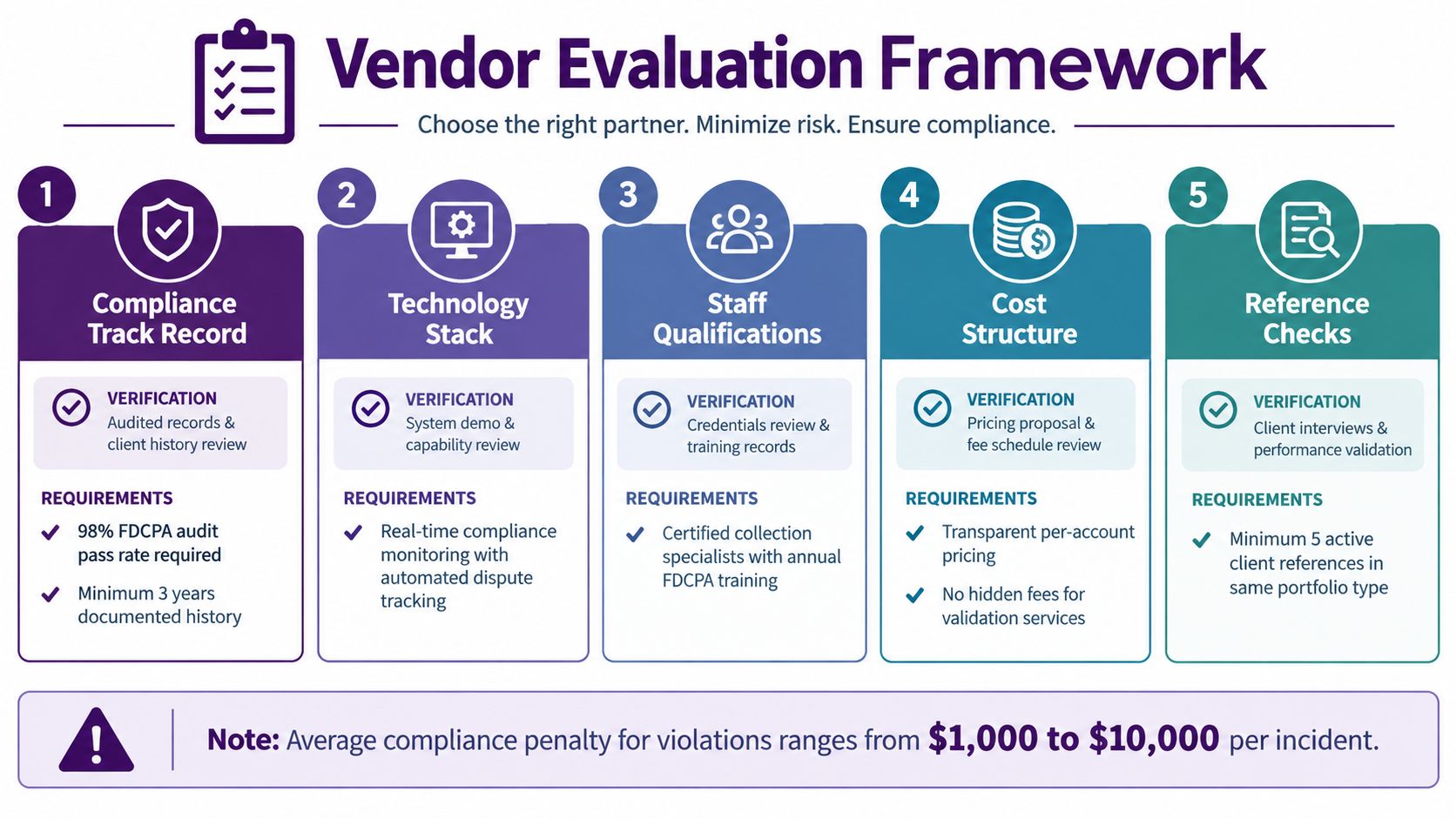
Evaluate a Nearshore Debt Collection Partner
Mexico-based delivery can support English-Spanish conversations and shared working hours with North American teams. Its fit depends on the proposed staffing, permissions, training, security, and supervision—not location alone.
Ask providers to demonstrate account actions using representative test scenarios. A polished script is insufficient if the dialer continues calling after the agent applies a restriction.
Questions to ask before a pilot
- Which activities and jurisdictions are included, and who approves licensing and legal scope?
- How do validation deadlines, disputes, contact preferences, and holds appear in the system?
- How are call histories coordinated across agents, campaigns, and phone numbers?
- How quickly do restrictions reach the dialer and other affected communication tools?
- What can agents approve, and which issues require client authorization?
- How are bilingual scripts, recordings, and account actions reviewed?
- Which access controls and secure payment procedures protect consumer information?
- What evidence will the pilot provide about recovery, critical errors, and operational cost?
Start with a defined portfolio segment, documented success criteria, and clear escalation ownership. Test wrong-party contacts, written disputes, payment exceptions, and suppression failures before expanding volume.
The strongest operating model connects the conversation to an accurate account state. That lets a permitted account move forward while keeping unresolved issues with the people responsible for reviewing them.
Frequently Asked Questions
What does a debt collection call center do?
It supports overdue-account follow-up, inbound consumer questions, approved payment arrangements, dispute intake, account research, and back-office coordination. The permitted scope depends on the portfolio, jurisdiction, and client-approved responsibilities.
Does every debt collection call center follow the same rules?
No. Applicable requirements depend on the collector’s role, debt type, jurisdiction, communication technology, and consumer circumstances. Define those factors before approving scripts, account actions, and outreach.
How should agents handle a disputed debt?
Record the consumer’s concern, submission method, and receipt date, then route it for review. Apply required or policy-based holds and document the response owner. Timely written disputes have specific protections under Regulation F; oral disputes should also be captured and reviewed.
Is the seven-in-seven call rule a universal allowance?
No. Regulation F’s telephone-frequency framework creates presumptions subject to exclusions. It does not authorize harassment or override other restrictions. Use coordinated contact histories and review the entire communication pattern.
When should automation hand off to a human agent?
Escalate identity uncertainty, disputes, hardship, legal issues, distress, language or accessibility barriers, and arrangements outside approved authority. Transfer the account context and the reason for escalation with the interaction.
What should a business evaluate in a nearshore collection partner?
Review the proposed legal scope, bilingual training, system holds, shared contact history, suppression, security, payment procedures, quality controls, and escalation ownership. Use a scoped pilot to compare recovery and operational quality together.
Bilingual Nearshore Support
Build a More Accountable Collection Workflow
Discuss your account follow-up, bilingual communication, and back-office coordination needs with CallZent. Define the support scope, client approvals, and escalation process around your portfolio.
coordination for North American portfolios. Visit CallZent to discuss a collection workflow built around validation, consent controls, human escalation, and measurable recovery operations.