

Bilingual Customer Support
English Spanish Support Guide for Business Growth and Nearshore Success
Learn how English and Spanish support drives growth, improves customer experience, and scales efficiently with a nearshore bilingual model.
TL;DR — Quick Takeaways
- English Spanish support is a growth lever, not just a compliance or customer service add-on.
- Spanish serves a massive global and U.S. customer base, making bilingual support essential for companies targeting North America.
- Quality matters more than basic fluency. Strong bilingual operations require training, QA, documentation, and workflow discipline.
- Healthcare, e-commerce, finance, insurance, telecom, and tech all face real revenue and service risks when language access is weak.
- Nearshore support gives North American companies bilingual talent, time-zone alignment, cultural proximity, and stronger collaboration.
If your company still treats Spanish support as a side queue, you’re leaving growth on the table.
As of November 2025, there were 635,743,644 Spanish speakers worldwide, including 519 million native speakers, representing 7.6% of the world’s population, and Spanish ranked as the third most widely spoken language globally when native and non-native speakers are counted, according to this global Spanish-language overview. That changes the conversation. English–Spanish support isn’t a courtesy feature. It’s market access.
The companies that win here don’t just hire a few bilingual agents and hope for the best. They build a support operation that can sell, solve, retain, and scale in both languages. Done well, English–Spanish support expands reach, protects revenue, and gives North American brands a practical edge. Done poorly, it creates longer handle times, awkward escalations, and avoidable churn.
For companies evaluating support structure, CallZent’s BPO and call center services show the kind of bilingual and back-office model many North American teams look for when they want to scale without adding operational drag.
Bottom line: English–Spanish support shouldn’t sit under compliance. It belongs in your growth strategy.
The Undeniable Growth of the Spanish Speaking Market
635.7 million people speak Spanish worldwide. That scale changes how serious companies plan support, staffing, and market coverage.
As noted earlier, a November 2025 report on global Spanish use estimated 635,743,644 Spanish speakers worldwide, including 519 million native speakers. It also placed Spanish at 7.6% of the global population, ranked it as the third most widely spoken language globally, and noted that 120 million Spanish speakers live outside Spanish-speaking countries. Another 24.6 million people are studying Spanish worldwide.
Treat those figures as an operating signal, not trivia.
Spanish is no longer a single-country service issue. It affects cross-border acquisition, onboarding, customer care, account management, renewals, and collections across the U.S., Latin America, and multinational customer bases. If your company sells into North America or supports distributed customers across the Americas, English-Spanish coverage belongs in your service design from the start.
That is why bilingual customer support for growing North American teams should sit inside revenue planning and customer retention planning, not under a narrow translation budget. Companies that handle Spanish support as an afterthought create friction at exactly the points where customers decide whether to buy again, stay, or leave.
The business impact shows up in predictable places:
- Demand generation loses value when Spanish-speaking prospects can reach your brand but cannot get clear pre-sale help.
- Onboarding slows down when setup instructions, account verification, or first-use support break across languages.
- Service costs rise when customers repeat themselves, transfer between queues, or abandon self-service because Spanish coverage is partial.
- Customer confidence drops when the company promises bilingual access but only delivers it for basic interactions.
This is a market access decision.
Customers do not separate marketing, sales, and support. They judge the company by whether they can get answers quickly, fix problems cleanly, and continue the relationship in the language they use. Companies that plan for that reality gain broader coverage and better execution. Companies that ignore it create avoidable churn, lower conversion, and weaker brand credibility.
The Tangible ROI of Bilingual Customer Experience
In the United States, bilingual support is no longer optional for companies that want broad market coverage.
According to the Federal Reserve Bank of Dallas analysis of U.S. language use, 67.8 million people in the U.S. spoke a language other than English at home in 2019, up from 23.1 million in 1980. Spanish was the most common non-English language, accounting for 62% of that group, with about 42 million people speaking Spanish at home.
That matters because customer experience breaks at the exact moments where revenue is most vulnerable. Product questions. Billing disputes. Order issues. Cancellations. Claims. Logins. Returns. Those aren’t “language moments.” They’re profit moments.
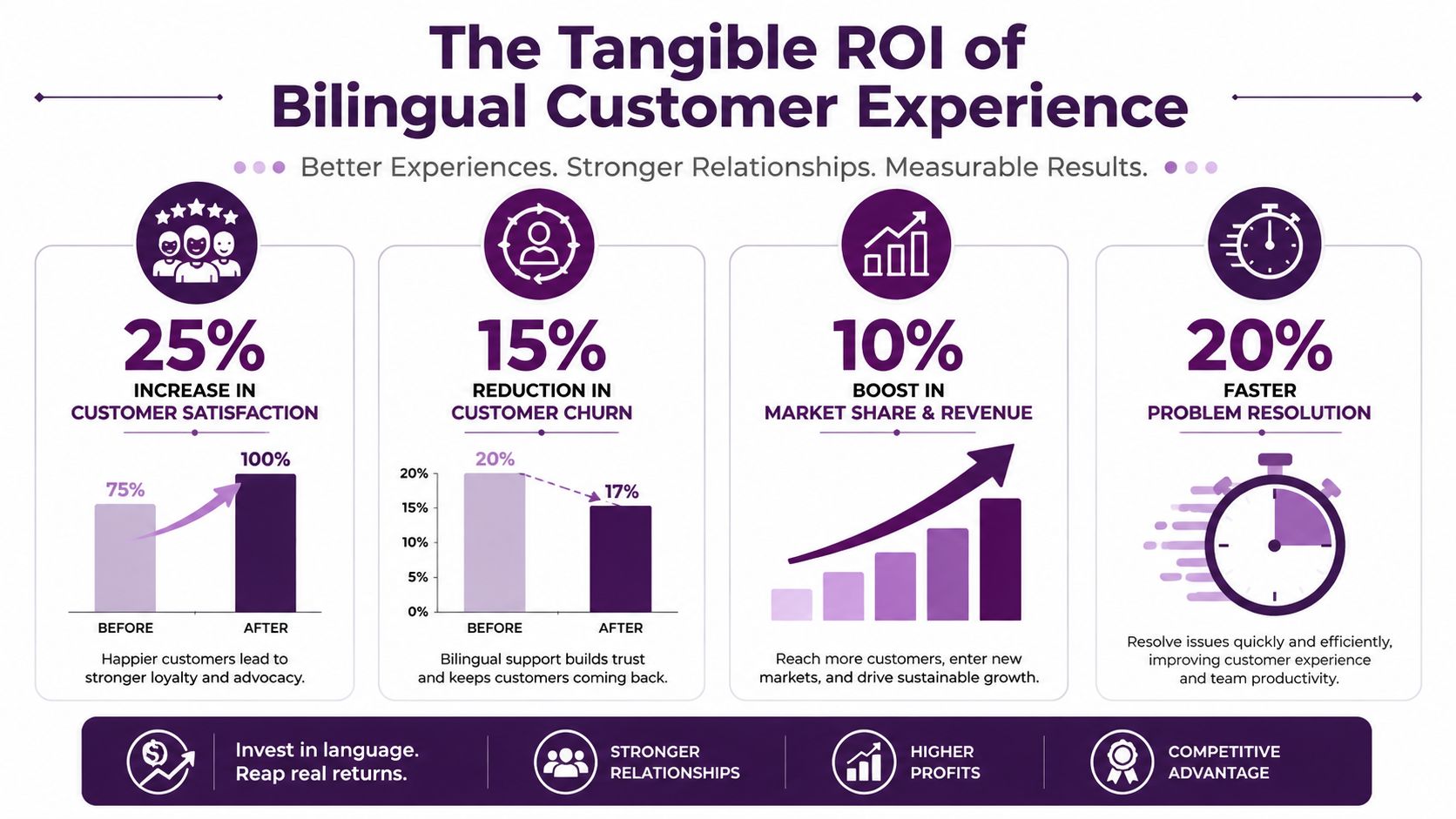
Where the ROI actually shows up
A lot of leaders make the wrong business case for bilingual support. They position it as a staffing expense. The better view is to treat it as a system that protects conversion and customer value.
Consider a simple retail example. A Spanish-speaking shopper places an order, the payment fails, and the chatbot can only handle English. If the customer needs to start over in another language or wait for a callback, the sale is at risk. A bilingual team catches that revenue leak in real time.
Or take subscription support. If a customer wants to pause a plan, understand a fee, or change account details, poor language handling pushes the conversation toward cancellation. Strong bilingual service gives the agent room to save the account instead of escalating confusion.
Poor English–Spanish support doesn’t just create friction. It creates lost transactions, preventable churn, and weak referral behavior.
The business case executives should use
Use this framework when evaluating ROI:
- Market access: You can serve a wider customer base in the language many households use at home.
- Lower abandonment: Customers are more likely to complete high-friction tasks when the service path matches their preferred language.
- Higher loyalty: Trust builds faster when customers can explain problems clearly and get complete answers without translation gaps.
- Stronger differentiation: Many competitors offer surface-level bilingual coverage. Fewer offer consistent operational quality.
A lot of companies discover this too late. They add Spanish support after complaints stack up, after reviews worsen, or after sales teams start hearing the same objection. The smarter move is earlier investment in outsourced bilingual customer support built around the customer journeys where revenue is won or lost.
What to measure
Don’t overcomplicate it. Focus on business outcomes tied to real customer behavior:
| Business area | What to watch |
|---|---|
| Sales support | Conversion on assisted purchases and quote completion |
| Customer care | Repeat contacts, escalations, and unresolved tickets |
| Retention | Cancellation saves, renewal support quality, and complaint patterns |
| Operations | Queue coverage by channel and language consistency across teams |
Serving Spanish-speaking households in the U.S. isn’t a niche initiative. It’s a direct route to broader market coverage and stronger customer retention.
How English–Spanish Support Drives Success Across Industries
Industry leaders act when they see the operational use case, not just the theory. English–Spanish support becomes valuable when it prevents specific failures inside real workflows.

Healthcare needs access, not just translation
Healthcare is the clearest example. Recent research found that uninsured Limited English Proficiency Spanish-speaking patients in emerging U.S. destinations were 40 percentage points less likely to receive a primary care appointment than those in traditional areas, with insufficient bilingual resources identified as the primary driver in this research record on language access and care.
That gap isn’t abstract. It shows up when a patient calls a clinic and can’t explain symptoms, coverage status, appointment preferences, intake requirements, or follow-up questions with confidence.
A strong bilingual support team in healthcare can help with things like:
- Appointment flow: Confirming what the patient needs before they reach the wrong department.
- Pre-visit communication: Explaining forms, required documents, and scheduling details clearly.
- Follow-up continuity: Making sure missed callbacks or unclear instructions don’t turn into no-shows or abandoned care.
E-commerce wins or loses in minutes
E-commerce is faster, but the logic is the same. A customer enters chat because a coupon won’t apply, a package is delayed, or a return label didn’t arrive. If the support path gets clumsy, the shopper may not come back.
That’s why many brands invest in customer support for e-commerce with bilingual coverage across pre-sale and post-sale interactions. The value isn’t only in answering questions. It’s in preserving momentum.
A practical scenario: a shopper asks in Spanish whether two sizes are available, whether shipping is delayed, and whether the order can be changed after purchase. A bilingual agent who can answer all three in one thread saves the sale and avoids repeat contact.
Finance and insurance depend on clarity
In finance and insurance, customers often call when they’re worried, behind on paperwork, or confused by policy language. Literal translation isn’t enough. Agents need to explain next steps, gather accurate details, and document the interaction in a way the business can use.
That means English–Spanish support matters in situations such as:
- Claims intake: The customer needs to describe what happened clearly and completely.
- Billing issues: Payment confusion can quickly become cancellations or complaints.
- Policy questions: Customers need explanations, not copied terminology.
A bilingual interaction is only useful if the customer understands what happens next and the business captures the details correctly.
Telecom and tech support need continuity
Telecom teams deal with outages, device issues, account resets, and service changes. Those interactions often move across channels and departments. If the customer starts in Spanish and gets pushed into English halfway through, the issue gets longer and more expensive.
A bilingual support model helps when the customer starts with a text, moves to chat, then ends on a voice call. The handoff stays cleaner, and the agent doesn’t need to rebuild context from scratch.
The Pillars of High-Quality Bilingual Operations
A lot of companies think bilingual means “can speak both languages.” That standard is far too low.
In real operations, English–Spanish support works only when language skill sits inside a disciplined service model. The agent has to understand the issue, use the right tools, follow policy, document accurately, and keep the customer confident through the whole interaction.
Fluency alone won’t solve operational problems
Technical support makes this obvious. A bilingual technical support role can require diagnosing application, infrastructure, operating system, and network issues, analyzing logs, performing root-cause analysis, and working with engineering teams, as described in this bilingual technical support job profile.
That means a strong bilingual agent must do more than translate symptoms. The agent has to turn a messy customer explanation into actionable technical data.
A real-world example: a customer reports in Spanish that the app “freezes,” the printer “disconnects,” and the office internet “works for everything else.” A weak agent logs vague notes and escalates blindly. A strong agent isolates whether the issue sits in the application, local device, network path, or permissions layer, then documents the case in a way the next team can use immediately.
Four pillars separate average teams from strong ones
Hiring for role fit, not just accent neutrality
Recruiters should screen for job-specific ability. For customer care, that means tone control, listening, and policy handling. For technical queues, it means troubleshooting logic. For regulated industries, it means documentation discipline.
Look for agents who can switch between customer-friendly Spanish and business-ready English notes without losing precision.
Training for real conversations
Script memorization isn’t enough. Teams need scenario-based training.
Examples include:
- Billing disputes: The customer is upset and needs both empathy and accurate explanation.
- Technical issues: The agent must ask layered questions without sounding robotic.
- Regulated workflows: The agent must verify identity, explain limits, and log information correctly.
Companies that want to understand how structured bilingual preparation works can review approaches like how CallZent trains bilingual agents, which highlights the kinds of language and service-readiness expectations serious providers build into onboarding.
Quality assurance in both languages
QA has to inspect more than politeness. It should check whether agents:
- Resolved the issue fully
- Captured the case accurately
- Maintained the correct tone in Spanish and English
- Followed compliance steps
- Avoided unnecessary transfers
If QA only reviews English notes and ignores Spanish call quality, blind spots multiply fast.
Compliance and channel discipline
Healthcare, finance, and insurance teams can’t treat bilingual service as an informal layer. They need the same rules applied in both languages. That includes identity checks, disclosure language, escalation paths, and documentation standards.
Operational rule: If your Spanish queue follows looser standards than your English queue, you’re not running bilingual support. You’re running two different service levels.
Choosing Your Model Onshore Nearshore or Offshore
Where you place English–Spanish support shapes cost, quality, oversight, and speed of execution. This decision shouldn’t be driven by labor rates alone. It should be driven by how well the model supports bilingual performance in the markets you serve.
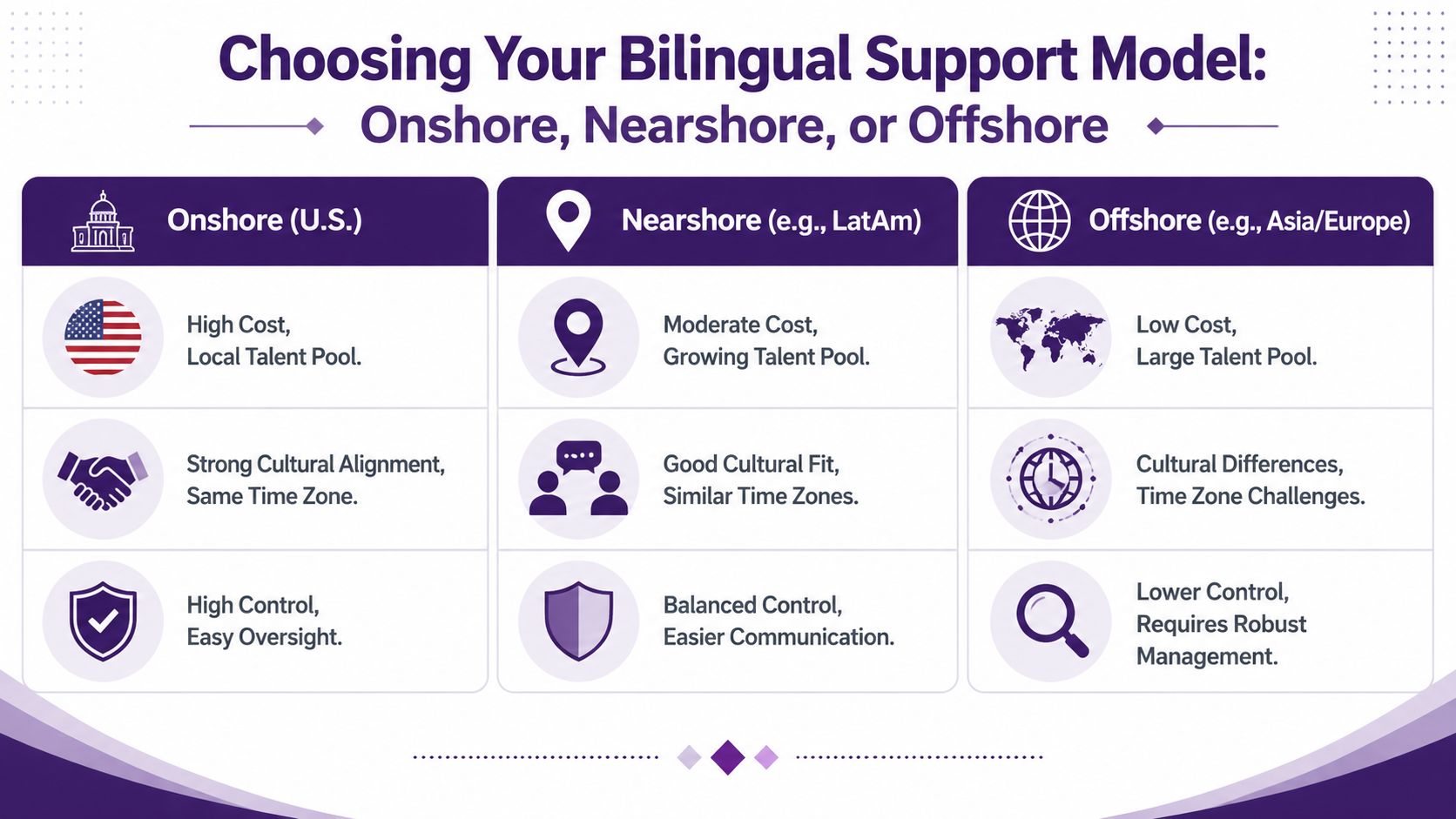
Call Center Sourcing Model Comparison
| Factor | Onshore (e.g., USA) | Nearshore (e.g., Mexico) | Offshore (e.g., Philippines) |
|---|---|---|---|
| Cost profile | Higher | Moderate | Lower |
| English–Spanish talent access | Local but expensive | Strong and relevant | More limited for native-level Spanish |
| Time-zone alignment with North America | Strong | Strong | Often harder |
| Cultural alignment with U.S. customers | Strong | Strong to good | More variable |
| Oversight and collaboration | Easier | Easier | Usually more management-heavy |
| Site visits and in-person planning | Easier | Practical | Less practical |
Onshore gives control, but often at a steep cost
If you build in the U.S., you usually get simpler oversight and close market alignment. That’s useful for sensitive programs or tightly controlled teams.
The tradeoff is obvious. Bilingual talent can be harder to recruit at scale, and operating costs rise fast. For many mid-market firms, that model limits how much support coverage they can realistically afford.
Offshore can cut spend, but Spanish quality often becomes the issue
Offshore works well for some English-language support environments. It’s less straightforward when the requirement is strong English and strong Spanish tied to North American customer expectations.
You may still find capable teams. But you’ll usually need stricter management, clearer process controls, and closer QA to protect consistency in bilingual interactions.
Nearshore is usually the smarter balance
For many North American companies, nearshore is the practical middle path. You get geographic proximity, easier collaboration, overlapping work hours, and a talent base that is far more relevant for English–Spanish support than what many offshore markets offer.
This is why decision-makers often compare nearshore vs offshore outsourcing costs, risks, and ROI before finalizing a sourcing model. Nearshore tends to reduce communication drag without forcing the full cost burden of onshore staffing.
Choose the model that protects service quality first. Cost savings disappear quickly when poor bilingual execution increases escalations, churn, and rework.
For businesses serving the U.S. and Canada, nearshore support from border markets such as Tijuana often fits the operating reality better than either extreme.
Your Implementation Roadmap and Provider Checklist
Programs break in the first 90 days for a predictable reason. Companies hire bilingual agents before they define service levels, workflow rules, QA standards, and ownership.
Treat English-Spanish support like an operating model, not a staffing request. The companies that get strong results start with demand, set measurable targets, launch in phases, and choose a nearshore partner that can execute without creating extra management work.
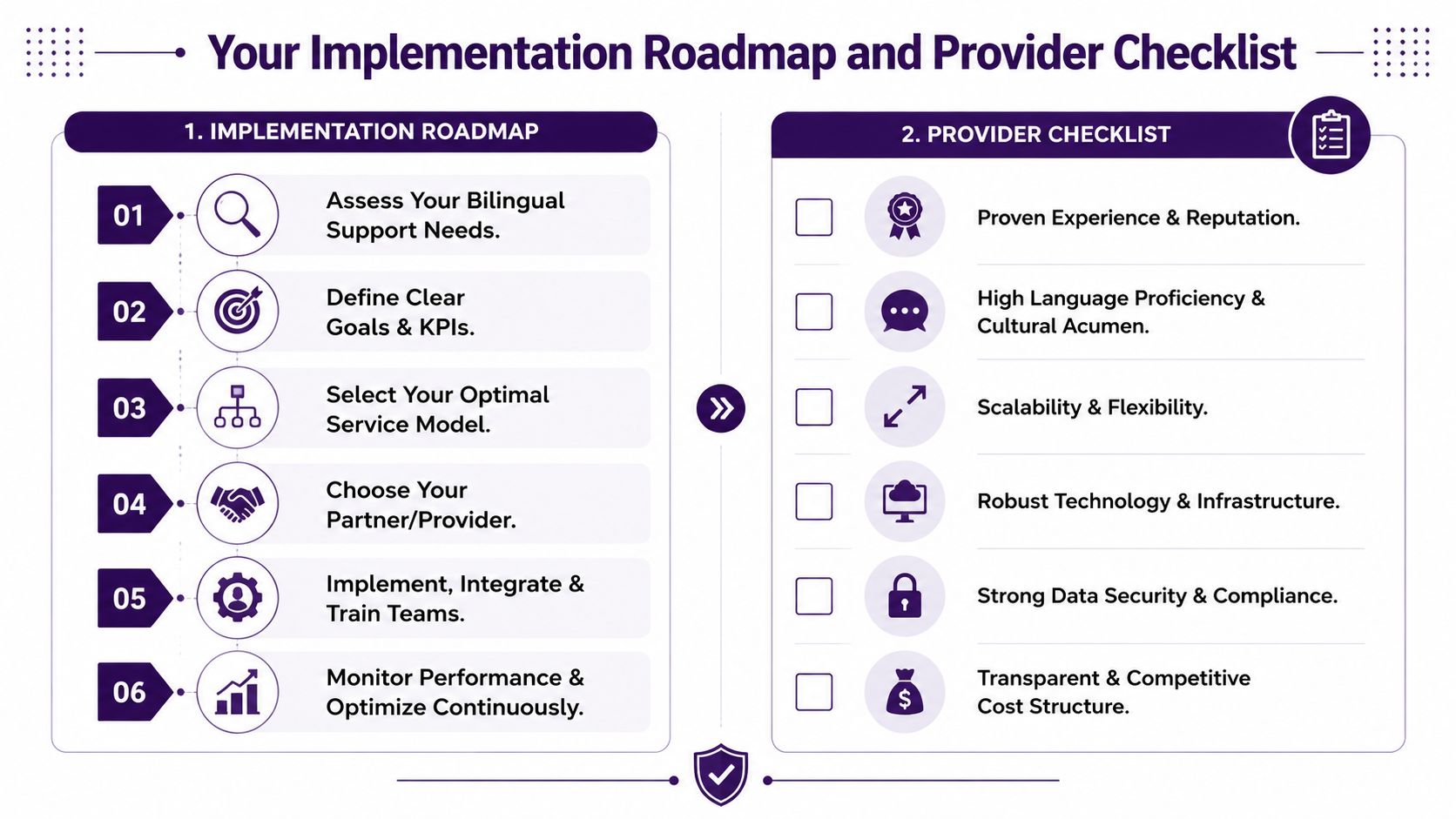
A practical rollout path
1. Assess your bilingual demand
Start with contact volume, revenue exposure, and customer friction.
Review where Spanish interactions already show up:
- Sales inquiries
- Customer care contacts
- Billing and account questions
- Technical support tickets
- Retention or cancellation conversations
Then rank those interactions by business impact. A billing queue with poor Spanish support creates repeat contacts and late payments. Weak bilingual coverage in sales lowers conversion. Cancellation calls handled badly increase churn. If Spanish demand is spread across teams, centralize the data first so you can size the program correctly.
2. Define success before hiring or outsourcing
Set the scorecard before you select a provider.
Choose the outcomes that matter to the business. Response time, first-contact resolution, conversion support, lower escalation volume, CSAT, retention, and QA consistency are all valid if they tie back to revenue, cost control, or customer loyalty. “Handle Spanish” is not a strategy. It is how companies end up paying for coverage that does not improve performance.
Write down:
- Which channels need coverage
- Which hours matter
- Which issue types require the strongest agents
- Which internal teams need bilingual documentation
- Which KPIs the provider will own from day one
3. Select the right service model
Match the model to the work.
A dedicated team makes sense when your workflows are complex, regulated, or closely tied to brand experience. A blended queue can work for lower-complexity contact types with stable processes. A phased model often works best for mid-market firms. Start with customer care or sales support, prove quality, then add technical or account-sensitive interactions.
Do not place high-risk work into a generic bilingual pilot. That decision usually creates rework, escalations, and a false read on whether bilingual support can perform.
Provider checklist for smarter vetting
Use this checklist in every vendor review. If a provider cannot answer these points clearly, keep looking.
- Language depth: Can they show business-level English and Spanish in both voice and writing?
- Operational fit: Can they work inside your CRM, ticketing workflows, QA process, and reporting cadence with minimal retraining on your side?
- Industry experience: Have they supported customer journeys with similar complexity, compliance pressure, or sales stakes?
- Training approach: Do they train for live scenarios, objections, and edge cases, or only script adherence?
- Quality controls: How are bilingual interactions scored, calibrated, and coached each week?
- Security and documentation: Can they meet your compliance requirements and maintain clean process documentation in both languages?
- Scalability: Can they add seats, channels, or hours without disrupting service quality?
- Location fit: Can your managers collaborate in real time, visit the operation easily, and fix issues quickly?
Add one more filter. Ask who owns continuous improvement. Strong providers do more than staff queues. They identify failure points, tighten workflows, and help raise performance after launch.
Launch small, then tighten operations
A phased launch is the right move.
Start with one queue, one channel group, or one customer segment. Review contact reasons, transfers, repeat contacts, language quality, and workflow breakdowns every week. Fix those issues before expanding volume. That is how you build a bilingual operation that improves margin and customer experience at the same time.
The best nearshore teams help with script localization, workflow mapping, QA calibration, reporting alignment, and channel coordination from the start. CallZent provides bilingual support and back-office services from Tijuana for companies building English-Spanish coverage around North American operations.
Start with the interactions that carry the most revenue risk or customer frustration. That is where excellent bilingual support proves its value fastest.
🚀 Ready to Scale English–Spanish Support Without Adding Operational Drag?
CallZent helps North American companies build nearshore bilingual support teams for customer care, sales support, technical queues, back-office workflows, and retention-focused operations.
Talk to an Expert
If your business serves North America, choose a provider that can deliver strong Spanish, reliable English, operational discipline, and nearshore collaboration. That combination gives you the fastest path to a bilingual program that scales cleanly and pays for itself.